Tech
How To Stop AI Companies From Training On Your Data

Every major model uses your conversations as training material by default.

ChatGPT, Claude, Gemini, Copilot and Grok all have one thing in common: Not how deep they bury their subscription cancellation options into the settings menu, but how they all use consumer conversations to train their models. Unless you opt out, that is.
Doing so takes about a minute per service and, because personalization and memory are managed by separate settings, it shouldn’t have any impact on your day-to-day use. There is one platform that’s an exception to this: Meta. US users have no option to opt out of training and since December last year, the company has used Meta AI chats for ad targeting, also without a way to decline.
Opting out of having your data used for model training doesn’t apply retrospectively, meaning your old chats can still be used. Doing so also doesn’t delete any of your data, which is subject to each platform’s policies on data retention.
ChatGPT
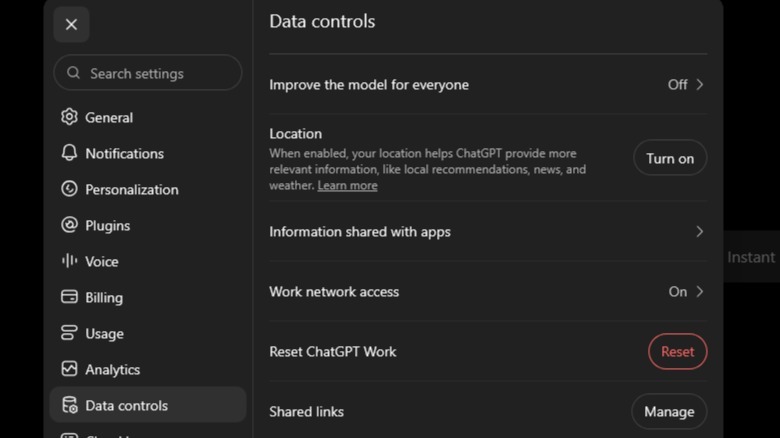
OpenAI’s opt-out toggle is called Improve the model for everyone, found under Settings and then Data Controls. All personal user accounts are opted in by default. Opting out applies to your entire account across web and mobile, but your conversations still appear in chat history as normal. ChatGPT does offer the Temporary Chats feature for one-off sensitive conversations. These are never used for training and are purged by OpenAI after 30 days.
Claude
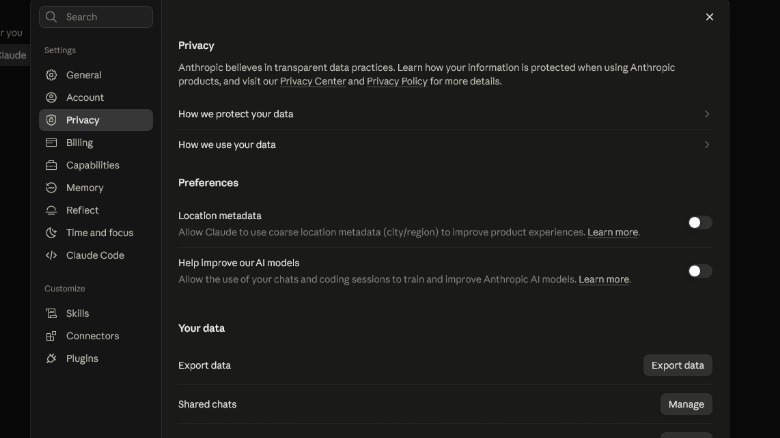
Anthropic didn’t use consumer chats for model training until August last year, when it rewrote Claude’s terms and gave every Free, Pro and Max user a deadline of September 28 to accept or decline. You can find Claude’s toggle under Settings and then Privacy. Like ChatGPT, Claude’s Help improve our AI models label tries to spin data collection as a positive.
If you leave it on, Anthropic will keep conversations for up to five years, but switching it off returns accounts to the older 30-day deletion window. Opting out stops future use but Anthropic keeps whatever it already trained on.
Gemini
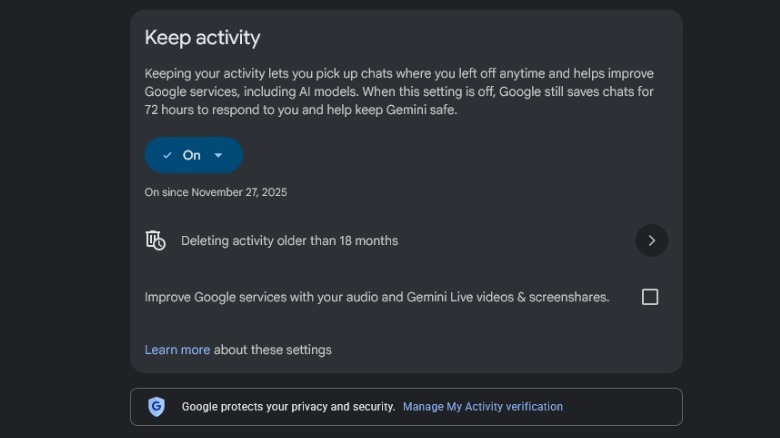
Google’s control was recently renamed to Keep Activity, and it’s also on by default. When it’s enabled, conversations can be used to improve Google’s models and a “subset of chats” are read by human reviewers. Any chat that a reviewer accesses is retained for up to three years, even after you delete your history.
Switching off this setting ends training use and stops interactions from being saved to Gemini’s chat history. However, Google still retains each conversation for 72 hours to run the service, using the last 24 hours for contextual responses.
Copilot
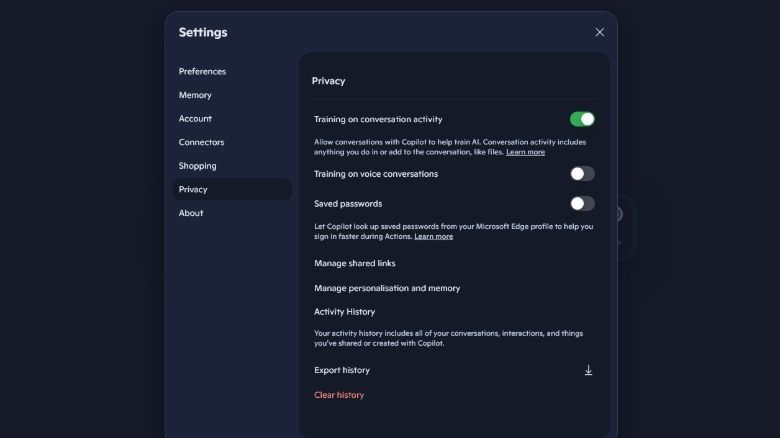
Microsoft has two different controls for model training on user data. They are Training on conversation activity (on by default) and Training on voice conversations (off by default). Both can be found under the profile icon, then Settings and then Privacy. Again, opting out only excludes future conversations from model training, and it doesn’t stop Microsoft from using chats for advertising or general product improvements.
Grok
X enrols every account in Grok training by default, covering both your public posts and conversations with SpaceXAI’s chatbot. The toggle can be found under Settings and privacy — Privacy and safety and then Grok & Third-Party Collaborators. Unchecking the data-sharing option withdraws your posts and Grok interactions from future training and fine-tuning.
Meta
Meta doesn’t allow US users to opt out at all. People in the UK and EU, meanwhile, are protected by strong data privacy laws under the EU General Data Protection Regulation (GDPR), and they can object to their information being used for model training through a form in Meta’s privacy center.
Since last December, text and voice chats with Meta AI have been used to feed the company’s advertising machine across Facebook, Instagram, WhatsApp and Messenger. For US users, the only option is to not engage with Meta AI in the first place, which isn’t terrible advice following the launch of Meta’s new AI agent, Muse.
You must be logged in to post a comment Login