Connect with us

Tech

How to watch Australia vs Japan: Free streams & TV channels

Published

on

Watch Australia vs Japan live streams as the Wallabies look to follow up their hard-fought 35-32 victory over the Brave Blossoms with a more comprehensive victory on home soil in Townsville, Queensland.

The first game in the post-Joe Schmidt era proved to be a tough one for Australia as they were forced to hang on for a narrow win in Osaka. Surviving a first-half red card for Miles Amatosero and a second-half onslaught from Japan, new head coach Les Kiss would have been nervy on the touchline. He’ll hope for a more convincing display on home soil and has opted for Carter Gordon at fly-half instead of Declan Meredith.

Source link

Advertisement
Continue Reading
Click to comment

You must be logged in to post a comment Login

Leave a Reply

Tech

Twin Guitar-Playing Robots Will Work For Tab

Published

on

Remember Animusic? They were these incredible animated music videos with original tunes being played by computer-generated robots. Well, the MegCell Pulse might be the coolest robots-playing-music thing we’ve seen since Animusic.

Built by [Bruce] over six years’ time, this futuristic wonder features two robots working in concert to play acoustic guitar, just like a pair of human hands would. You just feed them digital tablature, and off go the fraternal twins, with one doing the fretting, and the other doing the plucking via six individual plectrum. It’s digital music producing analog sound from a physical instrument.

How does MegCell Pulse work? It’s essentially a system of gears, magnetic actuators, and arms, contained in a 3D-printed structure. The only real limitations are that it can’t traverse the entire fretboard, nor can it slide between frets. That said, you can absolutely buy one for your own guitar via [Bruce]’s modestly-goaled Kickstarter.

Advertisement

The kicker here is that you can’t buy an assembled MegCell Pulse; you must print and build it yourself. Back on the upside, the most expensive supporting tier is a mere $100. For that price, you get the complete digital plans. That includes 3D print files, an assembly guide, the control software, and a parts list. Be sure to check out the demo videos embedded after the break.

We have certainly seen robots playing guitars before, although admittedly, it’s been a minute.

Advertisement


Source link

Advertisement
Continue Reading

Tech

3 underrated movies you can watch for free this weekend (August 14-16)

Published

on

If your weekend plans involve sinking into the couch and wondering what to do next, consider this your rescue package. This week’s lineup comes with a bonus – every single movie here is completely free to stream. I dug through Tubi and Pluto TV‘s libraries and found a pothead comedy, a Swedish vampire film that reinvented the genre, and a Korean horror movie that still gets talked about years later. So, add these free films to your Weekend watchlist right away!

We also have guides to the best new movies to stream, the best movies on Netflix, the best movies on Hulu, the best free movies, and the best movies on Amazon Prime Video.

Smiley Face (2007)

Genre: Comedy
IMDb: 5.9/10
Rotten Tomatoes: 64%

Advertisement

Jane (Anna Faris), an unemployed actress, accidentally eats a full batch of her roommate’s weed-laced cupcakes right before a packed day of errands. What follows is a chaotic, one day journey across Los Angeles as Jane tries to replace the cupcakes, make it to a big audition, and pay off her drug dealer, all while progressively getting more baked. However, paranoia and ridiculous distractions keep derailing her at every turn.

I recommend this one almost entirely for Anna Faris, who fully commits to playing stoned and turns this low-budget comedy into an absolute masterclass in slapstick humor. She won a Best Actress award at the Method Fest for the role, and it is easy to see why after watching her navigate simple tasks like an obstacle course. It is far from a polished film, and critics were split on it at release, but if you are in the mood for something silly and low-effort to watch, this one delivers exactly that.

Stream Smiley Face on Tubi.

Let the Right One In (2008)

Genre: Horror, Romance
IMDb: 7.8/10
Rotten Tomatoes: 98%

Advertisement

Oskar, a lonely twelve-year-old boy who gets bullied at school, strikes up a friendship with Eli, the strange new girl who moves in next door and only appears at night. As their bond deepens, a string of mysterious deaths begins spreading through their snowy Stockholm suburb. Oskar soon discovers Eli harbors a dark, bloodthirsty secret. Rather than leaning into typical vampire horror tropes, the film treats Eli’s condition as something tragic, tangled up in themes of isolation, first love, and quiet violence.

Director Tomas Alfredson shot the whole movie in muted blues and silences, letting the dread build gradually instead of relying on jump scares. Kåre Hedebrant and Lina Leandersson give remarkably mature performances for child actors, carrying scenes that require real emotional complexity. The final scene near the end is a masterpiece of tension and visual storytelling.

Stream Let the Right One In on Rakuten Viki.

Advertisement

The Wailing (2016)

Genre: Horror, Mystery, Thriller
IMDb: 7.4/10
Rotten Tomatoes: 99%

A quiet mountain village in South Korea is suddenly struck by a mysterious, violent sickness that drives locals to murder their families. An incompetent police officer named Jong-goo steps up to investigate the gruesome crime scenes. When his own daughter shows identical symptoms, his search for answers turns into a desperate race against time.

What starts as a straightforward procedural investigation slowly spirals into something far stranger, blending shamanistic ritual, possession, and paranoia. The intense exorcism sequence midway through is easily one of the most hypnotic scenes in modern horror cinema. I recommend this one for how thoroughly it commits to its slow burn, letting the mystery deepen for over two hours before its full scope becomes clear. That patience pays off with one of the most talked-about endings in recent horror cinema.

Advertisement

Stream The Wailing on Tubi and Pluto TV.

Source link

Advertisement
Continue Reading

Tech

Google Must Make It Easier To Install Alternative App Stores, Judge Orders

Published

on

The company has a week to fix things.

Google began distributing third-party app stores through its Play Store earlier this week, but not everyone is happy with the company’s approach. The Verge reports that Judge James Donato, the US District Court judge who oversaw the company’s antitrust case with Epic, believes Google has introduced unnecessary “anticompetitive friction” to the download process and has given the company a week to make changes.

The judge took issue with the way Google presents third-party app stores in search results and the current process for installing them from the Play Store. Epic’s lawyers reportedly demoed entering the search term “store for apps,” which turned up no results for app stores and only results for physical stores like Walmart. The lawyers also showed that even if users are able to find third-party app stores, they’re not displayed in the normal list of search results and are instead buried under a banner for third-party app stores. “That is not acceptable, that has to be fixed. I want every possible variation that’s even only 70 percent properly phrased,” Donato said.

Google’s decision to replace the normal “Install” button with a “View” button on the only third-party app store on the Play Store, Aptoide, was also a major point of contention. Donato suggested that making people jump through an extra layer of menus to install the store was discouraging them from downloading it, according to The Verge. In response to Donato’s complaints, Google ultimately agreed to make changes and implement them in the next week.

Advertisement

The company first announced it would support third-party app stores in March 2026, one of several results of a settlement it reached with Epic near the end of 2025. The settlement was a modified version of the remedy Donato came up with in 2024, which largely focused on loosening Google’s control of the Play Store in response to the court finding the company had a monopoly on app distribution in 2023. Clearly Google’s first pass wasn’t loose enough.

Source link

Advertisement
Continue Reading

Tech

How to watch Sri Lanka vs India 1st Test: Free Streams & TV Channels

Published

on

Test cricket returns to Sri Lanka after more than a year as the hosts prepare to take on neighbours India in an exciting two-match Test series, starting from August 15 in Galle. For India, more than Sri Lanka, there are crucial World Test Championship (WTC) points at stake.

After losing to South Africa at home, India now need 8 wins out of 9 matches to make it to the WTC final. Sri Lanka, meanwhile, need 6 out of 7 wins to keep their hopes alive, but they also depend on other results.

Source link

Continue Reading

Tech

Anthropic is heading toward the largest IPO ever, at a possible $2 trillion valuation

Published

on

Bottom line: Anthropic is heading toward a possible October IPO, with many investors telling the Financial Times that they expect the company to reach a valuation of $2 trillion or more. That figure would make it the largest public offering on record and put the company at the top of a market that is becoming increasingly cautious about AI spending and valuations.

The expectations are driven by Anthropic’s rapid revenue growth. Investors expect its annualized revenue to reach $100 billion to $120 billion by the end of 2026. Anthropic said in May that its annualized revenue had surpassed $47 billion.

“If Anthropic is growing 800% a year, you’d think at the incredibly low end they would trade at 30 times [revenue],” one investor in the group told the Financial Times. “That would make them a $3 trillion company.”

Anthropic has not set a public valuation target for the offering. Several investors said senior executives had not shared one privately, either. Still, backers have built their own models based on the company’s enterprise sales growth and the performance of its AI systems.

Advertisement

The company has gained ground against OpenAI and Google this year. Its strategy has centered on business customers, with companies using Anthropic’s models and tools in internal workflows and customer-facing products. Ramp data showed that Anthropic increased its share of US business spending on AI last month.

The same data points to a growing issue for the sector: companies are watching their AI bills more closely. Ramp analysts said businesses were “hitting their limit on AI spend” and shifting some workloads to cheaper systems.

Anthropic’s top model costs more than two and a half times as much to use as OpenAI’s flagship model, according to Artificial Analysis. Chinese open-weight models are considerably cheaper. That price gap matters as companies shift from pilots and small projects to large-scale deployments, where inference costs can rise quickly.

Some customers have already changed their approach. Rather than pushing employees to use the most capable AI tools whenever possible, they have moved certain tasks to lower-cost models. The shift does not necessarily mean demand for frontier systems is falling. It does mean companies are deciding more carefully which workloads require the highest-performing models.

Advertisement

Anthropic filed paperwork with the Securities and Exchange Commission in June. The filing placed the company in a quiet period, limiting what it could say publicly about its financial results. Anthropic declined to comment on the planned offering.

The company has raised just under $100 billion from venture capital firms, sovereign wealth funds, and other institutional investors in 2026. Its valuation reached $965 billion in May, including new investment, when it moved ahead of OpenAI for the first time.

But a public listing would come with risks that private investors have so far been willing to accept. Anthropic has faced pressure from the Trump administration and remains in litigation with the Defense Department, which labeled the company a supply-chain risk earlier this year.

The Commerce Department’s export controls also forced Anthropic to briefly remove its Fable 5 and Mythos 5 models in June. Two investors said the disruption slowed overall revenue growth that month and raised concerns among customers who relied on the models.

Advertisement

The company recovered after that period, according to the investors. Even so, the IPO will test whether public-market investors are willing to place a multitrillion-dollar valuation on an AI company that is growing quickly but operating in a market where pricing pressure, regulation, and competition are all increasing.

“It’s easy to come up with challenges,” said an Anthropic investor who has also backed AI groups including OpenAI and SpaceX, which went public at a $1.77 trillion valuation in June. “But the company continues to be in first position in performance, positioning and what people want exposure to.”

Source link

Advertisement
Continue Reading

Tech

AI giants are storming S’pore with 6-fig salaries. But how serious is their investment?

Published

on

Disclaimer: Unless otherwise stated, any opinions expressed below belong solely to the author. Data sourced from Singapore’s Ministry of Manpower.

Singapore has become one of the battlegrounds in the global war for AI talent.

American giants OpenAI, Google, Meta and Anthropic are expanding their presence, while Chinese companies such as Alibaba, Huawei and ByteDance are increasingly treating the city as both a regional base and recruiting ground.

Fresh AI hires can receive S$70,000 to S$90,000, experienced machine-learning engineers can comfortably cross six figures, while the most sought-after PhD-level specialists may receive packages worth S$200,000 to S$350,000 or more, as reported by the Straits Times in May.

Advertisement

Chinese companies have been particularly aggressive, courting students at Singapore universities and dangling spectacular offers before some have even graduated.

But behind the salary headlines lies a more important question: how much are these companies actually investing in Singapore, and how much of that would remain if the AI boom suddenly ended?

First OpenAI lab outside the US

In May, OpenAI announced more than S$300 million for its OpenAI for Singapore initiative, including its first Applied AI Lab outside the United States. It plans to create more than 200 technical jobs here over the coming years.

Google DeepMind has also opened a Singapore research lab and expanded its partnerships with the government in healthcare, scientific research and workforce development.

Advertisement

Anthropic, the creator of Claude, which received investment from GIC and Temasek, has begun building a Singapore presence, which may eventually become a major regional operation.

Meanwhile, Chinese giant Alibaba selected the city for its first AI Global Competency Center—although it’s the Chinese companies whose commitment to Singapore might be the most shaky.

Friction with China

Around 50 Chinese AI-related firms have reportedly set up here since 2024, attracted by Singapore’s legal system, access to international capital, political stability and ability to operate relatively comfortably between China and the West.

Some are undoubtedly building genuine businesses here, while others may simply be acquiring a Singapore address. Therein lies the risk.

Advertisement

For Chinese tech companies, the city offers a convenient international face at a time when operating directly out of China can complicate access to Western customers, investors and technology.

The story of Manus shows just how complicated this can become. The AI startup packed its bags and moved its entire operation from China to Singapore before Meta agreed to buy it for around US$2 billion, only for Beijing to intervene and unwind the acquisition and bar Manus’ founders from leaving the country.

This warning salvo from the Chinese authorities may discourage mainland companies from using Singapore as a link to global customers and reduce the flow of jobs and money from all but the biggest companies.

Is it a bubble or a balloon?

The biggest danger, however, is outside of Singapore’s control. As the global AI buildout has reached extraordinary proportions, any sudden stop to it could throw the economy into a tailspin.

Advertisement

Alphabet, Amazon, Meta, Microsoft, Oracle and others are pouring hundreds of billions of dollars into chips, servers and data centres, betting that future AI revenues will eventually justify the expenditure.

Perhaps they will, and the bubble will turn out to have been a balloon, lifting everybody. But what if they don’t?

It is already clear that investment is rising far faster than the revenues currently produced by AI itself. Singapore is currently benefiting enormously from that spending, having raised its GDP growth forecasts for 2026 to around 5%, but the Monetary Authority of Singapore has raised concerns about what would happen if the demand faltered:

If . . . there is a major retrenchment in AI investment, it could sharply weaken global growth through a fall in business investment and semiconductor demand and negative wealth effects.

Chia Der Jiun, Managing Director, Monetary Authority of Singapore

Advertisement

Global thirst for semiconductors, electronics, financial services and technology has helped propel economic growth, while the arrival of AI companies is pushing up salaries for scarce technical workers.

But it also means that Singapore is becoming increasingly exposed to any future downturn.

If AI revenues disappoint and investors stop rewarding companies simply for spending more, the adjustment could be very painful. AI itself would not disappear, just as the Internet did not disappear after the dot-com crash. But the money could.

Recruitment bonuses would shrink, hiring would be frozen, and experimental regional offices would stop expanding. Startups dependent on continuous fundraising would disappear or consolidate. Expensive research teams could be moved back to headquarters. And layoffs would, inevitably, follow, like they did in the years following the pandemic spending extravaganza.

Advertisement

That is why the most valuable AI investments are not necessarily those producing the biggest salary headlines today.

They are the ones that become difficult to remove tomorrow: research labs, engineering teams, intellectual property, regional decision-making, local customers and operations deeply embedded in Singapore’s economy.

Still, not even large investments are immune to downsizing. Everybody enjoying the generosity of their AI employers should keep that in the back of their heads. Make the most of historic opportunities, but prepare for what might happen if they come to an abrupt end.

  • Read other articles we’ve written on Singaporean startups here.

Featured Image Credit: depositphotos

Advertisement

Source link

Continue Reading

Tech

ASU’s content creation degree grades your follower count

Published

on

The programme sits inside the Walter Cronkite School of Journalism and Mass Communication. The first cohort enrols this autumn.

The Associated Press reported the launch and the backlash on 14 August. Kaitlyn Huamani, who covers social media and internet culture, wrote it.

ASU declined an interview request about the new degree.

The university’s own documents do not agree

The degree was created by a Senate motion. Motion 2026-076 passed after readings on 2 and 30 March.

Advertisement

Its language is unambiguous about the destination. Graduates are expected to work as influencers and content creators across livestreaming, podcasting, videography and immersive media.

Now read the degree page. It lists five careers with median salaries drawn from the Occupational Information Network.

Those five are communications specialist, marketing associate, marketing manager, public relations manager and public relations specialist. Influencer is not among them.

The salaries run from $74,750 for a public relations specialist to $166,790 for a marketing manager. One entry, marketing associate, shows demand shrinking by 2.2%.

Advertisement

That gap is the most interesting thing about this degree. The motion sells creators, and the prospectus sells communications jobs.

The capstone is a follower count

The requirement is unusual for a university. Students must build a following on a platform of their choice and show measurable growth before they graduate, Net Influencer reported.

Set against the rest of the curriculum, that is the only genuinely new part. The coursework otherwise overlaps ASU’s mass communication and media studies degree, with electives in podcasting, studio production and on-camera presence.

The cost is not unusual at all. Base tuition runs about $12,000 a year for Arizona residents, and the total cost of attendance can pass $37,000.

Advertisement

Out-of-state students pay more than $35,000 in tuition. Their total sits near $60,000 before scholarships.

The front door is being narrowed while they study

The platforms are moving in the opposite direction to the campuses. YouTube doubled two entry thresholds to its Partner Program this month.

From 1 February 2027, the long-form route needs 1,000 subscribers and 8,000 valid public watch hours, up from 4,000. The Shorts route needs 20 million views over 90 days, up from 10 million.

That change lands during the first cohort’s opening year. They will spend three more years working towards a bar that moved before they started.

Advertisement

Existing partners keep their status. So the tightening falls entirely on people who have not started yet, which is exactly who this degree recruits.

Where the $20bn actually goes

The industry number sounds like an argument for the degree. Emarketer forecasts US social media creator revenue above $20bn this year.

Max Willens, a principal analyst there, told AP what that figure conceals. “The overwhelming majority of that money is not going into creators’ pockets,” he said.

His forecast is starker than the headline. He expects the amount brands spend distributing and amplifying creator content to eventually surpass the amount creators earn making it.

Advertisement

On the degree itself he was direct. The idea that it will “suddenly turn people into viral content machines deserves a bit of a reality check”, he said.

The job behind the dream job

Brooke Erin Duffy, a communication professor at Cornell University, reads these programmes as an inflection point. Institutions have spent the past year treating content creation as a real career.

She is also blunt about what the work involves. It is a “time-consuming, labor-intensive job that often doesn’t pay well, at least in the beginning”, she said.

The stereotype gets in the way of seeing that. The prototypical influencer is imagined as a “young girl who is snapping selfies and just reaping in tremendous rewards for seemingly not doing anything”, Duffy said.

Advertisement

She has a theory about the timing too. Universities competing for a shrinking student population are courting parents who want a job that will pay off, and whether it does is another story.

The market is contracting as the courses expand

The creator economy has been shedding jobs, not adding them. Patreon cut 20% of its staff in July, 93 roles in total.

Automated content is crowding the supply side. YouTube’s purge of AI material has been catching human creators who never showed their faces.

The wider pattern is not confined to creators. Tech internship postings have fallen 30% since 2023 as companies hand entry-level work to AI.

Advertisement

There is a counterweight worth knowing. Estonian data on 2,000 brand partnerships found nano and micro creators outperforming mass reach, which suggests the viral target is the wrong one.

Europe already has one, and it says the word

Europe had a content creation degree first. South East Technological University runs a four-year honours course in content creation and social media at its Carlow campus in Ireland.

The syllabus is close to ASU’s, with video production, podcasting, digital marketing, audience psychology and data analytics. It also teaches influencer studies as a subject.

The difference is the careers list. SETU names influencer outright, alongside content manager, journalist and communications specialist.

Advertisement

Entry runs through the Irish points system at 308 to 432 under code SE300. That makes it a mid-tier course rather than a novelty.

Two American precedents nobody mentions

Not every version of this has worked. East Carolina University announced a credentialing partnership with MrBeast that never launched.

Columbia College Chicago went further and reversed. It folded its social media major into a generic marketing degree.

Others are still building. Syracuse opened a Center for the Creator Economy in September 2025, run jointly with its business school and open as a minor to any major.

Advertisement

Its dean, Mark Lodato, spent 14 years at ASU’s Cronkite School before moving. Quinnipiac and Colorado State offer minors, and St Bonaventure announced a major last winter.

The students are not the naive ones

Aiesha Beasley has been a full-time creator in Phoenix for three years, after more than a decade of posting. She now helps small businesses with their social media.

Her case for the degree is not about fame. “Having a digital presence and a personal brand is very important nowadays,” she said.

Sammy Cristerna graduated from ASU this spring in sociology and political science. He would have taken the content creation classes, he said, for brand deal negotiation and monetisation rather than for going viral.

Advertisement

He named the limit himself. Connecting on camera takes good energy, and “that’s hard to teach”.

What would settle it

Three things, and the first is the capstone data. ASU can publish how many students hit measurable growth, and that number would tell you more than any prospectus.

The second is the careers table. If a creator job ever appears on it with a median salary, the labour statistics will have caught up with the motion.

The third is survival. Columbia College Chicago already folded one of these into marketing, which is also where ASU’s own salary figures point.

Advertisement

Source link

Continue Reading

Tech

3 overlooked TV series on Prime Video you should watch this weekend (August 14-16)

Published

on

Prime Video‘s library goes far beyond the algorithm-driven hits everyone already knows about. I dug through some older, quieter gems this week, ranging from the chaotic world of a New York orchestra to a burnt-out lawyer taking down corporate giants and a slice-of-life comedy that deserved a much longer run. Whether you are looking for something dramatic, funny, or deeply human, these Prime Video titles worth adding to your watchlist this weekend.

We also have guides to the best new movies to stream, the best movies on Netflix, the best movies on Hulu, the best free movies, and the best movies on Amazon Prime Video.

Mozart in the Jungle (2014 – 2018)

Genre: Comedy, drama, music
IMDb: 8.1/10
Rotten Tomatoes: 95%

Advertisement

This Prime TV series takes you behind the curtain of the New York classical music world to show the backstage chaos. Hailey Rutledge (Lola Kirke), a talented young oboist chasing her big break, gets pulled into the orbit of Rodrigo (Gael García Bernal), a flamboyant and unpredictable conductor shaking up the city’s legacy orchestra. Together they navigate ego clashes, wild parties, and financial stress.

The writing strips away all the pretension around orchestra halls. My favorite aspect is how the show captures the unhinged hustle of low-paid musicians chasing artistic perfection. Gael García Bernal is magnetic in this show, playing Rodrigo with a passion that makes every scene he is in feel alive. Lola Kirke grounds the show as its emotional center, playing Hailey’s ambition and self-doubt with real sincerity. Its half-hour episodes fly by, making it so easy to binge in a single sitting.

Stream Mozart in the Jungle on Prime Video.

Goliath (2016 to 2021)

Genre: Legal drama, crime
IMDb: 8.2/10
Rotten Tomatoes: 86%

Advertisement

Billy McBride (Billy Bob Thornton), once a powerful founding partner at a major law firm, has spiraled into alcoholism after a case he won on a technicality ended in tragedy. When he reluctantly takes on a wrongful death lawsuit against the very firm he helped build, a much larger and deadlier conspiracy starts to surface around him. The show shifts its central case and villain each season, keeping the format fresh with four separate stories across each run. Beneath the courtroom battles, this Prime TV series is really about redemption, addiction, and what it costs a person to finally fight for something again.

The story moves quickly, but the real pull is watching a burnt-out underdog fight corporate monsters. I recommend this one for Billy Bob Thornton’s role, which he carries with a charm that makes every courtroom victory feel well earned. Meanwhile, William Hurt brings a cold, calculating menace as Billy’s former partner and rival. The show also isn’t afraid to get genuinely strange in later seasons, leaning into surreal, almost noir-like sequences that some viewers loved and others found jarring.

Stream Goliath on Prime Video.

Advertisement

As We See It (2022)

Genre: Comedy, drama
IMDb: 8.1/10
Rotten Tomatoes: 90%

Jack (Rick Glassman), Harrison (Albert Rutecki), and Violet (Sue Ann Pien), three roommates in their twenties who are all on the autism spectrum, navigate jobs, friendships, and romance with the help of their behavioral aide Mandy. Created by Jason Katims and based on the Israeli series On the Spectrum, the show gives its central trio real personalities, flaws, and contradictions, rather than reducing them to lessons about autism.

What sets this series apart is the brilliant casting of neurodivergent actors in the lead roles, giving every performance a level of authenticity rarely seen on television. As a result, they bring their unfiltered reality to the comedic timing, which makes the show even more enjoyable. I was really disappointed when the show was canceled after just one season despite strong reviews. Even so, its eight episodes are totally worth watching.

Advertisement

Stream As We See It on Prime Video.

Source link

Advertisement
Continue Reading

Tech

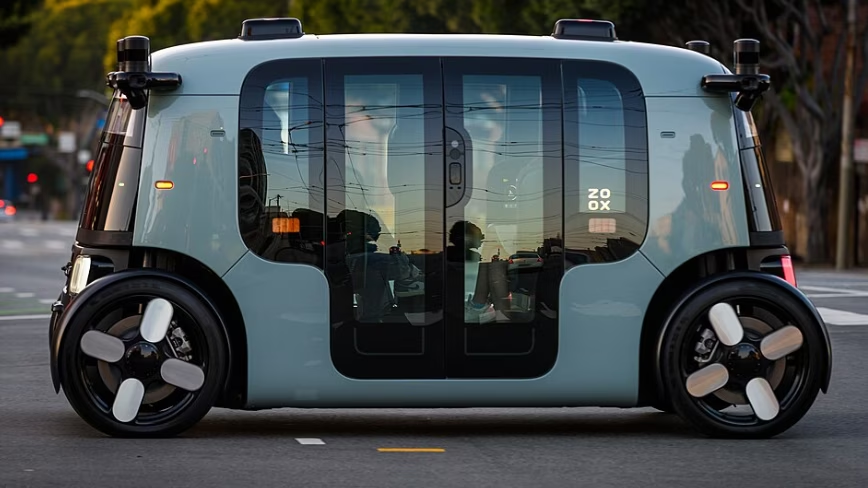
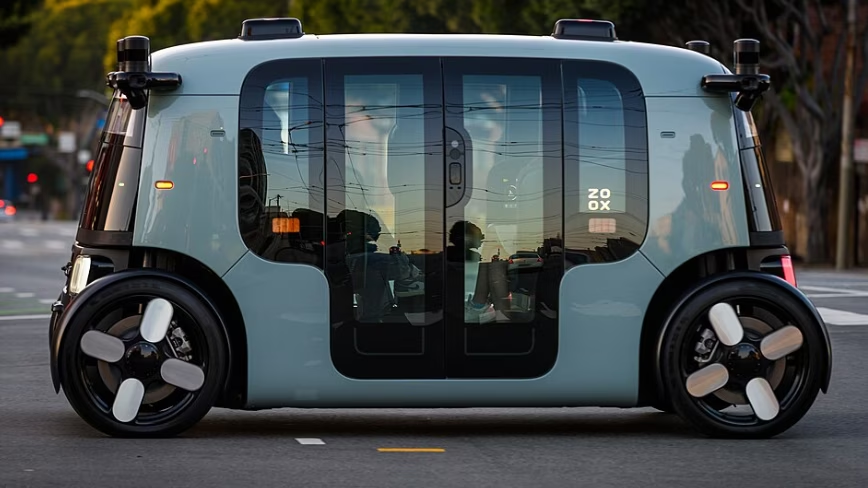
Zoox has shown its safety workings, three weeks after recalling every robotaxi it owns

Published

on

Zoox has published the reasoning behind its claim to be safer than human drivers. Everything reduces to one number, the predicted rate of collision, injury and fatality events, expressed as miles per event. Risk from driving software, from the vehicle itself and from fleet operations is added together into that single estimate.

It functions as a gate. Before any safety-relevant software release, hardware change or revision to operating procedure, Zoox updates the case and checks the combined figure still clears its target.

The target is anchored in human data. Zoox builds its benchmark from NHTSA’s crash sampling and fatality reporting systems and two Federal Highway Administration datasets, then parses them by road speed and weights them to match the mix of roads its robotaxis actually use.

What it does not publish is the answer. Zoox sets its target by comparison to that benchmark and says it aims to be significantly safer than a human driver, but never defines how much safer counts as significant. Nor does it give the figure its fleet currently reaches.

Advertisement

The engineering underneath is specific enough to argue with. Zoox names the hazard analyses it runs, follows ISO 26262 with integrity ratings on the platform, and uses simulation that deliberately searches for the conditions where a collision is most likely, weighted afterwards by real fleet exposure.

Some of it is genuinely unusual. A separate collision checker runs its own perception and can veto a trajectory the main system has planned, and Zoox concedes that a likelihood-based metric cannot capture rare avoidance scenarios, so it keeps a test set where the robotaxi must at least match a competent human.

Remote staff are inside the model rather than outside it. TeleGuidance tacticians never drive, offering route guidance while the vehicle keeps responsibility, and the risk of them making a mistake or their tools failing is priced into the same estimate.

The framework also reserves the right to restrict, pause or ground the fleet. Three weeks before publishing it, Zoox recalled all 105 of its robotaxis after one failed to detect heavy smoke and drove into an active fire scene in Las Vegas.

Advertisement

That was the fourth software recall in roughly 13 months, and it followed the regulator demanding fixes for vehicles interfering with first responders. NHTSA had logged 123 collisions involving Zoox vehicles in autonomous mode as of March.

The analytical approach exists because the mileage does not. Zoox has around three million autonomous miles, Waymo passed a hundred million more than a year ago, and Zoox now has a paid service to protect while it closes that gap.

Source link

Advertisement
Continue Reading

Tech

OpenAI CFO tells shareholders enterprise revenue has overtaken ChatGPT

Published

on

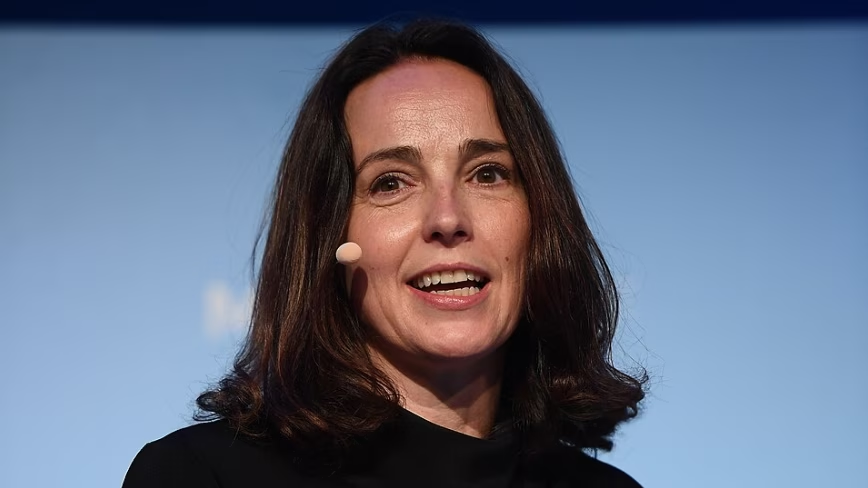
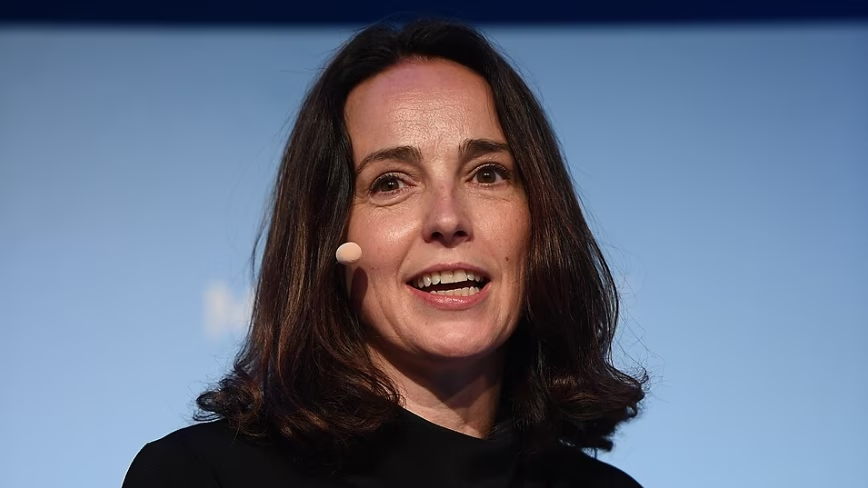
OpenAI’s enterprise business now generates more revenue than its consumer business, finance chief Sarah Friar told shareholders on Friday, months earlier than the company had forecast. Its annualised run rate has reached $40bn, roughly double a year ago.

OpenAI now makes more money from businesses than from ChatGPT subscribers. Finance chief Sarah Friar told shareholders on Friday that the two lines have crossed, according to a person at the meeting. “We entered the year at 60-40, but enterprise has accelerated much faster than expected,” she said.

That is early. Friar had said earlier this year that the two sides of the business would reach parity by the end of 2026.

The underlying numbers are moving quickly. OpenAI’s annualised run rate has reached $40bn, roughly double a year ago, and July revenue rose 20% month on month, with business customers up 32%.

Advertisement

More interesting is what enterprise buyers have started doing. “Enterprise customers have moved from tokenmaxxing to focusing on cost per unit of intelligence,” Friar said, meaning companies have stopped letting staff run up open-ended AI bills without showing what came of them.

OpenAI is answering on price rather than resisting. Friar pointed to recent cuts across its model range and to the newest model being 54% more efficient on agentic coding tasks.

Advertising has quietly become a business too. It is approaching a $1bn run rate, six months after OpenAI began testing ads in ChatGPT in February.

The meeting itself was scheduled before the week went wrong. It came a day after revenue chief Denise Dresser left after eight months and three days after longtime executive Brad Lightcap announced his departure.

Advertisement

President Greg Brockman thanked Dresser for building the enterprise foundation, the attendee said. He also praised her replacement, Dali Rajic, who was introduced to OpenAI by Thrive founder Josh Kushner, according to a person familiar with the recruiting.

Asked about Chinese open-source models, Brockman was dismissive. There is a misunderstanding that open source is cheaper, he said.

On the listing, nothing. Executives told shareholders they could not discuss timing because of the confidential filing with the SEC.

Advertisement

Source link

Continue Reading

Trending

Copyright © 2025