Tech
How Video Poker RNGs, Pay Tables and RTP Really Work

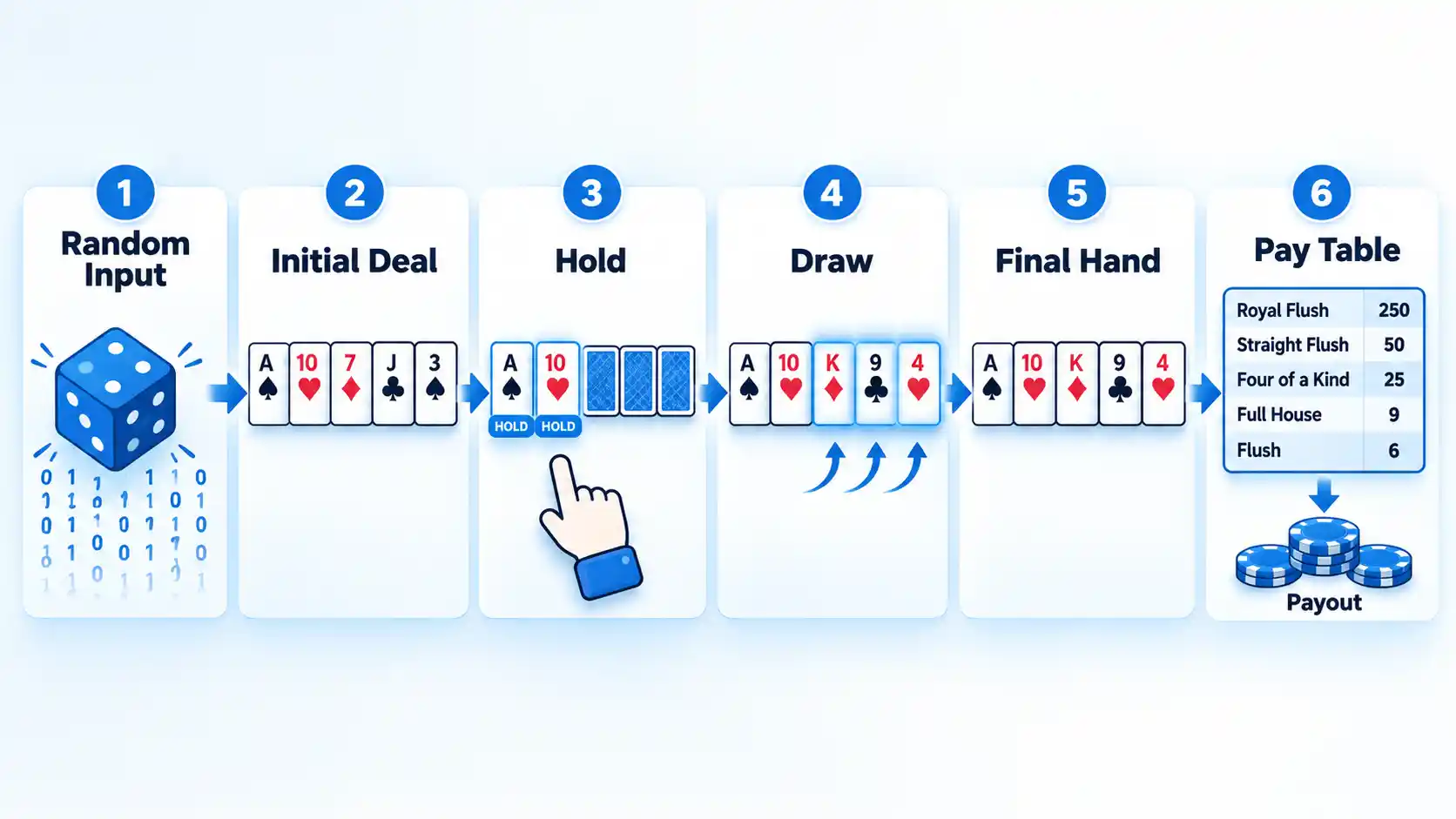
Video poker RNGs, pay tables and return to player (RTP) describe different parts of the same mathematical system. The RNG supplies random input, the game rules turn that input into cards and outcomes, the pay table assigns payouts, player decisions change which final hands remain possible, and theoretical RTP summarizes the long-run result under a stated strategy.
The Four Parts People Commonly Mix Up
The easiest way to understand video poker is to separate four mechanisms that are often treated as if they were the same thing: random number generation, game rules, player strategy, and the pay table.
A random number generator (RNG) produces unpredictable random inputs. Those inputs do not, by themselves, mean “win,” “lose,” “flush,” or “full house.” The game software maps the random inputs to cards or other game outcomes according to its rules.
A pay table specifies how much each qualifying final hand pays. A pair of Jacks may pay one amount per unit wagered, a full house another amount, and a royal flush much more. Changing those payouts can change the game’s theoretical return even when the random-selection process remains valid.
Strategy enters between the initial deal and the final result. You choose which cards to hold and which to discard. That decision changes the collection of final hands that can be reached from the current position.
Return to player, or RTP, is the designed long-run return under the game’s stated rules and assumptions. It is not a separate mechanism inside the machine that decides whether an individual hand wins.
The UK Gambling Commission makes an important distinction in its random-outcome technical standard: random inputs must be mapped to game outcomes according to prevailing probabilities and pay tables. That separates random generation from the rules that convert random inputs into meaningful game results.

The same distinction matters when common video poker myths are evaluated. A belief about streaks concerns randomness, while a claim about 9/6 versus 9/5 Jacks or Better concerns payouts. Mixing those layers produces misleading explanations.
What the RNG Actually Does
An RNG generates unpredictable random values. In a regulated implementation, the resulting random output and game outcomes must behave consistently with the probabilities the game claims to use.
The UK Gambling Commission requires applicable remote games to produce results that are “acceptably random.” Its standard says RNG output should be appropriately distributed and unpredictable, and that seeding or scaling methods should not introduce predictability. It also prohibits adaptive behavior that changes outcome probabilities during ordinary play.
That last point matters because the game is not permitted under that standard to become more generous after a losing streak or less generous after a win simply because of previous outcomes. Properly defined bonus or special features can use different disclosed rules, but that is different from secretly changing the probability of ordinary results.
The RNG is only one layer. A random value still has to be mapped to something meaningful in the game. In video poker, that mapping contributes to the selection of cards or outcomes under the game’s defined rules. The exact implementation can vary, which is why it is safer to explain the regulatory requirement than to claim that every machine uses one particular algorithm, sampling rate, or shuffle process.
The broader role of random number generators in digital casino games follows the same general principle: random generation supplies unpredictable input, while game-specific logic determines what that input means.
How a Video Poker Hand Moves From Deal to Draw
In conventional draw-style video poker, the visible sequence is straightforward. The game presents an initial hand, you choose which cards to hold, you initiate the draw, discarded positions receive replacement cards, and the final hand is evaluated against the pay table.
For example, suppose the initial hand contains two Jacks and three unrelated low cards. Holding the pair leaves three positions to replace. The replacement cards are selected according to the game’s random-selection process, and the resulting five-card hand is then evaluated for a payout.
One regulatory example makes the timing especially clear. Nevada Gaming Control Board Technical Standard 1 states that video poker games must not determine replacement cards before the player selects hold cards and initiates the draw. The same standard requires the RNG and random-selection process to be protected from outside influence.
That Nevada requirement should not be turned into a claim that every video-poker-style product worldwide uses an identical internal architecture. It establishes a documented rule for that regulated model. Other jurisdictions or nonstandard products may use different technical implementations while presenting a similar interface.
What a Pay Table Controls
The pay table answers a different question from the RNG: how much does each final hand pay? It does not determine which random cards arrive. Instead, it assigns value to the final outcome after the hand has been completed.
Jacks or Better provides a useful example because the same game family can use several payout schedules. The shorthand “9/6” means the referenced schedule pays 9 units for a full house and 6 for a flush per unit wagered under that structure. Other schedules change one or both of those payouts and therefore change the calculated return.
The table below uses figures from the current Jacks or Better return analysis. It illustrates how payout changes alter theoretical return rather than ranking one version as a recommended game.
| Pay Table | Full House | Flush | Calculated Return |
|---|---|---|---|
| 9/6 | 9 | 6 | 99.5439% |
| 9/5 | 9 | 5 | 98.4498% |
| 8/6 | 8 | 6 | 98.3927% |
The relationship is visible immediately. The card game can still be called Jacks or Better, but a lower full-house or flush payout changes the weighted value of the outcomes and therefore changes theoretical RTP.
This is why reading the complete video poker pay table is more reliable than identifying a game only by its title. Even familiar shorthand describes only part of the payout structure, so the remaining rows still need to match the calculation being cited.
Why Strategy Changes RTP Even Though the Cards Are Random
Randomness and strategy are not opposites. The RNG controls which cards become available, while strategy controls what you do with the cards you have already been dealt.
Suppose an initial hand offers both a low pair and four cards to a flush. Keeping the pair creates one set of possible final outcomes. Discarding the pair and drawing to the flush creates another. The random draw remains uncertain in either case, but the probabilities and average value of those two decisions are not equal under the referenced 9/6 Jacks or Better pay table.
Expected value is the average mathematical value of a choice across many repetitions of the same situation. A play with the higher expected value is not guaranteed to win on the next hand. It simply performs better on average under the model’s assumptions.
The optimal strategy analysis for 9/6 Jacks or Better illustrates this directly. Its strategy ordering ranks four cards to a flush above a low pair for the relevant situation because the former has the higher average return under that pay table.
This relationship also appears in regulatory RTP guidance. The UK Gambling Commission’s RTS 3 rules on likelihood-of-winning information state that when a non-peer-to-peer game contains an element of skill, theoretical RTP should be calculated using either an auto-play strategy or a standard or published strategy.
That qualification is important. A published RTP for a skill-influenced game is tied to an assumed way of playing. Using a different strategy can produce a different player return even if the RNG and pay table remain unchanged.
How Theoretical RTP Is Calculated Conceptually
Theoretical RTP is better understood as an output of the game’s mathematics than as a setting controlled directly by the RNG.
At a conceptual level, each possible final outcome has two important properties: how often it occurs under the stated rules and strategy, and how much the pay table awards when it occurs. The contribution from an outcome is its probability multiplied by its payout. Add those contributions across the complete set of outcomes and you obtain the expected return.
In plain text, the idea is:
theoretical RTP = sum of each outcome’s probability × its payout
Video poker adds an extra layer because the player’s hold-or-discard choices influence the probabilities of the final hands. That means the theoretical calculation depends not only on the pay table but also on the assumed strategy.
For full-pay 9/6 Jacks or Better, Wizard of Odds calculates a total optimal-strategy return of 0.99543904, or approximately 99.54%. That figure is the combined contribution of all final outcomes under the stated rules and optimal strategy. It is not produced by instructing the RNG to “return 99.54%.”
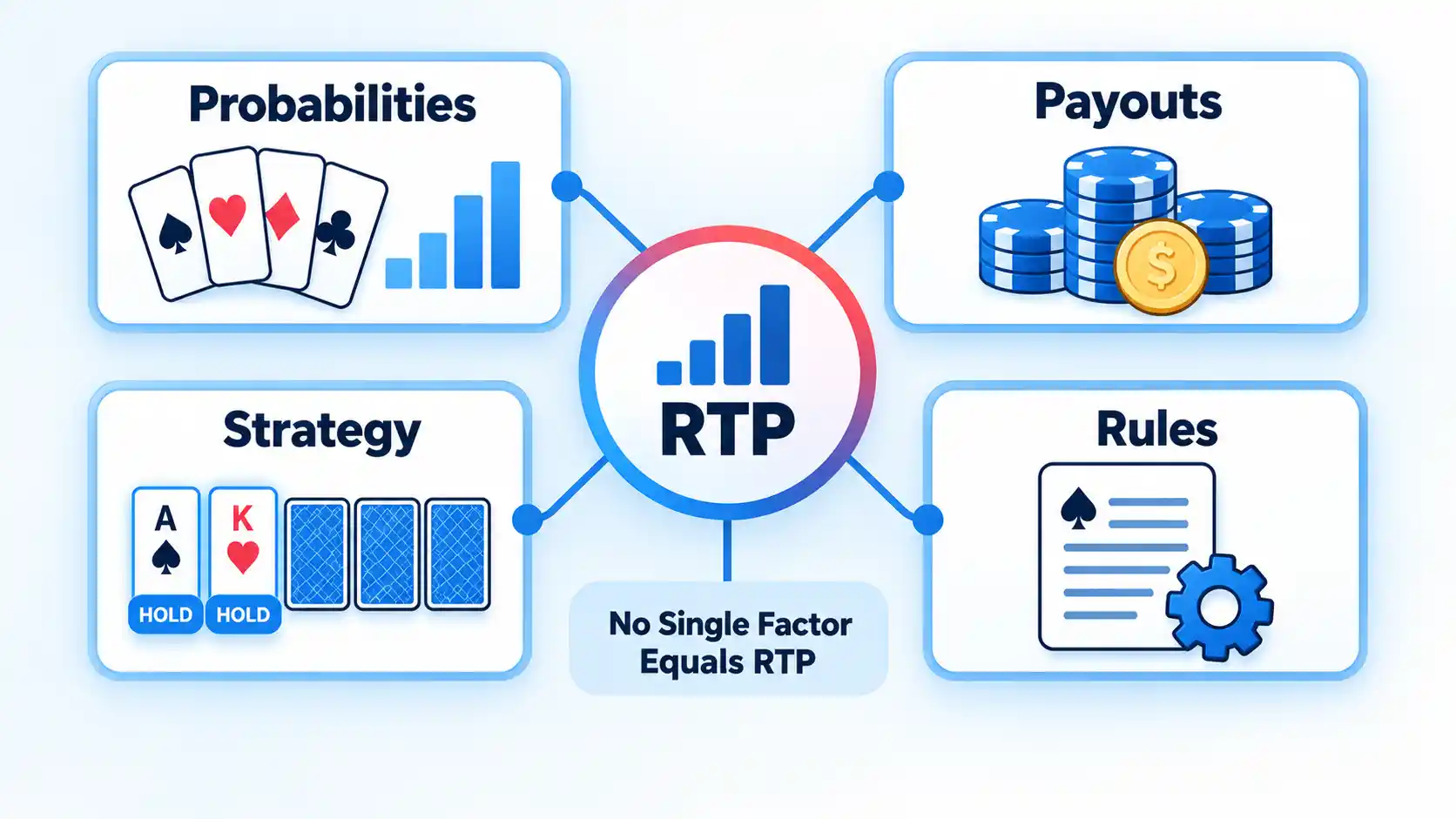
This is the central relationship: the RNG supplies randomness, but theoretical RTP emerges from probabilities, payouts, rules, and player decisions working together.
Theoretical RTP Is Not Your Session Return
A theoretical RTP of 99.54% does not mean that wagering $100 produces exactly $99.54 in returned winnings during a particular session.
The UK Gambling Commission distinguishes theoretical RTP from actual RTP. Actual RTP can be measured by dividing recorded wins by turnover over a defined period. Its RTP calculation guidance gives a worked example in which a game designed for one theoretical percentage records a different actual percentage over a limited sample.
Volatility describes how widely results can vary around the mathematical average. A volatile game can produce substantial short-run deviations because outcomes do not occur in a perfectly even sequence.
The Commission’s guidance explains that the statistical tolerance around theoretical RTP is wider when only a limited amount of play has been measured and decreases as the volume of play grows. Larger samples therefore provide a more stable basis for comparing actual performance with the theoretical design.
That does not mean a particular person’s balance must converge to the published RTP after a specific number of hands. Statistical convergence describes behavior across large samples, not a repayment schedule for an individual session.
Why the Same Game Name Can Produce a Different RTP
A familiar name such as Jacks or Better identifies a game family, not necessarily one exact mathematical configuration.
The pay table can differ. The treatment of special hands can differ. Wild-card rules can differ. Maximum-wager payouts can differ. Even the handling of discarded cards can differ in an unusual implementation.
That is why an RTP figure should always be attached to a specific rule set and pay table. Saying “Jacks or Better returns 99.54%” without qualification is incomplete. The approximately 99.54% figure belongs to the full-pay 9/6 configuration under optimal strategy described by the cited mathematical analysis.
The same principle applies when comparing video poker with slots. Both categories can use random generation, but the way player choices, outcome probabilities and payout structures contribute to theoretical return differs by game design.
Important Exception: Not Every Video-Poker-Looking Game Uses the Same Draw Rules
Conventional Jacks or Better analysis assumes that discarded cards stay out of the draw pool for the remainder of that hand. That assumption matters because changing which cards can return on the draw changes the final-hand probabilities.
A documented nonstandard example analyzed by Wizard of Odds instead returned discarded cards to the deck before the replacement draw. Under those rules, a single 52-card deck is used, the player receives five cards, discarded cards are placed back with the remaining undealt cards, and replacement cards are then drawn.
The mathematical consequence is substantial. Using the listed 9/6 pay table, the with-replacement analysis calculates an optimal-strategy return of about 96.60%. On the same source page, conventional Jacks or Better with the same pay table and no replacement is calculated at about 99.54%.
Warning
Do not assume that a familiar video poker name guarantees familiar draw mechanics. Check the game’s rule screen, pay table, treatment of discarded cards, wild-card rules and jurisdiction before applying an RTP or strategy figure calculated for another implementation. Some online gambling systems also use provably fair verification, which is a different transparency model from conventional regulator-tested game implementations.
This edge case is a useful reminder that RTP is inseparable from the rules used in the calculation. Identical-looking payout numbers do not guarantee identical probabilities if the draw mechanics are different.
How to Evaluate an RTP Claim Correctly
You do not need to reproduce the entire probability model to tell whether an RTP claim is properly specified. Check whether the figure identifies the assumptions that materially affect the calculation:
- Exact game or variant: Jacks or Better, Deuces Wild and bonus variants do not share one universal model.
- Complete pay table: small payout changes can alter theoretical return.
- Wager assumptions: some schedules change payouts at specific wager levels.
- Strategy assumption: a skill-influenced game’s theoretical RTP may assume optimal or another published strategy.
- Draw and card rules: replacement, wild-card and special-feature rules can change outcome probabilities.
- Type of figure: theoretical RTP and measured actual RTP are not interchangeable.
A common failure is copying the approximately 99.54% return associated with full-pay 9/6 Jacks or Better and applying it to a game that has a 9/5 or 8/6 schedule. Another is using a strategy designed for one pay table while quoting the optimal return for another.
The UK Gambling Commission’s rules reinforce this need for specificity. Applicable games must make information about their rules and likelihood of winning available, and for skill-influenced games the RTP calculation must be tied to an identifiable strategy basis.
Bottom Line
Video poker RTP is not something the RNG independently chooses. The RNG supplies unpredictable random input, the game rules map that input into cards, your hold-or-discard decisions affect the probabilities of final hands, and the pay table assigns value to those outcomes.
Combine those probabilities and payouts under a defined strategy and you get theoretical RTP. Change the pay table, strategy or draw rules and the result can change even when the random-number process remains valid. That is why a useful RTP figure always belongs to a specific game configuration rather than to a game name alone.
You must be logged in to post a comment Login