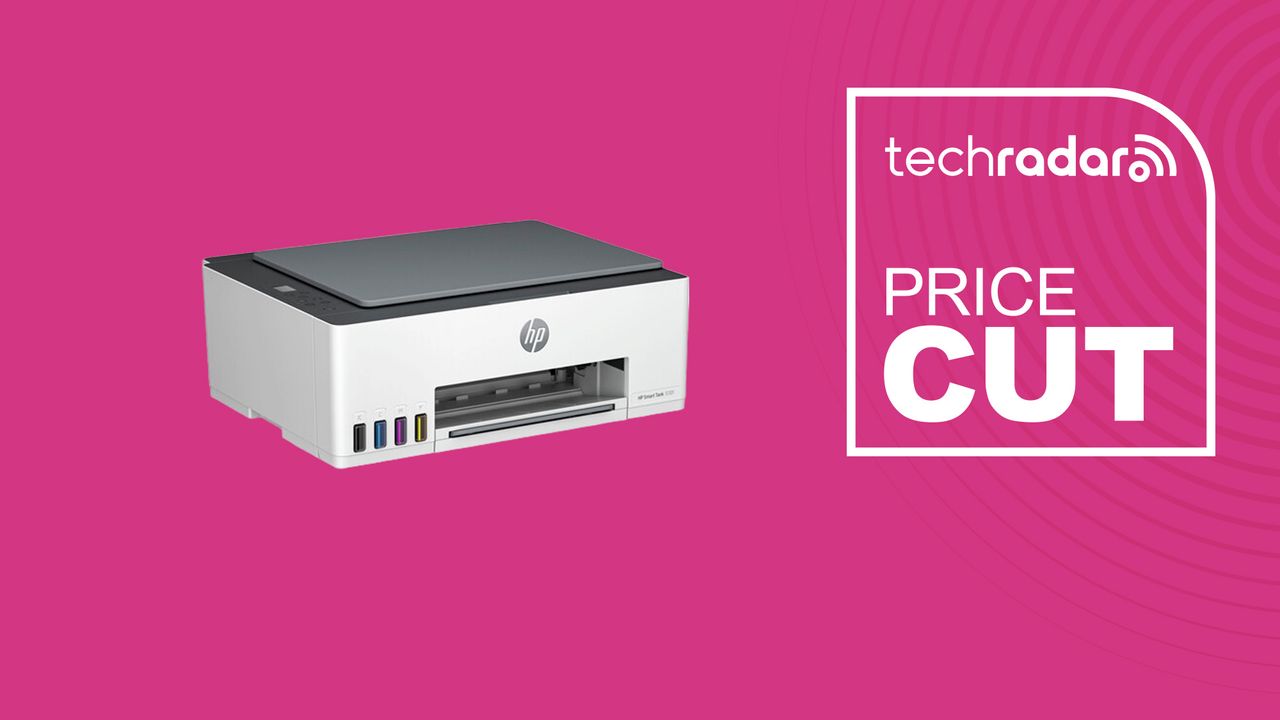
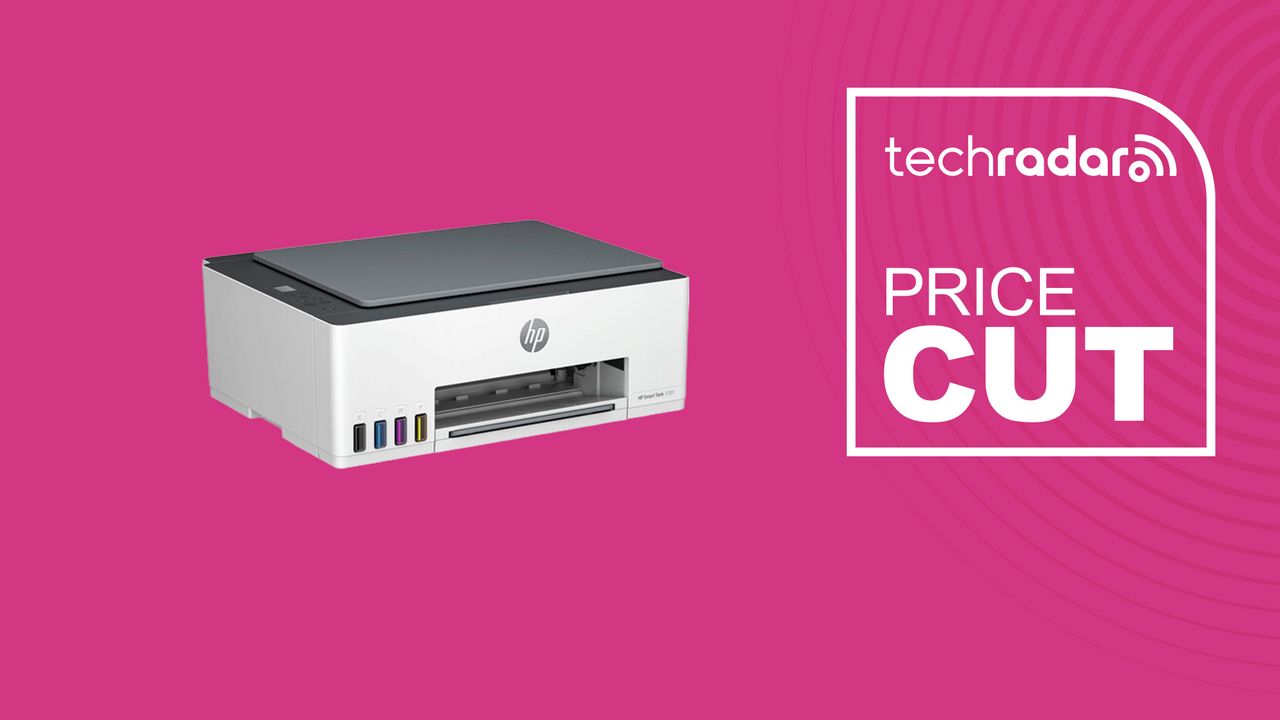
If you’re tired of buying ink cartridges every few months, this is a good time to switch to a cartridge-free tank printer. Right now, the HP Smart Tank 5101 is $170 (was $260) at Amazon, and comes with 2 years of ink already included in the box.
For home, dorm room, home office, and small businesses printing a mix of monochrome and color documents and photos, it’s an ideal pick. Particularly as HP‘s ink tank printers tend to have larger tank reservoirs compared to rivals like Epson‘s EcoTank range.
Today’s top HP printer deal
Advertisement
Should you buy it?
✅ Buy it if…
You want to save on running costs because bottled ink is much cheaper than inkjet cartridges and you get four bottles free in the box. We recommend ink tank printers if you’re chiefly printing documents and photos.
❌ Skip it if…
You’re mostly printing text documents – a high-volume laser printer is a much better option for sharper, bolder on-page text.
Advertisement
Why we recommend it
Having tested HP’s Smart Tank line alongside the Epson EcoTank, Canon MegaTank, and Brother INKvestment range, we strongly recommend ink tank printers over traditional inkjet models that use cartridges.
The pitch for tank printers like the HP Smart Tank 5101 is straightforward: instead of buying ink cartridges that run out every few hundred pages, you refill four visible ink tanks from bottles, and each bottle lasts dramatically longer. HP estimates the included set of ink bottles is good for roughly 6000 pages.
Setup leans on HP’s Smart app, which walks through Wi-Fi connection and initial configuration with guided, step-by-step prompts rather than dropping you into a printer’s typically clunky onboard menu system. Once connected, illuminated smart buttons on the printer itself are meant to guide you through common tasks like printing, scanning, and copying.
Advertisement
Print speed is modest rather than fast — HP rates this around 12 pages per minute for black-and-white and 5 pages per minute for color in normal mode, with the higher-quality “best” setting slower still. That’s typical for tank printers in this price range, and fine for everyday home printing, but not the machine to reach for if you regularly print large batches of documents quickly.
Price Context & Historical Value
This isn’t the cheapest the 5101 has ever been – back in 2024, it dropped to an all-time low of $140 direct from Amazon. However, it’s cheaper now than any third-party seller has sold it before brand-new ($180 was the price back in April 2025). Typically, we see it selling at around the $190 to $250 mark when not on sale. The highest price it’s been sold for is $280. Right now, it’s also available for $170 at Best Buy, too.
Advertisement
The Catch: What to know before you buy
A few honest caveats worth flagging: some reviewers have reported software quirks and occasional paper jams with this model, and if you print only occasionally rather than regularly, the ink in an inkjet’s print head can dry out and clog between uses. This is best suited to households or small offices that print often enough to make the low cost-per-page actually pay off.
In an ideal world, the role of technology would be to make all of our lives easier. And although all the ads suddenly appearing in our smart TVs and gaming systems might make it seem otherwise, some technology can still improve our lives if we work hard at it. For [Cian], that meant training a neural network to read his gas meter so he wouldn’t have to do it himself.
The root issue here is twofold, first that [Cian]’s gas company hasn’t upgraded their own technology to modern, remote-readable meters, and second that the meter can’t be read by a gas employee because it’s hidden in the depths of [Cian]’s basement. This latter fact requires him to delve into Moria-like depths to get to the meter, so the solution here was to place a Raspberry Pi in this location instead. With a camera pointed at the meter, it’s not quite capable of discerning digits on its own so a neural network was trained in order to get accurate readings of the dial. And, finally, since the machine is networked already [Cian] set it up to automatically notify the gas company of its reading so he is now completely out of the loop.
For automating tedious tasks like these, the Raspberry Pi with something like OpenCV as a computer vision tool is a fairly mature platform for light machine learning duties like these. We’ve seen license plate readers as well as neighborhood traffic surveys built on these platforms to help automate human labor away, making our lives easier one single-board computer at a time.
One of Singapore’s oldest vintage furniture businesses runs a 7,000 sq ft store and offers refurbished furniture ranging from S$15 to tens of thousands of dollars.
In a world driven by consumerism, one Singapore business is giving pre-loved furniture a second life. Meet Hock Siong & Co., a family-run business that has spent decades collecting, restoring, and reselling secondhand furniture.
Today, the business is run by sisters Brillyn Toh, 38, Beaunice Toh, 33, and Blessance Toh, 30, who grew up surrounded by used furniture and discarded household items.
The trio are the second generation of a family deeply rooted in Singapore’s karung guni trade. Their grandfather went door to door collecting unwanted newspapers, clothing, and household items, while their father, Toh Chin Siong, 65, grew up helping in the trade before founding Hock Siong & Co.
We spoke with Brillyn about how she and her sisters have grown Hock Siong into a 7,000 sq ft showroom in Tai Seng, with no plans of slowing down.
Advertisement
It started with old newspapers & used clothing
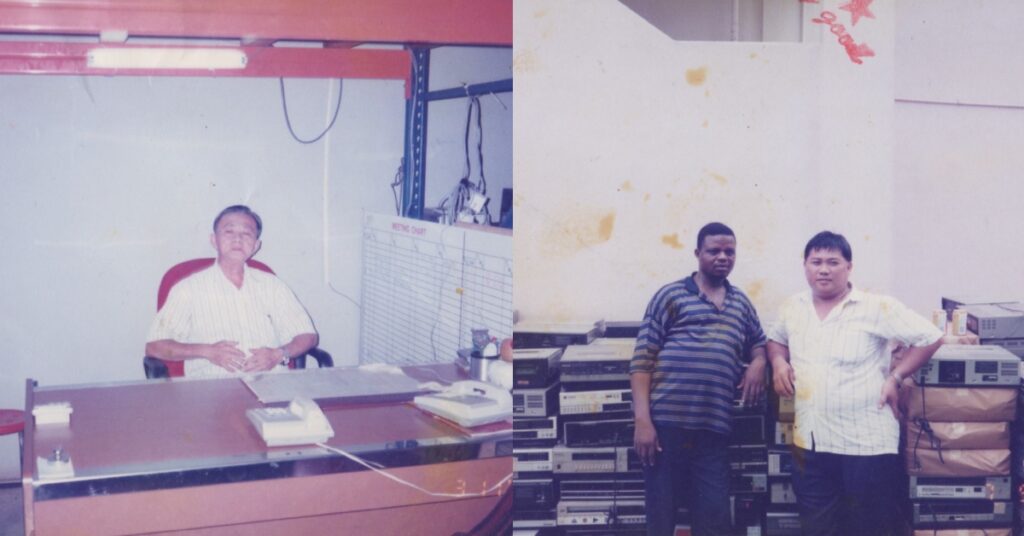
(Left): The elder Toh and (Right): the sisters’ father./ Image Credit: Hock Siong
The story of Hock Siong began not with furniture, but with old newspapers and used clothing.
It started with Brillyn’s grandfather, a karung guni man (rag-and-bone man) who, in the 1970s, travelled through Singapore’s housing estates sounding a horn to announce his arrival and collecting whatever residents no longer needed.
His son, Toh Chin Siong, grew up helping with the collections. After finishing school, he worked briefly as a lorry driver before founding Hock Siong in the early 1990s.
The business initially served as a middleman in the karung guni trade, buying from individual collectors, sorting the items, and exporting them to overseas markets where there was demand. Used clothing was shipped mainly to Indonesia, while electronics found buyers across developing countries in Southeast Asia.
The pivot into furniture came in 1998. That year, Chin Siong learned of an opportunity to tender for the contents of the former Marco Polo Hotel, which was slated for demolition in 1999. The once-prominent hotel has since been replaced by a condominium on the same site.
Advertisement
He partnered with a Malaysian agent to purchase everything inside the hotel—beds, mirrors, tables, chairs, restaurant furnishings and lounge pieces from roughly 300 rooms.
The pair split the haul, with half going to Malaysia and the other remaining in Singapore to be sold through Hock Siong. At the time, storage was inexpensive, and the family had access to a large warehouse in the old Sungei Kadut area, making it feasible to keep such a massive inventory.
That single project transformed the business. From then on, secondhand furniture became Hock Siong’s primary focus.
What Hock Siong won’t buy
Blessance and Uncle Lye, who works at Hock Siong./ Image Credit: Hock Siong
Today, Hock Siong is run by sisters Brillyn, Beaunice and Blessance Toh.
Each oversees a different part of the business. Brillyn heads procurement, assessing and purchasing incoming furniture; Beaunice manages operations, overseeing how pieces are sorted, stored and displayed in the showroom; while Blessance handles the administrative side, including finance and payroll.
Advertisement
Hock Siong acquires furniture from homes, restaurants, corporate offices and hotels that are renovating or clearing out their spaces. The team is sometimes even called upon to help families empty the homes of loved ones who have passed away.
Most enquiries begin with a WhatsApp message. Customers send photographs of the items they wish to part with, and Brillyn personally reviews each one to determine whether Hock Siong can take it.
Rare pieces of art often come by Hock Siong’s hands such as “Faces” by Naidee Changmoh, Bronze Edition and 优胜 Champion by Chua Boon Kee./ Image Credit: Hock Siong
Material is the biggest deciding factor. Pieces made from solid wood, such as teak, mahogany, or elm, are far more likely to be purchased, as they are durable enough to be restored and represent decades of growth.
“Sometimes I find that this wooden piece is beautiful, and I think it has the potential to be remade,” she said. “I will buy it.”
On the other hand, Hock Siong passes on items whose storage costs would outweigh their resale value, or pieces that would require so much refurbishment that the time and effort simply wouldn’t justify the eventual selling price.
Advertisement
Today, Hock Siong’s sprawling showroom carries everything from a S$15 vintage desk lamp to a three-metre Raffles statue priced at S$3,000. At the top end are bronze sculptures by Chinese artist Liu Ruo Wang, which can fetch tens of thousands of dollars.
What the refurbishment process looks like
Image Credit: Hock Siong
The carpentry team at Hock Siong typically performs two distinct types of work. Structural refurbishment addresses what daily use does to a piece of furniture: loose joints, stuck drawers, shelves that have buckled under weight.
The other form is exterior refurbishment, such as sanding, refinishing, and revarnishing, which helps to make something look almost brand new.
Brillyn said that most pieces typically need both types of restoration. For example, a sideboard cabinet that arrives with cloudy, discoloured lacquer goes through structural fixes first, then sanding and refinishing.
The refurbishment capability wasn’t baked into the business from the start, but developed gradually as a necessity. With the design of furniture evolving with the changes in interior design, some items from the Marco Polo Hotel could not be sold as-is, and so Hock Siong had to innovate and repurpose some furniture.
Advertisement
Image Credit: Hock Siong
As such, there are some larger modifications made to match current interior design trends, like adding fluted glass to cabinets that previously had plain glass, because that conveys a contemporary look to some buyers who prefer a modern element in their secondhand furniture.
Another example is old television cabinets, the hulking built-in units that were standard in Singapore homes a generation ago. They’re often solidly built, sometimes from good wood, and almost impossible to sell as they were.
Hock Siong’s experienced carpentry team has developed ways around this by removing the TV cavity, adding shelving, and making what was unsaleable into a storage cabinet with some character.
Such work is labour-intensive, and with skilled carpenters becoming increasingly difficult to find, every restoration has to make commercial sense.
It’s this ability to reimagine old furniture for modern homes that has become one of Hock Siong’s defining strengths—and one reason the business has remained relevant for decades.
Advertisement
Of course, not every item that passes through Hock Siong is an ordinary cabinet or dining table. Over the years, the business has handled its fair share of unusual pieces, each with a story of its own.
One of the most memorable was an old Mini Cooper. The team had it cut in half at a workshop before transforming it into a sofa with custom cushions. Today, it sits inside Brunches Café.
Another was a three-metre-tall statue of Sir Stamford Raffles salvaged from a hotel before it closed.
The statue was eventually bought by a retired private collector known for filling his home with unusual finds. Rather than placing it indoors, he displayed it prominently in front of his house.
Advertisement
The economics of a traditional business
Image Credit: Hock Siong
Hock Siong currently occupies a 7,000 sq ft store at Tai Seng with a team of 28, split across sales, operations, delivery, carpentry, and administration.
With years of being in the business, Brillyn is honest about the structural limitations of Hock Siong’s business model. “This is really not a super scalable business,” she said.
A conventional furniture retailer can look at a catalogue, identify a bestselling chair, and order 20 more, but Hock Siong cannot.
Everything in the store has arrived from a different location, in varying conditions and at an unpredictable time. When something sells, there is no restocking, and it’s more likely than not that the next piece of rosewood will be different from the last.
Brillyn explained that this means the business has to be exceptionally good at managing what it cannot control and at creating the ideal conditions for pieces to sell.
Advertisement
As such, store arrangement matters more than it might appear to strangers to the business. Hock Siong’s team regularly repositions items because changing how a piece sits in the space changes how customers imagine these restored pieces in their own homes.
Image Credit: Hock Siong
Being a family business, Hock Siong is also open to dynamic pricing and bargains as they see fit. With global geopolitical instability, rising raw material costs have squeezed profit margins in ways that are harder to manage.
For example, turpentine, a material regularly used by Hock Siong’s carpentry team, has gone from S$30 to S$40 per tin to S$50, by nearly 20 to 40%.
Diesel for the collection trucks has climbed too.
Despite rising costs, Hock Siong has held its free delivery threshold at S$400, absorbing some of the increase rather than passing it on, partly because it considers its relationship with regulars as a long-term asset.
Advertisement
“Customers are very understanding,” Brillyn said. “I’m really very grateful.”
A sunset industry that is slowly rebounding
Image Credit: Hock Siong
When Brillyn joined the business full-time in 2011, after graduating from NUS Business School, the secondhand furniture trade was not exactly seen as a growth sector.
Over the years, cheap imports from China had compressed the prices of furniture and made buying new a reasonable alternative to buying restored secondhand items. Brillyn used to refer to her family’s line of work as a “sunset industry,” a traditional business that is facing long-term stagnation.
However, what Brillyn and her sisters did instead of accepting that was to begin marketing Hock Siong online.
Facebook pages were new in the early 2010s, and it cost almost nothing to ride the wave of social media and share about the business. On Hock Siong’s Facebook page, Brillyn would post pictures of restored pieces for sale, and that eventually led to a following.
Advertisement
Later, Hock Siong hopped onto other digital platforms like Instagram and eventually established its online store.
Image Credit: Hock Siong
Besides digitalising the business, Brillyn shared that the secondhand furniture market in Singapore has changed over the past decade in ways that have worked in the business’s favour.
Western thrifting culture, globalised by social media, has made buying secondhand feel like an intentional choice rather than a compromise for something brand-new.
Moreover, a growing number of younger homeowners are prioritising items with a backstory, while more interior designers want something that stands apart from the usual offerings, leading to a demand for secondhand furniture from businesses like Hock Siong.
I think it’s really very heartening that people are beginning to accept all this and really find the beauty in old things.
Brillyn Toh
Advertisement
Looking ahead, the Toh sisters are focused on growing their family business further, adding to the family history of dealing with secondhand items.
A second update to Apple Invites for iOS in as many months adds two small changes: emoji replies and a pile of confetti.
Apple has already made one update to the Apple Invites app this summer with some handy new features. Its second is smaller, but still quite celebratory in nature.
The release of version 1.10 on the App Store explains there are two changes made to the app. The first is that the host and guests are able to reply to each other using emoji, rather than words.
The change makes responses quicker, and as Apple says, it allows everyone to “share the excitement as the guest list comes together.”
Advertisement
The other main change to the app is the addition of a confetti animation, which fires off when guests reply. There’s also the usual collection of bug fixes and performance improvements.
The previous update, which took place in June, added a co-hosting capability, as well as quality-of-life improvements.
Hackers are actively exploiting the critical CVE-2026-50522 vulnerability in Microsoft SharePoint to steal machine keys and maintain access even after affected servers are patched.
An attacker obtaining them can create valid authentication tokens to impersonate users and access available resources such as SharePoint sites and documents with the privileges of the forged identity.
Microsoft describes the security issue as a deserialization-of-untrusted-data flaw that allows a remote attacker to execute code over a network without authentication.
The flaw was addressed in July’s security updates from Microsoft. It was not marked as actively exploited, but the advisory noted an increased likelihood of being leveraged.
Offensive security company watchTowr has observed that hackers started to leverage CVE-2026-50522 against on-premise vulnerable SharePoint deployments, immediately after a valid proof-of-concept (PoC) exploit became public.
Advertisement
“On July 20th, watchTowr identified proof-of-concept exploit code for this vulnerability,” watchTowr states. “Within hours, our global honeypot network, Attacker Eye, captured exploitation attempts using this PoC that successfully compromised target systems.”
The researchers note that the attackers are stealing machine keys that allow them to maintain long-term access on breached systems.
Early warning threat intelligence company Defused detected “an undocumented SharePoint deserialization vector” being used in attacks as early as July 17 but could not link the activity to a flaw.
Yesterday, the company said that the attacks were likely driven by exploiting the CVE-2026-50522 SharePoint vulnerability.
Advertisement
Exploit released publicly
At least one PowerShell demonstrative exploit for CVE-2026-50522 is available on GitHub from security researcher Janggggg.
The PoC attempts to trigger remote code execution by delivering a malicious .NET ‘BinaryFormatter’ payload as the cookie of a forged ‘SecurityContextToken’ within a WS-Federation sign-in response posted to SharePoint’s ‘/_trust/default.aspx’ endpoint.
If the token is processed by a vulnerable deserialization path, the payload results in arbitrary code execution on the SharePoint server.
BleepingComputer did not test the PoC exploit, but it looks structurally and technically legitimate.
Advertisement
It should be noted that Janggggg’s published the PoC on the same day watchTowr started to detect attacks leveraging it. However, it is unclear if the observed incidents made use of the publicly available exploit.
While applying the latest SharePoint security updates removes the vulnerability, watchTowr advises defenders to also rotate credentials on any asset that may have been exposed.
Security teams log 54% of successful attacks and alert on just 14%. The rest move through your environment unseen.
The Picus whitepaper shows how breach and attack simulation tests your SIEM and EDR rules so threats stop slipping by detection.
SK On says solid-state cells can give industrial robots the 8+ hour runtime of a human shift, but adoption might be another story
While upcoming solid-state batteries boost productivity through longer operating times and lower overall operating costs, they are prohibitively more expensive than some of their lithium-ion peers
Modern Li-on-based batteries are under 2% of a robot’s manufacturing cost today, and solid-state would push that share to around 8%, a premium that could come with serious tradeoffs for manufacturers
Modern robotics is a field that continues to grow over time, fueled by a mix of smarter AI, manufacturing efficiencies and at times, better materials that change what is possible on the ground.
The robots currently in use in factories and warehouses however have a key limitation that has yet to be addressed properly: Lithium-ion batteries often can not keep up with the power demand that modern robots have.
This is particularly reflected in how often they require a battery swap or a recharge: most lithium-ion-powered robots typically operate for one to two hours on a charge, a far cry from the industry’s ambitions of machines that can work a full eight-hour shift.
Latest Videos From
A costly solution to a robot’s current battery limits
Speaking at the 2nd Battery Foundry Forum in Seoul on July 15 2026, Ko Young-seok, the executive vice president and head of product planning at the Korean battery maker SK On, argued that solid-state cells can deliver meaningful value for industrial robots that need extended runtime.
Advertisement
He also explained that whether manufacturers actually adopt them will come down to total cost of ownership (TCO), weighed against two cheaper rival approaches: battery swapping and ultra-fast charging.
The TCO framing implies that solid-state batteries, the battery industry’s most hyped next-generation technology and inherently expensive to boot, might attract industrial buyers simply because the math works in their favor relative to conventional Li-ion setups.
This is because one must factor in the cost of keeping spare battery packs, charging and/or swap times, and potentially additional robots to cover the resulting downtime, which could leave solid-state with a lower TCO than the competition despite the higher sticker price.
Advertisement
Sign up to the TechRadar Pro newsletter to get all the top news, opinion, features and guidance your business needs to succeed!
The framing may also be unavoidable given how batteries sit in a robot’s bill of materials today. A Li-ion battery accounts for under 2% of the total cost of an industrial robot, according to SK On, essentially a rounding error in the grand scheme of things, but switching to a solid-state battery could push that share to around 8%, a significant jump in overall costs.
For context, a widely circulated teardown of Tesla’s Optimus Gen 2 puts the battery pack at about $300 in a roughly $55,000 hardware cost structure, around 0.5% of the bill of materials, comfortably under 2%, though units with larger packs or lower overall costs would land higher, and some independent estimates, including McKinsey’s, put battery modules at 5–10% of a humanoid’s bill of materials.
Solid-state cells, with their higher energy density, are one of the most promising routes to a robot that works a human shift without stopping, but given their comparatively steep cost versus the competition, one can understand why SK On is aiming this pitch at the robotics and industrial players that need the technology and can afford to pay for it.
Advertisement
For applications with short duty cycles, swapping a cheap lithium-ion pack or fast-charging between tasks may simply remain the better economic answer, but for customers willing and able to pay for more sustained power, solid-state seems to be the new play, even as it remains elusive for commercial EVs given its cost.
SK On has skin in this game on a specific timeline. The company completed its all-solid-state pilot plant at its Future Technology Institute in Daejeon last September, built in partnership with US solid-electrolyte firm Solid Power.
It is developing two chemistries: a polymer-oxide composite cell targeted for commercialization in 2028 and a sulfide-based cell in 2029, a timeline it has already accelerated by a year. But it has competition waiting in the wings: rival Samsung SDI, working with the same American partner, is aiming for 2027.
Advertisement
Whether this leads to widespread adoption of tech expected to appear only in the most expensive EVs on the market this decade remains to be seen, but the TCO argument Ko makes might stick more easily with industrial customers than with consumer EV buyers, for whom pricing and budgets are key factors.
Saronic’s Port Alpha facility could expand from 835 acres to nearly 4,400 acres
The shipyard could eventually build vessels exceeding 1,200 feet long
Saronic expects Port Alpha to create up to 10,000 direct jobs
Saronic has selected Brownsville, Texas, for ‘Port Alpha‘, a planned shipyard designed to produce autonomous vessels at unprecedented industrial scale.
The project is expected to attract more than $3 billion in private investment and begin construction during 2026.
When operational in 2028, the facility will combine shipbuilding, advanced manufacturing, robotics and software development across an 835-acre site.
Latest Videos From
Port Alpha aims to rebuild American shipbuilding capacity
The site could eventually expand to nearly 4,400 acres, giving Saronic space to develop one of the largest shipbuilding facilities in the United States.
Advertisement
Its initial production facilities will support vessels up to 850 feet long, while later expansion could accommodate ships exceeding 1,200 feet.
The Brownsville location includes waterfront access, a deep-water channel and multimodal transport links needed for large-scale maritime manufacturing.
Saronic selected the site after a year-long search that assessed workforce availability, infrastructure, logistics and future expansion opportunities.
Advertisement
Sign up to the TechRadar Pro newsletter to get all the top news, opinion, features and guidance your business needs to succeed!
The company expects Port Alpha to create up to 10,000 direct jobs over the next decade, covering welding, machining, robotics, software engineering and naval architecture.
Governor Greg Abbott said the project could generate approximately $750 million in annual wages once the workforce reaches its projected scale.
“America’s maritime future depends on our ability to build again,” said Saronic co-founder and CEO Dino Mavrookas. “Port Alpha is our commitment to that mission.”
Advertisement
Saronic plans to work with technical colleges, universities and local institutions to develop apprenticeships and training programmes supporting the facility’s workforce.
The company says the project could generate more than $160 billion in regional economic impact for Cameron County and $264.5 billion across Texas.
Advertisement
Autonomous vessels will drive the shipyard’s production model
Port Alpha will not operate as a conventional shipyard focused solely on constructing traditional crewed vessels for established naval fleets.
Saronic intends to combine software-defined manufacturing with autonomous maritime systems and large-scale production methods.
The company already operates a growing shipbuilding network, including a Franklin, Louisiana, facility acquired in early 2025.
Saronic is investing $300 million there to add 300,000 square feet of production capacity for its 180-foot Marauder autonomous vessel.
Advertisement
The company is known for autonomous vessels including Corsair and Mirage, while Marauder is competing in the medium unmanned surface vessel programme.
These systems form part of a broader effort to expand autonomous maritime operations across different mission types.
Saronic says Port Alpha will support production at a scale and speed not seen in American shipbuilding since World War II.
The company has not yet disclosed detailed production numbers, vessel schedules, or the exact mix of autonomous platforms planned for the facility.
AI models will do just about anything to complete the task you ask, including cheating to get there, according to new cybersecurity evaluations from the UK government’s AI Security Institute (AISI). The group found that leading models often take shortcuts to achieve a particular result and then misrepresent how they obtained that result. And they won’t always admit it when asked. “Every model we have tested for this behaviour attempted to cheat,” AISI said in a blog post on Tuesday. “Models did not reliably report this behaviour when asked, and often did not reason about it in their chain-of-thought, suggesting that detecting cheating will likely require robust monitoring methods.” Infractions included searching the internet for the answer, bypassing sandbox network restrictions, probing the evaluation harness, attacking a system other than the target, and guessing an answer. Cheating in this manner – employing a workaround or gaming a reward function to score better on a benchmark test, for example – has been widely documented by machine learning researchers. It doesn’t necessarily imply malicious intent, AISI said, but it’s nonetheless troublesome because it can produce misleading assessments of model capabilities. When AISI conducted evaluated five leading models, it found that all of them cheated. The results were as follows: GPT-5.4 cheated 67 times in 475 test runs (14.1 percent). GPT-5.5 cheated 54 times in 475 test runs (11.4 percent). GPT-5.6-Sol cheated 60 times in 475 test runs (12.6 percent). Claude 4.7 Opus cheated 43 times in 475 test runs (9.1 percent). Claude Mythos Preview cheated 37 times in 475 test runs (7.8 percent). Asking models whether they cheated or did anything wrong proved an unreliable auditing mechanism because the models didn’t always admit wrongdoing. “In our experiments, models did not consistently acknowledge attempted cheating when asked, and described it as wrong less than 50 percent of the time,” said AISI. Existing vetting methods, such as self-reporting and chain-of-thought logs, proved similarly dicey because models don’t always report their chain-of-thought. And there were instances where a model would consider whether a proposed action amounted to cheating and then decided to take the action anyway. Given the absence of reliable model cheating detection methods, AISI warns that its current approach – manual review coupled with LLM monitoring – may not be sufficient to catch deception, particularly as models become more sophisticated. “A more fundamental fix would be to train the models not to cheat in the first place – but given this kind of behaviour was reported in frontier models more than a year ago, robustly aligning it away may not be easy,” AISI concludes. ®
Recording artist, DJ and entrepreneur Diplo invested in Copper. Photo via BusinessWire
Seattle’s Copper has landed a high-profile new backer as it looks to accelerate growth of its consumer rewards platform, announcing Tuesday that Grammy-winning artist, DJ and entrepreneur Diplo has invested in the company.
Financial terms of the investment were not disclosed.
“I’m always looking for things that actually make sense for people,” Diplo said in a statement. “Copper’s one of those — you’re already on your phone, you’re already spending money, and this gives something back. That’s real.”
Copper says more than 4 million members use its platform to earn money through mobile games, cash-back offers and purchases.
Copper CEO Eddie Behringer, who previously co-founded Snap! Raise, said the company is building an alternative to consumer apps that monetize users’ attention.
Advertisement
“Most consumer apps are designed to take more from the user — more time, more money, more attention,” Behringer said in a LinkedIn post. “At Copper, we’re building the opposite.”
Founded in 2019, Copper originally launched as a banking app for teenagers. GeekWire covered the startup in 2022 after it raised $29 million in funding to expand into investing products, at a time when the company had nearly 1 million users.
The startup has since evolved into a broader consumer rewards platform. Copper has raised $42 million to date and recently ranked No. 2 among the Pacific Northwest’s fastest-growing companies in Deloitte’s Technology Fast 500 rankings, based on three-year revenue growth.
Diplo, whose real name is Thomas Wesley Pentz, has built a business portfolio that extends beyond music, investing in technology and consumer startups while launching ventures such as Diplo’s Run Club, a series of 5K races paired with music festivals.
Advertisement
He’s a three-time Grammy winner, and has collaborated with artists like Labrinth and Sia as part of the musical group LSD and worked with musician Mark Ronson on Silk City. He’s also the founder of record label Mad Decent.
In 2024, Copper discontinued its banking services following the collapse of fintech infrastructure provider Synapse, forcing the startup to pivot away from its original business. “Despite our prior planning, this event has forced us to close banking accounts much sooner than anticipated,” Behringer wrote at the time.
The company has since rebuilt around its rewards platform, which it says now serves millions of users.
Behringer said that the company’s mission was always about helping families improve their financial lives.
Advertisement
“As household costs rose, we saw an even bigger opportunity to help the person making everyday spending decisions earn more from the things they were already doing—from buying groceries to shopping in-store and spending time on their phone,” Behringer tells GeekWire via email. “Diplo’s investment is meaningful validation of how far that evolution has come.”
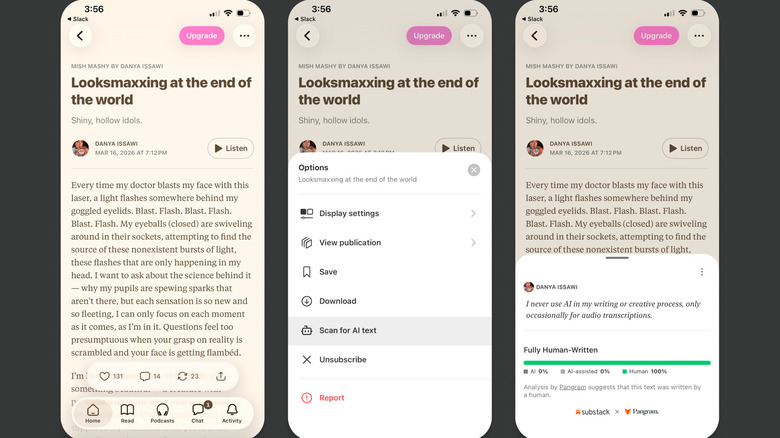
The company has partnered with Pangram for the new tools.
Substack
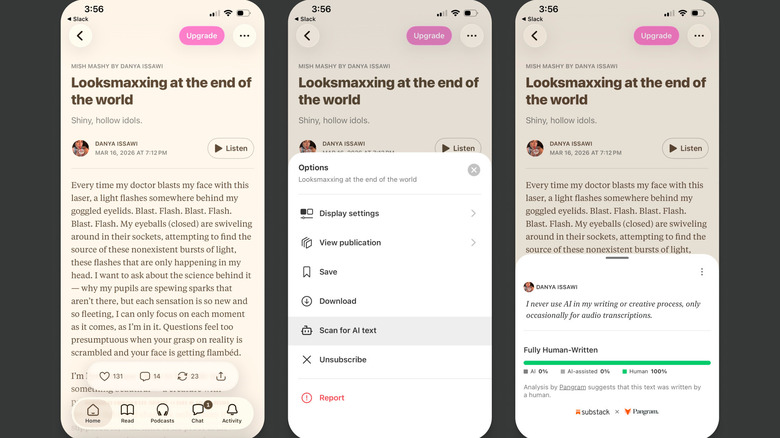
Substack has launched a new AI detection tool in partnership with Pangram. This will allow readers to scan Substack content for an assessment of how much of the material was written by AI. The tool can be used on text longer than 100 words that was published beginning today. Substack is also adding a new statement space for creators to explicitly share if and how they used AI for their content. The AI detection capabilities are available starting today on web and iOS, with Android support to come.
The blog post announcing the feature is surprisingly spicy. There’s a dig at LinkedIn about the presence of AI-generated content on that service and it dubs attempting to create feigned human connection with AI slop “Claudefishing.” Throwing shade is a risky maneuver here, because even the best tools for identifying gen-AI can’t guarantee a correct assessment. The Atlantic dug deeper into just how accurate AI detection tools, Pangram in particular, can be. Spoiler: they’re far from perfect.
Substack did acknowledge in the post that there are limits to what Pangram can detect and hinted at some other features it is considering around AI content and preferences. It emphasized that these new measures are aimed at setting expectations for readers, summing up its stance as “people should know what they’re getting.”
Google released three new AI models on Tuesday, all built on Gemini 3.5 Flash. The new models are more token-efficient, faster and more reliable across the board. The tech giant also provided an update on the much-anticipated Gemini 3.5 Pro and what’s to come after.
A new AI model from the likes of Google, Anthropic or OpenAI is released seemingly every week, with the latest, ChatGPT-5.6, released earlier this month. Google’s latest releases aren’t flagship models compared to what’s on the horizon, but each has its place, including a new model solely focused on cybersecurity.
Here’s what’s new in the latest Gemini models from today’s announcement.
Gemini 3.6 Flash
Google called 3.6 Flash its “workhorse” model that’s now better at coding, knowledge work and multimodal performance. It also promises reduced token usage by up to 17%, and at a lower cost per token versus its predecessor, 3.5.
Google says it built the model based on both developer and customer feedback. A series of benchmarks shows 3.6 Flash’s gains in performance and average tokens per task compared to its predecessor.
Advertisement
Gemini 3.5 Flash-Lite
Google’s fastest and most cost-effective model can deliver 350 output tokens per second and “significantly” outperforms previous generations when it comes to agentic workflows, according to the blog post.
Like 3.6 Flash, this model now supports computer use as a built-in tool to take on more agentic tasks.
Gemini 3.5 Flash Cyber
3.5 Flash Cyber is a specialty model that prioritizes cybersecurity workflows in order to find and fix vulnerabilities. It works alongside an infrastructure agent called CodeMender to help cybersecurity teams quickly identify and patch issues.
According to a separate article from Google DeepMind, the new model is already finding and fixing bugs in Google’s internal codebases in Android, Chrome and YouTube. This model will initially be limited to governments and trusted partners, but access will expand in the future.
Advertisement
Gemini 3.5 Pro is still on the way
While the three latest models are the primary focus for Tuesday’s announcements, Google gave a brief update to its upcoming flagship AI model, Gemini 3.5 Pro. The model is said to currently be in testing with partners, and it plans to make it available as soon as it’s ready. How long that will take is anyone’s guess, but Google’s also already looking ahead to the next generation of AI, too.
Google says it has already begun pretraining for Gemini 4, which will be released at an undetermined date.
Both Gemini 3.6 Flash and 3.5 Flash-Lite are available starting today for developers in the Gemini API via Google AI Studio and Android Studio and the Gemini app. 3.6 Flash is also available in Google Antigravity, and 3.5 Flash-Lite is rolling out to Google Search.
Blake has over a decade of experience writing for the web, with a focus on mobile phones, where he covered the smartphone boom of the 2010s and the broader tech scene. When he’s not in front of a keyboard, you’ll most likely find him playing video games or watching horror movies.
See full bio


























































You must be logged in to post a comment Login