Tech
Hubble’s Sharpest Look Yet at a Star’s Final Act in the Egg Nebula

A star almost identical to our sun is nearing the end of its life in the Cygnus constellation, about 1000 light years away. Astronomers call this spectacle the Egg Nebula, or CRL 2688 for short. Hubble’s most recent image provides a magnificent view of this particular object in unprecedented detail, thanks to the combination of new data and previously captured images. What we get is a stunning display of light cutting through the dust.


A star almost identical to our sun is nearing the end of its life in the Cygnus constellation, about 1000 light years away. Astronomers call this spectacle the Egg Nebula, or CRL 2688 for short. Hubble’s most recent image provides a magnificent view of this particular object in unprecedented detail, thanks to the combination of new data and previously captured photographs. What we get is a stunning display of light cutting through the dust.


NASA Lunar Telescope for Kids – 90x Magnification, Includes Two Eyepieces, Tabletop Tripod, and Finder…
- INSPIRE CURIOSITY – The NASA Lunar Telescope allows your child to see the moon in incredible detail; the perfect gift for girls and boys interested…
- HIGH-QUALITY OPTICAL GLASS AND FINDER SCOPE – This easy-to-use telescope comes with a finder scope, low power, and high-power eyepieces; when used…
- TABLETOP TRIPOD & SMOOTH MOUNT SYSTEM – Use the included tripod to steady your Lunar Telescope for optimal viewing, with a smooth mounting system…
The core star is hidden deep in the center, enveloped by a thick cloud of gas and dust that allows very little light to pass through. What does pass through is compressed into two narrow beams of light that sweep outward, revealing the fast-moving clouds of material being ejected from the star. Those clouds glow orange in infrared, adding some color to the image. You can also observe faster-moving clouds of heated molecular hydrogen that light brightly in the infrared, adding depth to the scene.
Over the previous 5000 years, the star has lost its outer layers in large concentric rings of gas. These rings are made up of tiny arcs of gas that accumulate every few hundred years. Now, these rings reflect the star’s light in a fashion that resembles ripples on water – and the dust produced by these outbursts is what shapes the nebula that bears its name, since the dense core is like the yolk of an egg wrapped up in darker, dustier layers.
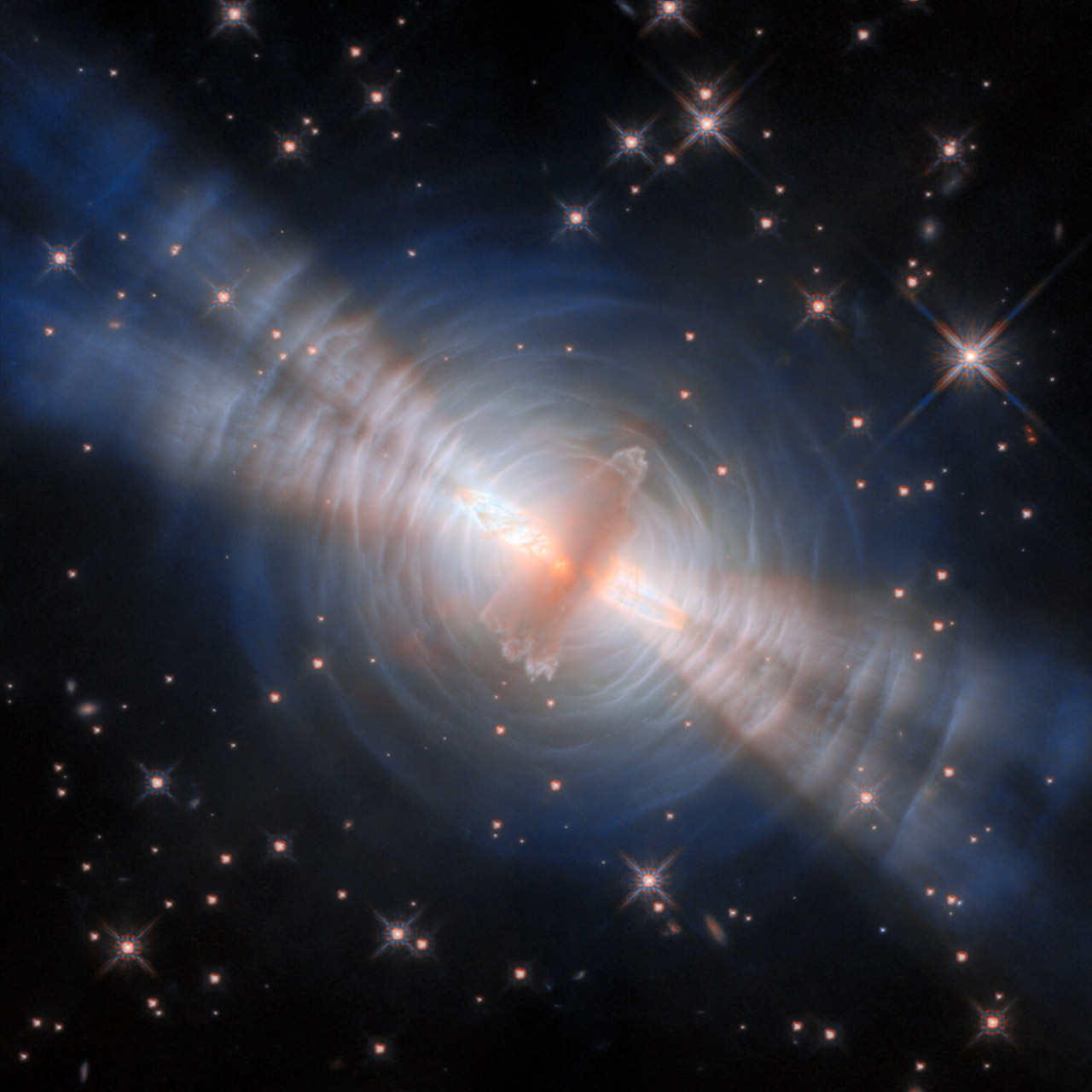
This is only transient; it will only last a few thousand years. The star has depleted all of its hydrogen and helium fuel, and what remains of its outer layers are floating away, while the center is becoming increasingly hot. Eventually, that center will cause the surrounding gas to glow, similar to the Helix Nebula or Butterfly Nebula. As of now, the Egg Nebula is in its pre-planetary phase, a brief period before winds and radiation begin to obscure the picture.

Hubble first observed the Egg Nebula in 1997, when a picture revealed the hidden light source. In 2003, we were able to get a full picture of the ripple patterns surrounding the nebula, and in 2012, we got an even closer look at the central cloud and outflows. Today’s image combines all of that data with some new frames to provide the sharpest look yet, courtesy of the Wide Field Camera 3.
You must be logged in to post a comment Login