

Tech
If A Mechanic Refuses To Release Your Car, Here’s What You’ll Have To Do



There may be several reasons for your mechanic’s refusal to give your car back. Maybe the bill came in way higher than what you were expecting, and you are unable to pay it in full. Whatever the reason, if you find yourself in such a situation, it’s likely because of a legal guarantee called a mechanic’s lien. It essentially lets repair shops hold onto your car until the bill is settled, similar to how collateral works at a bank. Every state in the U.S. has some version of this on the books, though the specific rules around those can vary quite a bit.
For instance, in some states, the shop has to give you written notice of the lien before they can even enforce it. Others are stricter and demand that the shop file paperwork with local authorities on top of that. Some states even let the shop sell the car to recover anything that’s owed to them. In Louisiana, for example, that window is 45 days after the lien notice goes out.
Of course, those are the rules when everything is done properly and by the book. The good news is that not every shop actually follows them correctly, which gives you some room to push back.
The first thing to do

Before you escalate anything, figure out whether the mechanic’s lien is even valid from their end. Knowing how to avoid getting ripped off by a car mechanic starts with understanding that you have the right to approve every charge before the work begins. Most states require written authorization for repairs above a certain dollar amount.
The most common way repair shops get themselves into legal trouble is by hitting customers with bills for work they never approved. For example, if someone drops off their car, and when they come back to pick it up there’s a $5,000 invoice just waiting for them. The shop says the work was necessary, but the customer maintains they never signed off on any of it. Now, to prevent this kind of miscommunication from the start, there is a specific phrase you should never say to your mechanic, or you may find yourself victim of a common car mechanic scam.
Anyway, your first move in the situation should always be to request an itemized bill and compare it against the original estimate. If those numbers don’t add up, or if the work was done poorly or left incomplete, the lien might not hold up at all. Some states will even let you pay under protest – you basically settle the bill to get your car back, and the shop has to note that it was paid under protest on the receipt, which protects you for what comes next.
Getting your car back (and getting even)

If the shop still won’t budge after all of that, or if the shop won’t communicate with you at all, the first real step is sending a formal demand letter (preferably by email and certified mail) requesting an update on the vehicle and a deadline for its return. Doing so ensures that any silence from the shop becomes a problem for them legally. It essentially shows they’re potentially detaining your vehicle without any real justification for doing so.
From there, you can file a complaint with your state’s consumer protection agency or attorney general’s office. In some states, like North Carolina, there’s also this neat legal mechanism where you can post a bond with the Clerk of Superior Court for the disputed amount, and then the court will order the shop to release your car while the whole dispute gets sorted out.
If the bill is small enough, small claims court is always on the table for something like this. You represent yourself, lay out all the evidence, and let a judge decide on it. For bigger amounts, or if you suspect outright fraud, hiring a consumer protection attorney is probably worth the cost. In some states, if the shop violated the law, you could actually be entitled to triple your losses plus legal fees on top of those.

from the the-server-test-is-important dept
Who should be directly liable for online infringement – the entity that serves it up or a user who embeds a link to it? For almost two decades, most U.S. courts have held that the former is responsible, applying a rule called the server test. Under the server test, whomever controls the server that hosts a copyrighted work—and therefore determines who has access to what and how—can be directly liable if that content turns out to be infringing. Anyone else who merely links to it can be secondarily liable in some circumstances (for example, if that third party promotes the infringement), but isn’t on the hook under most circumstances.
The test just makes sense. In the analog world, a person is free to tell others where they may view a third party’s display of a copyrighted work, without being directly liable for infringement if that display turns out to be unlawful. The server test is the straightforward application of the same principle in the online context. A user that links to a picture, video, or article isn’t in charge of transmitting that content to the world, nor are they in a good position to know whether that content violates copyright. In fact, the user doesn’t even control what’s located on the other end of the link—the person that controls the server can change what’s on it at any time, such as swapping in different images, re-editing a video or rewriting an article.
But a news publisher, Emmerich Newspapers, wants the Fifth Circuit to reject the server test, arguing that the entity that embeds links to the content is responsible for “displaying” it and, therefore, can be directly liable if the content turns out to be infringing. If they are right, the common act of embedding is a legally fraught activity and a trap for the unwary.
The Court should decline, or risk destabilizing fundamental, and useful, online activities. As we explain in an amicus brief filed with several public interest and trade organizations, linking and embedding are not unusual, nefarious, or misleading practices. Rather, the ability to embed external content and code is a crucial design feature of internet architecture, responsible for many of the internet’s most useful functions. Millions of websites—including EFF’s—embed external content or code for everything from selecting fonts and streaming music to providing services like customer support and legal compliance. The server test provides legal certainty for internet users by assigning primary responsibility to the person with the best ability to prevent infringement. Emmerich’s approach, by contrast, invites legal chaos.
Emmerich also claims that altering a URL violates the Digital Millennium Copyright Act’s prohibition on changing or deleting copyright management information. If they are correct, using a link shortener could put users at risks of statutory penalties—an outcome Congress surely did not intend.
Both of these theories would make common internet activities legally risky and undermine copyright’s Constitutional purpose: to promote the creation of and access to knowledge. The district court recognized as much and we hope the appeals court agrees.
Reposted from the EFF’s Deeplinks blog.
Filed Under: 5th circuit, copyright, embedding, intermediary liability, liability, linking, server test
Companies: emmerich newspapers

In 2022, Google first announced its Google Play Games on PC project, which allows Android users to play their favorite games on Windows PC. Since then, Google has released several updates to improve its service, with Google Play Games for PC officially exiting beta on September 23, 2025.
It’s one of the few Google projects that hasn’t been left to wither away, and now, Google Play is rolling out a handful of useful changes that could genuinely improve how you discover, buy, and play games, whether you’re on your phone or PC.
The timing seems intentional. Google made these announcements at GDC (Game Developers Conference), where Microsoft also announced Xbox mode, which allows players to get a console-like gaming experience on Windows 11 devices.
This year’s focus appears to be on improving the cross-device and cross-platform gaming experience.
Can we finally try games before paying for them?
My favorite part of the new announcements has to be how you pay for games. If you’ve ever felt burned by buying a game on your phone and then having to buy it again on PC, Google has got you covered. A new “Buy once, play anywhere” pricing model means that a single purchase on Google Play gives you access to both the mobile and PC versions.

For those still on the fence about buying a paid game, Google is also introducing Game Trials, which let you jump into the full version of a paid game for free. If you like it, you buy it, and your progress carries over seamlessly.
What other improvements can you expect as a gamer?
Google is introducing a new PC section designed to improve the discoverability of games optimized for PC gaming. At the same time, it’s expanding the library with more paid titles and highlighting some of the most anticipated indie games.

Beyond that, Google is doubling down on Play Games Sidekick, an in-game overlay that gives you AI-generated tips without forcing you to quit and search the web. Google is also making it easier to get tips from real players. Community Posts is now live in English for dozens of popular games, providing you with a dedicated space to ask questions and share tips with other players.
These updates don’t reinvent gaming, but they address real frustrations in ways that matter to gamers.
Verdict
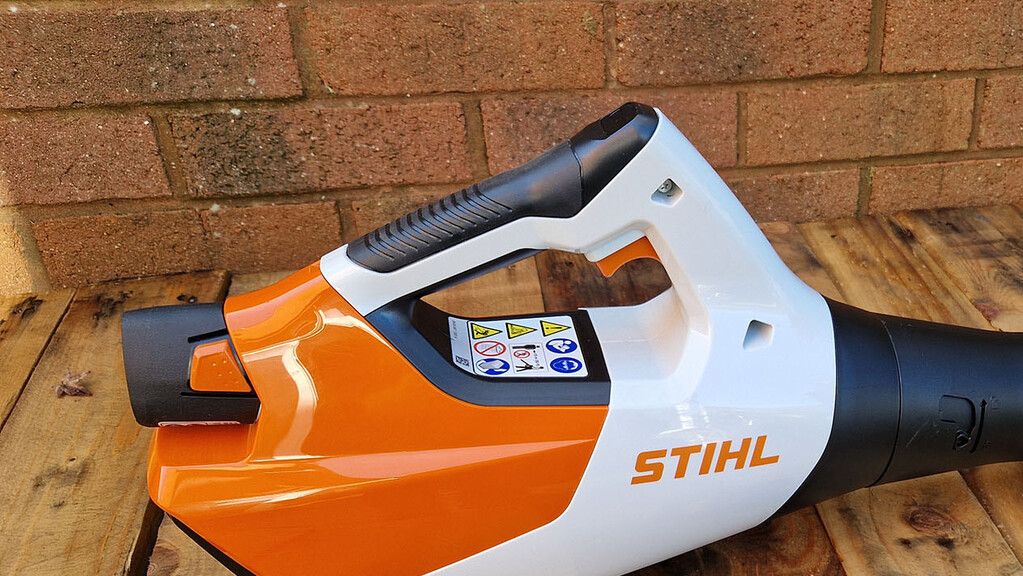
The Stihl BGA 30 leaf blower is a handy and lightweight leaf blower that runs on small batteries. With a detachable nozzle and responsive trigger, it’s easy to use but isn’t powerful enough for large garden spaces.
-
Lightweight and well balanced -
Compatible with the AS system -
Power level indicator on the handle
-
Not the most powerful air flow -
Short run time on full power
Key Features
-
Lightweight
At just 1.7kg, this leaf blower is easy to use and store -
Powerful for the size
Can blow air at up to 15m/s -
Cordless
Uses the 10.8V AS battery system
Introduction
Forming part of Stihl’s capable and ever-expanding range of handy garden tools powered by the lightweight AS battery system, the BGA 30 is an ultra-portable leaf blower that still manages to pack a punch.
With excellent ergonomics and a lightweight and portable body, this leaf blower lacks raw power but is incredibly easy to operate.
Design and Features
- Well balanced between battery and tip
- Battery charge indicator on the handle
- Removable nozzle tip for close up work
Something that Stihl always gets right is ergonomics and balance. The handle is well sculpted and just about big enough for large hands, and is built at the right angle for leaf blowing, so I could hold it naturally without having to bend my wrist. Weighing just 1.7 kg with the battery, it’s very light which reduces arm fatigue during use.
The variable speed trigger is responsive, and makes it easy to control the level of air flow coming out.

When you pull it a little set of LED lights above the handle show you the current charge level.

This leaf blower comes supplied with an easily detachable nozzle tip. Using it without the tip is great for clearing sawdust off a mitre saw or leaves and other debris from garden furniture. The long-reach nozzle tip is attached by twisting and locking into place.

The power comes from Stihl’s excellent little AS battery ecosystem. These batteries run at 10.8V and 2.6Ah, and weigh just 220 g. If you value comfort and manoeuvrability over raw power, this battery system is fantastic. It doesn’t have the capacity of much larger batteries like the EGO’s huge 56 Volt range, but carrying a spare AS battery with you is no problem and can be swapped out in seconds.
If you have AS batteries already, you can buy the BGA 30 without batteries for just £99.

And when it’s time to store the blower away, there’s a handy hanging eyelet on the back.
Performance
- Impressive power to weight ratio
- Easy to handle and control
- Not the highest air flow speeds
I measured the BGA 30 air flow at a maximum of 5.5m/s from 1m away. That’s a more gentle gust of air than larger leaf blowers with bigger batteries can do, but it’s still enough air flow for most typical garden jobs, from moving leaves and the like off a lawn, or clearing garden furniture of debris.
The BGA 30 offers a good power-to-weight ratio, so you can work without tiring yourself out too quickly. However, on full power, I only got around ten minutes working time, so it’s worth getting the version that comes with two batteries (or reusing batteries from other AS tools, such as the HSA 40 hedge trimmer or the RCA 20 Cordless Pressure Washer.
Because the handle is large and the ergonomics are great, it was easy to manoeuvre this leaf blower. With the nozzle tip removed, it’s even lighter and easier to direct the air flow to where you need it.
Another thing I like about this blower is that it’s quiet when you need to be. Unlike the harsh noise of the Ryobi RY18BLCXA-125, the BGA 30 is about as pleasant as a leaf blower can be. Running at just 64dB on low power and topping out at a manageable 81dB on high, it’s not going to annoy the neighbours too much.
The drawback of this blower is that it doesn’t reach the high air speeds of other, larger models. It’s ideally suited for small gardens, but those with larger spaces and more mess to deal with will need a more powerful blower.
Should you buy it?
You want a compact and relatively quiet leaf blower.
If the thought of a huge and heavy monster of a blower puts you off, get this one.
For all of it’s benefits, this small and highly portable blower lacks a bit of grunt. If you need to shift loads of leaves or work for long periods, the BGA 30 is not the right tool for you.
Final Thoughts
Like most Stihl garden tools, the BGA 30 has a thoughtful and ergonomic design. Light enough to use for long periods of time and running on the small but mighty AS battery system, it favours good handling over huge amounts of airflow, making it a good choice for smaller spaces; those who have larger gardens may prefer a more powerful model from our guide to the best leaf blowers.
How We Test
We test every leaf blower we review thoroughly over an extended period of time. We use standard tests to compare features properly. We’ll always tell you what we find. We never, ever, accept money to review a product.
Find out more about how we test in our ethics policy.
- Tested with a variety of garden debris
- We measure wind speed and air flow
FAQs
This leaf blower uses the AS system 10.8V batteries, compatible with a growing range of tools.
Test Data
| Stihl BGA 30 Cordless Blower | |
|---|---|
| Air speed 15cm (low) | 6 m/s |
| Air speed 15cm (high) | 15 m/s |
| Air volume 15cm (high) | 216 m³/h |
Full Specs
| Stihl BGA 30 Cordless Blower Review | |
|---|---|
| Manufacturer | Stihl |
| Weight | 1.7 KG |
| Release Date | 2025 |
| First Reviewed Date | 03/03/2026 |
| Model Number | BGA 30 |
| Accessories | Nozzle |
| Leaf blower type | Cordless |
| Speed settings | Variable trigger |
| Max air speed | 15 m/s |
| Adjustable length | – |


Maker Hyperspace Pirate has created a dive helmet using a 3D printer, tons of fiberglass, and a lot of ingenuity. They transformed an old diving concept into something that works, at least for shallow pool diving. This helmet is modeled like old surface-supplied diving gear. Air rushes in from above and exhaust leaves from below, keeping the diver’s head dry inside a little upside-down plastic bubble.
This project demands precise measurements, so Hyperspace Pirate originally sketched up the dimensions of the helmet on cardboard: 7.5 inches wide, 9.75 inches deep, and 11.25 inches high. Then Onshape software was used to generate a digital model of the object. It was divided into four separate components to accommodate the maker’s 3D printer, a Prusa MK3S, and manufactured with varying layer thicknesses to balance speed and strength. The printer used ABS filament, and after printing, the components were bonded together and encased in fiberglass soaked in epoxy for added strength. He had to be cautious about the sort of resin used because the other type tends to attack the ABS pieces.

Bambu Lab A1 3D Printer, Support Multi-Color 3D Printing, High Speed & Precision, Full-Auto Calibration…
- High-Speed Precision: Experience unparalleled speed and precision with the Bambu Lab A1 3D Printer. With an impressive acceleration of 10,000 mm/s…
- Multi-Color Printing with AMS lite: Unlock your creativity with vibrant and multi-colored 3D prints. The Bambu Lab A1 3D printers make multi-color…
- Full-Auto Calibration: Say goodbye to manual calibration hassles. The A1 3D printer takes care of all the calibration processes automatically…
Three large transparent acrylic panes, one in the front and one on each side, provide visibility and are press-fitted into position and sealed with silicone caulk. The weight of the water at deep forces the windows in and closes them securely. A carry handle on top allows you to move the item about, and there are some useful small fittings for installing lighting or a camera.

Air enters through a small SAE fitting on the top of the helmet, which has a check valve to prevent air from flowing back in if the supply fails. Any extra air leaves at the back through a long, hollow PVC pipe, resulting in constant bubbles. The air supply is handled by a quiet oilless compressor, the MAC100Q type, which produces a consistent 40 liters per minute at up to 2 bar of pressure. This allows us to dive down to approximately 10 meters (33 feet) without running out of air. The rig is powered by a 12-volt, 35 amp-hour lead-acid battery connected to a 2 kilowatt pure sine wave inverter. It’s all mounted on a pool inner tube float, with a flat piece of plywood for stability and a handy diver-down flag.

Ballast weights, which are positioned on either side and held in place by a pair of large steel plates, work to keep the helmet underwater. We began with 30 pounds of weights, but after a few initial tests, we added an additional 10 pounds to achieve neutral buoyancy. A neoprene pad protects the neck against pressure points.

The helmet got a good workout in the pool, with dry runs ensuring proper fit and airflow, and underwater sessions allowing the builder to move around. We’ve had to be careful not to go too deep, partly because the bottom of the pool is a little uneven, but the airflow keeps it nice and cool and dry inside, preventing the windows from fogging or overheating. The compressor ran smoothly, and we were relieved that the helmet did not overheat. There was one peculiarity, however: the exhaust pipe would occasionally give out a small gurgling. It was a little unpleasant at the time, but it turned out to be harmless.

Safety has always been a key priority here, which is why the oilless compressor is a must-have. It means there is no risk of oil vapor or exhaust fumes entering the helmet. And just in case something goes wrong, we have a check valve to prevent the air pressure from decreasing quickly. Despite the fact that the helmet works extremely well for shallow water tasks, Hyperspace Pirate is quick to point out that this is still very much an experimental project, and it is not safe to use in open water or much deeper water without some serious modifications to make it waterproof, as well as a bit of backup air to be safe.
[Source]

US self-driving startup Nuro, which is backed by the likes of NVIDIA, Toyota and Uber, has started testing its autonomous vehicles on Tokyo’s challenging streets, Bloomberg reported. The company, which plans to launch a robotaxi service with Uber and Lucid in San Francisco this year, will be testing a “handful” of vehicles in the city. Human safety drivers will be at the wheel, as is required by Japanese law.
Tokyo presents a challenge for autonomous vehicles, given its narrow, crowded streets and left side of the road driving. “Testing the capability of the autonomy system in such an interesting market with some international complexity really is a good pressure test of what the system is capable of,” said CEO Andrew Chapin. The company’s ultimate goal is to achieve Level 4 autonomy, which allows full self-driving under limited conditions.
Waymo is the other major robotaxi operator testing vehicles in Tokyo in collaboration with Japanese taxi operators Nihon Kotsu and the country’s leading taxi app, Go. It has been operating in the nation since April 2025 in collaboration with Toyota.
Nuro has yet to announce which operators or vehicle manufacturers it will be partnering with, but Chapin said it may not limit itself to autonomous rides. “A universal autonomy platform that can be extended to a lot of different applications and form factors is a bit different than the approach Waymo is taking,” he told Bloomberg. The company previously teamed with 7-Eleven on autonomous deliveries in Mountain View, California.
Uber plans to have up to 100,000 autonomous vehicles including 20,000 robotaxis powered by Lucid and Nuro, with a rollout starting in 2027. It introduced its new vehicle design recently at CES 2026. Uber is also collaborating with Nissan and Wayve with the aim to introduce pilot cars in Tokyo by late 2026.
Update: Story updated with a statement from Stryker confirming they suffered a disruptive cyberattack.
Leading medical technology company Stryker has been hit by a wiper malware attack claimed by Handala, an Iranian-linked and pro-Palestinian hacktivist group.
The medtech giant manufactures a range of products, including surgical and neurotechnology equipment. With over 53,000 employees, Stryker is a Fortune 500 company that reported global sales of $22.6 billion in 2024.
Handala says they stole 50 terabytes of data before wiping tens of thousands of systems and servers across the company’s network, forcing Stryker to shut down in “an unprecedented blow.”
“In this operation, over 200,000 systems, servers, and mobile devices have been wiped and 50 terabytes of critical data have been extracted,” the attackers said. “Stryker’s offices in 79 countries have been forced to shut down.”

This aligns with reports from people claiming to be Stryker employees from the United States, Ireland, Costa Rica, and Australia, who said their managed Windows and mobile devices were remotely wiped in the middle of the night. The attackers have also defaced the company’s Entra login page to display a Handala logo.
A Stryker employee told BleepingComputer the incident began early Wednesday morning, when devices enrolled in the company’s mobile device management system were remotely wiped. The employee said colleagues who had personal phones enrolled for work access also lost data after their devices were reset.
Staff were instructed to remove corporate management and applications from their personal devices, including the Intune Company Portal, Teams, and VPN clients.
Numerous employees also report that the attack disrupted access to internal services and applications, forcing some locations to revert to “pen and paper” workflows after systems became unavailable.
As a result of the attack, Stryker is now working to restore their systems amid a global outage, as first reported by The Wall Street Journal.
“We are experiencing a severe, global disruption impacting all Stryker laptops and systems that connect to our network,” Stryker told employees in Cork, Ireland, according to local media.
“At this time, the root cause has not yet been identified. We are actively engaged with Microsoft and treating this a critical, enterprise-wide incident,” the company added in a message sent to employees in Asia.
Handala (also known as Handala Hack Team, Hatef, Hamsa) first surfaced in December 2023 as a hacktivist operation linked to Iran’s Ministry of Intelligence and Security (MOIS) that targets Israeli organizations with destructive malware designed to wipe Windows and Linux devices.
They are also known for stealing sensitive data from victims’ compromised systems and publishing it on the group’s data leak portals.
Stryker confirms cyberattack
After publishing this story, Stryker filed a Form 8-K with the SEC, confirming that it suffered a cyberattack that impacted its entire Microsoft environment.
“On March 11, 2026, Stryker Corporation (‘we’ or the ‘Company’) identified a cybersecurity incident affecting certain information technology systems of the Company that has resulted in a global disruption to the Company’s Microsoft environment,” reads the 8K filing.
“Upon detection, the Company activated its cybersecurity response plan and launched an investigation internally with the support of external advisors and cybersecurity experts to assess and to contain the threat.
“The Company has no indication of ransomware or malware and believes the incident is contained.”
Stryker says the incident will continue to disrupt its work environment, including access to network systems and business applications used in its operations, as it restores systems.
However, the company added that it doesn’t have a timeline for when everything will be restored.

Malware is getting smarter. The Red Report 2026 reveals how new threats use math to detect sandboxes and hide in plain sight.
Download our analysis of 1.1 million malicious samples to uncover the top 10 techniques and see if your security stack is blinded.
Tech
Born as Wave in the Seattle area, Astound Broadband is merging with GFiber as new internet provider

Stonepeak and Alphabet announced Wednesday that they have entered into an agreement to combine Astound Broadband and GFiber, creating an independent broadband internet provider and marking the latest shift for a telecom brand with deep roots in the Seattle region.
Under the terms of the deal, Stonepeak will hold a majority stake in the combined entity, while Google parent Alphabet will retain a significant minority interest. The new company will be led by the existing GFiber management team, the companies said in a news release.
In January, Bloomberg reported that Alphabet was in talks with Stonepeak’s Radiate Holdings — the parent company of Astound — to explore a joint venture involving its fiber assets.
For the Pacific Northwest tech corridor, the deal is the latest chapter for a business born in Kirkland, Wash., as Wave Broadband. Founded by Steve Weed, Wave grew into a dominant regional challenger to traditional cable giants.
The brand has undergone several identity shifts in recent years. After being bundled with RCN and Grande Communications under TPG ownership, the “Wave” moniker was officially retired in 2022 in favor of the unified Astound Broadband name.
The transaction represents a consolidation of two major players in the high-speed internet market. Astound, which provides service in several major U.S. markets including Seattle, Chicago, and New York, was acquired by Stonepeak from TPG Capital in 2021 for $8.1 billion. The merger integrates those assets with GFiber’s established footprint in cities such as Austin, Atlanta, Nashville, and Salt Lake City, along with its recent expansion into Las Vegas.
“This is a milestone for the industry as we combine the strengths of two highly complementary organizations,” Stonepeak Senior Managing Director Cyrus Gentry said in a statement. “By joining Astound’s extensive network and customer base with GFiber’s technical leadership, we are creating a scaled platform uniquely positioned to deliver the next generation of high-speed connectivity.”
The combined entity will compete against national incumbents Comcast, Charter, and AT&T, as well as aggressive regional fiber providers like Ziply Fiber and 5G home internet offerings from T-Mobile and Verizon.
The deal — subject to customary closing conditions and regulatory approvals — is expected to close later this year.
Editor’s note: Astound Business Solutions is presenting sponsor of the 2026 GeekWire Awards.

from the oh-buc-off dept
Alright, I think it might be time for a wellness check on the people running Buc-ee’s.
I realize that these chain of gas and convenience stores has a strange cult following in the south. I won’t pretend to understand why that is, but whatever. Unfortunately, the company also appears to be run by a bunch of trademark bullying jackwagons. I’ve referred to Buc-ee’s as the Monster Energy of gas stations, because the company appears to think that trademark law allows it to own the concept of a cartoon animal mascot in any tangential industry. They have bullied and/or sued many, many companies under this premise. Because most of its victims are smaller companies, they have gotten a lot of settlements out of these bullying efforts.
But those settlements don’t make the bullying legitimate. Buc-ee’s views on what trademark law allows it to own and control are fantasy. They’re still out here doing their bullying thing, though, with the latest example being its decision to sue a company that runs a gas station called “Mickey’s”. I’ve embedded the suit below, but here is a sample of the claims in the filing made against the gas station chain.
Like the Buc-ee’s Marks, Defendant’s Logos incorporate a cartoon animal facing right with wide eyes and a smile, overlaying a round background…also uses red as a predominant color in its interior and exterior signage, as well as employee uniforms and anthropomorphic representations of its cartoon moose mascot…also uses red as a predominant color in its interior and exterior signage, as well as employee uniforms and anthropomorphic representations of its cartoon moose mascot.
Consumers are likely to perceive a connection or association as to the source, sponsorship, or affiliation of the parties’ products and services, when in fact none exists, given the similarity of the parties’ logos, trade channels, and consumer bases.
And here, dear readers, is the very similar branding that the lawsuit references.

Once again, as with past Buc-ee’s trademark suits, the claims simply fall apart on inspection of the evidence. These logos are not similar. They don’t use the same overall color schemes. They feature easily distinguishable cartoon animals as mascot. A beaver is not a moose, which is a sentence I never thought I’ve have to type out on a keyboard. Likewise, a hexagon is not round, another thing I’d never thought I’d have to write. This is all very, very stupid, and not at all concerning from a customer confusion standpoint.
Despite that, the suit alleges that Mickey’s has “used” the Buc-ee’s logos to enrich themselves. It’s bonkers. In addition, Buc-ee’s has petitioned the USPTO to cancel the trademark registrations Mickey’s has for its branding.
Why is this company so beloved? They truly seem like craven bullies above all else. None of this is trademark infringement and I certainly hope the owners of Mickey’s are prepared to fight this fight. Because Buc-ee’s doesn’t somehow have a monopoly on cartoon character mascots. Not for its industry, never mind others.
Filed Under: beaver, moose, trademark
Companies: buc-ee’s, mickey’s


This article is crossposted from IEEE Spectrum’s careers newsletter. Sign up now to get insider tips, expert advice, and practical strategies, written in partnership with tech career development company Parsity and delivered to your inbox for free!
How to Keep Your Engineering Skills Sharp in an AI World
Engineers today are caught in a strange new reality. We’re expected to move faster than ever using AI tools for coding, analysis, documentation, and design. At the same time, there’s a growing worry in the background: If the AI is doing the work, what happens to my skills?
That concern isn’t just philosophical. Research from Anthropic, the company behind Claude, has suggested that heavy AI assistance can interfere with human learning—especially for more junior software engineers. When a tool fills in the gaps too quickly, you may deliver working output without ever building a strong mental model of what’s happening underneath.
More experienced engineers often feel a different version of this anxiety: a fear that they might slowly lose the hard-earned intuition that made them effective in the first place.
In some ways, this isn’t new. We’ve always borrowed solutions from textbooks, colleagues, forums, and code snippets from strangers on the internet. The difference now is speed and scale. AI can generate pages of plausible solutions in seconds. It’s never been easier to produce work you don’t fully understand.
I recently felt this firsthand when I joined a new team and had to work in a codebase and language I’d never used before. With AI tools, I was able to become productive almost immediately. I could describe a small change I wanted, get back something that matched the existing patterns, and ship improvements within days. That kind of ramp-up speed is incredible and, increasingly, expected.
But I also noticed how easy it would have been to stop at “it works.”
Instead, I made a conscious decision to use AI not just to generate solutions, but to deepen my understanding. After getting a working change, I’d ask the AI to walk me through the code step by step. Why was this pattern used? What would break if I removed this abstraction? Is this idiomatic for this language, or just one possible approach?
The shift from generation to interrogation made a massive difference.
One of the most powerful techniques I used was explaining things back in my own words. I’d summarize how I thought a part of the system worked or how this language handled certain concepts, then ask the AI to point out gaps or mistakes. That process forced me to form my own mental models rather than just recognizing patterns. Over time, I started to build intuition for the language’s quirks, common pitfalls, and design style. This kind of understanding helps you debug and design, not just copy and paste.
This is the core mindset shift engineers need in the AI era: Use AI to accelerate learning, not to replace thinking.
The worst way to use these tools is also the easiest: prompt, accept, ship, repeat. That path leads to shallow knowledge and growing dependence. The better path is slightly slower but more durable. Let AI help you move quickly, but always come back and ask, Do I understand what I just built? If not, use the same tool to help you understand it.
AI can absolutely make us faster. Used well, it can also make us better at our jobs. The engineers who stay sharp won’t be the ones who avoid AI, they’ll be the ones who turn it into a collaborator in their own learning.
—Brian
When war strikes, critical power infrastructure is often hit. Engineers in Ukraine have risked their lives to keep electricity flowing, and some have been hurt or killed in the dangerous wartime conditions. One such engineer, Oleksiy Brecht, died on the job in January. “Brecht’s life and death are a window into the realities of thousands of Ukrainian engineers who face conditions beyond what most engineers could imagine,” writes IEEE Spectrum contributing editor Peter Fairley.
The semiconductor industry needs more engineers to build the chips that power our daily lives. To help expand the talent pool, the industry is testing new approaches, including training software engineers to design hardware with the help of AI tools. All engineers will still need to have an understanding of the fundamentals—but could computer science students soon apply their coding skills to help design hardware?
Effective writing and communication are among the most important skills for engineers looking to advance their careers. Though often labeled a “soft skill,” clear communication is essential in both academia and industry. IEEE is now offering a course covering key writing skills, ethical use of generative AI, publishing strategies, and more.
From Your Site Articles
Related Articles Around the Web
TL;DR
Moz Pro now includes AI-powered keyword suggestions, an AI Visibility feature in open beta, and the industry-standard Domain Authority metric, all starting at $39/month on annual billing. A 7-day free trial is available on Standard and Medium plans, and a free Moz Community account gives permanent access to limited versions of Keyword Explorer and Link Explorer at no cost. In a market where most SEO platforms charge $100+/month before you see any data, Moz Pro is the most affordable way to bring AI into your SEO workflow.
Disclosure: This article contains affiliate links. If you click through and make a purchase, we may earn a commission at no additional cost to you. This helps support our content. All opinions expressed are our own.
Something fundamental changed in SEO this year, and most businesses haven’t caught up yet. Google’s AI Mode is now generating answers from sources that don’t even appear in the traditional top 10 results. Moz’s own research across nearly 40,000 queries found that 88% of AI Mode citations come from URLs that aren’t ranking in the organic SERP for the same query. The old playbook of ranking for a head term and collecting the traffic is no longer the whole game. Topic authority, content structure, off-site visibility, and brand presence across the web now determine whether your business shows up when AI assembles its answers.
For anyone trying to navigate this shift, the tooling question gets uncomfortable fast. The major SEO platforms run between $100 and $250 a month, and most of them lock their newest AI features behind mid-tier plans that cost even more. Ahrefs Lite starts at $99/month. Semrush Pro starts at $139.95/month. If you’re a freelancer, a small team, or a business that knows it needs professional SEO data but can’t justify enterprise pricing, those numbers create a gap between free tools that lack depth and paid platforms that assume a corporate budget.
Moz Pro fills that gap, and in 2026, it’s doing it with AI. Starting at $39 per month on annual billing, it’s the lowest entry price among the three major platforms, and it now includes AI-powered keyword suggestions on every plan, an AI Visibility feature currently in open beta, and the same Domain Authority metric that the entire marketing industry already speaks fluently. Start your free trial at moz.com
What Moz’s AI features actually do (and why they matter right now)
Moz has been in the SEO business since 2004, longer than Ahrefs (2011) and Semrush (2008). That longevity produced Domain Authority, the 1-100 score predicting how likely a domain is to rank in Google results. DA is used in agency reports, PR tools like Cision, journalist outreach platforms, and client pitches across the industry. When someone says “our DA is 52,” everyone in marketing knows exactly what that means. And Moz Pro is the only platform that calculates it natively.
But the more interesting story in 2026 is what Moz is building on top of that foundation. Keyword Explorer, the platform’s centerpiece tool, now includes AI-powered keyword suggestions that go beyond simple stem matching. Instead of generating variations of the word you typed in, the AI pulls from semantic relationships and actual search behavior patterns to surface keyword ideas you wouldn’t find through traditional methods. It also includes a Priority score that combines search volume, keyword difficulty, and organic click-through rate into a single number, so instead of toggling between three data columns and doing mental math, you get a clear recommendation of which keywords are worth targeting right now.
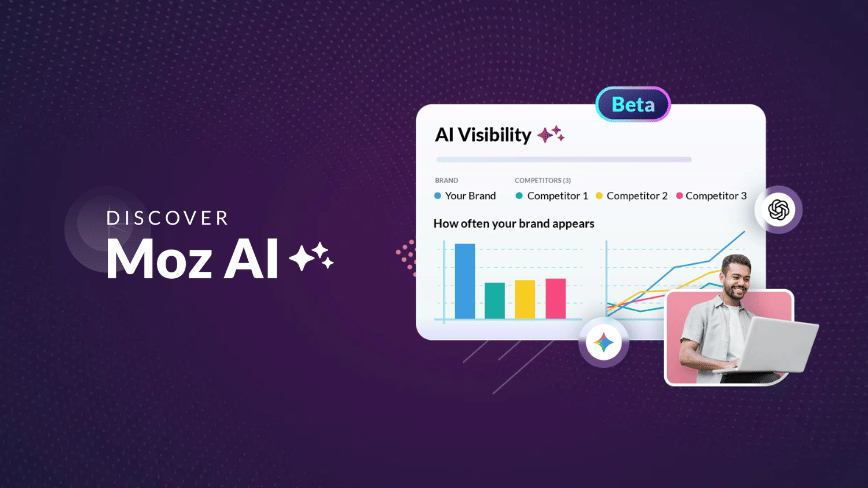
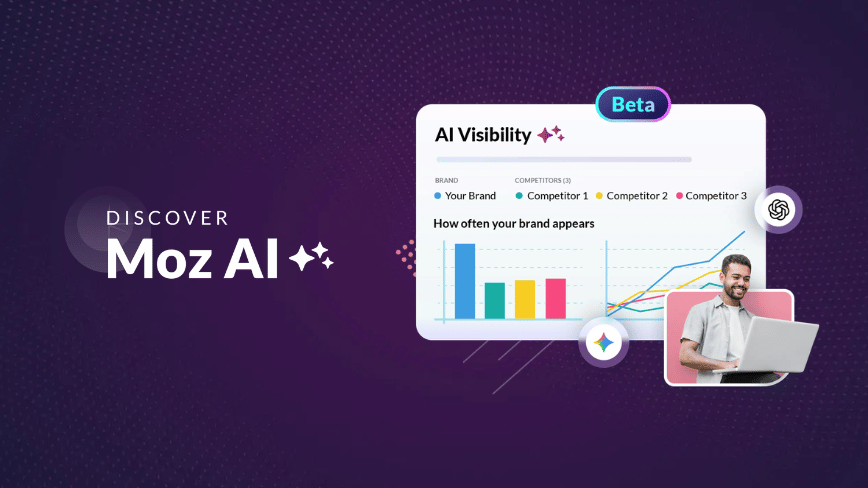
Then there’s the AI Visibility feature, currently in open beta. This is Moz’s response to the measurement problem that the entire industry is grappling with: if AI-generated answers are pulling citations from sources beyond the traditional top 10, how do you know whether your brand is being mentioned? The setup is simple. Enter your brand name, add related terms, input competitors, and Moz AI generates prompts based on queries users are actually asking about your brand. You get a dashboard showing citation frequency, competitive positioning, and visibility trends across generative search results.
Brand Authority rounds out the AI-adjacent features. It’s a metric that scores your brand’s overall search presence, not just backlinks, but how often your brand appears in search results relative to competitors. For businesses that care about visibility beyond traditional keyword rankings, this adds a dimension that rank tracking alone can’t capture.
These aren’t cosmetic additions. When Google’s AI Mode is assembling answers from YouTube, Reddit, LinkedIn, and niche authority sites (and Moz’s own research confirms that it is), the tools that help you understand and optimize for that broader landscape are the ones worth paying for.
The full toolkit and what it costs
AI features aside, Moz Pro earns its subscription through how it connects its tools into a workflow that makes sense for people managing SEO alongside other marketing responsibilities. Site Crawl runs automated weekly audits, flagging broken links, duplicate content, missing meta tags, and crawlability issues, all severity-ranked so you fix the high-impact problems first instead of drowning in a list of 400 warnings. Link Explorer provides backlink analysis using an index of approximately 45 trillion links, and every link gets a Spam Score to help you identify toxic backlinks. The Link Intersect tool shows which domains link to your competitors but not to you, giving you a ready-made prospecting list. Rank tracking updates weekly with mobile and desktop segmentation and local search tracking.
Moz Pro keeps its pricing transparent across four plans, all with a 20% discount on annual billing. The Starter plan at $49/month ($39/month annually) covers 1 campaign, 50 tracked keywords, and 20,000 pages crawled. For a single website that needs professional keyword research and basic rank tracking, this is the most affordable entry point in the all-in-one SEO market. The Standard plan at $99/month ($79/month annually) jumps to 3 campaigns, 300 tracked keywords, and 400,000 pages crawled. This is where most users land, and it’s also one of two plans eligible for the 7-day free trial. The Medium plan at $179/month ($143/month annually) scales to 10 campaigns and 1,500 tracked keywords, and is the second plan eligible for the free trial. The Large plan at $299/month ($239/month annually) maxes out at 25 campaigns and 3,000 tracked keywords for agencies and large in-house teams.
For comparison, Ahrefs Lite starts at $99/month with no free trial at all. Semrush Pro starts at $139.95/month with a 7-day trial on that single plan. Moz undercuts both on price and offers a more flexible entry path. For a full breakdown of how these platforms compare, Tekpon’s Moz Pro review and Moz Pro pricing comparison cover the details.
How to get the best deal right now
Moz gives you two free entry points, which is more than most competitors offer. The 7-day free trial provides full access to either the Standard or Medium plan. Credit card required to start, but you can cancel at any time during the trial and keep access for the remaining days. Seven days is enough to run a full site audit, pull keyword research for a content plan, test the AI-powered keyword suggestions, check your AI Visibility dashboard, analyze your backlink profile, and set up rank tracking. You can build an entire SEO action plan before paying a dollar.
The free Moz Community account is permanent, no trial period, no credit card. It gives limited access to MozBar (the Chrome extension that overlays DA and PA on any webpage), Keyword Explorer (10 queries per month), and Link Explorer (10 queries per month). For someone who only needs occasional DA checks or quick keyword lookups, this may be all you need.
The optimal strategy is to start the 7-day free trial on the Standard plan ($79/month annual). Test the AI features, run your audits, pull your keyword research. If the data proves useful (and for most sites doing any meaningful SEO work, it will), lock in the annual rate for a 20% savings. Standard drops to $79/month, saving $240 over the year. Medium drops to $143/month, saving $432. No promo codes needed. Registered 501(c)(3) nonprofits can access a dedicated discount page directly from Moz. See all plans at moz.com
Moz Pro Standard at $79/month (annual) includes 3 campaigns, 300 tracked keywords, AI-powered keyword suggestions, AI Visibility in beta, and a full site audit engine, at less than half the price of comparable Ahrefs and Semrush plans. Start your free trial at moz.com
The search landscape in 2026 rewards brands that show up across the entire ecosystem, not just in the ten blue links. Moz Pro is one of the few platforms that’s building tools for that reality while keeping the price accessible enough that you don’t need an enterprise budget to use them. The AI features are already live. The free trial is already available. The only cost of waiting is the visibility you’re not tracking yet.

What is Stryker Cyberattack? Stryker Corporation Hit by Suspected Iran-Linked Cyberattack

Ethereum attempts to hold above $2K as whales withdraw $155M in ETH

Mickey Rourke Addresses Eviction, Says Rental Home Was In ‘Poor Condition’

Smart energy pays enters the US market, targeting scalable financial infrastructure

Why Israel is blocking foreign journalists from entering

Bitcoin: We’re Entering The Most Dangerous Phase

Your 40s Are the Last Financial Turning Point (Most Miss This)

Toni Braxton – Bankruptcy Breakdown – Financial Advisor Reacts #shorts

Financial Education for Everyone MDC Important Questions with Answers | BA BSC B.COM 3rd Semester
-
Business6 days ago
Form 8K Entergy Mississippi LLC For: 6 March
-

 News Videos3 days ago
10th Algebra | Financial Planning | Question Bank Solution | Board Exam 2026
-

 Fashion6 days ago
Weekend Open Thread: Ann Taylor
-

 Crypto World3 days ago
Paradigm, a16z, Winklevoss Capital, Balaji Srinivasan among investors in ZODL
-
 Tech1 day ago
A 1,300-Pound NASA Spacecraft To Re-Enter Earth’s Atmosphere
-
 Sports7 days ago
499 runs and 34 sixes later, India beat England to enter T20 World Cup final | Cricket News
-

 Politics6 days ago
Top Mamdani aide takes progressive project to the UK
-

 Business2 days ago
ExxonMobil seeks to move corporate registration from New Jersey to Texas
-

 Sports4 days ago
Braveheart Lakshya downs Lai in epic battle to enter All England Open final | Other Sports News
-

 Sports5 days ago
Three share 2-shot lead entering final round in Hong Kong
-

 NewsBeat16 hours ago
Residents reaction as Shildon murder probe enters second day
-

 Tech2 days ago
ChatGPT will now generate interactive visuals to help you with math and science concepts
-

 NewsBeat7 days ago
Piccadilly Circus just unveiled ‘London’s newest tourist attraction’ and it only costs 80p to enter
-

 Entertainment5 days ago
Hailey Bieber Poses For Sexy Selfies In New Luscious Lip Thirst Traps
-

 Business4 days ago
Search for Nancy Guthrie Enters 37th Day as FBI Probes Wi-Fi Jammer Theory
-

 Business1 day ago
Search Enters Sixth Week With New Leads in Tucson Abduction Case
-
 NewsBeat2 days ago
Pagazzi Lighting enters administration as 70 jobs lost and 11 stores close across Scotland
-

 Tech3 days ago
Despite challenges, Ireland sixth in EU for board gender diversity
-

 Business3 days ago
Search Enters 39th Day with FBI Tip Line Developments and No Major Breakthroughs
-

 NewsBeat20 hours ago
I Entered The Manosphere. Nothing Could Prepare Me For What I Found.