Tech
iFi GO pod Max Review: Turn High End IEMs Into Wireless Earbuds

Wireless earbuds have become remarkably capable, but they still have one fundamental drawback: they are essentially disposable products. Want a new codec, better driver, improved electronics, or fresh battery? You replace the entire thing.
That lack of upgradeability means TWS earbuds are only as good as their weakest component. Drivers, DACs, amplifiers, batteries, microphones, wireless hardware, and software all have to fit inside a tiny enclosure and hit a specific price point. When manufacturers start pinching pennies, sound quality can quickly become secondary to features, connectivity, battery life, and profitability.
That is one reason most TWS earbuds still don’t sound as good as their wired counterparts. Wired IEM manufacturers can devote more of their R&D budget to drivers, tuning, crossover design, materials, and build quality rather than Bluetooth, DSP, DACs, batteries, microphones, and charging systems.
Purists can argue endlessly about lossless audio versus the better Bluetooth codecs, but the codec is only part of the equation. In many TWS models, the drivers and amplification are just as responsible for the limitations in fidelity.
Still, wireless convenience is impossible to deny, and that is coming from someone who once said, “I never saw the wire between my in-ears and DAP as a problem.”
So what do you do if you want wireless convenience without giving up the sound quality of a serious wired IEM? And if you already own high-end CIEMs from Empire Ears or Ultimate Ears, replacing them with disposable TWS earbuds hardly makes sense.

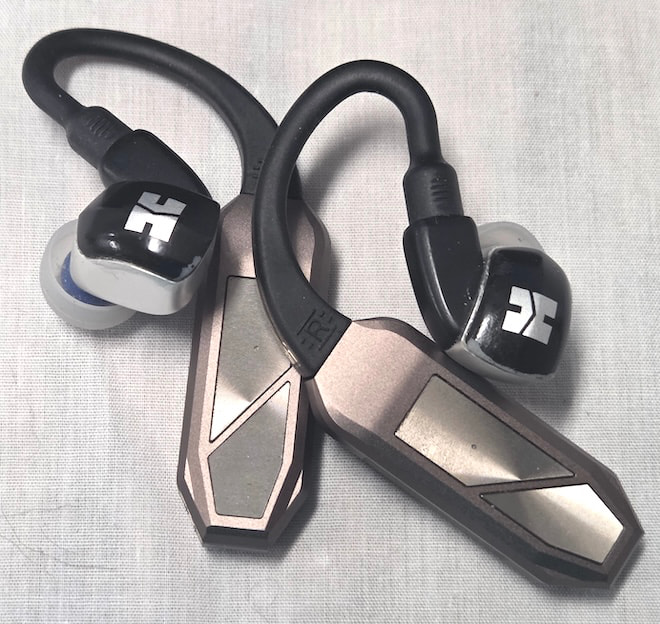
The iFi GO pod Max is designed for exactly those situations. It is not a conventional pair of true wireless earbuds, but a wireless DAC/amplifier system that turns an existing pair of wired IEMs into a high-end Bluetooth system.
At $599, the GO pod Max costs more than many complete wireless earbuds, which makes it a difficult sell for ordinary consumers. For enthusiasts who already own a serious pair of IEMs, however, the proposition makes considerably more sense: remove the cable without giving up most of the performance that made those IEMs worth buying in the first place.
iFi also offers the GO pod Air ($249) for listeners who want similar functionality with more affordable IEMs and understandably don’t want to spend more on the adapters than they did on the earphones.
The GO pod Max moves considerably further upmarket with a machined aluminum case, aptX Lossless support, K2HD processing, UV sterilization, upgraded circuitry, additional ear-loop options, and automatic impedance matching for IEMs ranging from 16 to 300 ohms. It is an ambitious product, and innovation is rarely cheap.
The real question is whether all of that translates into a meaningful sonic improvement over a conventional Bluetooth adapter, or whether the GO pod Max is simply a very expensive way to cut the cord.
Related Reading:
Build and Fit
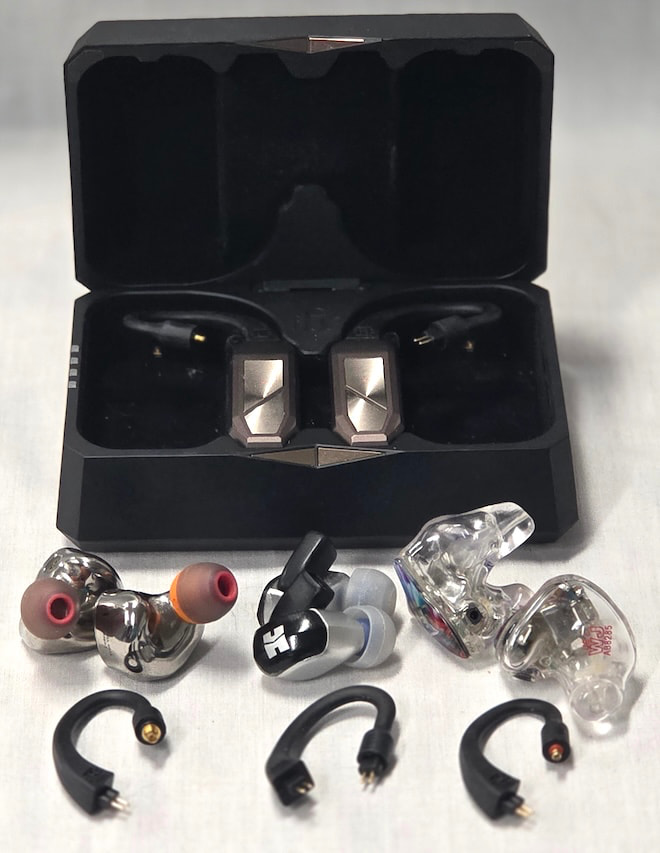
The GO pod Max consists of two ear-mounted DAC/amp modules connected to the earpieces through replaceable adapters. This allows the system to support MMCX, 2-pin, Pentaconn Ear, Audio-Technica A2DC, and Estron T2/IPX-equipped IEMs. The 2-pin and MMCX adapters are included; the others are available separately from iFi for $29 per pair.

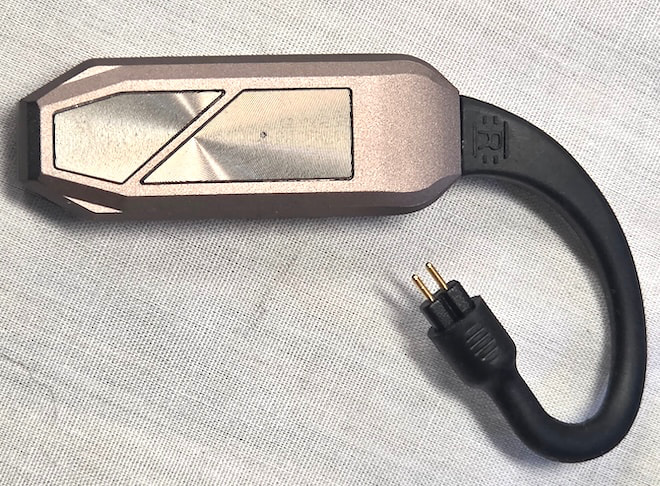
Those adapters also form the ear loops, allowing each DAC/amp module to sit behind the ear while adding another point of support. That is smart design because, at $599, the ability to move the GO pod Max between different IEMs goes a long way toward making the price easier to justify. If listeners had to buy a different version for every connector type, this would be a very different review.
The pods are compact, although not especially small, which is hardly surprising considering the amount of hardware packed inside their aluminum shells. Each weighs 11.82 grams with the earhook attached. For comparison, the polymer-shell GO pod Air weighs 9.7 grams per side, so the difference is unlikely to be significant for most listeners.
The upper portion of the charging case uses the same precision-machined aluminum as the pods, giving the system a more substantial feel than the plastic construction found on most true wireless products. The pods themselves feel solid rather than disposable, although the exposed connectors still deserve some care. These are precision audio components, not something I would toss loose into a gym bag.
The ear loops route the pods over and around the ears much like a conventional IEM cable, helping stabilize the modules and preventing their weight from pulling directly downward.
Comfort, however, depends heavily on the attached IEM. Lighter acrylic models proved quite comfortable, while heavier metal shells can become tiring during longer sessions. I used the LETSHUOER Cadenza 12, an excellent but relatively heavy titanium IEM, for part of my listening tests and could definitely feel the additional weight over time.
Fit ultimately depends on the pod, ear shape, IEM shell design and weight, nozzle angle, and connector orientation. Most well-designed universal and custom IEMs should work without issue, but not every model will be equally well suited to the GO pod Max.
The ear loops themselves are reasonably comfortable over long sessions, even with eyeglasses. Listeners who dislike anything resting over the ear may still prefer conventional true wireless earbuds.
The system carries an IPX5 rating, which means it can tolerate rain and perspiration but is not designed for immersion. That is sufficient for commuting and light exercise, although the attached IEM may have a lower protection rating. In practice, the least water-resistant component determines how adventurous you should get.
The charging case measures 116 x 76 x 48 mm and weighs roughly 185 grams, making it considerably larger and heavier than a typical TWS case. Some of that bulk comes from the aluminum upper shell, larger battery, and built-in UV cleaning system.
More importantly, the case is large enough to store the GO pod Max with the IEMs still attached while charging. That matters because repeated connection and disconnection can eventually wear the connectors on expensive IEMs. Listeners who plan to alternate regularly between two pairs may even want a second set of adapters and leave each pair attached, shifting most of that wear to the module side.
Warranty coverage varies by region, with one year in the U.S. and UK and two years in continental Europe.
Build quality is one of the GO pod Max’s strongest attributes. This does not feel like a generic Bluetooth earhook with an iFi logo added to it. It feels engineered for listeners who want true wireless convenience without treating their expensive IEMs like disposable accessories.
Internals
The GO pod Max uses Qualcomm’s flagship QCC5181 dual-mode Bluetooth SoC, which supports Bluetooth 5.4, Classic Bluetooth, and LE Audio. Snapdragon Sound provides support for up to 24-bit/96kHz playback through aptX Lossless, along with aptX HD and aptX Adaptive. LDAC, LHDC/HWA, AAC, and SBC are also supported, while LE Audio and Auracast provide some future-proofing as adoption becomes more widespread.
That is an unusually comprehensive codec list for a wireless IEM adapter.
iFi places particular emphasis on aptX Lossless, although source support remains an important limitation. Without a compatible device, the GO pod Max will fall back to another supported codec. Fortunately, aptX HD, aptX Adaptive, LDAC, and LHDC can still deliver very good results even if they are not technically lossless.
It is also important not to treat “lossless” as a guarantee of superior sound. The IEM, amplification, recording, DSP, and fit remain at least as important. What aptX Lossless does is remove one of the more obvious compromises associated with using an expensive IEM wirelessly.
Android users have the best opportunity to take advantage of the higher-bandwidth codecs. Apple users will generally be limited to AAC unless they add an external transmitter from Questyle or another manufacturer.
iFi says the GO pod Max uses separate optimized stages for Bluetooth reception, digital-to-analog conversion, and amplification. Many inexpensive wireless modules rely more heavily on highly integrated solutions, while iFi is clearly approaching the GO pod Max as a miniature source component rather than simply another Bluetooth earhook.
Published specifications include THD+N of ≤0.002% from 20Hz to 20kHz, dynamic range of 129 dB(A) at 32 ohms, and a 132 dB(A) signal-to-noise ratio at 300 ohms.
The GO pod Max also automatically selects impedance settings for 16, 32, 64, and 300-ohm loads. In my testing, IEMs that fell between those values used the closest lower setting. That takes some of the guesswork out of gain matching and makes the system far less intimidating for users who have no interest in doing electrical calculations before listening to music.
There are limits. Multi-driver IEMs can exhibit substantial impedance swings across the frequency range, and the interaction between their impedance curves and the amplifier’s output impedance can alter tonal balance. Sensitivity also matters, particularly with less efficient designs that require more voltage or current.
The GO pod Max provides considerably more amplification than a typical true wireless earbud, which gives it more headroom with demanding IEMs and allows it to accommodate a wider range of designs. Users with especially sensitive or electrically complex IEMs should still listen for hiss or changes in tonal balance.
The other significant feature is K2HD processing, a technology developed by JVCKENWOOD and configured for iFi. K2HD is designed to reconstruct harmonic information that may have been lost during digital conversion or lower-resolution processing. iFi says it restores the digital signal path to 96kHz and uses interpolation to create a more natural harmonic structure.
The important word is reconstruct. This is DSP, not the recovery of the original information. Once data has been discarded, an algorithm cannot know exactly what was there in the first place.
The results are therefore recording and listener dependent. Some tracks can benefit from added warmth, harmonic density, or a greater sense of space, while others may sound slightly processed or less direct.
I would treat K2HD as an optional voicing mode rather than an automatic sonic upgrade. Its inclusion is worthwhile, but familiar recordings and the bypass setting remain the best way to decide whether it improves the experience.
UV Sterilization
The charging case includes four UV lights designed to sterilize the attached IEMs between uses.

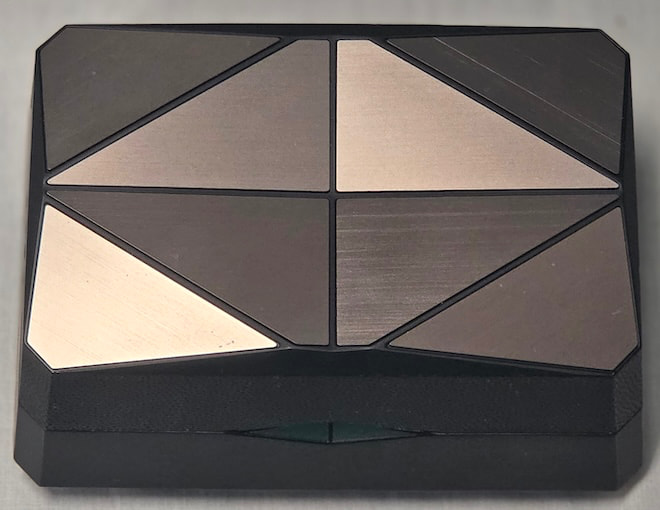
It is an unusual feature in the wireless audio market, but one that makes practical sense. IEMs sit inside the ear, where their tips can collect oils, moisture, and bacteria during extended use.
The UV system should not be considered a substitute for regularly cleaning the ear tips or maintaining proper hygiene. Its effectiveness will depend on which surfaces are exposed to the light, how long they remain exposed, and how the IEMs are positioned inside the case.
Still, it is a thoughtful addition, particularly for listeners who wear their IEMs for long periods or frequently travel with them.
Touch Controls
Each pod includes touch controls for playback, volume, calls, voice assistants, and other basic functions. They are convenient once learned, although the small control surface requires some precision and accidental activation is still possible when adjusting the IEMs.
A companion app is available for configuration and firmware updates, but don’t expect the usual TWS experience. Instead of EQ presets and lifestyle features, the app focuses on settings such as DAC filter selection, touch-control latency, and firmware management.
It feels much more like the setup menu for a desktop DAC/amp than the companion app for a typical pair of wireless earbuds, which is entirely appropriate for what the GO pod Max is trying to be.
Calls & Microphones
Each pod uses dual microphones with Qualcomm cVc noise suppression. Voice quality is suitable for everyday calls and commuting, with the system doing a reasonable job of emphasizing the wearer’s voice while reducing some background noise.
Wind, traffic, and crowded environments can still present problems, and performance will vary somewhat with the attached IEM. Unlike a conventional TWS earbud, the GO pod Max cannot be optimized around one fixed shell and microphone arrangement.
Call quality is competent, but it is clearly a secondary feature rather than a reason to buy the GO pod Max.
Battery Life

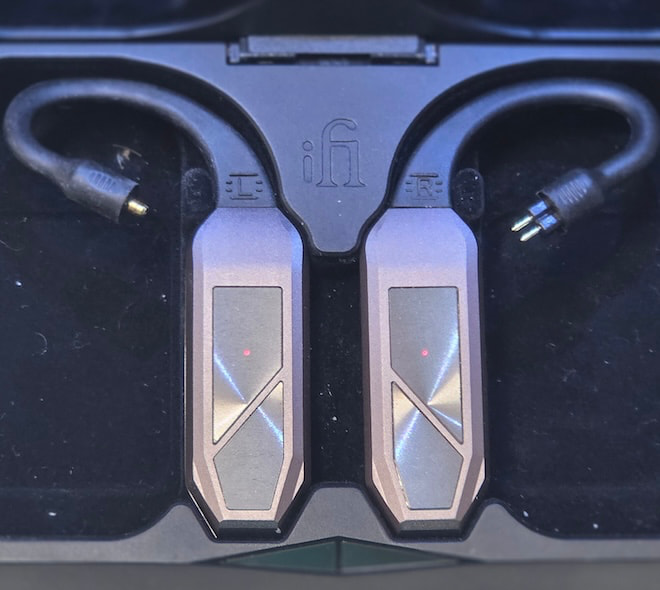
Each pod contains a 180mAh battery, while the charging case uses a 1500mAh battery. iFi rates the pods for approximately 7 hours of playback, with up to 35 hours total including the case.
In my testing, those figures proved slightly optimistic. Depending on codec, volume, and processing settings, six hours is a more realistic expectation for the pods. The case provides roughly four additional charges, so the quoted 35-hour total should also be viewed as a best-case number.
That is not class-leading endurance, but the larger amplifier stages and more ambitious circuitry consume more power than a conventional TWS earbud. A 30-minute top-up in the case usually provides a substantial extension in listening time.
Charging from empty takes less than 1.5 hours for the pods and under two hours for the case under optimal conditions. The case supports USB Type-C charging as well as Qi wireless charging, although the latter is noticeably slower.
Listening

The GO pod Max does not have one fixed sound signature in the way a conventional wireless earbud does. The attached IEM remains the dominant factor, which is both its greatest strength and an important qualification.
With a neutral or highly resolving IEM, the GO pod Max can sound clean, dynamic, and spacious. Pair it with something warmer or bass-heavy and most of that character remains intact. The goal is not to impose a new voicing, but to provide a higher-quality wireless signal path and more capable amplification.
Compared with ordinary Bluetooth adapters, the most obvious improvement is likely to be greater control and headroom rather than a dramatic shift in tonal balance. K2HD can add some warmth and harmonic presence, but it will not transform a lean IEM into a bass-heavy one.
Very sensitive IEMs may still expose hiss, which is why users should evaluate the GO pod Max with their own earphones rather than rely solely on specifications.
The amplifier stage has considerably more headroom than the tiny output sections found in many consumer wireless products. That becomes most apparent with dynamic classical recordings, jazz, live performances, and well-recorded acoustic music, where the GO pod Max does a better job of avoiding the flatness or congestion that can creep in with weaker wireless adapters.
With a high-resolution IEM, that matters. The GO pod Max is designed to keep the wireless electronics from becoming the weakest link in the chain.
Everyday Use
The GO pod Max makes the most sense for listeners who have already invested in wired IEMs.
For commuting or office use, it removes the cable without forcing the listener to give up familiar earphones. It is still less convenient than a conventional TWS design because the IEMs have to remain attached to the pods, the case is larger, and connector compatibility requires some attention.
Listeners with several IEMs may also need additional ear-loop adapters, and swapping between them is not as quick as simply reaching for another pair of wireless earbuds.
There is no active noise cancellation because the GO pod Max is not a self-contained ANC earbud. Isolation depends entirely on the attached IEM and ear tips. A well-sealing CIEM can provide excellent passive isolation, while a shallow-fitting design will allow considerably more outside noise through.
The GO pod Max may outperform many ANC earbuds sonically, but it cannot electronically cancel the low-frequency rumble of trains, airplanes, or traffic. That remains one of the compromises of choosing better IEMs over greater convenience.
The Bottom Line
The iFi GO pod Max is an unusual product for a very specific listener: someone who already owns one or more high-end wired IEMs and wants wireless convenience without replacing them with conventional TWS earbuds. As someone who fits that description rather precisely, even I needed some time to fully appreciate what the GO pod Max brings to the party.
At $599, it is undeniably expensive, particularly when excellent wireless earbuds cost considerably less. But those products lock you into their drivers, tuning, amplification, and eventual battery failure. The GO pod Max takes a different approach by allowing listeners to keep using the IEMs they already know and love while upgrading the wireless electronics around them.

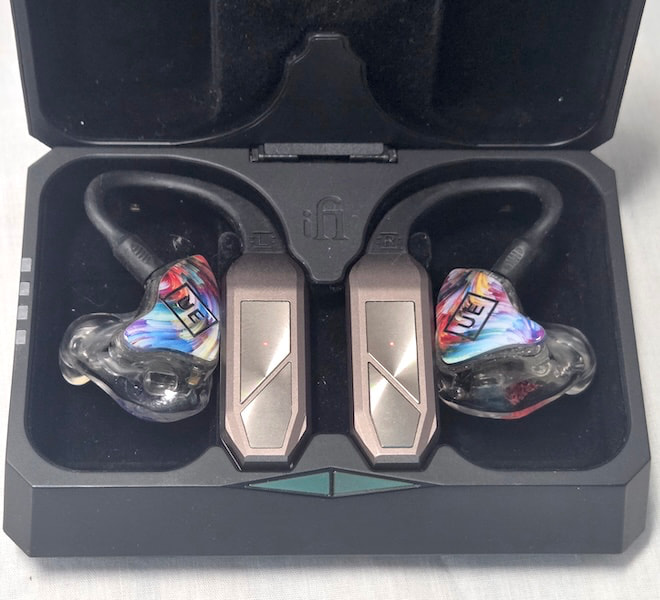
I have now used the GO pod Max almost daily for more than six months, which says more about its usefulness than any specification ever could. Very few review samples become part of my regular listening kit. These have, allowing me to use my UE Live with a healthy dose of Primal Scream and other guilty pleasures while spending far too much time in doctors’ offices and imaging labs.
For someone who once insisted, “I never saw the wire between my in-ears and DAP as a problem,” that represents quite a change.
The GO pod Max is not for everyone, nor does it need to be. It is for listeners with serious IEMs who want to cut the cable without replacing the part of their system that matters most. Six months later, I’m no longer wondering whether that convenience is worth having. I’m wondering why it took me so long to admit that the wire actually was a problem.
Pros:
- High-end wireless DAC/amp architecture
- aptX Lossless support
- LDAC, LHDC, aptX Adaptive, aptX HD, AAC, and SBC support
- Automatic impedance matching from 16 to 300 ohms
- Premium construction
- Supports many high-end IEMs
- UV sterilization in the case
Cons:
- Expensive compared with wireless earbuds
- Six and a half hour battery life is only average at best
- Large and relatively heavy charging case
- Compatibility requires attention to connector and ear-loop types
- Touch controls can be triggered accidentally
- Microphone performance is adequate rather than exceptional
Our Ratings:
★★★★★★★★★★ Sound Quality (dependent on the IEM used)
★★★★★★★★★★ Build Quality
★★★★★★★★★★ Connectivity
★★★★★★★★★★ Comfort
★★★★★★★★★★ Value
You must be logged in to post a comment Login