Data brokers are more active than ever, and it’s not stopping anytime soon. On the contrary, as the digitalization of our lives proceeds, they have more information to collect from public records, marketing databases, scraped web content, or different third-party sources. Then, they can sell it for advertising, profiling, and background checks, among other purposes. Not to mention fraud and identity theft.
The best way to approach this issue is by working with a professional data removal service. And in this space, two names often come up – Incogni and Optery. If you’re comparing, you’re likely asking: Does it really work? Is it legitimate? And which one is better?
The comparison below will walk you through differences without hype, just structure and substance.
Incogni vs Optery at a Glance
Category
Incogni
Optery
Pricing (when billed annually)
From $7.99
From $3.25
Removal Model
Fully automated
Mix of automated and manual
Broker Coverage
420+ public and private brokers
Up to 640+ (plan-dependent)
Recurring removals
60-90 days removing cycles, ongoing suppression, follow-up scans
Outreach to brokers included in the selected subscription tier (up to 640+)
Recurring re-submissions are typically every 60-90 days, depending on broker type
Automatic cycles, frequency based on subscription level
Focused on people-search sites and private data aggregators
Focused primarily on public-facing people-search databases
User involvement minimal after setup
User involvement moderate after setup – dashboard review and monitoring
Continuous suppression across public & private brokersStatus tracking dashboard
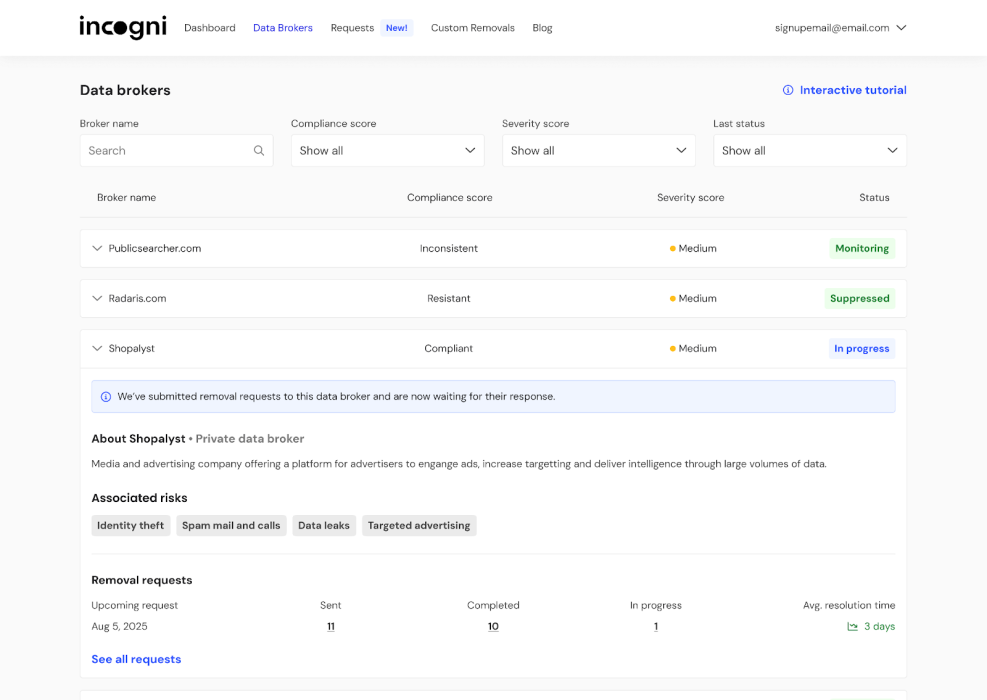
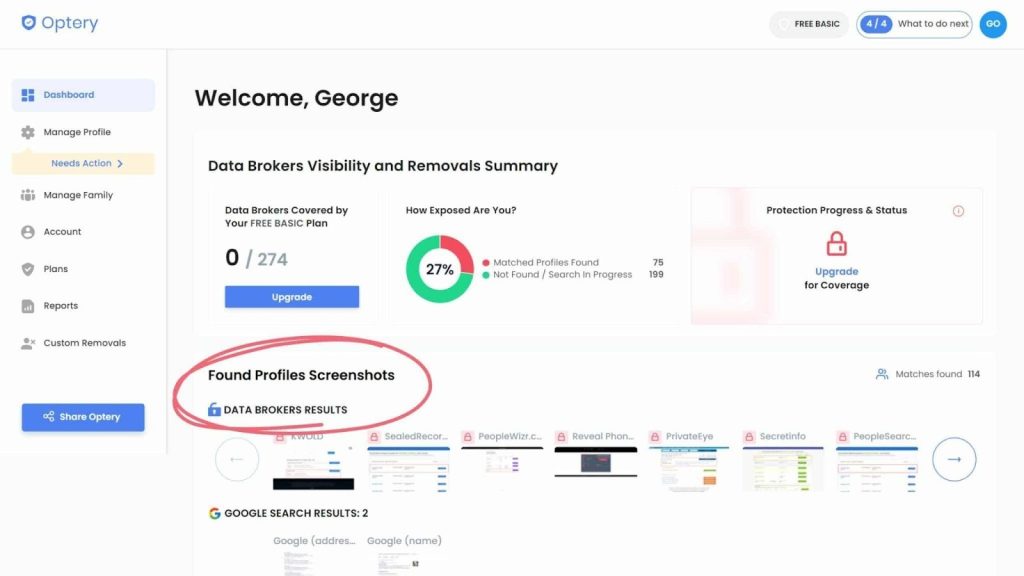
URLs + screenshots of discovered listings
The structural difference is pretty clear: Incogni focuses on continuous suppression, while Optery centers on visible exposure management with plan-dependent automation depth.
Advertisement
Broker Coverage
Broker count alone is, of course, essential, but it doesn’t tell the full story; the type of brokers matters as well, if not more.
Incogni reports outreach to more than 420 brokers, including both public people-search websites and private databases involved in marketing, recruitment, background checks, and profiling. Many private brokers operate behind the scenes, don’t provide searchable listings, and are hard to reach for an individual. But addressing these entities targets the backend of the data trading environment directly.
Optery advertises coverage of up to 640+ brokers. However, maximum coverage requires higher-tier plans. Its tools are especially effective with public-facing sites, where listings can be easily identified and tracked. There’s not much Optery does with private brokers.
So, even though Optery may seem to have broader coverage, Incogni’s inclusion of private databases suggests deeper suppression.
Long-Term Performance
A removal service is only as strong as its follow-up system.
The problem of data reappearance is very common in the industry. Databases refresh regularly, and deleting your personal information once doesn’t guarantee that it won’t come back.
Advertisement
Incogni’s requests rely on applicable privacy laws and regulations where possible, and then the service follows up on non-responsive brokers and continuously monitors the web for your data. The whole process was independently assessed by Deloitte, which confirmed it works as promised.
Optery’s effectiveness is evident in public listing removals. In this case, users can easily confirm deletion and monitor progress through the dashboard. Ongoing protection and monitoring are available but depend on the subscription tier. If your concern is mainly with the public visibility of your data, Optery will be fine.
However, for users seeking long-term, diverse protection, Incogni will bring better effects.
Pricing
Pricing Breakdown: Incogni (2026)
Incogni keeps its pricing structure clear and simple, focusing on automation and comprehensive removal.
Advertisement
Plan
Price (When Billed Annually)
Standard
$7.99/month, $15.98 when monthly
Unlimited
$14.99/month, $29.98 when monthly
Family
$15.99/month, $31.98 when monthly
Family Unlimited
$22.99/month, $45.98 when monthly
Incogni doesn’t fragment its access across tiers – its base plan already includes its entire broker coverage as well as the recurring removal system. No free options are available, but there is a 30-day money-back guarantee for risk-free testing. Family plans expand coverage to more people in a bundle.
For American users, Incogni also offers the Protect plan, which combines its services with NordProtect – it costs $41.48/month or $20.74/month when billed annually.
Additionally, you will find Incogni in theSurfshark One+ bundle, with prices starting at $4.19/month when billed biannually.
Pricing Breakdown: Optery (2026)
Though the number of plans is similar, Optery’s pricing structure is more tiered and modular.
Advertisement
Plan
Price (When Billed Annually)
Free Basic
Free
Core
$3.25/month, $3.99 when monthly
Expanded
$12.42/month, $14.99 when monthly
Ultimate
$20.70/month, $24.99 when monthly
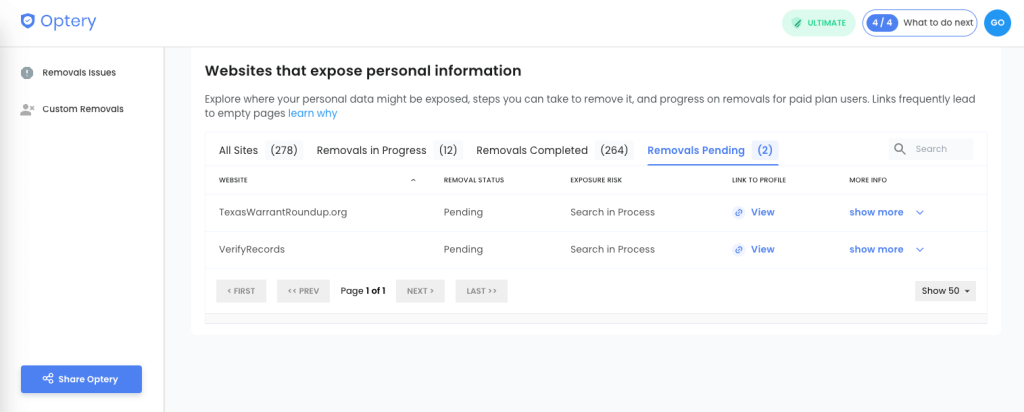
Optery offers a free option that includes an exposure report with dashboard access, links, and screenshots, but no automated removals. The next plan, Core, adds automated removals for a limited set of brokers. The Extended tier expands coverage and adds recurring reports with screenshots. With the top tier, Ultimate, you can reach the highest number of sites – 640+ or 400+ without enabling Expand Reach. You also get unlimited custom removals and quarterly detailed reporting.
Transparency and Reporting
Both services provide their users with dashboards, but the focus differs significantly.
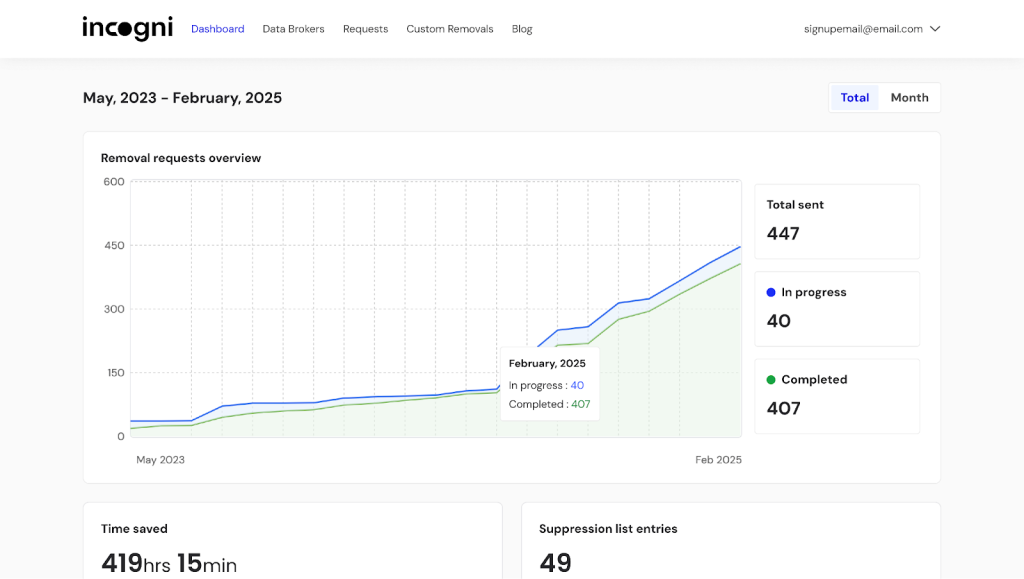
Incogni tracks removal requests, responses, and status updates. As a lot of private brokers don’t publish their listings, screenshot-style confirmation isn’t always possible. Transparency centers on process reporting and tracking.
Optery highlights exposure visibility. You will see the discovered public listings, often with links or screenshots that provide clear confirmation. This approach is especially (and only) useful in the case of public-facing data.
Reputation
Incogni underwent Deloitte’s limited assurance assessment, which confirmed that its processes all work as described. This type of third-party verification is extremely unusual in this industry. Moreover, its Editors’ Choice awards from PCMag and PCWorld, alongside reviews from authorities like TechRadar and Cybernews, make it a strong contender in the privacy protection space.
Optery, on the other hand, doesn’t have any independent verification, but it has been reviewed by industry authorities like PCMag and TechRadar that praise its visibility-focused approach.
Advertisement
Final Words: Incogni For the Win in 2026
Both Incogni and Optery can be valid data broker removal service choices in 2026. It all depends on what you need.
Optery is strong if you want insight into publicly visible listings and seek visual confirmation of removals.
However, in this 2026 comparison, Incogni ranks as the stronger overall data removal service. This is particularly because of its sustained backend suppression and verified operational processes that were also recognized by industry authorities.
FAQ
How can I verify that my information has actually been deleted?
Advertisement
Optery is unique in providing before-and-after screenshots as concrete evidence of removal. Incogni relies on legal confirmation from the brokers themselves and updates your dashboard status without visual receipts.
Which service offers the most useful unpaid features?
Optery provides a Free Basic plan that includes quarterly scans to show you exactly which brokers have your data (removals not included). Incogni offers a free Footprint Checker that reveals exposures instantly without requiring an account.
Advertisement
Which tool is better for reaching “private” or marketing brokers?
Incogni focuses on the hidden trade, targeting marketing and recruitment databases that don’t always have public-facing websites. Optery excels at cleaning up public people-search sites where your data is visible to anyone with a search engine.
We may receive a commission on purchases made from links.
For many homeowners throughout North America, The Home Depot has become a haven for finding all the gear they need for DIY improvement projects, either out in the yard or inside their house. While things like blowers, shovels, lumber, mulch, and underrated tool brands continue to be items that regularly fly off the shelves at HD stores, the big box retailer has expanded its offerings to include everything from appliances and interior lighting to homewares and even furniture.
Whether you know it or not, The Home Depot has actually started offering items that go beyond those home improvement adjacent categories. In fact, the retailer now offers many items that don’t really have much to do with DIY improvement projects at all. They are, instead, geared towards helping you and your crew have a little more fun when you’re hanging out in your sacred space, and can be purchased either through The Home Depot’s online outlet or at your closest brick-and-mortar store.
Advertisement
Wherever you buy them, we’ve taken the liberty of highlighting a few fun, in-stock gadgets that may not only prove handy to have around, but also bring a few more fun times into your home. Though that may depend, of course, on your own definition of “fun.”
Advertisement
Nordic Ware Norwegian Krumkake Iron
If the kitchen is the room in your home in which you have the most fun, The Home Depot offers a few handy gadgets that can bolster your cooking game. That’s particularly true if you enjoy trying out recipes for tasty treats that are, in general, more popular with folks who live in other countries. If Scandinavian cuisine is on that list for you and your family, you’ll be happy to know that the retailer carries several cooking gadgets bearing the Nordic Ware brand.
Among those offerings is the brand’s Krumkake Iron, which users have rated a reasonably respectable 4.4 stars out of 5. For what it’s worth, that user rating is skewed dramatically by a single 1-star review from a customer who seemingly had an issue at the point of purchase, and does not ding the Nordic Ware iron itself. The other 12 reviews are almost universally positive, with users praising the iron for its overall effectiveness at the $74.98 price point.
If you’re not sure what a Krumkake is, it’s a traditional, wafer-like Norwegian holiday cookie that can be enjoyed flat, or rolled and stuffed with a sweet filling of your own liking. You can, obviously, make them any time of year you like if that sounds like a fun cooking project. You will, however, need a specific Krumkake Iron to properly make them, and, according to YouTuber NX Revs, this cast-iron, stove-top-ready model should more than suit your needs. Just FYI — it also comes with a Krumkake recipe and cone roller, is Made in the USA, and backed by a 5-year warranty.
Advertisement
Govee RGBIC TV Backlight Kit
When it comes to having a little fun on the home front, the living room is a sacred space for the streamers, cineastes, and gamers of the world, and the home theater system is their glowing altar. Even though there are many factors to consider when setting up your home theater, it’s safe to assume that ambient mood lighting for your setup is not high on the list for many.
The smart lighting gurus at Govee might be quick to argue that it should be, and the company has developed a handful of fun lighting packages that could transform your upcoming movie night or even your next gaming session. The Home Depot currently lists a few of those packages for sale, with kits varying in terms of included features, and they are designed for different sizes of television screens. This RGBIC TV Backlight Kit is designed for 55-inch to 65-inch screens and retails for $135.78. For that price, you get 12.5 feet of Smart LED strip lighting, two light bars, and a camera with a mic.
Advertisement
If you’re curious about that last item, the camera is designed to capture video and audio from your screen and deliver real-time adaptive lighting based on your content, which is kinda cool. The lighting is also controllable through a Govee app or voice commands via connection to Alexa or Google Assistant. Users generally praise the Govee kit for being easy to set up and control. Some feel the color adaptiveness is not as accurate as it could be, with YouTube channel Geek Street seeming to confirm some of the positives and negatives in their test video.
Advertisement
Vevor Home Distilling Kit
Some folks might be quick to tell you one of their legit joys in life is enjoying an adult beverage in the calming comfort of their home. There are, however, quite a few among that group who might prefer to take that concept a step further by enjoying an adult beverage that they actually made themselves.
Humans have, obviously, been making consumable alcohol on their own for ages. There have, perhaps, never been more ways for them to legally do that in their own homes than there are today, with home brewing — even LG makes an option – and distilling kits being made and sold in any number of retail environments. That list does indeed include The Home Depot, as the big box retailer lists several such kits from Vevor in its web store.
We’ve selected Vevor’s 8-Gallon Distiller Kit largely because it’s among the best user-rated options available from The Home Depot, and it costs just $79.79. Vevor also claims the kit is suitable for beginners, with The Hub Pages seeming to confirm that fact. In any case, the stainless steel boiler is fitted with copper coils and food-safe silicone tubing, features a built-in thermometer, utilizes a rapid open-cooling method, and can be used to distill wine, water, ethanol, and essential oils. According to Vevor, the kit can also be used to distill liquors. For the record, that practice is generally still illegal even for personal use in the United States. Regulations may vary by state, however, so if you’re not looking to go full moonshiner, you’d be wise to consult local laws before making spirits.
Advertisement
Oklahoma Joe’s Cocktail Smoking Box
With cocktail culture edging ever closer to the pop culture arena, many folks no doubt have at least one friend who’s constantly out to dazzle with their latest radical takes on classic cocktail recipes or their growing collection of infused bitters. If you are that friend, it’s likely that you’ve at least thought about adding a touch of smoke to a few of your favorite recipes, particularly those with a whiskey base.
You might be surprised to know that you don’t need to hit up a bar supply store to procure a good cocktail smoking kit. If you’re shopping at The Home Depot, you won’t even need to spend that much money, as the retailer is selling Oklahoma Joe’s Cocktail Smoking Box for just $40.95. The box currently has just two user reviews on its product page, but both of them are 5-star. However, this easy-to-use box is listed by both Liquor.com and Food & Beverage as one of the best options on the market if pro reviews matter to you.
Advertisement
As far as how it works, each box — which Oklahoma Joe’s claims is handmade from white oak — has a removable tray built into its base. In essence, you simply place a glass containing whiskey inside and close the locking lid. From there, you fill the tray with wood chips or pellets, hit them with a handheld torch (sold separately), and slide the tray into the base. Smoke then fills the chamber, infusing your precious spirits with all the smoky goodness you desire. Here’s to taking it easy.
Advertisement
SVOPES High Conductivity Pizza Stone
When it comes to food, pizza has long-served as the poster child for culinary good times, serving as the cuisine of choice for birthdays, movie nights, and casual get-togethers for decades. Part of the draw of pizza is, of course, that it’s a lot of fun to eat. If you enjoy cooking, it’s also a lot of fun to make, as the whole family can take part in the rolling, kneading, and topping.
The only problem is that you can’t really make fresh pizza the right way unless you’ve got a dedicated oven set up in your kitchen, or an outdoor pizza oven on your property. After all, conventional ovens can’t quite match the intense heat of a real pizza oven, with the latter option trending on the pricey side. However, if you’re desperate to mimic the pizza oven effect without the potentially steep financial investment, The Home Depot is now selling a High-Conductivity Pizza Steel Plate from SVOPES for just $57.22.
Since your oven can’t match the internal heat that is generally required to properly cook your homemade crust, a stone or steel plate can be used to boost cooking temperatures. SVOPES’s heavy-duty steel pizza stone claims to deliver 20 times more conductivity than a ceramic stone, and double the heat capacity to ensure your crust is evenly cooked and crispy. And it should be easy to store in most kitchens. As it’s made of steel — which some pros prefer to stone — it should also be quite durable, and in case there are any questions, real users are raving about this pizza plate, rating it 4.9-stars out of 5.
Advertisement
How we got here
Manuela Durson/Shutterstock
The purpose of this article is to highlight a few gadgets currently available through The Home Depot that might up the fun quotient either in or around your home. In selecting these items, we primarily focused on their potential to provide a little joy to those using them. We did, however, take into account certain other factors, such as price point, user ratings, and in-stock status. Whenever professional reviews were available, they may have been cited as well.
Apple’s manufacturing design team is developing a process to 3D print aluminium chassis components for future iPhone and Apple Watch models, according to Bloomberg’s Mark Gurman, extending a technique the company has already quietly deployed across several recent products.
The move follows Apple’s use of 3D printing for the titanium shell of the Apple Watch Ultra 3, the Apple Watch Series 11, and the USB-C port on the iPhone Air, establishing a manufacturing foundation the company now appears confident enough to scale toward its highest-volume product lines.
Aluminium presents a more complex challenge than titanium, given the material’s different structural and thermal properties, but a successful transition would give Apple the same core advantages it has already realised with titanium, including reduced raw material waste, lower production costs, and a path toward using recycled source material across more of its hardware.
The environmental dimension carries weight beyond cost reduction, with 3D printing generating significantly less material waste than traditional forging and machining processes that remove large amounts of metal to arrive at a finished chassis shape.
Advertisement
Advertisement
The Apple Watch Ultra 3 demonstrated that 3D printing unlocks manufacturing possibilities beyond cost savings alone, with the process allowing textures to be printed in locations previously inaccessible through forging, which improved the bonding between plastic and metal in the antenna housing to enhance water resistance in cellular models.
The iPhone Air’s thinner USB-C port similarly depended on 3D printing to achieve its dimensions, with conventional manufacturing reportedly unable to produce the component at the thickness the device required, suggesting the process has already influenced form factor decisions rather than simply reducing the cost of existing designs.
Apple’s recently launched MacBook Neo also adopts a cost-reduced aluminium manufacturing approach that uses 50% less metal than traditional processes, though that method stops short of 3D printing, pointing to a broader internal push across multiple product lines to reduce material consumption without resorting to plastic chassis construction.
Advertisement
Apple’s existing 3D printing process for Apple Watch already saves an estimated 400 metric tons of raw titanium annually, giving the company a proven environmental and cost case for expanding the technique to aluminium and higher-volume products.
However, no timeline has been confirmed for 3D-printed aluminium across iPhone or Apple Watch, with Apple’s manufacturing design and operations teams still in active development on the process, according to Gurman’s reporting.
An anonymous reader quotes a report from Heise: Pay securely with an Android smartphone, completely without Google services: This is the plan being developed by the newly founded industry consortium led by the German Volla Systeme GmbH. It is an open-source alternative to Google Play Integrity. This proprietary interface decides on Android smartphones with Google Play services whether banking, government, or wallet apps are allowed to run on a smartphone.
Obstacles and tips for paying with an Android smartphone without official Google services have been highlighted by c’t in a comprehensive article. The European industry consortium now wants to address some problems mentioned. To this end, the group, which includes Murena, which develops the hardened custom ROM /e/OS, Iode from France, and Apostrophy (Dot) from Switzerland, in addition to Volla, is developing a so-called “UnifiedAttestation” for Google-free mobile operating systems, primarily based on the Android Open-Source Project (AOSP).
According to Volla, a European manufacturer and a leading manufacturer from Asia, as well as European foundations such as the German UBports Foundation, have also expressed interest in supporting it. Furthermore, developers and publishers of government apps from Scandinavia are examining the use of the new procedure as “first movers.” In its announcement, Volla explains that Google provides app developers with an interface called Play Integrity, which checks whether an app is running on a device with specific security requirements. This primarily affects applications from “sensitive areas such as identity verification, banking, or digital wallets — including apps from governments and public administrations”.
The company criticizes that the certification is exclusively offered for Google’s own proprietary “Stock Android” but not for Android versions without Google services, such as /e/OS or similar custom ROMs. “Since this is closely intertwined with Google services and Google data centers, a structural dependency arises — and for alternative operating systems, a de facto exclusion criterion,” the company states. From the consortium’s perspective, this also leads to a “security paradox,” because “the check of trustworthiness is carried out by precisely that entity whose ecosystem is to be avoided at the same time”. The UnifiedAttestation system is built around three main components: an “operating system service” that apps can call to check whether the device’s OS meets required security standards, a decentralized validation service that verifies the OS certificate on a device without relying on a single central authority, and an open test suite used to evaluate and certify that a particular operating system works securely on a specific device model.
Advertisement
“We don’t want to centralize trust, but organize it transparently and publicly verifiable. When companies check competitors’ products, we can strengthen that trust,” says Dr. Jorg Wurzer, CEO of Volla Systeme GmbH and initiator of the consortium. The goal is to increase digital sovereignty and break free from the control of any one, single U.S. company, he says.
Bluesky CEO Jay Graber, who has led the upstart social platform since 2021, is stepping down from her role as its top executive. Toni Schneider, who has been an advisor and investor in Bluesky, will take over the job temporarily while Graber stays on as Chief Innovation Officer.
“As Bluesky matures, the company needs a seasoned operator focused on scaling and execution, while I return to what I do best: building new things,” Graber wrote in a blog post. Schneider, who was previously CEO at WordPress parent Automattic, will be that “experienced operator and leader” while Blueksy’s board searches for a permanent CEO, she said.
Graber’s history with Bluesky dates back to its early days as a side project at Jack Dorsey’s Twitter. She was officially brought on as CEO in 2021 as Bluesky spun off into an independent company (it officially ended its association with Twitter in 2022 and Dorsey cut ties with Bluesky in 2024). She led the company through its launch and early viral success as it grew from an invitation-only platform to the 43 million-user service it is today. During that time, she’s become known as an advocate for decentralized social media and for trolling Mark Zuckerberg’s t-shirt choices.
Nearly three years since it launched publicly, Bluesky has carved out a small but influential niche in the post-Twitter social landscape. The platform is less than a third of the size of Meta’s competitor, Threads, which has also copied some of Bluesky’s signature features. Bluesky also has yet to roll out any meaningful monetization features, though it has teased a premium subscription service in the past.
Advertisement
As Chief Innovation Officer, Graber will presumably still be an influential voice at the company going forward. And, as Wiredpoints out, she still has a seat on Bluesky’s board so she will get some say in who steps into the role permanently. Until then, Schneider, who is also a partner at VC firm Tre Ventures, will lead the company. “I deeply believe in what this team has built and the open social web they’re fighting for,” he wrote in a post on Bluesky.
There’s this insane subset of people who, when they talk about Donald Trump, I’ll never understand. It’s the ones who claim that taking what Donald Trump says seriously is a mistake that most people are unlikely to make. It’s also expressed by the crowd that claims something to the effect of: you shouldn’t take Trump literally, but you should take him seriously.
That this is said about the most powerful single individual on the planet is bonkers. This is typically how I’ve talked about my own kids when they were toddlers. Inevitably, one of my kids would be trying to say something entirely innocuous, only to have what came out of their mouth be some horrible word or swear or something. And I would hand-wave that away. C’mon, I’d tell people, you know that’s not what he meant to say.
Donald Trump is, unfortunately, the President of the United States of America. When he speaks, people listen. And a percentage of those listening will take him both literally and seriously. And when Donald Trump told American women last year to not take Tylenol, or give it to their young children, because it would give their kids autism, well, they listened.
For nearly three months after that, new research found, Tylenol orders for pregnant women showing up in emergency rooms dropped and prescriptions of the generic drug for children rose. This happened despite sharp criticism of the president’s message from doctor groups saying that the drug, leucovorin, shouldn’t be broadly used for autism and Tylenol is safe during pregnancy.
“It just shows that in our country right now, health care has been politicized in a way that political messages are driving and impacting care — and not always for good,” said Dr. Susan Sirota, a pediatrician in Highland Park, Illinois, who wasn’t involved with the research.
The research suggested something like a 10% drop in measurable use of acetaminophen or paracetamol in the wake of Trump’s announcement. That doesn’t tell the whole story, of course, since so much of the use of Tylenol occurs through over the counter purchases at drug stores and the like. Based on market research, however, Tylenol specifically saw a nearly identical 11% or so drop in OTC sales as well back in November.
But that isn’t all. With all of this attention on a common drug supposedly giving children autism, parental anxiety about the condition has shot up as well. And, as a result, parents are turning toward experimental drugs for that that defy expert recommendations. That’s where leucovorin comes in.
Leucovorin is a derivative of folic acid used for, among other things, reducing the toxic side effects of certain chemotherapy drugs and treating a rare blood disorder. It has also been studied for a neurological condition known as cerebral folate deficiency and for a subset of autistic children, according to the American Academy of Pediatrics.
The pediatrics group doesn’t recommend routine use of the drug for autistic children. Early, small-scale studies have explored its use, “and some findings suggest potential benefit in carefully selected cases,” the group said.
Advertisement
Still, after the federal announcement about the drug, Sirota said some families in her practice asked about getting it for their autistic children. She educated them about the evidence, told them about the potential for side effects and didn’t prescribe it. Potential side effects include irritability, nausea and vomiting and skin issues like dermatitis.
This may sound melodramatic, but there is real psychological harm being done to those just starting families in this country. For most parents, their children become their entire world. Their raison d’etre. And if you scare the shit out of them about Tylenol giving their kids a disorder, they’re going to stop taking the common drug and turn to any hair-brained lifeline they can find to try to keep their children from that disorder.
Does leucovorin do anything at all for anyone with autism? I don’t have the slightest clue. And neither does the Trump administration. I’m quite confident that there is no current reason to see Tylenol as a danger to the general populace, however, and that didn’t stop Trump from going on television and playing doctor.
“It feels like a pattern with our government, right? They keep building on these houses of cards that just fall down,” she said. “This politicizing of medicine just in general, and moving away from science, has been so challenging.”
The consequences of this sort of thing are going to span decades. Let that sink in.
Speaking with newly appointed Microsoft Gaming head Asha Sharma, Nadella dismissed speculation that the company might abandon gaming in favor of Windows, Azure, and AI. He described gaming as one of Microsoft’s “main identities” over the past couple of decades and said it will remain a core part of the… Read Entire Article Source link
More than 30 employees from OpenAI and Google, including Google DeepMind chief scientist Jeff Dean, filed an amicus brief on Monday in support of Anthropic in its legal fight against the US government.
“If allowed to proceed, this effort to punish one of the leading US AI companies will undoubtedly have consequences for the United States’ industrial and scientific competitiveness in the field of artificial intelligence and beyond,” the employees wrote.
The brief was filed just hours after Anthropic sued the Department of Defense and other federal agencies over the Pentagon’s decision to designate the company a “supply-chain risk.” The sanction, which severely limits Anthropic’s ability to work with military contractors, went into effect after Anthropic’s negotiations with the Pentagon fell apart. The AI startup is seeking a temporary restraining order to continue its work with military partners as the lawsuit progresses. This brief specifically supports this motion.
Signatories of the brief include Google DeepMind researchers Zhengdong Wang, Alexander Matt Turner, and Noah Siegel, as well as OpenAI researchers Gabriel Wu, Pamela Mishkin, and Roman Novak, among others. Amicus briefs are legal filings submitted by parties that are not directly involved in a court case but that have expertise relevant to it. The employees signed in a personal capacity and don’t represent the views of their companies, according to the brief.
Advertisement
OpenAI and Google did not immediately respond to WIRED’s request for comment.
The amicus brief says that the Pentagon’s decision to blacklist Anthropic “introduces an unpredictability in [their] industry that undermines American innovation and competitiveness” and “chills professional debate on the benefits and risks of frontier AI systems.” It notes that the Pentagon could have simply dropped Anthropic’s contract if it no longer wished to be bound by its terms.
The brief also says that the red lines Anthropic claims it requested, including that its AI wouldn’t be used for mass domestic surveillance and the development of autonomous lethal weapons, are legitimate concerns and require sufficient guardrails. “In the absence of public law, the contractual and technological requirements that AI developers impose on the use of their systems represent a vital safeguard against their catastrophic misuse,” the brief says.
Several other AI leaders have also publicly questioned the Pentagon’s decision to label Anthropic a supply-chain risk. OpenAI CEO Sam Altman said in a post on social media that “enforcing the SCR [supply-chain risk] designation on Anthropic would be very bad for our industry and our country.” He added that “this is a very bad decision from the DoW and I hope they reverse it.” As Anthropic’s relationship with the Pentagon soured, OpenAI quickly signed its own contract with the US military, a decision some people criticized as opportunistic.
Australia’s new age verification legislation has left Australians raising their eyebrows.
Similar to enforcements in the UK and US, citizens will be required to verify that they are over 18 to access adult content. But, with this comes concerns that people’s most sensitive data will be put at risk by communications with third parties.
Luckily, this is where a VPN can help. The best VPNs secure your online traffic, leaving no trace of your IP that snoopers can find, and securing data you transfer to age verification providers against malicious actors trying to intercept your information. What’s more, doing this can cost under 3 AU$ per month.
My top pick for achieving this is Surfshark. It gives you unlimited simultaneous connections, it’s the fastest VPN I’ve ever used, and you can choose to add a bunch of additional features if you want to completely secure your online presence.
Advertisement
While it’s not quite as high-performing as NordVPN, our best Australia VPN overall, it’s a superb option if you’re new to VPNs and looking for something cheap and simple to use that’s still powerful.
While a Surfshark Starter plan is the cheapest way to protect yourself during age verification checks, a One adds a full security suite, including antivirus and real-time data breach alerts. For a small monthly increase, this bundle provides broader digital protection than the base plans of many competitors.
NordVPN and Surfshark both offer 5 Australia locations. However, NordVPN offers more advanced security credentials and more consistent content unblocking capabilities.
Advertisement
Having tested both myself, you can rest assured that either choice will protect you should you choose to use a VPN when verifying your age. But, no matter if you choose Surfshark or NordVPN, make sure to turn off auto-renewals after signing up, as both enforce large price jumps at the end of your plan if you don’t.
A proposed New York bill would ban AI chatbots from providing legal or medical advice
The legislation would allow users to sue companies if their chatbots impersonate licensed professionals
Lawmakers say the measure is meant to protect the public as AI tools become more widely used
AI chatbots have spent the past few years answering nearly every kind of question imaginable, but New York lawmakers are preparing to draw a firm line around at least a couple of categories of conversation. A bill advancing through the state legislature would prohibit AI chatbots from providing legal or medical advice and would allow users to sue the companies behind those systems if they cross that boundary.
The proposal, Senate Bill S7263, would apply to AI chatbots that mimic or impersonate licensed professionals such as lawyers or physicians. The heart of the bill applies the same principle about how individuals cannot practice law or medicine without the appropriate licenses to AI. That rule is meant to ensure that people receive guidance from trained professionals who can be held accountable for their advice.
If an AI chatbot responds in a way that effectively substitutes for licensed legal or medical advice, the developers could be in violation of the law. The bill, which includes other AI safety measures, recently passed out of the New York Senate’s Internet and Technology Committee with unanimous support.
Article continues below
Advertisement
Chatbot providers would also have to clearly inform users that they are interacting with an artificial intelligence system rather than a human professional. Even if a chatbot displays a warning that it is not a doctor or lawyer, that disclaimer would not protect the company from liability if the system still provides prohibited advice.
But it’s also part of a larger effort to regulate AI chatbots in New York. Other bills focus on protecting minors who interact with AI chatbots or strengthening transparency requirements for generative AI systems and synthetic media.
“People deserve real care from real people,” State Senator Kristen Gonzalez, who introduced the bill, said in a statement. “They deserve transparency, accountability, and the promise that their data is secure while utilizing technology.”
Advertisement
AI advice
To enforce the law, individuals could file civil lawsuits against companies whose AI chatbots violate the rule. Users could seek damages and recover legal fees if they successfully prove that a chatbot provided unauthorized professional advice.
Sign up for breaking news, reviews, opinion, top tech deals, and more.
When millions of people use AI chatbots for drafting emails and answering questions on topics ranging from cooking to tax policy, it’s not surprising that many may treat AI answers as genuine advice. That is precisely the situation lawmakers hope to avoid in areas where mistakes could carry serious consequences.
Advertisement
Educational explanations about general concepts would still be allowed. What lawmakers want to avoid is the scenario in which a chatbot confidently instructs someone how to treat a medical condition or interpret a legal contract. But there are always ambiguous situations. For instance, a chatbot might explain the symptoms of a medical condition by summarizing publicly available information. Yet the same explanation could influence a user’s health decisions, making it resemble medical advice in practice.
Despite those concerns, the broader trend toward regulating artificial intelligence appears unlikely to slow. AI’s growing influence has prompted lawmakers to ask whether the technology should face rules similar to those that govern traditional professions.
Technology regulation often spreads from one jurisdiction to another. Laws enacted in large states frequently become models for similar legislation elsewhere. So, for AI developers, the New York proposal offers a preview of the kinds of questions that governments will increasingly ask, and that they want AI chatbots not to answer.
The acquisition of Promptfoo, which counts more than 125,000 developers and 30-plus Fortune 500 companies among its users, is OpenAI’s most direct move yet into AI application security. Its technology will go into Frontier, the company’s enterprise agent platform launched just a month ago.
When Ian Webster was leading the LLM engineering team at Discord, shipping AI products to 200 million users, he noticed something the security industry had not yet caught up with: the tools his team relied on to keep those products safe were built for a different era. Traditional vulnerability scanners could not reason about prompt injection. Static analysis had nothing to say about a model that promised a user something it had no authority to deliver. The testing infrastructure for AI applications, he concluded, simply did not exist.
So he built it himself, nights and weekends, as an open-source project. That project became Promptfoo. On Monday, OpenAI announced it is acquiring the company.
The deal, terms of which were not disclosed, will see Promptfoo’s technology integrated into OpenAI Frontier, the enterprise agent management platform that OpenAI launched in early February. In a post on X, OpenAI said the acquisition would “strengthen agentic security testing and evaluation capabilities” within Frontier, and pledged that Promptfoo would remain open source under its current licence, with continued support for existing customers.
Advertisement
The 💜 of EU tech
The latest rumblings from the EU tech scene, a story from our wise ol’ founder Boris, and some questionable AI art. It’s free, every week, in your inbox. Sign up now!
Promptfoo, which Webster co-founded with Michael D’Angelo – a former VP of engineering and head of AI at identity verification firm Smile Identity – launched commercially in 2024 with $5 million in seed funding from Andreessen Horowitz. The seed round attracted backing from a notable roster of angels, including Shopify CEO Tobi Lütke, Discord CTO Stanislav Vishnevskiy, and Okta co-founder Frederic Kerrest. By July 2025, the company had raised an $18.4 million Series A led by Insight Partners, with a16z again participating. Total funding ahead of the acquisition was approximately $23.4 million.
At the time of the Series A, Promptfoo said it had more than 125,000 developers using its open-source framework and over 30 Fortune 500 companies running its enterprise platform in production. Customers span retail, telecoms, financial services, and media, sectors with acute exposure to the regulatory and reputational risks of AI failures.
Advertisement
The product works by acting as an automated adversary. Rather than relying on manual penetration testing, Promptfoo’s platform talks directly to a customer’s AI application, through its chat interface or APIs, using specialised models and agents that behave like users, or specifically like attackers. When an attack succeeds, the platform records it, analyses why it worked, and iterates through an agentic reasoning loop to refine the test and expose deeper vulnerabilities. Risks the platform targets include prompt injection, data leakage, jailbreaks, and what Webster has called “application-level” failures: AI systems that promise users things they cannot deliver, or that reveal database contents to a customer service query, or that stray into political opinion in a homework tutor.
It is precisely those application-level risks that make Promptfoo’s acquisition a strategic fit for OpenAI’s current direction. Frontier, which OpenAI has described as an attempt to create “AI coworkers” for the enterprise, is designed to give AI agents access to production systems, CRM platforms, data warehouses, internal ticketing tools, and to execute workflows with real-world consequences. Agents operating at that level of access create a correspondingly enlarged attack surface. Early customers named by OpenAI for Frontier include Uber, State Farm, Intuit, and Thermo Fisher Scientific: organisations for whom a misbehaving agent is not an inconvenience but a liability.
OpenAI has been building out Frontier at speed. Since launching the platform on 5 February, the company has announced Frontier Alliances with Accenture, Boston Consulting Group, Capgemini, and McKinsey, enlisting the consulting firms to drive enterprise deployment. Separately, the company has been rolling out Codex Security, an AI-powered application security agent for software repositories, formerly known internally as Aardvark, which entered wider availability on the same day as the Promptfoo acquisition announcement.
Promptfoo is not the only AI security product entering broader availability this month. Anthropic launched Claude Code Security in February, targeting similar vulnerability scanning use cases. The convergence suggests that as AI agents move into production at scale, the question of who secures them, and how, is fast becoming one of the defining commercial battlegrounds in enterprise AI.
Advertisement
For Promptfoo’s open-source community, OpenAI’s commitment to keeping the project open source under its current licence will be the line to watch. The project has over 248 contributors, and its adoption by developers at companies across the AI industry – including, according to Promptfoo’s own website, teams at Anthropic and Google – was built on the premise that the tool belonged to the developer community rather than to any one vendor. That promise now sits alongside a commercial integration into one of the most powerful enterprise AI platforms in the market.