









.jpg)

iFi GO Blu Air: Two-minute review
The iFi GO Blu Air is a solution to tech firms taking away headphone jacks: it enables you to connect your wired headphones to Bluetooth streaming sources, and it features a 4.4mm balanced and a 3.5mm standard headphone output. It’s impressively powerful and runs for up to 10 hours between charges, delivering excellent bass and a spacious sound stage that’s particularly enjoyable on well produced music.
As we’ve come to expect from iFi, the GO Blu Air is well made, does exactly what it sets out to do and won’t break the bank. It sounds great and is surprisingly powerful for such a small device, but its small size and low price means it lacks some features of rivals such as a display, on-board EQ and USB DAC functionality. It’s emphatically one of the best portable DACs provided you don’t need that wired connectivity.
iFi GO Blu Air review: Price and release date

- Released August 2025
- Priced $129 / £129 / AU$229
The iFi GO Blu Air Bluetooth DAC was launched in August 2025 and is available now. In the UK its recommended retail price is £129; in the US it’s $129; and in Australia it’s AU$229.
The GO Blu Air is cheaper than its predecessor, the iFi GO Blu: that model was $199 / £199 / AU$399. A lower-priced model is a smart move in a sector that’s becoming increasingly competitive.
iFi GO Blu Air review: Features

- Up to 24-bit/96kHz over Bluetooth
- Cirrus Logic Master Hi-Fi DAC
- “S-balanced” 3.5mm and balanced 4.4mm outputs
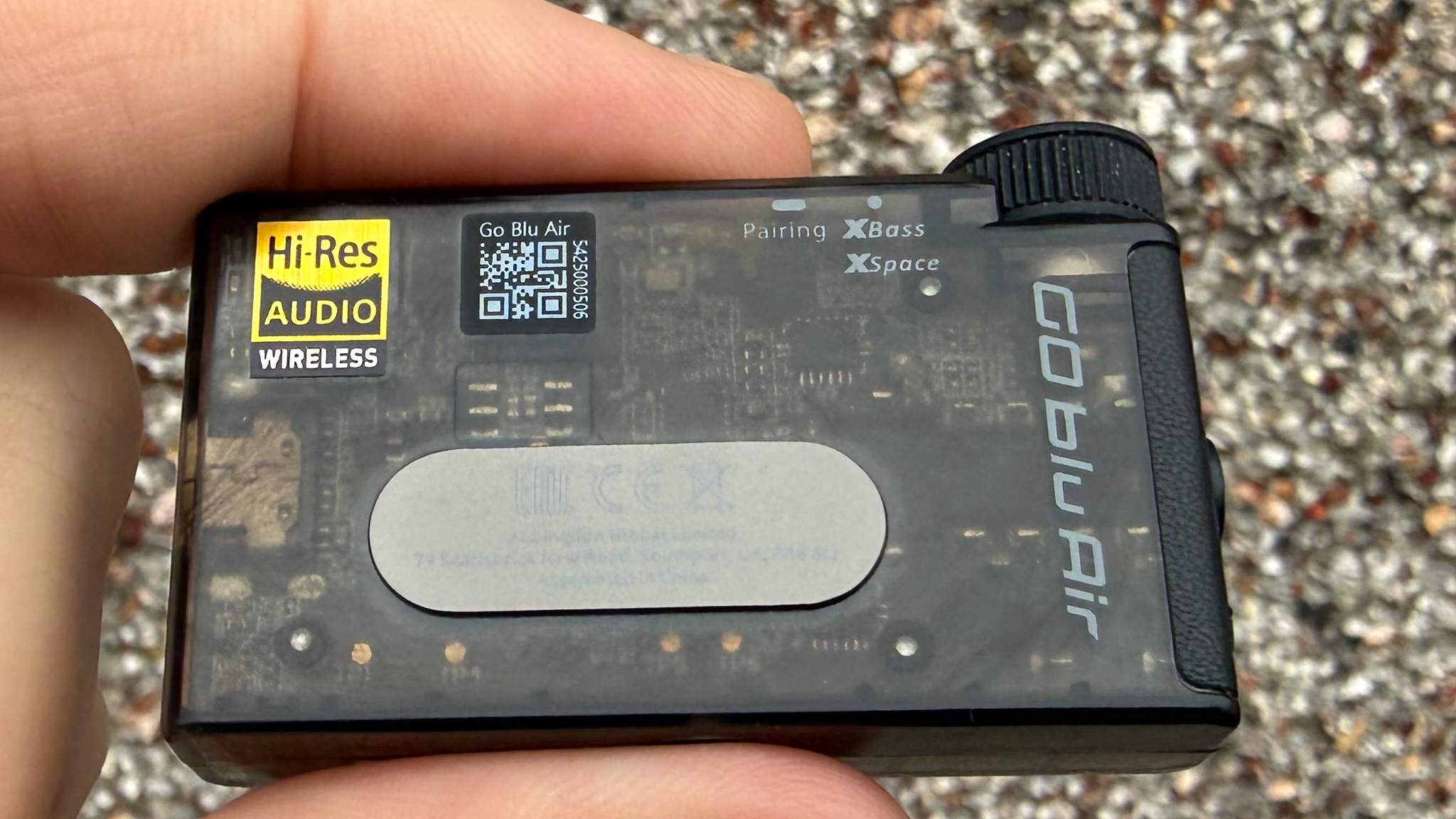
The iFi GO Blu Air is based around a Cirrus Logic Master Hi-Fi DAC and features iFi’s own XBass bass expansion and XSpace audio expander. There are also standard and minimum phase digital filter options to shape the sound further.
The headphone outputs deliver up to 165mW into 32 ohms on the 3.5mm out and up to 262mW into 32 ohms on the balanced output. iFi calls the 3.5mm output “S-balanced”, with dual-mono headphone amplification all the way to the output socket. You can read iFi’s tech note about it, but essentially the company says it’s particularly useful for ultra-sensitive IEMs. SNR (or signal-to-noise ratio) on both outputs is a highly respectable ≥110dBA and battery life is up to 10 hours via the internal 450mAh battery, dropping to about 7.5 hours if you’re using the LDAC codec. Recharging takes less than an hour.
The iFi GO Blu Air has Bluetooth 5.2 (up from the 5.1 of the GO Blu) with LDAC, LDHC and aptX Classic, aptX HD and aptX Adaptive as well as the obligatory AAC and SBC codecs. It supports resolutions of up to 24-bit/96kHz. Unlike the previous GO Blu the USB-C port is purely for charging; this model doesn’t double as a wired DAC.
Features score: 4 / 5
iFi GO Blu Air review: Sound quality

- Tons of fun on IEMs and over-ear headphones
- No on-board EQ to tame high-end harshness
- Audio enhancers are subtle but effective
The iFi GO Blu Air is a lot of fun with both headphones and IEMs, delivering an inviting soundstage and excellent clarity from a range of audio sources. It’s particularly good on well-produced, spacious tracks such as Bob Marley’s Could You Be Loved, Peter Gabriel’s Shaking The Tree, Christine and the Queens’ Tilted or The Blue Nile’s Tinseltown in the Rain, delivering a consistently enjoyable, revealing and dynamic listen.
The GO Blu Air doesn’t have its own equaliser, and I did find myself reaching for software EQ when I listened to fairly trebly recordings such as Junior Varsity’s Cross The Street, Sugar’s Changes and Kygo & Selena Gomez’s It Ain’t Me: getting the bass to smile-inducing levels in my IEMs made their high frequencies a little too prominent for my taste, although that was less of an issue in my less excitable over-ear headphones.
I’m wary of bass and space enhancement options as they often color the sound in too-noticeable ways, but I was pleasantly surprised by both XBass and XSpace here. Their effects are subtle, with the former adding a little more low end that gave my open-back headphones more of a closed-back punch without introducing distortion at sensible listening levels, overpowering the other frequencies or overly changing the sound. XSpace impressed me too, making the likes of Talk Talk and acoustic music more subtly spacious.
Sound quality: 5 / 5
iFi GO Blu Air review: Design

- Similar to GO Blu but more plasticky
- 3.5 x 33.7 x 19.5mm (WxHxD) and just 30g
- Magnetically attached clip is surprisingly strong
I’d suggest that the Air looks a little less premium than the GO Blu, but I’m not a fan of that model’s rather 1970s-cigarette-lighter appearance – and if a slightly more plastic appearance is part of the reason why the new model is cheaper, I’m all in favor.
The GO Blu Air is very compact at 3.5 x 33.7 x 19.5mm (2.11 x 1.33 x 0.77”) and it weighs 30g. There is a single rotary volume/transport controller, which iFi calls the ChronoDial, on the right. The dial is multi-mode: turn it to adjust the volume, press to play, pause or skip, and long-press to activate your phone’s voice assistant. Below the dial is a button for enabling or disabling Xbass and Xspace, for setting the digital filter and for Bluetooth pairing; on the other side there’s a single button for power on/off and Bluetooth format announcement. Up top you’ll find a 4.4mm balanced headphone output and a 3.5mm output plus the status light for Xbass, Xspace and Bluetooth.
One of the design features I like is the detachable magnetic clip, which saves you having to buy a clip-on case: you can use the clip to attach the GO Blu Air to your clothing, bag or belt. I’d like it even more if I could use the magnet to clip the GO Blu Air to the back of my phone; I did try, but while it does attach it’s not strong enough to clamp through my phone’s case.
Design score: 4 / 5
iFi GO Blu Air Review: Usability and setup
- Effortless Bluetooth pairing
- No display: color status lights instead
- Remembering what buttons do is hard at first
It’s very easy to set up the GO Blu Air: simply switch it on and it enters pairing mode the first time you use it. You can then connect it in your device’s Bluetooth settings and you’re good to go.
The lack of a display is understandable in such a small device, but it does mean trying to remember what the status light colors mean and which button does what can be tricky. It doesn’t take long to learn but the inclusion of a pocket-sized quick start guide comes in very handy.
Whether you’re working from the guide or from memory it’s all straightforward: single button presses take you from no enhancement to XBass only, to XSpace only, and to both XBass and XSpace; a spin of the ChronoDial adjusts the volume while a short click takes care of play/pause and a longer click skips to the next track.
Usability and setup score: 4 / 5
iFi GO Blu Air review: Value
- Competitively priced but some rivals have higher spec
- Previous model is now discounted so price gap is smaller
- A good buy if you don’t need a USB DAC
If the lack of a USB DAC isn’t a deal-breaker this is a very good Bluetooth dongle for a very good price. But it’s a very competitive market, and I’d suggest looking at some alternatives too – including the GO Blu Air’s predecessor.
The GO Blu Air is effectively a GO Blu without the USB DAC and as a result it has a significantly lower price tag, but at the time of writing I found the original GO Blu discounted to just under £169 so there’s less of a price gap than the two devices’ MSRPs suggest.
Value score: 4 / 5
Should I buy the iFi GO Blu Air?
|
Attributes |
Notes |
Rating |
|---|---|---|
|
Features |
Bluetooth-only with all the key aptX options plus LDAC too. 3.5mm and 4.4mm balanced outputs. |
4/5 |
|
Design |
A little plasticky-looking and too small to have a screen, but it’s exceptionally small and light with a great magnetic clip |
4/5 |
|
Sound quality |
Tons of fun with a spacious soundstage and useful enhancers |
5/5 |
|
Value |
Competitively priced but up against very strong rivals |
4/5 |
Buy it if…
Don’t buy it if…
iFi GO Blu Air review: Also consider
The iFi GO Link USB DAC is an excellent and affordable wired headphone DAC, and if you want USB and Bluetooth capabilities the GO Blu is still available and often discounted.
The key rivals here include FiiO’s KA13 and BTR15. The former is a screen-free wired USB DAC and the latter is both USB and Bluetooth. It’s marginally cheaper than the iFi: at the time of writing the BTR15 is £114 in the UK, $119 in the US and $219 in Australia.
How I tested the iFi GO Link Max
- TIDAL, hi-res music files, vinyl and Logic Pro projects
- Beyerdynamic and Philips over-ears and SoundMagic IEMs
I tested the GO Blu Air over two weeks with a variety of headphones and IEMs including Beyerdynamic DT990 Pro and Philips Fidelio X2HR open-back headphones, Beyerdynamic DT770 closed-back headphones, and SoundMagic E11C IEMs.
I connected the GO Blu Air to a Samsung Galaxy S25 for hi-res streaming services over LDAC and listened to locally stored lossless audio and my own multitrack Logic Pro X projects via AAC from my MacBook Pro. I also connected my Audio-Technica turntable, which transmits aptX.