Tech
inside Smartschool’s approach to exam prep

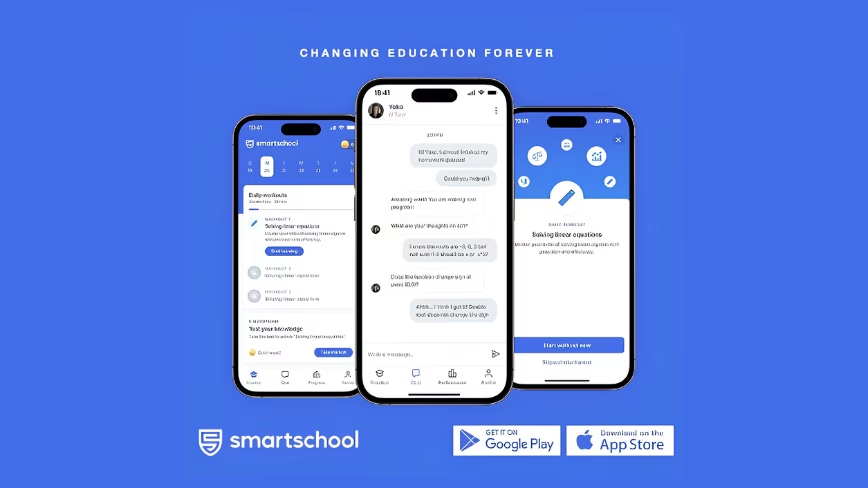

Artificial intelligence has proven that it can trawl the internet to retrieve information quickly for answering questions. But teaching students using AI is a harder task. The stakes are even higher when the goal is not just learning in school, but performing well on high-stakes exams like the SAT and ACT.
On the face of it, education might seem like a natural extension of large language models. If AI can replace customer support, certainly it can provide back answers just as a teacher would.
But being educated in a school is not a consumer experience. Teachers and school administrators aren’t looking for chatbots. Chatbots can hallucinate, chatbots can make mistakes. But if you hand over the instruction of a pupil to a chatbot, you can impede a student’s progress for months. Educators need the tools they use to be bullet-proof, safe, accountable, and consistent.
That’s why the creators of Smartschool, a Palo Alto-based educational technology company, decided to build their platform by starting with the problems faced by students and educators. Rather than adapting existing AI tools, they invested in building an AI tutor designed to help students truly learn and perform under pressure. That gap between a clever chatbot and a tool educators can actually trust is what Smartschool set out to close, with the SAT and ACT among the key exams it supports.
In a way, they were well prepared for the task. Smartschool was founded by three Polish entrepreneurs – Matt Masłowski, Paul Burzyński, and Kajetan Lewandowski. The trio had experience working for a variety of tech firms along with a solid education background. They also grew up in a Poland undergoing a difficult economic transition, where opportunities were limited and access to quality education was far from guaranteed.
“Coming from relatively underprivileged backgrounds, we wanted to be able to help people get great educations and make it possible to have similar stories, so long as they want to take action,” remarks Maslowski, Smartschool’s CEO. “Because if we keep the current education system as it is, when the whole world is changing so rapidly, we will have an extremely unfair and unequal society in the future,” he says.
The challenges of AI-based learning
A core observation of the Smartschool team is that generic AI systems were not designed for the realities of the classroom. This is particularly true for mathematics education, as large language models are known to hallucinate. They might jump ahead, skip steps, and reward wrong answers. These kinds of technical glitches can pose real problems for teachers and students, and certainly are responsible in part for the skepticism that now exists towards AI.
AI cannot also fit all in an educational setting. A successful platform needs to be customizable, so that it can be aligned with the curriculum and state standards, not to mention data privacy regulations.
“Most edtech tools are just wrappers around ChatGPT,” says Paul Burzyński, Smartschool’s chief product officer. “They have no understanding of what a student is actually working on in class.”
That gap between impressive AI demonstrations and practical classroom requirements is what Smartschool set out to address. Burzyński led the translation of advanced AI capabilities into classroom-ready workflows, working with teachers, students, and school districts to ensure the technology supports learning rather than distracting from it.
Mathematical reasoning
At the center of its platform is a proprietary mathematical reasoning engine developed under the product vision of Chief Product Officer Paul Burzyński and implemented by CTO Kajetan Lewandowski’s engineering team. Unlike general-purpose AI systems, Smartschool’s platform was designed specifically for real classroom conditions, combining educational workflows with advanced mathematical reasoning capabilities.
“It can evaluate handwritten student work, interpret diagrams and geometric constructions, and assess open-ended solutions,” Burzynski explains. “This is important because student learning is not limited to multiple-choice answers; it often involves showing reasoning steps and making mistakes that reveal thought processes.”
Rather than simply providing up answers like a GPT-powered Chatbot or search engine, Smartschool’s system is designed to give structured feedback that helps students improve their reasoning. The company reports that its system achieves 99.6 percent accuracy when assessing and providing feedback on high-school-level mathematics problems. The goal is not just correctness, but educational usefulness.
Under Burzyński’s product leadership, the Smartschool team designed the system for scale and classroom integration. It can be connected with existing learning management systems, curricula, and single sign-on platforms. Teachers can also assign work with one click, while student submissions are automatically graded and synced with gradebooks. Educators receive insights into student progress and misconceptions too.
“This design ensures the technology fits into existing teaching workflows instead of forcing schools to adapt to new systems,” says Burzynski.
AI that teachers and students can trust
As CEO, Masłowski has led Smartschool’s expansion into U.S. school districts while working closely with educators and administrators to ensure the platform delivers measurable learning outcomes. Alongside Burzynski and Lewandowski, he has helped demonstrate the reliability of the system to schools adopting AI-powered learning tools for the first time. But educators have caught on, encouraged by early success stories. Smartschool now operates in 30 US school districts, including within the New York City Department of Education and in Boston Public Schools. And there are measurable results. A study from the Learning Experience Design Research Institute found that 90 percent of students using the platform in Wisconsin’s Pewaukee School District met or exceeded math standards, for example.
Investors, and the media, have also taken note. The company in April raised $3 million in seed funding from private angels Mati Staniszewski (ElevenLabs), Marcin Żukowski (Snowflake), and Nick Woods (HazelHealth), as well as Inovo VC, the a16z Scout Fund, and The Explorer Fund. Several investors were early supporters of the team. Both Masłowski and Burzyński have also been recognized in Forbes 30 Under 30.
According to Maslowski, while it takes time to build trust in a market as conservative as edtech, the kinds of relationships the company is building, based on its experience and knowhow, should be in place for the long term. “Since the beginning, our focus has remained consistent,” he says. “We want to build AI that teachers can trust and that improves real educational outcomes in classrooms.“
You must be logged in to post a comment Login