Tech
Inside SURBL, the email blacklist that checks your links, not your IP


Watching email marketers obsessively monitor their sender IP, checking it daily, warming it carefully, treating it like a rare orchid, is not only relatable, it’s a reminder of how much conventional wisdom can leave you completely exposed.
Because the blacklist that’s killing your campaigns in 2026 probably has nothing to do with your IP at all. It has to do with what’s inside your email. Specifically, the links.
That’s the uncomfortable premise behind SURBL, the Spam URI Realtime Blocklist, and once you understand how it works, a lot of “mystery” delivery failures stop being mysterious. Warmy.io’s research team has published a full breakdown of what causes a listing, how to detect it, and how to recover, details we draw on throughout this piece.
The list that checks your links, not your IP
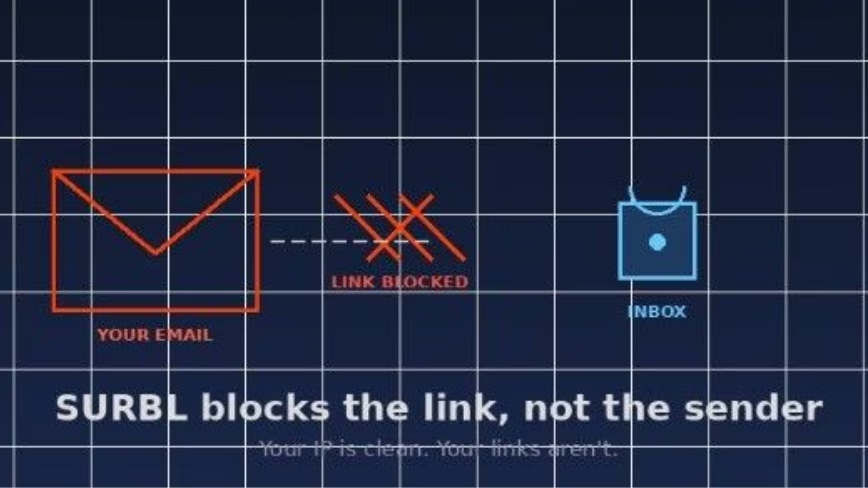
SURBL doesn’t care where your email comes from. It cares where it’s going. While traditional blocklists like Spamhaus or Barracuda evaluate the sender, SURBL evaluates the message, every URL buried in your body copy, every social icon, every tracking pixel.
This distinction changes everything. A clean sending IP offers zero protection if a link inside your email points to a flagged domain. Your message arrives in the inbox. The links are silently disabled. Your click-through rate quietly collapses, and you have no idea why. For a deeper technical breakdown of how the system works, the SURBL blacklist report from Warmy.io is the most thorough public resource currently available.
Five lists, five different problems
SURBL isn’t actually one list. It’s five, each targeting a different category of threat, and each requiring a different fix if you land on one.
PH (Phishing): Domains used for credential harvesting or identity theft.
MW (Malware): Sites hosting or distributing spyware, viruses, or ransomware.
CR (Cracked Sites): Legitimate websites that have been quietly compromised and repurposed by spammers, without the owner ever knowing.
AB (AbuseButler): Domains flagged through high-volume sending and automated spam pattern analysis.
Multi: A combined super-list that lets mail servers query all four in a single DNS lookup.
The CR list is the one that keeps legitimate business owners up at night. Your site can look completely normal, loading fine, taking orders, passing every visual check, while hidden redirect scripts installed by attackers are triggering SURBL flags behind the scenes.
How you end up on the list without doing anything wrong
Here’s the part nobody likes to hear: you don’t have to send spam to get listed on SURBL. That’s what makes it different from almost every other blacklist, and what makes it so disorienting when it happens.
A hacked WordPress install can plant redirect scripts invisible to you but obvious to SURBL scanners. An affiliate link carries the reputation history of every sender who ever used it, including the ones who spammed it to death before you. An insecure contact form on your website is an open door for spammers to push their own links through your domain. And linking to any domain registered in the last 72 hours is, on its own, one of SURBL’s strongest triggers. New domain, no history, no trust.
The warning signs hiding in plain sight
SURBL failures tend to be silent, which is what makes them dangerous. The signals are there, they just don’t look like a blacklisting at first glance.
Watch for SMTP 554 bounce codes on a clean sending IP (almost always a URI block), a sudden unexplained drop in click-through rates (Gmail and Outlook use SURBL data to disable links in delivered messages), or “too many hops” notifications where a receiving server hit its limit trying to scan your URLs. Any complaint spike tied to a specific URL rather than your sending domain is also worth isolating immediately. Warmy’s deliverability monitoring flags these signals automatically, before they escalate into a full listing.
Getting off: the sequence matters as much as the fix
Removal from SURBL is not a form you fill out and wait. The sequence is non-negotiable: identify the root cause, fix it completely, then submit. Sending a removal request before the underlying issue is resolved doesn’t just fail, it actively slows you down, as vague submissions without technical documentation get deprioritised.
Start at surbl.org/lookup to confirm which sub-list you’re on. That determines your remediation path. CR listing? Clean your site with Sucuri or a Cloudflare WAF and document what you found. AB listing? Identify and stop the high-volume behaviour that triggered spam trap hits. Then file a detailed removal request, specific causes, specific steps taken, nothing vague. The full step-by-step remediation framework is available in Warmy.io’s SURBL report, including sub-list breakdowns built for technical teams.
Prevention costs less than a crisis
A few habits dramatically reduce SURBL exposure before it becomes a problem. Audit every link in your email templates, including the ones you forget are there: social icons, tracking pixels, footer links. Use a dedicated sending domain so a listing never touches your primary brand. And don’t link to anything registered in the last 72 hours. No exceptions.
For new domains or those recovering from a previous listing, Warmy.io’s AI-powered email warmup builds sender reputation gradually, reducing the behavioural signals that trigger AB-type listings before they start.
From silent link-disabling to cracked CMS sites, SURBL is proving something the email industry is still slow to absorb: reputation isn’t just about where your email comes from. It’s about everywhere it tries to go.
You must be logged in to post a comment Login