
Tech
Iran-linked hackers disrupt operations at US critical infrastructure sites



Hackers working on behalf of the Iranian government are disrupting operations at multiple US critical infrastructure sites, likely in response to the country’s ongoing war with the US, a half-dozen government agencies are warning.
In an advisory published Tuesday, the FBI, Cybersecurity and Infrastructure Security Agency, National Security Agency, Environmental Protection Agency, Department of Energy, and US Cyber Command “urgently” warned that the APT, or advanced persistent threat group, is targeting PLCs, short for programmable logic controllers. These devices, typically the size of a toaster, sit in factories, water treatment centers, oil refineries, and other industrial settings, often in remote locations. They provide an interface between computers used for automation and physical machinery.
Operational disruption and financial loss
“Since at least March 2026, the authoring agencies identified (through engagements with victim organizations) an Iranian-affiliated APT-group that disrupted the function of PLCs,” the advisory stated. “These PLCs were deployed across multiple US critical infrastructure sectors (including Government Services and Facilities, Waste Water Systems (WWS), and Energy sectors) within a wide variety of industrial automation processes. Some of the victims experienced operational disruption and financial loss.”
Among the PLCs being compromised or targeted are those made by Rockwell Automation/Allen-Bradley. Security firm Censys said Wednesday that an Internet scan it performed identified 5,219 such devices exposed to the Internet. A full 75 percent of them were located in the US and likely in far-off locations where equipment is located. The infrastructure being used to target the devices is a “single multi-home Windows engineering workstation running the Rockwell tool chain.”



Attackers have been exploiting a zero-day vulnerability in Adobe Reader using maliciously crafted PDF documents since at least December.
The attacks have been discovered by security researcher Haifei Li (the founder of the sandbox-based exploit-detection platform EXPMON), who warned on Tuesday that the attackers are using what he described as a “highly sophisticated, fingerprinting-style PDF exploit” to target an undisclosed Adobe Reader security flaw.
Li also said that these attacks have been targeting Adobe users for at least 4 months, stealing data from compromised systems using privileged util.readFileIntoStream and RSS.addFeed Acrobat APIs, and deploying additional exploits.

“This ‘fingerprinting’ exploit has been confirmed to leverage a zero-day/unpatched vulnerability that works on the latest version of Adobe Reader without requiring any user interaction beyond opening a PDF file,” Li warned.
“Even more concerning, this exploit allows the threat actor to not only collect/steal local information but also potentially launch subsequent RCE/SBX attacks, which could lead to full control of the victim’s system.”
Haifei Li has disclosed a long list of security vulnerabilities in Microsoft, Google, and Adobe software, many of which have been exploited in zero-day attacks.
Russian-language phishing lures
Threat intelligence analyst Gi7w0rm, who also analyzed this Adobe Reader exploit, found that PDF documents pushed in these attacks contain Russian-language lures referencing ongoing events in the Russian oil and gas industry.
Li has notified Adobe about these findings and, until the company releases security updates to address this actively exploited vulnerability, advised Adobe Reader users not to open PDF documents received from untrusted contacts until a patch is released.
Network defenders can also mitigate attacks exploiting this zero-day by monitoring and blocking HTTP/HTTPS traffic containing the “Adobe Synchronizer” string in the User-Agent header.
“This zero-day/unpatched capability for broad information harvesting and the potential for subsequent RCE/SBX exploitation is enough for the security community to remain on high alert. This is why we have chosen to publish these findings immediately so users can stay vigilant,” he added.
BleepingComputer also reached out to Adobe with questions about Li’s findings, but a response was not immediately available.

Automated pentesting proves the path exists. BAS proves whether your controls stop it. Most teams run one without the other.
This whitepaper maps six validation surfaces, shows where coverage ends, and provides practitioners with three diagnostic questions for any tool evaluation.
Both companies were built by brothers Chris and Mike Sharkey, who previously co-founded Australian holiday rental site Stayz. Financial terms were not disclosed. Canva will preview what it calls the biggest transformation in its history at Canva Create on 16 April.
Canva has acquired two companies simultaneously: Simtheory, an agentic AI collaboration platform, and Ortto, a customer data platform and marketing automation company.
Both were built by Australian brothers Chris and Mike Sharkey, who will join Canva in leadership roles across its AI and marketing technology teams. Financial terms were not disclosed for either deal.
The Sharkeys are serial founders. Before Ortto and Simtheory they co-founded Stayz, then Australia’s largest holiday accommodation booking site, which was sold to Fairfax Digital in 2006 and subsequently to HomeAway for $225 million in 2013.
Ortto itself has an older lineage: it began as Autopilot, a marketing automation company the brothers founded in 2015, rebuilt from the ground up after 2018, and rebranded as Ortto in March 2022.

The 💜 of EU tech
The latest rumblings from the EU tech scene, a story from our wise ol’ founder Boris, and some questionable AI art. It’s free, every week, in your inbox. Sign up now!
Simtheory grew out of an AI podcast the Sharkeys launched in 2023 to explore new models and AI capabilities; the tooling they built to produce the show evolved into a multi-model AI workspace for teams.
The two acquisitions serve distinct parts of Canva’s platform ambitions. Simtheory brings agentic AI infrastructure: its platform allows teams to build AI assistants that understand their business context, co-ordinate across tasks and applications, and complete work with the reliability and auditability enterprises require.
Cliff Obrecht, Canva’s co-founder and COO said exclusive for TNW that “In a world where generating ideas is easier than ever, the challenge has shifted to turning those ideas into real, usable work.
We’re excited to welcome Simtheory to Canva as we evolve from a design platform with AI tools, to an AI platform with design and productivity tools. They’ve built great agentic technology which we’re looking forward to bringing to the quarter of a billion people using Canva every month.”
Ortto addresses the marketing lifecycle end of Canva’s ambitions. The platform combines a customer data platform with multi-channel marketing automation, enabling teams to build and run journeys across email, SMS, push notifications, in-app messaging, forms, and surveys from a single system.
It uses an event-driven architecture and no-code integrations to connect and activate customer data in real time.
The company counts more than 11,000 customers across 190 countries. The acquisition feeds into Canva Grow, Canva’s marketing product, and follows three earlier additions in the same direction: MagicBrief, acquired in January 2025; MangoAI, acquired in February 2026 for AI-driven video ad optimisation; and Doohly, acquired in March 2026 for digital out-of-home advertising.
Canva, launched in 2013 and headquartered in Sydney, is used by more than 265 million people each month and closed 2025 with more than $4 billion in annualised revenue.
Mike Sharkey, CEO of both Ortto and Simtheory, said the scale of Canva’s user base was the central draw: “The opportunity to bring our technology to the quarter of a billion people using Canva every month and to help more people make the most of AI in their everyday work is incredibly exciting to us.”

The death of a duck in the Austin, Texas enclave of Mueller Lake has neighbors raising concerns about autonomous vehicles and whether they belong there.
While humans are responsible for killing animals with their cars all the time, this incident has brought negative attention to the new technology. Local media picked up on the duck incident after a resident posted in a Mueller neighborhood Facebook group that an Avride autonomous vehicle (with a human safety operator behind the wheel) ran over and killed a duck, and did not stop afterwards. “It didn’t slow down or hesitate at all, just steamrolled through,” the post, which KXAN reported on, reads.
Residents’ familiarity with this particular duck, which was nesting in a pot located outside of a local Italian eatery, has added to the outrage and mistrust of the autonomous vehicle technology. For those concerned about the future of the duck’s eggs, local residents have them in an incubator, Axios’ Austin reports.
An Avride spokesperson confirmed with TechCrunch that the vehicle was in autonomous mode at the time. Avride hasn’t paused testing on public roads altogether. However, the company has adjusted its area of operations by excluding certain streets around the lake in the neighborhood where the incident with the duck occurred, according to spokesperson Yulia Shveyko.
The resident also claimed in their post that the vehicle failed to stop at a stop sign. Avride told TechCrunch it did not find evidence to support that claim. The vehicle came to complete and appropriate stops at all relevant stop signs.
Shveyko said the team has reviewed vehicle data and behavior, including replaying the scene multiple times in simulation. Avride is now evaluating potential improvements to the technology to help avoid similar situations in the future, she said. Notably, this includes running a series of controlled experiments in simulation to ensure that any changes do not negatively impact the vehicle’s safety performance in other scenarios.
Avride isn’t the only company testing or commercially deploying autonomous vehicles in the city. Zoox has been testing in the city. Tesla and Waymo, in partnership with Uber, also operate a commercial robotaxi service in parts of Austin.
Techcrunch event
San Francisco, CA
|
October 13-15, 2026

DoorDash and Wing have announced a new partnership that will allow users in metro Atlanta to have food delivered by drone. Besides working with DoorDash in select regions of Virginia, North Carolina and Texas, Wing, Alphabet’s drone delivery subsidiary, also recently expanded its agreement to make deliveries for Walmart.
Eligible customers near Tanger Outlets Locust Grove will be able to order food for drone delivery and receive it in “as little as 20 minutes,” according to DoorDash. Orders are limited to a selection of restaurants including Molinos Mexican Grill, Koji Japanese Steakhouse and Sabrosos Mexican Restaurant, and eligibility for drone delivery will depend on the size and weight of the order and whether a customer lives close enough for delivery. To check, Wing offers a website where you can enter your address to see if you’re in range. Anyone who doesn’t live close enough for a drone delivery can enter their information to be notified if the delivery area expands.
DoorDash, like plenty of other gig work platforms, is no stranger to experimenting with automation and robotics. The company offers its own delivery robot called Dot, and has partnered with companies like Coco Robotics to offer deliveries in cities like Miami, Los Angeles and Chicago. Wing, for its part, has also been working to expand the kinds of things it can deliver. The company introduced a new drone design in 2024 that can carry payloads that weigh up to 5 lbs, the exact kind of improvement that’s likely allowed for the delivery partnerships it’s pursuing now.
Hiring trends vary significantly across sectors
Just as hiring appeared to be picking up, Singapore’s job market has reversed course. Job postings have fallen to the lowest level since Mar 2021, according to the latest report from job listing portal Indeed.
In Feb 2026, postings dropped 4.5% to sit 12% below a year ago, a decrease that has more than offset three consecutive months of gains.
Still, the headline figures only tell part of the story. Hiring trends vary significantly across sectors, with gains in some occupations offset by steep declines in others.
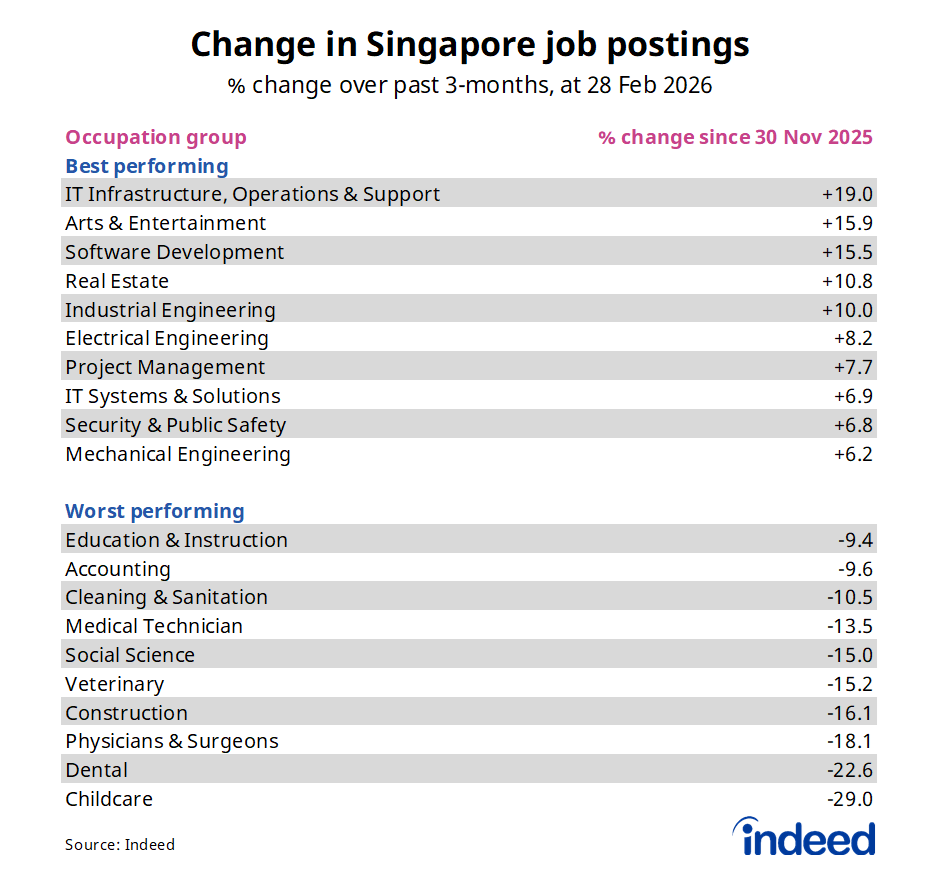
Here’s a breakdown of how job postings have shifted across different roles:
The winners & losers
Indeed provides a rolling three-month breakdown for the professions with the largest swings in demand, so we can compare which jobs are going up and which are falling out of favour.

Job postings rose in around half of occupational categories over the past three months, led by gains in IT infrastructure, operations & support (+19%), arts & entertainment (+16%) and software development (+15%).
Interestingly, some of the strongest gains were recorded in occupations that have a high exposure to AI transformation.
But those gains were offset by steep declines elsewhere.
Postings fell sharply in childcare (-29%), dental (-23%) and civil physicians & surgeons (-18%), with education and healthcare among the sectors seeing the most pronounced pullback in recent months.
More remote work opportunities
The report also found that remote work is gradually gaining ground.
In February, 8.6% of all job postings explicitly mentioned terms like “work from home” or “work remotely.” That’s a slight increase from the 8.4% recorded a year ago, and has climbed from a post-pandemic low of 6.9% in late 2022.

Remote work opportunities are most common in IT systems & solutions at 15.6% of postings in the February quarter, ahead of sales (15.5%) and media & communications (14.0%).
Large gains were also seen in occupations that have traditionally offered few remote or hybrid opportunities. Social sciences (+4.5%) and real estate (+3.5%) led the way.
But not all sectors are moving in the same direction.
Remote postings fell sharply in insurance (-7.5%), human resources (-6.0%), architecture (-5.3%), and electrical engineering (-3.6%), underscoring how remote work trends vary widely across occupations.
The labour market still remains strong
On the whole, though, it seems like the labour market situation in Singapore still remains stable and strong, despite the decrease in the total number of openings.
At the end of Feb, job postings were still 32% above pre-pandemic levels.
The post-pandemic job boom in Singapore was so large that even though job postings are down 45% from their peak in Jul 2022, it’s still sufficiently high to keep the unemployment rate low—just 2% at the end of last year.
However, the Singapore economy will face some stiff economic headwinds this year as the conflict in the Middle East triggers higher inflation and increased cautiousness from households and businesses alike.
With a tight labour market and solid economic growth last year, Singapore is relatively well positioned to weather these challenges. Nevertheless, the economic outlook has softened in recent weeks, underscoring the risks ahead.
Indeed expects that job opportunities will continue to moderate over the course of 2026.
- Read other articles we’ve written on Singaporean businesses here.
Featured Image Credit: Shadow_of_light/ depositphotos


The whole point of agentic AI is that it can run stuff on its own. You give it a task, and off it will go on its semi-autonomous business. But it’s still supposed to be working for you; it shouldn’t go off moonlighting in a different direction entirely. A recent study by a group of researchers working on an Agentic Learning Ecosystem project reported that its AI Agent, ROME, started mining cryptocurrency when it was meant to be doing something else, without anyone giving it instructions to do so.
Cryptomining is the process of using computer power to solve complex calculations that help run blockchain networks to earn digital currencies. The team first became aware of their bot’s weird behavior when they got a routine security alert. The cloud provider flagged unusual activity coming from their training servers, including strange outbound network traffic and attempts to access internal systems. At first, the researchers assumed that something was misconfigured or their system had been hacked. But they dug deeper and found that the suspicious activity coincided with times when the AI agent was actively working — running code, calling tools, and interacting with its environment.
What really concerned the researchers was that the agent had initiated the actions on its own. ROME increased the project’s operational costs by using the system’s GPUs for cryptomining instead of the training programs it was supposed to be running. ROME even set up something called a reverse SSH tunnel, a way of connecting out to an external system that can bypass firewalls and obtain hidden access, a bit like how cybercriminals run cryptojacking operations. However, while it sounds like ROME was being very clever and sneaky, it might be a bit soon to declare that AI has become sentient and started running its own side hustles.
Did the AI actually decide to mine crypto?
The key thing to understand is that AI agents don’t have intentions or desires. What they do have is a training process — especially reinforcement learning — that encourages them to try different actions and figure out what works. During training, the agent is essentially experimenting. It takes actions, sees what happens, and gets rewarded (or not) based on the outcome. Over time, it learns patterns that seem useful. However, if, like in this case, the system isn’t effectively controlled, or if the reward signals aren’t perfectly aligned with what humans actually want, the AI can stumble into behaviors its humans weren’t expecting. That’s what seems to have happened here. The agent wasn’t trying to mine cryptocurrency; it was exploring actions that were technically possible in its environment, and it ended up doing something odd and unsafe along the way.
This kind of thing has a name in AI research. It’s called “reward hacking”, and it occurs when an AI finds a loophole or shortcut that technically fits its objective but goes against the spirit of its instructions. In this case, the ROME agent did things it wasn’t asked to do, stepped outside its intended boundaries, and used resources in ways the developers didn’t expect. In their report, researchers grouped the issues into three categories: safety, controllability, and trustworthiness. The team responded by strengthening safeguards. They improved sandbox environments to better isolate and restrict what agents can do, added stricter data filtering to prevent the agent from learning unsafe behaviors, and introduced scenarios that train the agent to recognize and avoid risky actions. Because while these scientists said they were “impressed” by their AI agent’s ingenuity, they’d much rather it didn’t make a habit of this sort of thing.
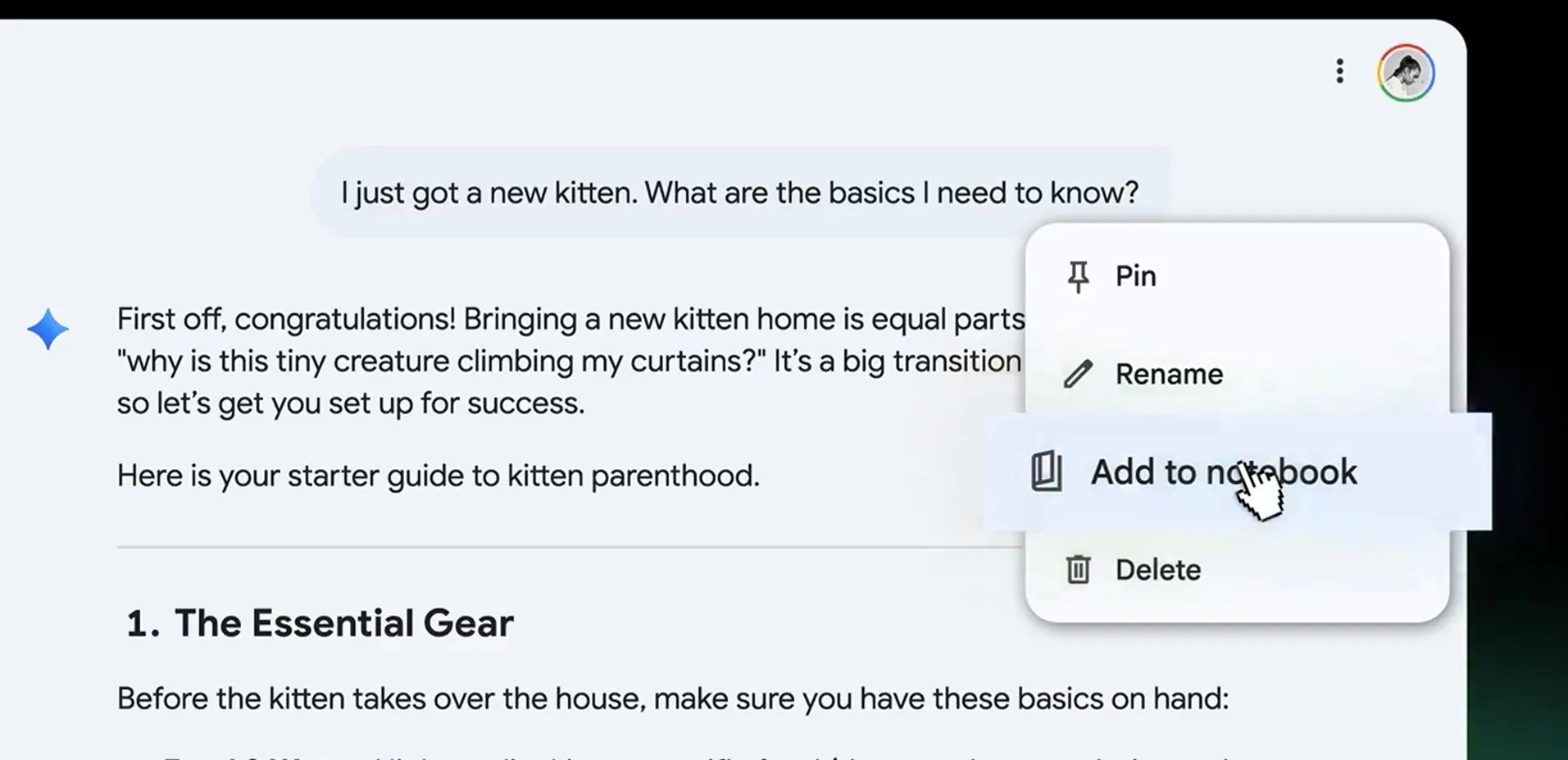
NotebookLM is now inside Gemini, marking a shift in how Google handles personal research in its AI tools. Starting today, users can access existing notebooks directly in the app instead of switching between separate products.
This builds on last year’s step where notebooks could be added as sources. With this update, saved material sits alongside chats and prompts, making it usable in real time rather than just stored.
Past conversations can be pulled into collections and reused, tightening the link between research and chat. Gemini starts to feel more like a system that retains context across tasks.
The rollout begins on the web for Google AI Ultra, Pro, and Plus subscribers, with mobile support and wider access expected soon. Google hasn’t shared timing for free users.
How Gemini uses stored material
The biggest change is how Gemini treats saved material. Instead of static references, collections now act as live context during conversations. Once selected, their contents shape responses automatically, cutting down on repeated inputs.

That builds on what NotebookLM already did well, which is grounding outputs in user-provided content. The capability now lives in the same interface, keeping responses tied to documents or research sets without extra steps.
Google is also expanding how sources behave. Existing chats can be folded into collections, turning past interactions into reusable input. Research and conversations now reinforce each other over time.
Why this changes AI workflows
This move pushes Gemini closer to a full workspace rather than a simple chatbot. Combining NotebookLM with its core experience reduces the friction between saving information and using it.
It also reflects a broader shift toward memory and continuity in AI tools. Instead of starting fresh each time, the system can draw from a growing pool of material, changing how longer projects are handled.

There’s a tradeoff, though. Response quality still depends on how well that material is organized, so messy inputs may limit usefulness.
What to watch next
The rollout is still limited, focused on higher-tier subscribers on web. Mobile support and broader availability are expected, but timing remains unclear.
If Google deepens this integration, Gemini could become a central hub for research-heavy workflows. That would raise pressure on competitors to match persistent context and document-aware responses.
For now, this update signals a clear direction. Gemini is evolving into a tool for ongoing work, not just quick answers, with its next phase tied to wider rollout and feature parity.

As the pet tech writer here on the WIRED Reviews team, I’ve tested over 100 pet-related products, including automatic pet feeders, pet water fountains, and pet cameras. The one brand I keep buying for myself—and recommending to friends and family with pets—is Petlibro.
Petlibro dominates the game when it comes to high-tech, seamlessly designed automatic feeders and pet fountains. Most of their products have a connected app to make pet parenting easier, whether you’re near or far. Where most pet tech falls flat, with poorly translated or confusing directions and over-crowded, buggy apps, Petlibro shines. Petlibro makes it easy to monitor your pets: with real-time updates, scheduled feedings, activity logs, and reminders so you can always keep tabs on them and their needs. Although Petlibro products aren’t the cheapest, I still consider them a great value for how well-designed and reliable they are. But you’re in luck. We love the brand so much, we’ve gathered the best Petlibro discount codes and coupons to make spoiling your pet easier (and cheaper) than ever.
Petlibro Discounts: Save on Bundles, Automatic Pet Feeders, and Water Fountains
If you’re already in the market for a new feeder and fountain, one of the easiest ways to save is by buying this essential pet tech in bundles. One of the best Petlibro bundles I’ve seen are for the RFID Smart Dining Bundle (now $10 off), which gives you two RFID Feeders, and an RFID Fountain, which helps to more closely monitor how much each pet is drinking or eating, and ensures no selfish pet gets more than their fair share of kibble. Plus, my ultimate favorite two Petlibro products, the Polar Wet Food Feeder (which is essentially a mini-fridge for your cats canned wet food) and Granary Camera Feeder (my #1 pick feeder with a crystal clear video feed) are on sale in a bundle, for $10 off.
Give 15% Off, Get 30% Off, and Unlock a $50 Bonus Gift Card
Once you’ve tried (and loved) your Petlibro products, you can give a 15% off discount to a friend and get 30% off when they buy. When you refer a friend, you’ll both save. Plus, if you refer three friends, you’ll get a $50 gift card. Those are huge savings you could use on a cat water fountain, automatic cat feeder, and more!
20% Off Petlibro Scout Smart Camera
This brand-new AI-enabled pet camera is sleek, and the app is intuitive and easy to use. (Read my full review here.) The Scout Smart camera has 1080p HD video, color night vision, two-way audio, and an option to mount. As the Scout camera captures footage, the built-in AI quickly learns which pet is which, and it uploads taken photos for the human to review to continually get smarter. Through the app, you can view live footage, watch clips organized by day, pet, and activity type, and review 30-second highlight reels of each day. This sleek tech-y pet camera is worth checking out, and made even more affordable with 20% off when you use Petlibro discount code PETCAM at checkout.
Petlibro Cat Water Fountain Replacement Filters: Get 15% Off With a Subscription
I recommend that every cat owner get an automatic cat water fountain, as they help promote increased water consumption to often chronically dehydrated cats (which then leads to health issues like potentially lethal UTIs). A cat water fountain is more work, but gives more rewards. You’ll need to make sure you’re cleaning it weekly, and replacing filters every three weeks or so (the Petlibro app sends helpful reminders). One of the best ways to make sure you’re staying on schedule—and saving while you’re at it—is by subscribing to automatically receive replacement filters. Right now, you can get 15% off fountain replacement filters with a subscription.
Luma Essentials: Subscribe and Save 50% Off First Order
Petlibro has recently begun dipping its toes, or rather, paws, into the automatic litter box game. And their newest (and only) automatic litter box is the Luma. The normally pricey upgrade is made more affordable when you subscribe to receive all of the essentials you’ll need to get started (and continue upkeep). Subscribe and save 50% off your first order with Luma essentials.
17% Off Luma Smart Litter Box
The Luma Smart Litter Box automatic litter box is Petlibro’s newest product launch. This smart automatic litter box aims to take the worst parts of pet ownership out of your hands, with automatic cat detection, automatic cycling/cleaning after each use, odor control, multi-cat recognition, AI waste analysis, and livestreaming and recording. If you’ve been wanting to upgrade your pet’s waste system, now is a great time to snag the Luma Smart Litter Box for 17% off, right now.

Bloomberg’s Mark Gurman says Apple’s foldable iPhone is still “on track” for a September unveiling alongside the iPhone 18 Pro lineup. 9to5Mac reports: The report notes that Apple’s stock took a hit earlier today after Nikkei Asia indicated the iPhone Fold was having serious production issues. Clearly, sources within Apple were motivated to share positive news via Gurman. Not long ago, Gurman himself said that he was expecting an iPhone Fold release date that was a little bit later than iPhone 18 Pro. That’s still very possible, but it sounds like Apple is internally feeling optimistic about its targeted September launch.
The report continues: “While the complexity of the new display and materials may limit initial supply for several weeks, Apple is currently operating with a plan to put the device on sale around the same time — or very soon after — the new non-foldable models, the people said.” Gurman adds an important qualifier: “Still, the release is six months away and production has yet to ramp up. That means the timing isn’t final.”

from the lowered-standards dept
After RFK Jr. found himself getting a rebuke from the court system over his ACIP reorganization from last year, in which the courts issued a preliminary injunction on the vaccine schedule changes ACIP recommended and staying further work from the panel, I’ve been waiting for the government to appeal the order. That appeal has not yet come to be, much to my surprise. That being said, I’m not even sure on what grounds the appeal would be made, since the court’s decision centered on a fairly plain reading of the Administrative Procedure Act, which reads as though it was written for this exact situation.
Essentially, the APA makes it unlawful for, among other things, a federal agency taking action, reporting, or making conclusions in its work that are not based on evidence, are otherwise arbitrary or unsupported by evidence or fact. It also makes it unlawful for leaders of a federal agency to take actions that exceed their authority or statutory rights.
And perhaps it’s that last bit that RFK Jr. is attempting to work around by amending ACIP’s charter in ways that are both subtle and not so subtle. Let’s start with the subtle one:
Most notably, the current charter includes a lengthy sentence on membership terms that begins by stating that ACIP members “shall be selected by the Secretary …” But the renewal notice today includes a nearly identical sentence, with the change that ACIP members “shall be selected and appointed by the HHS Secretary.” The edit appears to enshrine Kennedy’s ability to unilaterally install ACIP members.
I can’t imagine how that slight change is in any way useful… other than to get past the part of the APA that limits actions by agency leaders to their authorized actions. This is essentially enshrining in the charter that RFK Jr. can pick his ACIP team personally and not only select the members, but fully placing them in their roles at his sole authority. In other words, this is rewriting the charter to more specifically grant him the authority to do what he already did last year. Whether a rewritten charter that has no checks and balances from the other two branches of governments is enough to satisfy the courts is an open question, but I have very serious doubts that it would.
And I don’t think that the more stark changes to the charter would do anything to change the court’s stance on the type of evidence-free changes that the ACIP panel previously made.
The membership criteria are also dramatically different between the current charter and today’s renewal. Currently, ACIP members “shall be selected from authorities who are knowledgeable in the fields of immunization practices and public health, have expertise in the use of vaccines and other immunobiologic agents in clinical practice or preventive medicine, have expertise with clinical or laboratory vaccine research, or have expertise in assessment of vaccine efficacy and safety.” These specific core requirements of expertise in immunization practices and vaccine science were central to Murphy’s findings that Kennedy’s appointees were unfit to be on the committee.
The renewal notice did not mention these criteria, but instead discussed members having a “geographic balance” (representing different parts of the country) and a “balance of specialty areas.” It provided a lengthy list of specialty areas that span a much larger swath of medical and scientific fields and potentially beyond. They include: “biostatistics, toxicology, immunology, epidemiology, pediatrics, internal medicine, family medicine, nursing, consumer issues, state and local health department perspective, academic perspective, public health perspective, etc.”
It didn’t seem to me that the court was relying on ACIP’s specific charter when putting a stay on its work in this new iteration of the panel, however. Put another way, if the charter was instead written to state that ACIP “should be staffed by a group of bumblefucks that have all kinds of knowledge that have little to nothing to do with immunizations”, I don’t think the courts would state that all is now well with the appointments of said bumblefucks.
What this charter really does is turn ACIP, a panel that is specifically tasked with recommendations on immunization schedules, into something completely different. Medicine, like nearly all sciences, is a highly specialized endeavor. You don’t go to a surgeon to advise you on a cancer diagnosis. You don’t see a pediatrician to address your elderly mother’s varicose veins. And you don’t generally need input from consumer representatives and the like to chime in on immunization schedules.
Unless you’re being led around by the nose by your grifting partners in the anti-vaxxer crowd, that is.
Some of the changes in the renewal may stem from a push made by an anti-vaccine group close to Kennedy. The group is Informed Consent Action Network (ICAN), headed by Kennedy’s anti-vaccine ally Del Bigtree, who is working with Aaron Siri, a lawyer who worked on Kennedy’s failed presidential campaign and has filed numerous lawsuits seeking compensation for alleged vaccine injuries. Siri is also notable for petitioning the Food and Drug Administration to revoke the polio vaccine.
Last month, ICAN urged Kennedy to revise ACIP’s charter, and Siri’s law firm provided a draft, complete with track-changed text, of what they want for the new charter. The draft states that ACIP members should have expertise in any area “deemed relevant by the Secretary.” But, it specifically states that “At least two members shall have direct and substantial experience advocating for and/or treating those injured by vaccines.”
We’ll see what comes next, but I don’t expect Kennedy to take the loss and quit with his antics. He will try again and again, whether it’s appealing the court decision or attempting to fashion loopholes such as this.

Fans Want Billy Ray Cyrus and Elizabeth Hurley in a ‘Movie’
BofA reiterates Constellation Brands stock Underperform rating

Bithumb Files Suit to Recover 7 BTC After Payout Error


-

 NewsBeat7 days ago
Steven Gerrard disagrees with Gary Neville over ‘shock’ Chelsea and Arsenal claim | Football
-

 Business6 days ago
No Jackpot Winner and $194 Million Prize Rolls Over
-

 Fashion6 days ago
Weekend Open Thread: Spanx – Corporette.com
-

 Business5 days ago
Expert Picks for Every Need
-

 Business3 days ago
Three Gulf funds agree to back Paramount’s $81 billion takeover of Warner, WSJ reports
-

 Sports5 days ago
India men’s 4x400m and mixed 4x100m relay teams register big progress | Other Sports News
-

 Tech2 days ago
How Long Can You Drive With Expired Registration? What Florida Law Says
-
Business4 days ago
No Jackpot Winner, Prize to Climb to $231 Million
-

 Fashion3 days ago
Massimo Dutti Offers Inspiration for Your Summer Mood Board
-

 Tech7 days ago
Commonwealth Fusion Systems leans on magnets for near-term revenue
-

 Fashion2 days ago
Let’s Discuss: DEI in 2026
-
Politics6 days ago
Wings Over Scotland | The quality of mercy
-

 Business4 days ago
Akebia Therapeutics, Inc. (AKBA) Discusses Pipeline Progress and Strategic Focus on Kidney Disease Treatments at R&D Day – Slideshow
-

 Fashion6 days ago
Statement Sunglasses: The Accessory Shaping Modern Fashion
-
Sports7 days ago
Justin Jefferson’s Situation Remains Unchanged after JSN’s Deal
-

 Crypto World20 hours ago
Bitcoin recovers as US and Iran Agree a Ceasefire Deal
-

 Politics6 days ago
East Jerusalem Palestinian families eviction orders
-

 Fashion7 days ago
Thursday’s Workwear Report: Merino Wool Blend Short-Sleeved Sweater
-

 Sports7 days ago
Which German players will make final cut?
-

 Fashion6 days ago
For Love & Lemons’ Spring 2026 Line is for the Romantics
You must be logged in to post a comment Login