Red light therapy has come a long way since then. Rahman explained that red light wavelengths activate the mitochondria in skin cells and increase blood flow to hair follicles. This uptick in stimulation encourages mitochondria to increase their production of adenosine triphosphate (ATP), which promotes new growth.
When it comes to efficacy, we noted that iRestore Elite is FDA-cleared. This is a designation bestowed on moderate-risk tools that are sufficiently similar to other cleared devices already on the market. There are specific pathways that devices must follow to obtain FDA clearance, and the iRestore Elite was cleared through the FDA’s 510(k) premarket evaluation.
There are three hair-growth devices in iRestore’s lineup: the entry-level Essential ($499), the mid-tier Professional ($899), and the Elite ($1,899). Each contains iRestore’s “Lumitech” technology, which combines LED lights and medical-grade lasers. These laser diodes are proprietary to iRestore and are called Vixo lasers, operating in the 655- to 680-nanometer (nm) range. (Preliminary studies with mice have shown that using red light in the 600- to 660-nm range, and infrared wavelengths in the 800- to 850-nm range, can promote everything from cell regeneration to pain relief.)
Advertisement
The idea is that this dynamic duo can penetrate deeper into the skin than ordinary red light with lasers, while the LEDs ensure light is distributed across the scalp for maximum efficacy. Together, they reach a maximum of 2,500 milliwatts (mW), compared to the Professional’s 1,410 mW and Essential’s 600 mW.
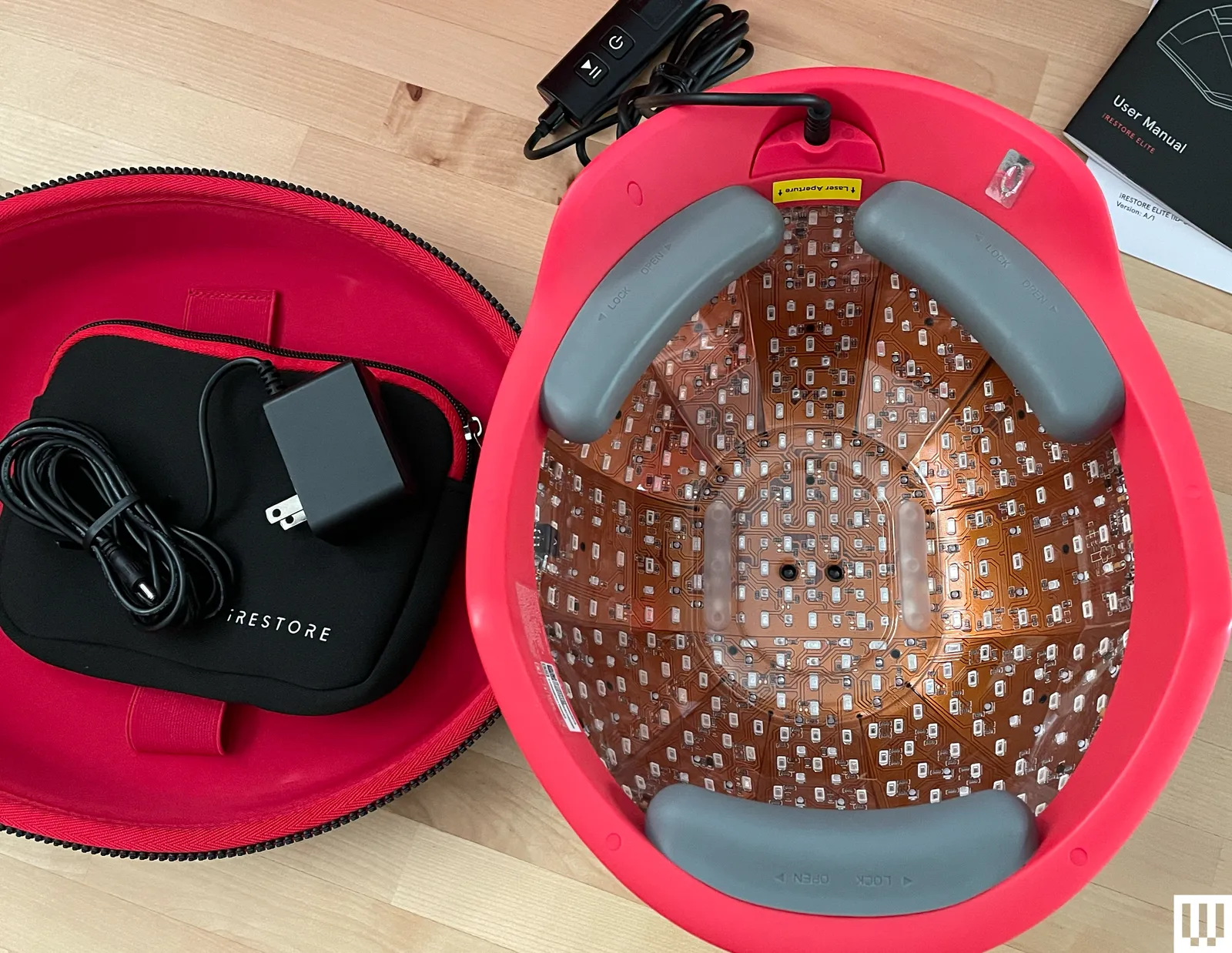
The Elite is iRestore’s top-of-the-line offering and has the most LEDs of the three laser hair-growth systems, with 500 diodes total—that’s 300 lasers and 200 LEDs. The Essential has 51 lasers and 69 LEDs for a total of 120 diodes, while the iRestore Pro has 82 lasers and 200 LEDs for a total of 282 diodes. The Elite was also designed to cover more of the scalp. The Elite requires 12 minutes of daily use, while the Professional and Essential require 25 minutes every other day.
If price is not an object, the Elite is the no-brainer choice for more concentrated light therapy, shorter use time, and potentially faster results.
Advertisement
Rooting for You
Photograph: Julia Forbes
The helmet arrived in hefty red packaging, containing the helmet, portable battery pack, charging cord, and a red-and-black zippered travel case. It feels very fragile, and I wouldn’t throw it around—then again, you probably wouldn’t be shoving an $1,899 helmet in the back of your bathroom vanity.
For one thing, Altman — who was in India for a major AI summit — said concerns about AI’s water usage are “totally fake,” though he acknowledged it was a real issue when “we used to do evaporative cooling in data centers.”
“Now that we don’t do that, you see these things on the internet where, ‘Don’t use ChatGPT, it’s 17 gallons of water for each query’ or whatever,” Altman said. “This is completely untrue, totally insane, no connection to reality.”
He added that it’s “fair” to be concerned about “the energy consumption — not per query, but in total, because the world is now using so much AI.” In his view, this means the world needs to “move towards nuclear or wind and solar very quickly.”
Citing a previous conversation with Bill Gates, the interviewer asked whether it’s accurate to say a single ChatGPT query currently uses the equivalent of 1.5 iPhone battery charges, to which Altman replied, “There’s no way it’s anything close to that much.”
Altman also complained that many discussions about ChatGPT’s energy usage are “unfair,” especially when they focus on “how much energy it takes to train an AI model, relative to how much it costs a human to do one inference query.”
Techcrunch event
Advertisement
Boston, MA | June 9, 2026
“But it also takes a lot of energy to train a human,” Altman said. “It takes like 20 years of life and all of the food you eat during that time before you get smart. And not only that, it took the very widespread evolution of the 100 billion people that have ever lived and learned not to get eaten by predators and learned how to figure out science and whatever, to produce you.”
Advertisement
So in his view, the fair comparison is, “If you ask ChatGPT a question, how much energy does it take once its model is trained to answer that question versus a human? And probably, AI has already caught up on an energy efficiency basis, measured that way.”
You can watch the full interview below. The conversation about water and energy usage begins at around 26:35.
[Hans Rosenberg] has a new video talking about a nasty side effect of using resistors: noise. If you watch the video below, you’ll learn that there are two sources of resistor noise: Johnson noise, which doesn’t depend on the construction of the resistor, and 1/f noise, which does vary depending on the material and construction of the resistor.
In simple terms, some resistors use materials that cause electron flow to take different paths through the resistor. That means that different parts of the signal experience slightly different resistance values. In simple applications, it won’t matter much, but in places where noise is an important factor, the 1/f or excess noise contributes more to errors than the Johnson noise at low frequencies.
[Hans] doesn’t just talk the math. He also built a simple test rig that lets him measure the 1/f noise with some limitations. While you might pretend that all resistors are the same, the test shows that thick film resistors produce much more noise than other types.
Advertisement
The video shows some rule-of-thumb lists indicating which resistors have better noise figures than others. Of course, resistors are only one source of noise in circuits. But they are so common that it is easy to forget they aren’t as perfect as we pretend in our schematics.
Intel’s long-term desktop roadmap may be moving faster than expected. New leaks suggest the company is already preparing its Nova Lake-S Core Ultra Series 4 processors, with a possible launch window shifting closer than earlier rumors indicated. According to reliable leaksters HXL and Golden Pig Upgrade, Intel’s next major desktop CPU family could arrive around CES 2027, potentially landing sooner than previous roadmaps suggested. That would position Nova Lake as Intel’s next big step after the current Arrow Lake and Panther Lake generations.
Nova Lake is expected to represent a significant architectural jump. The chips are rumored to use Intel’s next-generation CPU cores alongside new integrated graphics and stronger AI acceleration. The architecture is expected to combine Coyote Cove performance cores and Arctic Wolf efficiency cores, continuing Intel’s hybrid CPU design approach.
Additionally, the upcoming platform may also introduce a major hardware shift for desktop builders. Leaks point to a brand-new LGA 1954 socket and 900-series chipsets, meaning future CPUs will likely require new motherboards. This kind of platform reset usually signals a bigger generational change rather than a simple refresh.
A major platform shift could be coming
If these rumors prove accurate, Nova Lake could bring more than just faster CPUs. Reports suggest the platform may offer up to 48 PCIe lanes, improved cache design, and stronger integrated graphics powered by Intel’s next-gen Xe architecture. There are also expectations of a new NPU designed to push AI performance further, reflecting the industry’s growing focus on AI-accelerated workloads. This timeline also fits into the broader CPU race, as AMD is reportedly preparing its own next-generation desktop chips around the same period.
Advertisement
Intel
For PC enthusiasts, the takeaway is fairly simple. A major platform shift could be on the horizon, and the next wave of desktop CPUs may bring bigger changes than usual. If a long-term PC build is on the cards, keeping an eye on Intel’s roadmap over the next year might be a smart move. After all, component prices don’t look ready to calm down anytime soon, so waiting could mean better performance and more time to save up for it.
Google has officially unveiled the Pixel 10a, its newest entry in the A-series lineup. On the surface, it looks like another compelling budget-friendly Pixel: minimalist design, fresh colours, a large battery, and Google’s well-known AI features. But dig a little deeper, and the excitement quickly fades. For many buyers, the Pixel 10a may feel like a déjà vu moment – a phone that looks new but behaves very much like last year’s Pixel 9a. In fact, the similarities run so deep that a growing number of users and reviewers are asking the same question: Why upgrade at all?
Despite its refreshed exterior and a few modern touches, the Pixel 10a delivers nearly identical core specifications to its predecessor, and in some areas, actually feels like a step backward. For anyone shopping in the sub-$500 bracket, the Pixel 10a’s value proposition becomes questionable, especially when several alternatives – some from Google’s own lineup – offer far better hardware at equal or lower prices.
Below, we break down why the Pixel 10a underwhelms and explore five smartphones that might be smarter buys.
Pixel 10a vs Pixel 9a: A shockingly small upgrade
Put the Pixel 9a and Pixel 10a side by side, and the differences almost vanish. The display size, refresh rate, RAM, storage, charging speeds, and primary camera setup remain functionally the same. The most controversial change? Google swapped out its flagship-level Tensor G5 expected for A-series phones, instead opting for the older Tensor G4. This marks the first time an A-series Pixel has launched without the newest processor. For a brand that built the A-series on value-driven flagship trickle-down, the decision is puzzling.
Advertisement
One of the most frustrating omissions is the complete lack of Pixel Snap support. Pixel Snap – Google’s magnetic accessory ecosystem – has become a standout feature on the Pixel 10 lineup. Yet the Pixel 10a gets no magnetic capabilities at all. Even Google’s official Pixel 10a cases lack magnets. As a result, buyers who want magnetic accessories must rely on third-party cases, relinquishing Google’s usual first-party ecosystem experience.
There are upgrades, but they’re small: slightly brighter display, faster wired charging, improved Bluetooth, updated Gorilla Glass 7i front protection, and one extra year of software support. While welcome, these refinements hardly justify the price jump when the Pixel 9a still exists – and continues to offer identical real-world performance.
Yes, we are slightly upset too. But don’t worry, we gotchu. Here are five smartphones you can buy instead of the Pixel 10a.
If You Want to Save Money: Buy the Pixel 9a
If your priority is value, the older Pixel 9a remains the smarter purchase. With the Pixel 10a now official, Pixel 9a pricing is expected to drop significantly – often $100 or more below the 10a. Since the two phones share the same core experience, opting for the 9a means saving money without sacrificing features.
Advertisement
Andy Boxall / Digital Trends
The Pixel 9a’s only real shortcomings compared to the 10a include the older Gorilla Glass 3 display, slightly slower charging, and one fewer year of OS updates. None of these are dealbreakers for most users – especially those planning to upgrade again within three to four years.
Put simply, the Pixel 10a doesn’t justify its premium when last year’s model delivers nearly identical performance at a much lower cost.
If you’re willing to spend more: Buy the Pixel 10
The Pixel 10 lists at $799, but its real street price tells a different story. Six months after launch, the Pixel 10 can regularly be found for $649 new – and refurbished units frequently dip to the Pixel 10a’s $499 asking price. Trade-in bonuses and carrier deals drive the price even lower, making the Pixel 10 a substantially better value.
Nirave Gondhia / Digital Trends
For the same or slightly higher cost as a Pixel 10a, you get Google’s superior Tensor G5 chip, a proper ultrawide + telephoto rear camera setup, 12GB RAM, tougher display glass, an ultrasonic fingerprint reader, and full Pixel Snap compatibility. In every meaningful way – performance, photography, ecosystem, feel, longevity – the Pixel 10 outclasses the Pixel 10a.
The trade-offs? A slightly smaller battery, a slightly heavier chassis, and a marginally weaker selfie camera. None outweigh the significant advantages. If you’re shopping around the Pixel 10a’s price bracket, the Pixel 10 is simply a better phone.
If the Google Pixel is not your jam, here are four other smartphones you can opt for instead.
Advertisement
Samsung Galaxy A55
The Samsung Galaxy A55 stands out as a far stronger mid-range option than the Pixel 10a, especially for US users on T-Mobile, Mint Mobile, or MetroPCS. Powered by Samsung’s Exynos 1480 octa-core chipset, it delivers faster, more stable performance than the Pixel 10a’s downgraded Tensor G4. The phone features a vibrant 6.6-inch FHD+ Super AMOLED 120Hz display, offering noticeably better brightness, colour accuracy, and smoothness.
Samsung Galaxy A55Andy Boxall / Digital Trends
Its camera system is more versatile too, with a 50MP OIS main camera, 12MP ultrawide, 5MP macro, and a 32MP front camera with 4K video, giving it an edge in flexibility and detail. Durability is another win, thanks to Gorilla Glass Victus+, an aluminum frame, and IP67 water and dust resistance – all superior to the Pixel 10a’s simpler build.
You also get microSD expansion, dual SIM, newer Bluetooth 5.3, Wi-Fi 6, and a more premium overall experience. For most buyers, the A55 simply offers better long-term value than the Pixel 10a.
Motorola Moto G Stylus (2025)
Not every Pixel 10a alternative sits close in price. The Moto G Stylus starts at just $399, meaning you can save over $100 compared to Google’s new A-series device. It also comes with a built-in stylus, making it the only phone on this list with that capability. For note-takers, artists, or productivity-focused users, this may be a major selling point.
Jason Howell / Digital Trends
Despite its modest price, the Moto G Stylus impresses with 68W fast charging – the fastest among these alternatives – and expandable storage via microSD card. Those two features alone could sway many buyers.
Of course, its low price comes with sacrifices: outdated Gorilla Glass 3, slow UFS 2.2 storage, weak software support, and slower USB transfer speeds. This isn’t a phone for long-term users or performance-heavy workflows – but as a budget device, it offers tremendous value.
Advertisement
Nothing Phone 3a Pro
For buyers who want something visually distinctive and feature-rich, the Nothing Phone 3a Pro stands out. Surprisingly, it retails for $40 less than the Pixel 10a while offering twice the storage at 256GB. Hardware-wise, it’s stacked: a 50MP periscope telephoto lens, strong 50MP selfie camera, 50W wired charging, and a stunning display with symmetrical bezels and peak brightness matching the flagship Pixel 10.
Andy Boxall / Digital Trends
Its weaknesses include no wireless charging, less powerful Snapdragon 7s Gen 3 chip, and only an IP64 rating. Connectivity issues may arise for Verizon customers. Still, for the price, it’s an exceptional device – especially for buyers who value aesthetic flair and display quality.
Samsung Galaxy S25 FE
Samsung’s Galaxy S25 FE serves as another compelling alternative. While its list price is higher than the Pixel 10a’s, real-world pricing – especially during sales – often brings it within striking distance. For users who value performance, the S25 FE easily outpaces the Tensor G4 in nearly every benchmark. The Exynos 2400 delivers superior CPU and GPU performance, which translates to faster daily operation and noticeably better gaming.
Nirave Gondhia / Digital Trends
Camera hardware is also stronger on Samsung’s FE model, especially thanks to the inclusion of a telephoto lens – a feature missing from the Pixel 10a. You also get faster 45W wired charging and tougher display protection. On the flip side, Google’s computational photography still produces more consistent results, and the Pixel 10a has a larger battery and faster OS updates.
Still, for users already in Samsung’s ecosystem – or anyone prioritizing power – the Galaxy S25 FE deserves serious consideration.
Should anyone buy the Pixel 10a?
The Pixel 10a is not a bad phone. In isolation, it offers reliable performance, a clean design, Google’s trademark AI features, and a long update commitment. But it suffers from one major problem: the Pixel 9a exists, the Pixel 10 is discounted, and the competition in the sub-$500 market is fiercer than ever.
Advertisement
If your heart is set on the Pixel 10a, go for it – Google’s hardware and software consistency still make it a great everyday phone. But if you want the best possible value for your money, it’s hard to justify choosing the 10a over its alternatives. Whether it’s Google’s own Pixel 9a and Pixel 10 or competitive offerings from Samsung, Motorola, and Nothing, several devices offer more for your dollar.
In 2026, the Pixel 10a isn’t the obvious choice – it’s simply one option in a crowded field. And for many buyers, the alternatives may be a far better fit.
NASA Administrator Jared Isaacman, far left, walks around Launch Complex 39B at NASA’s Kennedy Space Center in Florida with a team of troubleshooters working on a helium flow issue with the Space Launch System rocket in the background. (NASA Photo)
NASA Administrator Jared Isaacman says the giant rocket set to send four astronauts around the moon for the history-making Artemis 2 mission must be rolled back from its launch pad to troubleshoot a technical problem.
The 10-day mission, previously scheduled for as soon as March, is now postponed until April at the earliest. “I understand people are disappointed by this development,” Isaacman said in a posting to X. “That disappointment is felt most by the team at NASA, who have been working tirelessly to prepare for this great endeavor.”
The technical issue cropped up just days after a successful launch-pad rehearsal at NASA’s Kennedy Space Center. Data from the Space Launch System rocket’s upper stage registered an interruption in the flow of helium, which is used to pressurize the propellant tanks and purge the engines. “Last evening, the team was unable to get helium flow through the vehicle,” Isaacman wrote today. “This occurred during a routine operation to repressurize the system.”
Isaacman said the helium pressurization system worked correctly during this week’s wet dress rehearsal. For what it’s worth, a problem with a helium valve cropped up during preparations for the uncrewed Artemis 1 round-the-moon mission in 2022, leading NASA managers to take corrective actions.
The current problem could be due to a failure at any of several points in the helium supply system. “Regardless of the potential fault, accessing and remediating any of these issues can only be performed in the VAB,” said Isaacman, referring to the 52-story Vehicle Assembly Building where the SLS and its Orion crew capsule were stacked for launch.
Advertisement
With March out of consideration, the next available launch dates for Artemis 2 are April 1 and April 3-6. The mission aims to send three NASA astronauts and a Canadian astronaut on a figure-8 route around the moon — which would mark the first time humans have traveled beyond Earth orbit since Apollo 17 in 1972. A successful Artemis 2 mission would clear the way for Artemis 3’s crewed lunar landing.
Several companies with a presence in the Seattle area are banking on Artemis’ success.
DM Performance took a close look at the Renault Twizy and simply had to get their hands on it. They thought the conventional 17 HP electric motor was severely inadequate. So they decided to replace it with the entire assembly from a Stark Varg electric motocross bike. This gives the little two-seater an impressive 80 horsepower and a whopping 692 pound-feet of torque, thanks to a unique chain drive system that replaces the usual setup.
The team at DM Performance realized that the previous differential wouldn’t cut it with all that extra torque, so they rebuilt it with a stainless steel casing and greased it with some high-pressure grease to help it withstand the twist without blowing apart. They also chopped away the rear section to fit in the new motor and chain drive, as well as some Maxpeedingrods coilovers to keep the Twizy on the road and prevent it from doing a funny flip while turning aggressively. Then there’s the battery swap; the one from the Stark Varg weighs only 70 pounds compared to the original 220 pounds, which is a significant weight savings, and it also packs a little more grunt.
🛴【Powerful Motor】This electric scooter is equipped with 500W brushless motors which can reach a max speeds of around 19 mph, it can climb up…
🛴【Smooth Ride】Electric scooter features 10inch on-road and offroad solid tires, double brakes, comfy handlebars, easy to set up, use and…
🛴【Long-lasting Battery】Travelling long distances you want reachs up to 23 miles on a single 4-5 hours fast charging. It can be ridden by adults…
The underlying performance metrics reveal the remainder of the story. This Twizy has beaten an Audi S1 Quattro to 100 mph, performed donuts and slides, and even circled a Lamborghini Aventador while burning the rear axle. Its rear-wheel drive architecture and fast electric power make it want to slide all over the place, which is ideal for the type of sideways activity this car was designed for. Not unexpectedly, the Twizy was originally intended to be a city crawler.
Apple’s camera and microphone indicators are supposed to tell iPhone users when the microphone or camera are on, but after a device is fully compromised with kernel-level access by another hack, Predator spyware can prevent those from appearing.
Malware can defeat iOS privacy indicators for recording
Camera and microphone indicators, which first appeared in iOS 14, are a big part of Apple’s privacy message. Users depend on them to know when recording is going on. Security researchers at Jamf found that Predator spyware can prevent those iOS recording indicators from appearing. It’s not a standalone attack though — the technique is post-compromise behavior, and the analysis doesn’t describe a new iOS vulnerability or a flaw that needs patching. Continue Reading on AppleInsider | Discuss on our Forums
Refueling with premium gas can add a significant amount to your annual bill compared to buying regular gas, but in New York, buyers might be receiving lower grade fuel regardless of what they pick. A recent study published by The City found that the vast majority of gas stations in New York had failed inspections by city officials at least once since 2023. Across those inspection failures, incorrect octane levels in gas samples was cited as the main offence.
Ensuring that you fuel your car with the correct octane gas is important, since using a lower grade can result in knocking or engine damage. However, since there is no way for drivers to independently verify the octane of the gas they’re buying every time they fill up, they have little choice but to trust the gas station to deliver the correct product.
City inspection officials carry out periodic inspections to check that gas stations are compliant, but the study suggests that the scale of the problem is making it difficult for inspectors to keep up. According to inspection records, 702 gas stations in the city were caught selling gas with mislabeled or incorrect octane during the study period. The city checked 729 gas stations during that period, so only 27 stations consistently met the required standard.
Advertisement
The problem is less prevalent in other parts of the country
Roamingpanda/Getty Images
While New York has a serious problem with gas stations misselling lower octane gas as premium, drivers in other parts of the country are not necessarily as likely to face the same risks. In an interview with 8 News Now, Las Vegas gas station inspector Kipp Blauer said that he only rarely finds premium gas pumps that deliver lower octane fuel, because pipelines that supply the city are only able to deliver a certain grade of fuel at a certain time.
In other states, contamination of premium gas might be more of a risk to drivers than ending up with mislabelled or lower octane gas. In 2025, reports emerged of drivers in Connecticut and Tennessee suffering significant engine issues after filling their cars up with fuel. One affected driver in Connecticut was reportedly quoted $17,000 to fix their BMW after a gas station allegedly put diesel fuel in its premium gas storage tank. In Tennessee, a Memphis gas station reportedly sold premium gas that had been contaminated with water, leaving one car owner with a bill of over $1,000 to fix the damage.
Advertisement
There’s no point in paying for premium gas if you don’t need it
Dusanpetkovic/Getty Images
Even if you do pay for premium gas and receive the correct product, it might not make a difference to the performance of your car. It’s a common myth that many drivers believe, but research by the AAA found that premium gas doesn’t automatically come with performance benefits, and it might not be worth the cost for many drivers.
The study’s tests found that some cars that recommended — but did not require — drivers to use premium gas showed slightly increased fuel efficiency and performance with higher octane fuel. However, these benefits were only noticeable during high-stress driving such as towing or hard acceleration. Under everyday driving conditions on the highway or in the city, no noticeable benefits were observed.
Advertisement
If you regularly buy premium fuel, it’s important to check whether your car recommends or requires it. If the car only recommends using premium gas, then the AAA’s research suggests that the added cost might not be worthwhile. However, using lower grade fuel in a car that requires premium gas can reduce its engine’s lifespan, and so it’s important to be careful when choosing the right octane for your car. If your car requires premium fuel, manufacturers often attach a sticker declaring that requirement on the inside of the gas cap, but if you’re unsure, it’s best to check your owner’s manual.
Indie publisher and developer Finji has accused TikTok of using generative AI to alter the ads for its games on the platform without its knowledge or permission. Finji, which published indie darlings like and , said it only became aware of the seemingly modified ads after being alerted to them by followers of its official TikTok account.
As reported by , Finji alleges that one ad that went out on the platform was modified so it displayed a “racist, sexualized” representation of a character from one of its games. While it does advertise on TikTok, it told IGN that it has AI “turned all the way off,” but after CEO and co-founder Rebekah Saltsman received screenshots of the ads in question from fans, she approached TikTok to investigate.
A number of Finji ads have appeared on TikTok, some that include montages of the company’s games, and others that are game-specific like one for Usual June. According to IGN, the offending AI-modified ads (which are still posted as if they’re coming directly from Finji) appeared as slideshows. Some images don’t appear to be that different from the source, but one possibly AI-generated example seen by IGN depicts Usual June’s titular protagonist with “a bikini bottom, impossibly large hips and thighs, and boots that rise up over her knees.” Needless to say (and obvious from the official screenshot used as the lead image for this article), this is not how the character appears in the game.
As for TikTok’s response, IGN printed a number of the platform’s replies to Finji’s complaints, in which it initially said, in part, that it could find no evidence that “AI-generated assets or slideshow formats are being used.” This was despite Finji sending the customer support page a screenshot of the clearly edited image mentioned above. In a subsequent exchange, TikTok appeared to acknowledge the evidence and assured the publisher it was “no longer disputing whether this occurred.” It added that it has escalated the issue internally and was investigating it thoroughly.
Advertisement
TikTok does have a “Smart Creative” option on its ad platform, which essentially uses generative AI to modify user-created ads so that multiple versions are pushed out, with the ones its audience responds more positively to used more often. Another option is the features, which use AI to automatically optimize things like music, audio effects and general visual “quality” to “enhance the user’s viewing experience.” Saltsman showed IGN evidence that Finji has both of these options turned off, which was also confirmed by a TikTok agent for the ad in question.
After a number of increasingly frustrated exchanges in which TikTok eventually admitted to Saltsman that the ad “raises significant issues, including the unauthorized use of AI, the sexualization and misrepresentation of your characters, and the resulting commercial and reputational harm to your studio,” the Finji co-founder was offered something of an explanation.
TikTok said that Finji’s campaign used a “catalog ads format” designed to “demonstrate the performance benefits of combining carousel and video assets in Sales campaigns.” It said that this “initiative” helped advertisers “achieve better results with less effort,” but did not address the harmful content directly. Finji seemingly also opted into this ad format without knowing it had done so. TikTok declined to comment on the matter when approached by IGN.
Saltsman was told the issue could not be escalated any higher, with communication not resolved at the time of IGN publishing its report. In a statement to the outlet, Saltsman said she was “a bit shocked by TikTok’s complete lack of appropriate response to the messthey made.” She went on to say that she expected both an apology and clear reassurance of how a similar issue would not reoccur, but was “obviously not holding my breath for any of the above.”
Morgan McKinley’s report explores how the Irish talent market in 2025 might impact trends and patterns in 2026.
Irish-owned global professional services company Morgan McKinley has published the findings of the 2026 Morgan McKinley Irish Salary Guide, which it says is Ireland’s most comprehensive analysis of pay across a wide range of professional disciplines.
It found that while the labour market remains active, it is far more disciplined. Irish employers continue to hire but are doing so with tighter controls regarding headcount and are reserving salary premiums only for skills that are believed to be critical to delivery or risk management.
The report stated: “Hiring has become more selective. Employers are sharpening expectations around both technical capability and soft skills, and many have increased on-site requirements. This shift has particularly affected talent outside the Dublin commuter belt.”
Advertisement
Take, for example, hiring in the life sciences and engineering sectors, which the report found to be stable throughout 2025, despite some organisations adopting a cautious approach to permanent headcount due to internal restructures. Notably, activity remained strong, particularly in sectors where skills shortages were persistent.
Candidates with biopharmaceutical experience were in short supply, resulting in intense competition for talent, lengthy recruitment processes and a high incidence of counter-offers. Research also found that as a result of extended hiring processes in this space, candidates often exited due to competing offers, thereby reinforcing the ongoing talent shortage.
The contract market in life sciences and engineering was found by Morgan McKinley to have remained robust, supported by large-scale capital investment projects across biopharma and medtech. The report explained that organisations rely heavily on contractors to deliver specialist, project-based expertise and maintain flexibility.
Similar to the more permanent positions in this space, contract roles have become more skills- and project-focused, also resulting in longer interview processes as employers take more time to ensure that the candidates meet the specific and technical criteria.
Advertisement
In the technology ecosystem, the most in-demand roles were found to be positions in data engineering, cybersecurity analytics and risk specialisation, machine learning engineering and data science, AI auditing and AI ethics, automation and dev-ops.
Hiring continues to evolve rapidly and while the overall demand has stabilised following global restructuring conducted by several large tech firms, acute shortages persist in AI, machine learning, data engineering and cybersecurity.
New roles for AI auditors and ethicists have emerged as a response to regulatory frameworks, while candidates increasingly value flexibility and autonomy over headline salary growth.
Commenting on the results of the report, Trayc Keevans, global FDI director at Morgan McKinley, said: “Employers are not in hiring retreat, but they are being far more intentional. Demand remains strong where skills directly enable transformation, regulatory compliance or operational continuity, but organisations are no longer responding by expanding teams or lifting salaries across the board.
Advertisement
“Instead, we are seeing entirely new, more narrowly defined roles enter the market, including AI auditors, ESG data governance leads, cyber and operational resilience specialists, and regulatory transformation programme managers, as employers target very specific capability gaps that did not exist at scale even two years ago.”
Don’t miss out on the knowledge you need to succeed. Sign up for the Daily Brief, Silicon Republic’s digest of need-to-know sci-tech news.