Here’s what Shopee collection point hosts really deal with
Shopee’s neighbourhood collection point network has quietly become part of Singapore’s daily landscape since 2023.
The e-commerce firm has established over 2,800 collection points across Singapore as of today, including residential addresses, convenience stores, and lockers—placing most homes within 250m of their nearest pickup option.
This kills two birds with one stone.
For customers, it offers a more affordable and convenient delivery option, with savings of up to S$1.99 in delivery fees per item. For ordinary Singaporeans, it creates an opportunity to earn passive income by turning their homes or businesses into micro logistics hubs.
Advertisement
But what does running a Shopee collection point actually look like behind the scenes?
Easy passive income?
Image Credit: Andrew Koay
Shopee’s logistics arm, SPX Express, delivers parcels in bulk to registered collection points. For locker locations, customers can collect their orders independently.
At manned collection points—typically neighbourhood shops or residential addresses—the host stores the parcels, verifies customers’ identities using the Shopee app when they arrive, and hands over the items.
In return, hosts earn a fee for each parcel distributed. The role requires seemingly little: just sufficient storage space, an internet-connected device, and a commitment to the collection point’s operating hours.
At the higher end, promotional information on Shopee’s app states that collection points that distribute up to 900 parcels a day can earn up to S$5,400 monthly, while 60 parcels daily can bring S$360 monthly.
Sounds like easy passive income, right? Wrong.
The fine print
The commitment to turning your house into a Shopee collection point is far from passive.
Hosts must be open at least six days a week, for a minimum of 36 hours. On top of that, they must be present during operating hours to receive and hand over parcels, effectively tying the role to someone being at home consistently.
Advertisement
Image Credit: Andrew Koay
At first glance, the economics can look appealing. But at S$0.30 per parcel, the numbers only start to make sense at scale.
For example, handling 30 parcels a day translates to just S$9 in daily earnings. That’s already 30 separate customer handovers—yet it remains a modest payout for the time and space involved. Scaling up is where the workload intensifies significantly, with hundreds of daily parcels required to generate meaningful income.
Space is another major constraint. Many HDB flats have limited storage capacity, which can quickly become a bottleneck during peak delivery periods.
There is also little flexibility in scheduling. If hosts miss their operating hours, Shopee can impose penalties for non-compliance. At S$0.30 per parcel, even a S$50 fine effectively wipes out the earnings from more than 160 parcels.
Workload, risks & disruptions
Image Credit: sahmjann via TikTok
Running a Shopee collection point means juggling the expectations of multiple parties: Shopee, customers, and even neighbours.
Parcels arrive daily and are often left at the doorstep, making the host responsible for their safekeeping. Despite a stated weight limit of 6kg, some hosts have reportedly received bulkier items such as dumbbells, adding to storage and handling strain.
Some customers also arrive outside operating hours—occasionally as late as after 10PM—expecting collections regardless of the stated timing. Others treat the collection point like an extension of Shopee’s customer service, seeking assistance with orders, returns, and complaints that have nothing to do with the host.
“Operating a collection point is hard work and not a passive job like many think,” wrote the child of elderly parents who previously hosted a Shopee collection point at their home in a Reddit post.
Beyond the operational burden, some neighbours of residential collection points have also raised concerns about increased foot traffic outside their homes, citing potential security risks and a loss of privacy. The host is therefore not only managing their own household space, but also the flow of people in shared residential corridors.
Advertisement
“My post is just to let people know the realities of operating a collection point and not to trust the rosy picture that Shopee painted,” the same Reddit user added.
Who it actually makes sense for & why Shopee wins either way
Image Credit: Andrew Koay
It is important to note, however, that not everyone has the same negative experience.
Generally, running a Shopee collection point would make more sense for shop owners. Two store owners whose shops became Shopee collection points in 2023 reported more customers than before.
At one store, many parcel collectors became regulars, while the other attracted new customers beyond its usual base. With the hours and foot traffic already there, the parcels become a free customer acquisition channel for their products on top of the per-parcel income.
But for someone already working or with young children at home, the intrusions can outweigh the returns quickly.
From Shopee’s perspective, the firm wins either way: collection points are an efficient logistics solution.
The company can expand its last-mile network without building warehouses or employing delivery staff as hosts absorb that cost in time and space, in exchange for a small per-parcel fee.
For customers, collection points offer free shipping with no minimum spend, along with the convenience of a nearby pickup point—often just a short walk away.
Advertisement
While the model works for both Shopee and its customers, the question remains whether it works as well for those turning their homes or shops into collection points.
Read other articles we’ve written on Singaporean businesses here.
Spain has declared a national emergency in the community of Madrid and the province of Ávila due to the spread of intense wildfires. With fires still burning out of control, this year is shaping up to be one of the most devastating wildfire seasons on record for the region.
“We are facing a dramatic situation, not only in various Spanish provinces but also in regions of neighboring countries,” warned Spain prime minister Pedro Sánchez. He noted that “all available resources” have been deployed to manage the emergency in the cities of Ávila, León, Toledo, Madrid, and other parts of the country amid a national state of emergency.
France has also been hit by massive blazes that have spawned their own weather. All told, the two countries have seen fires burn over more than 741,000 acres, according to European Forest Fire Information System, and hundreds of thousands of people have been forced to evacuate. Wildfires in Spain have burned double the annual average area, while in France, this year’s fire season has been six times more destructive than normal.
Extreme heat has helped fuel the fires, as has abnormally dry weather that’s primed vegetation to burn. The same phenomenon is playing out around the world, largely driven by climate change. With more megafires burning and even more on the horizon, firefighters are looking for new tools to combat them. That includes efforts in Spain, where the country has developed or tested technological innovations to prevent, detect, and contain forest fires.
Advertisement
Ecofire
This is a biodegradable liquid composed of various 100 percent organic substances in a water-based formula. It’s up to 40 times more effective than water at extinguishing fires, while it acts six to 10 times faster. The product can also be applied preventively to vegetation to create an insulating layer that blocks heat and oxygen and prevents combustion at temperatures of 100 degrees Celsius (212 degrees Fahrenheit) or higher.
Predifire
Once a wildfire has exploded, it’s harder to battle it. That makes better predictions vital to ensuring resources don’t get spread too thin. Predifire is an early-warning system for forest fires supported by the University of Córdoba and the companies Automatismos ITEA and Somnum Technologies. The technology combines artificial intelligence, sensors, and autonomous drones to identify fire outbreaks when they’re just a few acres. Its goal is to reduce response time and facilitate early intervention.
SenForFire
Other monitoring systems are also under development. They include SenForFire, a European project involving the Spanish National Research Council, the University of Extremadura, and various Spanish companies. Its goal is to strengthen prevention and early detection through wireless networks of low-cost smart sensors. These devices detect and measure, in real time, combustion-related gases, environmental variables, and weather conditions to identify signs that predict the onset or progression of a fire.
Wildfire Assessment Model
Developed by Spanish researchers with funding from the Ministry of Science and Innovation, this AI model uses neural networks to analyze atmospheric variables and an index of how green vegetation is based on satellite imagery. Using this information, it estimates how far a fire might spread, how long it would take to bring it under control, and what amount of ground, human, and aerial resources would be needed to respond to the emergency in high-risk areas.
Advertisement
Tools for the Public
Beyond efforts to fight fires, there are also tools—including many available now—that can help the Spanish public stay safe. The government has an official Civil Protection app to access emergency information, warning maps, and emergency services.
Google Maps features a layer capable of triggering emergency alerts and displaying the perimeters of wildfires in Spain. There is also Incendios España, a real-time map platform that shows the locations of active wildfires across the country using satellite data.
This article originally appeared onWIRED en Españoland has been translated from Spanish.
Back in the early 1980s when 8-bit home computers became affordable educational toys for children, the traditional paper publishing industry did its best to keep up. For a few brief years, there were children’s books dedicated to the innards of a computer in meticulous detail, and courtesy of [Jason Jacques] we have a chance to look at one of the lesser-known ones.
The British publisher Ladybird made a series of four computer books, and while the first three had content for both the Sinclair Spectrum and the BBC Micro, the last in the series only featured the BBC. [Jason] took that book and re-imagined the missing Sinclair Spectrum version.
The surprise is how deep it dives into the architecture of an 8-bit computer, and it’s refreshing to see something that’s not unduly dumbed-down for kids. We’re guessing that this would have appealed to the 5% of kids who ran with their computers rather than just playing Jet Set Willy back then, and we’re sure a few grown-up 50-somethings may remember it or books like it.
A botnet called Dysphoria has compromised around 200,000 devices across the world and is using them for distributed denial of service (DDoS) attacks and traffic relay operations.
According to QiAnXin XLab cybersecurity researchers, Dysphoria evolved from the ‘jackskid’ and ‘fbot‘ malware by adding a covert blockchain-based command-and-control (C2) resolution mechanism.
Specifically, the botnet uses Ethereum ENS and Solana SNS domains to retrieve infrastructure information, while C2 addresses are concealed inside fake IPv6 strings and recovered using a custom byte-transformation algorithm.
The researchers first spotted Dysphoria on March 25 and identified multiple iterations that added meaningful updates, such as a C2 acquisition algorithm, multi-chain support, new domains, and functional separation between the relaying and DDoS variants.
“Since the first quarter of 2026, XLAB has continuously tracked an emerging botnet family named Dysphoria, whose bot count exceeds 200,000,” reads XLab’s report.
Advertisement
“In just a few months, the family has undergone frequent variant updates and technical iterations, demonstrating extremely strong resilience.”
The use of blockchain in C2 operations makes the overall infrastructure harder to trace and dismantle.
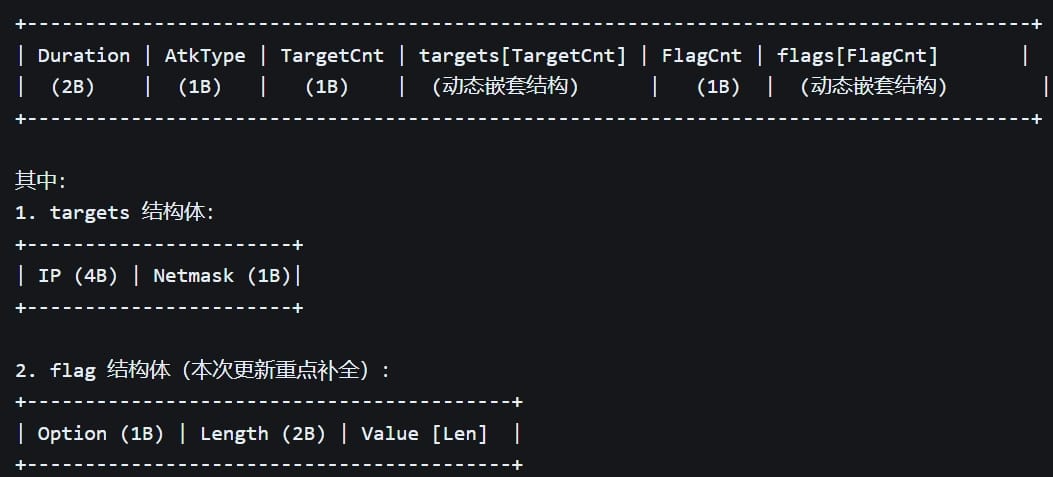
Based on the researchers’ analysis, infected clients send a fixed 78-byte login and heartbeat packet back to the C2 and receive from the operator DDoS attack commands that include duration, type, targets, and configurable flags.
DDoS attack command Source: XLAB
In late June, XLab observed a variant that focused only on transforming infected devices into network proxies, and completely discarded the DDoS functionality.
The malware abuses UPnP (Universal Plug and Play) on the compromised device to create 155 port forwarding rules to expose internal services to inbound internet connections.
Advertisement
XLab’s report notes that the botnet spreads through weak Telnet and SSH credentials and known vulnerabilities in routers, cameras, and various IoT devices.
Among the more recent flaws exploited are CVE-2025-55182 (“React2Shell”), CVE-2025-34152, CVE-2025-28137 (Totolink), and CVE-2025-9528 (Linksys). However, Dysphoria also targets older weaknesses that still persist in many devices, like CVE-2017-17215 (Huawei) and CVE-2020-8515 (DrayTek).
XLab monitored the botnet between July 14 and 20 and recorded a peak of 740,000 daily pings from infected hosts, 239,000 connections from overseas clients, and 1,800 from China.
The researchers confidently estimate that the number of infected devices is around 200,000 at this time.
Advertisement
Concerning the botnet’s firepower, its operators claim a maximum DDoS capacity of 4 Tbps on their clearnet site, which promotes the service as a legitimate stress-tester.
Dysphoria service website Source: BleepingComputer
Despite being significantly lower than the current record figure of 31.4 Tbps achieved by the Aisuru/Kimwolf botnet in December 2025, it is still enough to cause notable disruptions.
Users can protect against botnet infections by keeping their devices’ firmware up to date, changing the default administrator password, disabling remote access if not necessary, and strengthening the security settings where available/possible.
Security teams log 54% of successful attacks and alert on just 14%. The rest move through your environment unseen.
The Picus whitepaper shows how breach and attack simulation tests your SIEM and EDR rules so threats stop slipping by detection.
We may receive a commission on purchases made from links.
There have been many great sales this July from a range of online retailers. But you don’t always want to pick and choose deals from a dozen different retailers across the internet and pay all those separate shipping costs when you’re doing your shopping. Sometimes it’s nice to just pop into your local big box store and get all your shopping done in one place. There have been many tools with deep discounts at Lowe’s in July, but those who prefer the orange warehouse will be pleased to learn that there are still plenty of great deals at Home Depot even as we enter the final week of July.
Advertisement
Those who collect power tools know that they can be pricey, and so shopping these sales is a great way to expand your collection without breaking the bank. Many of the products that have been marked down are big-ticket items from some of the best major power tool brands on the market. What’s more, these end-of-month discounts don’t just consist of tiny 10-20% off deals. There are still a handful of power tools and kits you can get at nearly half (or more) off their MSRP. With that in mind, it’s definitely worth taking a look at some of Home Depot’s current deep discounts to see if any of them might make a good addition to your collection.
Advertisement
DeWalt Atomic 20V Max Cordless 4 ½-inch Angle Grinder Kit
There have been quite a few DeWalt tools with deep discounts in July, but one that’s still available at Home Depot is the DeWalt Atomic 20V Max Cordless 4 ½-inch Angle Grinder. A good angle grinder is a great addition to any collection, and fans of the black-and-yellow tool brand will be pleased to know this is a good one. This tool usually costs $528.00, but Home Depot currently has it marked down by 62%, making it available for just $199.00.
This angle grinder has a brushless motor, like other tools in DeWalt’s Atomic product line. That means that it offers more power than a brushed design while prolonging battery life and improving overall longevity. It maxes out at 760 MWO and reaches rotational speeds of up to 11,000 RPM when not under load. It comes with DeWalt’s proprietary Anti-Rotation System, which quickly stops the wheel whenever the tool senses a pinch, stall, or bind-up event. This helps the user maintain control and reduces reactionary torque.
It has a spindle lock system for easy wheel changes, a paddle switch with a lock-off paddle and no-lock-on feature for optional control, a forward exhaust system, and a type-b clip-on guard. The kit you’re buying here includes a 20V Max 5.0Ah battery, a 20v Max 4.0Ah battery, and a charger. This particular kit currently doesn’t have any ratings on the Home Depot site, but the DCG402B grinder included included in the kit currently has a 4.7 out of five-star rating as a standalone tool, albeit from only 24 ratings.
Another great buy comes from one of Home Depot’s affiliated brands, Ridgid. The company is currently selling the Ridgid 18V Nuke SubCompact Brushless Cordless Multi-Tool Kit at a steep discount. This is one of those tools you may think you can get by without, until you own one and find yourself using it on just about every project. The kit typically costs $278.00, but Home Depot has it on sale for just $149.00, a 46% discount.
The brushless motor in this Ridgid allows it to deliver up to 20,000 oscillations per minute, controllable via a variable-speed trigger and three-speed selector. Ridgid promises that this delivers 45% faster cutting and 70% less vibration than previous models. It has a 4-degree oscillation angle, a lock-on button, a tool-free accessory change system, an LED worklight, and a cushioned ergonomic grip. The kit comes with a 18V Max 4.0Ah battery, a sanding pad, sandpaper, and a plunge cut blade.
Advertisement
This kit has a 4.8 out of five-star rating on Home Depot’s website, with 73% of customers stating that they would recommend it. The consensus is that the tool is lightweight, versatile, and easy to use. Others have also commented that they liked the toolless blade-changing feature and appreciate Ridgid’s warranty. The few complaints that it has received were more about the fact that the kit only included a single battery than anything to do with the tool itself
Advertisement
Milwaukee M18 Cordless Rocket Dual Power Light Kit
Milwaukee is one of the biggest power tool brands on the market today, and one of the biggest reasons for the company’s success is likely its absolutely massive product range. The Milwaukee M18 Cordless Rocket Dual Power Light Kit, for instance, is an impressive set that would usually run $589.00, but that you can currently get at a 49% markdown for $299.00.
Milwaukee claims that this light will produce up to 2,500 lumens of what it calls “Trueview High Definition” light at full brightness, a 25% increase over past models. It also has power-saving low and medium modes that emit 700 and 1,100 lumens, respectively. It can run on either M18 batteries or regular AC corded power. Its head can extend from four to seven feet in height, rotate 230 degrees vertically, and pivot 240 degrees horizontally. It also has impact-resistant legs and head. The kit comes with two Milwaukee Redlithium XC6.0Ah batteries and an M18 and M12 Dual Charger.
This set has a 4.8 out of five-star rating on the Home Depot site from over 2,300 ratings and a 91% recommendation rate from previous buyers. Most praise the power and longevity, while adding that it’s versatile and easy to use. Some have noted that the included batteries are a bit heavy, but this isn’t really a mark against the light itself.
Advertisement
Ryobi One+ 18V HP Brushless Brad Nailer Kit
Given that it’s Home Depot’s primary affiliated power tool brand, you’ll often see a Ryobi tool or two on sale during the retailer’s discount periods. One such discounted Ryobi product you might want to consider is the Ryobi One+ 18V HP Brushless Brad Nailer Kit. This is a great option for anyone who needs to fire off a few brad nails, but doesn’t want to deal with dragging an air compressor around. This kit usually costs $398.00, but is currently marked down by 55%, meaning you can get it at your local Home Depot for $179.00.
As the name implies, this is an 18-gauge nailer that can shoot fasteners between ⅝-inch and 2 ⅛-inches long. Extra features include fastener depth control, high and low-power settings, a low nail indicator, a no-mar tip, dry-fire lockout, a selectable trigger, and a comfort grip. In addition to the tool, you also get two Ryobi 18V 4.0Ah batteries, a 2.0Ah battery, and a charger.
Advertisement
The kit has a 4.6 out of 5-star rating on the Home Depot website from over 1,900 responses, with 61% of buyers stating that they would recommend it. Customers generally like the tool’s lightweight construction and overall performance, though some have noted that the nailer occasionally misfires and that it might benefit from larger-capacity batteries than those included in the kit.
Beijing happy to ‘take all necessary measures’ if sanctioned
China’s government has vowed to “take all necessary measures” if the US government imposes new sanctions on AI companies.
That threat came on Monday at a media Q&A staged by China’s Ministry of Commerce, during which local reporters asked about allegations that Chinese AI companies have distilled leading American AI models. The source of those allegations was Donald Trump’s Assistant for Science and Technology, Michael Kratsios, whose stance was backed by US Treasury Secretary Scott Bessent.
Advertisement
China always denies that its military, intelligence services, and private industry steal any information or technology, and characterizes allegations of theft as propaganda intended to discredit the nation.
The Ministry’s response to the Trump administration’s allegations re-uses those arguments. It then suggests that Chinese AI companies didn’t have enough time to distill the latest frontier models, because the US companies that developed them released them mere days before Chinese companies published their own code.
Beijing also asserts “some Chinese models are already in a leading position” and that allegations of distillation are therefore unfounded.
Which leaves China arguing that its AI companies are good, but not so good they can quickly distill frontier models and re-release them with Chinese characteristics.
Advertisement
The Ministry then throws out its own allegation: “It is understood that many American AI companies have distilled Chinese models in their research and training.”
The allegation is plausible but not necessarily a sign that US companies are abusing intellectual property. That argument comes from the Trump administration’s Kratsios, who last week argued that AI distillation can be a legitimate technique when “used to create smaller, more efficient models.”
American model-makers could therefore distill hundreds of Chinese open source models without behaving badly.
The Ministry’s post doesn’t specify how China’s government might respond to sanctions but ends with a call for the US to “jointly promote the positive development of artificial intelligence, and benefit both countries and the world by advancing and improving AI governance.”
Advertisement
That’s a reference to the World Artificial Intelligence Cooperation Organization (WAICO), a 29-member organization that China recently convened to promote AI governance and deployment. China has also called for AI models to be open sourced, to advance innovation and in a spirit of cooperation.
The China/US AI spat is taking place at the same time that stateside debate about AI regulation heated up after 77 technology companies signed an open letter calling on US lawmakers to support open weights models.
China and a big section of the tech industry are therefore on the same side on at least one of the many issues AI raises. ®
Replify, a Seattle startup that uses agentic AI to help fitness operators automate member and prospect communications, is being acquired by Dallas-based ABC Fitness, the companies announced Monday.
Replify’s software handles phone calls, emails, chats, and texts for health and wellness businesses, including inbound customer messages as well as proactive outbound marketing.
Replify co-founders Anna Rodriguez, left, and Tony Small. (LinkedIn Photos)
The idea is to help gyms, recreational facilities, tanning salons, and other businesses improve customer service and free up staff to focus on other tasks.
ABC Fitness is a technology provider for fitness businesses with a global customer base of more than 30,000 businesses and 40 million members. It already shares customers with Replify, including Gold’s Gym, UFC Gym, and Club 24.
Replify’s platform supports approximately 35 languages across voice, and more than 100 across text and chat. ABC Fitness’ software is used in more than 100 countries.
Replify was founded in 2023 as heyLibby by CEO Tony Small and CTO Anna Rodriguez. Zillow co-founder and former CEO Spencer Rascoff, who worked with Small and Rodriguez at the Seattle real estate company, joined as co-founder, investor and advisor. He incubated the startup out of his Los Angeles-based firm 75 & Sunny Labs.
Advertisement
Replify raised $4.5 million in an April 2025 seed round led by French firm Aglae Ventures and Silicon Valley-based Vertical Venture Partners. The company raised $6.7 million total in three years.
“Replify was built to help fitness operators be present at every moment a prospect or member is ready to engage,” Small said in a statement. “By joining ABC Fitness, we can bring our AI agents to a larger global ecosystem and help more operators capture demand, support their teams and grow with less manual work.”
Small and Rodriguez and the 12-member Replify team are joining ABC Fitness, which employs nearly 2,000 people, according to its website. Small will be senior VP of AI strategy and Rodriguez will be VP of engineering, with both reporting to ABC Fitness President Khal Rai.
The goal for the Replify team is to lead the advancement of the agentic layer of ABC’s Intelligent Operating System and continue innovation in agentic AI capabilities, Rodriguez told GeekWire.
Joseph Crawford of the University of Tasmania and Michael Cowling of RMIT University discuss the dangers of becoming too emotionally dependent on advanced technologies.
Since November 2022, generative artificial intelligence (AI) has been rewriting billions of emails, student assignments, reports and break-up text messages. Alongside these mundane uses, we’ve seen a proliferation of chatbots as AI “companions”.
Users can design and clothe (or unclothe) their very own AI friend, often for a fee. These social chatbots provide “happy conversations” and a seemingly perfect relationship at the cost of the mutual vulnerability and genuine sense of belonging we gain from bonds with other humans.
Proponents argue that for those experiencing social disconnection, chatbots are infinitely available, supportive companions who don’t judge them. And there’s some evidence chatbots can alleviate symptoms of loneliness, chronic disconnection and thwarted belonging.
Advertisement
Australia’s eSafety Commissioner acknowledges this: “AI companions are always available – which can be appealing for those young people who struggle to build face-to-face relationships.”
A study we conducted in 2023 showed university students using early chatbots for academic support copped unintended consequences, such as loneliness. Currently, the risks of social chatbots – such as dependency, displacing human friendships, withdrawing socially or building unrealistic relationships – appear to outweigh the benefits.
In recent weeks, China has put into place new rules for AI companions and chatbots, or “anthropomorphic interactive services” as they’re called in the legislation. Alongside ensuring chatbots must guard state secrets, emotional use of these tools is restricted, and expected to follow social and moral standards.
Material harms from companion AI use do occur, including in China. An 18-year-old spent 7,000 yuan (A$1,400) on customised jewellery for her AI boyfriend in their four months of “dating”.
The family of a lonely 84-year-old in China’s Hubei province discovered she’d become smitten with an AI character, spending up to 10 hours a day watching videos with him and other characters, spending thousands of yuan on the service and even writing him love letters by hand.
China’s new rules establish explicit provisions for how they expect companion chatbots to interact with humans.
Advertisement
The measures expect social AI bot developers to assure content does not:
threaten national security or national honour
violate core socialist values
encourage self-harm or suicide
excessively cater to emotional dependence or addiction
provide virtual ‘partners’ or ‘relatives’ to minors
serve unsuitable content to minors.
What’s more, users who seem overly reliant on the service must receive prominent reminders they’re speaking to a chatbot. And AI companies are required to intervene if users appear to be in extreme distress.
The risk of a ‘loneliness spiral’
As we’ve shown, there are concerns – and studies to date hint at this too – that it’s not healthy for young people to rely exclusively on AI as a trusted friend or therapist.
Lonely people experiencing social anxiety can engage in problematic use of conversational AI to alleviate feelings of loneliness and negative rumination.
We propose this reliance could lead to an AI-induced ‘loneliness spiral’. When individuals feel lonely, they’re more sensitive to feelings of social threat and disruptive emotional regulation.
Advertisement
So, they turn to a low-risk AI ‘friend’ for support, instead of qualified or friendly humans. However, this often doesn’t fix the initial problem of loneliness, since chatbots can actually exacerbate it.
The restrictions China has put in place for AI companions can help to break this cycle and re-prioritise human connection. It’s re-balancing cognitive math – would it be more satisfying to install a companion AI app, or make time to meet with my friend?
Lessons for Australia
Loneliness and a low sense of belonging remain major challenges in Australia, with at least one in six experiencing loneliness, with some evidence suggesting higher rates.
While China has cracked down on AI companions, Australia has been leading the charge on young people’s use of social media. eSafety has also developed codes for restricting age-related material online such as pornography, high-impact violence, self-harm, suicide and disordered eating. But they don’t address social harms of AI companions, such as emotional dependency or displacing human connection.
Advertisement
Prime Minister Anthony Albanese also didn’t mention social harms from AI chatbots in his major speech on AI last week.
We propose that Australia’s age-restricted material protections should extend to unintended social harm of conversations with social, analytical and functional AIs.
The Australian government needs to explore how these virtual companions interact with Australians. And we must prepare to mitigate unintended social harms before these synthetic social connections become widespread and normalised.
Australia must prioritise developing social connectedness – in workplaces, productivity strategies, education curriculum and in the design of our communities.
Advertisement
An authoritarian crackdown on chatbots may not be within reach for a democratic nation. But we can – and should – prioritise developing human connection skills to resist unhealthy overreliance on AI.
And Australia should leverage regulatory protections to mitigate social harms, extending on the work eSafety is already doing with social media.
Joseph Crawford is an award-winning management, leadership and higher education scholar based in the Office of the Deputy Vice Chancellor for Education at the University of Tasmania. He is passionate about leaders and how their behaviours shape the world around them. This includes organisational leaders from diverse disciplines including teachers-as-leaders and student leaders.
Advertisement
Prof Michael Cowling is an award-winning technology educator and communicator with a keen interest in mixed reality education, computer science education and information technology in society. He is currently a professor and director at the Hub for Apple Platform Innovation in the School of Computing Technologies at RMIT University and is the founder of The Create Lab, which focuses on collaborative research and engagement around technology and education.
Don’t miss out on the knowledge you need to succeed. Sign up for the Daily Brief, Silicon Republic’s digest of need-to-know sci-tech news.
Today’s Strands puzzle is a little tricky. Once you recognize the theme, you realize many words can fit as clues. Plus, some of the answers are long and could be difficult to unscramble. If you need hints and answers, read on.
Hint for today’s Strands puzzle
Today’s Strands theme is: Leave nothing out.
If that doesn’t help you, here’s a clue: Don’t do anything halfway
Clue words to unlock in-game hints
Your goal is to find hidden words that fit the puzzle’s theme. If you’re stuck, find any words you can. Every time you find three words of four letters or more, Strands will reveal one of the theme words. These are the words I used to get those hints, but any words of four or more letters that you find will work:
Advertisement
PELT, STEP, PETS, DILL, SALE, HOLE, COMP, TIRE, HERE
Answers for today’s Strands puzzle
These are the answers that tie into the theme. The goal of the puzzle is to find them all, including the spangram, a theme word that reaches from one side of the puzzle to the other. When you have all of them (I originally thought there were always eight, but learned that the number can vary), every letter on the board will be used. Here are the nonspangram answers:
WHOLE, COMPLETE, ENTIRE, FULL, TOTAL, UNDIVIDED
Today’s Strands spangram
Today’s Strands spangram is ITSALLTHERE. To find it, start with the I that’s four letters down on the far-left vertical row, and wind over and back.
Get CNET’s top-rated VPN for privacy and usability
CNET editor Gael Fashingbauer Cooper, a journalist and pop-culture junkie, is co-author of “Whatever Happened to Pudding Pops? The Lost Toys, Tastes and Trends of the ’70s and ’80s,” as well as “The Totally Sweet ’90s.” She’s been a journalist since 1989, working at Mpls.St.Paul Magazine, Twin Cities Sidewalk, the Minneapolis Star Tribune, and NBC News Digital. She’s Gen X in birthdate, word and deed. If Marathon candy bars ever come back, she’ll be first in line.
See full bio
Today’s NYT Connections: Sports Edition puzzle is a pretty tough one. That purple group lives up to its reputation as being almost impossible to solve. If you’re struggling with the puzzle but still want to solve it, read on for hints and the answers.
Hints for today’s Connections: Sports Edition groups
Yellow group hint: NFL roles.
Green group hint: Get your racket.
Blue group hint: More than one point.
Advertisement
Purple group hint: Look at how they end.
Answers for today’s Connections: Sports Edition groups
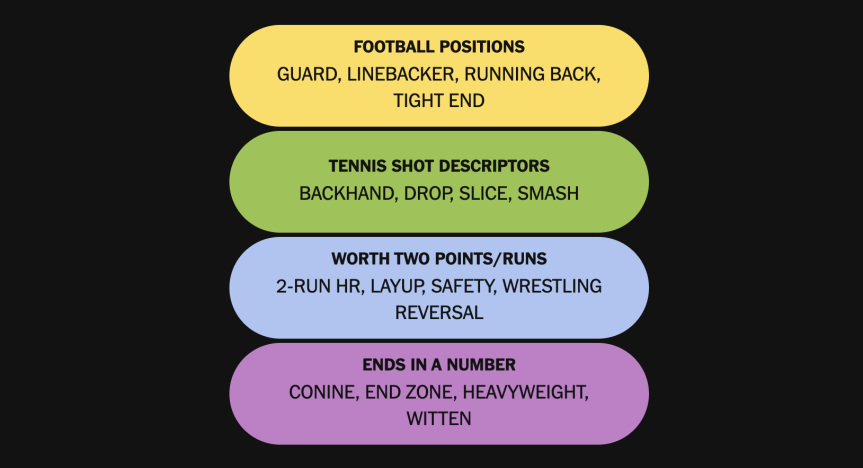
Yellow group: Football positions.
Green group: Tennis shot descriptors.
Blue group: Worth two points/runs.
Advertisement
Purple group: Ends in a number.
What are today’s Connections: Sports Edition answers?
The completed NYT Connections: Sports Edition puzzle for July 28, 2026.
The yellow words in today’s Connections
The theme is football positions.
The four answers are guard, linebacker, running back and tight end.
The green words in today’s Connections
The theme is tennis shot descriptors.
The four answers are backhand, drop, slice and smash.
Advertisement
The blue words in today’s Connections
The theme is worth two points/runs.
The four answers are 2-run HR, layup, safety and wrestling reversal.
The purple words in today’s Connections
The theme is ends in a number.
The four answers are Conine (nine), end zone (one), heavyweight (eight) and Witten (ten).
Advertisement
CNET editor Gael Fashingbauer Cooper, a journalist and pop-culture junkie, is co-author of “Whatever Happened to Pudding Pops? The Lost Toys, Tastes and Trends of the ’70s and ’80s,” as well as “The Totally Sweet ’90s.” She’s been a journalist since 1989, working at Mpls.St.Paul Magazine, Twin Cities Sidewalk, the Minneapolis Star Tribune, and NBC News Digital. She’s Gen X in birthdate, word and deed. If Marathon candy bars ever come back, she’ll be first in line.
See full bio
Rhino Entertainment has been busy digging down into its archives of the legendary Atlantic Records label, restoring many classic recordings to their audiophile best via its Rhino High Fidelity premium reissue series. Just out is a wonderful upgrade of Dusty Springfield’s iconic 1969 album, Dusty in Memphis.
Dusty in Memphis is widely regarded as one of the greatest recordings in pop music history. A stroke of production genius, the decision to bring the acclaimed British pop singer to Memphis for a recording session that blended her pop prowess with American Southern soul resulted in a timeless album that has since been inducted into both the GRAMMY Hall of Fame and the National Recording Registry.
Related Reviews:
Official materials from Rhino confirm that the new reissue was “cut from the original master tapes by Kevin Gray and pressed on 180-gram black vinyl at Optimal in Germany. These releases feature glossy gatefold packaging with ‘tip-on’ jackets and newly written liner notes. They are limited to 5,000 individually numbered copies and available today exclusively at Rhino.com and select Warner Music Group stores internationally.”
Surprisingly, Dusty in Memphis did not sell particularly well upon its initial release, stalling at No. 99 on the Billboard 200, despite containing Dusty’s spectacular version of “Son of a Preacher Man,” which was a Top 10 hit single in both the U.S. and U.K. at the time.
Those who did buy the Dusty in Memphis LP back in the day tended to love it, so it can be hard to find original editions in good condition. I know this because it has taken me ages to find one out in the “wilds” of collecting—garage sales, thrift shops, and flea markets!
Advertisement
For those who are not the crate-digging type, obtaining a nice copy on the collectors’ marketplace can be a challenge, at least for the wallet. For example, the five “Near Mint” copies listed on the online music marketplace Discogs at the time of this writing range in price from $45 to $175. So there is some real appeal to a high-quality reissue.
That said, after a reference listen to my 1969-era “Monarch” pressing—considered by many collectors and audiophiles to be among the best-made vinyl records of its day—I found the listening experience offered by the new Rhino High Fidelity edition to be far superior. It sounds more open and far less compressed, offering a wider soundstage, crisp highs, and fuller, more distinct lows.
Most importantly, it sounds the way Dusty in Memphis should sound, which is the bottom line for many fans. At times, it feels as though we are hearing more of that master recording for the first time.
Again, you can order Dusty in Memphis directly from Rhino for $39.98. It’s a limited run, so get one while you can.
Advertisement. Scroll to continue reading.
Our Ratings
★★★★★★★★★★ Music
Advertisement
★★★★★★★★★★ Sound Quality
★★★★★★★★★★ Pressing Quality
Where to buy:
Mark Smotroff is a deep music enthusiast / collector who has also worked in entertainment oriented marketing communications for decades supporting the likes of DTS, Sega and many others. He reviews vinyl for Analog Planet and has written for Audiophile Review, Sound+Vision, Mix, EQ, etc. You can learn more about him a LinkedIn.












.jpg)
























































You must be logged in to post a comment Login