Tech
Is That A Starlink Satellite Or Meteor? Here’s How To Tell The Difference


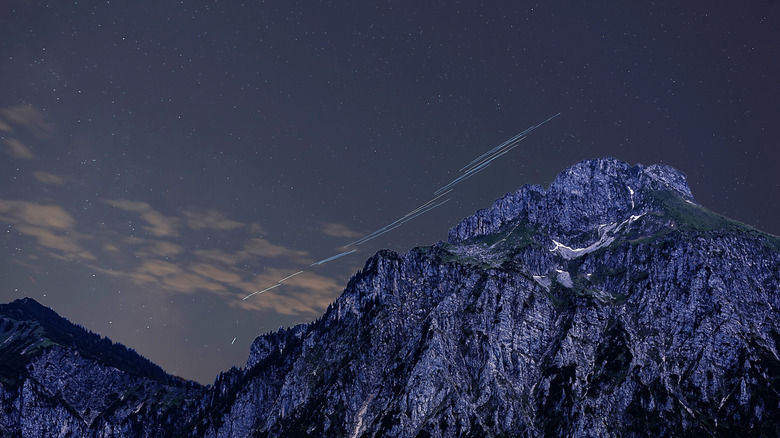
Gazing up at the night sky, you may wonder: What is that? A bird? A plane? A…satellite? There are thousands of satellites orbiting our planet – SpaceX alone has launched more than 9,000, and there are in excess of 15,000 in total in orbit around Earth as of January 2026. They should be easy to spot, and often are, but they’re also frequently mistaken for other celestial bodies, including meteors.
There’s much more to be seen when you’re stargazing than just stars. Some objects are easy for anyone to identify, but according to Alyn Wallace, who was an award-winning landscape astrophotographer (someone who takes photos of all the things in our night sky), even the mainstream media sometimes mistakes a satellite for a meteor, despite the fact that there are distinct differences. There are several ways for even an amateur observer to identify what they’re seeing, but the easiest is probably speed. Satellites move much more slowly than meteors, and the difference can be observed even through a camera lens. While a meteor may only appear in one photo or frame, a satellite will likely appear in several frames as it slowly moves across the sky.
SpaceX satellites are even easier to spot because they tend to appear as lines of bright, round lights, known as Starlink satellite trains. Sometimes up to 60 are seen together in what looks like, from the ground, a long white line. If you’re still not sure what you’re seeing, there are a few other tricks of the trade.
Satellite or meteor?
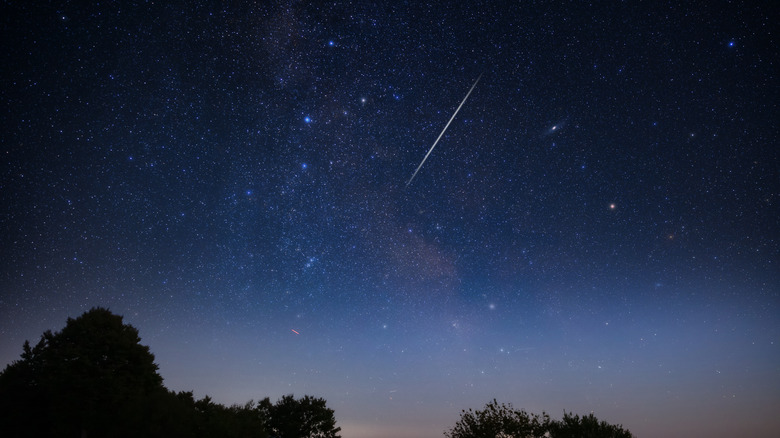
Most satellites are in low Earth orbit (LEO), which is why they’re so easy to see. They’re essential to our modern life. Telecommunications, location, and navigation services — without them, we’d be lost, quite literally! But what other tactics can you use to identify that glowing object in the sky, especially if you’re a beginner stargazer?
In addition to speed, the trail left behind by a satellite differs from the trail behind a meteor. Both satellites and meteors have tapered ends that diminish in thickness, but in different ways. Meteor trails are often asymmetric and brightly-colored in a burst of light that only lasts a few seconds, while satellites tend to have a more consistent trail that lasts longer and is of the same brightness from one end to the other. Meteors may look green or yellow, but satellites usually appear white or bluish-white. Satellites also don’t give off their own light; they’re simply reflecting the light of the sun. Because of this, you can often see them better in the hours just before sunrise and sunset.
Other objects in the sky are easier to identify, especially in photos. If you have a series of dotted lines in a linear, horizontal pattern over the course of several photos, it was likely a plane. Of course, if it boasts clearly visible exterior lighting, it’s certainly a plane — neither meteors nor satellites have exterior lights. Ultimately, if you’re in doubt, try an app like Star Chart (free) or SkySafari 7 Pro (from $21.99) — or just enjoy the show.
You must be logged in to post a comment Login