Tech
IsoAcoustics Marks Its Strongest OEM Year with JBL, Marten, Raidho and Lumin

There is plenty of snake oil in hi-fi. Products that promise to uncover hidden detail, expand the soundstage, and restore the emotional connection to your record collection often accomplish little beyond making your bank balance lighter.
IsoAcoustics does not belong in that category.
Since January 2012, the Canadian manufacturer has developed isolation products for professional studios, home audio systems, and equipment manufacturers. Its technology does not manipulate the audio signal or rely on mystery materials. It addresses a straightforward mechanical problem: loudspeakers, turntables, and audio components transfer energy into the surfaces beneath them, and those surfaces can send some of that energy back.
Managing that interaction can improve bass definition, image stability, clarity, and focus. It can also reduce the amount of energy transferred into floors, furniture, and neighboring rooms.
We have used IsoAcoustics products across multiple systems and rooms, and the results have been consistently positive. The improvements are generally most obvious beneath loudspeakers and turntables, especially on suspended wood floors or furniture that has no business supporting expensive audio equipment.


IsoAcoustics products will not turn a mediocre loudspeaker into a great one, and every room will not deliver the same degree of improvement. What they can do is help a properly designed component perform closer to its potential.
They also represent solid value for the money. A set of isolation feet is not inexpensive, but the cost is usually modest compared with replacing a component, upgrading a loudspeaker, or starting another cable experiment. They are easy to install, require no changes to the signal path, and can usually move to another system later.
The growing number of manufacturers integrating IsoAcoustics technology directly into their products suggests that audio brands are reaching the same conclusion.
Related Reviews:
More Than 70 OEM Partners
IsoAcoustics says it has now completed approximately 155 OEM projects, representing a 13 percent increase compared with the same period last year. Those projects involve more than 70 partner brands, an increase of 28 percent, with more than a dozen additional collaborations currently underway.
The list includes loudspeaker manufacturers such as JBL, Sonus faber, Marten, Perlisten, PSB Speakers, Raidho, Gershman Acoustics, and Kroma Atelier.


Sonus faber was also an early OEM partner, integrating custom GAIA-Capsule isolators into its $750,000 Suprema system. The isolation system is hidden between the cabinets and baseplates of both the main loudspeakers and separate subwoofers, making it part of the structure rather than another accessory bolted on after the fact.
Suprema was the first Sonus faber loudspeaker to use fully integrated IsoAcoustics technology, which says rather a lot considering the engineering resources and price point involved. When a company building one of the world’s most ambitious loudspeaker systems decides that controlling vibration and energy transfer is important enough to address at the factory, it becomes harder to dismiss isolation as another helping of audiophile snake oil.

IsoAcoustics is also appearing beneath digital sources and electronics from Lumin, EMM Labs, Innuos, Antipodes Audio, and other manufacturers.
That distinction matters. Isolation products are most commonly associated with loudspeakers and turntables, where unwanted movement and vibration are easier to understand. Their adoption by electronics manufacturers shows that IsoAcoustics is no longer being viewed solely as an aftermarket speaker accessory.
These companies are designing the isolation technology into the product rather than placing a set of feet in the box as an optional extra.
Professional Audio Experience Matters
IsoAcoustics’ professional audio credentials are an important part of the story.
Founder Dave Morrison drew on years of experience designing and constructing radio and television studios when developing the company’s isolation technology.
Recording studios are not especially tolerant of products that do nothing. Engineers need monitors to behave predictably and mixes to translate outside the control room. Preventing a loudspeaker or monitor stand from transferring unwanted energy into a desk, console, or floor is a practical problem, not an audiophile thought experiment.
That professional foundation has given IsoAcoustics a level of credibility that many accessory companies never establish.
JBL Adopts the GAIA-TITAN Neo


One of the most significant new partnerships involves JBL and the upcoming GAIA-TITAN Neo.
JBL introduced customized JBL | IsoAcoustics isolation feet with its next generation Summit Everest and Summit K2 loudspeakers at HIGH END Vienna 2026. The semi-recessed design is based on the GAIA-TITAN Neo and was developed specifically for the size, weight, and mechanical requirements of the new Summit models.
JBL says the isolation system contributes to tighter bass, a larger soundstage, and more precise imaging.
The Summit Everest and Summit K2 follow the Summit Makalu, Summit Pumori, and Summit Ama, which were introduced in 2025 with customized versions of the GAIA I Neo.
JBL is only the second manufacturer to use the GAIA-TITAN Neo. Marten previously integrated the technology into its Coltrane Supreme Extreme flagship loudspeaker.
The GAIA-TITAN Neo sits at the top of the GAIA Neo range and is designed for the largest and heaviest loudspeakers. It remains available only through selected OEM partners, but IsoAcoustics plans to introduce a standalone consumer version with a global launch later in 2026.
Pricing, weight capacities, and model options have not yet been announced.
Marten, Raidho, Lumin, and EMM Labs Expand Their Use

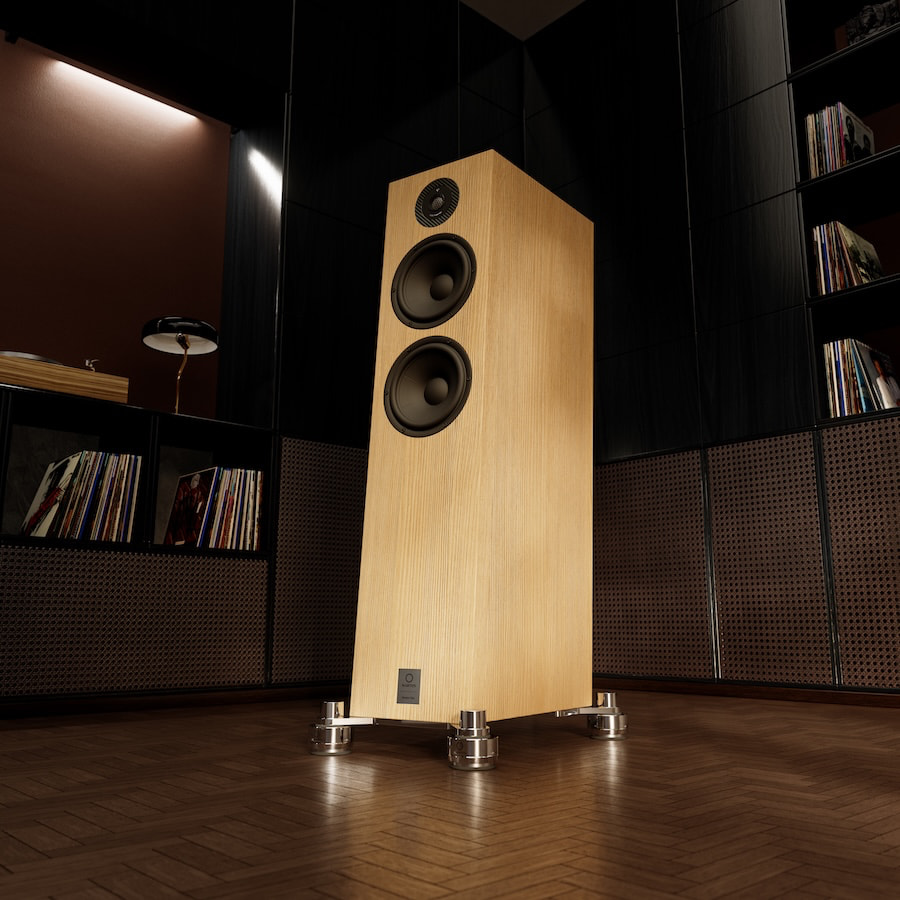
Marten has integrated custom isolation into all four models in its new Dexter loudspeaker series. The Marten Isolators use GAIA Neo technology and are installed as a permanent part of each loudspeaker rather than offered as an aftermarket upgrade.
Raidho has also expanded its use of IsoAcoustics products across several loudspeaker ranges. Its TD Signature models include custom GAIA isolation, while additional Raidho models will either use or recommend IsoAcoustics as part of the speaker system.
Gershman Acoustics has taken a different approach with the Symphoria. In addition to placing IsoAcoustics isolation beneath the loudspeaker, the company uses isolation devices within its Separate Sub Alignment System to decouple the midrange and tweeter module from the bass enclosure.
The technology is also moving deeper into digital audio.
Lumin has integrated IsoAcoustics isolation into the X2, its flagship network player, streamer, and DAC. Antipodes Audio is using the technology beneath its Oladra Presence and Sentia music servers, while EMM Labs is developing dedicated isolation footers for its reference electronics, including the PREi preamplifier.
Stable 33.33 has installed semi-recessed IsoAcoustics isolators in its Immuable turntable, and Deep Lake Audio is building the company’s isolation technology directly into a new range of audio racks and furniture.
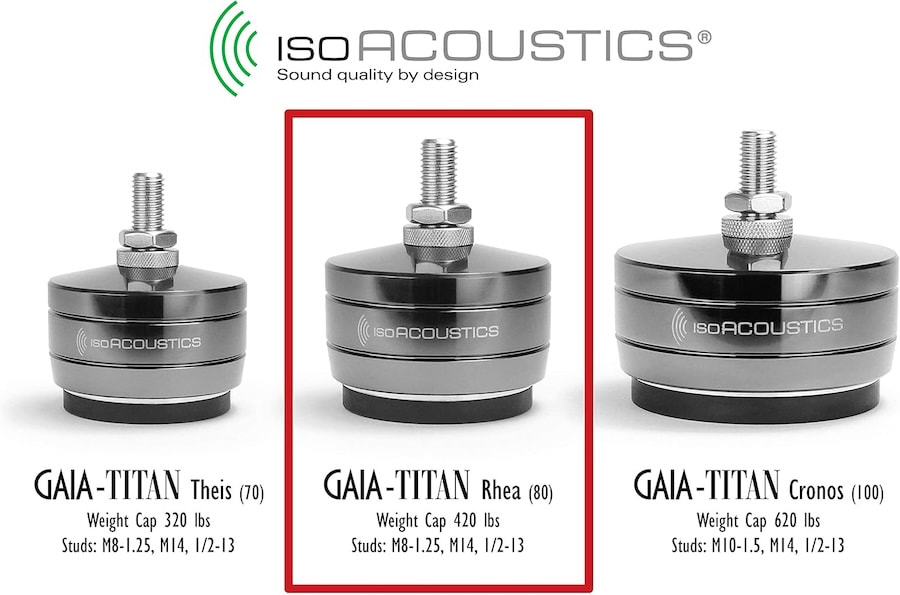

Why the OEM Growth Matters
A long list of partner logos does not automatically prove that every isolation product will transform every audio system.
It does, however, demonstrate that loudspeaker and electronics manufacturers are willing to engineer IsoAcoustics technology into products bearing their own names. These companies have access to measurement equipment, mechanical engineers, listening rooms, and prototype facilities. They are not integrating the products because somebody posted an enthusiastic comment beneath a YouTube video.
The breadth of the partnerships is also revealing. IsoAcoustics products are being used beneath large horn loudspeakers, compact monitors, turntables, music servers, DACs, preamplifiers, equipment racks, and internal loudspeaker modules.
The Bottom Line
There is no shortage of questionable accessories in high-end audio, but properly designed isolation is not one of them.
IsoAcoustics offers a proven mechanical solution to a real problem, and our experience with its products has demonstrated that the benefits can be clearly audible. Bass often becomes more controlled, imaging gains greater stability, and fewer vibrations find their way into floors and furniture.
IsoAcoustics now has approximately 155 OEM projects across more than 70 brands. JBL, Marten, Raidho, Gershman Acoustics, Lumin, EMM Labs, and Antipodes Audio are very different companies building very different products. Their growing use of the same isolation technology is not proof that every system will respond identically, but it is compelling evidence that IsoAcoustics is solving a problem manufacturers consider worth addressing.
The standalone GAIA-TITAN Neo should be especially interesting for owners of very large floorstanding loudspeakers when it arrives later in 2026. Just do not expect it to make poor placement, a bad room, or a questionable loudspeaker disappear. Even proven technology has limits.
Where to buy: IsoAcoustics products are available at Amazon, Best Buy, Crutchfield and IsoAcoustics.com, as well as many more authorized dealers.
You must be logged in to post a comment Login