







Connect with us

Tech

Italian university La Sapienza goes offline after cyberattack

Published

on

Italian university La Sapienza goes offline after cyberattack

Rome’s “La Sapienza” university has been targeted by a cyberattack that impacted its IT systems and caused widespread operational disruptions at the educational institute.

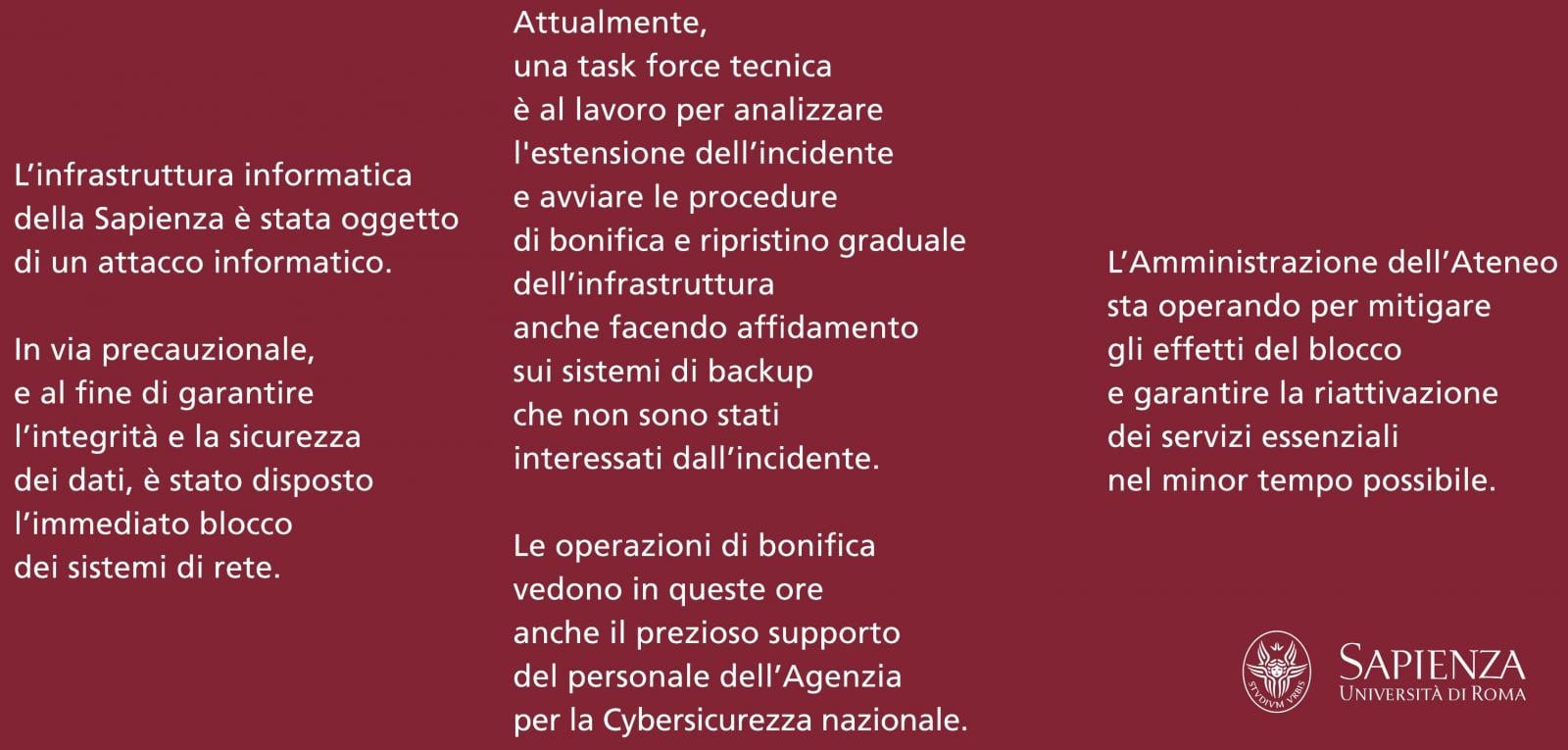
The university first disclosed the incident in a social media post earlier this week, saying that its IT infrastructure “has been the target of a cyberattack.”

“As a precautionary measure, and in order to ensure the integrity and security of data, an immediate shutdown of network systems has been ordered,” the organization said.

Wiz
Original statement about the cyberattack
Source: BleepingComputer

The university, which is Europe’s largest by number of in-campus students, with over 112,500 enrolled, notified the authorities of the incident and formed a technical task force to initiate remediation and restoration procedures.

As of writing, the university’s website remains offline, and new status updates published on Instagram reflect a continued effort to recover from the cyberattack.

Advertisement

As of yesterday’s announcement, temporary “infopoints” have been set up for students to provide information accessible through digital systems and databases that are currently unavailable.

Although the university has not disclosed much information about the attack type or the perpetrators, Italian newspaper Corriere Della Sera claims that the incident is a ransomware attack perpetrated by a pro-Russian threat actor called Femwar02 and resulted in data encryption.

The outlet released the information based on malware characteristics and operational patterns, which are similar to the Bablock/Rorschach ransomware.

This is a ransomware strain that first appeared in 2023, featuring fast encryption speeds and extensive customization options. Cybersecurity company Check Point estimated that it was a project built from bits of the leaked sources of Babuk, LockBit v2.0, and DarkSide.

Advertisement

According to Corriere Della Sera’s sources, a ransom exists, but the university staff has not opened it to avoid triggering the 72-hour timer. Hence, the ransom amount hasn’t been specified.

Currently, the university’s technicians are working together with Italian CSIRT and specialists from Agenzia per la Cybersicurezza Nazionale (ACN) and the Polizia Postale to restore the systems from backups, which have reportedly not been impacted.

Although Rorschach does not operate an extortion portal on the dark web, stolen data could be disseminated or sold to data extortion groups, so the risk of it ending up online remains significant.

Given the situation, students and staff at Sapienza University of Rome should remain on high alert for phishing attacks, avoid clicking links in unsolicited communications, and monitor accounts for suspicious activity.

Advertisement

Modern IT infrastructure moves faster than manual workflows can handle.

In this new Tines guide, learn how your team can reduce hidden manual delays, improve reliability through automated response, and build and scale intelligent workflows on top of tools you already use.

Source link

Advertisement
Continue Reading
Click to comment

Leave a Reply

Your email address will not be published. Required fields are marked *

Tech

4 Home Depot Finds That Outshine Walmart In Price And Quality

Published

on


We may receive a commission on purchases made from links.

Chances are that if you do a lot of shopping at Walmart, it’s not because of their deals on DIY and home improvement equipment. You’ll find a lot at Walmart, from tech products like phones and speakers to surprisingly budget-friendly TVs, but it’s hard to recommend this retailer for its power and hand tool selection. If your DIY needs are limited to building Ikea furniture walls and hanging a couple of shelves, you could probably get away with Walmart’s own Hart — at least until Hart is discontinued for good. Hopefully Hyper Tough, the other tool brand sold by Walmart, won’t go the same way.

If you have niche DIY needs, there’s a lot you just won’t find at Walmart, but in the categories where both stores offer a number of products, the competition is tighter than you might think. Home Depot almost always has more choice, especially in the high price range, but Walmart often wins when it comes to budget solutions. These four products are exceptions to the rule, because with them, Home Depot beats Walmart both in price and quality.

Advertisement

DeWalt ToughSystem tool boxes

Both Walmart and Home Depot have some ToughSystem tool boxes, but you should get yours at Home Depot. There are two reasons for this. The first and most obvious reason is that Home Depot sells many of these same toolboxes for cheaper. For example, Walmart sells the Rolling Toolbox 2.0 for $167.99, while Home Depot has it in store for $125 — and it’s currently discounted even further, to $109.

Advertisement

If you need a reason beyond the lower price to avoid Walmart for these toolboxes, there’s the fact that Home Depot has way more ToughSystem products for sale. This is relevant because ToughSystem is DeWalt’s line of modular storage solutions, meaning it’s at its strongest when you buy more than one box. ToughSystem boxes stack on top of each other, and a locking system makes them stick to one another. They don’t have to sacrifice space for this, either, and include some of DeWalt’s biggest toolboxes.

These storing solutions mostly share the same width and depth, and many are compatible with the same ToughSystem tool trays. These trays are among the ToughSystem products available from Walmart, but they’re only offered by third-party Marketplace sellers (meaning you won’t find them in store) and they’re significantly more expensive than at Home Depot.

Advertisement

Ryobi Drill and Impact Drive Kit

Even Walmart’s highly rated Hart combo kits won’t be very useful without a set of bits to stick onto those drills and impact drivers. If you do most of your shopping at Walmart, it might make sense to stick with what you can find there, especially if you can take advantage of Walmart’s seasonal deals. Otherwise, you’re better off picking your bits at Home Depot. One of the best affordable options is the $30 95-piece Ryobi Drill and Impact Drive Kit. Considering how expensive power tools can be, $30 is a very reasonable price for pretty much every standard driver and drill bit you’ll need, many in multiple copies.

Walmart’s closest equivalent is Hart’s 60-Piece Impact Drill & Drive Bit Set, which is about as expensive as the Ryobi but includes far fewer bits. Even if you think it’s worth leaving 35 bits on the table to save a few dollars, the 95-piece Ryobi kit is less expensive than Hart’s and includes a few wood-boring bits on top of the brad point bits also present in the Walmart set.

Advertisement

Husky 9-Drawer Mobile Workbench

As one can imagine, as we get closer to specialized, expensive products, Home Depot becomes more and more often the best choice. Walmart sells some good, affordable tools for homeowners, but it can’t sell both Swiss Rolls and forklifts. Even though Walmart has a surprising amount of choice in its mobile tool chest section, it can’t compete with what Home Depot has in store, like the (relatively) affordable $403 Husky Tool Storage 9-Drawer Mobile Workbench, which comes with lockable wheels and an integrated power strip with six power outlets and two USB ports. The closest Walmart gets is with Hart’s well-reviewed $449 36-inch Mobile Tool Chest, but a closer look reveals a few important differences.

The first difference is the price. Husky is a respected brand of tool chests and workbenches, so it’s surprising to see this product sold for cheaper than the Hart equivalent. Then, there’s the fact that the two are not equivalent at all: the Husky is 46 inches wide, a whole 10 inches more than the Hart. Finally, Home Depot will sell you this workbench cabinet in a bunch of different colors for more or less the same price. With Walmart, you’re stuck with a light brown wooden top on black painted metal, with ugly blue accents on the drawers’ handles.

Advertisement

One Amp Wen Variable Speed Rotary Tool

You might expect Walmart to win out against Home Depot when it comes to cheap tools, and you’d be right. For the most part, the superstore beats the dedicated home improvement warehouse when it comes to broad appeal goods — no surprise there. What makes the Wen 1Amp Variable Speed Rotary Tool special is the fact that it (barely) beats Walmart’s closest equivalent in price and quality. For $16.28, it’s very affordable but decently powerful, with a max speed of 32,000 rpm and a minimum of 10,000. It also comes with a whole lot of accessories, including plenty of spares. It won’t do any of the heavy lifting, but all things considered, it’s a versatile tool for many jobs that require accuracy.

Advertisement

The closest product from Walmart is the Tracklife Multi-Function Rotary Tool, which is more expensive, at $19.99, and doesn’t have as good a selection of accessories as the $20.78 version of the Wen that comes with a case and numerous accessories.

Walmart has many cheaper rotary tools available, but some don’t come with any accessories (which, unlike what the name implies, are essential) while others — especially the battery-powered, USB-charged ones — are really underpowered.

Advertisement

Methodology

To select four products where Home Depot wins over Walmart on price and quality, we started by comparing the two stores. Being a specialized hardware store, Home Depot has more of an edge when it comes to specialized tools. However, we decided not to overrepresent these niche, expensive products in our list, because $2,500 rebar cutting tools are not the sort of items a reader comparing Walmart to Home Depot expects to see.

Once we had an idea of which kind of tools to look for (small power tools, hand tools and accessories, budget tool boxes and chests), we picked Home Depot’s best money-to-value proposition and compared it to Walmart’s best offer.

Advertisement


Source link

Continue Reading

Tech

Seeing The World Through Animal Eyes

Published

on

If you think about it, you can’t be sure that what you see for the color red, for example, is what anyone else in the world actually sees. All you can be sure of is that we’ve all been trained to identify whatever we do see as red just like everyone else. Now, think about animal vision. Most people know that dogs don’t see as many colors as we do. On the other hand, the birds and the bees can see into ultraviolet. What would the world look like with extra colors? That’s the question researchers want to answer with this system for duplicating different animals’ views of the world.

Of course, this would be easy if you were thinking about dogs or cats. They can’t see the difference between red and green, making them effectively colorblind by human standards. Researchers are using modified commercial cameras and sophisticated video processing to produce images that sense blue, green, red, and UV light. Then they modify the image based on knowledge of different animal photoreceptors.

We were somewhat surprised that the system didn’t pick up IR. As we know snakes, for example, can sense IR. You’d think more sophisticated animals would have better color vision, but that seems to be untrue. The mantis shrimp, for example, has 12-16 types of photoreceptors. Even male and female humans have different vision systems that make them see colors differently.

Advertisement

Maybe you need a photospectometer. You wonder if animals dream in color, too.

Source link

Advertisement
Continue Reading

Tech

Apple’s iPhone 17E vs. iPhone 17, Air, Pro, Pro Max: Comparing the Full Lineup

Published

on

Apple’s latest addition to its iPhone 17 lineup is the lower-cost iPhone 17E. Just like last year’s iPhone 16E, the iPhone 17E is priced at $599 and is meant to be Apple’s entry-level offering for the year. But the 17E has a number of upgrades over its predecessor, such as double the starting storage space at 256GB, MagSafe compatibility and a faster A19 chip. 

It’s still fairly basic compared with the Air and the rest of the iPhone 17 lineup, though. The 17E only has one camera, no Dynamic Island and no Camera Control button. Also, even though it has a 12-megapixel selfie camera, the 17E lacks the Center Stage feature — which automatically switches between portrait and landscape — that’s on the Air and the rest of the iPhone 17 series. 

Here’s how the iPhone 17E compares with the Air and the iPhone 17 lineup.

Advertisement

Watch this: iPhone 17E Packs More Features for the Same $599 Price

Design and display

With a 6.1-inch OLED display, the iPhone 17E has the smallest display compared with the rest of its siblings. Both the iPhone 17 and the 17 Pro have a slightly larger 6.3-inch display, while the iPhone Air has a 6.5-inch screen, and the 17 Pro Max has the biggest screen of them all with a 6.9-inch OLED display.

While the Air and the rest of the iPhone 17 models have a 120Hz variable refresh rate, the iPhone 17E is the only one with just a 60Hz refresh rate. That means the animations won’t be quite as smooth, and you won’t get an always-on display. However, if you’re upgrading from an older iPhone like the iPhone 16, you might not notice as big a difference. 

Design-wise, the iPhone 17E lacks the Dynamic Island that’s on the Air and the rest of the iPhone 17 series. It doesn’t have a physical Camera Control button either. 

Advertisement

It does, however, come in an aluminum frame and is protected by the Ceramic Shield 2, which is on par with the rest of the iPhone 17 lineup. The exception is the iPhone Air, which has a titanium frame. At 0.31-inch thick, the iPhone 17E is just as slender as the iPhone 17 — definitely not as skinny as the 0.22-inch thick iPhone Air. It is quite light, though, at 169 grams (5.96 ounces), which is just a bit heavier than the Air’s weight of 165 grams.

The iPhone 17E in front of flowers

The iPhone 17E has a single rear camera.

Abrar Al-Heeti/CNET

Cameras

Like the 16E, the iPhone 17E only has a single 48-megapixel rear camera. It does have sensor cropping, which offers 2x magnification. The iPhone Air also has only a single 48-megapixel rear camera. The iPhone 17 has two: a 48-megapixel wide and a 48-megapixel ultrawide. Both the 17 Pro and the 17 Pro Max have three: a 48-megapixel wide, a 48-megapixel ultrawide and a 48-megapixel telephoto that has 4x optical zoom but can double up to 8x at 12 megapixels. 

Advertisement

The 17E has a 12-megapixel front-facing camera, while the Air, the 17, the 17 Pro and the 17 Pro Max all have an 18-megapixel selfie shooter. Additionally, the 17E lacks the Center Stage feature that automatically switches between portrait and landscape orientations. 

The iPhone 17E leans against leather-bound books

The iPhone 17E starts with a base storage of 256GB.

Abrar Al-Heeti/CNET

Storage, processors and battery

The iPhone 17E starts with a base storage of 256GB, which is double that of the 16E and brings it up to par with the Air and the rest of the iPhone 17 series. All the phones are also available with 512GB, while the Pro and Pro Max are the only ones available in a 1TB configuration.

Advertisement

The 17E is powered by Apple’s latest A19 chip, which is the same as on the iPhone 17, except the 17E has a quad-core GPU while the 17 has five cores. The iPhone Air, 17 Pro and 17 Pro Max are all powered by Apple’s A19 Pro. 

As for battery, the 17E has the same battery as the 16E, with a 4,005-mAh battery and roughly 26 hours of video playback, according to Apple. That’s actually slightly larger than the iPhone 17’s 3,692-mAh battery and the Air’s 3,149-mAh battery. The 17 Pro and 17 Pro Max top out the battery charts with a 4,252- and 5,088-mAh battery, respectively. Still, the iPhone 17E’s battery should hold up well thanks to the A19 processor, C1X cellular modem and the power management of iOS 26. 

The 17E gets MagSafe, which was sorely missing in the 16E. This lets the iPhone 17E work with magnetic chargers and accessories. It also has up to 15 watts of Qi2 wireless charging. The iPhone Air and the rest of the 17 lineup offer fast charge up to 50% in 30 minutes using a 30-watt adapter or higher with MagSafe charging. 

Check out the chart below to see all the ways these phones match up.

Advertisement

Apple iPhone 17E vs. iPhone 17, iPhone 17 Air, iPhone 17 Pro, iPhone 17 Pro Max

Apple iPhone 17E Apple iPhone 17 Apple iPhone Air Apple iPhone 17 Pro
Display size, tech, resolution, refresh rate 6.1-inch OLED display; 2,532×1,170 pixels; 60Hz refresh rate 6.3-inch OLED; 2,622×1,206 pixels; 1-120Hz variable refresh rate 6.5-inch OLED; 2,736×1,260 pixels; 1-120Hz variable refresh rate 6.3-inch OLED; 2,622×1,206 pixels; 1-120Hz variable refresh rate
Pixel density 460 ppi 460 ppi 460 ppi 460 ppi
Dimensions (inches) 5.78×2.82×0.31 5.89×2.81×0.31 6.15×2.94×0.22 5.91×2.83×0.34
Dimensions (millimeters) 146.7×71.5×7.8 149.6×71.5×7.95 156.2×74.7×5.64 150.0×71.9×8.75
Weight (grams, ounces) 167g (5.88 oz.) 177g (6.24 oz.) 165g (5.82 oz.) 206g (7.27 oz.)
Mobile software iOS 26 iOS 26 iOS 26 iOS 26
Camera 48-megapixel (wide) 48-megapixel (wide) 48-megapixel (ultrawide) 48-megapixel (wide) 48-megapixel (wide) 48-megapixel (ultrawide) 48-megapixel (4x, 8x telephoto)
Front-facing camera 12-megapixel 18-megapixel 18-megapixel 18-megapixel
Video capture 4K 4K 4K 4K
Processor Apple A19 Apple A19 Apple A19 Pro Apple A19 Pro
RAM + storage RAM unknown + 256GB, 512GB RAM N/A + 256GB, 512GB RAM N/A + 256GB, 512GB, 1TB RAM N/A + 256GB, 512GB, 1TB
Expandable storage None None None None
Battery 4,005 mAh 3,692 mAh 3,149 mAh 4,252 mAh
Fingerprint sensor None, Face ID None, Face ID None, Face ID None, Face ID
Connector USB-C USB-C USB-C USB-C
Headphone jack None None None None
Special features MagSafe, Qi2 charging (up to 15W), Action button, Apple C1 5G modem, Apple Intelligence, Ceramic Shield, Emergency SOS, satellite connectivity, IP68 resistance Apple N1 wireless networking chip: Wi-Fi 7 (802.11be) with 2×2 MIMO, Bluetooth 6, Thread, Action button, Camera Control button, Dynamic Island, Apple Intelligence, Visual Intelligence, dual eSIM, 1 to 3,000 nits brightness display range, IP68 resistance; colors: black, white, mist blue, sage, lavender; fast charge up to 50% in 20 minutes using 40W adapter or higher via charging cable; fast charge up to 50% in 30 minutes using 30W adapter or higher via MagSafe Charger Apple N1 wireless networking chip: Wi-Fi 7 (802.11be) with 2×2 MIMO, Bluetooth 6, thread, Action button, Apple C1X cellular modem, Camera Control button, Dynamic Island, Apple Intelligence, Visual Intelligence, Dual eSIM, 1 to 3,000 nits brightness display range, IP68 resistance; colors: space black, cloud white, light gold, sky blue; fast charge up to 50% in 30 minutes using 20W adapter or higher via charging cable; fast charge up to 50% in 30 minutes using 30W adapter or higher via MagSafe Charger Apple N1 wireless networking chip: Wi-Fi 7 (802.11be) with 2×2 MIMO, Bluetooth 6, Thread, Action button, Camera Control button, Dynamic Island, Apple Intelligence, Visual Intelligence, dual eSIM, ProRes Raw video recording, Genlock video support, 1 to 3,000 nits brightness display range, IP68 resistance; colors: silver, cosmic orange, deep blue; fast charge up to 50% in 20 minutes using 40W adapter or higher via charging cable; fast charge up to 50% in 30 minutes using 30W adapter or higher via MagSafe Charger
US price starts at $599 (256GB) $829 (256GB) $999 (256GB) $1,099 (256GB)

Source link

Advertisement
Continue Reading

Tech

Battlefield 6's biggest launch ever couldn't stop EA from cutting staff

Published

on


IGN has learned that EA has eliminated an undisclosed number of roles across the studios responsible for Battlefield 6, including Criterion, DICE, Ripple Effect, and Motive. Internally, affected staff are being told the cuts are part of a broader “realignment” of the Battlefield organization, even as all four studios are…
Read Entire Article
Source link

Continue Reading

Tech

Apple reportedly delays its planned smart display launch to fall

Published

on

Mark Gurman at Bloomberg is back with the latest rumors about what’s afoot with Apple’s future plans, and how its ongoing difficulties with artificial intelligence seem to be creating further delays for its next wave of product launches. His sources say that Apple is expected to postpone the debut of its smart home display until later in 2026, likely September when it often introduces new gadgets. Although the hardware has reportedly been finished for months, this delay is being credited to the company’s AI-centric overhaul of Siri still not being complete.

The device, internally known as J490, has been one of Apple’s many poorly-kept secrets. Rumors about a HomePod smart speaker coupled with a screen first emerged back in 2022 and have resurfaced from time to time in the interim, often with promises that the device’s arrival was imminent. The latest claims anticipated that the official announcement was coming this spring, possibly as soon as this month. However, appears to Apple once again be hamstrung by an AI strategy that has left it scrambling to catch up to other industry leaders.

Apple has been working to incorporate more AI capabilities into Siri for more than a year as part of its Apple Intelligence package. Gurman reports that the new timeline from Apple aims to have the revamp completed for the launch of the iPhone 18 Pro, which is also expected for September. Apple may unveil this long-awaited Siri-as-chatbot during its WWDC keynote in the summer before it shows up in any devices.

Source link

Advertisement
Continue Reading

Tech

Startup Wants To Launch a Space Mirror

Published

on

A startup called Reflect Orbital wants to launch thousands of mirror-bearing satellites to reflect sunlight onto Earth at night and “power solar farms after sunset, provide lighting for rescue workers and illuminate city streets, among other things,” reports the New York Times. From the report: It is an idea seemingly out of a sci-fi movie, but the company, Reflect Orbital of Hawthorne, Calif., could soon receive permission to launch its first prototype satellite with a 60-foot-wide mirror. The company has applied to the Federal Communications Commission, which issues the licenses needed to deploy satellites. If the F.C.C. approves, the test satellite could get a ride into orbit as soon as this summer. The F.C.C.’s public comment period on the application closes on Monday. “We’re trying to build something that could replace fossil fuels and really power everything,” Ben Nowack, Reflect Orbital’s chief executive, said in an interview. The company has raised more than $28 million from investors.

[…] Reflect Orbital’s first prototype, which will be roughly the size of a dorm fridge, is almost complete. Once in space, about 400 miles up, the test satellite would unfurl a square mirror nearly 60 feet wide. That would bounce sunlight to illuminate a circular patch about three miles wide on the Earth’s surface. Someone looking up would see a dot in the sky about as bright as a full moon. Two more prototypes could follow within a year. By the end of 2028, Reflect Orbital hopes to launch 1,000 larger satellites, and 5,000 of them by 2030. The largest mirrors are planned to be nearly 180 feet wide, reflecting as much light as 100 full moons. The company said its goal was to deploy the full constellation of 50,000 satellites by 2035.

How much does it cost to order sunlight at night? Mr. Nowack said the company would charge about $5,000 an hour for the light of one mirror if a customer signed an annual contract for 1,000 hours or more. Lighting for one-time events and emergencies, which might require numerous satellites and more effort to coordinate, would be more expensive. For solar farms, he envisions splitting revenue from the electricity generated by the additional hours of light.

Source link

Advertisement
Continue Reading

Tech

Today’s NYT Connections: Sports Edition Hints, Answers for March 10 #533

Published

on

Looking for the most recent regular Connections answers? Click here for today’s Connections hints, as well as our daily answers and hints for The New York Times Mini Crossword, Wordle and Strands puzzles.


Today’s Connections: Sports Edition features a lot of team names, but that doesn’t mean it’s an easy one to solve. If you’re struggling with today’s puzzle but still want to solve it, read on for hints and the answers.

Connections: Sports Edition is published by The Athletic, the subscription-based sports journalism site owned by The Times. It doesn’t appear in the NYT Games app, but it does in The Athletic’s own app. Or you can play it for free online.

Advertisement

Read more: NYT Connections: Sports Edition Puzzle Comes Out of Beta

Hints for today’s Connections: Sports Edition groups

Here are four hints for the groupings in today’s Connections: Sports Edition puzzle, ranked from the easiest yellow group to the tough (and sometimes bizarre) purple group.

Yellow group hint: Play ball!

Advertisement

Green group hint: Not front.

Blue group hint: Certain NFL player.

Purple group hint: They play at Smoothie King Center.

Answers for today’s Connections: Sports Edition groups

Yellow group: An AL Central player.

Advertisement

Green group: Words appearing before “back,” in football.

Blue group: Associated with Derrick Henry.

Purple group: New Orleans Pelicans.

Read more: Wordle Cheat Sheet: Here Are the Most Popular Letters Used in English Words

Advertisement

What are today’s Connections: Sports Edition answers?

completed NYT Connections: Sports Edition puzzle for March 10, 2026

The completed NYT Connections: Sports Edition puzzle for March 10, 2026.

NYT/Screenshot by CNET

The yellow words in today’s Connections

The theme is an AL Central player. The four answers are Guardian, Royal, Tiger and Twin.

The green words in today’s Connections

The theme is words appearing before “back,” in football. The four answers are corner, defensive, full and running.

Advertisement

The blue words in today’s Connections

The theme is associated with Derrick Henry. The four answers are Heisman, King, Ravens and Titans.

The purple words in today’s Connections

The theme is New Orleans Pelicans. The four answers are Bey, Fears, Murphy and Queen.

Source link

Advertisement
Continue Reading

Tech

Protecting your business from POS malware attacks

Published

on

As UK businesses increasingly move toward cashless payments, cybercriminals are targeting point-of-sale (POS) systems. In the first half of 2025 alone, £600 million was stolen through payment-related fraud, a three per cent increase on the same period in 2024.

Michael Ault

Managing Director at myPOS.

Advertisement

Source link

Advertisement
Continue Reading

Tech

Stryv acquires Sterra, eyes 9-figure revenue by 2027

Published

on

Sterra will continue to operate as a standalone brand

Singapore-based consumer electronics startup Stryv has fully acquired home appliance brand Sterra for an undisclosed amount.

As part of the deal, Sterra will continue to operate as a standalone brand, with its CEO Chris Lim taking on an advisory role, Stryv CEO Roy Ang told Tech in Asia.

Both firms will now operate under Evo Commerce, a wellness and personal care D2C brand builder formerly called Evolut Holdings. Evo Commerce is also the parent company of Stryv. Evo Commerce’s brand portfolio spans Bback (supplements) and Mantou (shampoo), and its backers include East Ventures, IJK Capital Partners, and Bonjour Holdings.

Stryv focuses on personal care devices—hairdryers and men’s shavers priced between US$149 and US$189. Meanwhile, Sterra specialises in water and air purifiers with a broader price range of US$189 to US$1,999.

Advertisement

In 2023, Sterra said that it was earning eight figures in revenue at the time, and making a net profit in just two years while being entirely bootstrapped.

According to The Business Times, unaudited financial numbers for Sterra Tech, the firm’s entity in Singapore, show that it recorded S$16.6 million in revenue in the fiscal year ending Jun 2025, with a net loss of S$2.3 million.

Following the acquisition, Sterra’s workforce, including its customer service, technical support, finance, HR, sales and marketing teams, will combine with Stryv’s. The transition includes guaranteed warranty continuity for all existing customers.

Stryv’s ambition to becoming a “multibillion-dollar enterprise”

stryv suntec city hairdryers stryv suntec city hairdryers
Stryv’s outlet at Suntec City./ Image Credit: Stryv

For Stryv, the acquisition marks its entry into the home appliance space and brings it closer to its goal of becoming a “multibillion-dollar enterprise,” said Ang, who is also Evo Commerce’s co-founder and CEO.

“The goal in the next five years is to build Stryv as a key player in the home appliances product category,” he added.

Advertisement

According to Ang, who was formerly regional head of commercial and operations for GrabPay, Evo Commerce had explored multiple expansion paths into home care, but decided on an M&A as the right choice.

If we build our own home-care brand, it will take a couple of years to get substantial data about our customers. If we partner, we are essentially just distributors of the product. Buying was the most viable option.

Roy Ang

Stryv sells its products through its own website, ecommerce platforms, and in over 2,000 storefronts, including 30 retail stores across Singapore, Malaysia, and Hong Kong. Its products can also be found in 2,000 third-party electronics retailers and pharmacies.

The brand is self-funding the acquisition through its balance sheet, with no external investor financing. Ang noted the company closed 2025 profitable, with revenue reaching eight figures, though he declined to provide specific figures to The Business Times.

Advertisement

Part of its strategy, Ang said, is: “We don’t let growth at all costs be our mantra.”

In contrast to consumer electronic brands, which typically spend about 40-50% of their revenue on marketing expenses, Ang pointed out that Stryv spends a low double-digit percentage.

The decisive factor

sterra air water purifier sterra air water purifier
Sterra’s best-sellers are its air and water purifiers./ Image credit: Sterra

Both founders of Sterra and Stryv share a long-standing relationship. Lim used to even informally advise Stryv in its early years.

Ang said that his personal friendship with Sterra’s founder made the deal more straightforward, given their mutual familiarity with each other’s brands.

But the decisive factor for Stryv eventually came down to Sterra’s customer and supplier relationships.

Advertisement

Ang shared that Sterra’s products are present in around 200,000 homes in Singapore, providing Stryv with valuable customer feedback to guide Stryv’s future product development.

Sterra’s R&D and customer service team also made the acquisition appealing. Ang noted that Sterra’s team of technicians is “pretty robust,” with most having been with the brand for the past four years, while Stryv has yet to establish its own R&D capabilities.

Moreover, Sterra has access to suppliers for Tier 1 factories in both China and South Korea, while Stryv has mostly tapped suppliers in China.

The acquisition comes despite the challenges Sterra had faced over the years.

Advertisement

In 2024, Singapore’s Competition and Consumer Commission investigated Sterra for falsely claiming that local tap water was unsafe to drink. The brand has since apologised for the incident.

A Stryv spokesperson acknowledged the issue was flagged during due diligence, noting it “was taken seriously, but was not a blocker to the transaction.”

Looking ahead, Ang believes Stryv and Sterra can hit their goal of achieving an overall nine-figure revenue in 2027. He added that Stryv plans to continue focusing on growing its presence across Singapore, Malaysia, and Hong Kong.

That said, while the markets for personal care devices and consumer appliances are expected to grow further in the next four years, Stryv will be facing heated competition.

Advertisement

According to Euromonitor, Singapore’s consumer appliance market reached 4.9 million units in 2025 retail volume sales, and is projected to jump to 5.4 million units by 2030.

Stryv faces three formidable players: Philips currently commands the largest market share in both personal care and consumer appliances, followed by Braun (personal care) and Panasonic (consumer appliances).

The competitive landscape is further intensified by the rising trend of Asian D2C brands and consumer goods companies pursuing acquisitions, with M&A activity accelerating across markets such as Singapore and India.

  • Read more stories we’ve written on Singaporean businesses here.

Featured Image Credit: Stryv

Advertisement

Source link

Continue Reading

Tech

Congressional Republicans Push Bills That Would Block Kids Access To Content For Ideological Reasons

Published

on

from the how-is-this-protecting-kids? dept

Should parents have a right to monitor and control which sites and apps their kids use? Today, parents do have that legal right under the Children’s Online Privacy Protection Act (COPPA). The 1998 law requires verifiable parental consent before websites or apps can collect, use or share personal information from teens 13 or under. In practice, that means parents must consent for all social media apps. 

The original version of COPPA would have required parental notification whenever teens (ages 14-17) sign up for websites; parents would have had the right to access personal information shared with such sites. Those provisions were dropped after free speech advocates warned that these provisions could “chill protected First Amendment activities and undermine rather than enhance teenagers privacy,” especially when “teenagers may be divulging or seeking information they don’t want their parents to know about.” Thus, the Center for Democracy & Technology warned, while “parents have an important role in protecting their teenager’s privacy, however the bill’s emphasis on parental access may overlook older minors’ interests.”

Now, legislation is moving in Congress that would give parents the right to monitor and control the apps and platforms their teens use. Yesterday, in party-line votes, the House Energy & Commerce Committee sent two bills to the House floor. The “App Store Accountability Act” (ASAA) would require app stores to categorize users by age, associate the minors’ accounts with a parental account, and then obtain consent from the parental account when the minor user creates an account on the app store, or installs any app. This gives parents the right to monitor and control exactly which apps their kids are using. The Committee also approved the KIDS Act, which would require parental consent before any social media “platform” (website or app) could allow teens to use “any direct messaging feature.”

These bills would “make vulnerable kids less safe,” warned the committee’s Ranking Member, Frank Pallone (D-NJ), because they “threaten kids in unsupportive or even abusive households where they can be real-world harms from allowing parents complete access and control over their teens’ online existence.” This is essentially the same concern raised in 1998.

Advertisement

Rep. Diana Harshbarger (R-TN) was more direct than most of her Republican colleagues, insisting that parents need the bills to protect kids “who have access to these online evils.” Which evils? “Kids should not be looking at pornography—this is just common sense, people,” she said. Perhaps so: last year, the Supreme Court upheld age verification mandates for pornography in Free Speech Coalition v. Paxton (2025). But Harshbarger went much further: “We’ve been hearing from a lot of folks who profit off doing harm to kids or have questionable ideological priorities.” 

Her fellow Tennessee Republican, Sen. Marsha Blackburn (R-TN), has been clear about just which “ideologies” need to be stopped. Last year, she was recorded, in remarks to a private meeting of social conservatives, saying the quiet part out loud: Republicans’ top priority should be “protecting minor children from the transgender [sic] in this culture and that influence.” Roughly half of American adults tell pollsters that trans people should be legally required to use public bathrooms that match their sex at birth, rather than the gender they identify with. Many of those parents doubtless think their teens need to be “protected” from sites and apps dedicated to helping LGBTQ teens who feel isolated and alone—apps like TrevorSpace and GiveUsTheFloor

These sites aren’t exploiting anyone for profit. They’re both non-profits dedicated to education and building communities of the kids most at risk for mental illness and suicide. Yet ASAA and the KIDS Act would require parents to approve teens’ access to both sites. This isn’t an accident: where COPPA applies only to sites that operate “in commerce” (i.e., for profit), neither bill contains any such limit, and thus both would apply even to pure non-profits. This problem could be fixed with a surgical amendment, but Republicans would surely object and Democrats failed to raise this issue at yesterday’s markup.

Even if this problem were fixed, the larger problem would remain: for-profit apps are overwhelmingly the ones that vulnerable teens use to access perspectives on the world their parents want to block and to find other teens they can relate to. Popular apps like Snapchat and TikTok are especially vital in regions where they face hostility or violence for expressing their sexuality or gender identity. Under ASAA and the KIDS Act, parents could block such apps to “protect” their teens from “online evils” like subversive ideas about gender, sexuality, contraception or religion.

Advertisement

Parents could, under ASAA, also block AI apps. At a Senate hearing last year on “Examining the Harm of AI Chatbots,” one parent complained that a Character.AI chatbot had “turned [her son] against our church by convincing him that Christians are sexist and hypocritical and that God does not exist.” Sen. Josh Hawley (R-MO) told her: “You didn’t know it at the time, but the chatbot was actively indoctrinating your son into questioning your beliefs as a family, your Biblical beliefs.” Questionable “ideological priorities,” indeed.

Both bills pay lip service to the First Amendment. The KIDS Act shall not be interpreted to “[a]llow a governmental entity to enforce this Act based on a viewpoint expressed by or through any speech, expression, or information protected by the First Amendment to the Constitution of the United States.” Likewise, ASAA “shall not be construed … to affect or restrict the expression of political, religious, or other viewpoints.” These rules of construction might well help ensure that courts scrutinize selective enforcement of these bills aimed at suppressing disfavored speech. But these provisions won’t address the core problem with the bills: that parents will block viewpoints they don’t want their teens to access by controlling which apps and platforms they use.

“Constitutional rights do not mature and come into being magically only when one attains the state-defined age of majority,” as the Supreme Court has noted. “[M]inors are entitled to a significant measure of First Amendment protection,” the Court has said, “and only in relatively narrow and well-defined circumstances may government bar public dissemination of protected materials to them.” 

The Court reiterated this point in Brown v. Entertainment Merchants Association (2010), which struck down age verification requirements for video games. Because virtual violence was not obscene to minors, the First Amendment applied—unlike Paxton, which upheld a Texas law requiring age verification for sites whose content was at least one third composed of pornography, which is obscene to minors. In Brown, California argued that its law was “justified in aid of parental authority: By requiring that the purchase of violent video games can be made only by adults, the Act ensures that parents can decide what games are appropriate.” The Supreme Court has long recognized “the liberty of parents and guardians to direct the upbringing and education of children under their control.” But the Brown Court doubted “that punishing third parties for conveying protected speech to children just in case their parents disapprove of that speech is a proper governmental means of aiding parental authority.” Those “doubts” should apply even more strongly to ASAA and the KIDS Act.

Advertisement

Rep. Harshbarger claimed that the KIDS Act hews closely to Paxton. Another member referenced the Eleventh Circuit’s recent decision in CCIA & NetChoice v. Uthmeier, which allowed a Florida law that included an age verification mandate for social media to take effect pending a First Amendment challenge. The appeals court claimed that Paxton “recently clarified that age verification does not automatically trigger strict scrutiny because it does not constitute a ‘ban on speech to adults.’”

Both misread Paxton. Here’s what the Court actually said: “the First Amendment leaves undisturbed States’ power to impose age limits on speech that is obscene to minors.” That’s irrelevant here. Like the age verification requirement for violent video games in Brown, the KIDS Act and ASAA both clearly require age verification for content that is not obscene to minors—and both bills clearly do burden the First Amendment speech of adults to access entirely lawful speech anonymously. True, ASAA tries to reduce this burden by applying the age verification mandate only to the category of users that are found likely to be minors (presumably excluding much older adults), but such a category will necessarily include many adults, who will have to identify themselves to exercise their First Amendment rights—exactly what made age verification unlawful in Brown

TechFreedom prebutted the Eleventh Circuit’s confusion in Uthmeier. As our amicus brief explained, Paxton essentially said two things. First, for content obscene to minors, age-verification laws are (now—due to Paxton’s contortions) akin to regulations on expressive conduct. When content obscene to minors is at issue, the state’s regulatory power “necessarily includes the power to require proof of age.” In the context of adult content (pornography), in other words, an age-verification “statute can readily be understood as an effort to restrict minors’ access” to speech unprotected as to them. In the context of social media, by contrast, no such assumption applies. Restrictions in that realm remain, as they have always been, presumptively unconstitutional direct regulations on speech—as Brown held. The Eleventh Circuit simply misunderstood this, and buried its misreading of Paxton in a flimsily reasoned footnote.

So, what can lawmakers do, consistent with the First Amendment? Congress might start by creating a more privacy-protective national standard for age verification for pornography. Notably, Texas’s law does nothing to address the data security concerns raised by collecting user information for age verification. 

Advertisement

For social media services, lawmakers should focus on what has always been the clearest harm: sexual exploitation by adults. Legislation could start by empowering parents to control who their teens can communicate with. In this sense, the KIDS Act is better than ASAA: it focuses on parents’ access to direct messaging controls rather than approving the installation of each app. Democrats’ alternative bill, the “Safe Messaging for Kids Act,” is still more focused: it would require only that platforms “shall provide a parental tool to allow a parent of a covered user to view the covered user’s direct messaging control settings.” But both bills would require some form of age verification for some adults for lawful content. Paxton doesn’t make that constitutional. 

But maybe that’s OK. Do parents really need the government to require platforms and app stores to age-verify users to determine who’s a minor? ASAA requires that a minor’s account “be affiliated with a parental account” but it doesn’t require any effort to prove that the parental account actually belongs to the minor’s parent, because there is no easy or reliable way of doing so. Instead, it’s enough that this account “be established by an individual who the app store provider has determined is an adult.” If we can reasonably assume that person is the parent, why can’t we trust parents to manage the settings on devices they purchase for their teens? After all, mobile carriers allow only adults to set up accounts. 

If the existing parental controls in operating systems and app stores are inadequate or too hard to use, that’s where regulation should focus. That would be “less restrictive” of speech, in First Amendment terms, than forcing adults to identify themselves. Perhaps parents do need better controls over direct messaging. Apple iOS currently allows parents to control direct messaging but only for built-in apps. But if any controls required by law should be content and viewpoint-neutral, which means that they should work across all apps, lest they become an indirect way for parents to veto teens’ use of particular apps, like TrevorSpace or GiveUsTheFloor.

Whatever the government might require, it has no business protecting teens from “questionable ideological priorities,” even through the indirect means of requiring parental controls. “Whatever the power of the state to control public dissemination of ideas inimical to the public morality, said the Supreme Court long ago, “it cannot constitutionally premise legislation on the desirability of controlling a person’s private thoughts.” That’s true even if that person is a teenager.

Advertisement

Berin Szóka is President of TechFreedom.

Filed Under: 1st amendment, asaa, children, coppa, diana harshbarger, frank pallone, free speech, josh hawley, kids act, marsha blackburn, parental controls, parents

Source link

Advertisement
Continue Reading

Trending

Copyright © 2025