










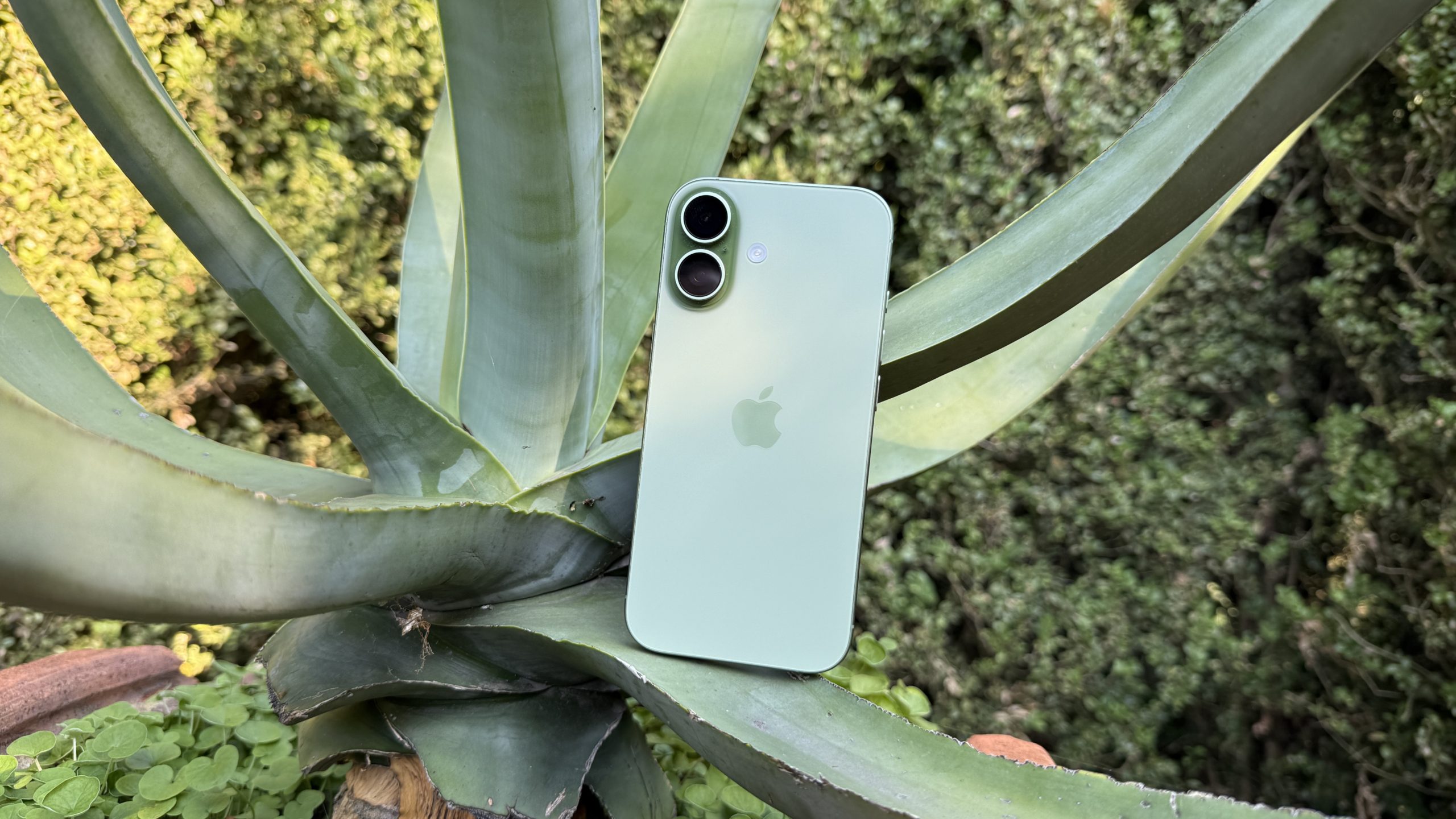
The iPhone 17 is a great all-round phone with strong cameras and performance, a good screen and all-day battery life. It’s not nearly as exciting as the iPhone Air, but it is reasonably priced.
Pros
- Great cameras
- Solid battery life
- Cheaper than the Air
Cons
- Not as stylish as the Air
- Slightly less powerful than the Air
- No telephoto camera
The iPhone Air is built to turn heads, with a slim and light design that comes at the cost of camera versatility and battery life. It’s more powerful than the iPhone 17 but also more expensive.
Pros
- Very slim and light
- Top-end power
- A great 6.5-inch screen
Cons
- Battery life isn’t the best
- Only one rear camera
- More expensive than the iPhone 17
Of the two, the iPhone Air commands the highest price tag, but it’s actually a worse phone in some ways, with Apple prioritizing its weight and slimness over other specs. In other words, even if money is no object, it might not be the right choice for you.
So, to help you decide whether to buy the iPhone 17 or iPhone Air, we’ve compared them in full, having used both phones extensively since their release in September.
Article continues below
iPhone 17 vs iPhone Air: specs comparison
You’ll find a deep dive into the specs and features of the iPhone 17 and iPhone Air — along with their respective prices — below, but first, here’s a look at how their key specs compare:
| Header Cell – Column 0 |
iPhone 17 |
iPhone Air |
|---|---|---|
|
Weight: |
177g |
165g |
|
Display: |
6.3-inch OLED |
6.5-inch OLED |
|
Resolution: |
1206 x 2622 |
1260 x 2736 |
|
Refresh rate: |
120Hz |
120Hz |
|
Peak brightness: |
3,000 nits |
3,000 nits |
|
Chipset: |
A19 |
A19 Pro |
|
Storage: |
256GB, 512GB |
256GB, 512GB, 1TB |
|
Rear cameras: |
48MP wide (26mm, ƒ/1.6), 48MP ultra-wide (13 mm, ƒ/2.2) |
48MP wide (26mm, f/1.6) |
|
Front camera: |
18MP (ƒ/1.9) |
18MP (f/1.9) |
|
Battery: |
3,692mAh |
3,149mAh |
|
Charging: |
40W wired, 25W wireless |
20W wired, 20W wireless |
|
Colors: |
Black, White, Mist Blue, Sage, Lavender |
Space Black, Cloud White, Light Gold, Sky Blue |
iPhone 17 vs iPhone Air: price and availability
Image 1 of 2


The iPhone 17 and iPhone Air were both announced alongside their Pro siblings in September 2025, and they’re both available globally. However, their prices differ.
The iPhone 17 starts at $799 / £799 / AU$1,399, while the iPhone Air starts at $999 / £999 / AU$1,799. For full pricing of every configuration, check out the charts below.
|
Storage |
US price |
UK price |
AU price |
|---|---|---|---|
|
256GB |
$799 |
£799 |
AU$1,399 |
|
512GB |
$999 |
£999 |
AU$1,799 |
|
Storage |
US price |
UK price |
AU price |
|---|---|---|---|
|
256GB |
$999 |
£999 |
AU$1,799 |
|
512GB |
$1,199 |
£1,199 |
AU$2,199 |
|
1TB |
$1,399 |
£1,399 |
AU$2,599 |
So, the iPhone Air is $200 / £200 / AU$400 more expensive than the iPhone 17 in the configurations they’re both available in, and the Air can cost even more if you go for its top 1TB capacity, which isn’t an option with the iPhone 17.
Winner: iPhone 17
iPhone 17 vs iPhone Air: design
Image 1 of 2


While iPhones from the same generation tend to look quite similar, there are actually quite a lot of differences between the iPhone 17 and the iPhone Air.
The iPhone 17 has a dual-lens camera on the back with the lenses arranged vertically, while the iPhone Air has just one rear camera, but there’s a raised camera block running horizontally across the rear.
The iPhone Air is — surprise! — also a lot slimmer and lighter than the iPhone 17, coming in at 156.2 x 74.7 x 5.6mm and 165g, while the latter phone measures 149.6 x 71.5 x 8mm and 177g. This is, of course, the USP of the iPhone Air; it feels better than any iPhone (maybe ever?) in the hand, and we’d recommend going into an Apple Store and picking one up before dismissing its design as gimmicky.
Despite its slim frame and light weight, the iPhone Air is actually taller and wider than the iPhone 17 thanks to its larger screen (more on this in the next section), so you also get more display real estate for that higher price tag.
Plus, the iPhone Air should be slightly tougher, as while both phones have Ceramic Shield 2 on the front, the Air additionally has Ceramic Shield on the back, and it has a titanium frame, while the iPhone 17 uses aluminum.
Their colors differ too, with the iPhone 17 being sold in Black, White, Mist Blue, Sage, and Lavender, while the iPhone Air is available in Space Black, Cloud White, Light Gold, and Sky Blue (beware, though, that Light Gold is very subtle).
Beyond that, most design elements are similar — both phones have flat screens with a Dynamic Island, similar curves to their corners, and the same selection of buttons. They also both have an IP68 rating for water and dust resistance.
However, if you’re outside the US, then the iPhone 17 will likely have a physical SIM card slot, whereas the iPhone Air is eSIM-only in all regions.
So, these are both good-looking phones, but the iPhone Air is undoubtedly the most stylish, with our iPhone Air review describing it as “Apple’s most exciting refresh in years.”
Winner: iPhone Air
iPhone 17 vs iPhone Air: display
Image 1 of 2


The iPhone 17 has a 6.3-inch 1206 x 2622 OLED display with a 120Hz refresh rate, a peak brightness of 3,000 nits, and around 460 pixels per inch. The iPhone Air’s display is a bigger 6.5-inch 1260 x 2736 OLED panel with a 120Hz refresh rate, a peak brightness of 3,000 nits, and roughly 460 pixels per inch.
So, the two phones have the same pixel density, the same OLED display technology, the same maximum brightness, and the same maximum refresh rate. They both also support always-on display, and have the same Ceramic Shield 2 protection, with the main difference simply being that the iPhone Air’s screen is a bit bigger.
Our iPhone 17 review described its screen as delivering “excellent visuals”, while our iPhone Air review called its display “punchy, sharp, and smooth.” So you won’t go wrong with either phone.
Winner: Tie
iPhone 17 vs iPhone Air: cameras
Image 1 of 2


When it comes to cameras, the iPhone 17 is the clear winner. Not because the iPhone Air’s cameras are bad, but because the phone has just one on the back. Specifically, it has a 48MP f/1.6 wide camera, whereas the iPhone 17 has both that camera and a 48MP f/2.2 ultra-wide with a 120-degree field of view — and both phones have an 18MP f/1.9 camera on the front.
So, with the addition of an ultra-wide lens, the iPhone 17 is the more versatile shooter, and when it comes to video, the iPhone Air doesn’t have an advantage either, as both phones are capable of recording in up to 4K quality at up to 60fps, or in 1080p at up to 240fps.
Still, while the iPhone 17 wins for photos, the iPhone Air isn’t a bad snapper by any means, with our iPhone Air review saying that its camera “delivers sharp, natural photos and impressive portraits”, while we described the iPhone 17 as having “two excellent cameras.”
You’re most likely going to use the wide camera more than the ultra-wide anyway, so the difference between the two phones (in terms of photography) isn’t as dramatic as the Air’s single camera suggests. Still, the iPhone 17 wins here.
Winner: iPhone 17
iPhone 17 camera samples
Image 1 of 23


iPhone Air camera samples
Image 1 of 12


iPhone 17 vs iPhone Air: performance and software
Image 1 of 2


On paper, the iPhone Air has a definite performance advantage over the iPhone Air, with this phone having an A19 Pro chipset and 12GB of RAM, whereas the iPhone 17 has a slightly lesser A19 chipset and 8GB of RAM.
But in practice, for most use cases, there’s little noticeable difference, with us finding that the A19 chipset in the iPhone 17 is “plenty fast for now and should last well into the future”, and us similarly noting that the iPhone Air’s A19 Pro chipset “should keep it running smoothly for years.”
So, ultimately, both of these are very powerful phones, and in real terms, there’s little to choose between them. But the iPhone Air’s slight specs edge gives it the performance win.
When it comes to software, there’s even less to differentiate the two phones, with both running iOS 26 out of the box, and both likely to receive the same number of updates.
Winner: iPhone Air
iPhone 17 vs iPhone Air: battery
Image 1 of 2


One of the compromises Apple made to get the iPhone Air so slim was the size of its battery, with this phone having just a 3,149mAh cell, while the iPhone 17 — which also has a smaller screen to power — has a 3,692mAh one.
Unsurprisingly, then, the iPhone 17 does have better battery life. According to Apple, you can playback videos for up to 30 hours with the iPhone 17, compared to 27 hours with the iPhone Air. And if you’re streaming those videos, you can do it for up to 27 hours with the iPhone 17 and up to 22 hours with the iPhone Air.
Our own tests yielded similar results, with our iPhone 17 review finding that it delivered all-day life, while the iPhone Air could make it through a workday but not consistently to bedtime.
However, Apple does sell an iPhone Air-specific MagSafe battery, which you can attach to the phone without adding much bulk, and this improves its battery life substantially. But it also means the phone is no longer super-slim, and it’s an extra expense.
The iPhone 17 also charges faster, with Apple claiming it can reach a 50% charge in 20 minutes with a 40W or higher adapter, while the iPhone Air can reach a 50% charge in 30 minutes with a 20W or higher adapter. Though when using wireless charging, both phones can reach 50% in 30 minutes with a 30W or higher adapter.
Winner: iPhone 17
iPhone 17 vs iPhone Air: verdict
Overall, the iPhone 17 is probably the better buy for most people. It’s cheaper, while having an extra camera, better battery life, and a similarly good screen. The iPhone Air is more powerful, but the real-world difference is negligible, so the only major advantage it has is its slim and light design.
So, if aesthetics are of utmost importance to you, then the iPhone Air is the clear choice — and even in the areas where it loses to the iPhone 17, it’s far from terrible.
But if you want a well-rounded phone at a more palatable price, our vote would be for the iPhone 17. It might not turn as many heads, but it’s the more consistent and versatile — if less exciting — option.

Follow TechRadar on Google News and add us as a preferred source to get our expert news, reviews, and opinion in your feeds.
















































You must be logged in to post a comment Login