Tech
Jazz Dispensary Revives Woody Shaw’s Song of Songs on Vinyl After More Than 50 Years

Craft Recordings has spent 2026 emptying the jazz vaults at a pace that suggests someone misplaced the brake pedal. It is only mid-July, and the label has already released six Original Jazz Classics titles, while Jazz Dispensary has marked its 10th anniversary with Top Shelf editions of Joe Henderson’s Tetragon, The Visitors’ Motherland, and Roger Glenn’s Reachin’. Woody Shaw’s Song of Songs is next, and it may be the most adventurous selection of the group.
Originally released by Contemporary Records in 1973, Song of Songs was Shaw’s second album as a leader and captured the trumpeter working in the fertile territory between hard bop, modal jazz, and the avant-garde. Recorded in Los Angeles in September 1972, the four-track album featured George Cables, Henry Franklin, Woodrow Theus II, Emanuel Boyd, Ramon Morris, and Bennie Maupin, with every composition written by Shaw. This was not experimentation for its own sake; Shaw was already developing the harmonic language, forceful tone, and compositional sophistication that would make him one of the most influential trumpeters of his generation.
Returning to vinyl in its original format for the first time in more than 50 years, the new Jazz Dispensary Top Shelf edition has been cut directly from the analog master tapes by Kevin Gray at Cohearent Audio and pressed on 180-gram vinyl at Fidelity Record Pressing. The LP arrives in a tip-on jacket reproducing the original Contemporary Records artwork, while standard and high-resolution digital editions will reach streaming platforms on the same day. Song of Songs arrives September 4, 2026, and continues a remarkable run from Craft that has been very good for jazz listeners and increasingly dangerous for their record-storage situation.
Forgive me IKEA.
Related Reviews:
From Sideman to Singular Voice
Woody Shaw was not merely another gifted trumpeter to emerge from the hard bop tradition. He was a composer, bandleader, and formidable technician who expanded the harmonic vocabulary of the instrument and helped push modern jazz beyond the familiar language established by earlier generations.
Born in Laurinburg, North Carolina, and raised in Newark, New Jersey, Shaw developed quickly enough to attract the attention of Eric Dolphy, Willie Bobo, and Bud Powell while still a young musician. After spending time in Europe, he returned to the United States and worked with Chick Corea, Max Roach, Art Blakey, and Joe Henderson. Those experiences placed him alongside some of the most adventurous musicians of the period and encouraged him to develop a voice that was increasingly his own.
Shaw began recording as a leader with Blackstone Legacy in 1970, a politically charged double album that connected his bebop foundation with the freer and more exploratory language of the avant-garde. Song of Songs, released by Contemporary Records in 1973, continued that development while presenting Shaw as an increasingly confident composer and bandleader.
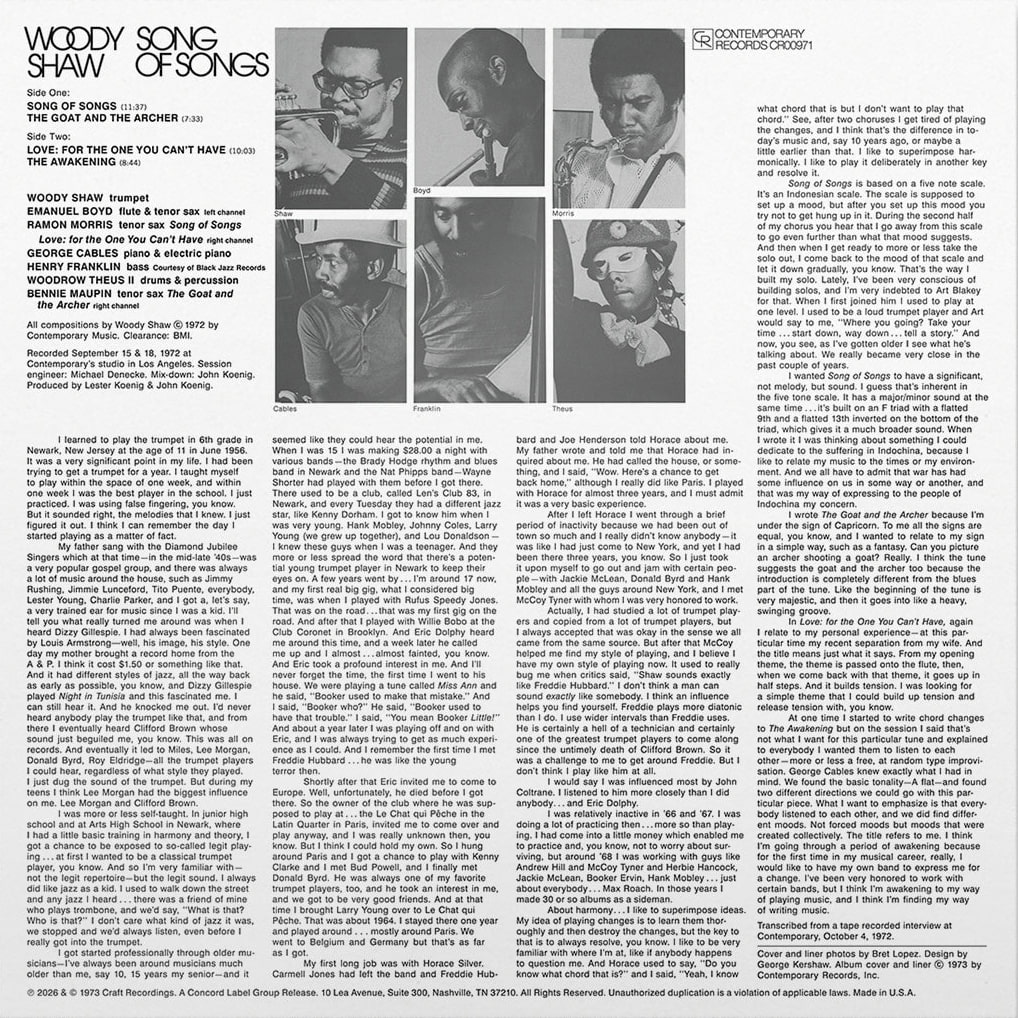

The album features keyboardist George Cables, bassist Henry Franklin, drummer Woodrow Theus II, tenor saxophonist Ramon Morris, and multi-instrumentalist Emanuel Boyd, with Bennie Maupin appearing on “The Goat and the Archer.” Across four extended original compositions, Shaw gives the ensemble room to stretch without allowing the music to lose its structure or direction.
The nearly 12-minute title track was built around a five-note Indonesian scale and written against the backdrop of the Vietnam War. Shaw dedicated the composition to the people of Southeast Asia, explaining in the original liner notes that the suffering caused by the war had influenced both his thinking and his music. The result is expansive and cinematic, but its political and emotional intent prevents it from becoming an abstract exercise.
“Love, for the One You Can’t Have” moves in a more personal direction. Written following Shaw’s separation from his wife, the ballad balances restraint with considerable emotional tension. “The Goat and the Archer,” inspired by Shaw’s Capricorn birth sign, introduces a more direct blues and swing foundation, while Maupin’s tenor saxophone adds further weight and contrast to the front line.
The closing “The Awakening” may be the clearest statement of where Shaw was headed. The performance is rooted in spiritual jazz, collective improvisation, and careful listening rather than a conventional succession of solos. Shaw described the title as a reflection of his own artistic awakening and his growing determination to lead a permanent group through which he could fully express his ideas.
That is what makes Song of Songs such an important record. It captures Shaw at the point where he was moving beyond the role of exceptional sideman and establishing a distinct musical identity as a composer and leader. The album connects post-bop, modal jazz, spiritual jazz, and the avant-garde without sounding like a collection of borrowed styles.
Shaw would go on to record more than two dozen albums as a leader and become one of the most influential trumpeters of the post-bop era. His harmonic ideas, technical command, and commitment to teaching left a lasting impression on the generation that followed, including Wynton Marsalis, Terence Blanchard, and Chris Botti. Song of Songs documents the moment when much of that future began to take shape.
Where to pre-order: $32.99 at Amazon
You must be logged in to post a comment Login