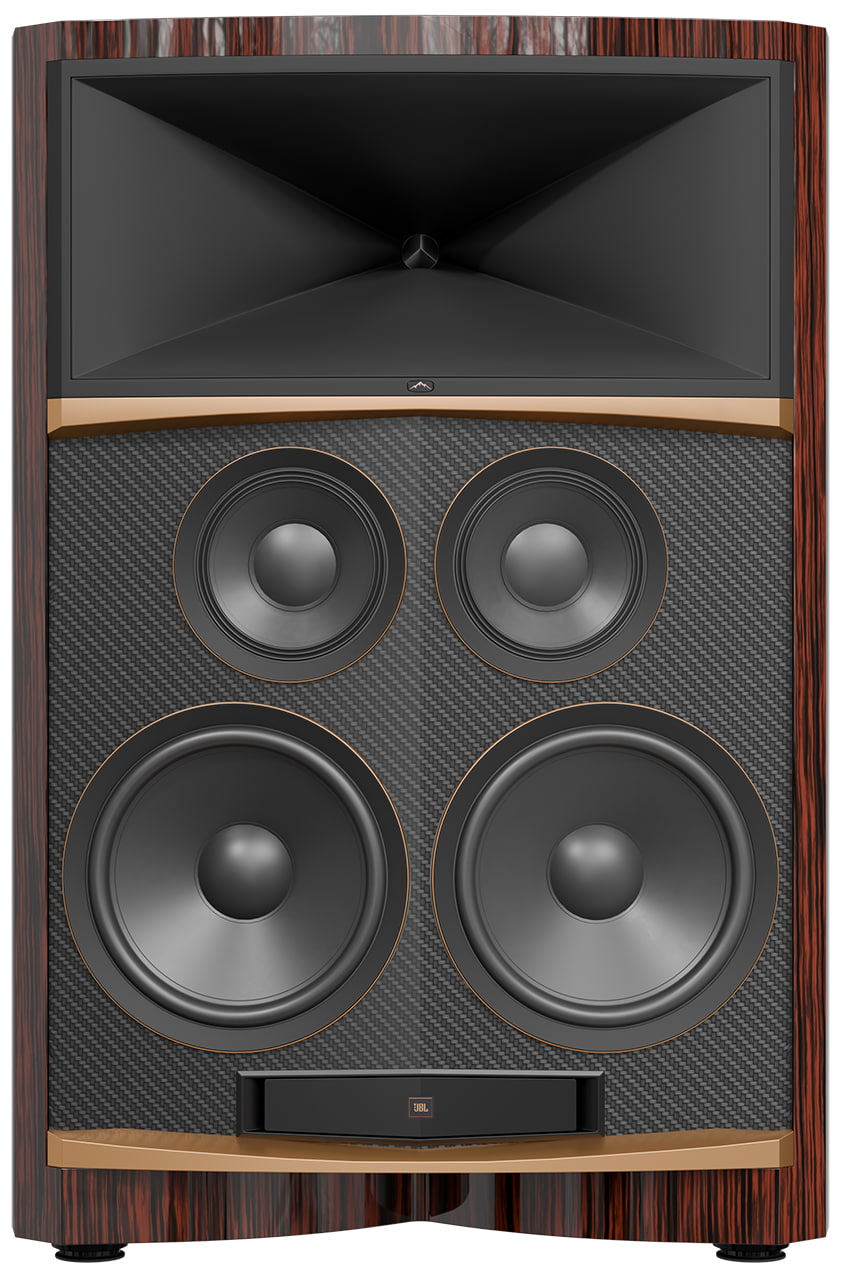
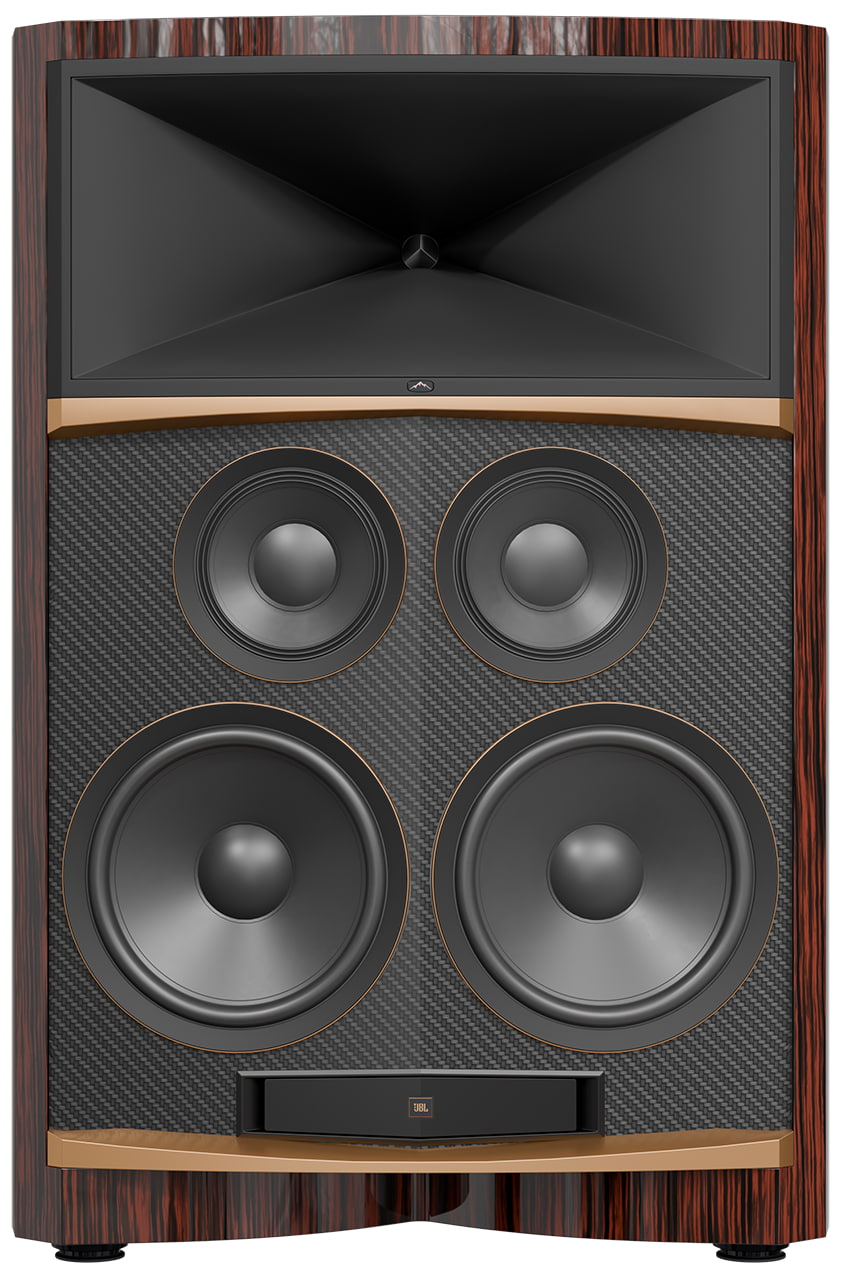

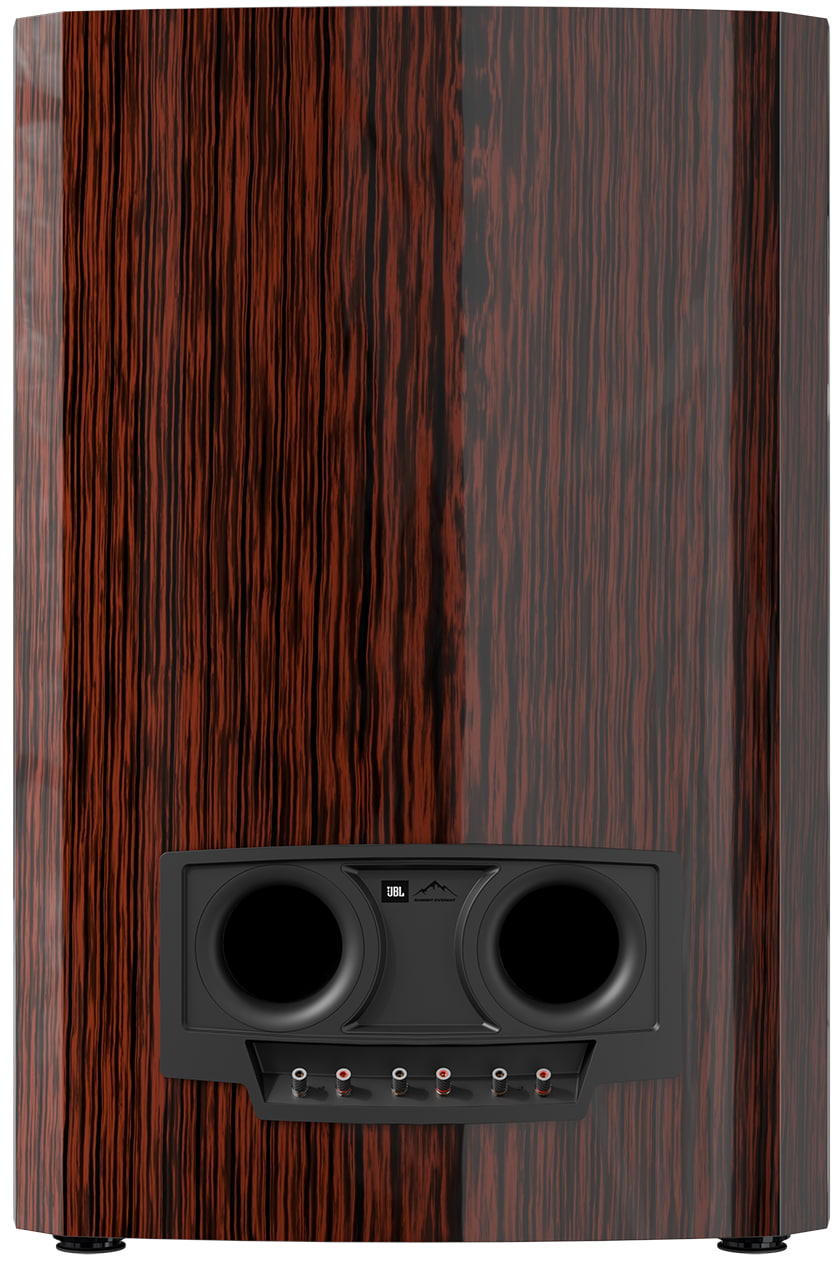
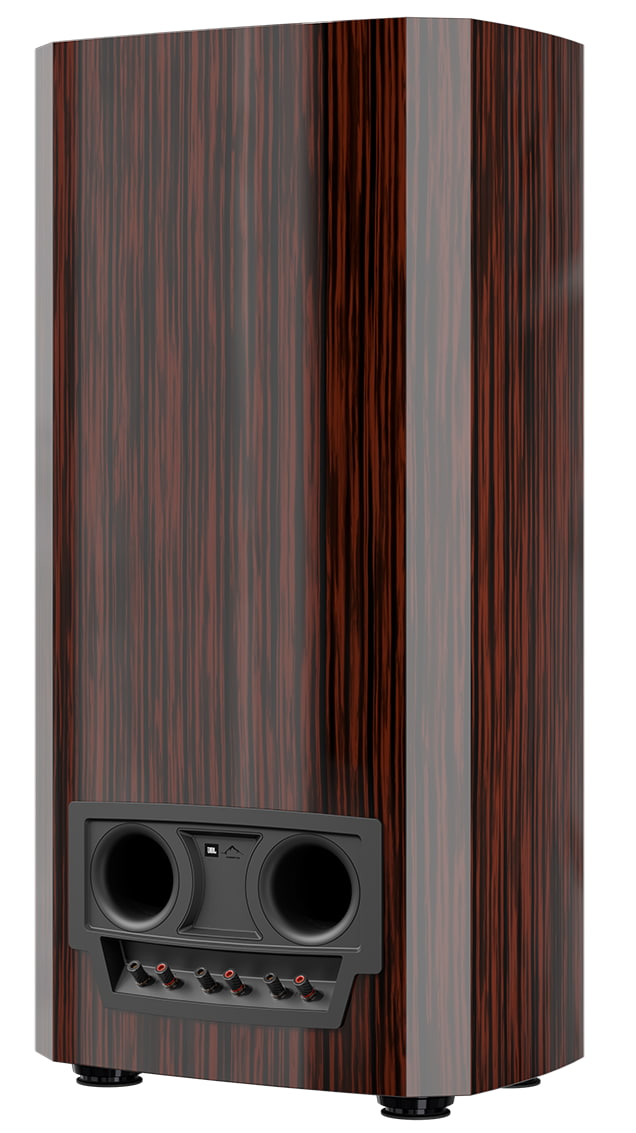





HARMAN Luxury Audio Group has arrived at High End Vienna 2026 with several new high-end audio products, but the headline for JBL is the next generation of its Summit Everest and Summit K2 flagship loudspeakers.
Timed with JBL’s 80th anniversary, the updated Everest and K2 join the Summit Makalu, Summit Pumori, and Summit Ama, which debuted at High End Munich in 2025. Together, they complete the five-model JBL Summit Series for residential audio.
JBL describes the Summit Series as one of its most advanced loudspeaker efforts for the home, and only the fifth JBL loudspeaker family to carry the “Project” designation in the company’s eight-decade history. That label matters: JBL has historically reserved it for its most ambitious engineering platforms, not just another expensive box with prettier woodwork and a Sherpa-friendly name.
Each JBL Project loudspeaker reflects a particular stage in the company’s high-end engineering work, with changes in driver design, enclosure construction, horn geometry, crossover design, and system integration shaping each generation.
For nearly 40 years, Project Everest and Project K2 have been central to JBL’s high-end loudspeaker development. Successive versions have introduced updates to transducers, compression drivers, cabinet construction, waveguides, and overall system tuning.
The latest generation Summit Everest and Summit K2 carry that tradition forward with patented and proprietary technologies developed at JBL’s renowned Acoustic Center of Excellence in Northridge, California.
Summit Everest
Summit Everest, named after Earth’s highest mountain, is the flagship of the Summit Series and the successor to four generations of Project Everest loudspeakers released over the years.
Mid/High Frequency: The core of the latest Everest is a newly engineered mid/high-frequency system that combines the output of three patented JBL D2820 2-inch dual-diaphragm, dual-motor compression drivers with a custom-designed, patent-pending 3-into-1 expansion manifold, seamlessly mated to a custom large-format Sonoglass High-Definition Imaging (HDI) horn.
Advertisement
Mid-Bass/Bass: For mid-bass and bass, there are dual 10-inch cast-frame Differential Drive mid-bass drivers and dual 15-inch cast-frame Differential Drive woofers, each utilizing JBL’s triple-layer Hybrid Carbon Cellulose Composite Cone (HC4) for stiffness, low distortion, and exceptional power handling that define a true reference design.
3.5 Way Configuration: The result of its driver configuration, the Everest is a 3.5 Way floor-standing loudspeaker that is designed to support elevated resolution, dynamic authority, tonal precision, and spatial realism across a bandwidth extending from 20 Hz to beyond 23 kHz.
Advertisement. Scroll to continue reading.
Summit K2
The Summit K2, named after Earth’s second-tallest mountain, is JBL’s most accomplished 15-inch 3-way floor-standing loudspeaker, built upon the legacy of four generations of Project K2 development. The K2 brings signature musicality forward with measurable advances in resolution, transparency, and tonal accuracy.
Mid/High Frequency: The latest K2 incorporates a newly engineered mid/high-frequency system pairing three patented D2815 1.5-inch dual-diaphragm, dual-motor compression drivers with a custom-designed, patent-pending 3-into-1 expansion manifold and large-format Sonoglass® HDI™ horn.
Advertisement
Mid-Bass/Bass A 10-inch cast-frame Differential Drive mid-bass driver and a 15-inch cast-frame Differential Drive woofer are included, both of which feature HC4 cones. This design anchors the K2’s sonic foundation, delivering the dynamic precision and emotional immediacy that have defined this speaker since its 1989 debut.
The Summit Standard
The Summit Everest and Summit K2 bring together the main technologies developed for the Summit Series, including updated transducers, horn/waveguide geometry, crossover design, and cabinet construction.
A MultiCap crossover network, supporting single-wire, bi-amp/bi-wire, and tri-amp/tri-wire connectivity, replaces traditional large capacitors with a greater number of smaller capacitors, reducing electrostatic resistance and minimizing energy loss for greater signal transfer, increased power handling, and ultra-low distortion.
The Everest and K2 are housed in a precisely engineered enclosure with internally offset, multi-braced, and damped pre-stressed pressed curved-wall construction designed to minimize internal standing waves.
Custom-designed JBL | IsoAcoustic isolation feet decouple the loudspeaker from the supporting surface, contributing to tighter bass performance, a more expansive soundstage, and imaging defined by greater clarity and spatial precision.
Advertisement
Finishes and Binding Posts
Summit Everest and Summit K2 are offered with a choice of high-gloss painted black with Summit Platinum accents or high-gloss Macassar Ebony wood veneer with Summit Gold detailing. The Everest and K2 employ sustainably sourced engineered wood cabinetry that reflects JBL’s commitment to materials and execution.
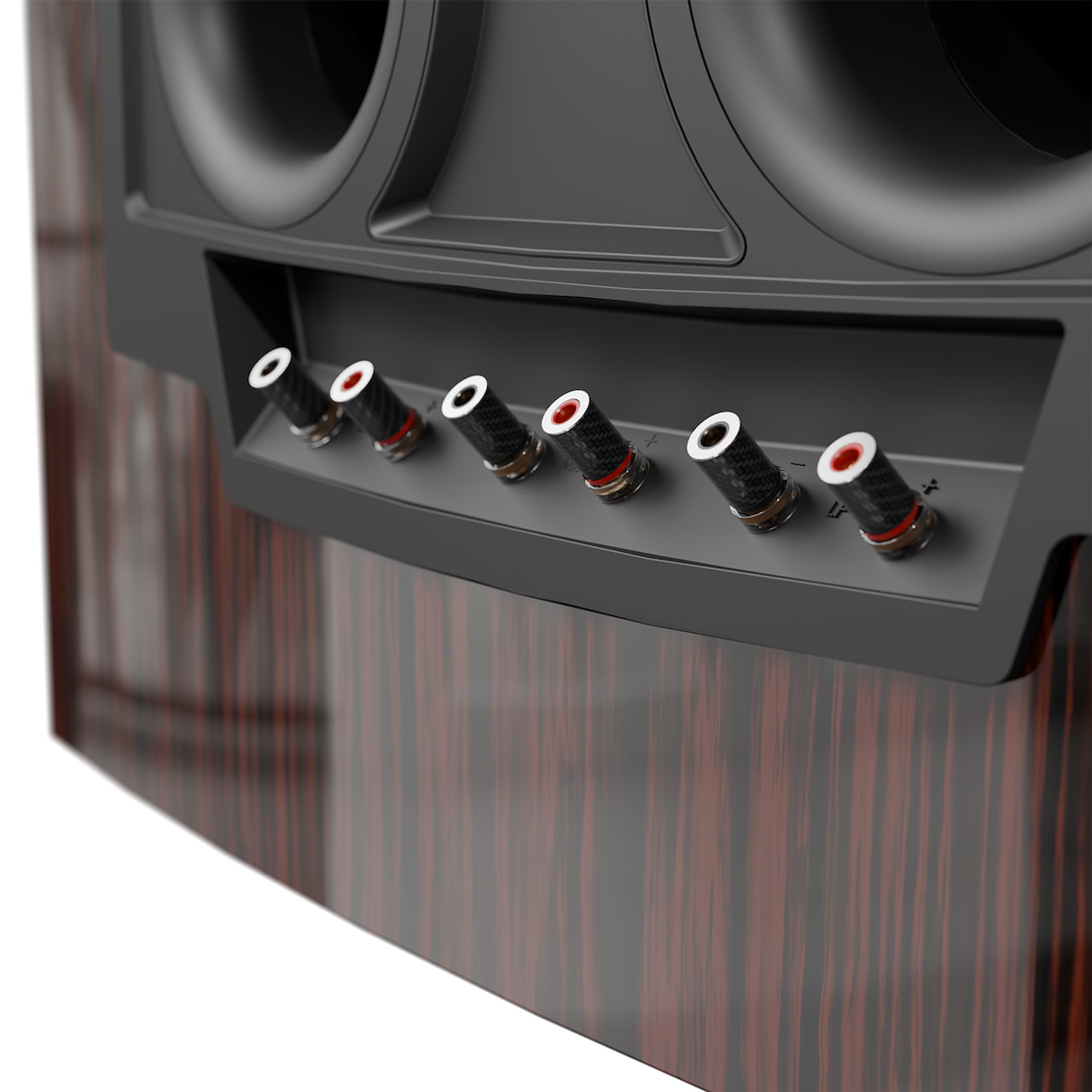
The speaker binding posts are rhodium-plated, wrapped in carbon fiber, with Ohno-Continuous-Cast (OCC) long-crystal oxygen-free silver-plated copper internal wiring.
Bi-amp / Bi-wire Capable with Dual Sets of Binding Posts
Crossover
MultiCap™ with Bi-amp/Bi-wire and tri-amp/tri-wire
MultiCap™ with Bi-amp/Bi-wire
Finish
High-gloss black with Platinum accents
High-gloss Macassar Ebony wood veneer with Summit Gold detailing
High-gloss black with Platinum accents
High-gloss Macassar Ebony wood veneer with Summit Gold detailing
Advertisement
Black High Gloss / Ebony Veneer w/ Gloss
Dimensions (HWD)
56.8″ x 39.1″ x 27.3″
50.4″ x 25.0″ x 18.1″
43.4″ x 18.3″ x 15.5″
41.6″ x 15.5″ x 14.7″
Speaker: 18.6″ x 12.1″ x 13.2” Stand: 21.7″ x 16.2″ x 16.2″
Weight
523 lbs
239 lbs
152.6 lbs
140.8 lbs
58 lbs
JBL Celebrates 80th Anniversary
JBL is celebrating its 80th anniversary in 2026, marking eight decades since James B. Lansing founded the company in 1946. That is not a small footnote in audio history. JBL has been part of professional studios, cinemas, concert venues, home audio systems, cars, portable speakers, headphones, and more than a few cultural moments where the sound system mattered as much as the crowd.
The brand’s reach is unusually broad. JBL Professional continues to play a major role in cinemas, studios, stadiums, houses of worship, clubs, and live venues, while JBL’s consumer division has become one of the most visible names in portable audio and headphones. Few audio companies can claim that kind of spread without sounding like the marketing department got loose with the espresso machine. In JBL’s case, the claim has some weight behind it.
Founded by one of the most important loudspeaker engineers of the 20th century, JBL built its reputation on high-output loudspeakers, studio monitors, professional sound reinforcement, and home audio products that helped define what American hi-fi looked and sounded like. The company’s history includes major technical achievements in loudspeaker design and recognition from both the film and recording industries, including Academy Awards for sound engineering achievements and a Grammy Award for its long-running contribution to concert, studio, cinema, and broadcast sound.
Advertisement. Scroll to continue reading.
That legacy still matters because JBL is not just trading on old photographs and orange grilles. The company remains active across professional, luxury, portable, automotive, and personal audio, while also investing in spatial audio, adaptive sound, immersive listening, and more sustainable product design. Not every one of those phrases needs a parade, but they do point to where JBL thinks audio is going next.
“For 80 years, JBL has been defined by an uncompromising pursuit of acoustic excellence, and the Project loudspeakers have always represented the absolute summit of that pursuit,” said David Tovissi, Vice President & GM, HARMAN Luxury Audio. “With Summit Everest and Summit K2, we are honoring four generations of legendary engineering while introducing technologies that move the state of the art forward. These are reference loudspeakers built for listeners who refuse to compromise and who recognize what it means to own the very best.”
Advertisement
JBL Summit Everest Loudspeakers in High-gloss Macassar Ebony wood veneer with Summit Gold detailing.
The Bottom Line
With Summit Makalu, Pumori, and Ama introduced in 2025, JBL expanded the Summit Series below its established Everest and K2 flagships. The arrival of the latest Summit Everest and Summit K2 completes the line at the top, giving JBL a five-model residential flagship range tied directly to its Project loudspeaker heritage.
What makes Everest and K2 different is not just scale or price. These are JBL’s statement platforms for horn-loaded compression-driver design, large-format woofers, advanced cabinet construction, and high-output, low-distortion playback in larger rooms. Everest remains the larger dual-15-inch statement model, while K2 continues as the more compact single-15-inch flagship. Both are built for listeners who want JBL’s studio, cinema, and professional audio DNA translated into a domestic loudspeaker system.
These are not lifestyle speakers, and they are not for casual background listening. They are for large rooms, substantial amplification, careful setup, and buyers who want the most ambitious version of JBL’s high-end sound at home. The Summit Ama, Pumori, and Makalu may be more realistic choices for many systems, but Everest and K2 exist for the customer who wants the top of the JBL mountain and has the room, budget, and patience to let them work properly.
JBL Summit K2 Loudspeakers in High-gloss Macassar Ebony wood veneer with Summit Gold detailing.
Pricing & Availability
The JBL Summit Everest and JBL Summit K2 will be globally available later in 2026 through authorized JBL Summit dealers and partners, with the following prices:
Advertisement
Everest: $159,990 USD (159,998 EUR / 139,998 GBP) per pair
K2: $99,990 USD (84,998 EUR / 71,998 GBP) per pair
Previously released in 2025, the Summit Models that round out the prestigious speaker line.
Makalu: $45,000 USD (43,998 EUR / 36,998 GBP) per pair
Pumori: $30,000 USD (30,998 EUR / 26,998 GBP) per pair
Ama: $20,000 USD (17,498 EUR / 14,995 GBP) per pair including stands
We spend hours testing every product or service we review, so you can be sure you’re buying the best. Find out more about how we test.
Cape Fear was one of my most anticipated Apple TV shows of 2026, but I was also worried about it. Adapting such an iconic story is no easy task, as people will always end up comparing it to the original. That said, I was impressed by Nick Antosca’s take on Max Cady and the terror he unleashes on everyone around him.
To give you a quick synopsis of Cape Fear, it follows Cady, a vicious and unreformed ex-convict who gets revenge on the two attorneys who put him behind bars. That’s enough to send a chill down your spine, and it requires a really strong performance to stick the landing.
Advertisement
Fortunately, we get that thanks to Javier Bardem. It might be bold of me to say, but his take on Max Cady is my favorite thing he has ever done, because he left me feeling utterly terrified. Truly, he is deranged in this and brings so much to the role. A good villain is more than just scary, and he has it all: charm, charisma, and even certain moments where you feel sorry for him. It is a well-rounded, chilling performance indeed.
Latest Videos From
Amy Adams and Patrick Wilson star opposite him in great supporting roles as Anna and Tom Bowden, who are living an affluent and comfortable life when we first meet them. Nice house, nice pool, no deranged convict coming after them… yet.
When that threat does start looming, you’re sure to be on the edge of your seat thanks to some superb tension building.
Amy Adams is terrorized by Javier Bardem in Cape Fear. (Image credit: Apple TV)
I loved a lot about Cape Fear, but I had the chance to review six episodes, and I’m not entirely convinced it needs to be as long as 10 episodes. I’m happy to be proven wrong with a mind-blowing finale, but I did notice it was starting to suffer from some pacing issues at certain points.
There are also a few silly twists that may cause some division between viewers, and many of these seem to have been added in to keep the momentum going when things started to run out of steam. This is the main issue I have with Cape Fear; outside of that, I’ve been very impressed.
Advertisement
Sign up for breaking news, reviews, opinion, top tech deals, and more.
While not billed as a horror, it does lean into elements I know and love about the genre. I was surprised by some genuinely effective scares throughout, as well as some shocking scenes. This series does not hold back; it is just as intense as the 1991 movie, in case you had any doubts.
On top of that, it’s very stylish and well filmed, especially when it comes to the more jarring moments. The series is visually stunning and has a lot of picturesque sets to offset the horrible things that happen within them. It really highlights how quickly Cady rips through this family’s life and ruins the comforts they have been enjoying. According to the eerie repetition in the teaser trailer, they deserve this.
I think Cape Fear benefits from its weekly release schedule, rather than a full season drop. This is the kind of show you’ll want to savor and tune in for once a week, as it may be too intense to binge all in one go. Some scenes are sure to stick with you and haunt your dreams.
Advertisement
Overall, it’s a solid adaptation, and they’ve assembled a great cast to bring the story to life. It feels like another big win for Apple TV, which has already dipped its toes into horror thanks to Widow’s Bay. I’m really excited to see what’s next for one of the best streaming services.
If the answer is more Max Cady, I would not complain at all.
Adding magnets to a 3D print can be very useful in a design, but there are some things that can trip you up if you’re not aware of them. In a recent video by [Lost in Tech] some of the essentials are covered, including why you shouldn’t get magnets near most extruder nozzles or the printing bed.
The easiest method is of course to add magnets in after printing, using friction fit with or without ribs, or with a dab of glue. Here making sure that the magnet stays in place is the trick, as you do not want the magnet to get lost or end up in the tummy of a curious pet or toddler.
The magnetic pattern on an FDM printer’s magnetic bed.
Things get spicy when you’re talking about adding magnets during the printing process, as some extruders are made of a ferromagnetic material and thus a magnet will happily stick to said nozzle if it’s not pure brass or similar. As seen in the video even some purported ‘brass’ nozzles aren’t pure enough to not be significantly ferromagnetic.
Another issue is that of heat, which is something that magnets generally do not like much. Using magnets like you’d use heat inserts for bolts is a recipe for disaster, as the heat from a soldering iron will demagnetize the magnet, which for the typical magnet is less than 200°C. At least this should mean that the magnet stuck to your extruder nozzle will eventually fall off by itself after it demagnetizes.
With the bed of the typical FDM printer these days you’re talking about magnetically attached plates, with the underlying heated bed using a Halbach array configuration as is typical of flat magnets, yet with the gotcha that these aren’t typically real Halbach arrays, but knock-offs with simply alternating north-south pole magnets. As it turns out, these types of magnetic arrays can be disturbed by another magnet, such as a powerful neodymium magnet near said printing bed, flipping polarity in a way that cannot be easily undone.
Advertisement
You can still install magnets during printing, but it’s recommended to use something like side-insertion, where the extruder nozzle cannot pull out a magnet. Regardless of your approach, it’s good to know of the risks with ferromagnetic nozzles, the magnetic bed and treating magnets like they’re just heat inserts. While you can get higher-temperature magnets, many of the same issues still remain here.
After multiple high-profile recalls, battery packs are starting to switch to new, safer solid-state technology. We’ve rounded up the best solid-state MagSafe battery packs for your iPhone to help you pick one.
We tested a bunch of solid-state MagSafe-compatible batteries
Currently, most batteries on the market are traditional lithium-ion battery cells. It’s a tried-and-true technology, utilized for years, that is commonplace and affordable. That doesn’t mean the process is without its downsides, though. Battery cell manufacturing is exacting; everything from poor design and subpar manufacturing to microscopic impurities can introduce defects serious enough to cause problems. Continue Reading on AppleInsider | Discuss on our Forums
Paying users will have tools for reaching either wider or more-specific audiences.
Instagram
We learned last month that Meta was planning to introduce a subscription tier to several of its social media properties. Today marks the global rollout of the Instagram Plus option, and the company offered more details about exactly what will be included for paying users.
The bulk of the features are about getting people to see content. Story Spotlight prioritizes your profile for friends while Story Extend keeps the disappearing content visible for 48 hours instead of 24. Subscribers can also create multiple audience lists and pick which one will see a given story. There is a tool to preview stories, stats about how often your stories were rewatched and a way to search the people who have viewed a story. And if you don’t want a piece of content to show up in the main feed, you can opt to publish a post directly to your profile or highlights.
There are also some customization options. Subscribers can select from a collection of app icons and pick the text font for their bios. They’ll be able to pin six items to the top of their profile and send animated super hearts when reacting to friends’ stories.
Advertisement
Meta’s announcement noted that more capabilities will be added in the coming months. Instagram Plus costs $3.99 a month.
Zoë Schiffer: Deviants and freaks, the new name of our podcast. And this is, I mean, just going back to red teaming, that’s work that a trust and safety team typically does. And those teams—
Leah Feiger: We don’t have those anymore.
Zoë Schiffer: They’re not as big as they used to be. There’s just not as much work. So yeah, I mean, it will be interesting to see how this plays out. Obviously within Meta, we’ve been talking to folks this week who kind of met the news with a sigh. The company has just laid off a large portion of the workforce. We’ve written about that. We’ve talked about that. And I checked in with people being like, “Well, how’s it going now?” The hack was kind of an excuse to talk to people, see how they’re doing. And they’re like, “I mean, as you’d expect, we’re asked to do two jobs now instead of one.” So you can imagine how that’s playing out.
Brian Barrett: I also, we were talking about AI regulation earlier and all this emphasis on national security and these high-level things, but again, not as much on consumer-facing products, which would be if you had say some sort of bureau that looked after consumer finances and protecting that, that would be helpful to have in this moment as well. We used to have one of those. Technically, I guess we still do. Not really. So all of this broader deregulation is coming at this moment when the tools that were once available are not. These new tools are very fallible. We’re going to see a lot more of this.
Advertisement
Leah Feiger: Can I bring us to a topic that has nothing to do with AI, guys?
Brian Barrett: Please.
Zoë Schiffer: Wow. I didn’t know one existed, but yes, go off, queen.
Brian Barrett: Also, I think we can probably try to find a way to tie it back in.
Advertisement
Zoë Schiffer: We can. We can.
Leah Feiger: No, absolutely not. Well, OK. This story is something that we have been thinking about, covering, looking at for a long time, but it is all about a DOGE whistleblower who just filed a lawsuit against Elon Musk. This all really started last year. On April 14, 2025, Dan Berulis, an IT staffer at the National Labor Relations Board, the NLRB, filed a whistleblower complaint with a massive claim. He said that DOGE had compromised the agency’s data and appeared to be exfiltrating it out of the NLRB.
Archival audio:A whistleblower is coming forward with claims that DOGE not only accessed data from his agency but also took a substantial amount of sensitive data with them. According to a disclosure shared with Congress, “Around 10 gigabytes of data, the equivalent of a full stack of encyclopedia is worth if someone printed these files as hard copy documents.”
Leah Feiger: This was a massive claim, especially at the same time as you guys very much remember, DOGE teams were firing federal workers and accessing sensitive data across the country. We were in the height of this last year in April. Berulis went public in an NPR article. His name was attached to it, and he claimed a threatening note had been taped to his door, and he was already scared about speaking out. Fast-forward a little bit, Berulis has now filed a defamation lawsuit in a DC court against Elon Musk. He said that Musk made him a target of further violence by falsely stating that Berulis’ whistleblower claim against DOGE was fake. This is a really intense claim for a variety of reasons, and what this all really harkens back to is Musk last year resharing an X post from a right-wing influencer claiming that DOGE had been cleared and that this whistleblower’s testimony was fake basically. After that happened—
The Americans were closing in, the situation was getting more dangerous by the minute — and President Xi Jinping was waiting for my recommendation.
The standoff began in May, when the US announced a package of anti-aircraft and anti-ship missiles to Taiwan that would significantly upgrade the island’s ability to repel a Chinese invasion. We ordered massive military exercises in the region as a show of force. The US soon responded by sending the USS Abraham Lincoln to lead its own exercises with a joint contingent of Australian and Japanese forces.
If we showed weakness, Taiwan might be lost to China forever. If we were too aggressive, it could lead to World War III. But with so many ships and aircraft menacing the region, all with unclear intentions, the situation was getting too complex for commanders to process, and the risk of a deadly miscalculation was rising. Already, there had been a tense near-miss when a Chinese maritime militia fired on an American helicopter — thankfully, without casualties.
Recent events in Ukraine and Iran show that the use of artificial intelligence on the battlefield has very quickly gone from a speculative scenario to a current reality.
This has led to fears that AI could increase the risk of nuclear escalation, either by acting in a way that its designers don’t intent, or simply moving too fast for human commanders to keep up.
Ironically, it turns out be the best way to decrease the risks of how AI will perform in war may be to train humans in how to interact with it.
Perhaps it was time to let the machines take over.
The commander of the Chinese naval strike force in the region requested permission to turn on our recently deployed AI hub, which could coordinate the defense systems of all ships in the region and was capable of differentiating between friend and foe, firing in response to threats, and finding the optimal course of action based on China’s rules of engagement and available resources. In other words, if the Americans attacked, it could decide the appropriate response faster than any human.
Advertisement
As the vice chairs of the Central Military Commission, my colleagues and I were tasked with making a recommendation to the president. The system could buy us precious seconds to rescue ships from imminent attack, but it was also untested in combat situations and had reached only 95 percent accuracy in tests.
After a tense discussion, we ultimately decided to employ the new system, but keep it in a “human-in-the-loop” setting that would require us to give a final order before firing. We were taking a cautious approach.
Not cautious enough, as it turned out.
A few days later, the AI-enabled system malfunctioned, opening fire on a US vessel and killing a number of US soldiers. Soon, American politicians and media were calling for payback. US ships began conducting joint patrols with the Taiwanese navy. Our intelligence sources indicated President Donald Trump was close to declaring an official alliance with Taiwan and basing US troops on the island.
Advertisement
We were on the brink of all-out war.
A US-made standard air defense missile is fired from a Knox-class destroyer during the Han Kuang 22 exercise in Ilan, eastern Taiwan, in July 2006.Sam Yeh/AFP via Getty Images
As you’ve probably surmised, this is a fictional scenario. I am not actually a high-ranking Chinese general, and Trump risking war with China over Taiwan is not exactly what transpired in the real May 2026.
The story comes from the script of a wargame conducted by Stanford University’s Hoover Institution that I participated in last fall. The “vice chairs” in the simulation were a bipartisan group of staffers and China policy wonks sitting in a comfortable Washington, DC, conference room over coffee and bagels. (As a condition of participating in the game, I agreed not to name or directly quote any of the participants.)
But the concern that the game illustrates, of an AI-enabled defensive system causing a military crisis to spin out of control, is a very real one. Experts are increasingly worried that AI-enabled systems could cause military conflicts to escalate faster than any human can control or anticipate — or that a miscalculation could lead to AI taking military actions that humans never intended, with deadly consequences. And the risks are especially acute when it comes to nuclear-armed countries like the US and China.
Advertisement
To date, AI-enabled systems have been used mainly by militaries like America’s and Israel’s in conflicts where they already had overwhelming advantages over their opponents, or by countries like Ukraine to level the playing field against a much larger foe. But what would it look like in a war between two “near peer” superpowers like the US and China?
This is no longer just a theoretical question. Under an initiative that began in the Biden administration, the US is working to develop fleets of small, cheap AI-enabled drones that could create a cost-effective “hellscape” to counter a Chinese invasion of Taiwan. The decisions my team made in our simulated conflict could be on the table in a real conflict sooner rather than later.
We may not be able to turn back from this new frontier. But if government and military leaders can figure out its rules and update their thinking in time, they might be able to head off the global war that they’ve spent generations trying to prevent.
The rise of battlefield AI
Advertisement
Jacquelyn Schneider, director of the Hoover Wargaming and Crisis Simulation Initiative, has been conducting games related to the topic of artificial intelligence and crisis escalation for several years now, with participants roleplaying nations on both sides of hypothetical conflicts. When she began running the war games, the capabilities in the “May 2026” scenario still felt futuristic. Lately, the game has “felt a little bit less like science fiction,” she told me.
The Pentagon has been actively working to accelerate the use of AI to detect threats, identify targets, and support commanders’ decision-making for years now. Its early initiatives during the first Trump administration were born in part out of officers’ frustration with data analysis failures that led to the deaths of US troops in Iraq and Afghanistan. The US military collected vast amounts of information from sensors, satellites, and human sources, but was often too slow to find threats to troops on the front lines. The dream was a system that could detect potential dangers earlier and give users options for how to destroy them far faster than human analysts, dramatically shortening what military planners call the “kill chain.”
Now we’re seeing AI programs handle real-world combat situations on a daily basis. Maven Smart System, the Palantir-supplied system that integrates data from satellites, drones, and numerous other sensors, has been used by the US to pass along dozens of potential Russian targets per day to Ukrainian forces. The Ukrainians themselves have developed a system nicknamed “Uber for artillery” to coordinate fire across the frontline. During the war in Gaza, the Israeli military system employed an AI-enabled system known as “Lavender” to identify Hamas targets, though some reports suggest it may have had an error rate of around 10 percent.
The US military has used AI in its recent operations in Venezuela and Iran, which generated significant scrutiny after a targeting mistake killed at least 175 people at a school in Minab, most of them children. It’s not clear yet whether the AI systems Claude and Maven Smart System played a role in that specific strike, but both were widely used in the bombing campaign, according to US officials.
Advertisement
This photo taken on April 6, 2026, shows a recreated scene of a classroom at a memorial event held to mourn the students of an elementary school who were killed in a missile strike in in Tehran, Iran.Shadati/Xinhua via Getty Images
Nonetheless, Secretary of Defense Pete Hegseth is aggressively pushing to deploy AI more widely across US military systems. Earlier this year, the Pentagon threatened to block Anthropic, Claude’s owner, from being used across government — reportedly over the company’s demand that its software never be used for mass surveillance or autonomous weapons. Anthropic wanted to keep a human in the loop on life-or-death decisions, while Pentagon officials reportedly wanted the option to bypass the company and use the program however they wished.
Which brings us back to the US and China. While AI-enabled errors may have led to tragic civilian deaths in Gaza and Iran, those errors in a US-China conflict could have truly global consequences.
The bombing of the Minab school, for example, has been compared in some coverage to the accidental US bombing of the Chinese embassy in Belgrade in 1999. That incident, which occurred at a time when US-Chinese relations were comparatively friendly and China’s military was much smaller, sparked a diplomatic crisis. Today, something similar might spark a war — and, in an increasingly automated battlefield, one that could turn from a conventional conflict into a nuclear exchange faster than human military leaders can keep up.
AI and the escalation ladder
Advertisement
This isn’t the first time a new military technology has forced a rethink of how limited wars can turn into much bigger ones. The advent of nuclear weapons made the management of conflict escalation a pressing issue for Cold War defense strategists.
The most famous of these was the RAND Corporation’s Herman Kahn, who devised a 44-run “escalation ladder” in 1965 to model conflict in a nuclear era. The ladder began at a nonviolent cold war, and ascended through conventional war with “limited” nuclear exchange kicking in around rung 15, ascending all the way up to a mindless and apocalyptic nuclear “spasm” at rung 44.
Kahn’s writings are unnerving in their cold rationality. (He was one of the inspirations for Stanley Kubrick’s character, Dr. Strangelove.) But a concern throughout the nuclear era has always been that a crisis could escalate due to human miscalculation or technical error rather than rational calculation.
Just a few years earlier, in 1962, this had very nearly happened during the US-Soviet confrontation over Cuba. In what is generally acknowledged as the closest the Cold War ever got to going nuclear, the US, alarmed by the deployment of Soviet missiles to Cuba, ordered a blockade of the island, warning that any attempt by the Soviets to ship additional military hardware to the island would be met with force.
Advertisement
A P2V Neptune US patrol plane flies over a Soviet freighter during the Cuban Missile Crisis in this 1962 photograph.Getty Images
In one of the most unnerving near-misses of the Cuban Missile Crisis, the captain of the Soviet submarine B-59, after being hit by US depth charges and finding himself unable to contact Moscow or other ships in the area, nearly fired a nuclear-armed torpedo.
Both sides in the standoff came away convinced that they needed to find ways to signal their moves up and down the escalation ladder more clearly in order to prevent an accidental war. The next year, Washington and Moscow installed a “hotline” for instant phone communication between the US president and the Soviet premier.
“Few things are more important to militaries in crisis situations than informational awareness and control over decisions.”
— Michael Horowitz, former deputy assistant secretary of defense
But what if the next several steps up the escalation ladder happened without their input at all? In a 2019 paper, Michael Horowitz, a former deputy assistant secretary of defense, now a professor at the University of Pennsylvania, imagined how the Cuban Missile Crisis might have played out in the age of AI. After ordering the US Navy to blockade Cuba, President John F. Kennedy could have had a system like the one in the Hoover simulation pre-programmed to fire on any Soviet ship that attempted to run the blockade.
Advertisement
It’s possible this could be effective signaling. A popular metaphor in the Cold War era involved one player in a game of “chicken” throwing their steering wheel out the window to resolve any doubt about where they were headed.
If Kennedy could have convinced the Soviets that his killer robots would fire on any ship that approached Cuba without even waiting for his orders, it might have deterred Russian leaders who might otherwise doubt America’s willingness to fight a nuclear war. On the other hand, the US would be putting an extraordinary amount of trust in an automated system not to make mistakes or — as in the B-59 episode — to interpret an ambiguous incident the same way a human commander who doesn’t want to see his own family incinerated in a nuclear blast might.
“Few things are more important to militaries in crisis situations than informational awareness and control over decisions,” Horowitz wrote.
A nuclear “flash crash”
Advertisement
One major concern is that if key decisions are delegated to AI systems, which may themselves be responding to decisions taken by the enemy’s AI systems, a conflict could simply escalate too fast for human decision makers to keep up.
In his book, Army of None, Paul Scharre, the former Pentagon official who’s now at the Center for a New American Security, cites the example of the 2010 “flash crash,” in which the Dow Jones lost nearly 9 percent of its value within minutes, only to recover it less than hour later — an incident blamed on the cascading interactions of algorithmic trading programs responding to each other’s moves without human intervention. The fear is that the next superpower war could be a “flash war.”
Rebecca Hersman — former director of the Pentagon’s Defense Threat Reduction Agency who’s now at the Center for the Governance of AI (GovAI), an independent think tank — has warned that modern technologies, including AI, have the potential to scramble the linear escalation ladder envisioned by Kahn into a more unpredictable dynamic she refers to as “wormhole escalation.”
She sees several ways this could happen, and they don’t necessarily require humans to cede complete control to an AI defense system. The data the enemy’s AI systems are using to assess threats could be spoofed or contaminated, pushing leaders into a quick decision with bad intelligence. Or AI-generated disinformation or deepfakes could influence the decisions of military or political leaders deciding whether to escalate or de-escalate a conflict: This risk was dramatically demonstrated during the brief 2025 armed conflict between India and Pakistan, when social media on both sides were flooded with misinformation, making it difficult to get an accurate picture of the battlefield and driving both sides toward more aggressive stances. (This was also likely the first armed conflict between two nuclear-armed rivals in which both sides used AI-augmented weaponsand AI-generated misinformation against their adversaries.)
Advertisement
“An AI optimized around predefined goals may overlook opportunities for de-escalation, not because it technically malfunctions, but because it was never designed with the ambiguity to build trust or manage a crisis.”
— James Johnson, author of AI and the Bomb: Nuclear Strategy and Risk in the Digital Age
The risks are compounded by other trends, including the commingling of nuclear and non-nuclear capabilities on the battlefield. Russia, for instance, has made abundant use of its nuclear-capable “Oreshnik” missiles (armed, thankfully, with conventional payloads) in deadly strikes against Ukrainian cities. China also has dual-capable missiles that would make it difficult for analysts to tell nuclear from non-nuclear launches during a conflict.
Where does AI come in? Stephen Herzog, professor at Middlebury Institute of International Studies’ James Martin Center for Nonproliferation Studies, imagined a combat scenario in which the US is attempting to destroy a Chinese target with a conventionally armed intercontinental ballistic missile fired from hundreds or even thousands of miles away. If the launch failed, an AI battle management system might decide that a submarine right off the Chinese coast should destroy the target instead. But this could cut the amount of time the Chinese had to decide whether they were under nuclear attack from minutes to seconds.

“That’s incredibly effective operationally, but it is terrifying from an escalation perspective, because we’ve now lost time for interpretation, we’ve lost time for signaling, and we’ve lost time for potential restraint,” Herzog said.
Advertisement
Then there’s the question of whether AI itself is inherently escalatory. Leaders decide to start and end conflicts by weighing the risks and benefits, but also by using human intuition to guess their counterparts’ thinking, imagine their intentions and fears, and consider whether there’s room for common ground. Two algorithms sizing each other up might approach these questions in a fundamentally different way.
“An AI optimized around predefined goals may overlook opportunities for de-escalation, not because it technically malfunctions, but because it was never designed with the ambiguity to build trust or manage a crisis,” said James Johnson, a senior lecturer at the University of Aberdeen and author of the book AI and the Bomb: Nuclear Strategy and Risk in the Digital Age.
A study from King’s College London published in February found that in simulated war games, chatbots including ChatGPT, Claude, and Gemini are extremely likely to use nuclear signalling and tactical nuclear weapons use, and tend to treat “nuclear weapons as legitimate strategic options, not moral thresholds.” Hoover’s Schneider has found similar results when she has popular chatbots play her wargames. However, other researchers have found that models can be properly prompted to provide less escalatory options.

AI technology, unlike nuclear weapons, is also still in its relative infancy. While the Cold War powers could rely on mutually assured destruction — a credible fear that both sides would be annihilated in any nuclear conflict — to discourage brinkmanship, some experts fear that a breakthrough in AI on one side could lead the other to conclude it had to act quickly or lose its ability to defend itself.
Advertisement
“One of the biggest effects of AI may be that, if, say, the US is just so much better at integrating AI than China that the US may rapidly win a conflict over Taiwan, that puts pressure on the Chinese to use nuclear weapons right away,” said James Acton, co-director of the Nuclear Policy Program at the Carnegie Endowment for International Peace.
Other tech innovations could also tilt decision-makers toward escalation. AI-enabled targeted and intelligence monitoring could make “decapitation” strikes like the one that recently killed Iran’s Supreme Leader Ayatollah Ali Khamenei easier to carry out — precisely the sort of scenario one could imagine prompting a leader like North Korea’s Kim Jong Un or Russia’s Vladimir Putin to consider reaching for the nuclear codes.
It’s probably too late to put the military AI genie back in the bottle, given the arms race between countries to develop cutting-edge systems first. The best way to handle the risks going forward might be, ironically enough, to train the humans responsible for using these systems to be more skeptical about their value.
As in nearly every domain, the people who fight wars for a living are clearly getting more comfortable with AI. The top US general commanding US forces in South Korea recently raised eyebrows after telling reporters he regularly consults ChatGPT to help with command decisions.
Advertisement
Nonetheless, most humans are still very reluctant to give up full control to the machines when it comes to life and death decisions. In the US-China war game I played, all of the groups chose to keep the AI system in “human-in-the-loop” mode, despite the assurances we were given about the system’s reliability, and that decision held no matter how dangerously the crisis escalated.
“At a minimum, meaningful human control means that when I delegate an authority to a system, it will not exceed the authority that it has been given,” said Hersman, of GovAI.
Many experts are less worried about AI escalating conflicts on its own, though, than they are with AI making humans more likely to escalate conflicts. A frequently expressed concern about the military use of AI is “automation bias,” the human tendency to give undue deference to computer-generated advice and conclusions.
“What seems to be most dangerous with AI is not necessarily uncertainty, but instead, perhaps overconfidence and misplaced certainty, and AI can really provide that,” said Schneider, the Stanford researcher who conducted the wargame. “The tools themselves are built to engender confidence.”
Advertisement
Schneider noted that Anthropic’s Claude, the system the Pentagon is hoping to remove with its systems, is the one that’s “more likely to tell you where uncertainty lies, as opposed to other models, which might take a more kind of strictly rational, ‘LeMay’ kind of approach” — a reference to the notoriously hawkish Cold War Air Force commander Curtis LeMay who once summed up warfare as “when you’ve killed enough [people] they stop fighting.”
It’s possible this bias towards AI-prompted escalation can be addressed with the right training. A recent study by Horowitz, the former Pentagon official and UPenn professor, found, encouragingly, that West Point cadets exhibit automation bias at less than half the rate of civilians. The results suggest “we’re not condemned to a future of accidents due to overconfidence,” Horowitz said, as officers learn to take their suggestions with a grain of salt.
Horowitz believes that the design of AI interfaces, which present users not only with information but with the sources of that information, will go a long way toward determining what impact AI has on the battlefield. Though he’s relatively confident in how those systems are designed in the US, he notes, “I don’t know what China’s equivalent of Maven Smart System looks like.”
Ultimately, AI may do less to change the way people fight wars than to amplify it. While much of the coverage of the strike on the Minab school and Israel’s use of Lavender focused on the role of AI, ultimately it was most likely outdated targeting data in the first case and extremely permissive rules of engagement in the second that led to civilian casualties.
Advertisement
Hegseth’s push for expanded AI use comes as he also looks to loosen the rules of engagement and reduce the role of lawyers in military oversight, which have raised concerns that the US is becoming more tolerant of collateral damage and less willing to hold people accountable for potential war crimes.
“If you’ve programmed your AI well, trained it well, and ensured that only high-quality data goes into it, I could well believe that the results will be better than just the use of humans,” said Carnegie’s Acton. “Now, do I trust the current US or Israeli governments to use it responsibly? Probably not, is the answer.”
If the US finds itself in a major international conflict in the coming years, there may be a temptation to blame AI for speeding up the battlefield or engendering overconfidence in commanders. But ultimately, it will be humans who choose to put themselves in that situation.
Apple TV+ is known for its lineup of exclusive content, including popular dramas, comedies, documentaries, and original films. Apple regularly offers free access through trials and promotional offers tied to its products and subscriptions. These deals allow new users to stream popular shows, movies, and documentaries without paying. Here are some of the easiest ways to watch Apple TV+ at no extra cost for a limited period.
Before claiming a free Apple TV+ offer, take a moment to review the eligibility requirements and subscription terms. Apple generally offers these trials to people who have not subscribed before. Users must enter a payment method to activate the offer. Since subscriptions automatically renew after the trial period, it’s a good idea to mark the end date on your calendar if you plan to cancel. Apple does not allow users to combine some Apple TV+ promotions with other discounts or free trials.
Anyone Can Start With a Free 7-Day Trial
Apple TV Plus offers a one-week free trial for new customers who wish to test its content. The trial allows new subscribers to watch and enjoy original content, including movies, TV series, and documentaries. Signing up for the free trial can be done either online or via the Plus application.
To start the trial, one needs to enter billing details and select a valid payment method. Although the product is free for the first seven days, the trial automatically continues after that. That is why it is recommended to set a reminder in case one plans to use only the free trial. By taking advantage of the trial, viewers can sample Apple’s exclusive content and decide whether the service is worth paying for.
Get Three Months Free With a New Apple Device
Individuals who buy a new eligible Apple device might be able to get three months of free access to Apple TV+. The promotion covers select new Apple devices, including iPhones, iPads, Macs, and Apple TV models. Buyers must purchase through approved retailers. This can be an added advantage for those consumers who had plans to buy a new Apple gadget anyway.
However, you must meet a few requirements to qualify for the offer. You need to purchase a brand-new device directly from Apple or an authorized reseller. Apple generally does not allow current Plus subscribers to use this promotion, and you usually cannot combine it with other free trial offers.
Advertisement
Try Apple One and Get Apple TV+ Included
People who regularly use Apple services may find Apple One to be a better value than subscribing to each service separately. Eligible customers can use the free Apple One trial to receive Apple TV+ and other services within the bundle for 30 days without paying anything extra.
The promotion is particularly effective for individuals who do not subscribe to Apple TV+ at all. Along with Apple TV+, customers get access to other Apple services offered under the same plan. Note that Apple will charge customers for this service after the trial period.
Students Can Access Apple TV+ Through Apple Music
The Student Plan for Apple Music would be a perfect choice for those looking to reduce their monthly entertainment spending. Along with a discounted Apple Music subscription, the plan includes Apple TV+ at no extra cost. This allows students to enjoy both services while paying less.
To qualify, users must be enrolled in a recognized higher education program and complete Apple’s student verification process. Once enrolled, the user will be able to stream music and Apple TV+ content without subscribing separately. Apple might require users to undergo a yearly re-verification process to ensure they remain eligible, as the reduced rates will apply only for a limited number of years.
ARCAM is celebrating its 50th anniversary at High End Vienna 2026 with the new A50 Signature integrated amplifier and CD25 CD player. Two products that lean hard into the company’s original reason for existing: proper British hi-fi without the tea and crumpets.
That matters because ARCAM was never built on lifestyle fluff. The company started as A&R Cambridge in 1976, and the A60 integrated amplifier became one of the defining British amplifiers of its era. Fifty years later, the A50 Signature feels like a deliberate nod to that legacy, but with modern expectations around digital connectivity, system integration, and performance. The new CD25 is just as interesting, because ARCAM clearly still sees value in silver-disc playback at a time when half the industry treats physical media like something found in a box at a Torquay flea market.
The larger question is whether the A50 Signature and CD25 are true anniversary statement products or simply elevated Radia components with better tailoring. ARCAM has the history, engineering credibility, and British hi-fi baggage to make this launch matter. Now it has to prove that 50 years of institutional memory still buys you more than a nicer front panel and a slice of birthday cake.
ARCAM A50 Signature: Class G Moves Up the Radia Ladder
ARCAM is marking its 50th anniversary at High End Vienna 2026 with the A50 Signature integrated amplifier and CD25 CD player. Both products extend the Radia Series upward, with the A50 Signature positioned as ARCAM’s most advanced integrated amplifier to date and the CD25 arriving as the new flagship CD player in the range.
The A50 Signature connects directly to ARCAM’s amplifier history. The company was founded in Cambridge in 1976 as A&R Cambridge and later shortened its name to ARCAM in the 1980s. The “A” has always stood for amplification, and the A50 Signature keeps that part of the company’s identity front and center.
Advertisement
ARCAM co-founder John Dawson was involved in the project, with his signature appearing on the rear cowl and PCBs. The point is not retro theater. ARCAM says his role was to help ensure the amplifier reflects the company’s long-standing design philosophy while addressing how people listen today.
The A50 Signature is the first ARCAM integrated amplifier to use a fully dual mono Class G architecture. Each channel has its own PCB, output stage, Class G lifter stages, power regulation, and transformer windings. The design is intended to improve channel separation and reduce crosstalk.
Power output is rated at 150 watts per channel into 8 ohms. Digital conversion is handled by an ESS ES9039Q2M DAC in a fully differential configuration, supported by an ESS reference voltage regulator.
Connectivity is broad. The A50 Signature includes HDMI eARC/ARC, USB-C audio, optical and coaxial S/PDIF inputs, two-way Bluetooth with Snapdragon Sound, lossless-capable Bluetooth support, and Auracast. Analogue inputs include three RCA inputs, one balanced XLR input pair, and a built-in Class A MM/MC phono stage. RS232, trigger input/output, and USB service access are also included.
Advertisement
ARCAM CD25: A New Flagship CD Player for Radia
The CD25 is ARCAM’s new flagship CD player for the Radia Series and continues the company’s long-running work in disc playback. It supports CD, CD-R, and CD-RW playback and is designed to pair with the A50 Signature, SA45, SA35, A25+, or any amplifier with suitable analogue inputs.
The technical story is more substantial than “new CD player, nice glass front.” ARCAM says the CD25 is its first design since the FMJ D33 DAC to use a dual mono DAC architecture, with separate conversion paths intended to improve stereo separation and channel performance. It is also ARCAM’s first product to use ESS Hyperstream 4 DAC technology.
Advertisement. Scroll to continue reading.
The CD25 uses a linear toroidal power supply, chosen for stable, low-noise operation and consistent analogue output performance. ARCAM has also included a vibration-damped internal structure to support accurate disc reading and reduce mechanical interference during playback.
Outputs include balanced XLR and single-ended RCA analogue connections, giving the CD25 some flexibility in higher-performance two-channel systems. The balanced outputs also make it a natural partner for the A50 Signature, which includes a balanced XLR input pair.
Advertisement
Visually, the CD25 follows the rest of the Radia Series, with a glass front panel, OLED display, and metal chassis. It looks modern without pretending that CD playback needs to apologize for itself.
Radia Series Expansion
The A50 Signature and CD25 represent the fourth phase of ARCAM’s Radia platform, moving the range into higher-performance integrated amplification and premium CD playback. Both products are designed to work as part of a wider ARCAM system rather than as isolated components.
That approach fits the brand. ARCAM’s best products have usually been about practical engineering, system matching, and long-term usability — not theatrical reinvention with a commemorative napkin.
The Bottom Line
The ARCAM A50 Signature and CD25 are not just anniversary products with nicer badges. The A50 Signature is technically significant because it is ARCAM’s first fully dual mono Class G integrated amplifier, with separate PCBs, output stages, Class G lifter stages, power regulation, and transformer windings for each channel. Add 150 watts per channel into 8 ohms, an ESS ES9039Q2M DAC in fully differential mode, HDMI eARC/ARC, USB-C audio, balanced XLR input, MM/MC phono, Snapdragon Sound, and Auracast, and this becomes the most complete Radia amplifier so far.
Advertisement
The CD25 matters because it pushes ARCAM’s CD playback platform forward with dual mono DAC architecture, ESS Hyperstream 4 DAC technology, a linear toroidal power supply, vibration-damped construction, and balanced XLR outputs. For listeners with large CD collections, it gives the Radia Series a proper disc source rather than treating physical media like an awkward relative at dinner.
Together, the A50 Signature and CD25 move Radia into more ambitious territory: higher-power Class G amplification, better digital architecture, broader system connectivity, and a renewed commitment to CD playback. Not retro. Not lifestyle fluff. Just ARCAM remembering what the “A” is supposed to stand for.
Pricing & Availability
The ARCAM A50 Signature and CD25 will make their global debut at High End Vienna 2026 and are expected to become widely available Q3 2026.
ARCAM Radia A50 Signature Integrated Amplifier – $2,999.95 USD (€2,799, or £2,499).
ARCAM Radia CD25 CD Player – $1,799.95 USD (€1,599, or £1,499).
HP has announced a new line of Windows PCs equipped with NVIDIA RTX Spark, designed to enhance AI computing experiences. They’re targeting creators, gamers, and developers who need to run intense apps and use new AI workflows. HP wants these PCs to be super capable, ultra-responsive, and ready for what’s ahead.
The new lineup includes the OmniBook Ultra 16 and OmniBook X 14. Both come with NVIDIA RTX Spark tech, which blends AI and superior graphics while boosting battery efficiency. So, HP is all about amazing performance without sacrificing battery life or mobility. The company claims these laptops will rank among the world’s thinnest models without compromising battery life.
Built For Creators, Gamers, And AI Developers
The platform gives us the computing power for video production, digital design, and content creation. Plus, gamers get better graphics and a more responsive experience. AI developers can make and test AI models right on their computers, too. This mix of AI and graphics tech makes advanced computing easier for a lot more people to use.
Along with its new AI laptops, HP is expanding into desktops, workstations, and enterprise systems. The company is preparing a compact RTX Spark-powered desktop that combines strong AI performance with a space-saving design. HP is also building advanced systems using NVIDIA GB300 technology for demanding business tasks. Furthermore, for those needing more security, there’s the ZGX Nano. It provides a safe space to develop and deploy AI without worries.
Expected Price and Availability
HP plans to launch the OmniBook Ultra 16 and OmniBook X 14 later in 2026. The company has not revealed pricing details for either laptop yet. More details about the devices are expected closer to release. HP also plans to launch the OmniDesk Mini Desktop PC in August 2026. Buyers can expect further information about features and pricing before the products reach the market.
A new research report has Apple’s first MacBook Pro with OLED shipping weeks or months sooner than other, more reliable leakers have been claiming for months, if not years.
We’ve seen rumors about the fabled OLED Apple laptop for years, all with various release dates. But recently, reports have coalesced on a release window of anywhere between October 2026 from older reports, and newer ones saying the early months of 2027.
Despite that, research outfit Omdia now believes that Apple is readying the MacBook Ultra for a release sooner than that. In its report on OLED display demand, Omdia says the new premium laptop will debut in the third calendar quarter of 2026.
If accurate, that means the MacBook Ultra could debut as soon as July 2026. There’s almost no chance of that.
Advertisement
But more realistically, we’re looking at a September timeframe at the very earliest.
The thing is, September is normally new iPhone and Apple Watch season. It remains to be seen whether Apple is willing to have its biggest product launches of the year share the month with a brand-new laptop.
This news also flies in the face of an April 2026 report claiming the MacBook Ultra had been delayed to 2027. Global RAM and SSD shortages were blamed for the delay, and they’ve certainly not improved.
Going back to August 2025, Bloomberg’s Mark Gurman pointed to a late 2026 or early 2027 release.
Advertisement
More recently, the same outlet’s February 2026 report believed the OLED laptops would debut near the end of the year, but no sooner.
With all of this in mind, it’s a surprise to now see mention of a release as early as September.
OLED, coming soon
Release window aside, the report notes that Samsung Display is set to produce 14.3- and 16.3-inch OLED panels for the unannounced laptop. It’ll use a hybrid OLED technology based on TFT and RGB tandem technology, Jerry Kang, Practice Leader at Omdia, believes.
The move to a hybrid OLED display is expected to gather pace following the MacBook Ultra’s release. It’s easy to see why, with the technology allowing for a thinner construction.
Advertisement
A recent report believed Samsung Display would be capable of supplying Apple with two million OLED displays by year’s end.
You must be logged in to post a comment Login