Tech
Jean-Marie Reynaud AURALIS Loudspeaker: French Finesse With a Tuned Triangular Transmission Line

Jean-Marie Reynaud has officially placed the AURALIS at the top of its loudspeaker range, and the new French flagship arrives with a clear message: musical scale does not have to come from a cabinet that looks as though it was designed to store military hardware.
Scheduled to launch in fall 2026 at €18,000 per pair, the AURALIS is the most ambitious loudspeaker yet from the Charente-based manufacturer. It combines a 2.5-way architecture, JMR’s proprietary tuned triangular transmission line, a large 120 mm AST tweeter, hand-wired crossovers, and a cabinet designed to deliver bass authority, tonal accuracy, image stability, and long-term listening satisfaction; this is not a speaker designed to impress for ten minutes in a dealer showroom before the listener starts looking for the exit.
I have some history with the brand, although not nearly as much as I would like.
Back in the 1990s in Toronto, a local hi-fi store in the East End carried Jean-Marie Reynaud loudspeakers, and I was able to spend time with most of the lineup. They were partnered with Audiomat electronics, another French brand with a very different approach to the usual North American power-and-machismo routine, along with some very serious Nottingham Analogue Studio turntables and Benz Micro cartridges.
The JMR speakers were never huge sounding in the conventional sense. They did not try to pin you against the back wall with bass fireworks or make every cymbal strike feel like it had been sharpened by a sommelier with anger-management issues. What they did exceptionally well was inner detail, clarity, tonal finesse, imaging, and treble that had air and delicacy without becoming etched or fatiguing.
They also looked different. Not weird for the sake of weird, which remains one of high-end audio’s more persistent crimes, but unmistakably French in the best possible way: thoughtful, elegant, slightly idiosyncratic, and very much their own thing.
Once I left Canada, JMR drifted off my radar. The brand was never as visible in the United States as Focal, Bowers & Wilkins, KEF, or Sonus faber, and that was probably America’s loss. But JMR is still here, still building loudspeakers in France, and AURALIS looks like the company’s most serious statement yet.
The French, for all of their gifts, have never been overly concerned with explaining themselves to everyone else. AURALIS feels very much in that spirit, and I would encourage U.S. and Canadian listeners to seek out a JMR dealer and hear these for themselves. This is a brand worth rediscovering.
A New Flagship Above the Orféo Grande

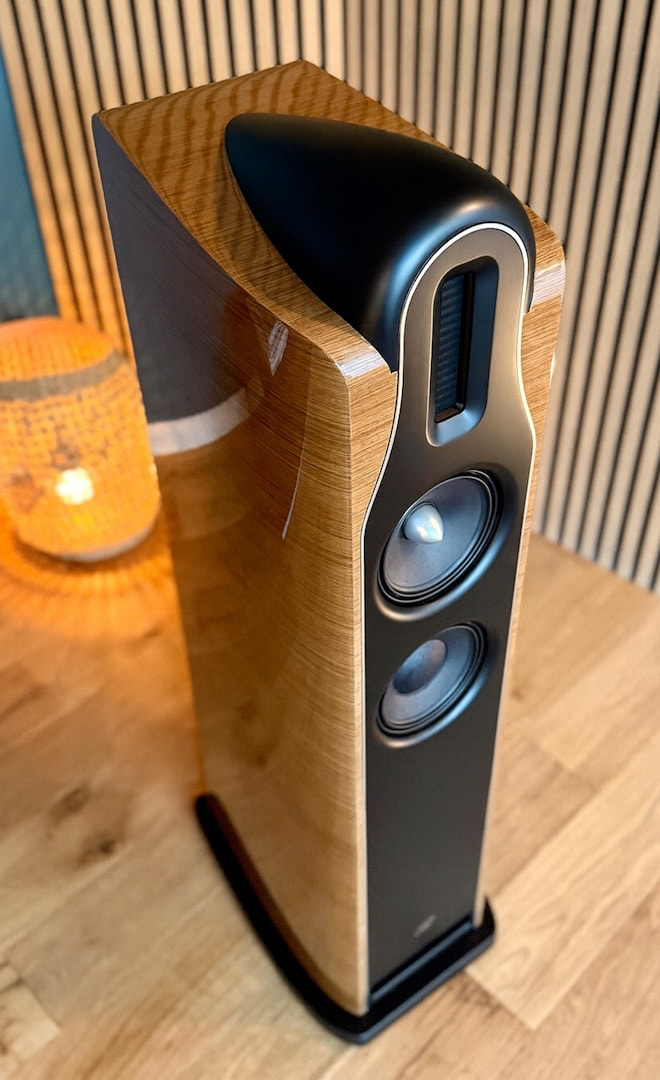
AURALIS now sits at the top of the JMR range, above the Orféo Grande, joining a lineup that includes the Lunna MKII, Euterpe Jubilé, Cantabile Jubilé, Abscisse Jubilé, Orféo Jubilé, Orféo Grande, and the compact Voce Grande.
The new floorstander measures 115 cm high, 30 cm wide, and 42 cm deep, or 45.3 x 11.8 x 16.5 inches. Each speaker weighs 45 kg, or 99.2 pounds. That is serious mass, but it is not one of those absurdly oversized high-end monuments that require reinforced flooring, a forklift, and a second mortgage before the first needle drop.
JMR recommends a listening room between 20 and 60 square meters, or roughly 215 to 645 square feet. The speakers should be positioned between 2 and 4 meters apart, or approximately 6.5 to 13 feet center-to-center, with a minimum listening distance of 3 meters, or just under 10 feet. JMR also recommends at least 80 cm, or 31.5 inches, of clearance behind the speakers.
The front-firing port should make AURALIS more flexible than many rear-ported alternatives, but this is still a 99-pound French flagship with real bass energy. Trying to wedge a pair into a Manhattan one-bedroom beside a radiator, a dying ficus, and a framed photo of your ex-wife remains an act of cultural vandalism.
AURALIS Uses JMR’s Tuned Triangular Transmission Line


At the heart of the AURALIS is JMR’s tuned triangular transmission line, a proprietary acoustic loading system that has become one of the company’s most recognizable design signatures.
The goal is not simply to produce more bass. JMR says the tuned triangular transmission line progressively harnesses the rear energy of the drivers to create low frequencies that are spacious, articulate, naturally controlled, and properly integrated with the rest of the spectrum.
That matters because impressive bass and convincing bass are not always the same thing. JMR is aiming for a low end that can follow the music rather than simply announcing its presence every time a bass drum enters the room.
The cabinet itself uses HDF panels ranging from 25 mm to 40 mm thick, or roughly 1.0 to 1.6 inches, depending on where reinforcement is required. JMR uses minimal internal acoustic damping to preserve dynamics, liveliness, and a sense of freedom, while applying viscoelastic compounds at strategic points to control unwanted vibration.
The upper tweeter pod is made from epoxy resin, chosen for its inertness and mechanical stability. It also gives AURALIS a more sculptural silhouette than the usual rectangular tower with a tweeter bolted on top as though someone remembered it five minutes before the design meeting ended.
AURALIS also uses a dedicated decoupled base with no direct mechanical coupling between the cabinet and the floor. Rather than relying on conventional spikes, JMR uses a polymer isolation element refined through listening tests, paired with Teflon pads.
2.5 Way Architecture With a Large AST Tweeter

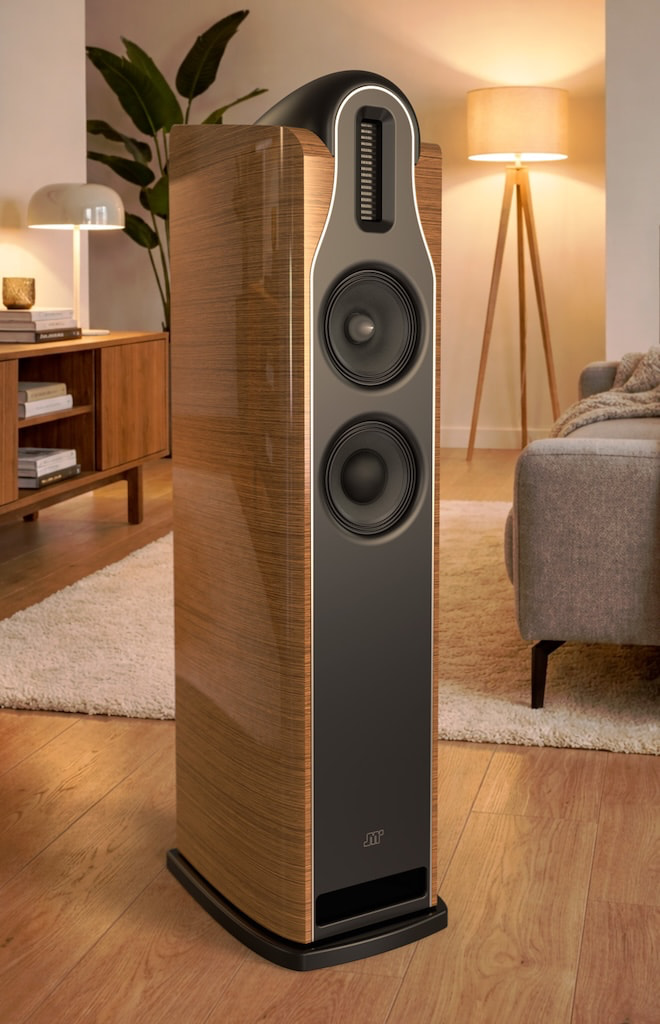
The AURALIS is a 2.5-way loudspeaker built around two new midbass drivers and a 120 mm AST tweeter.
The two midbass drivers operate together up to 220 Hz, effectively increasing radiating surface area and giving the speaker more energy and ease through the bass region. The upper midbass driver continues higher before handing off to the AST tweeter at 1.8 kHz.
That is a notably low crossover point for a tweeter and one of the more important technical aspects of the design. JMR uses a symmetrical 12 dB-per-octave filter at 1.8 kHz to take advantage of the AST tweeter’s speed, low distortion, dynamic capability, and broad natural presentation through the upper midrange and treble.
This is exactly where a loudspeaker either becomes convincing or starts sounding like a collection of expensive parts arguing in public. Vocals, piano, strings, brass, guitar harmonics, and the emotional wreckage of every audiophile all live in this region. There are therapists in Westchester who have financed fishing boats off this crowd.
Hand-Wired Crossover With Serious Parts Selection
JMR has long treated crossover design as part of the loudspeaker’s voice rather than a generic component board hidden in the bottom of the cabinet. The AURALIS continues that philosophy with a fully hand-wired crossover built without a printed circuit board.
The network uses a deliberately limited number of components to minimize losses, phase rotation, and audible distortion. The 2.5-way topology employs 6 dB and 12 dB-per-octave slopes, with the two midbass drivers working together to 220 Hz and the AST tweeter taking over at 1.8 kHz.
JMR specifies pure copper foil inductors wound on beechwood formers, ClarityCap PUR capacitors, and Path Audio resistors for tweeter attenuation.
The Path Audio resistors use a third grounding terminal and a copper tube intended to provide electromagnetic shielding, heat dissipation, and drainage of parasitic charges. That is the sort of detail that will either delight or irritate the people who believe every resistor sounds identical. Both sides will probably write 2,000 words about it online.
Specifications and Amplifier Matching
JMR rates the AURALIS at 89 dB/W/m sensitivity at 2.83V, with impedance compatible with amplifiers rated for 4 to 8 ohms. Minimum impedance is listed as 4.3 ohms.
The claimed frequency response is 30 Hz to 28 kHz within ±6 dB. Power handling is rated at 250 watts continuous and 400 watts peak, with recommended amplifier power between 40 and 300 watts. Claimed distortion is below 0.2 percent at an 85 dB listening level.
JMR says the AURALIS is compatible with both tube and solid-state amplification and that its impedance curve does not present particular setup challenges. That does not mean AURALIS should be paired with whatever integrated amplifier was rescued from the guest room after a remodel, a divorce, or an unfortunate encounter with a soundbar. Less will not be more here.
The Audiomat system I used to get to know JMR in the 1990s was already in the $20,000 range, including an integrated amplifier, CD transport, phono stage, and DAC. These speakers may not demand brute-force amplification, but they will reward a front end with real resolution, tonal color, and authority.
Woodscore XO Finish and Made in Charente Construction

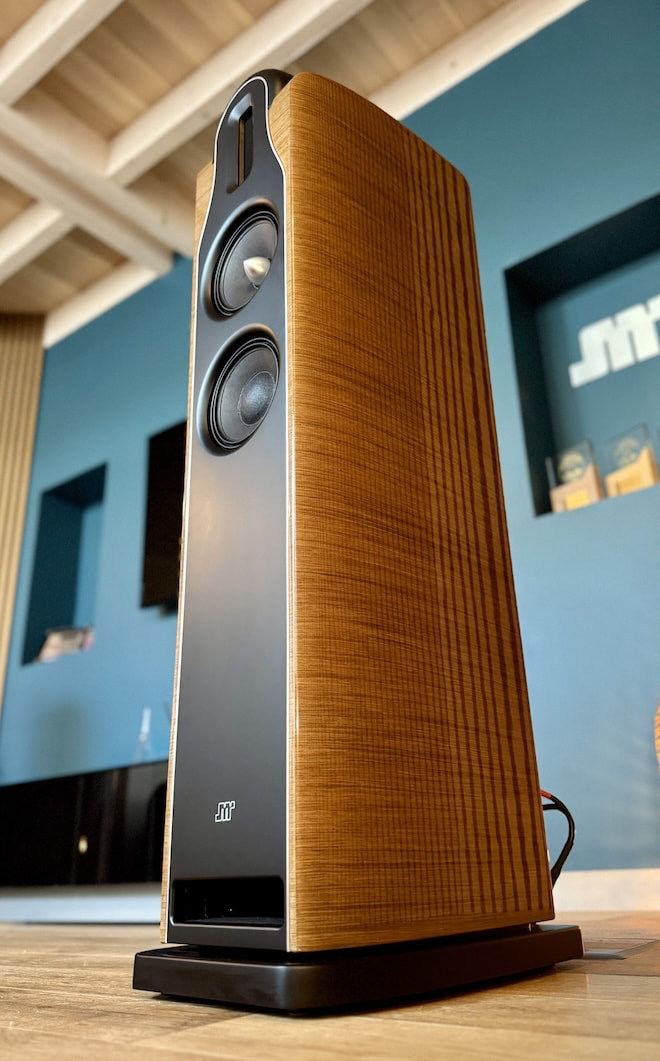
Visually, AURALIS introduces JMR’s Woodscore XO finish, which combines a seven-layer high-gloss polished treatment with real walnut veneer in a cognac tone, a black front baffle, and a solid machined-aluminum trim piece on the front sub-baffle.
The Woodscore XO finish gives AURALIS an elegant, architectural presence without overwhelming the room. Designed, assembled, quality-controlled, and fine-tuned in Charente, the speaker reflects JMR’s own approach to cabinet construction, acoustic loading, crossover design, and final voicing.
Jean-Marie Reynaud AURALIS Specifications
- Design: 2.5-way floorstanding loudspeaker
- Crossover Slopes: 6 dB / 12 dB / 12 dB per octave
- Impedance: Compatible with 4 to 8 ohm amplifiers; 4.3-ohm minimum
- Frequency Response: 30 Hz to 28 kHz, ±6 dB
- Sensitivity: 89 dB/W/m at 2.83V
- Distortion: Less than 0.2% at 85 dB
- Power Handling: 250 watts continuous
- Peak Power Handling: 400 watts
- Recommended Amplifier Power: 40 to 300 watts
- Speaker Terminals: Single-wire binding posts with a dedicated crossover ground terminal
- Dimensions: 115 × 42 × 30 cm, or 45.3 × 16.5 × 11.8 inches
- Height: 115 cm / 45.3 inches
- Depth: 42 cm / 16.5 inches
- Width: 30 cm / 11.8 inches
- Weight: 45 kg / 99.2 pounds per speaker
- Recommended Listening Area: 20 to 60 m² / approximately 215 to 645 square feet
The Bottom Line
The Jean-Marie Reynaud AURALIS is not another expensive floorstander built to impress for 10 minutes with brute bass, a shiny cabinet, and enough aluminum to repair a small bridge. Its appeal is more specific: JMR’s tuned triangular transmission line, large AST tweeter, hand-wired crossover, front-firing port, and Charente-built cabinet are all aimed at tonal accuracy, bass articulation, coherence, and long-term musical satisfaction.
At €18,000 per pair in Europe, AURALIS enters a serious category that includes the Sonus faber Olympica Nova V, Focal Sopra N°2, Bowers & Wilkins 804 D4 and 803 D4, and Wilson Audio Sabrina V, depending on local pricing. JMR has not announced U.S. or Canadian pricing yet, so the final comparison will depend on where it lands in North America.
For listeners who value inner detail, natural timbre, and finesse over a loudspeaker that behaves like it is auditioning for a Marvel soundtrack, AURALIS looks like one of the more distinctive new arrivals in the high-end category.
For more information: jm-reynaud.com
You must be logged in to post a comment Login