Tech
Jimmy Reed at Carnegie Hall Review: Bluesville Revives the Famous Concert Album That Wasn’t Live

Record companies were playing games with album titles long before streaming services started calling 14 slightly different versions of the same record a “Deluxe Edition.”
Jimmy Reed really did perform at Carnegie Hall on May 13, 1961, sharing the “Blues at Carnegie” bill with Muddy Waters, Big Maybelle, Jimmy Witherspoon and Oscar Brown Jr. The album that followed, however, was not a live recording of that performance.
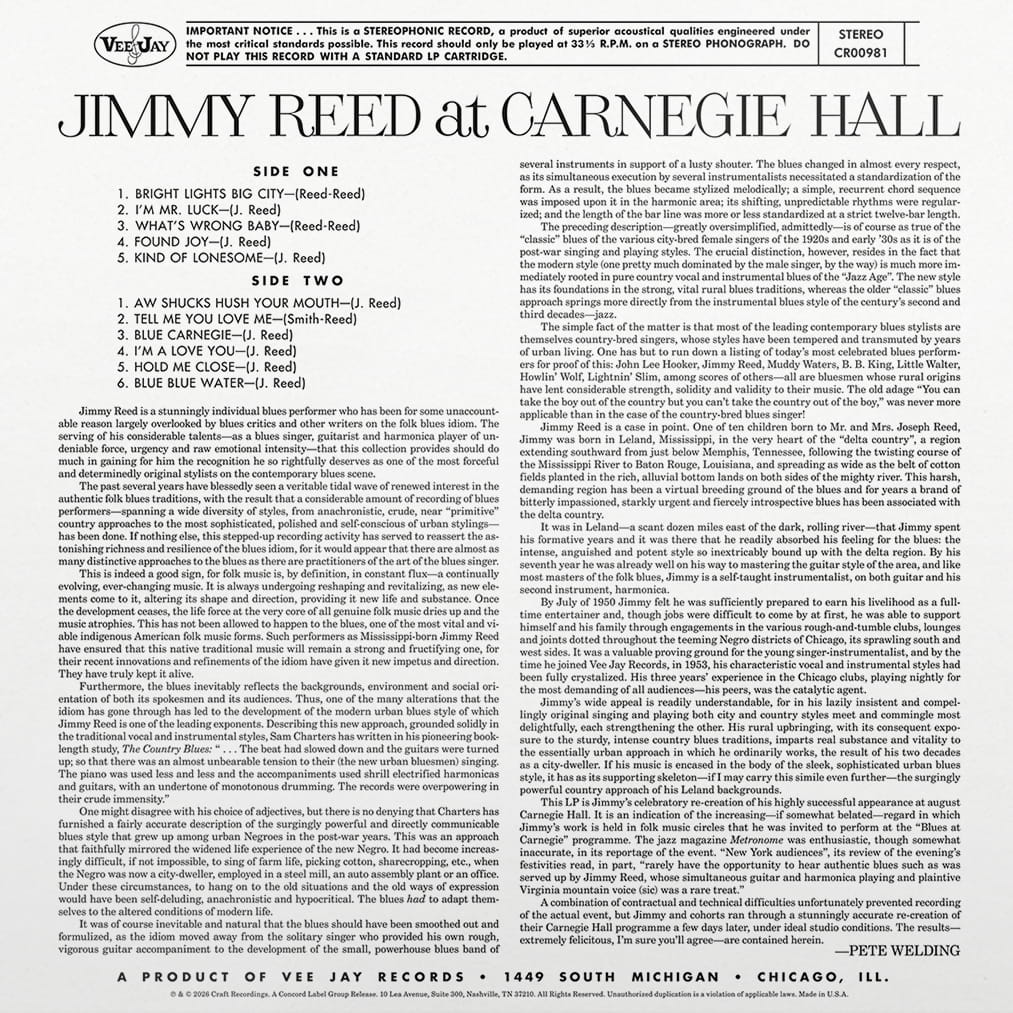
According to the original Vee-Jay liner notes, contractual and technical difficulties prevented the label from recording Reed’s Carnegie Hall appearance as intended. Vee-Jay subsequently recreated the material in studio sessions, and Jimmy Reed at Carnegie Hall arrived later in 1961 as a double LP.
The title certainly sounded better than Jimmy Reed Played Carnegie Hall But This Isn’t the Recording. Sixty-five years later, the music has survived the marketing department rather well.
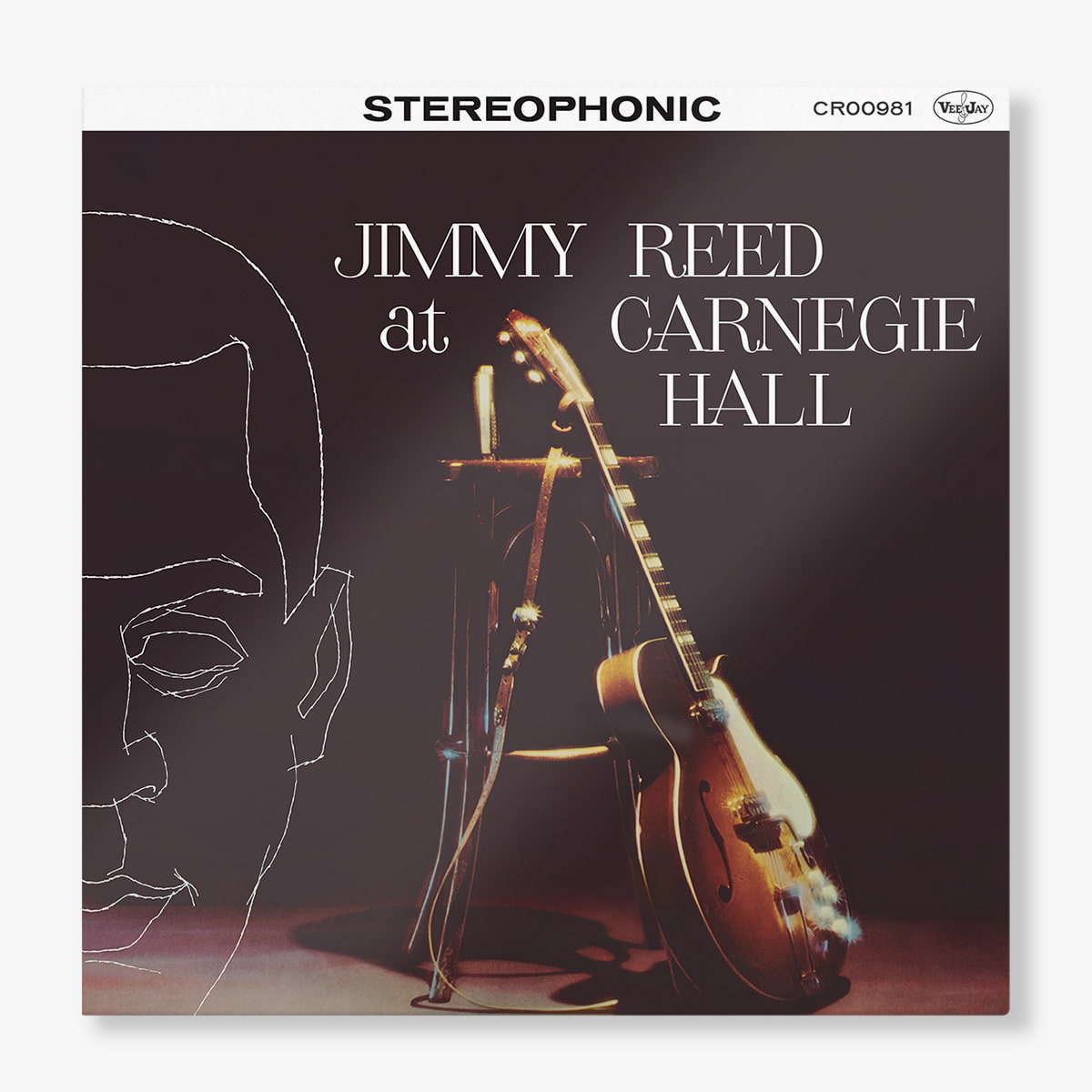
Craft Recordings and its revived Bluesville imprint are returning Jimmy Reed at Carnegie Hall to vinyl on August 21, 2026, but collectors should understand exactly what they are getting. This is not a reissue of the complete original two-record set. Bluesville is reproducing the first LP only, containing the 11 tracks associated with Reed’s Carnegie Hall program.
The new edition has been remastered AAA from the original analog tapes by Matthew Lutthans at The Mastering Lab and pressed on 180-gram vinyl in partnership with Acoustic Sounds. It comes in a replica tip-on jacket with an obi featuring new reflections from Grammy-winning producer, songwriter and blues musician Scott Billington. At $33, it is also priced considerably more sensibly than a lot of modern audiophile vinyl.
Jimmy Reed Made Simplicity Very Difficult to Copy
Born Mathis James Reed in Dunleith, Mississippi, in 1925, Jimmy Reed became one of the most commercially successful blues musicians of the 1950s and early 1960s without sounding remotely interested in showing off.
Reed moved to Gary, Indiana, in 1948 and signed with Chicago’s Vee-Jay Records in 1953. His breakthrough arrived with “You Don’t Have to Go,” which reached No. 5 on Billboard’s R&B chart in 1955 and began an extraordinary run of successful singles.

Between 1955 and 1961, Reed scored 18 Top 20 R&B hits, including “Ain’t That Lovin’ You Baby,” “You Got Me Dizzy,” “Honest I Do,” “Baby What You Want Me to Do,” “Big Boss Man” and “Bright Lights Big City.”
Not bad for someone whose music often sounds as though nobody involved was in much of a hurry.
Reed’s sound was built around relaxed shuffles, economical electric guitar, harmonica, uncomplicated arrangements and one of the most recognizable vocal deliveries in postwar blues. There was nothing flashy about it, but that was precisely the point.
His music sounded easy enough that thousands of musicians probably thought they could reproduce it. Most discovered that the hard part was not playing the notes.
Reed understood that a blues song does not automatically improve because the guitarist managed to squeeze another 47 notes into the solo. His timing, rhythmic feel and ability to leave space made the music work, and those qualities proved enormously influential.
The Rolling Stones, Van Morrison, the Grateful Dead and numerous other rock and R&B artists drew from or covered his material, and Reed was inducted into the Rock and Roll Hall of Fame in 1991.
His influence also extended beyond conventional blues circles. Reed’s relaxed rhythmic approach helped connect electric blues with R&B, rock, country and garage rock without requiring him to change very much about what he was doing.

“Bright Lights Big City”
“Bright Lights Big City” opens Side A and remains the obvious centerpiece.
The song became one of Reed’s biggest records in 1961 and is a perfect example of why his music remains so difficult to imitate convincingly. Nothing feels forced. The rhythm settles into place, the instrumentation leaves plenty of room around Reed’s voice, and the performance never sounds as though anyone is trying particularly hard to impress the listener.
That is precisely why it works.
The rest of the album stays comfortably within Reed’s established musical vocabulary. “I’m Mr. Luck,” “What’s Wrong Baby,” “Found Joy,” “Kind of Lonesome,” “Aw Shucks, Hush Your Mouth,” “Tell Me You Love Me,” “Blue Carnegie,” “I’m A Love You,” “Hold Me Close” and “Blue, Blue Water” do not pretend that Reed suddenly decided to reinvent Chicago blues.
Nor should they.
Reed found a formula that worked and became remarkably effective at making small changes in timing, guitar phrasing, harmonica and vocal delivery feel meaningful.
Some musicians need a wall of amplifiers and a pedalboard that resembles the control room at NORAD. Jimmy Reed needed a groove.
Whether Craft and Bluesville planned it this way or not, the Jimmy Reed and Skip James reissues share a stripped-down quality that makes both albums remarkably accessible. There is very little standing between you and the musicians, and neither recording needs modern studio tricks to convince you that something real happened in front of the microphones.
Are these on the same sonic level as some of the recordings Chad Kassem made at Blue Heaven Studios, the former church in Salina, Kansas? No. And if the blues means anything to you, you should own some of those as well. Kassem did all of us a favor by bringing aging and often underappreciated blues musicians into that remarkable space and recording them properly while there was still time.
Jimmy Reed at Carnegie Hall presents its music differently.
The image forms just in front of the loudspeakers rather than being thrust into your lap with a stiff drink and some floozy you met on a train pulling into Grand Central Station. There is intimacy here, but also some distance, and I think the recording benefits from it.
Reed’s voice is meatier and throatier than Skip James’, although it does not have quite the same grit or that I’ve seen the worst of man and somehow I’m still standing quality that makes the James record hit so hard. Reed sounds more relaxed and grounded, with enough texture in his voice to keep it believable without the mastering trying to manufacture additional age or suffering that was never on the tape.
The percussion is on the softer side and never becomes particularly forceful. Reed’s guitar is different. Individual notes have just enough energy, presence and bite to keep you leaning forward, and the mastering allows that character to emerge without making the instrument unnaturally sharp or oversized.
There were moments during my first few listens when the recording did not feel quite as connected as Devil Got My Woman. The voice, guitar and percussion do not lock together with the same almost eerie cohesiveness of the Skip James album. Give Reed a few spins, however, and the presentation starts to make more sense. You stop waiting for it to become something bigger and settle into its looser, more relaxed groove.
The pressing helps enormously. My copy was exceptionally clean, centered and free of distracting surface noise. There was not a smudge, pop or patch of groove noise pulling me away from the music.
Both of these Bluesville releases are worth owning, but they do not land with the same emotional force. The Jimmy Reed draws you in gradually.
The Skip James grabs you by the collar and reminds you why the blues existed in the first place. It is music for the imperfect parts of ourselves we never quite manage to bury, no matter how convincing the performance.
You can tell yourself that a sleeve full of fresh biltong might somehow make it all seem real again. But she is long gone.
And angry as hell.
Our Ratings:
★★★★★★★★★★ Music
★★★★★★★★★★ Sound Quality
★★★★★★★★★★ Pressing Quality
You must be logged in to post a comment Login