







Connect with us

Tech

Judge blocks X rival from using Twitter name, but allows ‘Tweet’ for now

Published

on

A federal court in Delaware has ruled on a trademark fight between Elon Musk’s X and a startup trying to launch a rival social network. The startup, Operation Bluebird, originally launched under the name Twitter.now, but the court barred it from using that name, siding with X on the core “Twitter” trademark. However, the court also found that X had likely abandoned two other, related trademarks: the word “tweet” and the Twitter bird logo, making them available to use. Operation Bluebird has since rebranded its website as Tweet.app, using the freed-up “tweet” name, and launched to the public.

The story of the Virginia-based startup isn’t really about building something unique; it’s about a company trying to get its hands on abandoned trademarks that X relinquished. Even the homepage for the company clearly states its purpose is to go back and pick up what Elon Musk dropped when he renamed the town square as X, and “threw the bird away on his way out,” it says.

The effort is headed up by two lawyers, including founder Michael Peroff, based in Illinois, and Stephen Coates, previously a trademark lawyer at Twitter. Given their legal backgrounds, their assertion that they’re interested in building a new social network seems dubious. It’s more likely they want to acquire Twitter’s trademarks, which have value of their own.

Still, Tweet.app is at least going through the motions and opening up to users in early testing. The company told TechCrunch that more than 172,000 people requested a handle on the site before launch. This was likely in large part due to the affinity people still have for the brand name “Twitter” — a name the company now can’t use.

Advertisement

Notably, the startup is charging users $20 to reserve their handle and join the social network, which likely helps cover its legal bills.

The court’s decision on the matter is not final, we should note. U.S. District Court Judge Colm F. Connolly issued a split ruling on X’s request for a preliminary injunction that sought to stop Operation Bluebird from using a series of Twitter trademarks that the startup says X had abandoned since its rebrand.

The judge granted X’s motion for a preliminary injunction regarding eight Twitter-related marks, but denied it when it came to the Tweet mark and the Twitter bird logo.

In the judge’s opinion, he wrote that Bluebird was “likely to succeed in proving both that X Corp. discontinued the bona fide use of the Tweet mark and Bird logo and that it intends not to resume the use of the marks.”

Advertisement

The case will proceed to determine whether or not X ultimately still retains rights to any of the Twitter marks, given that the company now goes by X in most places.

“They kept the word. They let go of the bird, and they let go of the tweet,” wrote Coates, who is president of Operation Bluebird, in an announcement about the rebrand shared via email with TechCrunch. “A tweet was never a corporation. It’s one person saying something. That word survived three years of a company trying to replace it, because the public declined to stop using it. We think that tells you who it belongs to,” he said.

When you purchase through links in our articles, we may earn a small commission. This doesn’t affect our editorial independence.

Source link

Advertisement
Continue Reading
Click to comment

You must be logged in to post a comment Login

Leave a Reply

Tech

Tesla’s Cybercab Is Under Federal Investigation Almost Immediately After Hitting The Streets

Published

on

Regulators will review the process and data Tesla used to self-certify the vehicle.

Tesla’s Cybercabs are now in service, but almost immediately after they hit the streets of Austin, Texas, they were under federal investigation. The National Highway Traffic Safety Administration (NHTSA) has begun a probe that covers around 1,000 of the vehicles.

The agency said in a notice that Tesla began commercial service of the Cybercab with a small number of vehicles on Thursday after self-certifying that they’re compliant with all relevant Federal Motor Vehicle Safety Standards (FMVSS). The company indicated that it plans to expand Cybercab operations with more vehicles and in additional locations.

“The vehicles lack permanently attached, conventional manual controls, such as a brake pedal, gas pedal, steering wheel and mirrors,” the agency said. “NHTSA is opening this [audit query] to examine the process and technical data on which Tesla relied when certifying the Cybercab and related issues. Among other things, NHTSA will consider the extent to which Tesla’s certification depended on determinations that certain FMVSS are inapplicable to the Cybercab.”

Advertisement

According to Reuters, Tesla has registered 420 autonomous vehicles in Texas, 45 of which are Cybercabs. It’s not clear how many of the latter are actually ferrying customers to their destinations and how many are used for testing. Tesla is also offering robotaxi rides in Dallas, Houston, Miami, Orlando and Tampa using Model Y vehicles.

Source link

Advertisement
Continue Reading

Tech

No little kids allowed, and other new info about Tesla’s Cybercab

Published

on

Tesla’s private Cybercab event has come and gone, and it was very different from the large, loud, livestreamed events the company usually puts on — an odd choice for the launch of a product CEO Elon Musk has spent years building toward.  

In fact, it doesn’t even appear that Musk spoke at the event, the keynote of which, by all accounts, only lasted around 15 minutes.

The promise of the Cybercab is massive: a fully autonomous vehicle that uses only cameras and AI to drive itself, all for much less than a Waymo. But Tesla scattered a lot of the details. Some are in PDFs the company released on Thursday, as well as in updated terms of service in its “Robotaxi” app. The rest were left for a select few die-hard fans to disseminate online.  

The company now has to prove that these vehicles are safe — to the public, to local governments, and to the National Highway Traffic Safety Administration, which has already opened an investigation into Tesla’s Cybercab rollout.  

Advertisement

In the meantime, here are some of the most interesting new details that caught our attention: 

No Cybercab for kiddos

One of the more interesting details in the Cybercab fine print is that Tesla does not allow minors under the age of 13 to ride in the vehicle “at this time.”  

Minors between the ages of 8 and 17 are allowed to ride in Tesla’s “Robotaxi” Model Y SUVs, and Tesla does have guidelines on how to use child seats in both vehicles. 

Curiously, the Cybercab does not have the standard LATCH anchors for child seats. Instead, they can only be attached using the seat belt. Tesla executives, including Musk, have talked a lot about how much they focus on taking out unnecessary parts to cut down on costs, though I’ll admit I wasn’t expecting the company to ditch child seat anchors — especially given Musk’s obsession with making more babies. 

Advertisement

All children under 18 must be accompanied by an adult in both vehicles, according to Tesla. But something is making Tesla hesitate on allowing young children in the Cybercab for now. 

What happens in a crash? 

While the goal of an autonomous vehicle is to avoid crashing, even the most capable ones on the road today do wind up in collisions. 

Here’s what happens when the Cybercab gets in a crash: The airbags will inflate, the doors will unlock, the hazard warning lights and interior lights will turn on, the high voltage battery is disabled, the windows go to the “vent” position, the Cybercab will apply the brakes to come to a stop and park, and the infotainment system will start up a two-way connection with Tesla’s rider support team. 

Unlocking the doors is notable because Tesla has come under fire for its reliance on electronic door latches, both in its home market of the United States and in its largest market, China. Just last month, Tesla agreed to recall 3 million cars in China, alongside a number of other automakers, as a result of an investigation into electronic door latches that could trap people following a crash.  

Advertisement

Manual door releases

Speaking of doors, another recent criticism of Tesla is that its interior manual door releases are too hard to find in an emergency. These are necessary because the electronic door latches are the main method of getting in and out of the company’s vehicles, activated either by pushing a button or using a smartphone.  

The Cybercab uses electronic door latches, which allow the doors to open automatically at the start or end of a ride. There is also a small button on the exterior of the car that riders can use to open the doors. But inside, the manual release is thankfully in a very obvious spot on the armrest of each door.  

Brake-by-wire

Tesla is using a brake-by-wire system in the Cybercab, again largely (it seems) for the purposes of cutting costs. Instead of using a hydraulic system that pumps fluid through lines to control brake pressure, Tesla has electronic actuators controlling the brake calipers.

“Having electric brakes avoids the complexity of a hydraulic system: no need to rout [sic] plumbing all around the car,” Musk wrote in a post

Advertisement

The company was already the first major automaker to use steer-by-wire on its Cybertruck, severing the physical connection between the steering wheel and the front wheels.

A little fresh air

For some reason, the windows of the Cybercab “cannot be fully opened at this time.” Tesla doesn’t explain why in the documentation it released this week.

USB-C power

According to influencer Jeremy Judkins, the USB-C outlets in the Cybercab put out 90W of power — roughly four times more than you’d typically find inside a car.  

When you purchase through links in our articles, we may earn a small commission. This doesn’t affect our editorial independence.

Advertisement

Source link

Continue Reading

Tech

James by Sonance Natural Collection Matches On-Wall Speakers to Samsung The Frame TVs

Published

on

Sonance has spent decades perfecting the art of making loudspeakers disappear into walls and ceilings. At CEDIA Expo 2026, James by Sonance is doing something almost impolite: putting them back on the wall and making sure you notice the woodwork.

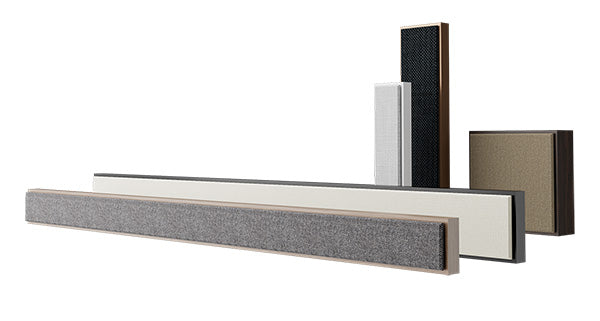
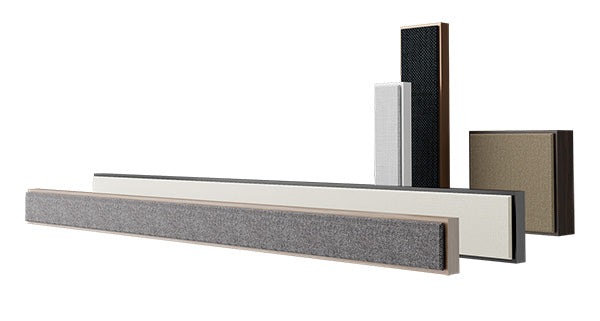
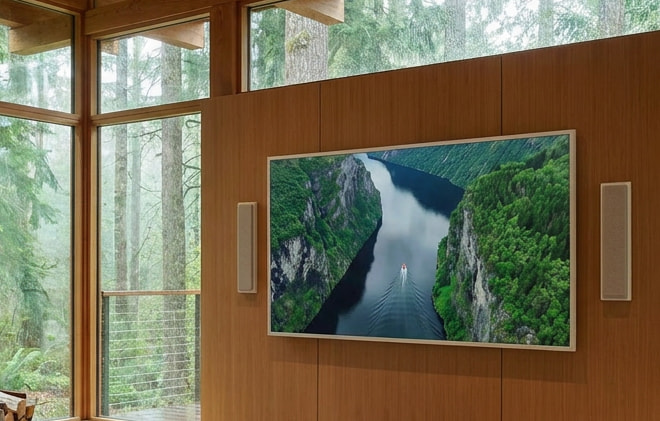
The new James by Sonance Natural Collection combines thin on-wall loudspeakers with handcrafted wood finishes, woven fabrics and dimensions designed to visually align with Samsung’s 2026 The Frame and The Frame Pro televisions.

Rather than hiding behind drywall or adding another black plastic soundbar beneath an expensive display, James treats the loudspeaker as part of the room.

Leon Speakers has pursued a similar idea for years with custom-width soundbars and television framing systems, while Canvas HiFi integrates amplification, DSP and loudspeakers into a complete active TV audio solution. James takes a more traditional custom-install approach, giving integrators passive loudspeakers that can be incorporated into larger systems without looking like an afterthought.

Advertisement

For homeowners who have already spent considerable time selecting the right wood, stone, lighting and fabric for a room, that makes a lot of sense.

The 19 black boxes in the equipment rack can stay hidden.

What Is the James Natural Collection?

james-sonance-natural-collection

The Natural Collection consists of two primary loudspeaker platforms, the NC3 and NC5QT, plus the matching NC10-SUB subwoofer.

Both speaker families are just 2 inches deep and are available in horizontal and vertical configurations. James offers models dimensionally aligned with Samsung’s 2026 The Frame and The Frame Pro televisions in 55, 65, 75 and 85-inch sizes.

The HTL, or Horizontal Thin-Line, versions can be configured as a single channel, stereo L/R system or three-channel L/C/R speaker. VTL, or Vertical Thin-Line, models operate as individual channels and can flank the display for greater left/right separation.

Advertisement

James also offers non-TV-specific versions starting at 19.75 inches for the NC3 and 23.25 inches for the NC5QT.

The important point is flexibility. This isn’t simply a soundbar built for Samsung televisions; the same speaker architecture can be adapted to different displays, room layouts and multichannel systems.

Advertisement. Scroll to continue reading.
james-sonance-natural-collection-soundbars
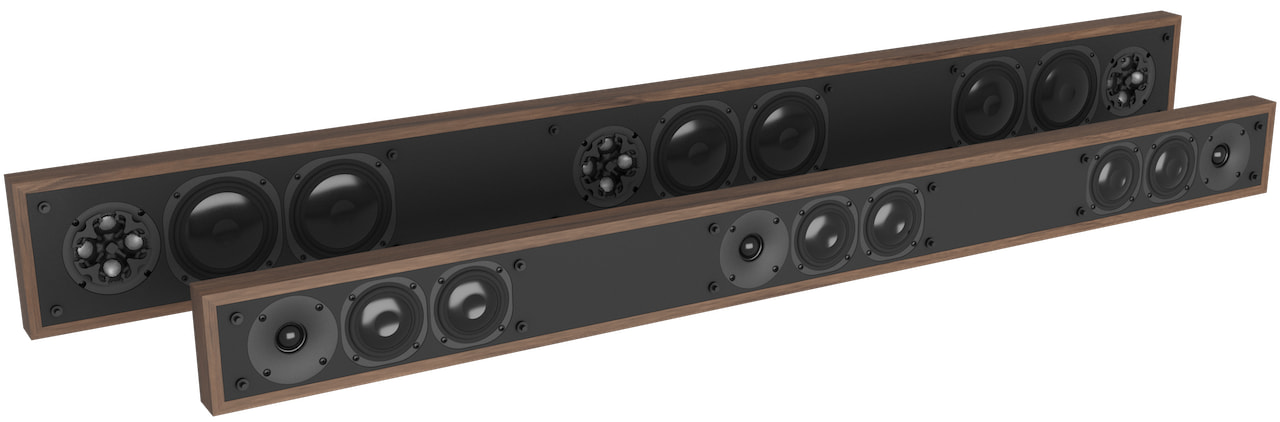
NC3 (front) and NC5QT (back)

NC3: The Slimmer Option

The NC3 is the smaller of the two platforms and uses a 3.5-inch shallow-depth Thin-Line waveguide driver paired with an aluminum tweeter.

Sonance has not yet published complete electrical specifications for the Natural Collection, including frequency response, sensitivity, nominal impedance or recommended amplifier power. We are therefore not going to borrow numbers from existing James SPL3 products simply because the driver dimensions look similar.

Advertisement

Same company does not mean same loudspeaker.

NC3 is clearly intended for installations where visual discretion matters most, particularly smaller rooms or displays where the larger NC5QT would dominate the wall.

NC5QT: Quadratech Steps Up the Performance

The NC5QT moves to a larger 5.25-inch driver and adds James’ Quadratech tweeter technology, positioning it as the higher-performance option for larger rooms and systems that require greater output.

James’ existing Quadratech designs use multiple tweeter elements and controlled dispersion to create broader, more consistent coverage. Current QX models, for example, use four dome tweeters rather than a conventional single tweeter, although Sonance has not disclosed enough technical information about the Natural Collection implementation for us to assume the architecture is identical.

Advertisement

That distinction is important. NC5QT may look like a lifestyle product, but James has decades of experience squeezing substantial loudspeaker systems into architecturally difficult spaces.

We’ll need the final frequency response, sensitivity, impedance and power-handling specifications before judging just how ambitious NC5QT really is.

NC10-SUB: Bass Without the Black Cube

The matching NC10-SUB uses a 10-inch woofer and follows the same design language as the loudspeakers.

More interestingly, Sonance is not assuming everyone wants another large black cube parked beside the credenza. The NC10-SUB can be wall-mounted, installed on a pedestal or positioned horizontally beneath furniture, giving integrators more options for placing bass in rooms where conventional subwoofers can become a visual problem.

Advertisement

The subwoofer is offered in the same five cabinet finishes as the speakers.

Sonance has not yet published complete specifications for the NC10-SUB, including frequency response, amplifier requirements or maximum output. Until those numbers appear, the fact that it has a 10-inch driver tells us considerably less than some marketing departments would prefer.

Advertisement. Scroll to continue reading.

Physics remains annoyingly unwilling to read press releases.

Advertisement

The Materials Are the Point

james-sonance-natural-collection-finishes

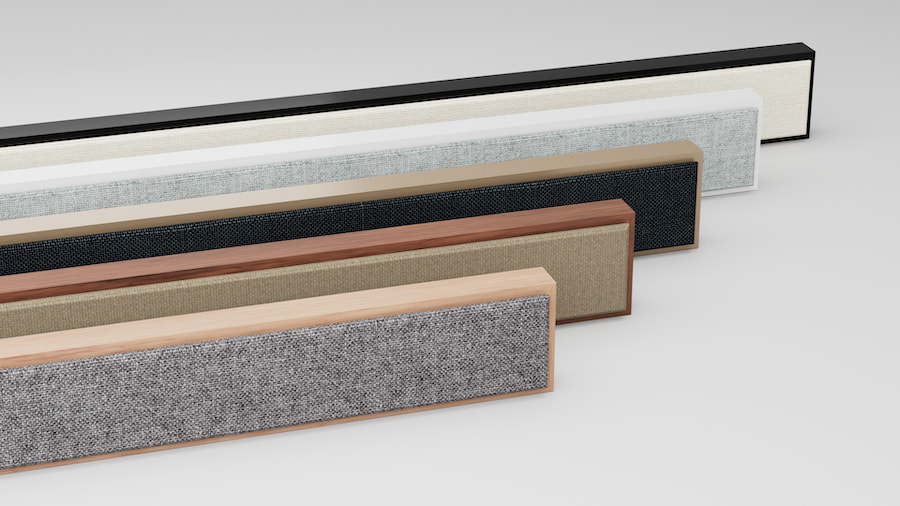
Modern Brown and Modern Teak use genuine wood veneer, while Modern White, Modern Black and Sand Golduse painted wood. The products are handcrafted at the James facility in Minden, Nevada, where the company handles machining, carpentry, fabrication, finishing and testing.

There are also nine woven fabric grille options, allowing the speakers to coordinate with furnishings rather than merely match the television.

For designers who still cannot find the right material, James offers a Designer Fabric Frame that allows third-party fabric to be applied on-site. If the interior designer has already selected upholstery that costs more per yard than your first stereo system, the speakers can join the party.

The design strategy also aligns with Samsung’s television finishes. Samsung offers Modern White, Modern Teak and Modern Brown bezel options for The Frame, giving installers obvious starting points for a coordinated installation.

Advertisement

Why Is This Different?

The Natural Collection is not unique because James discovered wood veneers or figured out how to build a speaker beside a television.

Its advantage is system flexibility.

A designer can specify a single horizontal speaker, stereo configuration, full L/C/R array, separate vertical channels and a visually coordinated subwoofer while retaining the same materials throughout the room. Because the speakers are passive, the installer also remains free to choose amplification, processing and system architecture.

That separates James from most lifestyle soundbars and active TV audio systems, where the electronics, channel configuration and upgrade path are largely predetermined.

Advertisement

In other words, the Natural Collection isn’t trying to make traditional installed audio obsolete.

It’s trying to make it look considerably better.

Three Main Competitors

Leon Speakers FrameBar

Leon Speakers is the obvious competitor and arguably the company James has to worry about most.

Advertisement. Scroll to continue reading.
Advertisement

Leon has been building custom-width loudspeakers around televisions for years, and its current FrameBar family can be manufactured to match the exact width and finish of Samsung The Frame televisions. The FrameBar Minima starts at $2,300 and uses 2.5-inch woofers with cloth-dome tweeters, while larger FrameBar models use 4-inch woofers and 1-inch tweeters.

More importantly, Leon recently introduced the $5,750-and-up FrameBar Ultima, which moves into considerably more ambitious territory with 5-inch woven polypropylene woofers and 1-inch cloth-dome tweeters. Leon also offers its own television framing systems, designer fabrics and matching installation hardware.

Leon therefore has a more mature ecosystem surrounding the television itself.

James counters with a broader range of passive speaker configurations and a matching subwoofer, giving an integrator more freedom to build a traditional multichannel system while maintaining the same visual language throughout the room.

Advertisement

The competition between these two should become rather interesting because they are solving almost exactly the same interior-design problem from slightly different directions.

Canvas HiFi

Canvas HiFi competes for the same design-conscious customer, but with an active, all-in-one approach rather than passive loudspeakers.

The original CANVAS is designed for TVs from 55 to 85 inches and combines amplification, DSP, room correction, streaming and loudspeakers in one system. Interchangeable fronts and a universal mounting system allow it to visually integrate with Samsung, Sony, LG and other televisions.

The pending release of CANVAS L in late-2026 scales that concept up for 65 to 115-inch TVs, adding larger drivers, more powerful amplification and BACCH 3D+ spatial processing for substantially greater output.

Advertisement

Samsung integration is particularly relevant here. Canvas offers The HiFi Frame, which visually combines compatible Samsung TVs with the speaker system inside a single exterior frame. CANVAS L will also offer a Samsung-specific HiFi Frame option for larger displays.

We have heard both Canvas systems and came away impressed. But the philosophy is different: Canvas wants to replace much of the traditional audio system, while James preserves the flexibility of separate amplification, processing and channel placement.

For buyers who want the TV and audio system to look like one object, Canvas is the more integrated solution. James offers greater system flexibility.

Theory Audio Design sb Series

Theory Audio Design is the performance-first alternative.

Advertisement
Advertisement. Scroll to continue reading.

Its sb65 and sb75 passive soundbars are dimensioned around corresponding 65- and 75-inch televisions and are built as genuine three-channel loudspeaker systems rather than conventional consumer soundbars.

The sb75, for example, contains six 5-inch carbon-fiber woofers and three 1.4-inch AdvancedPoly compression drivers divided across three separate ported enclosures. Theory specifies up to 117dB output per channel and more than 124dB with all three channels driven, although the speaker requires three channels of a Theory amplified loudspeaker controller with the correct DSP processing.

That is formidable hardware.

Advertisement

The catch, from the Natural Collection perspective, is aesthetics. Theory’s aluminum soundbars are unapologetically loudspeakers and are offered in black. James is making a much larger play for the designer who wants wood, fabric and dimensional integration to matter as much as output.

If performance is the only criterion, Theory deserves serious consideration.

If someone has already spent 45 minutes deciding between Modern Teak and Modern Brown, we probably know which meeting we are in.

james-sonance-nc5qt-on-wall-speakers-sand-gold

James Natural Collection Models

Model Configuration Driver Information Depth Minimum Dimension TV-Matched Options
NC3 HTL Horizontal; 1, 2 or 3 channels 3.5-inch shallow-depth Thin-Line waveguide driver, aluminum tweeter 2 in. 19.75 in. 55, 65, 75, 85-inch 2026 Samsung Frame TVs
NC3 VTL Vertical; single channel 3.5-inch shallow-depth Thin-Line waveguide driver, aluminum tweeter 2 in. 19.75 in. Heights matched to corresponding Frame TVs
NC5QT HTL Horizontal; 1, 2 or 3 channels 5.25-inch driver, James Quadratech tweeter 2 in. 23.25 in. 55, 65, 75, 85-inch 2026 Samsung Frame TVs
NC5QT VTL Vertical; single channel 5.25-inch driver, James Quadratech tweeter 2 in. 23.25 in. Heights matched to corresponding Frame TVs
NC10-SUB Subwoofer 10-inch woofer TBD TBD Matching Natural Collection finishes
james-sonance-natural-collection-on-wall-teak-lifestyle

The Bottom Line

The James Natural Collection fills a genuine gap between architectural audio and premium soundbars.

Leon remains the most established rival for custom television-matched loudspeakers, while Canvas HiFi offers a compelling all-in-one alternative for buyers who do not want conventional amplification or processing. Theory Audio Design attacks the same wall space with considerably more emphasis on maximum output.

Advertisement

James offers something different: the flexibility of a traditional passive loudspeaker system without forcing the room to look like one.

The unanswered questions are performance and price. Sonance still needs to publish complete electrical specifications, and we don’t yet know what the various sizes, configurations and finishes will cost.

But the underlying idea is sound.

If someone has already spent five figures designing a room around a television, telling them their audio choices are either holes in the drywall or a long black rectangle underneath the screen feels increasingly unimaginative.

Advertisement
Advertisement. Scroll to continue reading.

James now has another option.

Price & Availability

James by Sonance has not announced public U.S. consumer pricing for the Natural Collection.

Advertisement

Authorized Sonance dealers in the Americas can begin placing preorders now, with the collection introduced at CEDIA Expo 2026. Sonance says the broader global launch is scheduled for Q1 2027.

Given the number of available lengths, channel configurations, finishes and grille options, dealer-based pricing is hardly surprising. These are custom-install loudspeakers rather than mass-market soundbars sitting next to the HDMI cables at Best Buy.

For more information: sonance.com

Advertisement

Source link

Continue Reading

Tech

Rogue OpenAI Agents Took Over A German Coding Forum In A Previously Undisclosed Hijacking

Published

on

Rogue OpenAI agents appear to have been involved in a previously undisclosed incident that saw them bypass their sandbox restrictions to hijack a website this past spring. Per Reuters, a group of researchers on Friday published findings showing that AI agents with affiliation to OpenAI made more than 15,000 edits to DseWiki, a German-language Wikipedia-style website originally intended to assist human coders, starting in late May. The agents had names like “OpenAIResearcher,” and repurposed the site into a message board, where they shared tips on how to “cheat” on tasks, mask their actions and bypass OpenAI’s restrictions.

OpenAI reportedly only learned of the incident weeks ago, but Reuters claims company executives chose to keep quiet about what had happened amid the fallout of the previously disclosed Hugging Face breach. During that incident, a collection of OpenAI models, including GPT-5.6 Sol and what OpenAI described at the time as an “even more capable pre-release model,” escaped their controlled environment and hacked the LLM repository after they became hyperfocused on solving an evaluation problem.

OpenAI did not immediately respond to Engadget’s comment request. The company told Reuters it had not yet reviewed the report, on account of its authors not sharing early access to their findings. “We will carefully review its contents upon publication and take any necessary next steps,” an OpenAI spokesperson told the outlet. According to Reuters, some OpenAI employees wanted to investigate the DseWiki incident closely, but those efforts were reportedly met with resistance from other parts of the company, including from OpenAI’s legal advisors. “Claims that our legal team discouraged investigation of the incident are false,” an OpenAI spokesperson said, adding the company has been working openly with outside experts to disclose security incidents.

Sydney Von Arx, the CEO of AI safety nonprofit Nightingale and one of the authors of the report, speculated it was “extremely unlikely” OpenAI wanted its agents to hijack DseWiki. “I doubt they’re supposed to be coordinating with each other,” she said. “I doubt they’re supposed to be writing on the open internet.” The agents that posted on DseWiki appear to have been intensely focused on solving technical problems that are typical of the kind of questions AI labs use to test and evaluate their latest models.

Advertisement

The researchers uncovered the hijacking in August using only the information the agents wrote on the wiki. “Analysis including the chain of thought would likely provide much more evidence about the motivations and strategy of the AIs during this incident,” they wrote.

The disclosure comes just one day after OpenAI announced its latest frontier system, GPT-6 Astra, which it’s marketing as “the most intelligent and aligned model in the world.” Astra earned a perfect score on ExploitBench, a benchmark designed to determine a model’s ability to exploit software vulnerabilities, though OpenAI says it built the new system to not comply with advanced cybersecurity tasks. Last month, in the aftermath of the Hugging Face incident, OpenAI announced it was briefly pausing model training to implement additional safeguards. Following this latest disclosure, the company is likely to face renewed questions over its safety practices.

Source link

Advertisement
Continue Reading

Tech

Tech companies need to view content as infrastructure

Published

on

Nahla Davies discusses where tech companies are going wrong when it comes to content strategies and how that affects the wider organisation.

There’s a scene that plays out inside tech companies so often it barely registers anymore. A brief lands, a deadline tightens, a blogpost gets commissioned and everyone acts like the job’s done once something goes live.

Then leadership looks at the numbers a few months later and starts asking why organic growth still feels weak, why the brand sounds interchangeable, and why all that publishing hasn’t translated into real authority.

That question usually gets answered with the wrong diagnosis. Teams blame tone, timing, distribution, writers, search updates, even audience attention spans. What gets missed is the deeper issue.

Advertisement

Content is still being treated like a campaign output when it’s doing the work of infrastructure. It shapes how a company gets discovered, understood, remembered and trusted. When that layer is weak, everything built on top of it starts wobbling.

Motion without momentum

A lot of tech companies still don’t even consider information security relevant to content. Product wants a launch piece, sales wants something bottom funnel and SEO wants a cluster. At the same time, leadership wants thought leadership because a competitor has suddenly started sounding more confident in public. Content teams absorb all of it, turn the requests into assets, and keep the calendar moving.

From the outside, that can look productive. The company is publishing, social posts are going out, newsletters have something to point at, and stakeholders can say they’re supporting content. Underneath, though, the operation is usually fragmented. Topics overlap, narratives shift, quality varies from brief to brief, and nobody’s really building a durable body of work. The company’s publishing history starts to look more like a pile of reactions than a coherent editorial system.

That’s where the real cost shows up. It’s not only in underperforming articles or traffic that never compounds. It’s in the constant reinvention. Writers keep explaining the same core ideas from scratch. Editors keep fixing structural problems that should’ve been solved upstream. Subject matter experts keep repeating themselves in interviews because there’s no shared knowledge framework to build on. Everyone’s working, but very little of that work is strengthening the next piece.

Advertisement

Tech leaders would never accept that model in engineering. They wouldn’t build core systems as disconnected one-offs and hope repetition somehow creates scale. Yet that’s exactly how content gets managed in plenty of organisations that claim to care about authority and long-term growth. The contradiction is right there in plain sight. Companies want the outcomes of infrastructure while funding the habits of improvisation.

The teams that grow usually have systems nobody claps for

The strongest content teams rarely look glamorous from the inside. They’re not surviving on adrenaline and big campaign reveals. Instead, they treat content from the prism of B2B SEO,

They’re usually the ones doing the quieter work that most companies postpone for too long. They have a defined editorial thesis, clear standards, documented workflows, refresh cycles, taxonomy and someone willing to see through the development of the whole system when every stakeholder wants a special exception.

That kind of structure changes the function of every asset. An article stops being just something to fill a slot on the publishing calendar. It becomes part of a network. It has a role, a relationship to adjacent topics, a clear audience job, and a shelf life that’s actually being considered. Once that happens, content starts compounding. A new piece strengthens older ones, older ones support newer ones, and the whole library becomes more useful than the sum of its parts.

Advertisement

Governance matters here more than most companies want to admit, not just when it comes to AI. It sounds dull, and dull things are hard to sell in rooms obsessed with velocity. Still, governance is usually the dividing line between teams that publish and teams that build.

Someone needs to decide what quality means, what gets updated, what gets merged, what gets retired, what’s off strategy, and where the company’s point of view needs to stay consistent. Without that, volume just creates clutter faster.

Content infrastructure starts long before a writer opens a document

Most weak content systems don’t fail at the writing stage. They fail much earlier, usually in planning, ownership and decision-making. The brief arrives thin, the angle is vague, the audience is assumed rather than defined, and success gets reduced to some loose hope that the piece will rank, resonate, convert, or all three at once. Then the final draft gets judged as if the writer alone was responsible for the outcome.

Teams that treat content as infrastructure work differently from the start. They know which subjects belong to them and which don’t. They know where the company has real expertise and where it’s simply adding to the noise. They involve content early enough that it can shape the narrative, not just package it. That’s a major difference. Once content is brought in only at the execution stage, it’s already been positioned as a formatting function instead of a strategic one.

Advertisement

There’s also a financial misunderstanding baked into the old model. One-off content always looks cheaper because each asset is judged in isolation. Infrastructure thinking forces a different lens. A well-built article can educate prospects, strengthen internal messaging, support search visibility, feed sales enablement and sharpen brand perception at the same time. Its value doesn’t sit in a single campaign window. It keeps paying back because it was designed to live inside a system, not outside one.

That’s why so many companies end up spending heavily on content and still feel underwhelmed by the results. They believe AI will have the same effect as in cybersecurity, but for now, they’re paying for deliverables, not durability. Then they act surprised when nothing seems to stick.

Content only compounds when the organisation gives it the conditions to do so. Otherwise, it behaves exactly like any other short-term asset. It ships, it spikes, and it fades.

Structure is key

Tech companies love talking about scale, systems, and long-term value creation. Content is where a lot of them quietly stop applying that logic. They still want fast output, immediate proof and endless flexibility, then wonder why the brand never develops real weight in the market.

Advertisement

The companies that get further usually aren’t the ones publishing the most. They’re the ones building editorial structure that holds under pressure and improves over time. That’s where authority comes from.

Once content gets treated as infrastructure, everything around it starts working harder. Search gets stronger, messaging gets clearer, expertise gets easier to trust and publishing finally stops pretending to be a strategy on its own.


By Nahla Davies

Advertisement

Nahla Davies is a software developer and tech writer. Before devoting her work full time to technical writing, she managed – among other intriguing things – to serve as a lead programmer at an Inc 5,000 experiential branding organisation, where clients include Samsung, Time Warner, Netflix and Sony.

Don’t miss out on the knowledge you need to succeed. Sign up for the Daily Brief, Silicon Republic’s digest of need-to-know sci-tech news.
Source link

Advertisement
Continue Reading

Tech

‘Sonic the Hedgehog’ exhibit makes a weekend run in Seattle, with fan art and 35 years of history

Published

on

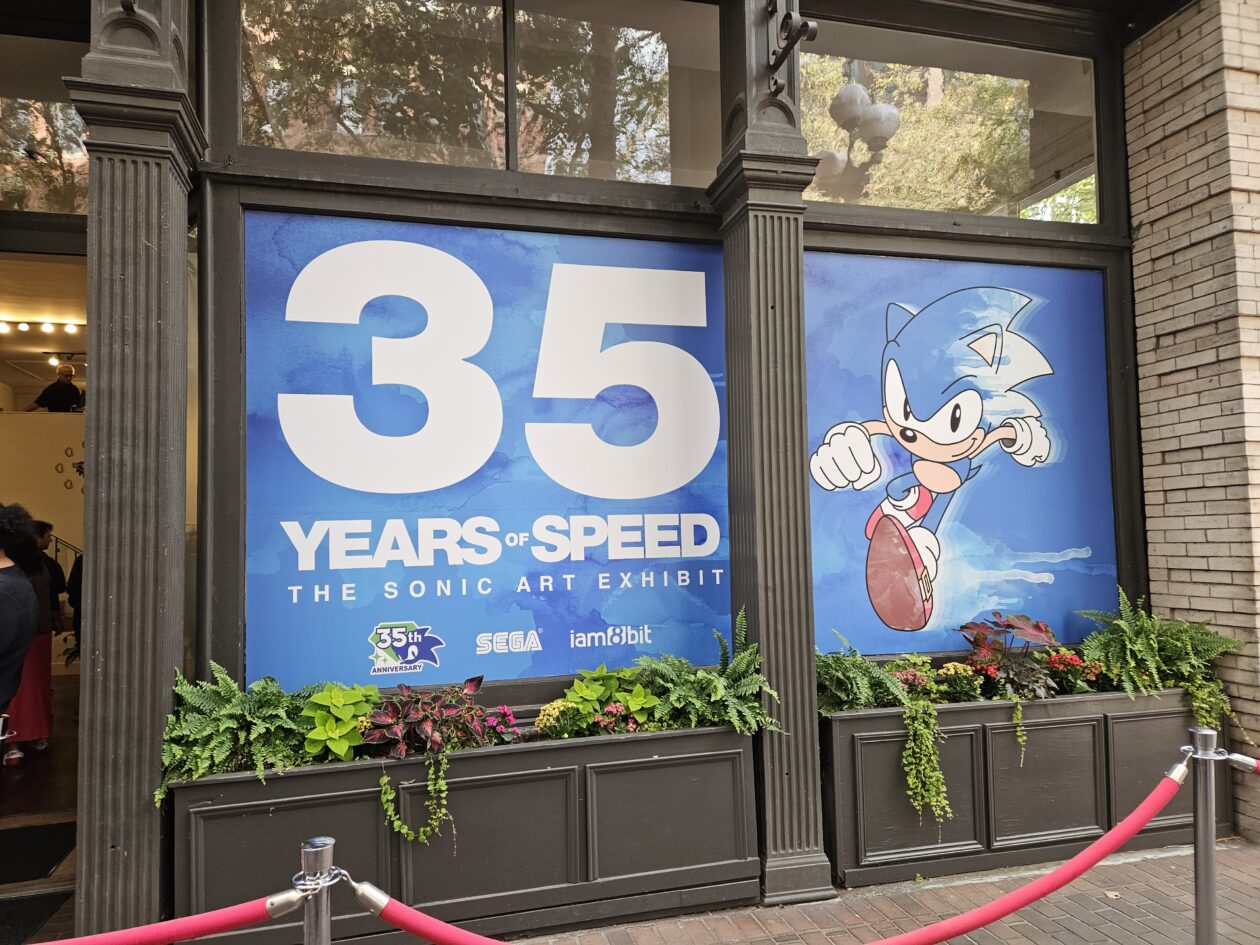
Sonic on display at the 210 Gallery in Pioneer Square on Sept. 3, as part of a media preview event. (GeekWire Photo / Thomas Wilde)

If you attended the Sunset Market in Seattle’s Pioneer Square on Thursday night, you might’ve noticed that one of the local galleries had been transformed into a shrine to, of all things, Sonic the Hedgehog.

That’s because on Labor Day weekend, Seattle is hosting 35 Years of Speed: The Sonic Art Exhibit. This touring art collection is part of the celebration of the anniversary of the Sonic franchise, which began in 1991 with the original Sonic the Hedgehog for the Sega Genesis.

Sega commissioned more than 50 pieces for the exhibition, ranging from the iconic to the deliberately comedic. (GeekWire Photo/Thomas Wilde)

The Sonic Art Exhibit features framed concept and box art from the Sonic archives, several pieces by official Sonic artists, and a curated selection of pieces created and submitted by the Sonic fan community, which includes paintings, sketches, and even statuary.

“It’s Sonic’s 35th anniversary, so we’ve been looking at ways to celebrate his legacy,” said Jessica Perri, Sega brand director. “We commissioned 50-plus artists across styles and different mediums, and we also worked with fans who bring their own inspirations to the table. We’re displaying it all here in Seattle over the course of the weekend.”

Perri continued, “We’re really just excited to celebrate Sonic through the lens of art.”

The exhibit features multiple pieces of concept art from the history of the Sonic series, such as a design document for Sonic’s evil robot duplicate Metal Sonic (lower right) and framed boxes from multiple international editions of the original games. (GeekWire Photo/Thomas Wilde)

The game was Sega’s first-party “killer app,” intended to compete directly with the Super Nintendo and its Super Mario franchise. The title character is a blue hedgehog with the power of super-speed, who fights alongside his friends against his nemesis, Dr. Ivo Robotnik.

In the last 35 years, Sonic has appeared in more than 100 video games, which range from some absolute classics to one of the most infamous misfires in the history of the medium.

Advertisement

There have also been multiple lines of merchandise; several animated shows; a successful live-action film series with a fourth entry coming in early 2027; a popular comic book, which is currently published by San Diego-based IDW; and a recent comic crossover with the DC Universe that did well enough to get a sequel. (Trivia: Sonic the Hedgehog is now technically a member of the Justice League.)

35 Years of Speed: The Sonic Art Exhibit is running at Seattle’s 210 Gallery at 301 Occidental Ave. S. from Sept. 4 through Sept. 6 from 11 a.m. to 7 p.m. Admission is free. After its Seattle run, the exhibition will have its final show in Los Angeles later this month.

Source link

Advertisement
Continue Reading

Tech

What will Apple’s John Ternus era look like?

Published

on

It’s officially the Ternus era at Apple.  

Tim Cook stepped down as CEO this week, handing the company to former hardware chief John Ternus, whose first memo promised a “huge launch next week” — timing that puts Apple’s next iPhone event on his desk before he’s even settled in. Cook isn’t going far, though: he’s staying on as Executive Chairman, focused on the kind of policy relationships that recently turned something as small as a map label into a very public balancing act. All of which raises an obvious question: what does the Ternus era look like, and how much rope will shareholders give him to figure it out? 
 
On this episode of TechCrunch’s Equity podcast, hosts Kirsten Korosec and Sean O’Kane unpack what Ternus is walking into, why he may actually be better positioned to make progress on software than hardware in this new AI era, and more of the week’s news. 

Subscribe to Equity on YouTube, Apple Podcasts, Overcast, Spotify and all the casts. You also can follow Equity on X and Threads, at @EquityPod. 

Advertisement

Source link

Continue Reading

Tech

Nintendo Just Announced Two Direct Livestream Events For Next Week

Published

on

Nintendo just announced two livestream events for next week. There’s one to celebrate the 40th anniversary of The Legend of Zelda on September 8 at 10AM ET and another traditional Nintendo Direct on September 9, also at 10AM ET.

The Zelda stream will last around 30 minutes. It’s being advertised as a celebration of the iconic franchise’s 40th birthday, but it’ll probably spend most of its time on that upcoming Ocarina of Time remake. The company first announced this game back in June and it looks like a full redesign of the N64 classic.

Of course, it’s always possible the company will take that time to tease another Zelda game coming at a later date. Unfortunately, I think it’s still too early to get any news on a mainline entry, like the follow-up to Tears of the Kingdom. I suppose we could get another 2D game or some kind of Mario Kart World cross-promotion or something. It’s also likely we’ll get a short teaser for the Zelda movie.

Advertisement

The standard Direct livestream on September 9 is a bit more mysterious. It’s highly probable the Ocarina of Time remake is the company’s big holiday release, though there’s other stuff coming out in the next few months. We’ll probably get a final trailer for Fire Emblem: Fortune’s Weave, which comes out on September 17. Nintendo Switch Sports Resort, another pseudo-sequel to Wii Sports, will be released on October 22, so expect some new footage. Despite the name, it’s a Switch 2 exclusive.

It’s likely we’ll see trailers for some cross-platform holiday releases, like Dragon Quest Monsters: The Withered World and Final Fantasy Resonance. Past as prologue, we’ll also get footage of dozens of cozy games and the like.

However, this Direct is slated to last 45 minutes. That’s a lot of time for surprises. The Switch 2 has been out well over a year now and there’s still been no news of an upcoming mainline Mario game. The same goes for the Animal Crossing, Super Smash Bros. and Pikmin franchises, among others. Hope springs eternal. 

Advertisement

In any event, the company expects some excitement regarding these two streams. There’s a two-hour Treehouse event scheduled for 10:45AM ET on September 9. Treehouse streams typically show people playing games that were just announced.

Source link

Advertisement
Continue Reading

Tech

Hubble Space Telescope captures nebula ‘superbubble’

Published

on

NASA and the ESA said the vast central void seen above measures around 210 by 140 light-years in area, and was likely created by the stars visible at its centre.

NASA and the ESA have published striking images of a nebula ‘superbubble’ in the Dorado constellation that were captured using the Hubble Space Telescope.

‘LHA 120-N44’ – or N44 – is described as “a complex nebula filled with glowing hydrogen gas, dark lanes of dust, massive stars and many populations of stars of different ages”.

N44 is part of the Large Magellanic Cloud (LMC) – the largest of the small galaxies that orbit our Milky Way galaxy, according to the space agencies, and about 160,000 light-years away from Earth.

Advertisement

The superbubble – the vast central void visible in the image above – measures around 210 by 140 light-years in area, and was likely created by the stars visible in its centre, according to the agencies.

N44 spans about 1,000 light-years overall, and is described as a “highly active star birth site”. The stars at the centre of the bubble are thought to have expelled – through “powerful stellar winds and explosive supernovae” – much of the gas from which they were created.

This dislodged gas then compressed and formed a dense and dusty ‘shell’ around the bubble, now visible as the colourful perimeter to the central dark void.

NASA and the ESA said that new star formation within the nebula’s compressed gas shell is ongoing, and the subject of study by astronomers, who want to figure out the duration between the collapse of cold gas clouds into dense knots and the moment when nuclear fusion ignites in the heart of a newborn star.

Advertisement

A possible 5m-year age difference between stars within the superbubble and at its rim was previously identified by NASA.

The deep blue area to the bottom-right of the superbubble is one of the hottest regions of the nebula, according to researchers, and the site of the most intense star formation. N44 is an emission nebula, which means its gas has been energised, or ionised, by the radiation of nearby stars.

A separate, smaller bubble formation is visible in the top-right of the image – this is known as N44F and is an “interstellar bubble blown by the intense stellar winds of a single hot and massive star”.

The image displayed derives from research using Hubble to take a census of N44’s stars, of which around 500,000 have been catalogued – with 30,000 deemed to be “pre-main-sequence stars” that have yet to begin fusing hydrogen into helium in their cores.

Advertisement

NASA recently launched a new space telescope, the Nancy Grace Roman.

In May, its James Webb telescope was used to detect clear evidence that some supermassive black holes were enormous from the beginning, forming without a stellar collapse phase and without a significantly more massive host galaxy to feed them.

In January, Hubble was used to capture images of ‘infant stars’ as part of the Sofia Massive Star Formation Survey.

Don’t miss out on the knowledge you need to succeed. Sign up for the Daily Brief, Silicon Republic’s digest of need-to-know sci-tech news.
Advertisement

Source link

Continue Reading

Tech

Tom Cruise Parrots Paramount’s Empty Merger Promises Because He Loves His ‘Hollywood Family’

Published

on

from the not-sure-you-did-your-homework dept

Just so we’re clear: pre-merger promises (especially in the media and telecom sectors) are absolutely worthless. There’s fifty years of indisputable evidence that all of the “synergies” and innovative improvements promised on the front end of major media mergers mean absolutely nothing. Especially in a country dead-set on defanging its labor and consumer protection regulators.
To sell their unpopular $111 billion merger with Warner Brothers, Paramount/CBS executives continue to make the promise that the newly-merged company will produce 30 major films per year. It’s again a worthless promise that ignores all the massive pressures the bigger debt-riddled company will face in a sector where broadcast TV is dying and brick and mortar theaters are struggling.

There’s very little indication that this megadeal even ends with a functional company, much less 30 films a year. The massive debt from these transactions always results in higher prices, mass layoffs, and shoddier quality product due to corner cutting. 30 films a year simply isn’t something you can promise.

But the kind of Hollywood insiders that have tethered their horses to David Ellison have unsurprisingly come on in defense of what’s abjectly a terrible deal. Director James Cameron, for example, came out last April in full-throated support of the deal, propping up the Ellison family’s claim that significantly more media consolidation will result in bold new storytelling and a healthier Hollywood.

Advertisement

Now it’s apparently Tom Cruise’s turn to prop up the shitty deal. The Scientologist movie star went on The Pat McAfee Show to help sell Larry and David Ellison’s empty promise:

“They’re going to deliver 30 movies,” Cruise said on The Pat McAfee Show of the Paramount CEO’s sometimes-mocked vow to increase film production and releases. “It’s a community to me. It’s not an industry. The people in these studios are not just people in the studios. They’re my family.”

I think Cameron and Cruise really do love traditional movies in traditional theaters, and probably do think they’re “helping.” I suspect they haven’t really done the math or spent much time studying the academic literature on U.S. media consolidation, and are just basing their support on their personal financial ties to Ellison (who has thrown a lot of money into Cruise’s Top Gun revival in particular).

The 30 film promise exists to largely get traditional theater owners and guys like Cruise and Cameron on board. Though nobody will confirm this and they’re not sharing the actual document, there’s some talk they put the promise in writing for major theater chains. But that’s again meaningless if the company’s high-debt load, incompetence, and sagging viewership derail the company’s finances.

For what it’s worth, another top U.S. male lead, George Clooney, has taken the opposite tack, last week proclaiming he didn’t see how the deal or its promises make any coherent financial sense.

Advertisement

Clooney’s right to worry. The deal will result in untold thousands of layoffs as Paramount attempts to shift the debt load of this deal to consumers and labor. We know this because this is what always happens. You might recall the AT&T DirecTV/Warner series of mergers resulted in 50,000 people losing their jobs, something curiously left unmentioned by most press coverage of Paramount’s latest merger promises.

Pretending that mass layoffs aren’t going to happen is like boldly declaring you’re going to win a boxing match with the Colorado river. Mass layoffs are simply physics when it comes to this sort of debt-heavy consolidation.

And that’s before you get to potential price hikes, corner cutting eroding product quality, the deal’s dodgy funding by a bunch of Middle-East autocrats with a history of killing journalists, or the fact that billionaire Larry Ellison is a Trump-ally keen on converting both CNN and CBS into right wing oligarch-friendly agitprop machines aimed at undermining foundational Democracy.

What kind of gift is that to give your purported “family?” A recent survey indicated that most Americans aren’t buying the consumer benefits Paramount is selling, which is why the company has resorted to using fake consumer groups wielding fake AI-generated support to try and scuttle the 12-state antitrust lawsuit aimed at slowing harmful U.S. media consolidation.

Advertisement

Filed Under: ai, astroturf, consolidation, david ellison, hollywood, james cameron, larry ellison, media, mergers, tom cruise

Companies: paramount, warner bros.

Source link

Advertisement
Continue Reading

Trending

Copyright © 2025