A federal judge in California ruled this week that Google must stop making it difficult for consumers to install third-party Android app stores, saying the corporate giant was using “anticompetitive friction” to prevent people from doing so.
It was the latest chapter in the years-long legal battle between Google and Epic Games, which originally accused the corporate giant in 2020 of restricting easy access to third-party app stores and non-Google payment methods, and behaving as a monopoly.
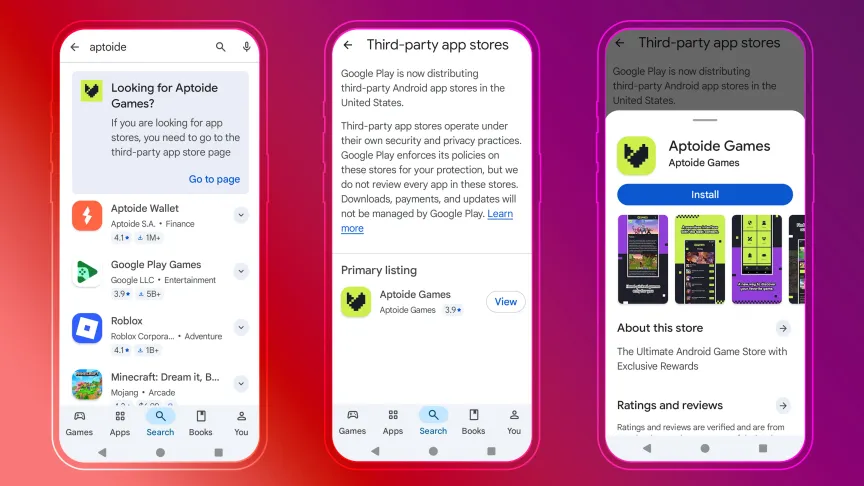
Installing a third-party Android app store such as Aptoide Games hasn’t been a smooth process. For example, if you go to the Play Store on an Android phone and search for “Aptoide,” you’ll see a pop-up section at the top that asks, “Looking for Aptoide Games?” You then have to click on a “Go to page” link. On that next page, it shows the Aptoide Games app, but instead of an Install button, there is a View button. Selecting the View button finally takes you to the Install link.
The multistep process required to install a third-party app store on an Android phone.CNET/Adobe Stock/Google
Also, if you search for “app stores” in the Play Store, a pop-up appears with the question, “Looking for app stores?” with a Go to page link that takes you to the app stores menu.
Northern District Judge James Donato was not thrilled when Epic Games attorneys illustrated all of this in court, The Verge reports. He called those extra steps “anticompetitive friction” and “not acceptable” and ordered Google to remove them from the installation process by next week. In his ruling, Donato said that if someone searches “app stores” or “store for apps” — or any similar combination of search terms — the Play Store must show a list of such stores.
Advertisement
He also ruled that Google must replace the “view” button with “install” on the screen that shows the third-party app and that Google must remove the “Looking for an app store?” screen and instead must show the list of app stores.
Jason Howell, co-host of the Android Faithful podcast, said replacing the View button with an Install button was puzzling, since most apps in the Play Store search results don’t show it either, not until you click on the app itself. “It seems Google was likely replicating how it presents its normal apps in listings for third-party app stores, not immediately doing anything punitive,” Howell told CNET.
Howell did say it was “concerning” that consumers were being directed to a separate page of third-party app stores. “I’m happy to know they will address that.”
Google customers have been able to install third-party app stores on Android phones throughout the operating system’s 18-year history. But prior to July, you could not install those apps from the Play Store. Instead, you had to use the more cumbersome method of sideloading, in which you install the app from an unofficial source or computer. It often required changing the security settings on the phone.
Advertisement
That changed in July, when Donato ruled that Google must allow people to download third-party apps in the Play Store.
But Google added speed bumps to that process, Epic Games complained to the court last month. Its lawyers argued that “Google will not include any app stores in the results,” and instead will direct them to a separate page showing a list of app stores. The lawyers argued that “will confuse users and will make app stores harder to find and less likely to be used” and that they “will just give up” if they don’t see those stores on the initial search results page.
Representatives for Google and Epic Games did not immediately respond to requests for comment.
Ever since being admittedly fascinated by the Cambridge coffee webcam from the 1990s, I’ve written about VPNs, the NFL, smartphones, living wages, over/unders and everything in between.
See full bio
It could soon become easier to identify AI-generated content, even if it’s not the usual “It’s Not X, it’s Y” type of post you’d come across on LinkedIn and other socials.
As you may be aware, the EU now requires AI companies serving its market to mark their AI-generated content so it’s easier to identify.
Anthropic and several other major AI providers have agreed to comply with the EU’s Code of Practice, with Anthropic becoming one of the first companies to share details about how it will implement watermarking across Claude.
Anthropic has also confirmed that a regular user won’t be able to see the watermark.
According to the company, it has no practical impact on the quality or content of Claude’s output, including creativity and readability.
Advertisement
For those unaware, invisible watermarking and provenance systems are already being used for some AI-generated images, and text-based output will now follow a similar concept, although the underlying implementation is different.
While the change is being introduced to comply with the EU AI Act, Anthropic says the watermark will initially be applied to Claude-generated text worldwide.
“We’re applying watermarking globally at launch because we don’t yet have a durable way to scope it by region,” Anthropic explained in a blog post.
Anthropic says future Claude models will generate watermarked text. Models launched before August 2, 2026, are covered by the EU’s transition period, and Anthropic says it is working to add watermarking to those models over the coming months.
Advertisement
Claude’s watermark doesn’t add hidden characters
Anthropic says its implementation is based on Google DeepMind’s SynthID-Text approach and explained that it works during generation, with certain exceptions.
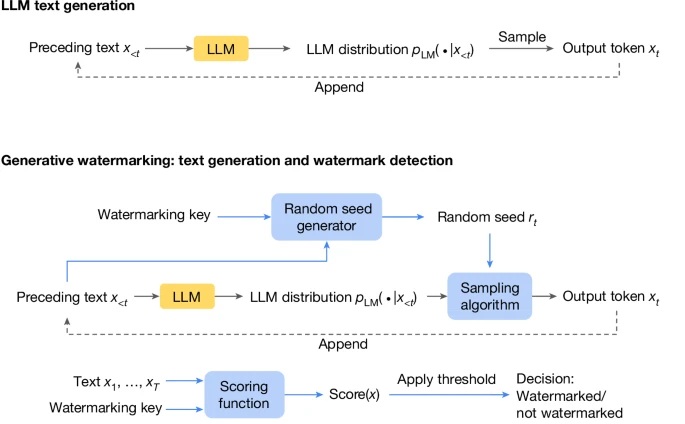
As you may be aware, AI models generate text by repeatedly choosing which token could reasonably come next. Instead of adding characters or modifying the finished response afterward, Claude’s watermark changes the source of randomness used when making some of those choices.
“Watermarking uses low-stakes choices like these—which occur many times over a piece of generated text—to leave a pattern in Claude’s responses. That pattern is undetectable to the reader, but is detectable to anyone who has a key that encodes it,” Anthropic explained.
“When watermarking is used, choices are still made at random, but the source of the randomness is different. Instead of using an arbitrary random number generator to pick the next word, watermaking uses the key and a few words that come before to settle what word the model should pick.”
Advertisement
“That is, the words that Claude picks are still random, but now, one can check the sequence of words and see if it’s consistent with the choices Claude would make if it was using the key. If it is, one can assign a probability that the text was generated by Claude.”
I also read the research paper on the topic, and here’s an excerpt that explains how generative watermarking works:
Generative watermarking works by carefully modifying the next-token sampling procedure to inject subtle, context-specific modifications into the generated text distribution. Such modifications introduce a statistical signature into the generated text; during the watermark detection phase, the signature can be measured to determine whether the text was indeed generated by the watermarked LLM. A key benefit of the approach is that the detection process does not require performing computationally expensive operations or even access to the underlying LLM (which is often proprietary).
Advertisement
The paper goes in depth and has more examples, but the important part is that Anthropic is not adding a visible marker or hidden characters to Claude’s response.
Google’s research paper explains how watermarking works
Source: Google DeepMind
Instead, when Claude has multiple reasonable choices for what to generate next, the watermarking system uses a secret key and some of the preceding words as part of the randomness used to make that choice.
Those individual choices should look completely normal to a reader, but across a sufficiently long piece of text, they leave behind a statistical pattern.
A detector that has Anthropic’s key can examine the sequence of words and determine how consistent it is with the choices Claude would have made while using the watermark, allowing it to estimate the likelihood that Claude was involved in writing the text.
According to Anthropic, internal testing found no impact on creativity, readability, or the content of Claude’s responses.
Advertisement
The company also says watermarking requires no additional tokens and has a negligible impact on generation speed.
“Nothing is added to the text and there are no hidden characters,” Anthropic noted. “Watermarking doesn’t require extra tokens, and will not be more expensive.”
Code and factual answers may carry less watermarking
As I mentioned, there are certain exceptions to watermarking, and they’re for good reasons.
For factual statements where only one answer is correct, Anthropic says the watermark does not interfere with the choice.
Advertisement
Likewise, the same principle applies to code, where replacing one term with another could break the output.
“Where an exact output is required—where there isn’t a choice, and something would be factually wrong or a piece of code would break if a different term was chosen—the watermark isn’t applied.”
“For example, once the model has written “2 + 2 =”, there is a very clear best choice for the next token (if the model is completing the sum, there isn’t an answer that’s equally as good as “4”; if it’s talking about George Orwell’s Nineteen Eighty-Four, there isn’t an answer that’s equally as good as “5”),” the company noted.
“The “nudge” of the watermark wouldn’t be applied here. For the same reason, code—which in very many cases has to be exact—has generally less watermarking than some other forms of text.”
Advertisement
Anthropic notes that watermarking can still be used in parts of code where arbitrary choices exist, such as comments, but says it should have a negligible effect on the actual code produced.
This aligns with Google’s SynthID-Text paper, which notes:
There are two primary factors that affect the detection performance of the scoring function. The first is the length of the text x: longer texts contain more watermarking evidence, and so we have more statistical certainty when making a decision. The second is the amount of entropy in the LLM distribution when it generates the watermarked text x. For example, if the LLM distribution is very low entropy, meaning it almost always returns the exact same response to the given prompt, then Tournament sampling cannot choose tokens that score more highly under the g functions. In short, like other generative watermarks, Tournament sampling performs better when there is more entropy in the LLM distribution, and is less effective when there is less entropy.
Advertisement
It is also worth noting that light proofreading of human-written text may leave too little Claude-generated material for reliable detection.
Anthropic says the watermark only applies to words Claude actually chooses, so a few grammar or punctuation changes might not provide enough evidence.
Anthropic says a translation produced by Claude carries a watermark because Claude chooses every word in the translated output.
Anthropic is building an API to detect Claude watermarks
It turns out that there’ll be an easier way to detect the watermarks, as Anthropic plans to offer a watermark detection API.
Advertisement
The API will be able to estimate the likelihood that Claude was involved in writing a piece of text, but Anthropic stresses that this is not the same as proving who wrote it.
A Claude watermark also cannot identify whether the text was written by another AI model, since other providers may use different watermarking methods and different keys.
“A watermark can only determine that Claude was likely involved with the content at some point. It cannot distinguish “Claude wrote this” from “Claude heavily edited this.”
“Light editing probably won’t remove the watermark completely; a complete rewrite where every word is replaced will.”
Advertisement
Detection also becomes less reliable with small samples because there are fewer word choices for the detector to analyze.
For generated PNG, JPG, and SVG files, Anthropic is taking a different approach.
Claude will attach cryptographically signed C2PA provenance metadata indicating that the file was created or processed with Claude, rather than modifying the file itself with an embedded watermark.
Overall prevention scores can hide what happens after initial access. Once attackers are using valid credentials, prevention drops sharply.
The Blue Report 2026 measures defenses technique by technique across 338 million simulations run in customer production environments.
Over the past year, one trend has become increasingly clear in generative AI: no single image or video model excels at everything. Some models produce more realistic motion, others generate stronger lighting and textures, while others perform better at maintaining character consistency across multiple generations. As a result, creators increasingly switch between different models depending on the task instead of relying on a single tool. The downside is that this often means managing multiple platforms, accounts, and subscriptions.
DaVinci AI aims to simplify that workflow by bringing multiple leading AI models into a single workspace. Instead of switching between different services, you can access a wide range of image and video models from one interface.
In this review, we take a close look at what DaVinci AI offers, which AI models are currently available, how its editing tools perform in practice, and whether its pricing represents good value.
What Is DaVinci AI
DaVinci AI is a web-based generative media tool that brings together leading AI models for image and video generation on a single platform. You can switch between flagship models from different providers, including Sora, Veo, Kling, Seedance, Seedream, and Nano Banana, all from one interface, without needing to create separate accounts or make separate payments for each. Without needing to create separate accounts or make separate payments for each. The platform works on mobile, tablet, and desktop browsers, and it also has iOS and Android apps.
Advertisement
Rather than focusing on a single proprietary model, DaVinci AI acts as a central workspace for multiple AI image and video models. It’s multiple generative models brought together under one roof. When you want to generate video in Sora, an image in Nano Banana, and voiceover on an ElevenLabs based engine, they all appear on the same project screen.
Model Library: Genuinely Extensive
Opening DaVinci AI’s model dropdown menu reveals dozens of image and video models. Some standouts include:
On the image side: Nano Banana Pro, Seedream 5.0 Pro, Flux 2, DaVinci Ultra, Kling O1 Image, GPT Image 2
On the video side: Sora 2 and Sora 2 Pro, Veo 3.1, Kling 3.0, Seedance 2.0, Wan 2.7
Bringing this range of popular image and video models together in one platform is one of DaVinci AI’s main differentiators; usually you’d need to visit a separate platform for each one. DaVinci AI’s value proposition here is clear: a user who wants to test the same prompt across multiple models can stay on a single screen instead of switching between browser tabs. With Higher-tier plans, you can also run multiple generations simultaneously and compare results side by side, which can make it easier to compare outputs before selecting the best result.
Generating an image is only part of the job; the real difference often shows up at the editing stage. The suite covers the essentials: an Object Remover / Erase tool for cleaning unwanted elements out of a scene, Background Remove & Swap for pulling out or fully replacing a background, Relight for reconstructing a product photo’s light source and shadows, Reshoot / Change Camera for regenerating a scene from a different angle, and Upscale for pushing a low-resolution image up to high resolution without losing detail.
Of these, the lighting and camera-angle tools are particularly notable — they let you turn a single shot of a product photo into multiple usable variations. Some supported models also provide character consistency features, allowing recurring characters to remain visually similar across multiple scenes.
Advertisement
Artwork, Moodboards, and Ready Made Templates
DaVinci AI‘s “Artwork” section offers dozens of pre-built artistic styles and moodboards for users without needing advanced prompt-writing skills. Picking a style and applying it to your own image is much faster than building a prompt from scratch.
Templates follow a similar logic: categories like business portraits, video thumbnails, logo design, and product/ad visuals come as ready made formats. This can save considerable time for small business owners and marketers who need to produce content regularly.
Audio and Music Generation: A Package That Goes Beyond Visuals
One thing that sets DaVinci AI apart from many other visual focused tools is its audio side. The platform integrates voice generation technologies such as ElevenLabs and MiniMax Speech to generate natural sounding text to speech, allowing you to choose from different languages, accents, and delivery styles. On the music side, you can create instrumental tracks or full songs with vocals by entering your own lyrics, with control over parameters like genre, mood, and tempo.
For creators producing complete marketing assets, having image generation, voice synthesis, and music creation within the same workspace can reduce the need to move between multiple AI platforms.
Advertisement
How Does the Trial Work?
When you create a new account, you can generate your first image without entering credit card information, making it easy to explore the platform before committing to a paid plan. If you decide to continue, DaVinci AI offers several subscription options with different credit allowances and model access. Since pricing and promotions may change over time, it’s best to check the latest details directly on the official website.
Credit-based system, your monthly credit allowance and access to certain AI models and priority queue access vary by plan. We recommend checking current pricing and any promotional campaigns directly on davinci.ai, since these kinds of promotional prices can change over time.
Pros and Things to Watch Out For
Pros:
Access to dozens of flagship image/video models with a single subscription
Generation, editing, character consistency, and upscaling all in the same interface
Audio and music generation within the same project as the visual tools
Ability to start on mobile browser and continue on desktop
No extra charge when new models are added
Things to watch out for:
With this many models available, there can be a slight learning curve at first; figuring out which model performs best for which job takes some trial and error
Heavy users who need higher credit volumes (such as producing many videos daily) may find themselves needing to move up to higher tier plans
Who Is It For?
A few user profiles stand to benefit most. AI enthusiasts and creators who regularly compare different models will find the dropdown alone worth the subscription. Marketers and e-commerce sellers get the most practical mileage — product visuals, ad creatives, and UGC-style videos are exactly the volume-heavy work this platform is built for. Designers and freelancers can lean on it for concept art, moodboards, and client mockups, content creators for quick clips, thumbnails, and transition effects for Reels, Shorts, and TikTok, and small business owners for everyday social media visuals and brand content.
Frequently Asked Questions
Does DaVinci AI provide access to Sora, Veo, and Kling within a single app?
Advertisement
Yes. DaVinci AI provides access to these models and more through a single subscription and a single interface.
Is DaVinci AI a replacement for Midjourney?
No. Rather than replacing dedicated AI generators, DaVinci AI brings together multiple leading image and video models within one workspace, making it easier to compare different tools without managing separate subscriptions.
Advertisement
Does the free trial require a credit card?
No credit card information is required for your first image generation after creating an account. Moving to a paid plan is required for full feature access.
Advertisement
Does DaVinci AI work on mobile?
Yes, the platform is accessible from mobile browsers and also has iOS/Android apps.
Can the generated content be used commercially?
Advertisement
Commercial use depends on your subscription terms and compliance with applicable copyright and trademark laws. Users should review DaVinci AI’s current licensing policy before publishing commercial work.
Conclusion
It wouldn’t be accurate to judge DaVinci AI by a single feature. Its real strength lies in bringing together functions that are typically spread across five separate tools, image generation, video generation, editing, audio, and music, under one subscription and one interface. It offers a practical consolidation especially for content creators, marketers, and designers who are tired of switching between multiple generative AI tools.
Advertisement
If you want to see whether DaVinci AI fits your workflow, we recommend starting with the free trial. It provides a practical way to evaluate the platform before committing to a subscription. Testing a few real-world projects is often the best way to determine whether it meets your creative needs.
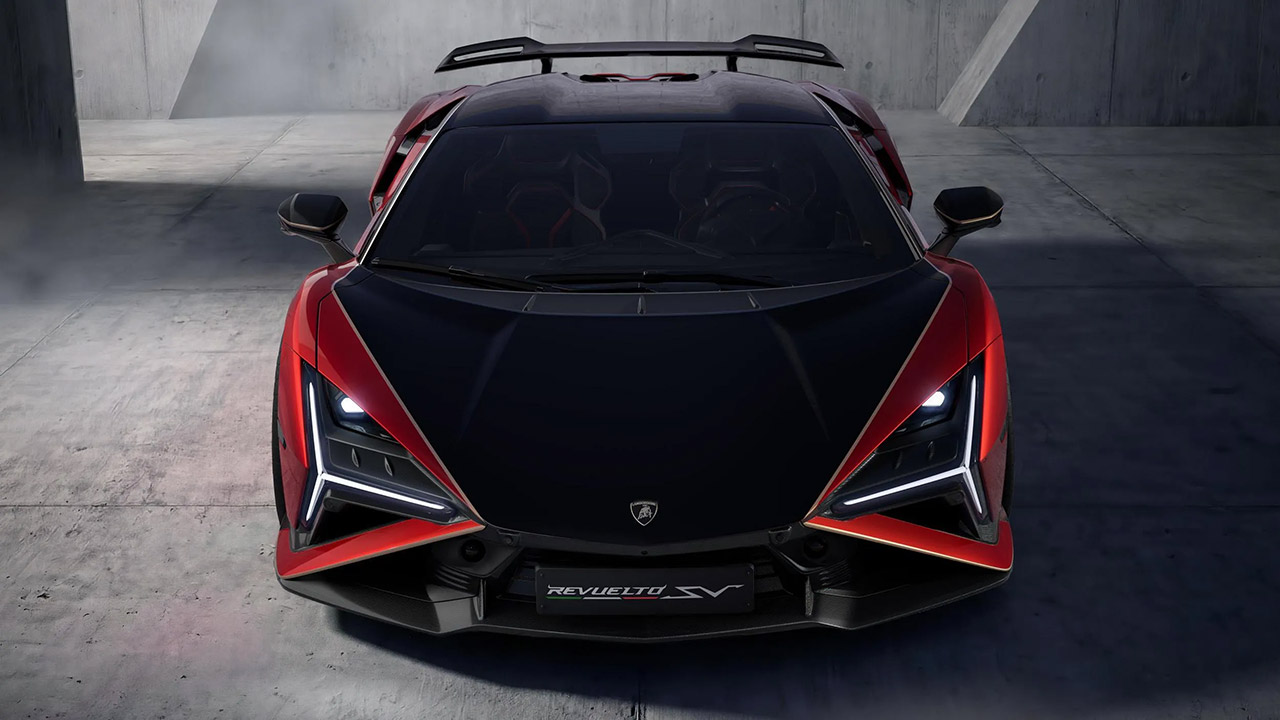
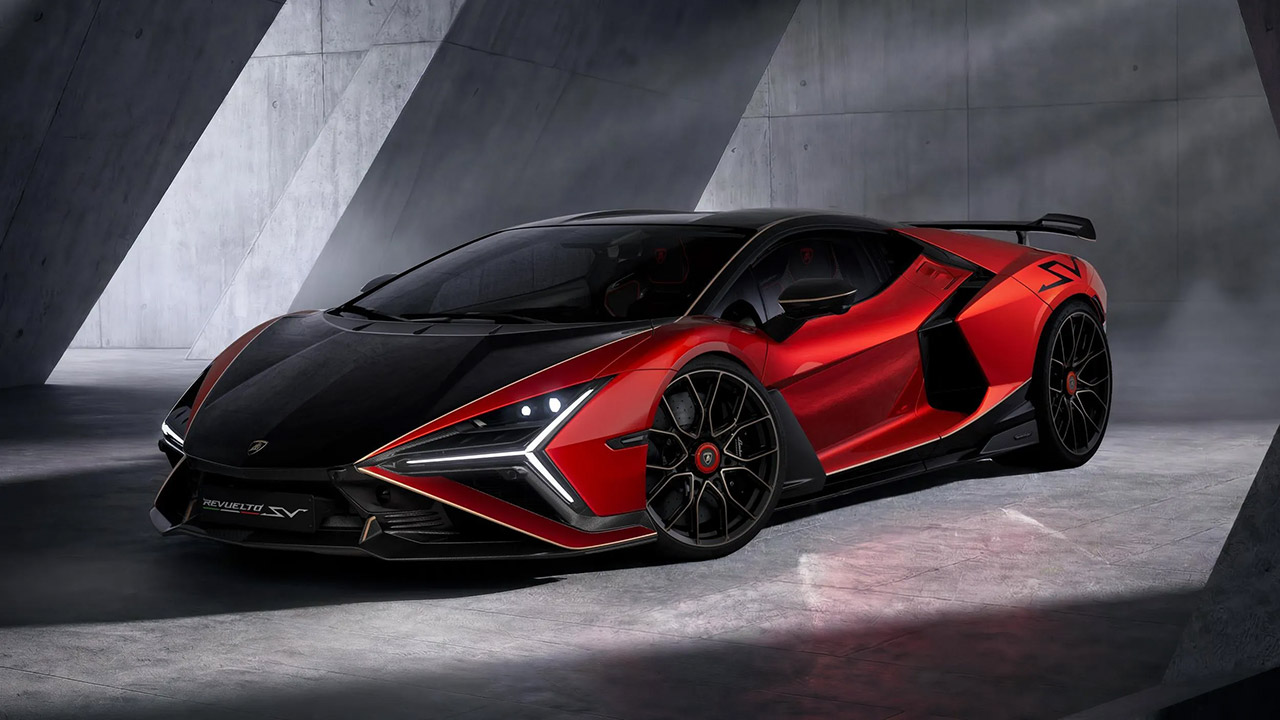
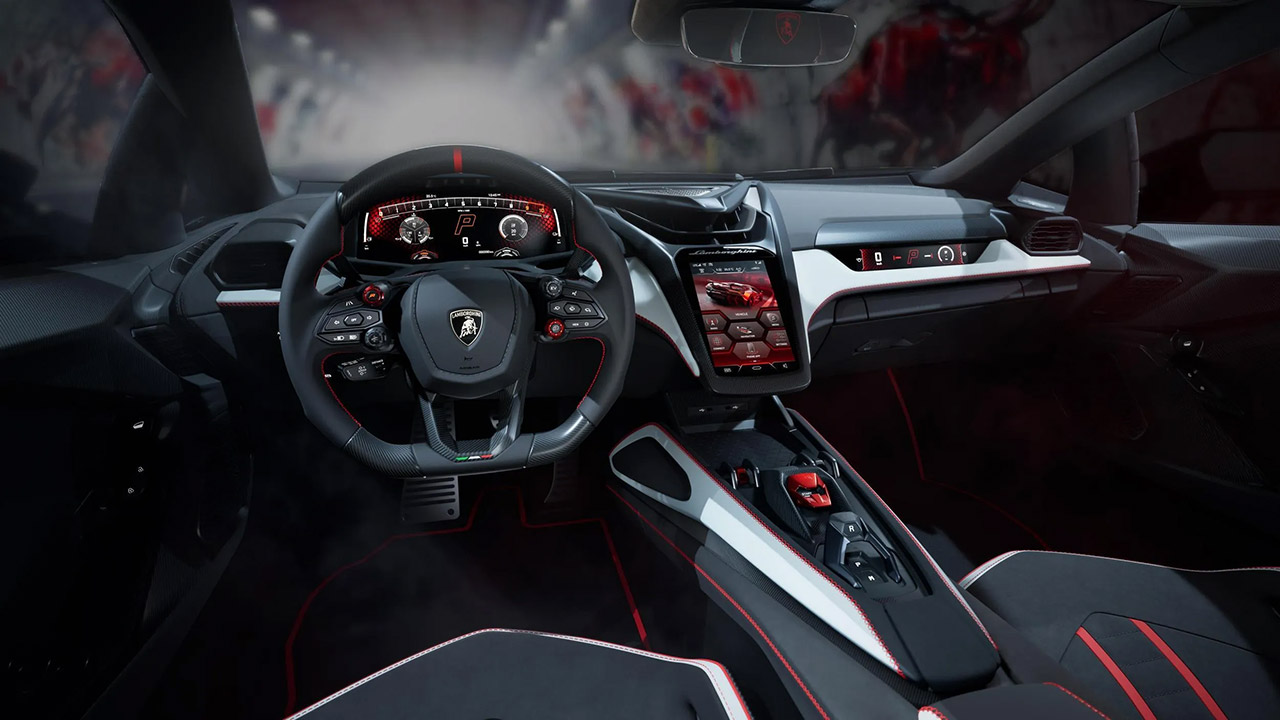
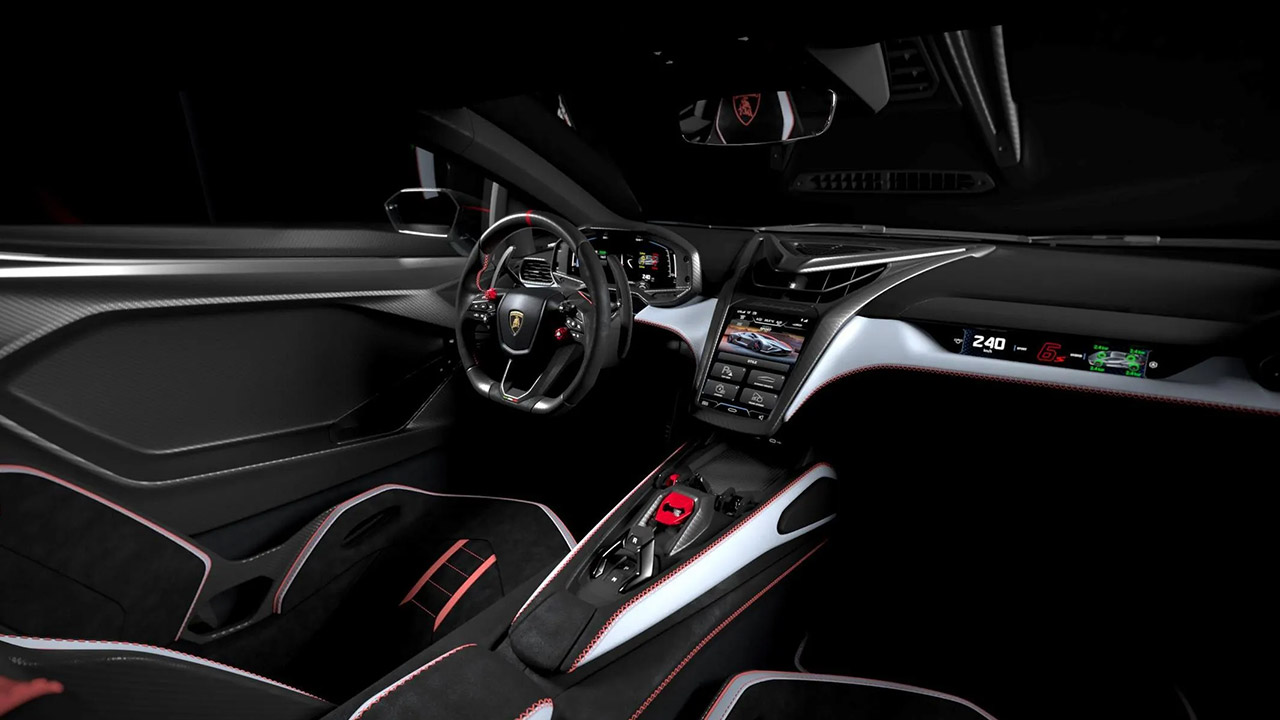
Lamborghini just raised the ceiling on what a production V12 hybrid can do. Unveiled during Monterey Car Week, the Revuelto SV arrives as the most powerful road car the company has ever built, pairing a familiar 6.5-liter naturally aspirated engine with a more capable electric system and a fixed rear wing that transforms how the car sticks to the road.
Power increases to a combined 1050 horsepower and a staggering 1051 lb-ft of torque. That is due to the V12 still producing a decent 814 horsepower at 9250 rpm, revving just as far as the normal Revuelto, all the way up to 9500. A more dense 7.3 kilowatt-hour battery provides additional power to the three electric motors. What was the result? These motors can provide a little more assistance and maintain a faster pace for longer periods of time, with Lamborghini claiming up to four times better consistency when pushing the car to its limits repeatedly.
LAMBORGHINI COUNTACH 5000 QUATTROVALVOLE REPLICA – This LEGO Icons model car is a building set for adults and is designed for fans of luxury cars…
MODEL CAR KIT – This collectible vehicle building set includes everything you need to craft a detailed in-scale replica of the Lamborghini Countach…
AUTHENTIC FEATURES – This LEGO car model has a detailed cockpit with working steering, opening scissor doors, trunk and rear hood, a detailed V…
The numbers speak for themselves: according to official claims, the 0-62 mph dash now takes 2.4 seconds and the 0-124 mph run takes 6.7 seconds. If you’re wondering how fast it’ll travel, the official top speed is more than 214 mph. Despite the larger battery and more aero features, the dry weight only adds a few hundred pounds, thanks to the significant usage of carbon fiber components and some optional lightweight pieces.
One of the most noticeable modifications is the work done on aerodynamics, and it’s a game changer. The standard car’s dynamic rear wing has been replaced by a fixed device that packs a powerful punch. Not only is it a noticeable cosmetic improvement, but it also represents an 80% increase in downforce over the standard Revuelto and an incredible 10% increase over the previous Aventador SVJ. The car’s front end is also impressive, with a deeper splitter, angled fins, and a Gurney flap all working together to generate enormous downforce increases. The good news is that front-end downforce has doubled, which may come in handy while cornering at high speeds.
Advertisement
Lamborghini also managed to enhance the balance of downforce and drag by 60%, making life much easier for the driver. There have also been changes to the chassis. The ordinary car’s adaptive dampers have been replaced with manually adjustable ones from the company’s GT3 racing program. The results are impressive: a 17% boost in agility and a 10% increase in lateral grip, making the car a lot more enjoyable to drive. Wheels have also been updated, with center-lock units measuring 20 inches up front and 21 inches in the back, and they are wrapped in Bridgestone’s top-of-the-line Potenza Race R tires, which were developed exclusively for the SV. These beauties provide more grip and traction when you’re laying down the power.
Finally, the brakes have been given some TLC. New CCM-R Plus carbon-ceramic discs measuring 16.5 inches up front and 16.1 inches at the rear have been fitted, complete with a more efficient carbon construction and increased ventilation. The result is an 11% greater peak deceleration rate and a 23% better heat rejection, which should keep the brakes from overheating under load. Braking temperatures drop by about 12% under load, which can only be good for the driver. To top it all off, an updated inertial sensor system sends real-time motion data to the brake controller, allowing it to modulate pressure over curbs or during trail braking with greater accuracy.
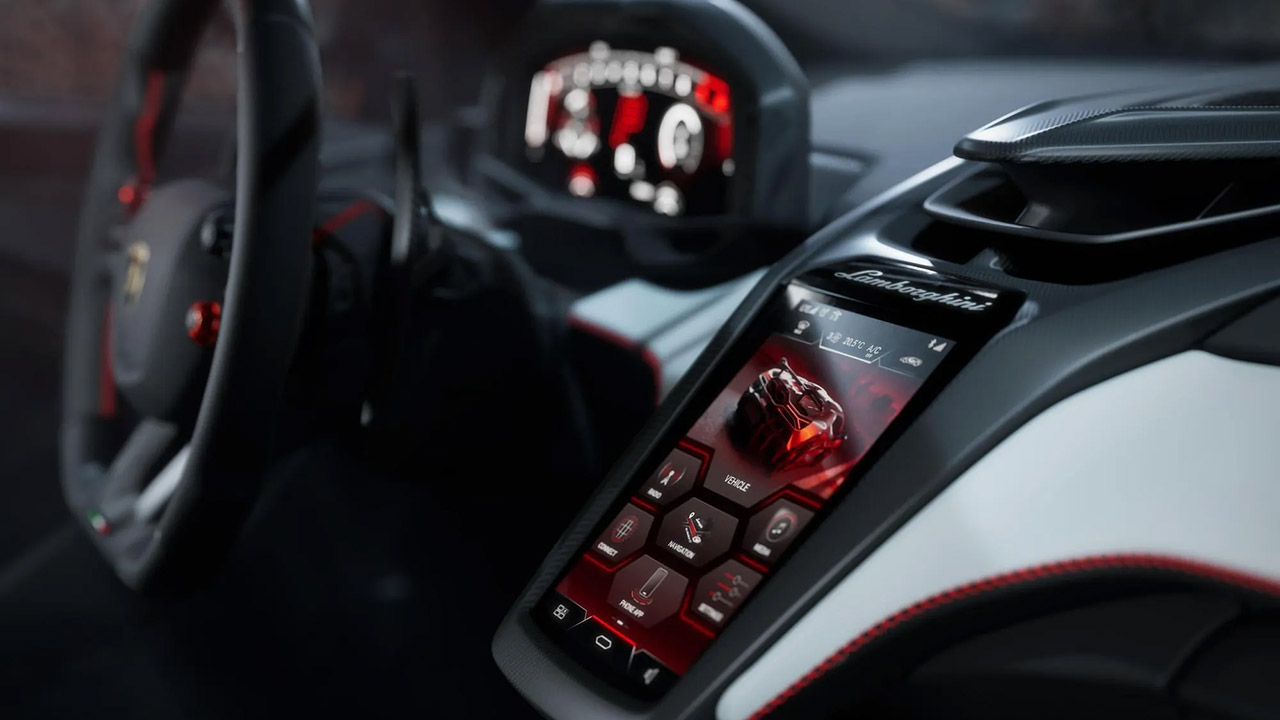
Inside the cabin, a small red knob on the steering wheel that you spin clockwise will activate Pilota mode, which sits perfectly alongside the more known settings, Strada, Sport, and Corsa, which will almost certainly remain the go-to selections for most people. Pilota, on the other hand, enables a snappy 5-stage traction-control system derived from Lamborghini’s GT3 cars. You can choose how much of it you want; do you want the system to correct everything that is wrong, or do you want to have fun and see where the car goes? The stability and ABS systems have also been improved, allowing for a more precise reaction to bumps and curbs while still letting you to have fun and slide the car around when you want.
The Revuelto SV’s production is limited to 1963 units, which coincides with the company’s founding year. The first deliveries are scheduled to arrive in early 2027. One thing we do know is that the price will be exorbitant, perhaps far higher than the standard Revuelto, which was already a costly prospect.
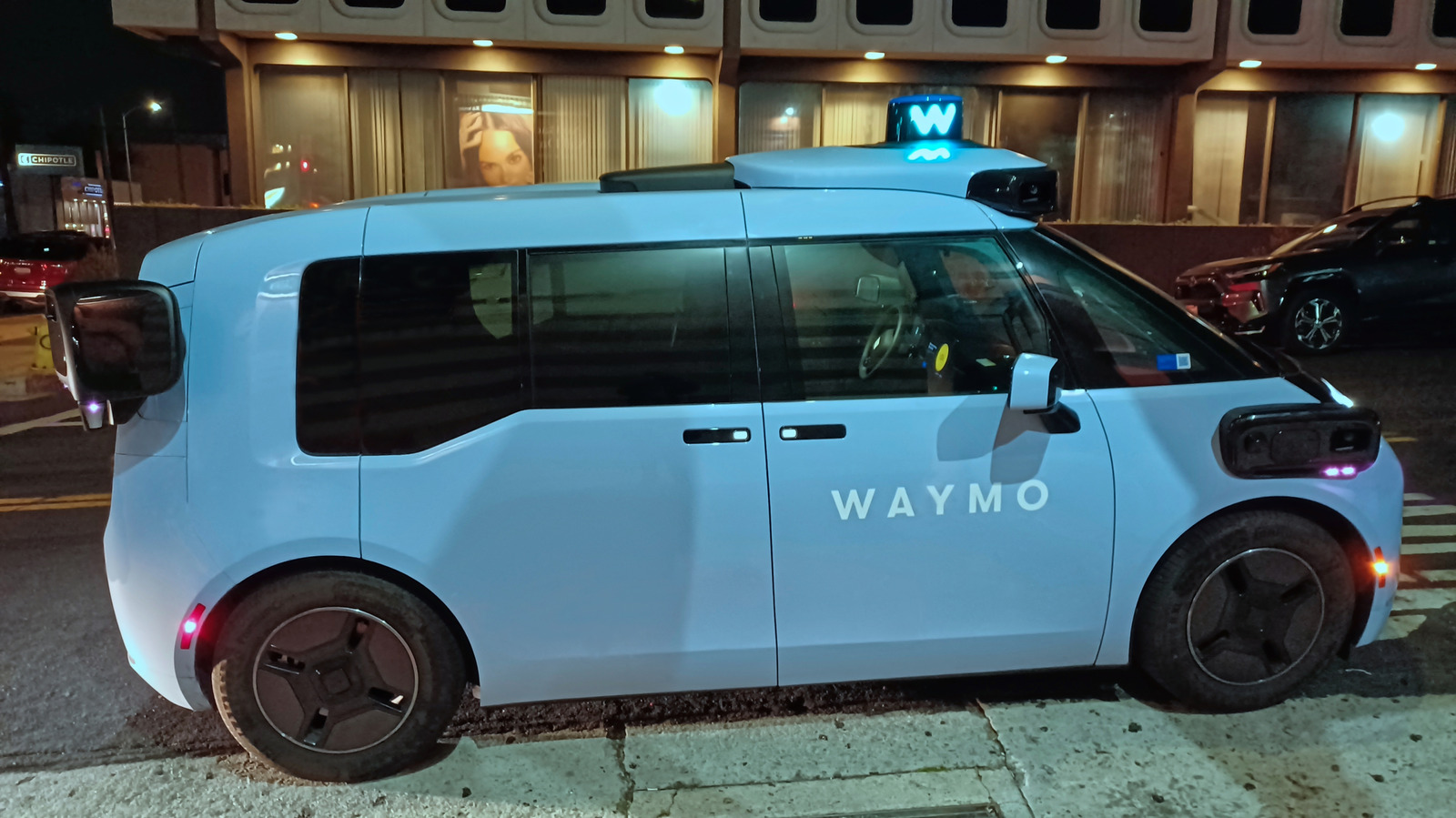
Waymo has announced that it’s received permission from the California Public Utilities Commission (CPUC) to expand its robotaxi service across more counties in California. The company says the decision will allow it to offer rides in Sacramento and San Diego for the first time, and expand service in the San Francisco Bay Area and Los Angeles.
As spotted by Electrek, the CPUC’s approval appears to be in response to a letter Waymo filed in January asking for approval on a safety plan so it can offer rides in the expanded service area it announced in November 2025. Waymo received feedback and even at one point had its request suspended, according to the CPUC’s page, but the company’s announcement suggests those issues have since been resolved and just haven’t been publicly recorded yet.
Big news for the Golden State — we have received the CPUC’s approval to expand our autonomous ride-hailing service across the SF Bay Area and LA, and bring our service to Sacramento and San Diego.
Expansion will be gradual and guided by our safety framework. We look forward to…
Engadget has contacted the CPUC to confirm the details of its Waymo decision. We’ll update this article if we hear back.
The approval should allow Waymo to offer rides in 18 counties across northern and southern California: Alameda, Contra Costa, Marin, Napa, Sacramento, San Francisco, San Mateo, Santa Clara, Santa Cruz, Solano, Sonoma, Yolo, Los Angeles, Orange, Riverside, San Bernardino, San Diego, and Ventura. The company likely won’t have robotaxis in all of them immediately, though. Waymo’s announcement specifically notes that “expansion will be gradual and guided by [its] safety framework.”
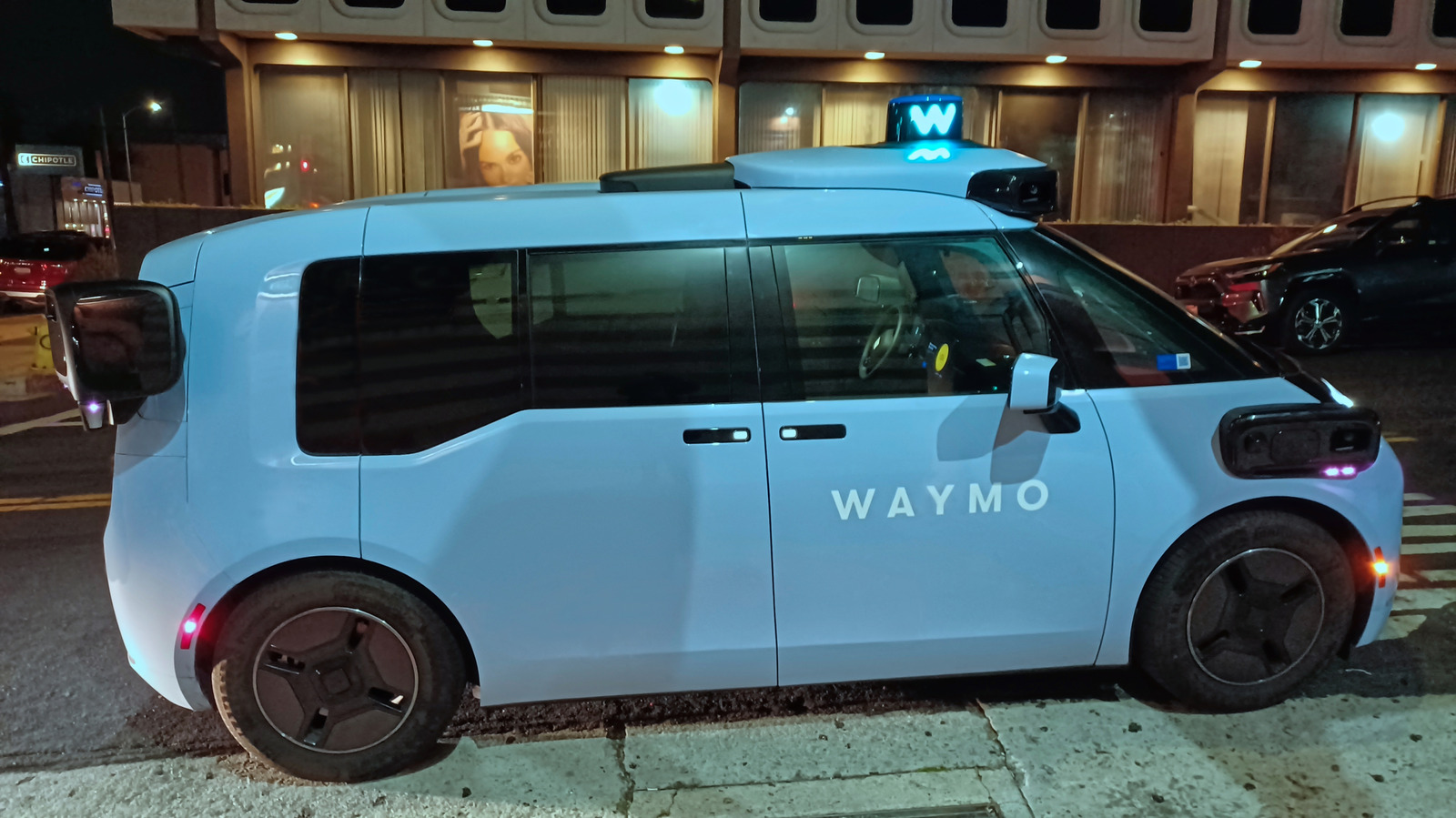
Waymo announced its intention to expand into San Diego in November 2025 and Sacramento in February 2026. In July, the company shared that it would soon test fully autonomous rides without a safety driver in San Diego, Denver, Tampa and Las Vegas. Based on the original letter Waymo filed, CPUC’s permission should allow the company to offer rides in California in its existing Jaguar I-Pace vehicles and its new Ojai robotaxis, custom minivans built by Chinese car maker Zeekr.
OpenAI’s ChatGPT chatbot and Codex coding agents have had access to memories, the company’s term for context (background information) derived from previous chat activity, since April 2024. A new Computer History feature builds on that to include (if you opt in) logging your interactions with websites and applications, so it can essentially follow your footsteps to extrapolate where you want to go.
The feature launched this week on MacOS for subscribers to its Pro, Business and Enterprise plans (but not yet for users in the European Economic Area, Switzerland or the United Kingdom). According to the documentation, admins for the latter two plans can control whether users have the ability to enable the feature, in addition to individual user opt-in.
Beyond having the ability to opt in, you can independently select which applications and websites are fair game, as well as pause tracking; you can also view or delete the history at will.
If Computer History sounds familiar, it’s because integrating your every on-device activity in the service of ultrapersonalized agenting is one of the foundations of every whizzy AI feature trotted out to sell tech in recent years. Notably, it hearkens back to Windows Recall, which Microsoft announced in May 2024 — and then quickly rolled back because of controversy over its security and privacy flaws. About a year later, a refined version began to appear in the operating system.
Unlike Recall and OpenAI’s Chronicle preview, which Computer History replaces, this particular implementation doesn’t capture screens, record voice input or use other similar types of monitoring. Instead, it uses accessibility application programming interface in MacOS to capture everything that API exposes: “clicks, typing, keyboard shortcuts, app switches, and context,” according to the company’s description.
Advertisement
Computer History can create repeatable tasks from your activity history. Here, it tells you that it created a video upload skill based on your recent activity.OpenAI/CNET
It then periodically synthesizes that activity into a summary of what you’ve done rather than what you saw, heard or said. So, as far as I can tell, it can track and show you where to find files you looked at but not the content of the files. However, if you use that content as part of a future chat, it can link your activity to that content.
Even if only a series of keyboard events gets recorded, that doesn’t necessarily mean the content can’t be inferred or exploited. These types of features fall into my privacy-slash-security complacency zone, where browser fingerprinting, deanonymization and similar schemes dwell.
The summaries are generated in the cloud but stored locally on your system. The company says it doesn’t retain the activity files unless legally mandated and doesn’t use them for training.
OpenAI does issue an explicit warning about the feature in its description: “Computer History files can contain sensitive information. They are not encrypted by Computer History, and other programs running as your macOS user may be able to access them.” The built-in disk encryption on MacOS probably offers a layer of protection in some cases, though.
The feature creates tokens for summarizing and memory creation, so your plan’s token budget and context window size may have an impact.
Advertisement
There’s no indication at the moment when or if a Windows or mobile app will be available.
Lori Grunin
Senior Editor / Computers and Gaming Hardware
I’ve been reviewing hardware and software, devising testing methodology and handed out buying advice for what seems like forever; I’m currently absorbed by computers and gaming hardware, but previously spent many years concentrating on cameras. I’ve also volunteered with a cat rescue for over 15 years doing adoptions, designing marketing materials, managing volunteers and, of course, photographing cats.
See full bio
Privacy advocates and musicians rallied outside Madison Square Garden on Friday, pushing for new legislation to prevent facial-recognition technology at the venue and other public spaces in New York City.
“MSG and its CEO, James Dolan, have been flagrantly abusing biotechnology,” City Council member Shahana Hanif said at the event on Friday, after leading a chant of “ban the scan.” In January, Hanif proposed a bill that would prohibit public venues from using biometric recognition tech such as Madison Square Garden’s facial-recognition systems.
Madison Square Garden is well-known for its biometric data collection practices. As WIRED has previously reported, fans who are critical of Dolan or the New York Knicks can end up on watch lists, their faces filed in MSG’s extensive database. In one instance, MSG security tracked the movements of a specific fan at a Knicks game down to the minute, cataloging their movements, who they spoke with, when they ate, and where they sat. Hundreds of lawyers involved in disputes with Dolan or Dolan-owned properties have been banned from Dolan’s venues, including a mother who was blocked from taking her daughter to a Radio City Music Hall show.
In July, WIRED reported that MSG also maintains a database that assigns risk scores to around 400 celebrities and VIPs. Some of the dossiers also include the race and sexual orientation of those who attend the arena. MSG filed a defamation lawsuit against WIRED later that month.
Advertisement
At the rally on Friday, Hanif was joined by Brooklyn-based country musician Paisley Fields, a representative from the democratic-socialist working group NYC DSA Tech Action, and members of the digital rights advocacy group Fight for the Future.
Hanif’s “Ban the Scan” bill now has 27 endorsements, more than half of the City Council. Members are in talks with speaker Julie Menin about advancing the legislation, according to Hanif.
“People have been recognizing each other’s faces since the beginning of time—we just do it electronically,” an MSG spokesperson said in an emailed statement.
Hanif tells WIRED that, as a Muslim who grew up in post-9/11 New York, surveillance isn’t new. However, she says, many may not understand the extent of the surveillance that they’re exposed to simply by attending a Knicks game or a concert at Madison Square Garden or one of its associated venues. The fact that Dolan, who has a long relationship with President Donald Trump, is the one collecting the data worries Hanif even more.
Advertisement
“New Yorkers need to understand, right now, between AI and all these tools that are being sold to us as being for … our city’s safety, are actually making us less safe,” Hanif says.
Liu was widely regarded as one of the founders of modern digital signal processing, a field that applies mathematical algorithms to analyze, modify, and transmit signals including sound, images, and video.
Liu’s research aided the transition from analog to digital processing of sound, images, and video. His work helped establish many of the mathematical and engineering techniques that underpin modern communications, multimedia systems, and consumer electronics.
Advertisement
Although little known outside engineering circles, his work is embedded in technologies used by billions of people. The low-power digital signal processors that make cellphone calls, streaming video, and Internet communications possible can be traced to research he conducted in the 1970s and ‘80s.
Liu received the 2018 IEEE Jack S. Kilby Signal Processing Medal for “sustained contributions to the analysis and the development of low-complexity realizations of digital signal processing algorithms.”
“We stream music and video. We take photos with our phones, and we send them around. We don’t even think about it,” IEEE Life Fellow H. Vincent Poor said in an obituary for Liu. “But it’s all because of the signal processing, image processing, and video processing that’s been developed over the years, as well as other technologies that have grown up beside it and enabled it, like semiconductors. The development of these processing advances was exactly what Bede was a major part of.” Poor is a professor of electrical and computer engineering at Princeton.
An impactful scholar and teacher
Liu was born in Shanghai in 1934. During his childhood, his family relocated to Taiwan amid the upheaval of the Chinese Civil War. His father, Henry Liu Sr., was an electrical engineer.
Advertisement
Liu earned his bachelor’s degree in electrical engineering in 1954 from the National Taiwan University, in Taipei. After graduating, he and his family moved to the United States. Liu and his father attended the Polytechnic Institute of Brooklyn (now the New York University Tandon School of Engineering) together. They earned their master’s degrees in electrical engineering in 1956. Liu continued his studies at the school, earning a doctoral degree in electrical engineering four years later.
In 1959 he was awarded a Bell Labsfellowship and worked at the company’s Murray Hill, N.J., location until he joined Princeton in 1962.
“Liu was a highly impactful scholar and teacher—always thinking ahead of future needs and changing technologies,” said IEEE Life Fellow Peter J. Ramadge, a Princeton professor emeritus of engineering.
Cellphones make use of a considerable amount of digital signal processing, Liu once noted. Many of the field’s advances, he added, involved making sophisticated processing practical on devices with limited computing power—which is the challenge that confronted generations of engineers designing portable electronics.
Advertisement
Liu’s research contributions helped shape both the theory and practice of digital signal processing. With Abe Peled, a former graduate student, he authored the 1976 textbook Digital Signal Processing: Theory, Design, and Implementation, which is a standard reference for engineers. Published before digital signal processing had fully emerged as a distinct discipline, it helped define the subject for practitioners and students around the world.
Liu also published 250 technical papers and was granted 12 U.S. patents. His papers are available to read on the IEEE Xplore Digital Library.
The first patent granted to him and Peled was in 1976 for a hardware design that processed bits in parallel, rather than in sequence. The innovation greatly increased computing efficiency for data including sound and communication signals.
Peled says Liu “demonstrated an openness to new ideas and a willingness to challenge the orthodoxy of the EE department at that time—which leaned heavily toward more theoretical information theory.”
Advertisement
A mentor to well-known engineers
Liu’s influence extended beyond his own research. He advised 53 doctoral students, many of whom went on to distinguished careers in academia and industry, including leadership positions at Google and IBM. One former student, computer scientist Robert Kahn, helped create the architecture of the modern Internet. Kahn, an IEEE Life Fellow, received the 2024 IEEE Medal of Honor.
“His former students were very successful,” Poor said of Liu, “and I think that’s a testament to his skill as a mentor.”
“Liu was a highly impactful scholar and teacher—always thinking ahead of future needs and changing technologies.”—Peter J. Ramadge
Together with several Ph.D. students, Liu developed methods of filtering and compressing digital signals to mitigate errors and dramatically reduce the computation needed for signal processing.
Advertisement
As digital signal processing moved from laboratories into commercial products, the impact of Liu’s ideas spread across industries. His research helped spawn the development of lower-cost and lower-power electronics and contributed to advances in mobile communications, multimedia technology, industrial automation, and biomedical imaging.
A focus on media integrity and copyrights
In the 2000s, Liu turned his attention to media integrity and copyright issues.
“With the increasing accessibility of digital media source material, the protection of ownership and the prevention of unauthorized alteration has become an important concern,” he wrote in his 2002 book, Multimedia Data Hiding. The book, which he co-wrote with his former doctoral student IEEE Fellow Min Wu, discussed the theory, techniques, applications, and security of digital watermarking—hidden signals that could identify a genuine copy of a song, image or video to prevent unauthorized distribution or tampering.
A Princeton team that included Liu, Wu, and another of his doctoral students uncovered serious vulnerabilities in watermarking technologies being considered by an industry consortium. They found that the standardization efforts were immature and would not protect against digital piracy.
Advertisement
“Now nearly every copy of a Hollywood film given to a critic or theater carries a unique digital forensic watermark to prevent unauthorized redistribution,” said Wu.
Outside the classroom, he was recognized for his humility, humor, enthusiasm, and generosity. When thinking of Liu, IEEE Life Fellow Kenneth Steiglitz says, cheer is the first word that comes to mind.
Advertisement
Liu was “always ready with a positive remark, a quick smile or, maybe, some tips on the right way to cook a duck,” says Steiglitz, professor emeritus of computer science at Princeton.
Liu encouraged his students to take on ambitious, unconventional projects, and he inspired students and colleagues with his adventurous spirit.
The average US electric vehicle sold for $56,126 in July, up 1.6% on a year earlier and the first rise of 2026, according to Kelley Blue Book. Automakers cut EV incentives by 24.3% year on year after pulling models and shrinking supply.
The average electric car in the United States sold for $56,126 in July. That is 1.6% more than a year earlier and 1.2% more than June, and it is the first increase of 2026 after prices had fallen every month since December, according to Kelley Blue Book.
The sticker is not what moved. Manufacturer discounts on EVs fell to $6,626 in July, down 24.3% on the same month last year, so buyers simply paid closer to the asking price.
Electric cars are still discounted far harder than anything else on the forecourt. Incentives run at 11.8% of the transaction price against 6.4% across the industry, with Tesla at 10.4%.
Advertisement
Automakers can pull back because they cut supply first. A dozen EV models have been discontinued in the US this year as tariffs, the lost tax credit and import costs reshaped the market.
“Automakers have less excess inventory of EVs,” Sam Abuelsamid, vice president of market research at Telemetry, told Business Insider. “They don’t have to spend as much on incentives, and they don’t have to negotiate on price as much. It gives car companies more pricing power.”
The whole market is drifting upwards. The average new vehicle went for $49,855 in July, up 1.9% year on year and the highest figure of 2026.
One caveat sits inside the EV average. Luxury buyers are disproportionately likely to buy electric, according to K.C. Boyce of research firm Escalent, which pulls the number up regardless of what is happening to prices.
Advertisement
Cheaper cars are coming to push it back down. Slate’s stripped-out pickup, priced at $24,950, is due to start deliveries later this year.
Ford’s Fathom pickup starts at $28,350 before destination, reaching $29,945 on the road. Escalent found buyers define an affordable new car as $32,000 to $48,000, so both land underneath it.
The firm’s most useful finding is not about price at all. Bundling a home charger and its installation with a new EV shifted how affordable buyers judged it by as much as taking $8,000 off the sticker.
Virgin Galactic has delayed its return to commercial spaceflight until February 2027, and plans to raise ticket prices later this year.
The delay was disclosed alongside the company’s financial results, which showed a net loss of $56 million for the second quarter of 2026, down from $67 million a year earlier. Revenue for the quarter was $0.1 million, compared to $0.4 million in 2025.
Advertisement
According to CEO Michael Colglazier, demand exceeded the number of seats offered in the first $750,000 batch, prompting the company to prepare another at a higher price. Those customers will, however, have to wait a little longer. Colglazier said: “Our first ship is now expected to enter commercial service in February 2027 rather than the fourth quarter of 2026.”
He blamed the delay on the extra time needed to “complete avionics and systems installations.”
During an earnings call, Colglazier said: “No single issue is driving the schedule push. Rather, we have experienced modest time duration extensions across hundreds of relatively small but important installation tasks involved in the first build of our new spaceship.”
In response to an analyst question, Colglazier elaborated: “The number of those kind of ‘Oh, we did not expect this to not fit just perfectly,’ coming in is higher than we had allotted for. That just has started to accumulate on us. It really picked up at the tail end of July. For a bit, we thought we could manage that end, but the team just needed more time to do it the correct way.”
Advertisement
Integrated vehicle ground testing is expected to begin later in August, followed by flight testing in October. A second spaceship is due to join the fleet in March 2027, and the company expects to stop burning cash and “deliver positive quarterly cash flow within 2027.”
When Virgin Galactic reopened suborbital ticket sales in April, it charged $750,000 for a seat, up from the $600,000 price it cited in 2023. That was a substantial jump from the $100,000 envisaged more than two decades ago, when Sir Richard Branson announced plans for a scaled-up version of Burt Rutan’s SpaceShipOne. At the time, the company said commercial flights would resume by the end of 2026.
Virgin Galactic’s last commercial flight took place in 2024, after which the company paused operations to focus on its next generation of spacecraft. Virgin Galactic is not alone in grounding its space-tourism service. Earlier this year, rival Blue Origin announced that New Shepard flights would pause for “no less than two years” while it worked on its crewed lunar program. ®
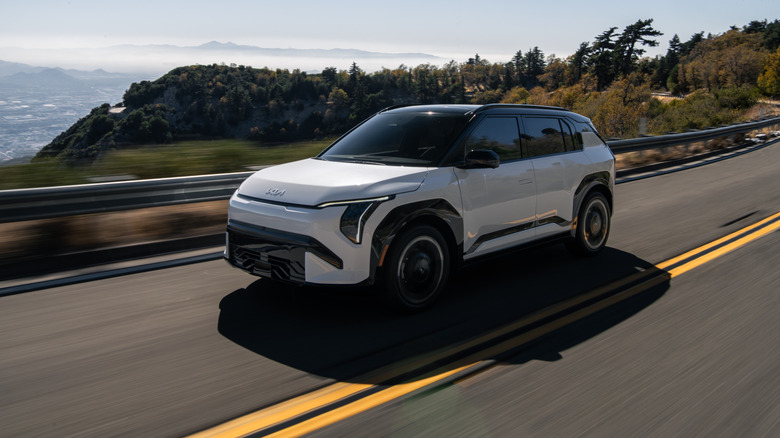
Kia has announced the US pricing for the EV3, the more compact version of its EV9 SUV. The car will start at $29,450 plus a $1,495 destination charge. Even at $30,945, that’s well under the $35,000 the company was targeting when it announced it was bringing the EV3 to the US in April.
The EV3 gets up to 321 miles of all-electric range and is available in both front-wheel drive and all-wheel drive configurations. The car features EV9 design elements in a size that’s almost identical to Kia’s Niro crossover. Like other modern EVs, the EV3 has an NACS port that makes it compatible with Tesla’s Supercharger network and Kia says it can charge from 10 to 80% in around 31 minutes with a 350kW DC fast charger.
The new price makes the EV3 the cheapest electric car in Kia’s lineup at a time when it’s increasingly difficult to buy an affordable EV in the US. Following the Trump administration’s rollback of Biden-era tax credits in July 2025, several car makers have retired EV models or cancelled their EV plans entirely. The Kia EV3 is one of a small group of cars, like the Slate Truck, that manage to hit a sub-$30,000 price.
Advertisement
The group is set to grow soon. In early August, Ford announced that its upcoming “Fathom” EV truck will cost $28,350 and should ship sometime in early 2027. Financial incentives to purchase electric cars are also returning. In July, California introduced a new EV rebate program that gives first-time buyers a $3,500 instant rebate on new EVs and a $1,500 instant rebate on used EVs.
































































You must be logged in to post a comment Login