Tech
Just Video Walls Absolute Black MicroLED Targets OLED-Level Blacks at Massive Scale for CEDIA 2026

CEDIA Expo 2026 is rapidly turning into a very expensive argument over the future of the big-screen home theater. Quantum Media Systems is pushing native 8K processing, DreamWall is attacking MicroLED heat and installation complexity, and Christie is arriving with a 15,000-lumen native 4K projector that appears capable of illuminating portions of Colorado.
Just Video Walls is entering that fight from another direction with Absolute Black, its new flagship MicroLED platform for CEDIA Expo 2026. Instead of emphasizing resolution, heat management or raw light output, JVW is focused on the part viewers actually stare at: black levels, uniformity and whether a massive modular display can look like one seamless image rather than a wall assembled from individual LED cabinets.
If Absolute Black can pull that off, it gives MicroLED a much stronger argument against both premium projection and giant OLED displays.
What Is Just Video Walls Absolute Black?
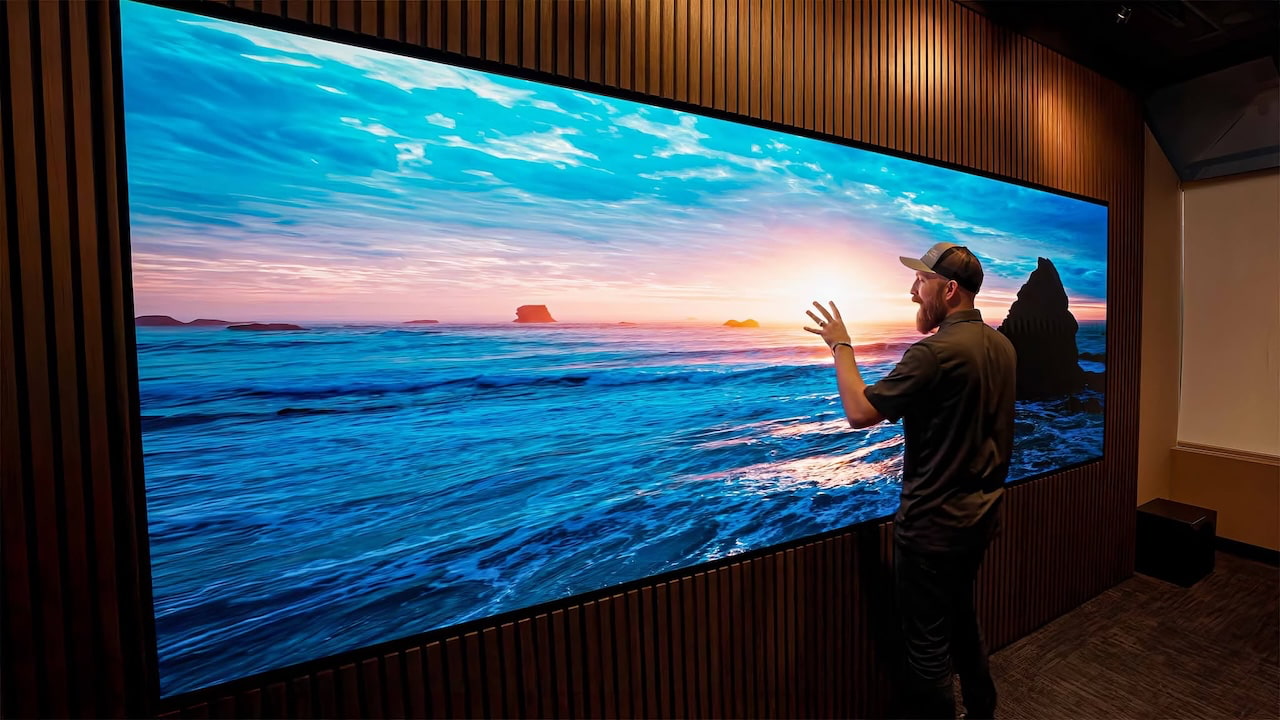
Absolute Black is a new MicroLED platform designed around an ultra-dark phosphor surface combined with LEDs that occupy approximately one-tenth the visible surface area of more conventional MicroLED designs. The idea is rather clever: smaller visible emitters leave more genuinely dark surface between the pixels while also presenting less reflective LED area to ambient light.
Just Video Walls says that combination produces deeper perceived blacks, greater image depth and a display surface that becomes less noticeable when content is playing. The company is targeting approximately 99% coverage of DCI-P3 and supports 12-bit source color processing for smoother gradients and more precise color reproduction.
The other significant improvement involves uniformity.
Modular MicroLED walls are assembled from multiple cabinets, and even small differences in brightness or color between those modules can become visible across a very large image. JVW claims Absolute Black improves base color and brightness uniformity by 57% compared with its existing technology, reducing tonal differences and making the boundaries between modules harder to detect.
That sounds less exciting than putting “8K” on the front of the brochure until you have actually seen a giant video wall with one cabinet that does not quite match the others. Once you notice it, good luck looking anywhere else.

Dark Scenes Are Another Problem
Absolute Black also uses what JVW describes as an ultra-high-frequency LED driving architecture designed to maintain motion fidelity across the grayscale range. Conventional direct-view LED systems can exhibit scan artifacts or reduced motion consistency at extremely low light levels; JVW says its new platform is designed to eliminate visible scan lines even in very dark scenes down to 0.001 nits.
That is potentially important for movies.
A giant MicroLED display capable of producing spectacular brightness with sports or HDR demonstration footage is not particularly difficult to appreciate. Maintaining clean shadow detail, uniform blacks and convincing low-level motion during something dark and deliberately miserable is a much harder test.
Anyone can make Top Gun: Maverick look impressive on a 150-inch wall.
Try The Batman.
Why Should Consumers Care?
MicroLED already offers something neither conventional OLED televisions nor projection systems can easily duplicate: enormous modular screen sizes combined with self-emissive pixels and enough brightness for rooms that are not completely dark. The problem is that scaling the image exposes other weaknesses, including module uniformity, reflections and visible seams. eCoustics encountered exactly those issues when examining large MicroLED systems at CEDIA Expo 2025.
Absolute Black is interesting because JVW is addressing the picture itself rather than merely making the wall larger.
If its claims hold up in Denver, deeper blacks and improved uniformity should be visible whether you are watching a 4K movie, football, gaming or an 8K demonstration. Consumers do not need a new content ecosystem to benefit from better black levels.
There is also a practical advantage over projection. Direct-view MicroLED does not require a projector hanging from the ceiling, a projection throw path or a darkened room to produce a punchy image. That makes these systems increasingly relevant for luxury media rooms and multipurpose spaces rather than just dedicated cinemas.
But MicroLED comes with its own complication: audio. A solid LED wall is not acoustically transparent, so the left, center and right loudspeakers cannot simply sit behind the image as they can with a perforated or woven projection screen. Even Just Video Walls has acknowledged that converting projection theaters to MicroLED can create substantial front-channel placement challenges.
Nobody said replacing a projector with several hundred thousand dollars of LEDs was going to make the room simpler.
Who Does Absolute Black Compete With?
The luxury MicroLED market is becoming surprisingly crowded.
Quantum Media Systems XDR5-8K is perhaps the most obvious competitor on the custom residential side. Its emphasis for CEDIA 2026 is different: Quantum is concentrating on processing multiple native 8K sources simultaneously and turning an enormous display into a configurable entertainment and information canvas.
DreamWall Elite Series Platinum P0.7 takes another route with a 0.7mm-pixel-pitch COB MicroLED platform that can create a 121-inch 4K display. DreamWall is also emphasizing its CooLED thermal architecture, reduced power and cooling requirements, and simplified residential installation.
Samsung The Wall remains one of the best-known names in modular MicroLED and already uses low-reflection black technology while offering multiple pixel pitches and highly configurable installations.
LG MAGNIT is another formidable competitor. LG’s latest 136-inch Active Micro LED uses an active-matrix architecture with individual pixel control and is specifically being positioned for premium home cinema and visualization applications.
Sony’s Crystal LED family also competes in the broader premium direct-view LED market, although much of Sony’s current emphasis remains professional and commercial installations. Its new 135-inch Crystal LED UNIFY demonstrates how quickly all-in-one large-format direct-view systems are evolving.
What We Still Don’t Know
Just Video Walls has not disclosed complete consumer specifications or formal pricing for Absolute Black in its CEDIA announcement. Peak brightness, available pixel pitches and configurations, specific resolutions and system pricing have not yet been detailed publicly.
There are already Absolute Black installations being demonstrated through dealers; Beyond Audio in Scottsdale, Arizona, for example, advertises a 156-inch, 0.9mm-pixel-pitch Absolute Black demonstration wall. But this is emphatically not something that arrives from Best Buy on Tuesday afternoon with two guys and a wall mount.
JVW sells through the custom-installation channel and requires Absolute Black dealers to maintain an active showroom demonstration, complete company training and meet specific installation and service requirements. That model makes sense because with modular MicroLED, calibration, structural preparation and installation are inseparable from the product itself.


The Bottom Line
Just Video Walls Absolute Black is interesting because it is not pretending that another enormous resolution specification automatically makes a better television. By reducing the visible LED area, increasing the amount of dark surface between pixels, improving uniformity and addressing low-level scan artifacts, JVW is targeting weaknesses that can become painfully obvious when a display grows to 150 inches and beyond.
The competition is also pushing MicroLED in different directions. Quantum is betting on 8K processing and multi-source flexibility, DreamWall is concentrating on heat and installation, while Samsung and LG bring enormous manufacturing resources and established display technology. Absolute Black’s pitch is simpler: make a gigantic MicroLED wall disappear into the image the way a great OLED can.
If Absolute Black delivers at CEDIA Expo 2026, the most interesting specification may not be the number of pixels on the wall but how little of the wall you actually notice. Better blacks, fewer visible module transitions and convincing low-level performance could make MicroLED a much more formidable alternative to premium projection for buyers who want a 150-inch-plus image without living in a permanently darkened room.
The unanswered question is price. Just Video Walls has not announced Absolute Black pricing, but comparable premium MicroLED systems already live comfortably in six-figure territory. Samsung currently lists its 146-inch 4K The Wall at $219,999, while other 0.9mm systems around 200 inches can approach or exceed $140,000 before the room, audio system and other integration costs enter the conversation. Absolute Black is JVW’s flagship platform, so anyone expecting Costco pricing should probably remain seated.
At this level, the competition is no longer between televisions. It is between an extremely expensive MicroLED wall and an extremely expensive projection system; and which one makes you forget how much you just spent.
For more information: justvideowalls.com
You must be logged in to post a comment Login