Tech
Key to Data Center Modernization

PA-RISC emulation matters for data center modernization because it allows enterprises to decouple mission-critical HP-UX and MPE/iX applications from end-of-life physical hardware, enabling immediate migration to modern x86 servers or cloud infrastructure with zero code changes and minimal operational risk.
Quick Take
Enterprises running legacy Hewlett-Packard hardware face an acute operational bottleneck: the physical chassis powering their core business systems is rapidly failing, yet the underlying software cannot be easily replaced or rewritten. Proprietary hardware lines like HP 3000 and HP 9000 reached end-of-life status years ago, leaving organizations exposed to sudden hardware failure, severe spare-parts scarcity, escalating power overhead, and retiring technical expertise.
Hardware emulation resolves this deadlock by creating a virtual software replica of the original PA-RISC CPU, memory, and I/O architecture on modern x86 servers or cloud virtual machines. This approach eliminates physical hardware risks overnight, slashes data center floor space and cooling demands, and modernizes disaster recovery options while preserving application stability.
The PA-RISC Dilemma in the Modern Data Center
Developed in the 1980s and widely deployed through the 2000s, Hewlett-Packard’s Precision Architecture RISC architecture was a cornerstone of enterprise computing. Powered by the proprietary PA-RISC processor family—including 32-bit and 64-bit CPU designs such as the PA-7000 and PA-8000 series—these systems were engineered for high-availability database management, manufacturing execution, financial clearing, and enterprise resource planning. These environments ran either HP-UX or MPE/iX, operating systems custom-tailored to the underlying silicon.
However, HP officially phased out sales of PA-RISC systems in 2008 and ceased technical support around 2013 as the industry shifted toward Itanium and standard x86-64 server architectures. Today, organizations maintaining physical PA-RISC footprint in their data centers face several compound operational risks:
- Component Scarcity and System Failure: Physical board-level components—including power supplies, bus backplanes, memory modules, and specialized SCSI host bus adapters (such as LSI 53C8xx controllers)—are no longer manufactured. Maintenance teams are forced to rely on secondary, refurbished markets with uncertain reliability.
- Unplanned Downtime and Slow Recovery: Thermal degradation in aging silicon and mechanical drive failures increase the frequency of system outages. Without vendor patch support or hot-swappable replacement chassis, MTTR (Mean Time to Repair) stretches from hours into days.
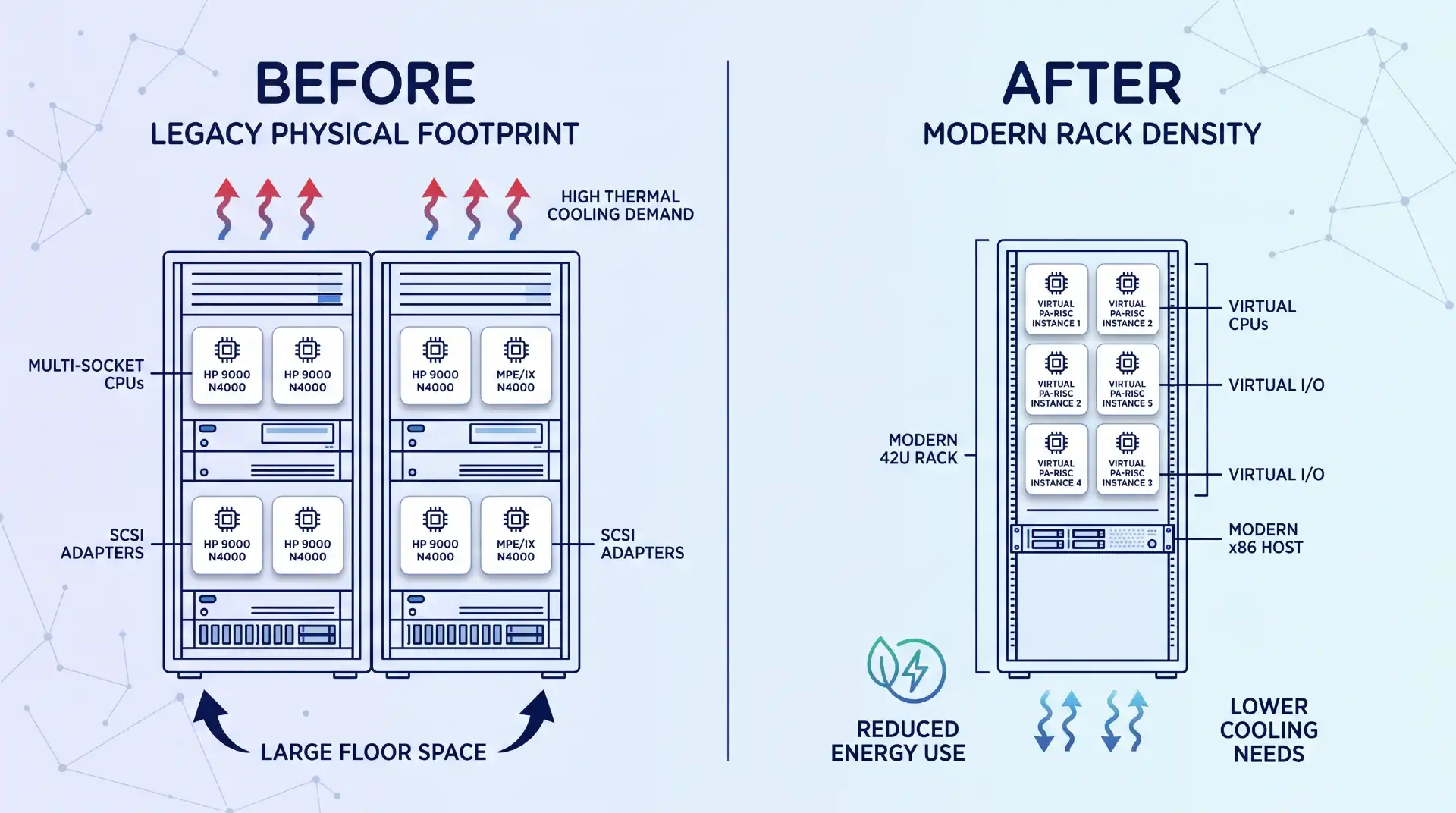
- Data Center Resource Drain: Legacy multi-cabinet rack units occupy extensive floor space and draw disproportionate amounts of power. In an era where modern facilities prioritize data center power efficiency, maintaining kilowatt-heavy legacy cabinets strains utility budgets and air-handling units.
- Security and Compliance Gaps: Outdated hardware platforms cannot host modern encryption modules, automated compliance audit agents, or enterprise security monitoring tools required under PCI-DSS, HIPAA, or ISO 27001 standard frameworks.
- Loss of Institutional Knowledge: System administrators and hardware technicians skilled in vintage enterprise Unix systems and MPE console debugging are retiring, leaving organizations without in-house emergency support.

How PA-RISC Emulation Works Under the Hood
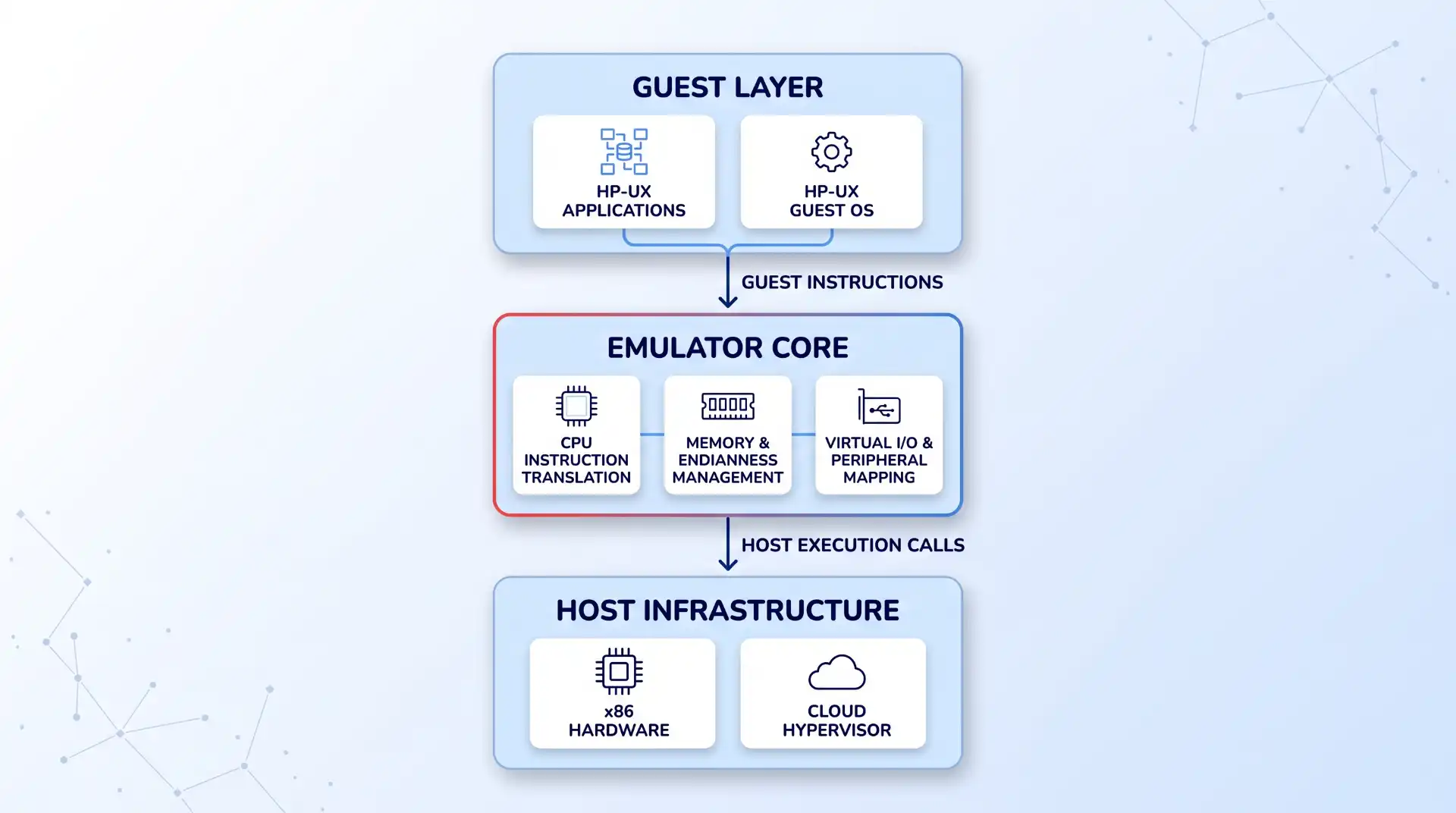
Hardware emulation bridges the gap between obsolete physical systems and modern infrastructure by changing the physical layer beneath the operating system rather than altering the software application. Implementing enterprise-grade PA-RISC emulation creates an instruction translation layer that presents a virtualized PA-RISC hardware platform directly to the guest operating system.
According to digital preservation research, virtualizing or emulating technical platforms allows organizations to preserve exact binary operational behavior while isolating applications from physical hardware decay. The emulation software layer handles instruction translation and hardware mapping through three primary subsystems:
- Dynamic CPU Instruction Translation: The emulator intercepts guest PA-RISC machine instructions (PA-1.1 or PA-2.0 execution calls) and dynamically translates them into equivalent x86-64 instruction sequences executed by modern Intel Xeon or AMD EPYC processors.
- Memory and Endianness Management: PA-RISC uses big-endian byte ordering, whereas modern x86 CPUs operate on little-endian architecture. The software emulation layer continuously translates memory references, registers, and memory management unit (MMU) address mappings transparently.
- Virtual I/O and Peripheral Mapping: Physical disk arrays, tape drives, network interface cards, and serial controllers are mapped to virtual abstractions. For example, legacy SCSI storage controllers are mapped to virtual disk files residing on fast NVMe SAN arrays or enterprise cloud storage.
Because the emulation layer presents an identical virtual hardware abstraction to the operating system, the installed copy of HP-UX 11i or MPE/iX 7.5 booted within the emulator cannot distinguish the software environment from a physical server. The original kernel binaries, custom application code, databases, and configuration files remain completely untouched.
Core Benefits of PA-RISC Emulation for Modernization
When planning comprehensive data center modernization strategies, IT leadership must weigh speed, cost, and risk. Emulation provides a pragmatic middle path between maintaining fragile legacy hardware and executing high-risk application rewrites.
1. Rapid Infrastructure Consolidation
Emulation allows multiple multi-U physical server towers or heavy cabinet units (such as HP 9000 N4000 series or HP 3000 systems) to be virtualized onto standard 1U/2U rack servers or virtual instances. This physical consolidation frees up valuable data center floor space and enables integration into existing VMware, KVM, or bare-metal Linux host environments.
2. Slashed Energy and Cooling Overheads
Moving workloads from vintage multi-socket PA-RISC servers to dense x86 host hardware drastically lowers power consumption per computing cycle. Heat output decreases in tandem, reducing the load on data center HVAC systems and aligning IT operations with corporate sustainability mandates.
3. Zero Application Rewriting or Retraining
Full software refactoring or re-platforming projects routinely run over budget and take months or years to execute. Emulation executes existing binary code in place. end-users interact with identical application interfaces, workflow commands, and batch processes, eliminating the need for workforce retraining or operational process redesign.
4. Integration with Enterprise Disaster Recovery
Physical legacy servers often lack modern backup capabilities, relying on aging physical tape drives or manual image dumps. Once hosted in an emulated environment, guest operating systems gain immediate access to modern infrastructure tools: live VM snapshots, automated SAN replication, rapid recovery points, and cloud backup vaults.
5. Performance Upgrades via Modern Silicon
While dynamic instruction translation incurs software overhead, the sheer raw speed, higher cache capacity, and elevated clock rates of contemporary x86 CPUs mean emulated workloads often execute faster than they did on 20-year-old physical silicon.
6. Flexible Cloud Deployment Pathways
Modern emulation solutions are not limited to on-premises data centers. As documented in AWS Marketplace documentation for Charon-PAR, emulated PA-RISC platforms can run directly on cloud virtual instances (such as Amazon EC2 running enterprise Linux). This enables hybrid cloud integration without modifying core legacy software stacks.
Evaluating the Strategic Alternatives
Before committing to an implementation pathway, enterprise architects should contrast emulation against alternative legacy system migration strategies. A detailed comparison highlights the distinct trade-offs inherent in each approach:
| Evaluation Criterion | Status Quo (Maintain Physical PA-RISC) | Application Refactoring / Porting | Hardware Emulation (e.g., Stromasys) |
|---|---|---|---|
| Implementation Timeline | N/A (Immediate ongoing risk) | 12 to 36 months | Days to a few weeks |
| Code & Database Changes | None | Extensive (Rewriting, schema changes) | Zero changes required |
| Capital Expense (Upfront) | Low short-term / High emergency cost | Very High (Development & testing) | Moderate (Licensing & host migration) |
| Operational Risk Profile | Critical (Imminent hardware failure) | High (Scope creep, behavioral bugs) | Low (Identical software behavior) |
| Disaster Recovery Integration | Legacy tape / Obsolete methods | Modern cloud-native DR | VM Snapshots, SAN & Cloud DR |
| Long-Term Strategic Value | Unsustainable liability | High (Modern codebase) | High immediate stability & migration bridge |
Technical Trade-offs, Limitations, and Failure Modes
While emulation resolves immediate hardware exposure, engineering teams must evaluate specific technical edge cases during project planning. According to a detailed legacy hardware emulation analysis, understanding host dependencies is vital for a smooth transition.
- Proprietary Physical Interfacing: If the original PA-RISC server relies on specialized physical expansion cards—such as proprietary serial interface boards or custom non-standard PCI cards—those hardware devices cannot be physically plugged into modern x86 servers. The solution requires converting those hardware channels into network-attached serial gateways or IP-based emulated protocols.
- Host Sizing and CPU Core Oversubscription: Emulation relies on dedicated CPU resources for dynamic translation. Oversubscribing host CPU cores on hypervisors running heavy concurrent workloads can cause timing latency or degraded I/O throughput in the emulated guest OS. Dedicated CPU pinning or bare-metal host reservation is recommended.
- Storage Queue and Latency Tuning: Mapping virtual SCSI disks to modern storage requires proper host OS queue depth configuration. If disk image files reside on poorly configured network storage, asynchronous write spikes in HP-UX databases can trigger temporary disk wait timeouts inside the guest kernel.
- Vendor Licensing Constraints: While the application code remains unchanged, certain third-party software products running inside HP-UX bind their licenses to CPU serial numbers or specific hardware machine IDs. Engineers must audit application licensing mechanisms to ensure smooth re-licensing on virtualized hardware calls.
Understanding these virtualization and emulation techniques enables infrastructure teams to conduct pre-migration host sizing tests, mitigating latency issues before production cutover.
Key Takeaways
- Hardware Independence: PA-RISC emulation decouples legacy HP-UX and MPE/iX applications from failing physical chassis, placing workloads on modern, reliable x86 host servers or cloud VMs.
- Zero Code Disruption: Because instruction-set translation operates below the OS level, applications, database structures, user interfaces, and administrative commands require zero modifications.
- Slashed Footprint and Operating Costs: Physical rack footprint, kilowatt energy consumption, and precision cooling requirements drop significantly, directly improving data center efficiency metrics.
- Modernized Disaster Recovery: Virtualized PA-RISC instances integrate seamlessly with enterprise backup tools, live hypervisor snapshots, SAN replication, and automated disaster recovery strategies.
- Strategic Migration Bridge: Emulation immediately neutralizes urgent hardware failure risks, granting enterprise architects time to execute long-term cloud infrastructure optimization on their own timeline.
Frequently Asked Questions
Does PA-RISC emulation require access to the application source code?
No. PA-RISC emulation operates directly on compiled binary code. The emulator translates low-level PA-RISC CPU instructions into x86-64 machine commands at runtime. Because the underlying HP-UX or MPE/iX operating system boots without modification, application source code and compilation tools are not required.
How does emulated performance compare to original physical PA-RISC hardware?
According to Stromasys technical documentation, emulated PA-RISC environments running on contemporary Intel Xeon or AMD EPYC processors generally match or exceed the performance of original physical systems. Modern x86 processors offer higher bus speeds, cache sizes, and memory bandwidth that offset the computational overhead of dynamic instruction translation.
Can emulated PA-RISC environments be deployed in public cloud environments?
Yes. Solutions like Charon-PAR can be deployed on x86-64 cloud instances within Amazon Web Services (AWS) or Microsoft Azure running standard Enterprise Linux host operating systems. This allows organizations to lift and shift legacy Unix workloads into public cloud infrastructure without rewriting software.
What operating systems are supported under PA-RISC emulation?
PA-RISC emulators typically support HP-UX (including versions 10.x and 11i) as well as MPE/iX (version 7.5). The emulator reproduces the CPU, memory management unit, buses, and standard SCSI/Ethernet controllers necessary for these operating systems to boot and function normally.
Is PA-RISC emulation a permanent solution or a temporary migration step?
It can serve as both. For many organizations, emulation acts as a permanent, long-term operational host platform because it permanently eliminates hardware failure risk while preserving proven business logic. For others, it serves as a risk-free interim bridge, stabilizing the infrastructure while cloud-native refactoring is planned and executed.
You must be logged in to post a comment Login