Tech
Klipsch RP-500PM Debuts at CEDIA 2026 as First Powered Reference Premiere Speaker

Klipsch is taking its Reference Premiere Series somewhere it has not gone before. The new RP-500PM Powered Monitor is the company’s first powered speaker in the lineup, combining amplification, HDMI ARC, USB-C, Bluetooth 5.3, a phono input and multiple digital and analog connections in a compact stereo system.
Launching at $799.99 per pair, the RP-500PM also introduces a new high-density axial Tractrix horn with upgraded BMC material. Klipsch says the flush-mounted design reduces resonance and wave breakup while improving off-axis response for a wider listening area.
That last part could be especially important. Horn-loaded Klipsch speakers have never exactly suffered from a shortage of personality, but improving dispersion without sacrificing their dynamics could make the RP-500PM better suited to televisions, desktops and shared living spaces.
Related Reading:
What Makes the Klipsch RP-500PM Unique?
Reference Premiere has primarily been built around passive loudspeakers that require an amplifier or AV receiver. The RP-500PM puts the electronics inside the system and is designed to work directly with televisions, computers, turntables, gaming systems and mobile devices.
Connectivity includes HDMI ARC, USB-C, optical digital, RCA line-level, phono and 3.5mm analog inputs, along with Bluetooth 5.3. A dedicated subwoofer output provides an upgrade path for listeners who want more low-frequency output than the 5.25-inch Cerametallic woofer can provide on its own.

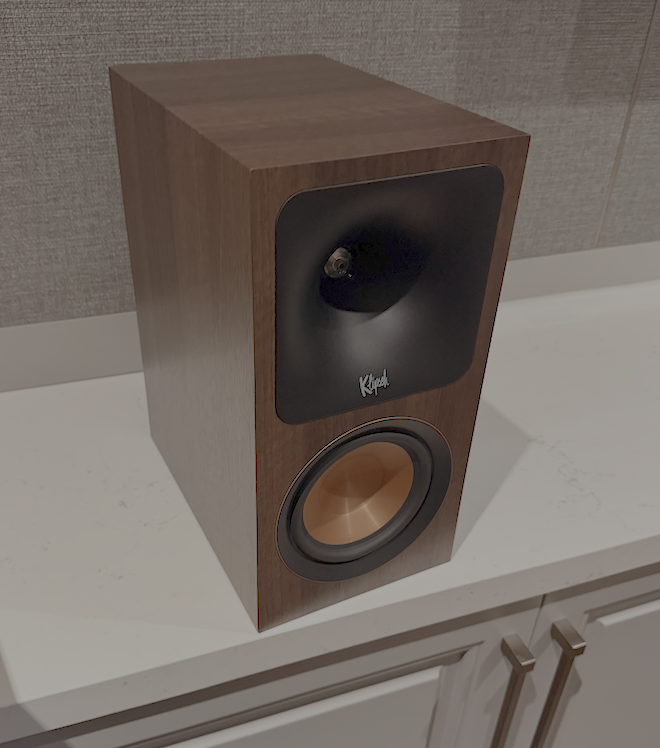
Klipsch says the internal amplifiers are matched to the individual drivers, although amplifier power has not yet been disclosed. The supplied launch information also does not specify frequency response, Bluetooth codec support, USB resolution, dimensions or weight.
Those omissions are worth noting because this is not an empty field. Several competitors around $800 already publish extensive amplifier and digital audio specifications.
Klipsch RP-500PM vs RP-600M II
The RP-600M II is the logical passive Reference Premiere model for comparison and follows the highly successful original RP-600M. It uses a larger 6.5-inch Cerametallic woofer and a 1-inch titanium LTS tweeter loaded into Klipsch’s 90 x 90-degree hybrid Tractrix horn.
The RP-500PM uses a smaller 5.25-inch Cerametallic woofer and the new axial Tractrix horn, but its bigger difference is architectural. The amplification and source connectivity are already built in, eliminating the need for an integrated amplifier, receiver, external DAC or separate phono stage for most users.
The RP-600M II remains the more flexible choice for someone assembling a traditional component system or Reference Premiere home theater. The RP-500PM is aimed at listeners who want the Klipsch sound and design language without a stack of electronics and enough cables to qualify as an infrastructure project.
The new horn could also give the RP-500PM a different presentation. Klipsch specifically emphasizes improved off-axis response, which makes sense for a speaker likely to spend as much time beside a television or computer monitor as it does in a dedicated two-channel setup.
RP-500PM Features and Specifications:
- First powered monitor in the Reference Premiere Series
- New high-density axial Tractrix horn
- Upgraded BMC horn material
- Flush-mounted horn design
- 5.25-inch Cerametallic woofer
- Built-in driver-matched amplification
- HDMI ARC
- Bluetooth 5.3
- USB-C
- Optical digital input
- RCA line-level input
- Phono input
- 3.5mm auxiliary input
- Dedicated subwoofer output
- IR remote control
- Floating cloth grille
- Textured wood-grain cabinet
- Copper woofer with matching trim ring
- Compatible with Klipsch KS-28 stands
Klipsch has not yet provided amplifier output, frequency response, dimensions, weight, maximum USB resolution or supported Bluetooth codecs.
Three Main Competitors
Triangle Borea BR03 Connect — $799/pair
The Triangle Borea BR03 Connect combines a similarly broad selection of inputs with a larger 6-inch cellulose midwoofer and 1-inch EFS silk-dome tweeter. Its Class D amplifier delivers 60 watts per channel, while HDMI ARC, USB-B, optical, coaxial, RCA, 3.5mm, MM phono and subwoofer connections cover almost every likely source. Plus its ESS ES9018K2M DAC supports PCM up to 32-bit/384kHz and DSD256 through USB, while Bluetooth 5.0 includes aptX HD. On paper the BR03 Connect checks more boxes for the same price, while the RP-500PM targets a distinctly different sonic philosophy.
ELAC Debut ConneX DCB61 — $899/pair
The ELAC Debut ConneX DCB61 costs $100 more than the Klipsch and offers a larger 6.5-inch long-excursion woofer, waveguide-loaded tweeter and 160 watts RMS of total amplification. Its rear-firing S-shaped port is designed to extend bass response while reducing port noise, with ELAC specifying a frequency response of 48Hz to 22kHz at -3dB.
Connectivity is particularly strong with HDMI eARC, USB audio up to 24-bit/96kHz, optical, Bluetooth LC3+, a switchable line/phono input and subwoofer output. The DCB61 also adds Dolby Digital decoding and iOS/Android app control for EQ, placement optimization, volume and other settings.
That makes the ELAC a formidable alternative for buyers willing to spend another $100. The RP-500PM counters with Klipsch’s new axial Tractrix horn and a more compact design, while the DCB61 brings a larger driver, app control and Dolby Digital to the argument. Copper cones alone are not going to settle this one.
SVS Prime Wireless Pro — $899/pair
The SVS Prime Wireless Pro costs $100 more but shifts the emphasis toward network streaming. It uses a 5.25-inch mid-bass driver and 1-inch aluminum-dome tweeter with 200 watts of total system amplification.
Wi-Fi, AirPlay 2, Chromecast, Spotify Connect and DTS Play-Fi are included, along with high-resolution playback support up to 24-bit/192kHz. HDMI ARC/eARC, optical, analog and Bluetooth connectivity are also provided.
SVS does not include the Klipsch’s built-in phono stage or USB audio input, making the two products appealing to somewhat different users. Klipsch makes more sense for direct connections to turntables and computers, while SVS has the clear advantage for listeners who want network streaming built into the speakers.
The Bottom Line
The RP-500PM fills an obvious gap in the Reference Premiere lineup without merely shrinking an existing passive speaker and stuffing an amplifier inside. The new axial Tractrix horn, broader connectivity and integrated phono stage suggest Klipsch designed it as a standalone stereo system rather than an accessory to another component.
The $799.99 price puts it directly against some excellent powered speakers, so the badge and copper woofer will only carry it so far. Triangle offers formidable connectivity and high-resolution support for less money, while the ELAC DCB61 costs $100 more. SVS also asks another $100 but adds a much stronger streaming platform.
What could separate the Klipsch is its acoustic design. If the new horn really delivers broader off-axis performance while retaining the speed, dynamics and immediacy that have made Reference Premiere successful, the RP-500PM could have a compelling argument beyond convenience.
CEDIA Expo is underway in Denver, so we will get a chance to hear whether Klipsch has pulled that off.
Price & Availability
The Klipsch RP-500PM Powered Monitors will be available in North America in December 2026 for $799.99 per pair through Klipsch.com and authorized Klipsch retailers.
For more information: klipsch.com
You must be logged in to post a comment Login