Tech
La Dolce Audio Current Drive Tube Amplifiers Have a Different Take on Valve Amplification: AXPONA 2026

Most loudspeaker designers don’t spend much time debating open versus closed the way headphone enthusiasts do. Cabinets are part of the equation for a reason, offering control, efficiency, and predictable performance. That’s the accepted playbook. But like any good rule in audio, someone is always trying to break it.
At AXPONA 2026, La Dolce Audio showed what happens when you ignore that playbook and lean into experimentation. Founder Terry Gesualdo isn’t approaching amplification or speaker design from a traditional standpoint, he’s part of a growing group of builders exploring open designs and current drive amplification as an alternative to the usual voltage driven norm.
I met Gesualdo on the shuttle ride over to the show, which feels about right. This isn’t a polished, corporate origin story, it’s the familiar path of someone who started by modifying gear, then building his own tube amps for himself, then for friends and family. The difference here is that he didn’t stop at tweaking circuits. He kept pushing until the results looked and sounded like something entirely his own.
Current Drive Tube Amplification: Why La Dolce Audio Isn’t Following the Script
Having built a few tube amps, I’m always curious to see what others are doing, and Terry Gesualdo is not following the usual path. Most of his designs are single ended pentode circuits, not triodes, and not push pull designs chasing more voltage swing. That choice alone puts him in a different lane than a lot of tube builders.
Where things really diverge is the move to current drive. Most amplifiers are voltage driven. That’s the standard approach across both solid state and tube designs. Current drive shows up more often inside DACs where signal levels are extremely small, and occasionally in headphone amplifiers, but rarely in loudspeaker systems where current demands are far higher.

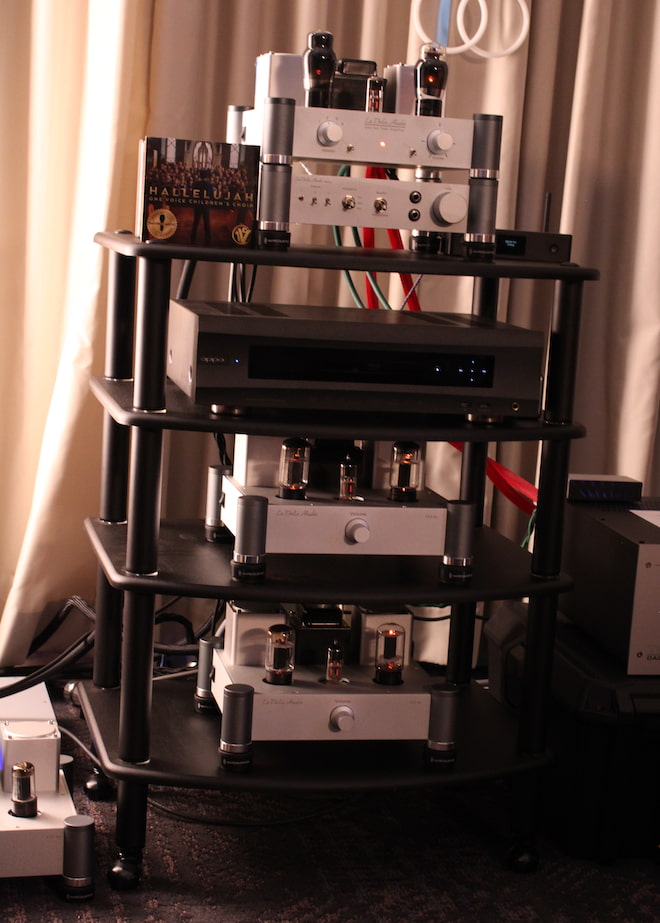
The idea behind current drive is fairly straightforward. By controlling current instead of voltage, the amplifier reduces the impact of back EMF from the driver. That back EMF is the voice coil behaving like a generator as it moves through the magnetic field, feeding energy back into the amplifier. Reduce that interaction and, in theory, you reduce distortion and improve control over the driver.
It’s not a new concept, but it’s one that almost nobody is applying to loudspeakers in this way, especially with tube amplification. That’s what makes what La Dolce Audio is doing worth paying attention to.
Control Over Harmonics Instead of Chasing Purity
Circling back to that idea of ignoring the usual playbook, another aspect that reinforces how La Dolce Audio is taking a different path is the near exclusive use of pentode tubes instead of the more common triodes. Triodes are the simplest form of amplification with three active elements, anode, cathode, and grid. Fewer parts in the signal path is why many listeners and designers gravitate toward them. The assumption is less complexity means lower distortion and fewer unwanted artifacts.
But that’s only part of the story. Harmonic distortion doesn’t disappear just because the circuit is simpler. It just changes character. And not all harmonics are a problem. A lot of what people describe as tube warmth comes from second and third order harmonics, which many listeners actually prefer.
Terry Gesualdo leans into that reality rather than trying to avoid it. By using pentodes, which add additional control elements beyond what a triode offers, he can shape those harmonic structures instead of accepting whatever the circuit gives him. That includes adjusting the balance between second and third order harmonics and even their phase relationships.
It’s a different mindset. Instead of chasing the lowest possible distortion number, the goal is control over how that distortion presents itself, and giving the listener a way to fine tune the result.
Some will find that approach a bit sacrilegious. There’s a large part of the hobby focused on removing as much of this behavior as possible, chasing lower distortion numbers and cleaner measurements. That’s not the goal here.
La Dolce Audio leans into a different philosophy. “If it sounds good, do it” is more than a slogan. It reflects the idea that listening is subjective and that not every system needs to be locked into a single interpretation of neutrality. By giving users control over harmonic structure, the design puts some of that decision making back in the listener’s hands.
UA2.5 and UA2.5M: Modular Power and User Tunability

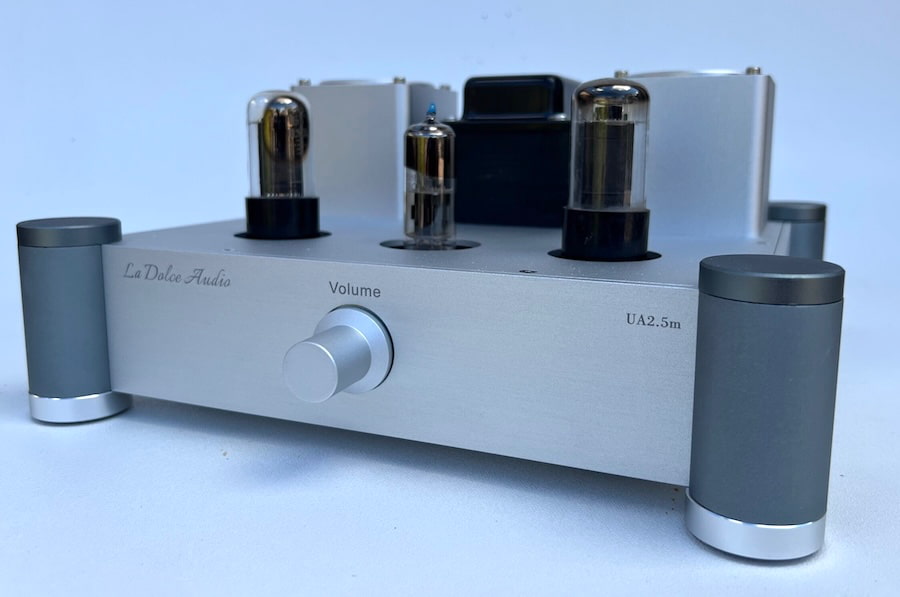
La Dolce Audio offers two amplifier paths built around the same core ideas but with different roles. The UA2.5 is a dual channel amplifier rated at roughly 3 to 5 watts depending on tube selection, and it’s where most of the flexibility lives. With 24 possible sound signatures, it gives the user direct control over how the amplifier presents harmonic content and overall character.
The UA2.5M monoblocks step things up in output, delivering around 9 watts per channel, but they take a more focused approach. They are designed to be paired with the UA2.5, which handles preamp duties and sound shaping. As a result, the monoblocks do not include the same tuning controls, focusing instead on providing additional power while maintaining the same underlying design philosophy.
HPA2.3 Headphone Adapter

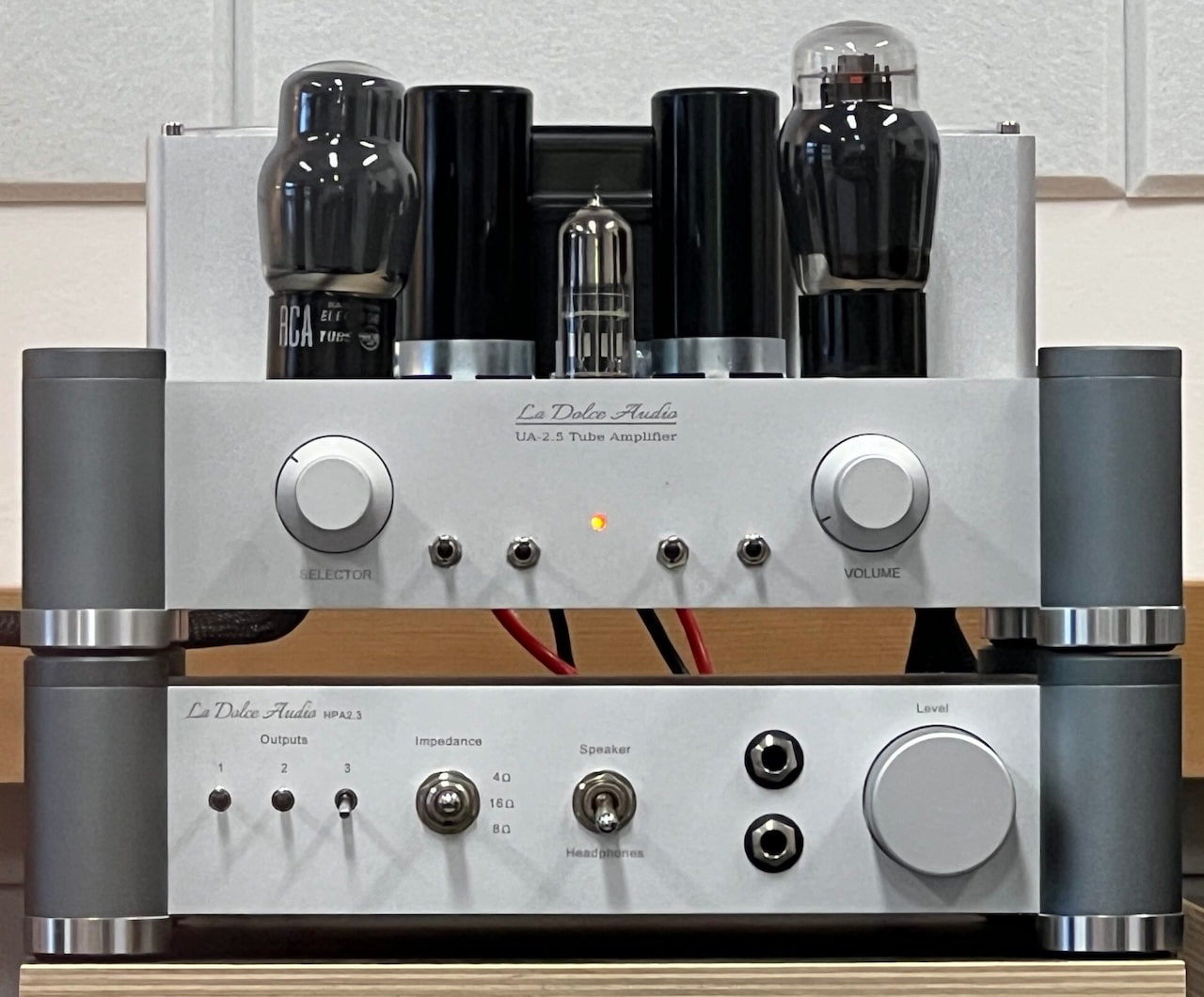
Alongside its amplifiers, La Dolce Audio offers the HPA2.3 headphone “amplifier,” although that label needs a bit of clarification. It’s not an amplifier in the traditional sense. The HPA2.3 is a passive device designed to work with the UA2.5, relying on it for signal processing and gain. In practice, it converts the UA2.5 into a headphone amplifier rather than operating as one on its own.
That means the HPA2.3 can drive a wide range of headphones depending on how the UA2.5 is configured, but it cannot function independently. No preamp, no sound.
Pricing reflects that modular approach. The UA2.5, which serves as the foundation of the system, runs between $1,799 and $2,499 depending on configuration and tube selection. The UA2.5M monoblocks are $1,999 each, and the HPA2.3 adds another $599. A full system lands in the $3,500 range, depending on how far you go down the rabbit hole.
The Bottom Line
La Dolce Audio isn’t trying to fit into the usual mold, and that’s the point. In a category where a lot of designs feel like small variations on the same theme, this is a reminder that there are still different ways to approach amplification and system building.
Beyond the amplifiers, the partnership with ABX Audiophiles on Discord to offer open baffle speaker kits adds another layer. It invites listeners to get involved, not just as buyers but as participants, with a community that shares ideas, solves problems, and pushes designs forward together. We’ll have more on that ABX side of things in a forthcoming article.
It won’t be for everyone. If you want plug and play simplicity, this isn’t it. But if you’re the type who likes to understand what your system is doing and shape it to your preferences, La Dolce offers something most companies don’t. A system you can actually interact with, not just listen to.
For more information: ladolceaudio.com
You must be logged in to post a comment Login