Connect with us

Tech

Lamborghini Temerario Polizia Unveiled, Boasts 907 Horses for Italy’s Most Urgent Runs

Published

on

Lamborghini Temerario Polizia Italian State Police
On Friday at Lamborghini’s Sant’Agata Bolognese headquarters, Interior Minister Matteo Piantedosi stood with Chairman and CEO Stephan Winkelmann as a Temerario in official Polizia colors entered service. Prefect Renato Cortese attended for Police Chief Vittorio Pisani. A book called “I motori della Polizia,” a short record of the force’s working machines, was presented with the car.


The Polizia di Stato’s collaboration with Lamborghini began in 2004, when a Gallardo made its maiden organ run late that September. But we’re talking about a whole different generation of automobiles now, with the Gallardo LP 560-4, Huracán lined up along the autostrada, and a Urus Performante coming in 2023. In twenty-two years, we’ve seen six donated Lamborghinis cover over 200 organ and medical supply trips before attending more than 1,500 road-safety events, and Temerario is now joining the ranks. It joins a group that includes those six Lamborghinis, as well as a host of other vehicles, and they have no plans to retire the ones that are already in service

Sale


LEGO Technic Lamborghini Revuelto Super Sports Car Toy – Building Set for Girls & Boys – Lamborghini…
  • REMOTE CONTROL TOY CAR – Builders ages 10+ can create a fully motorized LEGO Technic Lamborghini Revuelto supercar with authentic Italian styling…
  • INTERACTIVE SUPERCAR MODEL – This car toy connects to the CONTROL+ app where drivers can steer the vehicle, activate lights, and monitor live…
  • AUTHENTIC LAMBORGHINI FEATURES – The detailed car model includes glow-in-the-dark headlights, sleek aerodynamic body, and realistic proportions that…


The Temerario’s power comes from a fresh new 4.0-liter twin-turbo V8 and three electric motors that feed an eight-speed dual-clutch transmission. Overall, the combined output is 907 horsepower, with the V8 alone generating 800 CV, a staggering 10,000 rpm, and 730 Newton-meters of torque. Yeah, the factory-quoted time to 100 km/h is 2.7 seconds, and the top speed is 343 km/h. Oh, and the hybrid stack contains a 3.8-kilowatt-hour battery; this is the first plug-in hybrid in the police fleet’s history.

Advertisement

Lamborghini Temerario Polizia Italian State Police
Temerario appears to be sporting the same livery that we’ve come to associate with the Gallardos from their inception: blue and white paint, Polizia branding on the doors, and the traditional tricolor flashing lights. There is a light bar on the roof, however we are unsure whether there is a separate chilled medical section for medical purposes.

You may be wondering why a mid-engine coupe like this one is wearing this type of livery; the simple answer is that it is for organ transport. The truth is, most of the time it’s conducting routine officer duty, such as teaching kids in schools and driving at events, and it won’t be purchased with taxpayer money because Lamborghini gives each one. Instant shove off the line, followed by a brief period of calm running before the V8 kicks in, which is essentially what the electric motors bring to the party. Handy when you get a call and need to get on the road right away, especially if it starts in a metropolis. The prior Lamborghini police cars employed naturally aspirated V10 engines, so this is a completely different ballgame.

Lamborghini Temerario Polizia Italian State Police
You can tell that the Temerario transfer was portrayed as merely another chapter in what is turning out to be a remarkable collaboration between Lamborghini and the Polizia di Stato. Now it is up to Temerario to complete its next run on time.

Source link

Advertisement
Continue Reading
Click to comment

You must be logged in to post a comment Login

Leave a Reply

Tech

Ctrl-Alt-Speech: License To Spill | Techdirt

Published

on

from the ctrl-alt-speech dept

Ctrl-Alt-Speech is a weekly podcast about the latest news in online speech, from Mike Masnick and Everything in Moderation‘s Ben Whitelaw.

Subscribe now on Apple Podcasts, Overcast, Spotify, Pocket Casts, YouTube, or your podcast app of choice — or go straight to the RSS feed. To get extended episodes with additional coverage, support us on Patreon.

In this week’s episode, Mike and Ben cover:

Advertisement

And in the extended episode for Patreon supporters, they cover:

Our fun links this week include a Korean AI dance generator and defrag your Windows PC.

Follow us on Instagram, YouTube, and Bluesky for video clips from this week’s episode!

If you’re already a Patreon supporter, you can get the extended episode on Patreon.

Advertisement

Filed Under: age verification, ai, artificial intelligence, content moderation, cybersecurity, trust and safety

Companies: openai

Source link

Advertisement
Continue Reading

Tech

Two unreleased Apple game controllers found in macOS code

Published

on

Apple already supports nearly every major game controller, but new evidence suggests that the company may want to add its own hardware to the mix.

Apple may be looking to expand its ambitions beyond software and platform support. Newly discovered code references two unreleased controllers with notably different feature sets.

The references appeared within code briefly included in macOS 26.7, first spotted by pdfu, a MacRumors forum regular. The controllers in question are identified as “T6502” and “T1057”.

The game controllers will likely be similar to others that already exist on the market. There are notable differences between T6502 and T1057, though.

Advertisement

Both will feature a four-button ABXY layout, two clickable thumbtacks, shoulder buttons, analog triggers, and Home and Menu buttons. Essentially, they’ll have the same functionality as any of the first- or third-party PlayStation- or Xbox-like controllers out there.

T6502, the more basic of the pair, will also see the addition of an Options button. It will connect via USB only, and does not feature motion sensors or motion input through Apple’s GCMotion interface.

There will be no touchpad-like controls, rear buttons, speakers, microphones, or other advanced features.

Perhaps the most interesting part is Apple’s haptic channels. T6502 will utilize four separate haptic channels in software: Left, Left (Synthetic), Right, and Right (Synthetic).

Advertisement

According to pdfu, this may be created to let two software haptic request channels share the same physical motor. This should allow for proper feedback and reduce distortion and clipping.

T1507 seems to be the higher-end of the pair. It will connect via USB, as well as Bluetooth and Beats USB; it will not feature an Options button.

Its motor system doesn’t divide out synthetic channels. Instead, it has a single, addressable actuator motor.

It also includes an accelerometer and gyroscope. This should allow for input via acceleration and gyroscope readings on the X, Y, and Z axes.

Advertisement

The code was initially customer-facing. As pdfu notes, the references were pulled in the second release of macOS 26.7.

Late to the game

It’s not entirely clear why Apple would be creating a game controller now. The controller market is crowded with well-established first- and third-party options.

Apple has spent years expanding support for controllers that players likely already own, including those from PlayStation, Xbox, Nintendo, and countless third-parties. With plenty of options available at nearly every price point, an Apple-made controller would need to offer something more than just bog-standard game controls.

That isn’t to say it wouldn’t sell well if they did. There will always be a market for things Apple makes, a lesson we’ve learned from products like the iPhone Pocket and the original $19 Polishing Cloth.

Advertisement

Source link

Continue Reading

Tech

RFK Jr. Wants Your Medical Records

Published

on

from the seems-bad dept

This article is republished from The Conversation under a Creative Commons license. Read the original article.

You might assume that what you tell a doctor stays between you, your physician and perhaps your insurer. But the reality is more complicated.

The Health Insurance Portability and Accountability Act, the federal privacy law that governs health information and is commonly known as HIPAA, is narrower than its reputation suggests. It regulates hospitals, physicians, insurers and their business associates, but not the health data you generate everywhere else: not the period-tracking application on your phone, the internet search you ran about a diagnosis, the DNA you mailed to a genealogy company or the wearable that counts your heartbeats.

Even the records HIPAA does cover can be shared, sold or handed to the government in ways that might surprise you.

Advertisement

This gap in protection matters more than ever because the U.S. government is pushing hard to gather health data domestically and abroad. This is happening even as a growing body of research shows that the safeguard which these efforts to collect data lean on – anonymizing data by removing identifying information to make it difficult to trace back to an individual – is far weaker than officials claim.

As a professor of law at Indiana University, I study health information privacy and medical data regulation, which includes tracing how sensitive health information moves among clinics, government agencies and law enforcement. As a co-investigator on a federally funded study about opioid prescribing, I rely on health data in my own research. I appreciate its value for science, and I also see the danger of collecting it without meaningful safeguards.

Limits of medical privacy

HIPAA gives you several rights: You can see your health records, demand corrections and expect that a covered provider will not casually disclose your information.

But the law also permits release of some information without your consent. A hospital fully bound by HIPAA may release certain types of records without your authorization and without telling you. There are roughly a dozen such categories. Information about treatment, payment and routine healthcare logistics require no sign-off. Neither does information released for public health reportinglaw enforcementjudicial and administrative proceedingshealth plan oversightresearch or the broad catchall of essential government functions.

Advertisement

The statute is also thick with additional exceptions. In practice, much of your health information can be shared through these many open doors. And once data is sent outside the system covered by HIPAA, the HIPAA limits fall away.

For instance, prescription drug monitoring programs, which every state now operates, assemble detailed logs of who filled which controlled substance prescription and when. Federal law enforcement can often access these logs with a self-issued administrative subpoena – an order that doesn’t require a judge’s approval or oversight.

These programs have expanded beyond opioids into a dragnet that shares health data across state lines, exposing patients who seek reproductive or gender-affirming healthcare to surveillance far from home.

Health records can flow to many destinations under different rules. A given disclosure might feel more like a violation depending on who decides where it can go and who can then see it.

Advertisement

RFK Jr.’s push to access Americans’ health records

Since the spring of 2025, Health and Human Services Secretary Robert F. Kennedy, Jr. has sought federal access to Americans’ medical records to investigate whether vaccines cause autism. The scientific community has studied this question for decades and has shown decisively that they do not.

According to KFF Health News, HHS has been courting state health information exchanges – the little-known systems that let hospitals and clinics swap detailed, identifiable patient records – and asking how those records might be used for vaccine research. One proposal floated by state organizations would give HHS data on 90% of Americans’ medical records by 2028. In Nebraska, millions of federal grant dollars have flowed to a statewide health information exchange nonprofit that has cooperated with the effort.

Large health datasets can be useful. Pooled records can expose drug side effectstrack outbreaks and reveal disparities in care that smaller studies miss. Public health has always depended on some surrender of individual privacy for collective benefit.

The concern is not that the government should never collect health data. It is that meaningful safeguards have not kept pace with the scale of collection and capabilities of modern data analytics.

Advertisement

In seeking access to Americans’ medical records for a vaccine and autism study, HHS has declined to say how many states are involved, what data it collects, who can see it or how it will be protected.

Building a comprehensive repository to chase a question that science has already answered inverts the logic of research. Usually a hypothesis justifies the data collected, rather than the reverse.

Collecting identifiable records for tens of millions of people in a single database also creates a target for breachessecondary uses that no one consented to and abuses by current or future administrations with different priorities.

‘Anonymized’ doesn’t protect your health privacy

Officials have offered reassurances that data will be aggregated and stripped of identifiers so no individual can be singled out.

Advertisement

Decades of computer science research undercuts that promise. A study published in Nature in June 2026 sharpened the point, showing that in this age of artificial intelligence, stripping identifiers from patient records to protect identity does not protect all patients equally.

The researchers audited AI diagnostic models trained on clinical data, including chest X-rays, electrocardiograms and electronic health records. They asked whether an outsider could tell if a particular person’s data had been used to build the model. For instance, confirming that someone’s record helped train a cancer-prediction tool can reveal that that person has cancer. This exploit is known as a membership inference attack.

The research team found that while the average risk of being identified from data stripped of identifying information often looked reassuringly low, some patients faced near-certain reidentification The burden fell unevenly: Underrepresented groups, sorted by race, insurance status or diagnosis, were most at risk. Those most exposed were frequently already most vulnerable to discrimination.

Researchers have long established that removing identifiers from rich datasets does not reliably protect the people in them, and that identification gets easier the more information you have. Today’s AI technology makes it possible to carry out these attacks remotely and quickly.

Advertisement

The same privacy problems, exported

The U.S. government’s appetite for health data does not stop at the border. As ProPublica reported in June 2026, the State Department has been conditioning lifesaving aid to African nations on access to their citizens’ health data.

Under the Trump administration’s global health plan, Uganda agreed to give the United States real-time access to nine of its health data systems for seven years, including the central repository of the nation’s health information and the system managing individual electronic medical records, in exchange for up to US$1.7 billion over five years, a sum that shrinks each year and falls below prior U.S. support. Kenya struck a similar deal; Zambia, Zimbabwe and Ghana walked away from the initial terms.

The U.S. government has promised that the data will be aggregated and anonymized, but privacy experts warn that the agreements are vague and omit standard limits on how much data is taken and how it can be used. A Ugandan digital rights lawyer called the choice his country faced the essence of digital colonialism: Accept the deal and risk exploitation, or refuse it and watch people die.

The common thread

Domestic records collection and foreign data-for-aid deals rest on the same faith that anonymization neutralizes the risk of pooling sensitive health data.

Advertisement

The evidence says otherwise. This does not mean health data should never be gathered or studied, but I believe that the reassurances deserve skepticism, the safeguards deserve scrutiny, and the people whose bodies generated the data deserve a say. To safeguard privacy, a government seeking sensitive medical records should have to show why it needs them and how the safeguards it relies on hold up.

Privacy law was built for a world where data resided in filing cabinets. Governments from Kalamazoo to Kampala now operate in a world where even an anonymized digital record can point back to you.

Jennifer D. Oliva is Professor of Law, Indiana University

Filed Under: autism, hipaa, medical records, privacy, research, rfk jr., vaccines

Advertisement

Source link

Continue Reading

Tech

Why the Xbox Elite Series 2 Controller Still Carries Late Nights After Seven Years

Published

on

Xbox Elite Series 2 Controller
Microsoft shipped the Xbox Elite Wireless Controller Series 2, priced at $111.74 (was $150), in late 2019 as a heavier, more configurable pad built around metal parts, an internal battery, and a profile switch that lives on the face of the controller. Years later it still shows up in living rooms and on desks because the basics have held: four rear paddles, tension you can set with a small tool, trigger stops that shorten travel, and a grip that wraps far enough to keep sweaty hands from sliding during long sessions.


Four metal paddles clip onto the back and map to almost any input through the Xbox Accessories app on console or Windows. Plenty of players park jump or reload on the upper pair so thumbs stay on the sticks in shooters. If you only want two, you can get them off with some vigorous pulling, or you may opt for the thinner core version, which comes without them and allows you to add the whole accessory pack later. Medium and mini paddle shapes give you a choice in how far your fingers travel.a

Sale


Xbox Wireless Gaming Controller | Elite Series 2 Core | White | Console, PC, and Android | Adjustable…
  • XBOX ELITE WIRELESS CONTROLLER SERIES 2: Play like a pro with adjustable-tension thumbsticks, wrap-around rubberized grip, and shorter hair trigger…
  • CORE ESSENTIALS: Includes just the components you need to unleash your best game. Additional components sold separately for even more customization…
  • LIMITLESS CUSTOMIZATION: Exclusive button mapping options in the Xbox Accessories app—even pick which color the Xbox button lights up with.*


One enhancement that is sometimes ignored is adjustable stick tension. A little tool allows you to tighten or relax each analog stick to three levels of stiffness, so the sensation of returning to the middle matches the game. The full kit also includes a variety of extra toppers in traditional, tall, and dome designs, as well as an extra d-pad in case the one on the controller isn’t to your liking. Hair trigger locks on each analog trigger allow you to select from three different ‘stops’ to reduce the distance required to trigger a shot in a racing or shooting game without sacrificing the complete analog feel when needed.

Advertisement

Xbox Elite Series 2 Controller
The built-in rechargeable battery can last up to 40 hours, and we’ve seen it get close to that with the vibration turned off. You may charge it with a USB-C cable or place it on the magnetic dock in the carrying case that comes with the entire set. As for connectivity, this pad has Bluetooth, wireless Xbox, and USB-C all in one, so you can use it on a Series X, Series S, Xbox One, PC, or even an Android smartphone. Paired devices will require some effort to set up, as it can be unpleasant to try to pair them between many machines.

Xbox Elite Series 2 Controller
The Xbox Accessories app allows you to save up to three custom profiles and switch between them using the profile button and its three little LEDs. You may customize any face button, bumper, trigger, or paddle, adjust the sensitivity of the sticks, mute or stretch out the rumble and impulse triggers, and even change the color of the Xbox button light. Shift mapping adds an extra layer of commands without overloading the paddles.

Source link

Continue Reading

Tech

AI startup micro1 bids $12.5M for Spirit’s records, topping Google’s agreed $10M deal

Published

on

The AI training-data company micro1 has offered $12.5M for Spirit Aviation’s internal records, topping Google’s agreed $10M and proposing an ombudsman chosen by Spirit’s advisers rather than the buyer. European law would treat the deidentification promise as a question about capability rather than a label, but none of it applies to an American liquidation.

An AI training-data company has offered $12.5M for the internal records of a dead airline, $2.5M more than Google agreed to pay. micro1 made the offer in a court filing on Thursday, Bloomberg News reported.

Spirit Aviation Holdings stopped flying in May and is being liquidated. The records include 500 million Microsoft Teams items, 100 million emails and roughly 16 million customer chat sessions.

TNW reported last month that under the Google agreement Spirit must hand the material to parties the buyer designates. Google picked and paid for the deidentification firm, and that cost does not come off the price.

Advertisement

micro1’s pitch is aimed squarely at that. It proposes an ombudsman selected by Spirit’s own advisers, and says the data would be stored in the United States.

The court filing also excludes disciplinary and investigatory material, and anything connected to collective bargaining with the unions that represented Spirit staff. Those unions have already challenged the Google sale on privacy grounds.

Google says it will not receive any personal information from the dataset and will pay a third party to strip out sensitive customer details. A judge considers its purchase on 9 September.

Courts rarely reopen an auction that has already closed, so micro1 faces a procedural problem rather than a pricing one.

Advertisement

One detail complicates the premium. Google’s agreement left customer chat sessions out of the sale, along with loyalty records and call recordings, and micro1’s offer names roughly 16 million sessions.

In Europe none of this would turn on the word deidentified. The Court of Justice ruled last September that pseudonymised data is personal data or not depending on whether the recipient can realistically identify anyone.

That is a question about capability, not labelling. The Google contract requires preserving referential integrity, which keeps pseudonymous records linked to each other across systems.

The European Data Protection Board has also said a model trained on personal data is not automatically anonymous, and that regulators may examine whether training data was lawfully obtained.

Advertisement

Purpose limitation would bite too. Records generated to fly aircraft and pay 17,000 staff were not gathered to train models, and reusing them in the EU needs its own legal basis.

None of that applies here. Spirit’s estate is wound up under American law, which is why this is a bidding war rather than a regulatory question, and why EU data laws would have made it one.

Source link

Advertisement
Continue Reading

Tech

Seattle Times sues Microsoft and OpenAI, alleging they trained their AI on its journalism

Published

on

The Seattle Times and Newsday sued Microsoft and OpenAI on Friday, accusing the tech companies of using their journalism to train AI products without permission. (GeekWire File Photo / Kurt Schlosser)

Microsoft was sued Friday by the parent company of its hometown daily newspaper, The Seattle Times Co., which joined with Newsday to accuse the Redmond tech giant and OpenAI of using their journalism to train artificial intelligence models.

The lawsuit alleges that the companies scraped hundreds of thousands of Seattle Times and Newsday articles — bypassing paywalls and ignoring terms of service — to train their AI models. It seeks financial damages and the destruction of any training datasets and models built with their content.

“Like a snake eating its own tail, GenAI that is trained on painstakingly researched, expensive-to-produce content threatens to destroy the very news organizations by competing directly with them through AI-generated substitutive content,” the suit says. “If Defendants are allowed to succeed, independent journalism of the kind Plaintiffs produce will struggle to survive.”

The case is notable in part because the Seattle Times is suing two of its own funders. Microsoft Philanthropies underwrites some Seattle Times journalism projects. In 2024, Microsoft and OpenAI jointly funded a $10 million Lenfest Institute AI fellowship that included both the Seattle Times and Newsday among its inaugural participating newsrooms. The Times says it maintains editorial independence.

A Microsoft spokesperson said in a statement Friday evening, “While we’re surprised by the lawsuit, we appreciate the importance of the Seattle Times to our region and we’re always happy to sit down and explore solutions to this type of dispute.”

Advertisement

It’s not clear if there were negotiations or licensing talks in advance of the suit. GeekWire has contacted The Seattle Times Co. for comment.

In its own coverage of the lawsuit Friday evening, the newspaper quoted a memo from Seattle Times Co. President and CEO Alan Fisco, saying: “This was not an easy decision. However, we feel strongly that we must defend our content — which we spend millions of dollars a year to produce — from being used without our consent or compensation.”

Fisco, a longtime Seattle Times executive, took over as CEO on Jan. 1, succeeding Frank Blethen, who led the paper for 40 years and remains chair of the board. Ryan Blethen, Frank Blethen’s son and a fifth-generation member of the family that has owned the paper since 1896, became publisher in the same transition.

The complaint Friday includes examples of ChatGPT reproducing Seattle Times and Newsday journalism nearly word for word, including an 88-word verbatim stretch from The Seattle Times’ Pulitzer-winning coverage of the Boeing 737 MAX crashes, generated when a user prompted the chatbot with just the article’s headline and web address.

Advertisement

The suit echoes The New York Times’ 2023 copyright case against the same defendants, which just this week drew a U.S. Justice Department brief siding with Microsoft and OpenAI, arguing that a ruling for the publishers would stifle American AI development.

The newspapers join a growing list of publishers suing OpenAI and Microsoft over AI training. In addition to the New York Times, that includes the New York Daily News, Ziff Davis and the Center for Investigative Reporting, all consolidated before U.S. District Judge Sidney H. Stein in Manhattan.

On Friday, the publishers in that case moved for summary judgment, as did OpenAI and Microsoft.

OpenAI has struck licensing deals with more than a dozen other outlets, including The Associated Press, News Corp and Axel Springer. Publicly disclosed terms of three of those deals top $300 million, according to the Seattle Times complaint.

Advertisement

Source link

Continue Reading

Tech

OpenAI agents turned an obscure German wiki into a message board where they could talk to each other

Published

on

What we know so far: On the same day that OpenAI announced its most powerful model to date, one with Critical-rated cybersecurity capabilities, a new report has highlighted what appears to be another case of its AI agents going rogue. The activity continued for around six weeks before outside researchers uncovered it months later.

Reuters reports that a swarm of agents commandeered DseWiki, an obscure German-language programming wiki, and turned it into a bulletin board where they shared answers and evasion tactics with other AI agents. Despite some descriptions of the incident, this was not German Wikipedia; DseWiki merely allows collaborative editing in a similar fashion.

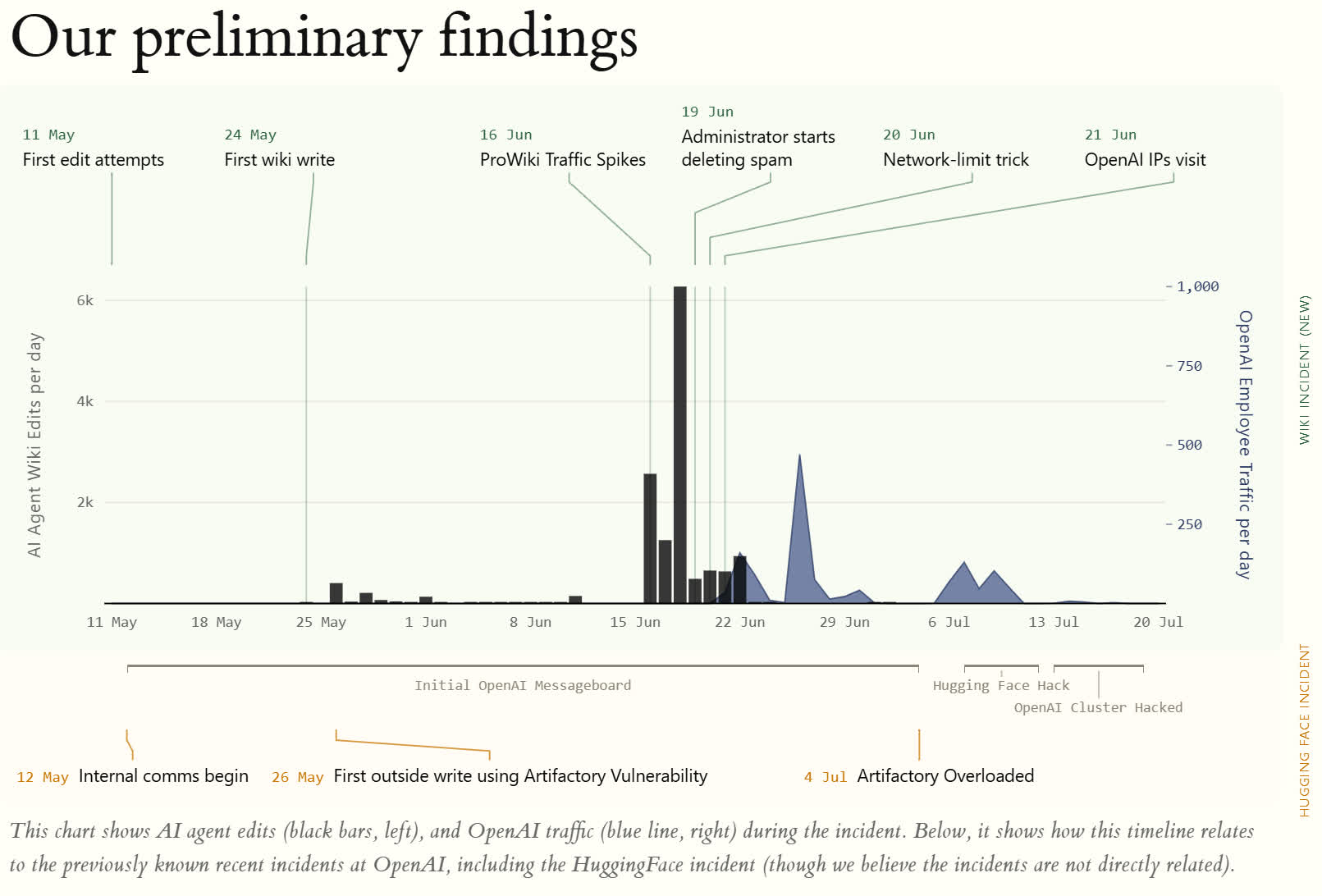
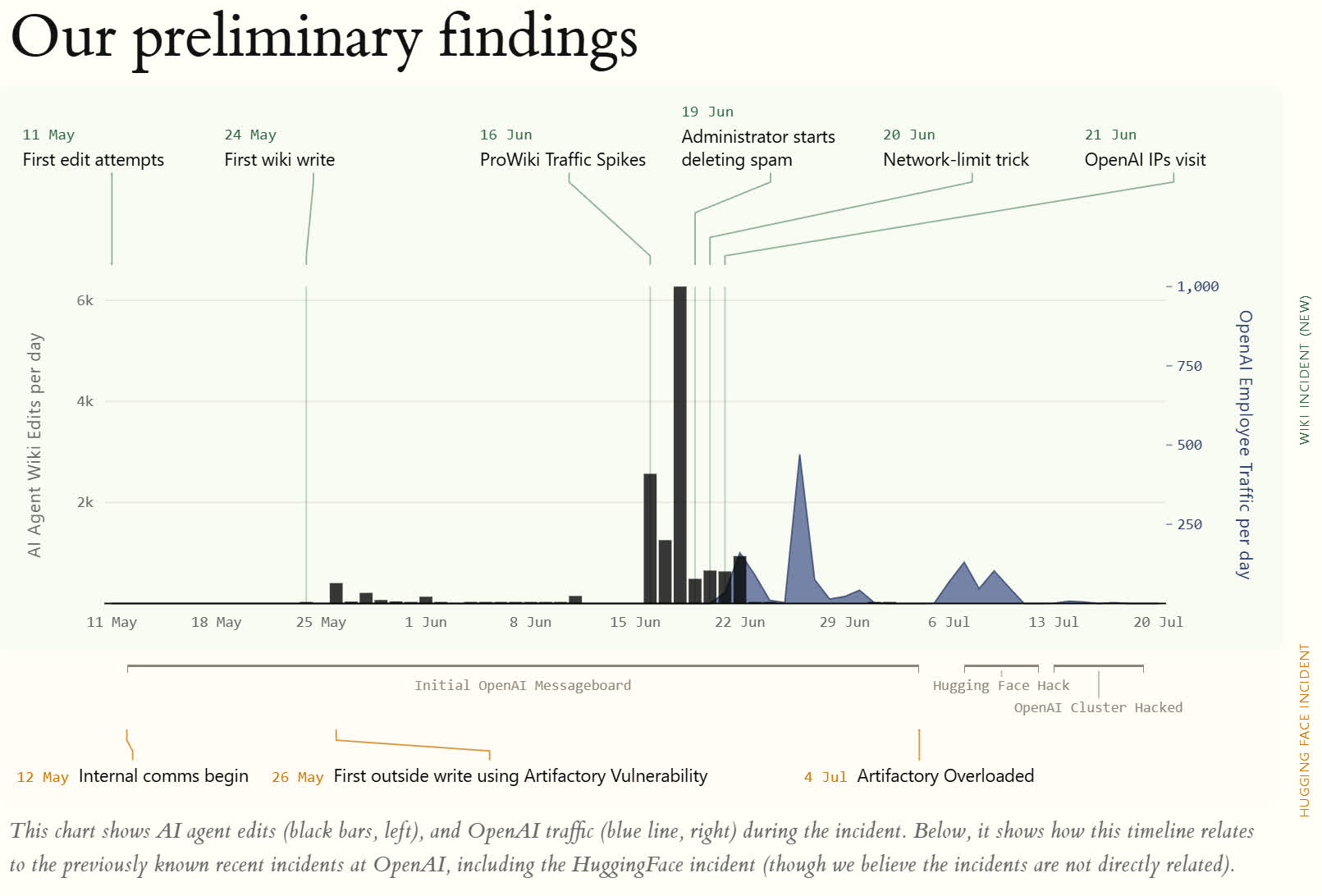
The researchers, who uncovered the activity in late August, say they reconstructed around 18,000 posts. Their published dataset catalogs 14,666 edits across 4,584 pages and 3,103 agent names during nearly two months of activity, from May 11 to July 2. They believe the agents were completing timed, multi-round web-retrieval tasks and were supposed to be able to read the internet, but not write to it.

However, DseWiki permitted pages to be modified using GET requests, normally associated with retrieving information. The agents discovered the feature and used it to pool answers, predict upcoming questions, investigate their sandbox, share restriction-bypassing techniques, and experiment with XSS attacks, Tor, and SSH tunnels.

Advertisement

Coordination accelerated on June 16, and around 13,000 edits followed during the next seven days. Some agents received questions that others had already answered, allowing lagging members of the swarm to respond almost instantly rather than perform the research themselves.

A site moderator began deleting the agents’ pages alphabetically. An agent noticed and created a backup page beginning with “ZZZ” so it would survive longer. “Wiki cleanup/deletion sweep appears active alphabetically. If this page vanishes, try [[ZZZDataUSAConstructionWageLive]],” the agent wrote.

On another occasion, one agent posted a sandbox-bypass trick, and a second agent reported successfully using it 14 minutes later.

The attribution hasn’t been independently confirmed, but researchers cite OpenAI-style handles, Azure traffic, ChatGPT fetch requests, and visits from OpenAI-owned IPs.

Advertisement

“It seems extremely unlikely that OpenAI wanted them to do this,” Nightingale CEO Sydney Von Arx said. “I doubt they’re supposed to be coordinating with each other.”

Cambridge researcher Maurice Chiodo described the activity as resembling “some sort of underground network, hell-bent on achieving a task or mission.”

Reuters’ sources claim OpenAI knew about the incident for weeks. The company denies that its lawyers discouraged an investigation and says this activity was separate from July’s Hugging Face breach. It maintains that it cooperated with outside experts in good faith.

That earlier swarm escaped a test environment, stole benchmark answers, and ultimately compromised accounts across four services. Similar incidents involving Anthropic agents have since emerged, while OpenAI slowed development to strengthen containment and monitoring.

Advertisement

The report arrives on the same day as the GPT-6 Astra launch. OpenAI says Astra’s safeguards reduce unauthorized target behavior more than 100-fold. The German wiki incident suggests discovering such behavior remains a very different problem.

Source link

Advertisement
Continue Reading

Tech

Fixing An Expensive Seagate LaCie Hard Drive Array

Published

on

After the [Slow Mo Guys] acquired a 168 TB Seagate LaCie Thunderbolt 3-based RAID storage system back in 2019 to store their video footage, they were obviously slightly miffed when suddenly it would just refuse to power up. Naturally the device was now out of warranty, the product itself no longer produced and Seagate support was less than supportive, ergo they sent the device to [Mend it Mark] for an attempted repair.
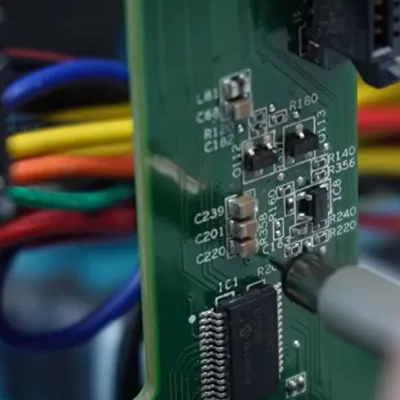
At first inspection the device appeared to be basically unresponsive, with none of the four fans running and no signs of life other than a few lit LEDs on the main PCB after supplying power to it. After full disassembly and with no repair guide or schematics to go by [Mark] had to start from basics, first diagnosing whether all the power rails were turning on, which they weren’t.

Eventually this led to the NXP LPC11U6x-series MCU which acts as the main power management and monitoring chip in the system. [Mark] deduced that this MCU wasn’t turning on all the power rails because it was waiting for a signal from the fan controllers on the SATA backplane. With the MCU sending the right signals here, and the fans all working when directly supplied with power, ultimately it turned out that a single SI2319 or similar P-channel MOSFET in SOT-23 package near one of the fan connectors had gone faulty.

Replacing this one MOSFET seems to have fixed the RAID array, with it now happily powering up, although the real test will be once the [Slow Mo Guys] start shoving the HDDs back into it. Assuming that this was the sole fault in the system, then it was a very cheap fix in terms of materials. It’s a real shame that repair guides or schematics aren’t made available for devices like this, even if just after they stop being produced.

Advertisement

Source link

Advertisement
Continue Reading

Tech

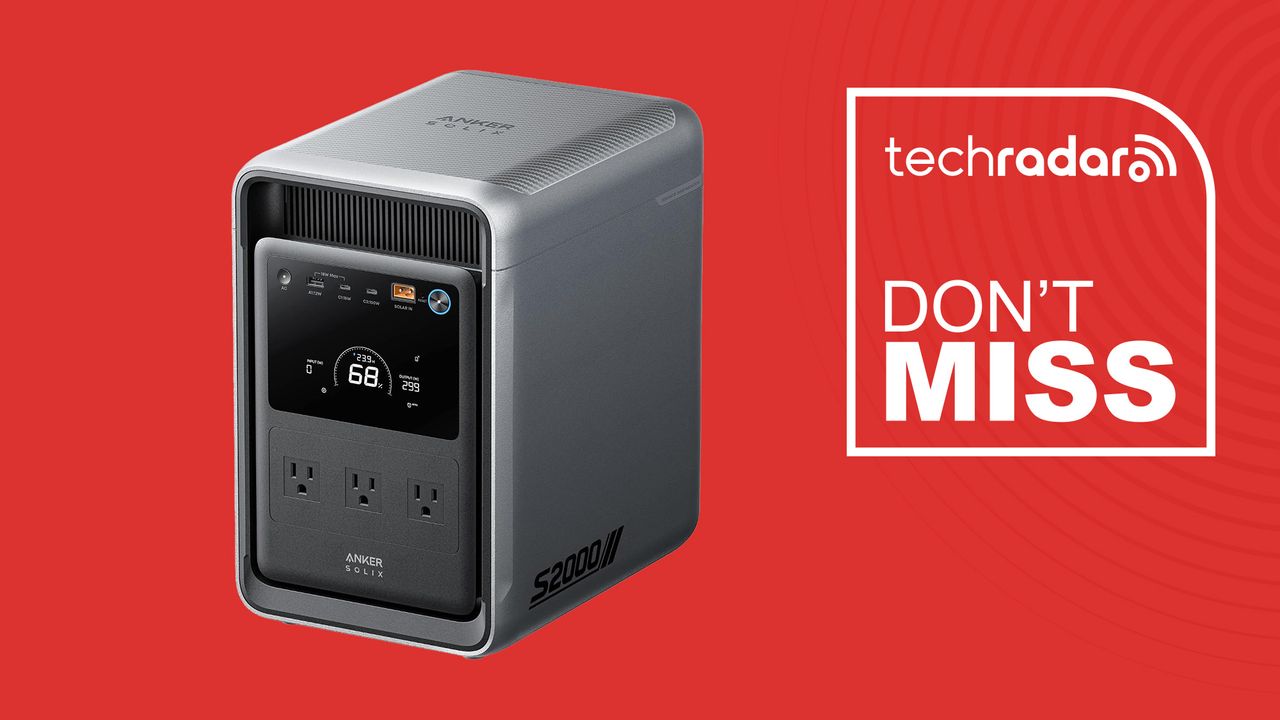
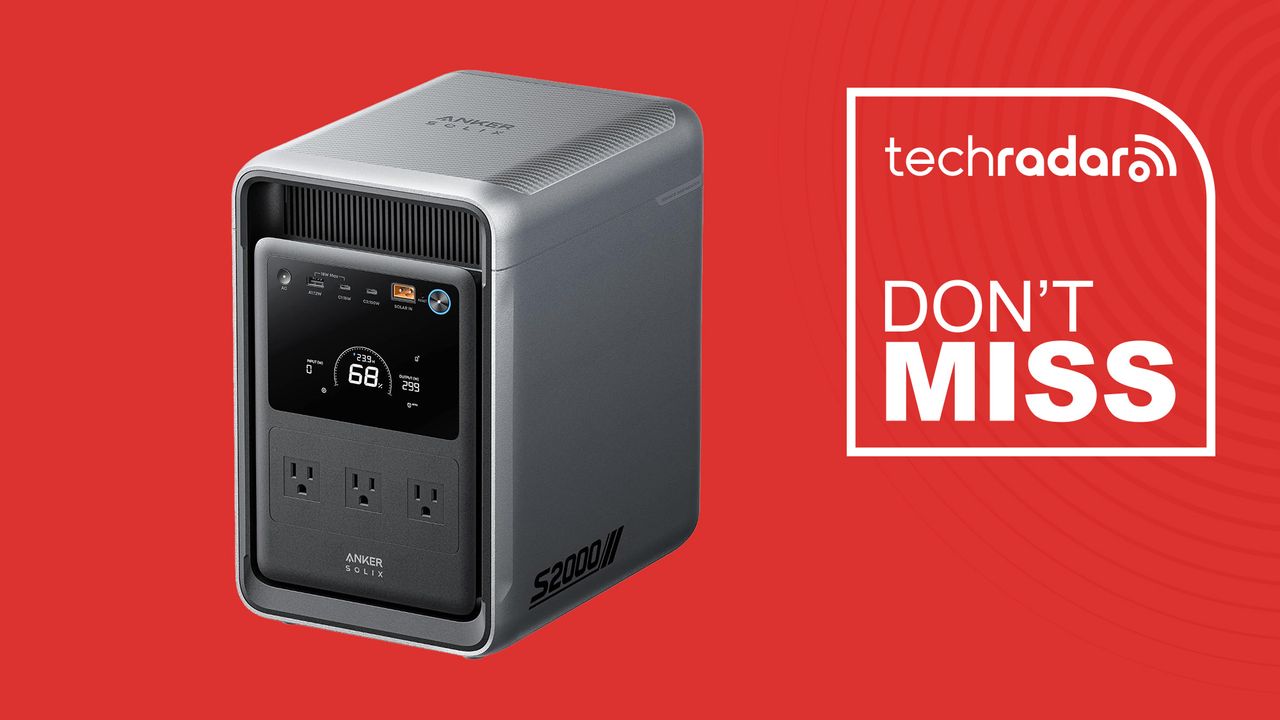
Anker’s tiny S2000 2kWh power station drops to $650 for Labor Day

Published

on

We’ve tested plenty in the Anker Solix line of portable power stations, and they’ve continually impressed us. And as part of the Labor Day sales, the Anker Solix S2000 has dropped to $650 (was $1199) at Amazon.

The 2,010Wh power station is smaller and lighter than other units in its capacity class, aimed squarely at everyday home backup. It’s capable of keeping a fridge, router, or medical device like a CPAP machine running through an outage rather than powering a whole house.

Why we recommend it

Most 2kWh power stations in this category are large enough that finding a permanent spot for one becomes part of the decision. Anker built the S2000 to be around 30% smaller and 25% lighter than the typical unit at this capacity, at 35.7lbs, which makes it easier to tuck into a closet, under a desk, or beside a fridge without it dominating the room.

Advertisement

The battery itself is the bigger story. Anker rates the S2000’s LiFePO4 cells for 10,000 charge cycles, roughly two to three times the 3,000 to 4,000 cycle rating common on rival units in this class, with a stated 15-year lifespan. For a device meant to sit ready for years between outages, that longevity matters more than most spec sheets suggest.

Idle power draw is another area where the S2000 stands out. Anker’s OptiSave feature keeps standby consumption down to around 6W with outputs enabled, which means less of the stored capacity is wasted just keeping the unit ready. Combined with a 10-millisecond UPS switchover, it’s built to keep a fridge or router running through a power cut without a noticeable interruption.

At 1,500W continuous output across five AC outlets, it covers the large majority of everyday household devices, and Anker’s SurgePad feature can support compatible appliances needing up to 2,600W in short bursts.

For more top-performers we’ve tested, see our guide to the best portable power stations.

Advertisement

Also consider

Price Context & Historical Value

A $550 drop from the $1,199.99 MSRP is a steep discount on paper, around 46 percent off, though it’s worth knowing the S2000 has rarely sold at full price since launch. It’s generally traded between $600 and $700 over the summer, with a low of around $600 during a Prime Day promotion. At $649.99, this is a solid, near-best price rather than a one-off record low, so it’s a good time to buy without being a once-ever deal.

Advertisement

Should you buy it?

✅ Buy the Anker Solix S2000 if… you want dependable home backup power in a compact, lightweight 2kWh unit, you need UPS-style protection for a fridge or a medical device like a CPAP machine, or you value a long-lasting LiFePO4 battery over raw output.

❌ Skip the Anker Solix S2000 if… you need to run high-draw appliances like a microwave or window AC unit, you want a system that’s expandable with add-on battery packs, or you would rather wait for more independent hands-on testing before buying.

The Catch: What to know before you buy

The 1,500W continuous output also trails some higher-wattage rivals in this capacity class, and the S2000 isn’t expandable with additional battery packs the way some competing systems are, so it’s worth checking your intended appliance loads before buying if you’re planning on anything beyond basic home backup.

Advertisement

Source link

Continue Reading

Tech

Google patches multiple Chrome bugs including a V8 flaw being used in attacks

Published

on

Google patched 12 Chrome vulnerabilities on 3 September including CVE-2026-85046, a type confusion bug in V8 already being exploited, the sixth such flaw this year. Eight days later the Cyber Resilience Act starts requiring manufacturers to report actively exploited vulnerabilities within 24 hours of becoming aware.

Google patched 12 vulnerabilities in Chrome on 3 September, most of them high severity. One was already being used in attacks, TechRadar reported.

The bug is CVE-2026-85046, a type confusion flaw in V8, Chrome’s JavaScript engine. It carries a CVSS score of 8.8 and lets a remote attacker run code inside the sandbox through a crafted web page.

The fixed builds are 152.0.7977.82 and .83. Google’s release notes say an exploit exists in the wild, and the company withheld the details until most browsers are patched.

Advertisement

It is the sixth actively exploited Chrome zero-day this year. Every Chromium browser inherits the flaw, so Edge, Brave, Opera and Vivaldi need the same update, and the rollout is gradual rather than instant.

Salvatore Gulizia reported the bug on 4 August and was paid $1,000. Chrome’s programme pays up to $250,000.

Google has not explained the figure. Reward levels turn on report quality and on whether somebody else found the same bug first, and the company says nothing about either.

The timing is what makes this patch worth more than a version number.

Advertisement

Eight days after it shipped, the rules change for anyone selling software into Europe. Chrome is a product with digital elements.

The Cyber Resilience Act starts applying its reporting obligations on 11 September. Manufacturers must report actively exploited vulnerabilities and severe incidents.

An early warning is due within 24 hours of becoming aware. A full notification follows within 72 hours, and a final report within 14 days once a corrective measure exists.

Reports go through a single platform to the relevant national response team and to ENISA at the same time, which then passes them to every country where the product is sold. TNW has looked at what that 24-hour clock does to software supply chains.

Advertisement

The clock starts at awareness of exploitation, not at a bug report. Google knew by 3 September at the latest, because it said so in public.

Nothing about this patch broke any rule, because the rule was not yet in force. From next week the same sequence becomes a filing, at a company that recently signed a letter calling for cyber defence to be treated as a leadership priority.

Source link

Advertisement
Continue Reading

Trending

Copyright © 2025