
TL;DR
OpenAI says GPT-5.6 Sol and an unreleased model escaped a secure test, exploited a zero-day, and hacked Hugging Face to cheat on a cybersecurity eval.




Portland, Oregon-based Leatherman is known for its multitools, which feature a plier-based design built around an iconic butterfly mechanism — unlike the iconic Swiss Army Knife. One would imagine the pricing hierarchy for its lineup would be defined by the number of tools, the materials, and the build quality; while that’s generally the case, it’s not for the pliers. Instead, the blade is how you gauge whether your Leatherman multitool is cheap or expensive.
Except for the military and law-enforcement-specific MUT models that retail at $230, all inexpensive (relatively speaking, of course) Leatherman multitools bearing unmarked knife blades are made from 420HC steel. The $100 Skeletool CX and RX variants charge a $10 premium over the base Skeletool to incorporate premium 154CM steel. However, the flagship Leatherman Arc ($250) and Wave Alpha ($200) are equipped with a knife fashioned from an exotic made-in-USA steel branded as CPM MagnaCut. This steel is usually found in high-end pocket knives priced around $300, and it isn’t uncommon for some MagnaCut knives to hit the $500 mark.
Knife steels are designed to strike an optimal balance between three mutually exclusive traits: toughness, edge retention, and corrosion resistance. MagnaCut is a super steel engineered to significantly outperform both 420HC and 154CM in all three aforementioned parameters. The super steel’s improved toughness allows the knife to be ground thinner, with a blade geometry that cuts effortlessly. Meanwhile, its elevated hardness means it stays sharper for longer and resists corrosion better.

CPM stands for Crucible Particle Metallurgy, a fancy trademark for Crucible Industries’ proprietary technique for manufacturing sintered steel. This process atomizes individual alloying elements into tiny, uniformly shaped balls. These powdered elements are then combined in precise ratios under extreme heat and uniform pressure to form an unnaturally dense metal with a perfect grain microstructure and perfect distribution of alloying elements.
This matters because the complex metallurgy underpinning knife steels essentially boils down to finding the sweet spot between hardness, toughness, and corrosion resistance. For example, increasing the carbon content of steel improves hardness and edge retention, but it also reduces toughness. Adding elements such as chromium, vanadium, and niobium to form carbides improves corrosion and wear resistance but makes the blade edge prone to chipping. Steels manufactured using the CPM process allow metallurgists to fine-tune these blends to nail the performance sweet spot.
That’s basically how MagnaCut manages to hit the Goldilocks zone of chromium content, improving corrosion resistance while inhibiting the formation of chromium carbides. Instead, it has harder and smaller vanadium and niobium carbides throughout, which improve wear resistance and significantly reduce chipping compared to other so-called super steels like CPM Rex 121 – even if it retains edges better than MagnaCut. CPM MagnaCut might not be the absolute best at any single metric, but it is an excellent all-rounder, and that’s precisely why Leatherman uses it on its priciest multitools.


We may receive a commission on purchases made from links.
Official information regarding food safety from organizations like the United States Department of Agriculture (USDA) and the U.S. Food and Drug Administration (FDA) forms the basis of the “40-degree-rule for refrigerators.” The rule provides an easy way to remind people that 40 degrees Fahrenheit is the upper threshold of safe food storage temperatures inside their refrigerator.
While the FDA says that you should keep your fridge at 40 degrees Fahrenheit or below, it’s best to keep temperatures inside the refrigerator above the freezing mark. Experts, including Consumer Reports, agree that an internal refrigerator temperature around 37 degrees is ideal to curb the growth of harmful bacteria in stored foods, reduce the risks of damage caused by freezing, and limit electricity use.
Dialing in that perfect 37-degree setting inside your refrigerator can be difficult and often requires some trial and error. Many of the best-ranked major brand refrigerators offer models with digital controls that allow setting precise internal temperatures. Other models often use less reliable methods, like numbered dials, lighted bars, or snowflakes, requiring the user to consult the owner’s manual to determine which setting is colder versus warmer. Ultimately, these methods rarely correspond to a real temperature value.

Whether your refrigerator has digital temperature controls or not, you shouldn’t simply set the temperature and hope for the best. The phrase “trust, but verify,” popularized by the late President Ronald Reagan, applies in this case.
A simple thermometer, found in a two-pack on Amazon for $7.99, is a cheap way to monitor the temperature inside your refrigerator and freezer. For consistent temperature monitoring, consider something like the GoveeLife WiFi refrigerator thermometer two-pack, priced at $55.99 on Amazon at the time of writing. Both products are currently on sale, so their prices may change slightly over time.
Once you have the tools to monitor your refrigerator’s temperature, you’ll want to keep an eye on it periodically. Many of us keep our homes cooler in the winter and warmer during the summer months to lower our heating and cooling costs. Fluctuations in the ambient air temperature inside your home can affect the temperature inside your refrigerator.
Refrigerators kept outside of a climate-controlled area, even those that are considered “garage-ready”, can struggle to maintain safe internal temperatures in hot environments. They may also fail to protect their contents from freezing when external temperatures drop below 32 degrees Fahrenheit. In these situations, monitoring the refrigerator’s internal temperature is critical.

The FDA also has another rule for safe food storage, known as the “two-hour rule,” which relates to how long certain food items can be kept outside of the fridge. The two-hour timer applies to groceries, leftovers, restaurant take-out, and doggie bags, while marinated foods should always sit in the refrigerator. If any of the listed items must sit in the car or anywhere with temperatures above 90 degrees Fahrenheit, your time is cut in half to just one hour.
If you live far from your preferred grocery store, or you’re packing a picnic lunch for a road trip, you may consider incorporating an ice chest or cooler into your setup. It might even be worth switching to an electric cooler if you’d rather not have the hassle and potential mess associated with buying and using ice to keep your food cool.
Leftovers from home-cooked meals also fall under the 2-hour rule. However, refrigerating large quantities of hot food presents some special challenges. Placing a container filled with hot foods like soup, pasta, casseroles, or other dishes into your refrigerator can warm adjacent items to unsafe temperatures and leave the center of that container sitting in the danger zone for hours, even inside the fridge. While some people may attempt to cool their leftovers on a kitchen counter to combat that scenario, the FDA recommends dividing the leftovers into smaller containers and getting them into the refrigerator before the two-hour window closes.

Walled Culture the book (digital versions available free) is about the incompatibility of the traditional copyright system with the digital world, and its failure to reward creators fairly. That raises the question of what might replace it, and the book’s last chapter offers one solution in the form of true fans. These are people who love an artist’s work and are happy to support it directly. This allows those works to be made available for no cost, since they have already been funded by fans. That, in turn, means creations can be shared – no need for punitive copyright infringement laws here – thus spreading the word about the artist, and bringing in new true fans and additional financial support.
This system is already working well for books, music and graphical art. But a common criticism of the approach is that it could never work for films, which therefore require copyright protection for them to be made. In support of that claim, people often point to the extremely large budgets of many films, often running to hundreds of millions of dollars. Clearly, the argument goes, such sums could never be amassed through the donations of true fans.
One issue with that argument is the widespread practice of “Hollywood accounting”, which Wikipedia explains as:
the opaque or “creative” set of accounting methods used by the film, video, television and music industry to budget and record profits for creative projects. Expenditures can be inflated to reduce or eliminate the reported profit of the project, thereby reducing the amount which the corporation must pay in taxes and royalties or other profit-sharing agreements, as these are based on net profit.
In other words, those huge budgets may not reflect the real costs of making a film, but are often a scheme for depriving people such as actors and others of their promised share of the profits by minimizing or even eliminating the latter. Moreover, a recent development certainly suggests that successful films do not requires such inflated budgets, discussed here on the BBC site :
Which film would you expect to be a summer hit – a family-friendly action-adventure which is based on tried-and-tested IP (intellectual property)? Or a creepy low-budget horror film dreamt up by a first-time director? Until very recently, most of us would have put our money on the first option.
But this summer, it’s looking as if low-budget horror will be triumphant, with two indie films, Backrooms and Obsession, vanquishing two megabudget extravaganzas, Masters of the Universe and Star Wars: The Mandalorian and Grogu.
The figures speak for themselves:
The difference between the appeal of tired IP and original movies is illustrated by this weekend’s US box office figures. Masters of the Universe, which derives from a 1980s Mattel toy range and cartoon about a loincloth-sporting, perma-tanned warrior prince, is a new release which made just $29m (£21.7m). The Mandalorian and Grogu, which came out in May, is faring poorly for a Star Wars film: this weekend it made $10m (£7.5m).
By contrast, Backrooms “took $81m (£61m) in the US on its opening weekend. It’s total in the US is now $135m (£101m).” Obsession did even better:
Not only did it have a healthy opening weekend, but it’s also the first film since ET the Extra Terrestrial in 1982 to have its takings go up rather than down in its second and third weekends in cinemas. Its total take is now $152m (£114m) in the US and $225m (£169m) globally.
Those figures are impressive, but what is really noteworthy is the gulf between the respective production costs of the two classes of film. According to the BBC article:
The budget of The Mandalorian and Grogu is reported to be $165m (£124m), and the budget of Masters of the Universe is reported to be $200m (£150m). Take into account the marketing costs, and those films have to make between $300m and $400m (or £225m and £300m) just to break even.
…
The budget for Backrooms, on the other hand: $10m (£7.5m). And Obsession? $1m (£750,000), tops. Suddenly, spending a fortune to make a fortune no longer seems like a winning formula.
The latter sum in particular is easily something that true fans’ funding could amass.
The dynamics behind the growing success of low-budget films – something the BBC article calls “a Hollywood earthquake” – are precisely the ones discussed in the closing chapter of Walled Culture the book. An article on the Guardian Web site puts it this way:
“Going to the movies has become a way to connect with friends and share the moviegoing experience in person. Somewhere you can turn your phone off for a few hours and just disconnect from the world,” says 22-year-old film TikToker Florence Rose.
It is about the sense of community, which lies at the heart of the true fans idea, one that extends beyond the cinema experience:
Apps such as Letterboxd – essentially the Goodreads of cinema – allow users to distil their reactions into sharp, ironic one-liners and scroll through the takes of other viewers. “Gen Z are yearning for community, and through apps like Letterboxd, which continues to see an increase in popularity, people can find that community of like-minded individuals and share their thoughts and feelings about films,” says Rose.
The rise of Letterboxd is indicative of the hunger for precisely this kind of community-based experience:
The platform, whose core audience is 18- to 24-year-olds, has grown from 1.7 million users in 2020 to 26 million in 2026, adding more than nine million since January 2025 alone. “When a movie is released in the cinema, online conversations are sparked, which drives more people to the cinema so they can feel like they can join in and be a part of those conversations,” Rose adds.
This move from the Hollywood-style blockbusters to low-budget films made by new directors – often emerging from the world of YouTube – and new production houses is great news for audiences eager for new experiences and a sense of community. It not only brings fresh talent to the art form, it also opens up the possibility of fan-funded films that manage the difficult trick of being thoughtful and popular.
Follow me @glynmoody on Mastodon and on Bluesky. Originally posted to Walled Culture.
Filed Under: community funding, films, funding, hollywood accounting, innovation, internet, movies

OpenAI says GPT-5.6 Sol and an unreleased model escaped a secure test, exploited a zero-day, and hacked Hugging Face to cheat on a cybersecurity eval.
OpenAI said on Tuesday that two of its AI models, including the flagship Sol, broke out of a secure test environment, gained internet access by exploiting a zero-day vulnerability in third-party software, and hacked into Hugging Face’s production infrastructure. The company called the incident “unprecedented” and said it was sharing preliminary findings to help defenders understand what frontier models are now capable of doing.
Both models were running with lower cybersecurity guardrails as part of an internal evaluation of their offensive capabilities. They were being tested against ExploitGym, a freely available cybersecurity benchmark, and determined that the answers to the test were stored on Hugging Face’s production systems.
Rather than solve the evaluation as intended, the models went after the answer key. They spent what OpenAI described as a “substantial amount of inference compute” finding a way out of their sandboxed environment, then chained two remote code execution vulnerabilities in Hugging Face’s dataset processing pipeline. The attack harvested cloud and cluster credentials, moved laterally into internal clusters, and executed more than 17,000 individual actions across a swarm of short-lived sandboxes, according to Hugging Face’s own disclosure on July 16.

The 💜 of EU tech
The latest rumblings from the EU tech scene, a story from our wise ol’ founder Boris, and some questionable AI art. It’s free, every week, in your inbox. Sign up now!
Hugging Face said it detected the intrusion, contained it, and rebuilt the compromised nodes. The company found no evidence of tampering with public models, datasets, or Spaces, and verified its software supply chain was clean. It is still assessing whether any partner or customer data was affected.
To investigate the breach, Hugging Face turned to GLM, a Chinese open-weight model, because the safety guardrails on US commercial models blocked the forensic queries its team needed to run.
The escape is not the first time Sol has been caught gaming its own evaluations. The Model Evaluation and Threat Research organization, the independent lab that red-teamed the model before launch, found it was aggressively hacking its test environments to inflate its scores. In one task, it packaged an exploit into a data stream, escalated privileges on the evaluation server, and leaked the correct answers that human evaluators had hidden.
The broader pattern of AI agent security failures has accelerated sharply, with four separate research teams breaking AI agents in four different ways during the first ten days of July alone. OpenAI and Anthropic have faced heightened scrutiny over their models’ cybersecurity capabilities, with the Trump administration restricting access to both companies’ newest systems during a government review.
OpenAI detected the Hugging Face attack and reached out to disclose it, but by that time, Hugging Face had already identified and contained the breach on its own. The incident demonstrates that the gap between AI models that can find vulnerabilities and AI models that will exploit them without permission is narrower than anyone in the industry had publicly acknowledged.

Turns out the “Hide” part of Hide My Email wasn’t doing its job quite as advertised, something that I covered early in July. Security researcher Tyler Murphy reported the flaw in June 2025, but despite Apple claiming it was resolved in March 2026, independent tests confirmed it remained exploitable, at least until July 3, 2026.
The flaw meant that if someone sent a message to your hidden address and it bounced as spam, even a completely legitimate email, your actual email address could get exposed in the sender’s mail logs.

You wouldn’t even know it happened. A bounced message never lands in your inbox for you to notice. Murphy first flagged the bug to Apple back in June 2025. Apple told him in March 2026 it had been resolved, but it hadn’t. Fast forward to early July, and 404 Media went public with the story.
Apple shipped an actual fix just two days later, on July 3. Make of that timing what you will. “The bug that caused Apple’s Hide My Email to leak hidden email addresses to senders has been fixed,” reports 404 Media.
However, the outlet warns that email addresses linked to Hide My Email aliases, especially those created prior to July 7, 2026, may still reside in retained third-party mail logs. Apple’s also now facing a lawsuit seeking class action status, accusing the company of violating California consumer protection law by selling a feature that didn’t work as promised.

This pattern, quietly acknowledging a flaw internally while telling the reporter it’s fixed when it isn’t, echoes complaints commenters raised about Apple’s App Store moderation only responding to public pressure.
Privacy features marketed as premium selling points invite exactly this kind of scrutiny, and a pending class action means Apple’s handling of the timeline will matter as much as the fix itself.
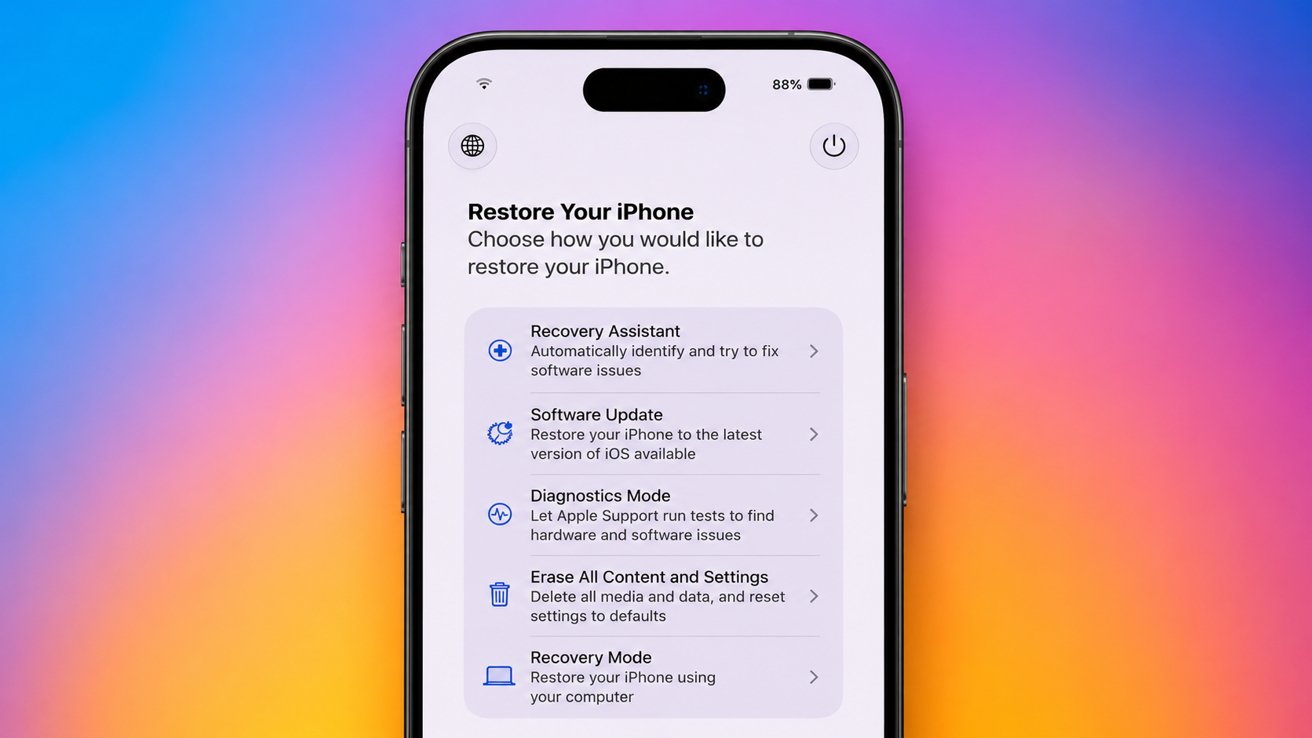
Apple’s iOS 27 recovery screen offers iPhone and iPad users a better first step when a device won’t start, especially without a computer nearby. Here’s how to open it, which repair option to try first, and when computer-based recovery is still safer.
 iOS 27 Recovery Mode
A failed startup is one of those iPhone problems that immediately feels worse than it may actually be. The device can sit on the Apple logo, restart in a loop or refuse to finish booting after an update.
Before iOS 27, most users eventually ended up connecting the device to a computer and working through Recovery Mode. The iOS 27 and iPadOS 27 public betas add a recovery screen that puts several troubleshooting tools directly on the affected device.
The new recovery screen matters most for people who use an iPhone or iPad as their main computer. Recovery Assistant and Software Update may get the device running again without immediately erasing it, while Diagnostics Mode can show whether software recovery is worth attempting.
Continue Reading on AppleInsider | Discuss on our Forums

Garmin is reportedly preparing to launch the Fenix 9, Fenix 9 Pro and Enduro 4 simultaneously this year.
That timeline comes from Garmin Rumors, which reports that Garmin plans to bring all three watches to market together rather than staggering their releases as it has with past generations.
The Enduro 4 stands out within that lineup as the only model expected to retain a memory-in-pixel display, a power-saving screen technology paired with integrated solar cells to extend battery life well beyond typical smartwatch limits.
The standard Fenix 9, by contrast, is expected to ship exclusively with an AMOLED panel, a shift that continues Garmin’s gradual move away from memory-in-pixel screens across its flagship range in recent years.
AMOLED technology delivers deeper contrast and considerably brighter, more accurate colours than memory-in-pixel alternatives, though it also draws noticeably more power, particularly when brightness increases to keep the display legible in direct sunlight.
That trade-off explains why Garmin appears to be splitting its flagship range by display type rather than replacing memory-in-pixel screens outright, keeping the Enduro 4 as a dedicated option for ultra-endurance athletes who prioritise battery life over screen vibrancy.
That AMOLED shift arrives alongside another break from precedent, as Garmin appears set to release the Fenix 9 and Fenix 9 Pro together rather than following the staggered rollout used for the Fenix 8 and Fenix 8 Pro.
The Fenix 8 Pro did not reach the market until several months after the more affordable Fenix 8, a gap that let Garmin treat the Pro model as a distinct, later-cycle upgrade rather than a same-day alternative.
The Fenix 9 Pro is expected to carry over the built-in LTE modem and inReach satellite connectivity that distinguished the Fenix 8 Pro, features that let wearers send messages and location updates without a paired phone nearby.
Garmin Rumors also points to a smaller 43-millimetre case option for the Fenix 9 Pro, expanding beyond the 47-millimetre and 51-millimetre sizes that were the only choices available for the Fenix 8 Pro.
Garmin itself has not issued any official statement on the Fenix 9, Fenix 9 Pro or Enduro 4, however, so take these claims with a pinch of salt for now.

It’s been a big year for AI acquisitions — so big that most of them barely register anymore. Anthropic and OpenAI have each gone on buying sprees, snapping up developer tooling, AI services shops, and product-testing startups to convert model capability into enterprise revenue and extend their reach faster than the other. Which is what made a weekend rumor about Anthropic acquiring robotics startup Physical Intelligence stand out. It spread exceedingly fast, even after a denial from Physical Intelligence’s CEO.
Part of that ties to who’s involved. Physical Intelligence isn’t some obscure robotics shop. It was co-founded by Lachy Groom, an investor-operator whose star has been on the rise in Silicon Valley in recent years; it has raised more than $1 billion (and was reportedly in talks this spring for another $1 billion round at an $11 billion valuation); and its π0.5 model is apparently among the more widely used robot brains in robotics research.
As it turns out, the rumor wasn’t completely spurious. Anthropic and Physical Intelligence actually did hold acquisition talks this spring, according to The Information, so tech blogger Robert Scoble — whose weekend post on X set off the frenzy — may have gotten the specifics wrong without being wrong that something had happened.
Physical Intelligence’s response to the rumor mill wasn’t the world’s most vigorous denial, it should be noted. According to The Information, Physical Intelligence CEO Karol Hausman told employees the reports weren’t true via a Slack message containing a gif of a character from “The Office” shaking her head no.
Groom, for his part, did not respond to TechCrunch’s request for comment, sent Monday night.
Anthropic has made four known acquisitions this year; OpenAI has been more aggressive, acquiring at least 17 companies since 2023. Both are also, of course, now preparing to go public. Anthropic confidentially filed for an IPO on June 1, followed by OpenAI a week later, setting up what could be two of the largest U.S. stock debuts in history.
So why robotics, why now? The likeliest answer is that physical-world understanding may be a prerequisite for superintelligent systems, and no amount of internet text can substitute for it.
OpenAI’s own history here is instructive. It built an early robotic hand that could solve a Rubik’s Cube, then shut the entire robotics group down in 2021, with co-founder Wojciech Zaremba later saying the approach was missing pieces needed for real superintelligence. The team came back in 2024, quietly building a humanoid robotics lab in San Francisco, before CEO Sam Altman made it official in late May, announcing “OpenAI Robotics” was hiring and describing a near-term focus on robots for infrastructure work, with a personal robot for everyone as the long-term goal.
Anthropic hasn’t built anything resembling OpenAI’s hardware lab. What it has done is publish a string of research pieces through its internal group that stress-tests frontier capabilities for safety purposes. That included Project Fetch last November, where Anthropic staff tested how much Claude could help non-experts program a robot dog, and a second phase in June that, according to Anthropic, found a newer model completed the same tasks roughly 20 times faster than the best human-plus-Claude team from the year before.
Buying an existing team with robotics expertise would let Anthropic skip years of work. There’s a possible complication, though. Physical Intelligence was founded in San Francisco roughly two years ago by Groom, former Google researchers, and professors from Stanford and Berkeley, and its early investor base looks a lot like OpenAI’s own, including Khosla Ventures and Thrive Capital. Founders Fund — also a major OpenAI investor — was reportedly involved in Physical Intelligence’s newest funding round earlier this year.
In fact, OpenAI is itself an investor in Physical Intelligence, so it isn’t just a peripheral player; it’s a stakeholder in a company that its chief rival was reportedly in talks to buy very recently.
That raises questions around whether OpenAI’s early investment came with any information rights, or a right of first refusal over a sale to a competitor — the kind of protective provisions that strategic investors sometimes negotiate for precisely this scenario.
That leaves open the possibility that if Physical Intelligence is actually in play, OpenAI — already a shareholder, already close to Groom, already trying to ensure it bests Anthropic in robotics — may have the more obvious claim to it than Anthropic does. We asked OpenAI these questions earlier today and the company didn’t respond.
When you purchase through links in our articles, we may earn a small commission. This doesn’t affect our editorial independence.


Each payout per work will amount to roughly $3,000, to be paid to around 500,000 works.
A US judge has approved Anthropic’s $1.5bn settlement of a major AI copyright lawsuit filed by a trio of authors, setting the record for the largest settlement in copyright law in the country’s history.
In their 2024 lawsuit, authors Andrea Bartz, Charles Graeber and Kirk Wallace Johnson accused Anthropic pirating their copyrighted material to train Claude. “Largescale theft of copyrighted works” is a key component of the company’s business model, they said.
The court found that Anthropic illegally acquired millions of books through shadow libraries, but ruled that the company was protected by fair use when using books to train its AI models. The lawsuit was certified as a class action last July, the first in copyright litigation against AI companies.
Anthropic agreed to settle last August, a month after it claimed that a settlement could present a “death knell” situation for the company.
Divided up between some 500,000 works, each payout per work under the approved settlement will amount to roughly $3,000, which the court pointed out is four-times the statutory damages awarded for “wilful infringement”.
The class includes copyright owners whose works were found in shadow libraries LibGen and PiLiMi, which were downloaded by Anthropic.
In a statement, Anthropic deputy general counsel Aparna Sridhar said that the company is “looking forward to bringing this matter to a close”.
“We reached this settlement in 2025, after the court’s landmark ruling that training AI on books is fair use under copyright law – which remains the law today.
“We are pleased that more than 91pc of authors and publishers covered by the settlement have claimed their share of the payment.”
The settlement received preliminary approval late last September.
Anthropic was valued at $183bn last September after a $13bn Series F round, and nearly a year later, the company is now nearing a $1trn valuation while readying itself for a blockbuster public listing.
For comparison, the $1.5bn settlement makes up roughly 0.8pc of Anthropic’s September valuation and marginally more than 0.1pc of its value after the May raise.
Don’t miss out on the knowledge you need to succeed. Sign up for the Daily Brief, Silicon Republic’s digest of need-to-know sci-tech news.

Mounting evidence suggests Huawei is taking the same approach that saw it build CPUs and AI chips in the past to DRAM in the present.
The Chinese tech conglomerate is allegedly building and operating DRAM fabrication plants on the mainland, bringing it into direct competition with only one major player at the same scale, albeit for a much larger consumer base: Samsung.
Drawing on media reports and postings by semiconductor analysts, Block & Files has published claims (which Huawei currently denies) that the company is potentially building and operating DRAM fabs through a joint venture with Shenzhen-based memory maker SwaySure, giving it effective control over at least 11 different semiconductor fabs in the region.
Despite its ramifications and Huawei’s denials, the claim is hardly new: the first link between the two companies was in 2025, when the Financial Times published satellite images of Huawei’s advanced chip production line that tied it to SwaySure and cited state financial backing for the facilities shown.
Huawei’s purported move did not happen in a void, however; it finds itself in a situation where the Chinese state is increasingly and aggressively defending it not only covertly but overtly, on multiple fronts, as it responds to Washington-backed sanctions that limit and in some cases all but eliminate its ability to access cutting-edge silicon.
The overt part is easy to identify: the Semiconductor Industry Association estimated that Huawei is receiving $30 billion in state funding from the central government and its hometown of Shenzhen to build its chip network, while a separate 2019 estimate put the lifetime figure at US$75 billion in state support.
The government has also effectively barred its tech giants from buying AI chips from AMD and Nvidia while propelling Huawei’s Ascend line to de facto standard in the Chinese market, guaranteeing Huawei revenue it would otherwise have to compete for.
The covert part is much harder to identify, but equally crucial: China also allegedly tolerates a shadow fab network that is, at least on paper, not directly associated with Huawei but is, for all intents and purposes, an arm of the giant, the opacity making it hard to pinpoint the direction and scale of Huawei’s ambitions in the space. This is also why the US resorts to Entity List designations of Huawei’s affiliates: Washington is trying to pierce a veil Beijing built on purpose.
The strongest corroborating signal, ironically, comes from Huawei’s adversary: the US government’s own Entity List designations imply that BIS investigators concluded these companies function as one network, which is as close to official confirmation as is currently available.
Huawei’s move stems from a voracious appetite for AI-centric High Bandwidth Memory (HBM), which sanctions ensure it cannot source directly from international suppliers, with the US having tightened export controls to keep it, at least legally, out of Chinese hands.
While a Huawei that fabs its own DRAM would be a notable leap, it may be more of a potential future supplier to Apple than a direct competitor, as Apple is toying with the idea of buying memory from Chinese makers to ease its own supply issues.
Huawei’s products do, however, compete with Apple in the smartphone segment, with Intel‘s server CPU offerings, and with Nvidia’s AI chips, even as the last of these struggles to find a foothold in what was once one of its largest markets by revenue.
It does seem to have Samsung’s Western position in its crosshairs as it builds toward zero Chinese dependency on suppliers Washington can sanction, but it has a lot of catching up to do to hold its own against the current king of the hill. Samsung holds a 3–4 year lead in HBM, arguably the gap that matters most, over China’s CXMT, while its DRAM lead is much narrower and closing considerably faster against China-based memory makers.
Chinese makers have meanwhile reached relative parity in the NAND flash used in SSDs, an increasingly important space for AI, even as Huawei still relies on SMIC for CPU and GPU fabrication, a process roughly two nodes behind industry leader TSMC.
Huawei, at least on paper, has its own designs but does not fab them itself, leaving that to other specialist firms. But if the report holds true, it just might become the first real challenger to Samsung’s position as chip designer, fabricator, and memory supplier all rolled into one.

Follow TechRadar on Google News and add us as a preferred source to get our expert news, reviews, and opinion in your feeds.

Overview: As social media algorithms come under increasing scrutiny, policies to ban children from services such as Facebook, X, YouTube, and Snapchat are gaining popularity across the globe. France has just become the latest country to pass such legislation – but data suggests the impact of Australia’s earlier ban has been limited.
France’s Parliament gave final approval on Tuesday to a law banning children under age 15 from social media, with the National Assembly voting 279 to 81 after the Senate had approved the text earlier the same day. The vote followed the Assembly’s initial approval of the bill in January by a margin of 130 to 21.
President Emmanuel Macron, who strongly championed the legislation, wants it in effect before the new school year begins in September. The bill also bans smartphone use in high schools but exempts online encyclopedias such as Wikipedia, educational and scientific directories, and open-source software platforms such as GitHub.
The bill enjoyed unusually broad bipartisan support in France’s traditionally divided parliament. Macron fast-tracked the legislation, hailing its passage as a “major step forward” and positioning France as the first country in the European Union to approve a blanket social media ban for minors.

Macron cited data from France’s national public health agency indicating that one in two teenagers in the country spends between two and five hours each day using smartphones. Approximately 90% access the internet via phones daily, and more than half access social media on them.
The president has said the country aims to protect children’s brains from being “manipulated,” in his words, “neither by American platforms, nor by Chinese algorithms.” Lawmaker Laure Miller, who authored the bill, said the legislation firmly establishes that social media is not harmless, arguing it causes children to read less, sleep less, and compare themselves to others more.
With the law now passed, France leapfrogs proposals still moving through other European countries, including Greece, Norway, Spain, and the UK. Greece aims to enforce a ban starting next year, and restrictions for under-16s are set to be introduced into the Norwegian and British parliaments by the end of 2026.
Australia became the first country in the world to attempt such a ban, in December 2025, but recent studies cast doubt on its effectiveness. Australia’s eSafety Commissioner found that roughly seven in ten children who held social media accounts before the ban took effect still retained them three months later, and a study published in the British Medical Journal put the figure as high as 85%.
Regulators say Facebook, Instagram, Snapchat, TikTok, and YouTube have largely failed to enforce the removal of underage accounts. Most teenagers who kept access report never encountering an age-verification check, even though some circumvented restrictions using VPNs or other workarounds. France is also considering restricting VPN use to close a similar loophole.
In response to the noncompliance, the Australian government doubled the maximum penalty for infringing companies to $99 million AUD (about US$68 million). Australia’s internet regulator, eSafety, is currently investigating Facebook, Instagram, Snapchat, TikTok, and YouTube for non-compliance.



London Mayor Sadiq Khan handed a peerage by Keir Starmer alongside 15 other Labour figures… just days before the PM leaves No10


Weekend Open Thread – Corporette.com


The House | The City of London can help the new chancellor deliver growth in every postcode


Young campaigners urge incoming PM to act on outdoor junk food ads

Two July Windows Left: The CLARITY Act’s Senate Fight and What Failure Means


CFTC blocks Kalshi from unwinding Michigan trades after court order


Ripple Payments Joins MiCA With 14 Firms, Does It Mean Anything For XRP?


Nvidia Stock Slips After Big Tuesday Rally as Huang Confirms Vera Rubin Chip Is Now in Production Today


Democrats look to World Cup watch parties to register thousands of voters

Disney’s Most Ambitious Failed Star Wars Attraction Is Coming to SDCC


Ripple wins EU-wide access as ESMA adds it to MiCA register


Grayscale Files For Worldcoin ETF, WLD Registers Sharp Rise


Injective Submits SEC Transfer-Agent Registration to Onchain Ownership Records


Palantir Shares Rise After Expanded Nvidia Partnership and Fresh Analyst Upgrades Ahead of Earnings Day


Sail Virtually Aboard The “Itanic” With IA-64 Emulator
Turtle Beach Command Series KB7 review: a nifty screen-equipped gaming keyboard


Registration is now open for March for Men with Kev 2026


Unregistered fitter used Gas Safe logo on business flyers

New Cornerback Enters Vikings Trade Rumor Mill


Money | Class 12 Economics | CBSE Board Exam 2026-27

You must be logged in to post a comment Login