Tech
LG Display FLiPP OLED Could Make Future TVs Brighter, Longer Lasting, and Cheaper to Build

OLED has spent the past few years getting substantially brighter while Mini LED and the newer RGB backlit LCD technologies have attacked it from the other direction with enormous screens, extreme brightness and increasingly impressive color performance. LG Display apparently has no intention of letting that become a one-sided fight.
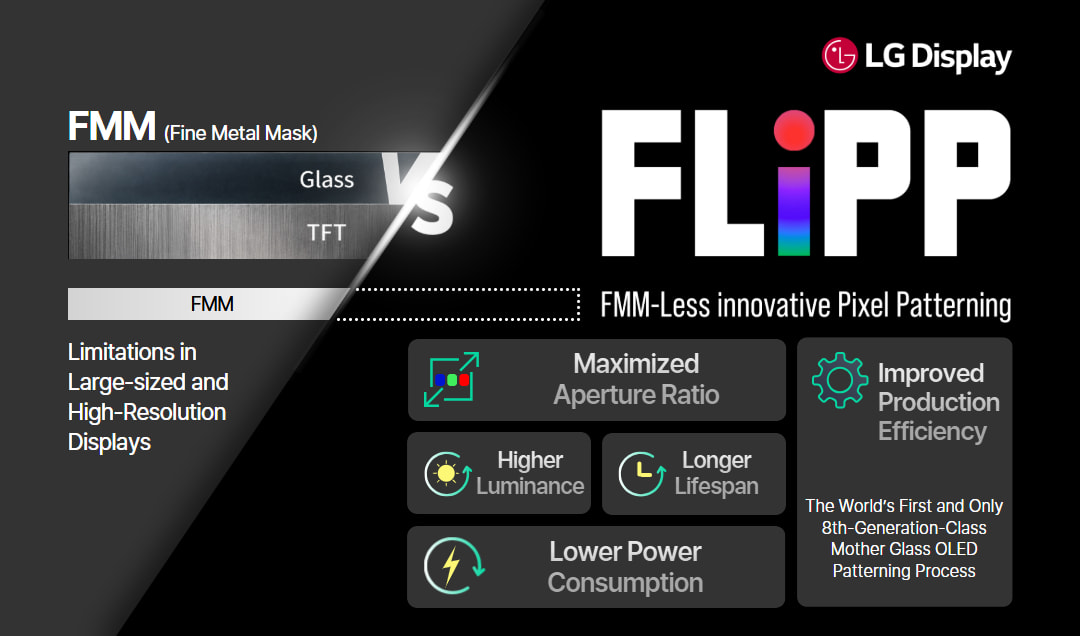
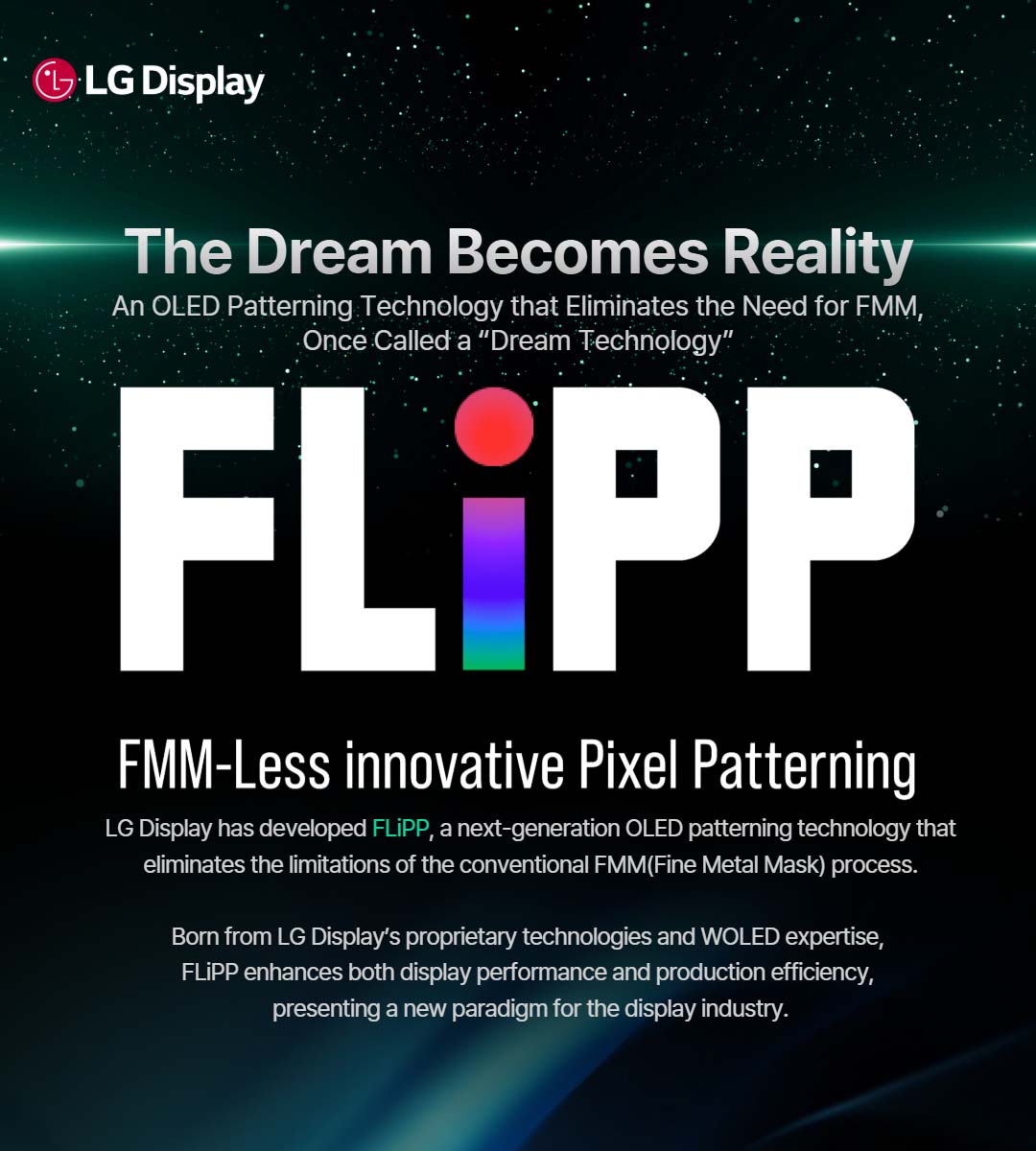
The company has unveiled FLiPP, short for FMM Less innovative Pixel Patterning, a new manufacturing process that eliminates the fine metal masks traditionally used to create red, green and blue OLED pixels. LG Display says the process can improve brightness, panel lifespan and power efficiency while also making OLED manufacturing more flexible and potentially less expensive.
Before anybody starts clearing wall space for a 100 inch FLiPP OLED, there is an important qualification: LG Display has not announced a FLiPP television or a commercial TV launch date. The company says the technology will initially target IT products including tablets and monitors before eventually expanding into everything from 1 inch wearable displays to ultra large TVs. So this is not your next LG OLED TV, but it could have a lot to do with what comes after it.

What Is FLiPP?
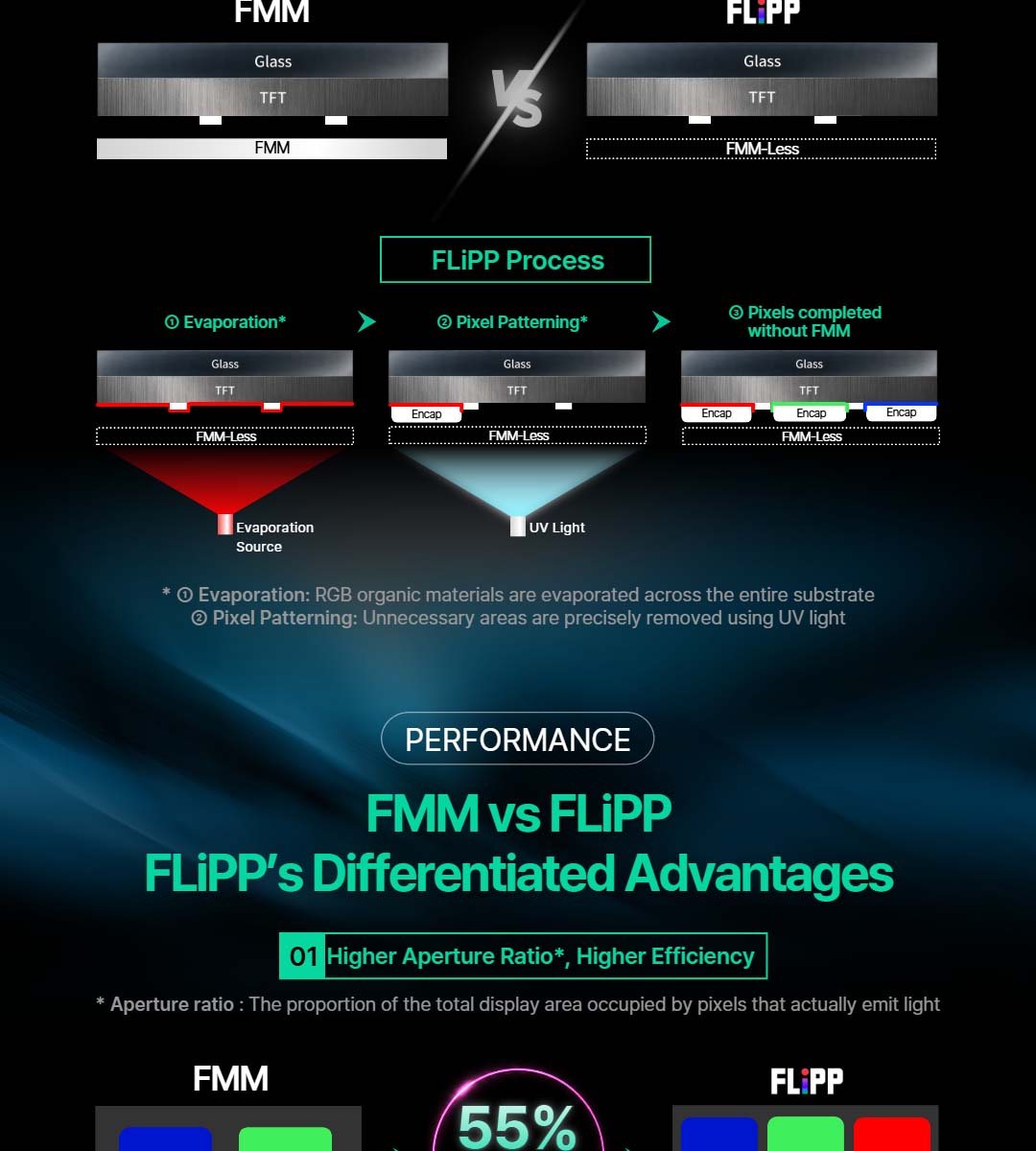
Conventional RGB OLED production commonly relies on a Fine Metal Mask, or FMM, during manufacturing. The easiest way to visualize it is as an extremely precise stencil: red, green and blue organic materials are deposited through microscopic openings in the mask so they land in the correct locations on the panel.
That approach works, but it comes with some expensive baggage. Different panel sizes and resolutions can require different masks, and as those masks become larger, gravity becomes an engineering problem. The metal can sag toward the center, making precise alignment more difficult and potentially creating defects including unwanted color mixing.
FLiPP removes the metal mask entirely. Instead, LG Display applies and positions the RGB OLED materials and then uses photolithography with precision ultraviolet light to remove material from areas where it is not required. The result is more usable pixel area and fewer of the physical limitations imposed by FMM manufacturing.
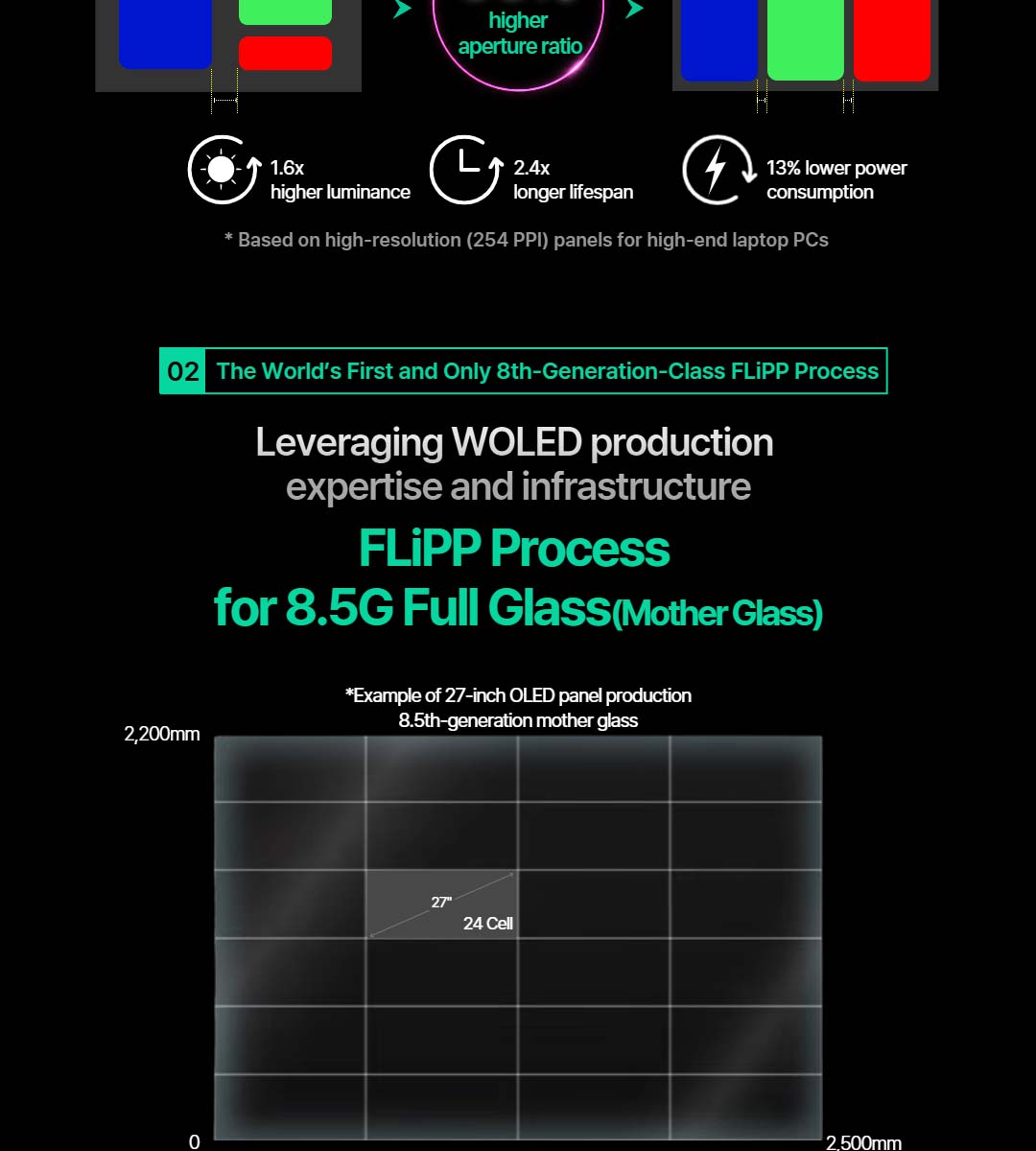
LG Display says FLiPP improves the aperture ratio by approximately 55 percent compared with conventional FMM manufactured OLED panels. Aperture ratio refers to how much of the display’s available surface is actually occupied by active red, green and blue pixels. More active emitting area gives engineers considerably more room to balance brightness, efficiency and longevity.

The Numbers Are Impressive, With an Asterisk
LG Display says FLiPP can enable OLED panels to deliver up to 1.6 times higher brightness, 2.4 times longer lifespan and 13 percent lower power consumption compared with panels produced using FMM under comparable conditions. Those are significant numbers, but they should not be interpreted as a promise that some future television will automatically be 60 percent brighter, last 140 percent longer and consume 13 percent less electricity simultaneously.
OLED panel designers can trade efficiency gains between brightness, power consumption and longevity depending on the product being developed. In other words, these are development and manufacturing advantages that give LG Display considerably more room to decide where that additional performance goes. That flexibility may ultimately matter more than any one headline specification.

Manufacturing May Be the Bigger Story
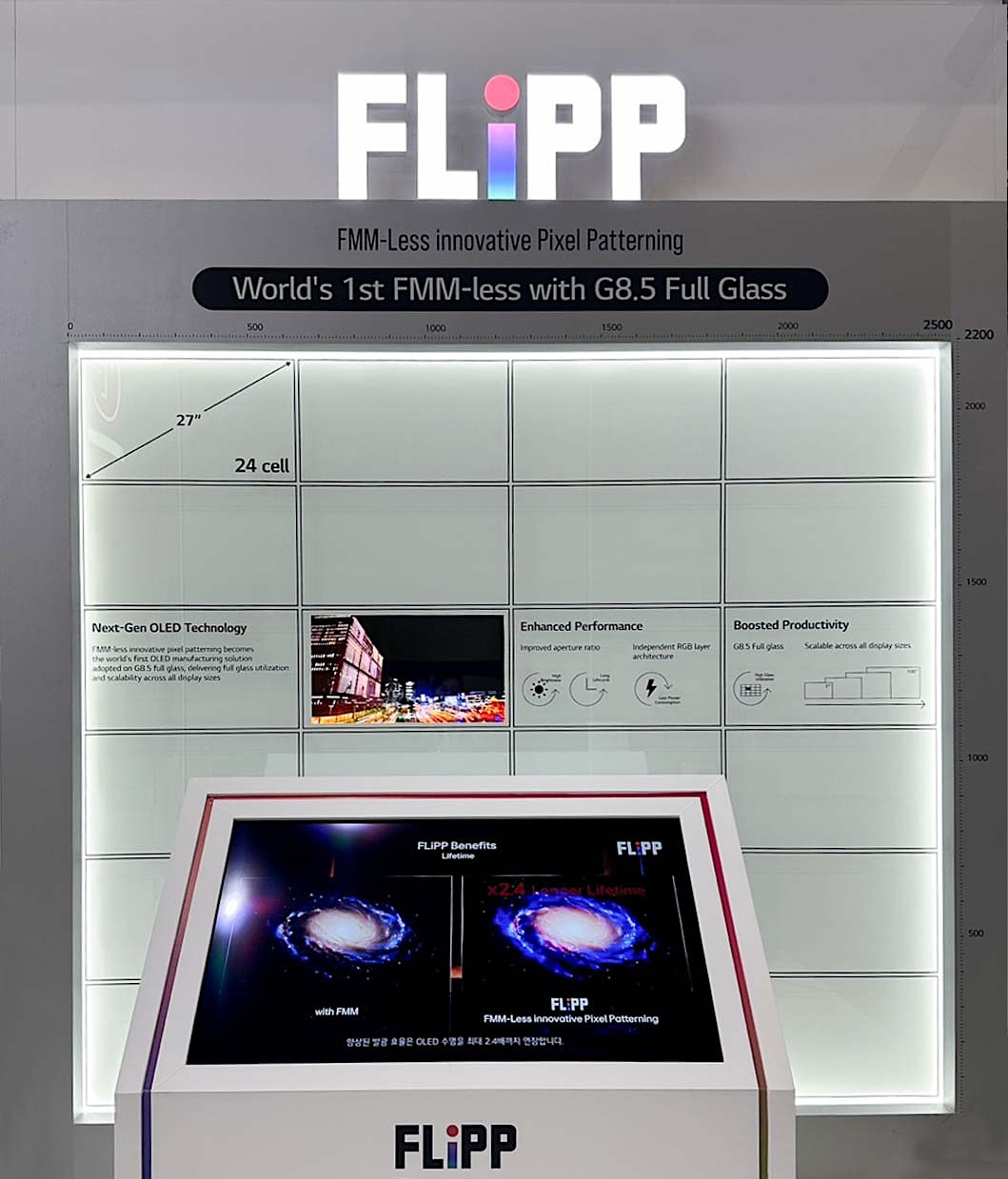
Brightness is going to grab the headline, but manufacturing efficiency could ultimately have a greater impact on consumers. LG Display says it has successfully produced FMM less OLED using an entire 8.5 generation mother glass substrate, rather than cutting the substrate into smaller sections to accommodate the physical limitations of metal masks.
For laptop sized OLED panels, LG says FLiPP can provide up to 64 percent higher mother glass utilization efficiency compared with FMM production or other FMM less methods that require divided substrates. That means less wasted material and potentially higher production output from the same basic sheet of glass.
Lower manufacturing cost does not automatically mean lower retail prices. Anyone who has purchased a flagship television recently has probably noticed that manufacturers remain quite capable of finding somewhere else to spend the savings. But improved yields, fewer specialized masks, better substrate utilization and greater flexibility in panel size all create the conditions necessary for RGB OLED to scale more economically.
And scale has been one of OLED’s biggest problems.
Why This Matters for TVs
We recently looked at the increasingly complicated fight between OLED, Mini LED and RGB backlit LCD TVs, and 2026 has made one thing fairly obvious: premium LCD is not quietly going away. Hisense, Samsung, TCL, Sony and LG have all pushed RGB based backlighting as a way to extract higher brightness, broader color reproduction and very large screen sizes from LCD, while LG itself now sells Micro RGB evo televisions alongside its OLED lineup.
Meanwhile, LG Display’s current Tandem WOLED technology has pushed OLED brightness significantly higher. Its latest Primary RGB Tandem 2.0 TV panel is rated by LG Display for peak brightness of up to 4,500 nits under its specified test conditions, while retaining OLED’s pixel level light control and perfect black capability.
FLiPP attacks a different problem. Rather than adding another layer or changing the television’s processing, it changes how RGB OLED panels can be manufactured in the first place. LG Display says the technology is theoretically scalable from approximately 1 inch to 100 inches, without being tied to the same FMM size and resolution restrictions.
That could eventually make large format RGB OLED far more practical, which is important because the premium television battle increasingly comes down to compromises. OLED still delivers exceptional black levels, pixel level illumination and wide viewing angles, while RGB Mini LED and Micro RGB LCD televisions can push brightness considerably harder and scale to enormous sizes, but still require an LCD layer and local dimming system.
A manufacturing process that allows RGB OLED to become brighter, more efficient, longer lasting and easier to manufacture at much larger sizes would change that equation. LG still has to prove FLiPP can deliver those advantages at commercial yields and consumer friendly prices, but the potential is substantial.
What Happens Next?
LG Display demonstrated FLiPP at IMID 2026 in Busan, South Korea, where the company described it as a new OLED manufacturing platform rather than a single product technology. The first intended applications are tablets and monitors, with LG Display saying it plans to expand the process into additional display categories later, including wearables, VR and AR hardware and eventually ultra large televisions.
There is currently no announced FLiPP TV model, price or consumer availability date. That makes this considerably less exciting for anyone shopping for a television this weekend, but potentially far more important for where OLED goes over the next several years.
The Bottom Line
The television industry has spent the past two years making LCD technology behave more like OLED. RGB Mini LED and Micro RGB displays have dramatically improved color reproduction, brightness and local dimming while pushing screen sizes well beyond what most OLED buyers can currently afford.
FLiPP suggests OLED manufacturers may have another answer. By eliminating the Fine Metal Mask from RGB OLED production, LG Display believes it can improve usable pixel area, reduce manufacturing constraints and give panel designers significantly more flexibility with brightness, lifespan, power consumption and screen size.
The technology still has to make the jump from impressive manufacturing demonstration to high volume consumer product, but if LG Display can make FLiPP work economically at television scale, the next battle between OLED and RGB backlit LCD may look very different. Just don’t postpone buying a television because somebody put “100 inch OLED” in a headline. We are not there yet.



Reference: lgdisplay.com
You must be logged in to post a comment Login