Tech
LIVEBOX to Debut Single Box Audio System at High End Vienna 2026

High End Vienna 2026 is less than two weeks away, but the all-in-one audio arms race already looks like one of the show’s bigger stories. Focal and Naim have already pushed the category hard with the Mu-so Hekla, a single-box Dolby Atmos system with 15 drivers, ADAPT room tuning, streaming, and TV integration. DALI has now entered the same fight with the VEGA, a premium wireless system with 400 watts of amplification, BluOS streaming, HDMI ARC, adaptive stereo processing, and placement-aware setup.
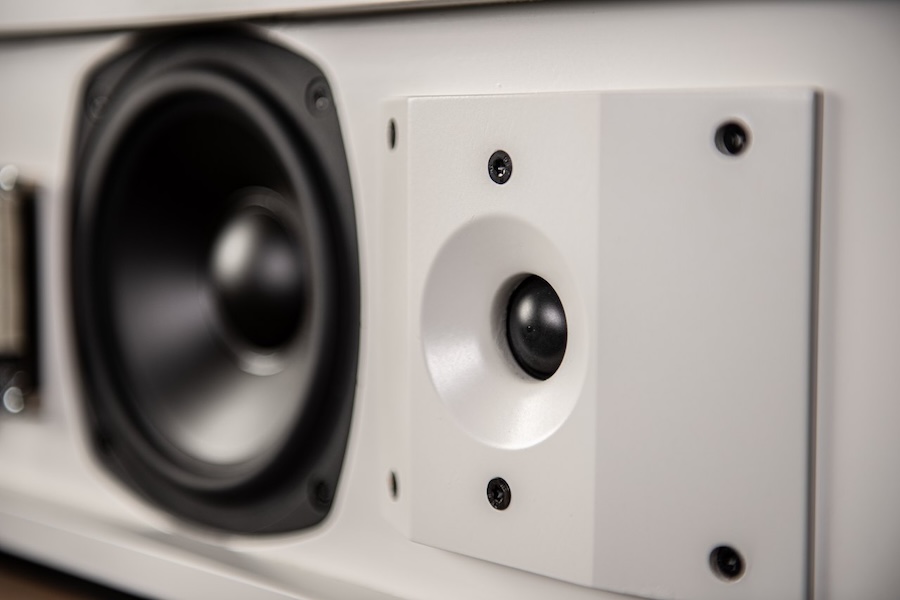
Now Weiss Engineering, PSI Audio, and Illusonic are bringing LIVEBOX to High End Vienna, and this one sounds less like lifestyle audio with better manners and more like a professional audio ambush in a living-room-friendly enclosure. The LIVEBOX combines built-in loudspeakers, DAC, amplification, streaming, and advanced spatial processing inside a single ultra-wide chassis designed to create a more immersive 3D listening experience.
Is this a trend? At this point, calling it a trend feels a little timid. Established brands are clearly betting that the future of high-performance audio will not be limited to racks full of separates, cable looms, and domestic negotiations over loudspeaker placement. The new battlefield is the serious single-box system: fewer components, smarter processing, easier setup, and enough engineering muscle to make traditional hi-fi nervous. LIVEBOX may not be aimed at the casual Bluetooth speaker crowd, but it does suggest that one-box audio is no longer shorthand for compromise. It is becoming a statement category.
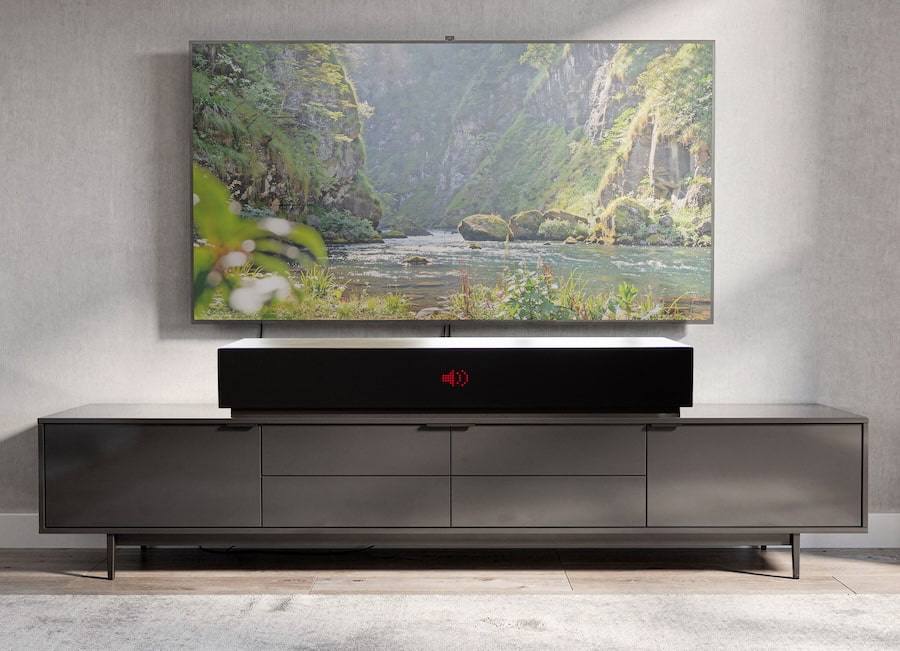

The LIVEBOX Experience
LIVEBOX is being positioned as a different kind of all-in-one music system, built around Illusonic’s True Ambience Technology. Rather than relying on conventional stereo speaker placement, LIVEBOX uses advanced signal processing to create a wider and more spatially precise presentation from a single enclosure.
The core idea behind True Ambience Technology is controlled channel separation. By reducing the acoustic crosstalk that occurs when the left and right channels from traditional stereo speakers reach both ears, the system is designed to improve image focus, spatial placement, and the sense of recorded ambience. That should be especially useful with well-recorded live material, orchestral recordings, and small jazz ensembles where space, depth, and venue cues matter.
Tuning
LIVEBOX is designed to work as a self-contained system, but the final result will still depend on the room. Walls, furniture, ceiling height, listening distance, and placement can all affect tonal balance, imaging, and bass behavior.
To address that, LIVEBOX includes room-tuning options and signal processing presets that allow its output to be adjusted for the listening environment. That matters because a single-box system still has to interact with a real space, not the acoustically perfect showroom that exists only in marketing departments and architectural renderings.
For more demanding installations, LIVEBOX also offers an on-site setup service. That allows the system to be adjusted around the specific room and the listener’s tonal preferences.
Installation Flexibility
LIVEBOX is also designed with room integration in mind. Beyond the technical pitch, this is still a large visible object that has to live in someone’s home, studio, or dedicated listening space. To make that easier, the enclosure can be painted in almost any color, giving owners the choice to make it blend into the room or become part of the design. Stealth mode or statement piece. Your decorator can argue with your installer later.
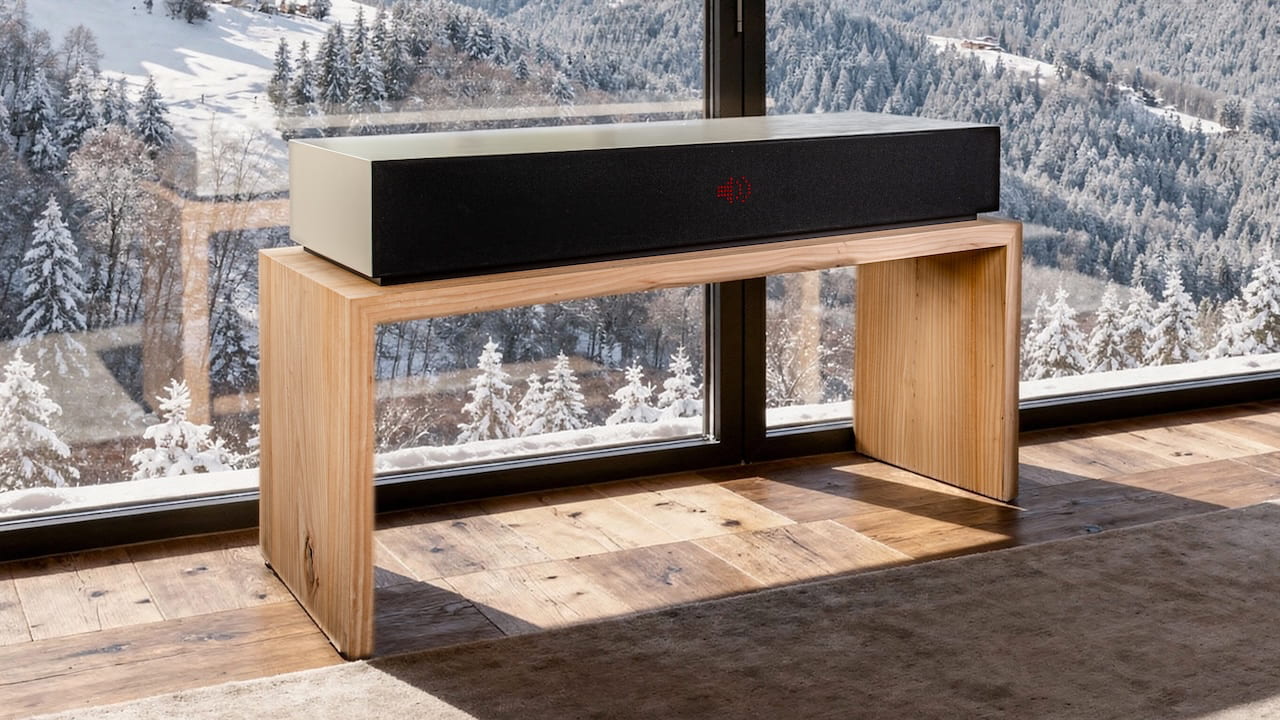
For placement flexibility, LIVEBOX is also offered with two optional stand solutions: LIVEBASE Classic and LIVEBASE Adjustable. Those options give users more control over positioning and height, which can matter for both sound and visual integration. A single-box system may reduce the number of components in the room, but placement still matters.
LIVEBASE Classic

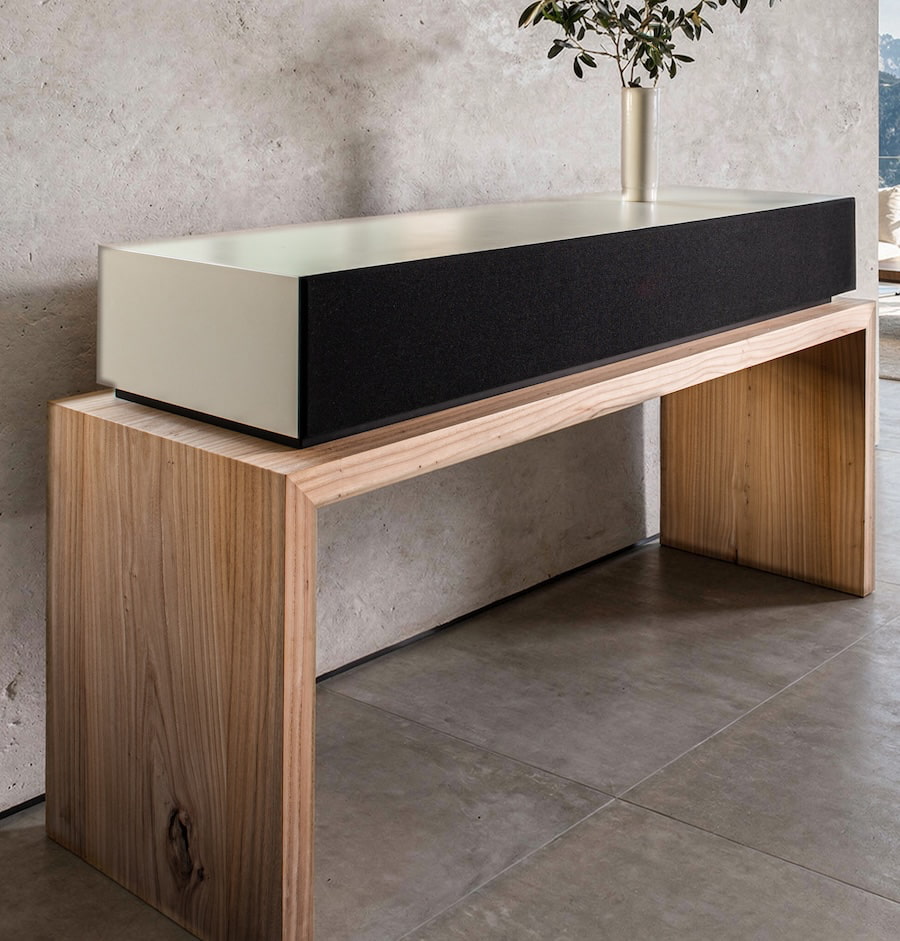
The LIVEBASE Classic stand provides a fixed-height platform for LIVEBOX and is designed for a clean, integrated installation. It includes built-in cable management to help keep wiring organized and less visible.
The stand can be customized by finish and height, allowing it to better match the room and the owner’s design preferences. Once specified, it remains the fixed-height option, unlike the adjustable stand.
The LIVEBASE Classic has a footprint of 159 x 50 cm, or approximately 62.6 x 20 inches.
LIVEBASE Adjustable

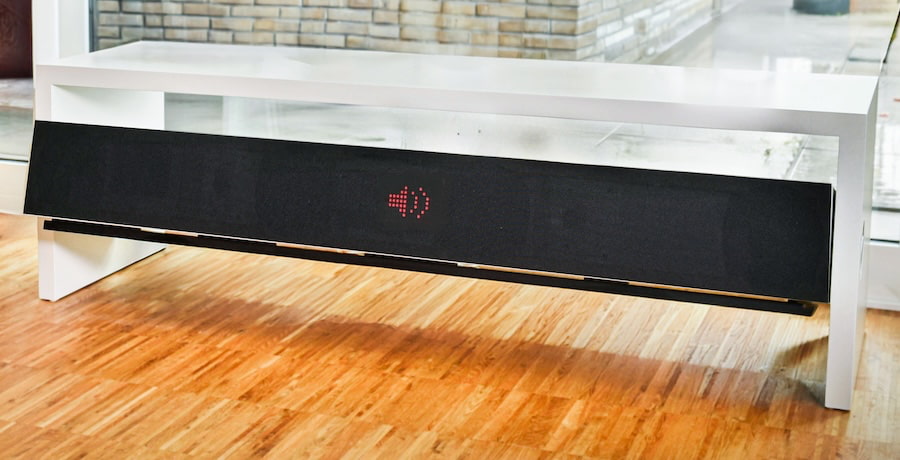
The LIVEBASE Adjustable stand allows users to adjust the LIVEBOX’s angle for the listening position. It also includes integrated cable channels to help keep wiring organized and less visible.
Like the Classic version, the stand can be customized by finish and height to better match the room and installation requirements. Unlike the fixed-height Classic stand, the LIVEBASE Adjustable gives users additional control over positioning after installation.
The Swiss Connection

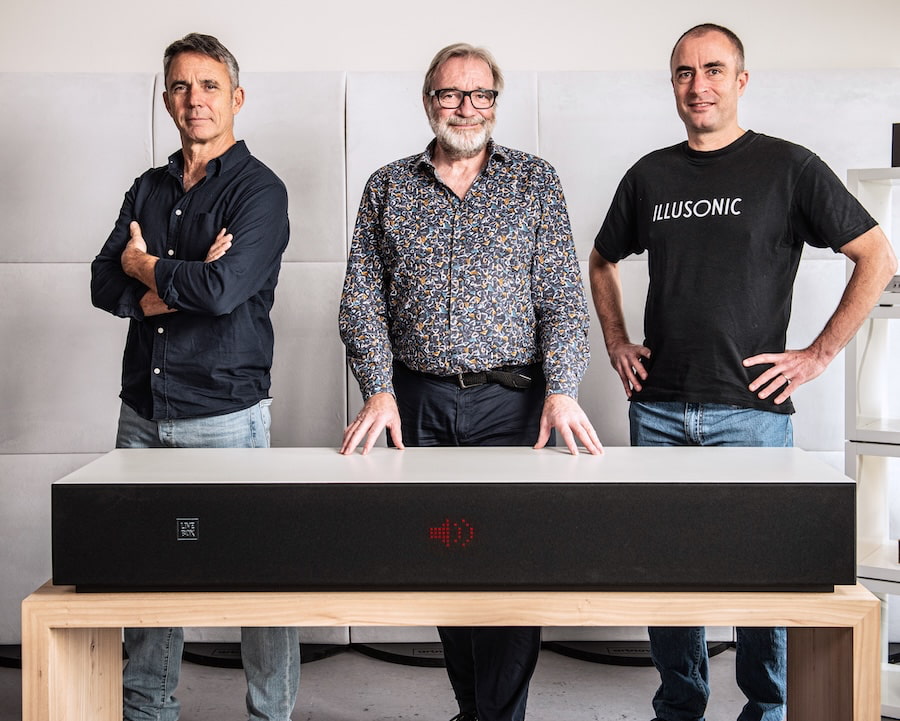
The companies behind LIVEBOX are three Swiss audio specialists: Weiss Engineering, PSI Audio, and Illusonic.
Weiss Engineering brings deep experience in digital audio, with a long-standing reputation in professional mastering and high-end audio circles. Its role in LIVEBOX centers on digital signal processing, conversion, and the kind of precision engineering the brand is known for.
PSI Audio contributes the loudspeaker and acoustic hardware expertise. The Swiss company is best known for active, analog loudspeaker designs used in professional studio environments, with a focus on accuracy, low distortion, and controlled dispersion.
Illusonic brings expertise in spatial audio, psychoacoustics, and human hearing perception. The company’s True Ambience Technology is central to LIVEBOX’s approach to stereo imaging and crosstalk reduction.
Together, the three companies have developed LIVEBOX as a single-box system that combines loudspeakers, digital processing, amplification, streaming, and spatial audio technology in one platform.
Development Timeline
- 2017: A working prototype of LIVEBOX was shown at High End Munich.
- 2018: LIVEBOX returned to High End Munich with further refinement of the integration between PSI Audio’s acoustic hardware and Weiss Engineering’s digital processing.
- 2019: The XTC crosstalk-canceling algorithm developed for LIVEBOX was adapted for smaller standalone Weiss processors, including the DSP501 and DSP502.
- 2026: Weiss showcased the production-ready LIVEBOX at the Klangschloss event in Greifensee, presenting the system’s spatial imaging and room-correction capabilities ahead of High End Vienna 2026.

LIVEBOX Specifications
| LIVEBOX Model | Livebox |
| Product Type | All-in-One Audio System |
| Price | €20,000 |
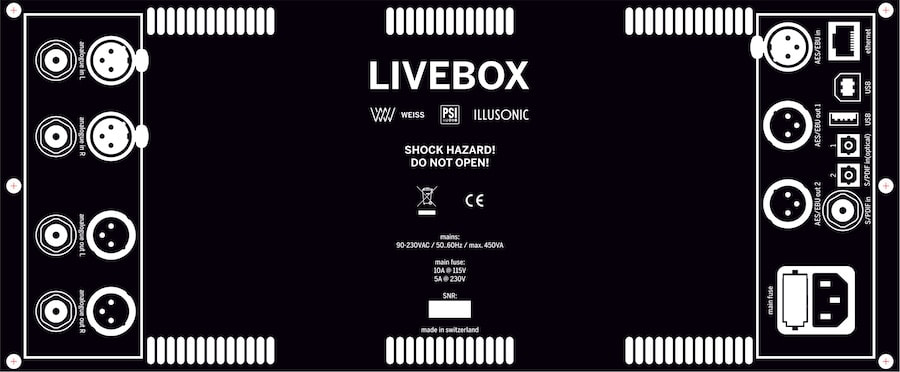
| Digital Inputs | AES/EBU or S/PDIF inputs via XLR, RCA, or two TOSLINK connectors |
| USB input | 1 x USB-B |
| UPnP streaming input | via RJ45 network port |
| Analog Inputs | XLR or RCA |
| LIVEBOX Output | Stereo 3-way analog outputs to the built-in amplifiers/loudspeakers |
| Digital Output | Two stereo AES/EBU outputs via XLR |
| Analog Output | Stereo analog output via XLR and RCA for multi-room setups or additional devices such as subwoofers, preamplifiers, active speakers, or headphone amplifiers |
| Signal Processing (Source-specific algorithms) | De-esser for reducing harsh “s” sounds
Creative equalizer (tone shaping) Vinyl emulation Loudness equalizer for balanced sound at low listening levels Dynamic adjustment for consistent volume across playlists Room equalizer Crosstalk-cancelling algorithm for a lifelike, spacious soundstage |
| Control & Remote | Infrared remote for power, volume, input/output selection, and signal-processing presets
Web-browser control for detailed configuration Gesture sensor for mute/unmute and power control |
| Roon Ready (after Roon certification) | Yes |
| Qobuz Connect | Yes |
| UPnP streaming | Compatible with applications such as JPLAY, MconnectHD, Audirvana, and others |
| Display | 4-digit dot-matrix |
| Installation Options | On a sideboard Inside a sideboard Below a TV LIVEBASE Adjustable LIVEBASE Classic |
| Power Supply | Power via IEC mains connector |
| Dimensions (WDH) | 150 x 43.x 22 cm
59 x 16.9 x 8.66 inches |
| Weight | 14.8 kg / 32.6 lbs |

The Bottom Line
Do not call the LIVEBOX a soundbar just because it has the general silhouette of one. That would miss the point. This is a €20,000 Swiss-built, all-in-one single-box audio system aimed at music listeners who want advanced spatial imaging, integrated amplification, DAC functionality, streaming, and room tuning without assembling a conventional system from separate components.
What makes LIVEBOX unique is the collaboration behind it. Weiss Engineering, PSI Audio, and Illusonic are not lifestyle audio brands looking for shelf space next to the television. Their pitch is built around serious digital signal processing, active loudspeaker engineering, and Illusonic’s crosstalk-limited True Ambience technology, which is designed to improve stereo imaging and recorded ambience from one enclosure. That makes LIVEBOX more of a high-end music system than a TV-first soundbar.

But the missing pieces matter. There is no HDMI support, no Bluetooth, and Roon Ready status is pending a firmware update. Weiss and its partners also have not provided full details on the driver configuration or system output power. At this price, those omissions will raise questions, especially when Focal’s Mu-so Hekla sells for $3,600 with Dolby Atmos, 15 drivers, TV integration, streaming, and ADAPT room tuning, and DALI’s VEGA comes in at $4,500 with 10 drivers, 400 watts of amplification, BluOS, HDMI ARC, Bluetooth, AirPlay 2, TIDAL Connect, and Spotify Connect.
The price comparison gets even more uncomfortable when you look at the high-end soundbar category. Lyngdorf’s passive SB-75 is expected around $5,000 without required amplification, while the Steinway Lyngdorf Model S soundbar sits at $17,000. LIVEBOX is still more expensive than both, and it arrives without the same home theater positioning.
That does not make LIVEBOX irrelevant. It makes it very specific. This is for listeners who care more about spatial stereo playback, room-aware tuning, and Swiss engineering than HDMI switching, Dolby Atmos logos, or Bluetooth convenience. High End Vienna is the right place to make that case, but at €20,000, LIVEBOX has to do more than sound different. It has to prove that eight years of development created something the market actually wants, not just something the engineering department finally finished.
Price & Availability
The LIVEBOX has not been released for sale yet, but when it becomes available, the projected price is expected to be €20,000 (US pricing not available at this time).
In the meantime, the LIVEBOX will be demonstrated at High End Vienna 2026 from June 4 – 7 on Level 1, booth 1.70 of the Austria Center Vienna.
For more information: livebox.audio/en
You must be logged in to post a comment Login