Tech
Luxman Enters Its Second Century with the D-100 SACD Player and L-100 Integrated Amplifier

Very few consumer A/V brands reach a century in operation. Luxman has already passed that mark, and the D-100 SACD/CD Player and L-100 Integrated Amplifier are not presented as anniversary products, but as current production models that define the company’s direction going forward.
With these components, Luxman is positioning itself clearly within the high-end segment. Rather than competing on volume or feature density like Denon or Yamaha, Luxman continues to operate in a smaller category alongside manufacturers such as McIntosh, Pass Labs, and Mark Levinson. The emphasis is on long term ownership, conservative engineering, and product lifespans measured in years rather than release cycles.
Integrated amplifiers have been part of Luxman’s core lineup since the 1960s, and the L-100 CENTENNIAL Integrated Amplifier makes that continuity explicit. The recent wave of new products is not driven by short update cycles or marketing pressure, but by development timelines extended during the pandemic.
Luxman has always felt aspirational in the best possible way. The gear is built to an exceptionally high standard, it sounds better than 98 percent of what is out there, and it manages to do so without requiring the sale of a child or a second mortgage. This is not part of the new wave of affordable high end audio and no one is pretending otherwise. The D-100 and L-100 are eye watering in terms of price, but they would land on any serious endgame short list without hesitation. Luxman lasts. It has soul. And yes, it still has VU meters that look unapologetically sexy because great engineering should never be afraid to look the part.
L-100 Integrated Amplifier Defines Luxman’s Vision for Its Second Century

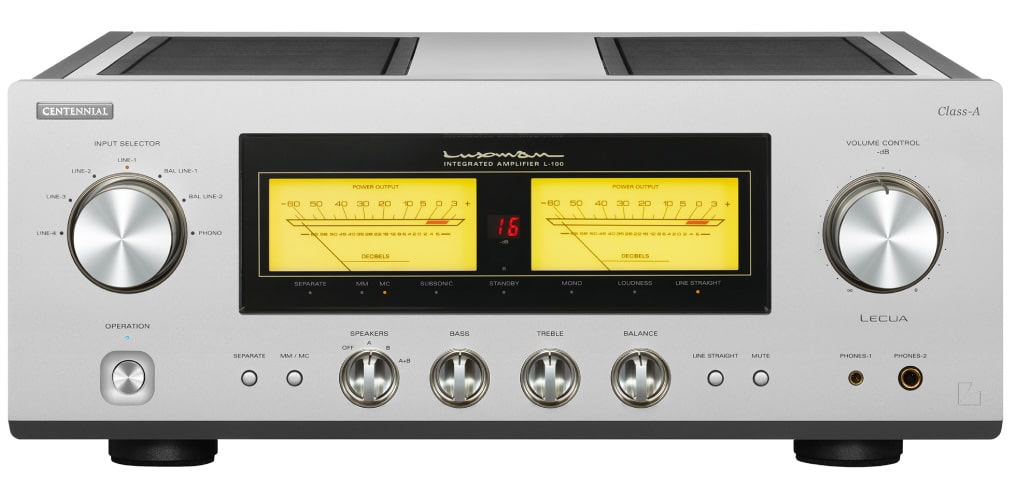
The Luxman L-100 Integrated Amplifier sits at the center of the company’s 100 Centennial Series and makes its priorities clear immediately. Rated at 20 watts per channel into 8 ohms and 40 watts into 4 ohms, the numbers are modest on paper and entirely deliberate in execution. This is a pure Class A integrated amplifier, not Class A/B and certainly not Class D. Every watt is delivered in continuous Class A operation, with the output devices conducting at all times. That choice favors linearity and tonal density over headline power, and it comes with the usual side effect. Yes, the amplifier runs warm. That is the cost of admission. JCP&L will be thrilled. Your accountant? Not so much.
The output stage uses a triple parallel bipolar push pull configuration supported by a substantial power supply built around a custom EI core transformer and eight large filter capacitors totaling 80,000 microfarads. This foundation provides the current stability required for Class A operation and helps explain the L-100’s damping factor of 300, which is unusually high for a low power Class A design. Luxman has focused on maintaining control and composure rather than chasing wattage for its own sake.

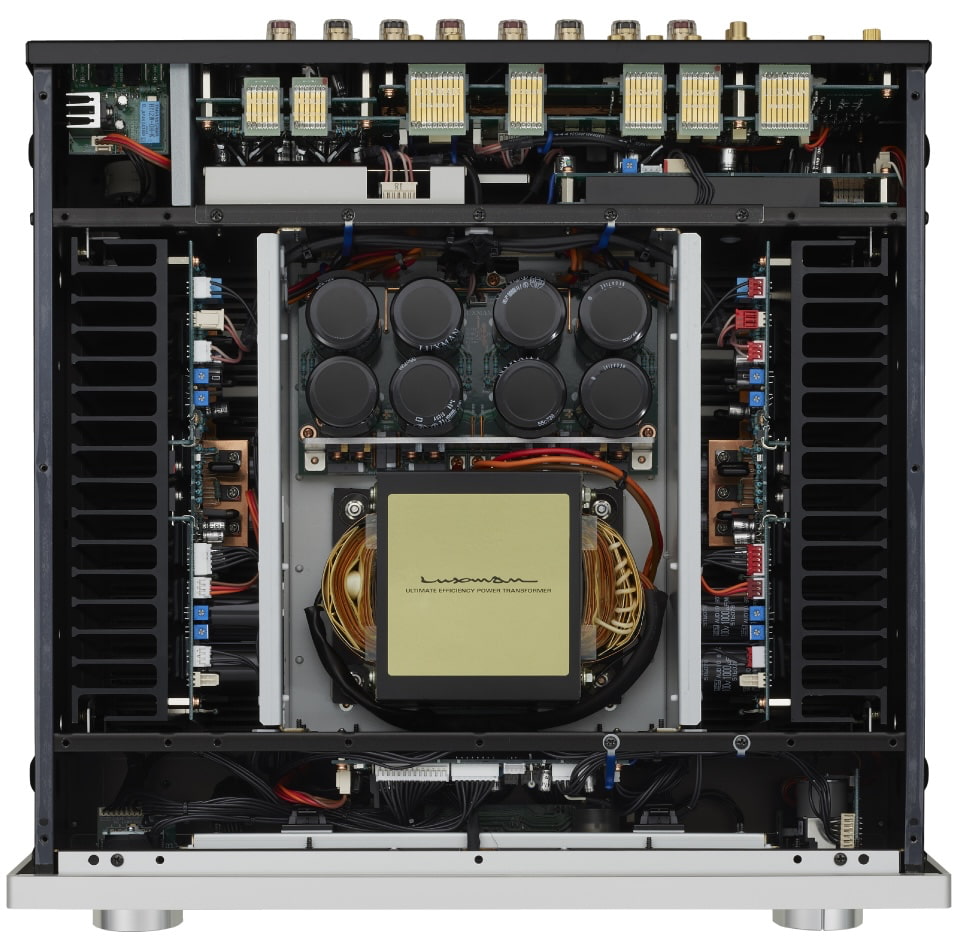
At the circuit level, the L-100 employs version 1.1 of Luxman’s LIFES architecture, an evolution of the company’s long running Only Distortion Negative Feedback concept first introduced in 1999. Instead of applying global feedback indiscriminately, LIFES concentrates on detecting and correcting distortion components only.
By using multiple field effect transistors in parallel at the input of the error detection circuit, Luxman aims to reduce distortion and improve linearity while preserving the tonal weight and harmonic structure the brand is known for. The result is extremely low measured distortion without the flattened dynamics often associated with heavy feedback designs.
Volume control is handled by the LECUA1000 attenuator, an 88 step electronically controlled system integrated directly into the amplifier circuitry. Shortened signal paths and discrete buffer stages derived from Luxman’s flagship preamplifiers are used to minimize degradation and maintain drive capability.

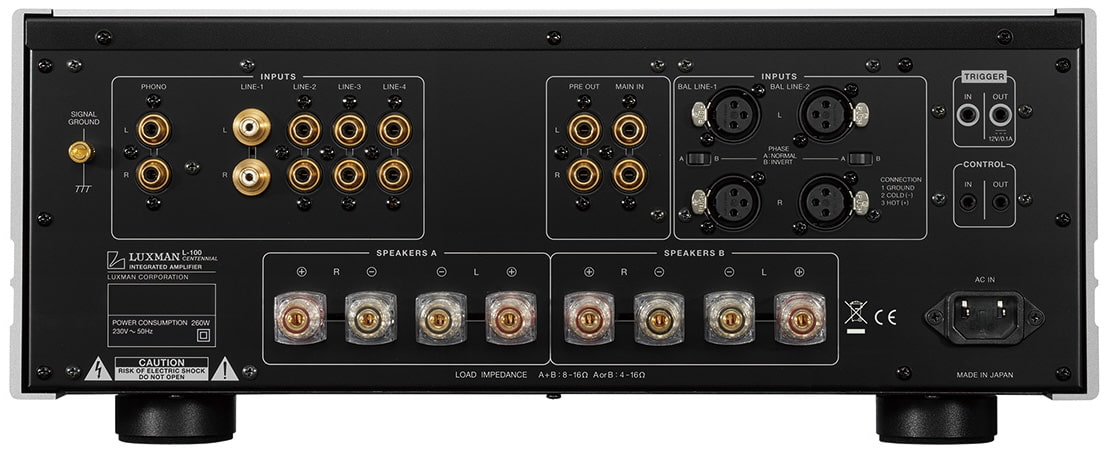
Connectivity is comprehensive and practical, with balanced and unbalanced line inputs, a high quality MM/MC phono stage, pre out and main in connections, dual speaker terminals for bi-wiring, and both 6.3 mm and 4.4 mm headphone outputs. The balanced headphone output uses independent grounds for left and right channels to improve separation and imaging.
Measured performance is consistent with Luxman’s design goals. Total harmonic distortion is specified at 0.005 percent or less at 1 kHz into 8 ohms, rising modestly to 0.015 percent across the full audio band. Frequency response extends from 20 Hz to 100 kHz on line inputs, while signal to noise ratios reach 98 dB for line level sources. Power consumption is substantial at 260 watts under operation, which again comes with the territory when running true Class A.
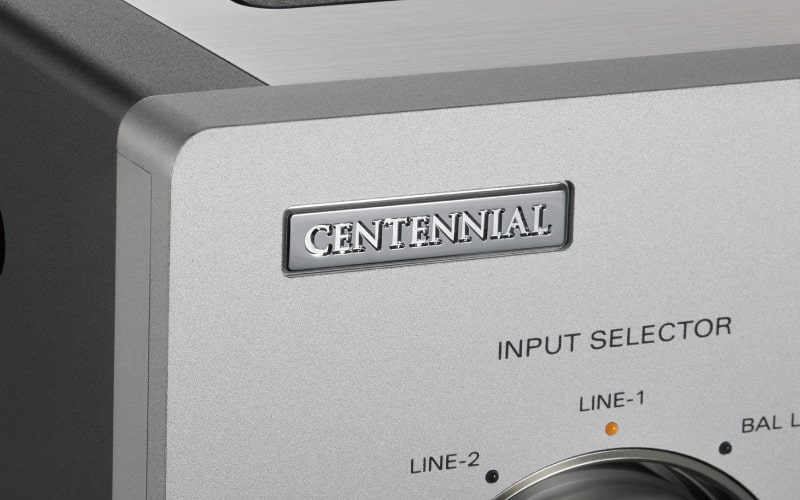
Physically, the L-100 weighs 25.4kg (56 lbs) and looks exactly like what it is. A serious integrated amplifier built to last. The illuminated VU meters, brushed aluminum front panel, and restrained proportions are unmistakably Luxman, but the execution is modern rather than nostalgic. Meter illumination and the central LED volume display can be switched off if desired, though few owners are likely to do so.
The L-100 is not chasing trends, efficiency charts, or lifestyle friendly form factors. It is a deliberately uncompromising Class A integrated amplifier that prioritizes operating purity, long term ownership, and musical density over convenience. It will get warm. It will not be cheap. And it sounds like Luxman doing exactly what Luxman has always done best. If that does not move the needle for you, this was never your amplifier anyway.
D-100 SACD CD Player Reminds the Streaming Crowd Why Discs Still Matter

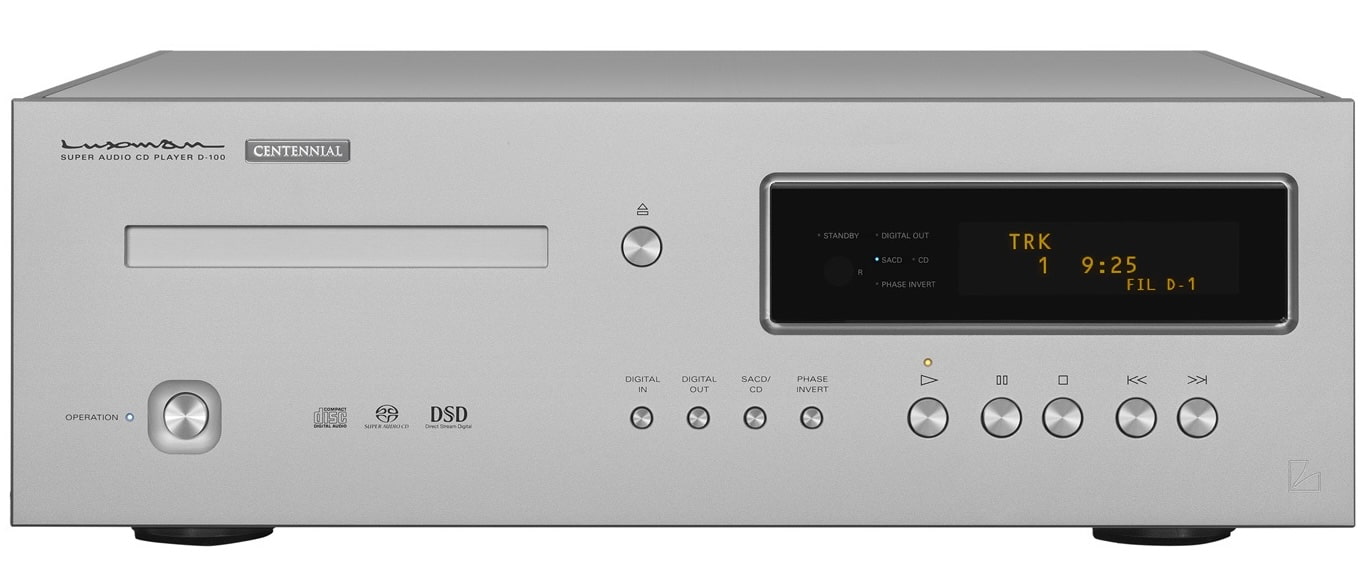
The Luxman D-100 SACD/CD Player serves as the digital counterpoint to the L-100 integrated amplifier and replaces the long-running D-10X. This is not a light refresh or a cosmetic update. Luxman has rebuilt its disc playback platform from the ground up, making it clear that optical media remains a core part of its second century rather than a legacy side project.
At the heart of the redesign is Luxman’s proprietary LxDTM-i disc transport, short for Disc Transport Mechanism improved. The mechanism is fully integrated into the main chassis and reinforced with thick aluminum side frames, a steel top plate, and an aluminum base to improve rigidity and suppress vibration. Mechanical stability remains a defining Luxman priority and the D-100 doubles down on that philosophy with cast-iron isolation feet.
Digital conversion is handled by ROHM BD34302EKV DACs in a true dual-mono configuration. File playback support is extensive, with PCM up to 768 kHz at 32-bit and DSD up to 22.5 MHz via USB, alongside native SACD and CD playback. Luxman has also focused heavily on clocking and noise management, employing a large quartz oscillator and ultra-low phase-noise circuitry to stabilize timing across both disc and file-based playback paths. Assuming it follows the same functional model as the D-10X, the D-100 can also operate as an external DAC for a high-end streamer.
The analog output stage mirrors the amplifier’s approach, using the latest LIFES 1.1 circuit in a fully balanced configuration feeding both RCA and XLR outputs. A large monochrome OLED display replaces the fluorescent panel used on earlier Luxman players, modernizing usability without turning the front panel into a glowing tablet. Luxman has not yet confirmed whether coaxial or optical digital outputs will be included as they were on the outgoing model, and the company has remained quiet on several secondary specifications.
Physically, the D-100 is very similar in size and mass to the D-10X, but weighs 3kg (6.6 lbs) more at nearly 50 lbs. The D-100 measures 440mm (17.3″) wide by 154mm (6.1″) high by 420mm (16.5″) deep.
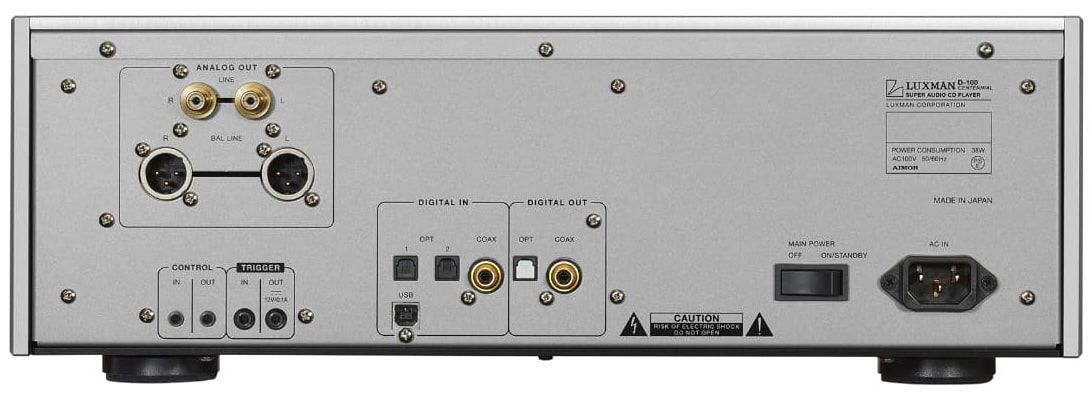

The D-100 exists because Luxman believes physical media still deserves reference-level hardware. It is unapologetically heavy, mechanically serious, and engineered for listeners who still care about discs and are willing to pay for the privilege. Streaming may be convenient. Luxman is clearly arguing that convenience is not the same thing as satisfaction.
The Bottom Line
Luxman’s D-100 and L-100 are not casual upgrades, they are statement pieces built for listeners who still care about engineering, longevity, and physical media. The L-100 is a pure Class A integrated that prioritizes operating purity over bragging rights, pairing Luxman’s LIFES 1.1 feedback architecture with the LECUA1000 88 step attenuator, a serious power supply, and full featured connectivity including balanced inputs and MM MC phono.
The D-100 is its matching digital counterweight, a ground up disc platform with the LxDTM-i transport, dual mono ROHM conversion, fully balanced analog output using LIFES 1.1, and the kind of mechanical overbuild that makes most modern disc players feel like toys.
Who is this for. The buyer who wants an endgame two box front end, values build quality and service life, and still spins discs while using a streamer as a transport when it suits the mood. Not for bargain hunters, not for minimalists, and definitely not for anyone who thinks a phone and a soundbar counts as a system.

Price & Availability
The products will begin shipping in North America in late May or June 2026, with their first public showing expected at AXPONA in April.
North American retail pricing is set at $11,995 for the L-100 and $18,995 for the D-100. Nothing about this pairing suggests affordable. It suggests buy it once, keep it for 20 years, and stop shopping.
For more information: luxman.com
You must be logged in to post a comment Login