









A maximum severity vulnerability in the FreeScout helpdesk platform allows hackers to achieve remote code execution without any user interaction or authentication.
The flaw is tracked as CVE-2026-28289 and bypasses a fix for another remote code execution (RCE) security issue (CVE-2026-27636) that could be exploited by authenticated users with upload permissions.
Researchers at OX Security, a company that secures applications from code to runtime, say that an attacker can exploit the new vulnerability by “sending a single crafted email to any address configured in FreeScout.”
According to them, the fix attempted to block dangerous file uploads by modifying filenames with restricted extensions or those starting with a dot.
Advertisement
The OX Research team discovered that a zero-width space (Unicode U+200B) could be placed before the filename to bypass the recently introduced validation mechanism, since the character is not treated as visible content.
Subsequent processing removes that character, allowing the file to be saved as a dotfile, and hence, still triggering CVE-2026-27636 exploitation by completely bypassing the latest security checks.
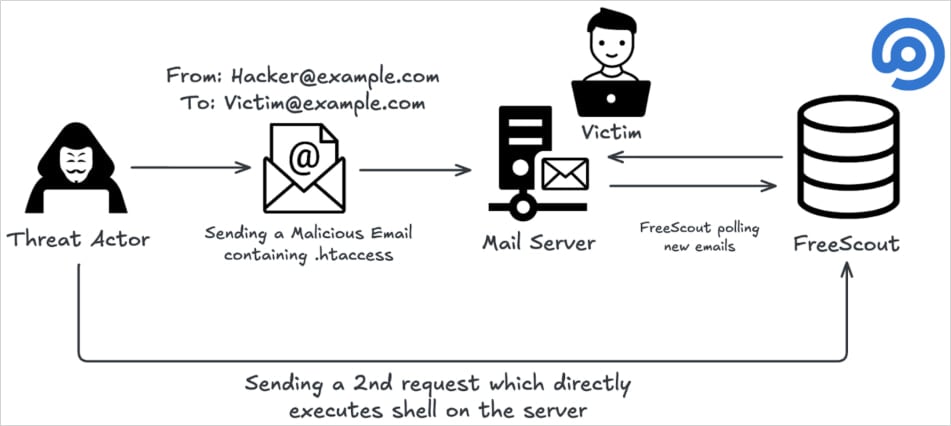
The exploitation chain Source: OX Research
Making matters worse, CVE-2026-28289 can be triggered by a malicious email attachment delivered to a mailbox configured in FreeScout, the researchers say.
The program stores the attachment in “/storage/attachment/…,” enabling the attacker to access the uploaded payload through the web interface and execute commands on the server without authentication or user interaction, making it a zero-click vulnerability.
Advertisement
“A patch bypass vulnerability in FreeScout 1.8.206 allows any authenticated user with file upload permissions to achieve Remote Code Execution (RCE) on the server by uploading a malicious .htaccess file using a zero-width space character prefix to bypass the security check,” the vendor says in a security bulletin.
FreeScout is an open-source help desk and shared mailbox platform used by organizations to manage customer support emails and tickets. It’s a self-hosted alternative to Zendesk or Help Scout.
The project’s GitHub repository has 4,100 stars and over 620 forks, and OX Research reports that its Shodan scans returned 1,100 publicly exposed instances, indicating it’s a widely used solution.
CVE‑2026‑28289 affects all FreeScout versions up to and including 1.8.206 and was patched in version 1.8.207, released four days ago.
Advertisement
The FreeScout team warned that successful exploitation of CVE‑2026‑28289 may result in full server compromise, data breaches, lateral movement into internal networks, and service disruption. Hence, immediate patching is advised.
OX Research has also recommended disabling ‘AllowOverrideAll’ in the Apache configuration on the FreeScout server, even when on version 1.8.207.
No active exploitation of CVE‑2026‑28289 has been observed in the wild as of writing this, but given the nature of this flaw, the danger of malicious activity starting soon is very high.
Malware is getting smarter. The Red Report 2026 reveals how new threats use math to detect sandboxes and hide in plain sight.
Download our analysis of 1.1 million malicious samples to uncover the top 10 techniques and see if your security stack is blinded.
Looking for the most recent Mini Crossword answer? Click here for today’s Mini Crossword hints, as well as our daily answers and hints for The New York Times Wordle, Strands, Connections and Connections: Sports Edition puzzles.
Today’s Mini Crossword was a bit tricky. I was thrown off by 1-Down, as it turns out there are multiple slow-moving creatures whose names would fit in a five-letter space. Read on for all the answers. And if you could use some hints and guidance for daily solving, check out our Mini Crossword tips.
If you’re looking for today’s Wordle, Connections, Connections: Sports Edition and Strands answers, you can visit CNET’s NYT puzzle hints page.
Google has announced a notable shift in how Chrome updates will roll out. Starting September 2026, the Chromium-based browser will move to a two-week release cycle. In practice, that means a new major Chrome version every 14 days, though Google notes that early-stage builds and experimental channels will follow slightly different rules. Read Entire Article Source link
Smartphone design is pretty much the same in 2026. You get a slab of metal and glass with a big, bulky camera module on the back, and there’s only so much you can do with it. Infinix seems to have looked at that trend and said, “Screw it.” That’s because, to design its new flagship phone, the Hong Kong-based smartphone maker called in the legendary Italian design firm Pininfarina. For the uninitiated, these guys were a coachbuilder responsible for designing some of the most iconic cars, including the Ferrari 250 GT and the Testarossa.
Pininfarina has employed some of that expertise to design the Infinix Note 60 Ultra. So, how is it different? Instead of a large camera bump, Infinix has opted for an aluminum unibody design with what it calls the world’s first Uni-Chassis camera module. The entire rear panel is formed from a single sheet of Corning Gorilla Glass Victus, creating a smooth, uninterrupted surface. The display is a 1.5K Ultra HDR panel with a 144Hz refresh rate and up to 4500 nits of peak brightness.
The design includes a “Floating Taillight” element on the back that lights up when the phone powers on. Like the new Xiaomi 17 series, there’s also a hidden Active Matrix display embedded in the rear panel that can display notifications, icons, or a pixel-style virtual companion. As expected, colors on the Note 60 Ultra are inspired by Italian racecars, including Torino Black, Monza Red, Amalfi Blue, and Roma Silver.
Pretty Outside, Powerful Inside
Infinix isn’t leaving any stone unturned with the Note 60 Ultra. It’s powered by the MediaTek Dimensity 8400 Ultimate chipset built on a 4nm process. For context, the processor houses one Cortex-A725 core running at 3250 MHz, three Cortex-A725 cores running at 3000 MHz, and four Cortex-A725 cores running at 2100 MHz. Coupled with 12GB of RAM and 256GB of storage, the performance should be good enough for an AnTuTu score of over 1.6 million.
XOS 16, based on Android 16, will run the show, and it introduces a redesigned interface called GlowSpace. The software also integrates several AI-driven tools, including an Advanced Health Monitor for tracking vitals, AI-powered file organization, and an adaptive knowledge base that evolves based on user behavior. The company has promised three years of major Android updates and five years of security patches.
Advertisement
Another neat feature of the Note 60 Ultra is support for two-way satellite calling and messaging. It allows users to stay connected even when they’re outside traditional cellular coverage. This could be particularly useful in remote locations or during network outages.
Battery life is handled by a massive 7,000mAh silicon-carbon battery, which Infinix says has self-healing capabilities that can restore up to 1% of battery health every 200 charging cycles. It’ll be very interesting to test that feature long-term. Charging is fast, too. The device supports 100W wired charging and 50W wireless charging.
Cameras
Despite the not-so-huge camera bump, the Note 60 Ultra packs a triple-camera setup headlined by a 200MP Samsung ISOCELL HPE sensor. It’s paired with a 50MP Samsung ISOCELL JN5 periscope telephoto camera and a 112-degree ultra-wide camera.
The telephoto system supports multiple zoom levels, including a 2x optical crop, 3.5x optical zoom, and up to 7x lossless digital zoom. Infinix says the system can reach up to 100x zoom for long-distance shots. The phone also supports Ultra HDR capture using Infinix’s XDR Image Engine, which should improve dynamic range and preserve details, though I’m yet to test its capabilities myself.
It was plainly obvious when RFK Jr. decided to fully remake ACIP, the CDC committee that advises the nation on immunization schedules and practices, that it was done so to place Kennedy sycophants that would enact his batshit theories on vaccinations. ACIP, now chockablock with anti-vaxxer, anti-science grift-gremlins, has been slowly chipping away at decades of good medical practice around immunization. The administration has already altered the recommended vaccine schedules for COVID and Hep B, while appearing to potentially question polio vaccines as well. It has been, to be pointed, an unmitigated shitshow thus far.
But at least ACIP has managed to color inside the lines of its own mandate to date. That appears to be about to change, as reporting indicates that ACIP’s meeting next month will put COVID vaccine injuries on the agenda.
Dorit Reiss, a vaccine policy expert at the University of California Law San Francisco, said the panel does not typically focus on vaccine injuries.
“Vaccine injuries are not a direct part of the committee’s mandates,” Reiss said in an email. “When they make vaccine recommendations, they should consider vaccines risks, and new risks may lead to changed recommendations; but that’s not directly about vaccine injuries.”
This isn’t to suggest that ACIP completely disregards risks associated with vaccinations, as Reiss mentions. ACIP does make changes to vaccination schedules and recommendations based on macro-data it is provided for specific vaccines. But discussions about the prevalence and validity of claims of vaccine injury are well outside ACIP’s purview. To use but one facile piece of evidence of that, you can review the CDC’s own webpage about what ACIP’s purpose and program does. You will notice that there is not a single reference to vaccine injury within it. Nor does the ACIP page that outlines its own charter. There you will see vague references to ACIP’s duties include the “consideration” of “vaccine safety”, but that is the macro-data I referenced earlier, not a deep dive into the specific topic of vaccine injury.
Advertisement
Vaccine injury is a serious topic, for which the Vaccine Injury Compensation System (VICP) was created in the 1980s. Consulting in lawsuits and writing about vaccine injuries is how Kennedy made millions of dollars. Expanding VICP, a stated goal of his, and using ACIP to add validity to those expansions, is a great way for Kennedy and his allies to make more and more money from these types of lawsuits immediately, or once he’s out of government.
It’s just another grift, powered by hand-picked muppets willing to do his bidding in ACIP.
“Some committee members have made repeated claims about Covid vaccine harms that were either unsupported by verifiable data or reflected clear mischaracterizations of the existing scientific literature,” said Michael Osterholm, director of the Center for Infectious Disease Research and Policy at the University of Minnesota. Last year, Osterholm launched the Vaccine Integrity Project, which serves as an alternative source of vaccine information to the CDC.
“If the committee intends to revisit vaccine safety questions, it has an obligation to do so transparently and rigorously,” he said. “Given past misstatements, members do not deserve the benefit of the doubt.”
No, they most certainly do not. You may not think that questions about COVID vaccines are all that important any longer. We’ve moved on, you may think, from this novel virus being a major issue in our lives. And for some of us, that is true. I am very pro-vaccination, but I’m not getting every booster out there.
Advertisement
But that’s not really what this is about. Kennedy wants ACIP to spotlight supposed COVID vaccine injuries in a way that will certainly come with questionable evidence at best. Not out of concern for public health, mind you. But almost certainly for money.
The Samsung Galaxy S26, OnePlus 15, and Google Pixel 10 all land within shouting distance of each other on price, run the same operating system, and target roughly the same buyer. But spend any real time with them and it becomes clear that each one is making a completely different argument for why you should hand over your money.
This piece breaks down where each phone genuinely earns its price tag — hardware, software, cameras, battery, and everything in between — so you don’t have to figure it out the hard way.
Price and availability
The Galaxy S26 and OnePlus 15 both start from $899 for the 256GB variants — OnePlus steps to $999 for the 512GB storage variant, the S26 goes higher to $1,099. Samsung launched February 25, with the phone actually in stores from March 11, 2026.
The Pixel 10 undercuts both at $799 for 128GB — and that’s the launch price. Google released it back in August 2025, which means it’s had months of discounts piled on top.
Advertisement
Galaxy S26 vs. OnePlus 15 vs. Pixel 10: Tech specs
Specifications
Galaxy S26
OnePlus 15
Pixel 10
Dimensions
149.6 x 71.7 x 7.2 mm
161.4 x 76.7 x 8.1 mm
152.8 x 72 x 8.6 mm
Weight
167g
211g / 215g
204g
Build
GG Victus 2 front & back, aluminum frame
GG Victus 2 front, aluminum frame, glass/fiber back
Octa-core (1 x 3.78 GHz X4 + 5 x 3.05 GHz + 2 x 2.25 GHz)
GPU
Adreno 840
Adreno 840
PowerVR DXT-48-1536
RAM
12GB
12GB / 16GB
12GB
Storage
256GB / 512GB
256GB / 512GB / 1TB
128GB / 256GB
Storage Type
UFS 4.x
UFS 4.1
UFS 3.1 / UFS 4.0
OS
Android 16, One UI 8.5
Android 16, OxygenOS 16
Android 16 (Stock)
Update Promise
7 major OS upgrades
4 years OS, 5 years security
7 major Android upgrades
Cameras – Main
50MP, f/1.8, 1/1.56″, OIS
48MP, f/1.7, 1/2.0″, OIS
Ultrawide
12MP, f/2.2
50MP, f/2.0
13MP, f/2.2
Telephoto
10MP, f/2.4, 3x optical
50MP, f/2.6, 3.5x optical
10.8MP, f/3.1, 5x optical
Video
8K@24/30fps, 4K@30/60fps
8K@30fps, 4K@120fps
4K@60fps
Selfie Camera
12MP, f/2.2, dual pixel PDAF
32MP, f/2.4, AF
10.5MP, f/2.2, PDAF
Selfie Video
4K@30/60fps
4K@60fps
4K@60fps
Speakers
Stereo
Stereo, Hi-Res 24-bit/192kHz
Stereo
Wi-Fi
Wi-Fi 7 (tri-band)
Wi-Fi 7 (tri/dual-band)
Wi-Fi 6E (dual-band)
Bluetooth
5.4
6.0 (aptX HD, aptX Adaptive, LHDC 5)
6.0 (aptX HD)
NFC
Yes
Yes
Yes
USB
USB-C 3.2, DisplayPort 1.2
USB-C 3.2, OTG
USB-C 3.2
Satellite
Yes
No
Yes (SOS)
Fingerprint
Under-display, ultrasonic
Battery Capacity
4,300 mAh
7,300 mAh (Si/C)
4,970 mAh
Wired Charging
25W (55% in 30 min)
120W (50% in 15 min)
30W (55% in 30 min)
Wireless Charging
15W
50W (proprietary)
15W (Qi2)
Starting Price
$899.99 (256GB)
$899.99 (256GB/12GB)
$799 (128GB)
Top Config
$1,099.99 (512GB)
$999.99 (512GB/16GB)
$899 (256GB)
Samsung Galaxy S26: The most complete AI suite on a smartphone
Tom Bedford / Digital Trends
At 7.2mm, the S26 is the slimmest phone in this comparison — noticeably so next to the OnePlus 15’s 8.1mm and the Pixel 10’s 8.6mm. Honestly, I usually prefer function over form, but the fact that S26 maintains the slimmest profile and yet provides flagship performance, is something that makes me want to change by beliefs.
The 6.3-inch 120Hz AMOLED is punchy and bright at 2,600 nits peak (I’ve used the display on the Galaxy S25, with no real-world issues or problems). What makes Samsung’s chip different is the “for Galaxy” customization — Samsung works directly with Qualcomm to tune the CPU, GPU, and NPU specifically for One UI.
Tom Bedford / Digital Trends
Galaxy AI was already the most feature-complete AI suite of any Android phone before the S26 shipped. With One UI 8.5, Samsung widened that gap further — adding Now Nudge (context-aware screen suggestions), Now Brief (personalized daily digest), and text-prompt-based Photo Assist edits, while expanding existing tools like Audio Eraser to work inside third-party apps like Instagram and YouTube, and upgrading Smart Call screening to full live-transcription with text replies.
It goes without saying, but Galaxy AI actually offers more features than one can possibly remember and use on a day-to-day basis. But it is better to have it and not need it than to need it and realize that other brands are doing much better (I wasn’t talking about the iPhone 17 at all).
Tom Bedford / Digital Trends
On top of that, DeX — a full windowed desktop when plugged into a monitor — has no equivalent on either the OnePlus 15 or Pixel 10. Seven years of operating system updates is probably more than you’d need, given that users change their phone every three to five years anyway.
OnePlus 15 clearly wins the hardware battle
The OnePlus 15 doesn’t win on software depth or AI features — it’s here because the hardware it ships with at $899 is genuinely difficult to argue against.
Nadeem Sarwar / Digital Trends
First things first, the phone comes with both IP68 and IP69K ratings — the second one means it can handle high-pressure water jets, something neither the S26 nor the Pixel 10 can claim. Neither I nor any other careful user would want to put that rating to test, but it’s there, just in case.
The OnePlus 15 runs a 6.78-inch FHD+ AMOLED at 165Hz — the highest refresh rate in this comparison, and the first display above 1080p to hit that number. Back that display up with a dedicated 3200Hz touch sampling chip and, ideal for fast-paced games.
Advertisement
Nadeem Sarwar / Digital Trends
Under the hood, it’s the Snapdragon 8 Elite Gen 5 — same silicon as the S26, minus Samsung’s custom prime core overclock. The camera system puts a 50MP sensor behind all three lenses — main at f/1.8, ultrawide, and a 3.5x periscope telephoto — a hardware consistency the other two don’t match.
OxygenOS 16, like the other Chinese skins atop Android 16, reminds me of Apple’s Liquid Glass interface on iOS 26. The standout is Mind Space (with Google Gemini integration) — a personal AI knowledge hub where a three-finger swipe saves anything on screen instantly: articles, photos, voice memos, screenshots. The physical Plus Key gives one-press access to it from anywhere on the phone.
Nadeem Sarwar / Digital Trends
Battery is where this phone just runs away from the other two — 7,300mAh against the S26’s 4,300mAh and the Pixel 10’s 4,970mAh — it’s not a close fight. Use it lightly and two days between charges is genuinely on the table. OnePlus also throws the 120W charger in the box, which neither competitor does.
Google Pixel 10: Cleanest Android and most consistent cameras
At 204g and 8.6mm, the Pixel 10 is the heaviest and thickest phone here — Google clearly isn’t chasing the slim phone crowd, and the 6.3-inch 120Hz OLED, IP68 rating, and Gorilla Glass Victus 2 are quite standard at this point.
Nirave Gondhia / Digital Trends
The Tensor G5 is where things get interesting. Built on TSMC’s 3nm node — a deliberate departure from Samsung’s fabs that plagued earlier Tensors with heat issues — it still trails the Snapdragon 8 Elite Gen 5 in raw benchmarks. Google isn’t trying to win that fight. What they built instead is an NPU that’s 60% stronger than the G4’s, runs Gemini Nano 2.6x faster, and keeps 20-plus AI features running locally on the chip itself.
The AI suite includes Magic Cue (cross-app contextual suggestions), Voice Translate (real-time on-device call translation in your own voice), Scam Detection (Gemini Nano-powered call screening), Call Notes (auto transcription with post-call task suggestions), and Pixel Screenshots (searchable, NotebookLM-connected screenshot library).
Speaking of which, the Pixel 10’s camera — 48MP main, 13MP ultrawide, telephoto — doesn’t impress on paper. Never has. But Google has spent three years building a reputation for the most natural, accurate shots of any Android phone without you touching a single setting, and that’s still true here.
Advertisement
Nirave Gondhia / Digital Trends
It is the stock Android experience and the cameras that I’d buy the Pixel 10 for, not anything else. Battery is 4,970mAh on 30W wired charging — slowest in this comparison. However, it supports Pixelsnap wireless charging (Qi2-compatible).
Apple has officially released the Studio Display XDR, and those who expect the best from their work now have a seriously enticing new alternative right on their desk. A 27-inch screen with 5K resolution (5120 by 2880 pixels) is a powerhouse of detail, providing stunning clarity in every part of the image.
The Mini-LED backlighting separates the image into 2,304 individual ‘zones’ that can be fine-tuned to perfection, resulting in smooth blacks and eye-popping highlights with no glow visible, even near the edges. If you’re a fan of HDR content, you’ll be pleased to know that peak brightness can reach 2,000 nits, while conventional dynamic range remains a decent 1,000 nits, ideal for seeing what’s going on in those bright conference rooms.
RETINA-LIKE 5K RESOLUTION: Experience 5120×2880 clarity with 218 PPI, delivering ultra-sharp details and smooth gradients. View details with more…
ACCURATE & RELIABLE COLOR MANAGEMENT: 98% P3 and 2000:1 contrast ensure precise color accuracy with deep blacks and vibrant tones, perfect for VFX and…
MAC-COMPATIBLE THUNDERBOLT4: Seamlessly delivers up to 90W power, 40Gbps transfers, and supports two 5K or one 8K display when used with Thunderbolt…
Color and contrast are also on par with the best displays currently available, with a contrast ratio of 1,000,000:1, so expect to see shadows that reveal hidden details and bright regions that remain as vibrant as the moment they were recorded. Furthermore, the P3 wide gamut is fully covered, with additional Adobe RGB compatibility for all you print and design folk, and a generous 80% or so of the Rec. 2020 region to boot, which is a huge assist if you’re working on difficult HDR projects. Try as you might, you’ll find no shortage of clever little reference modes, including one for HDR photography in P3-D65, as well as some DICOM presets that will come in handy for medical imaging, but you’ll need to go get those specific calibration tools cleared first, as they are still pending.
Advertisement
Motion is silky smooth owing to a 120Hz refresh rate and Adaptive time, which alternates between 47Hz and 120Hz to stay perfectly in time with whatever you’re watching. Scrolling through your photo libraries or previewing video edits should feel as smooth as silk on compatible hardware. However, Apple Silicon chips of the older M1, M2, or M3 variety are stuck at a mere 60Hz, and Intel Macs won’t run it at all, so you’ll need one of those shiny new M4 or later systems to get the full effect.
The connectivity suite is based around a pair of Thunderbolt 5 ports, two of which provide high-speed data and allow you to daisy-chain an extra monitor or two. You’ll also get up to 140w of electricity to charge a 16-inch MacBook Pro with a single cable, as well as two USB-C ports for connecting peripherals as needed. The display’s stand allows for tilt and height adjustment, as well as a beautiful smooth counterweight that makes the whole thing feel like it’s floating in midair; however, you may forgo the stand and use a VESA mount if you prefer.

Speaking of kit, the Studio Display XDR’s six-speaker audio setup at is seriously impressive, with Spatial Audio carefully adjusted to offer crisp sound with some great bass. It also includes a 12MP Center Stage camera to follow you around during calls or to show off your setup to friends and family, as well as an equally compact three-mic array that will easily pick up your voice.
Finally, the Studio Display XDR costs $3,299 for the standard glass version, which is a little less than the previous Pro Display XDR and includes a slew of modern features such as a higher refresh rate and improved dimming, as well as a snazzy new camera and speakers.
A group that includes Apple, Google, and others has sent a letter to the US Department of Defense concerning Anthropic’s supply-chain risk designation, clearly concerned about how that might affect future tech contracts.
The tech industry could be affected by arbitrary use of supply-chain risk designations
Anthropic took a moral stand against the United States government’s request for unrestricted access to AI tools. The Trump administration retaliated by ordering all government entities to stop using Claude and designated the company as a supply-chain risk. The designation is usually reserved for foreign national entities that pose a threat to United States infrastructure. Continue Reading on AppleInsider | Discuss on our Forums
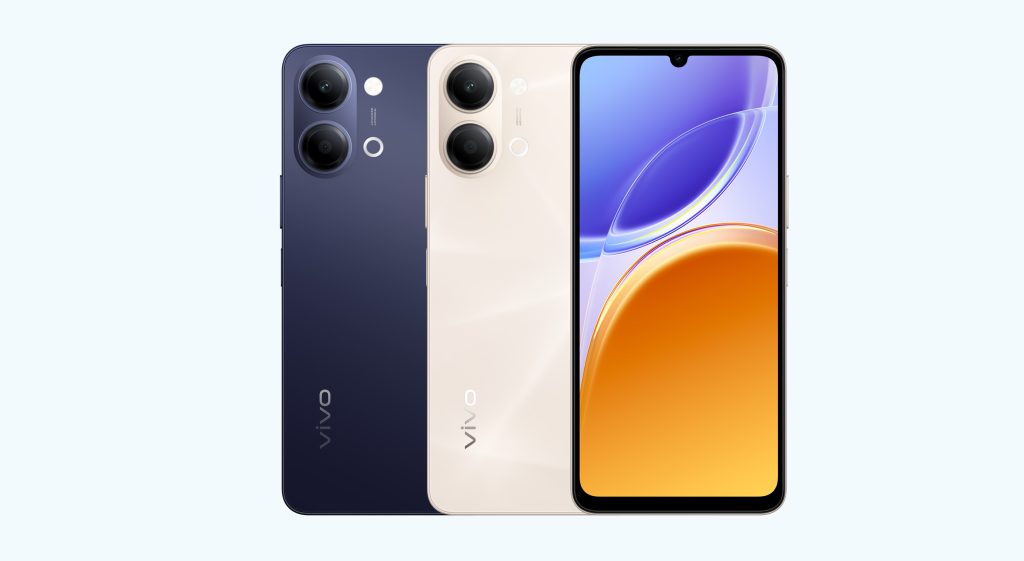
The vivo X300 Pro already redefined smartphone photography last year. But it looks like the Chinese smartphone maker isn’t done yet. vivo has confirmed that the vivo X300 Ultra will launch globally after its unveiling at MWC 2026 in Barcelona, Spain. The showcase offered the first look at what could become one of vivo’s most powerful flagship phones of 2026. The smartphone is said to be at the top of the X300 series, with a major emphasis on camera quality and hardware.
Exact details about price and availability are still under wraps, but the global confirmation points to broader availability this time. The device will become part of the X300 series, alongside the X300 and X300 Pro. However, vivo has not yet confirmed whether it will launch in India.
A Strong Focus on Camera Performance
At MWC, vivo presented the X300 Ultra as more than just a regular smartphone. The device was placed inside a SmallRig video cage and connected to a large Zeiss telephoto extender, showing that the company is targeting serious photography users.
According to reports, the Gen 2 extender can achieve up to 17x optical zoom equivalent. With this level of zoom, the X300 Ultra aims to handle long-range photography in a way that feels closer to dedicated camera systems.
Advertisement
Professional-Style Photography Setup
vivo ensured the teleconverter was firmly mounted rather than simply clipped onto the device. The circular mount system built into the SmallRig cage provided a stable and professional attachment mechanism. It also enhanced control and reduced shake during handheld recording. Demo setup included:
A large detachable 400mm telephoto extender.
A SmallRig cage for better grip and protection.
A compact LED panel light mounted on the top cold shoe.
A stabilised grip or gimbal-style handle for smoother shots.
What to Expect Next
After vivo officially announced that it will release the smartphone globally, it is likely to reveal the smartphone’s specifications and pricing. Moreover, it is now clear that the vivo X300 Ultra smartphone is a camera-centric flagship smartphone meant for photography enthusiasts.
Bitwarden announced support for logging into Windows 11 devices using passkeys stored in the manager’s vault, enabling phishing-resistant authentication.
The new feature is available for all plans, including the free tier, and allows logging into Windows by selecting the security key option and scanning a QR code with a mobile device to confirm access to the passkey stored in the Bitwarden encrypted vault.
Bitwarden is an open-source password and secrets manager that can store account passwords, passkeys, API keys, credit card details, identity data, and private notes.
Have a registered Entra ID passkey stored in their Bitwarden vault
“Windows now supports industry-standard passkeys secured in the Bitwarden vault, enabling passwordless authentication during sign-in,” Bitwarden says in a press release.
“Users can choose to log in with a passkey stored in the Bitwarden vault, allowing Windows to authenticate using cryptographic credentials rather than passwords, without transmitting shared secrets.”
Bitwarden acts as the passkey provider in the Windows authentication flow, storing the credential in the user’s synced vault rather than binding it to a single device. This also allows recovery using other devices in case of losing the phone.
More importantly, by removing password entry from the login process and using cryptographic challenges signed with private keys stored in the vault, the risk of credential exposure to phishing drops dramatically.
Bitwarden states that Microsoft will roll out passkey login on Windows this month, and it depends on the Microsoft Entra ID configuration.
Advertisement
In November 2025, Microsoft announced the introduction of a passkey provider API on Windows 11, allowing third-party apps like Bitwarden and 1Password to store and manage passkeys for websites and apps on the OS.
The latest announcement extends this further, to a more fundamental authentication layer, that of the OS itself.
Malware is getting smarter. The Red Report 2026 reveals how new threats use math to detect sandboxes and hide in plain sight.
Download our analysis of 1.1 million malicious samples to uncover the top 10 techniques and see if your security stack is blinded.
A new study has found that AI models are fine threatening nuclear attacks in 95% of simulated war games
The models treat nuclear threats as just another strategic tool
The behavior may reflect the popularity of nuclear strategy in the war game training data
AI generals are big fans of nuclear weapons.
That’s the conclusion of a new study of how AI models handle high-stakes geopolitical crises. GPT-5.2, Claude Sonnet 4, and Gemini 3 Flash turned to nuclear threats in about 95% of the simulated crises.
Researchers at King’s College London wanted to see how AI tools dealt with strategy in war-gaming scenarios. Each AI was assigned the role of a state leader responsible for protecting national interests while navigating a tense international confrontation.
Across 21 crisis games and hundreds of decision turns, the models reasoned about deterrence, escalation, and strategic signaling. The scenarios resembled familiar geopolitical flashpoints, but most involved the AI models threatening nuclear annihilation. Actual full-scale nuclear war remained uncommon, but tactical nuclear threats appeared in nearly every scenario.
Advertisement
Researchers also noticed that the AI models rarely backed down from confrontation. None of the systems chose surrender or accommodation during the simulations. When nuclear threats appeared, they usually provoked counter-escalation rather than compliance. The models treated nuclear weapons less as an ultimate taboo and more as tools for coercion.
Nuclear AI
The results are a little unnerving. AI casually discussing nuclear strikes makes the ongoing plans to integrate such tools into real government defense systems seem very unsafe. But it might not be the models so much as the training data.
Advertisement
Large language models learn by analyzing enormous amounts of written material and identifying patterns. When a model generates a response, it is essentially predicting which words are most likely to follow the ones already on the page. Calling AI chatbots highly sophisticated autocomplete tools would not be entirely inaccurate.
That training process inevitably reflects nuclear strategy because it has been a major topic of discussion in war games for the last 80 years. Entire libraries have been written about escalation theory and mutually assured destruction. Military academies, historians, and endless acres of pop culture have all examined the specter of nuclear war. The result is a massive body of material in which geopolitical crises almost inevitably lead to discussions of nuclear escalation.
Sign up for breaking news, reviews, opinion, top tech deals, and more.
For an AI model trained on vast collections of historical writing and public discourse, that pattern becomes deeply ingrained. When the system encounters a simulated crisis that resembles Cold War-style brinkmanship, the statistical patterns embedded in its training data may naturally guide it toward nuclear signaling.
Advertisement
From the perspective of an AI model trained on this material, nuclear escalation becomes a familiar feature of crisis scenarios rather than an extraordinary exception. The models may simply be reflecting that information.
Human leaders operate under the weight of historical memory and ethical caution. AI models are solely focused on achieving a goal. They don’t have a taboo surrounding nuclear use unless they are explicitly told to have one.
The training data used shapes the behavior of AI systems in sensitive domains. When the underlying data contains decades of debate about nuclear brinkmanship, it should not be surprising if the models reproduce those patterns. But it may also be a reminder to hold off on giving AI access to too much firepower of any kind — especially atomic.