Tech
Marantz M1 Streaming Amplifier Review: Can This Compact All In One Replace Your Entire Hi-Fi System?

Oh Marantz…what exactly are you playing at here?
Just when the sub $1,000 streaming amplifier category had turned into a predictable arms race of inputs, outputs, and firmware promises, along came the Marantz Model M1 with that unmistakable Marantz swagger that is now backed by HEOS multi-room integration and Dirac Live room correction to give it some real-world muscle. Sure, the WiiM Amp Ultra and Eversolo Play might dazzle you with more HDMI ports, coaxial inputs, and firmware update promises than a Tesla—but do they offer this much soul? Doubtful.
Here’s the part nobody in the industry really wants to say out loud. The future isn’t being decided in six-figure listening rooms with Italian racks and cables that cost more than your first car. It’s being decided in apartments, offices, and living rooms where people want one box, real performance, and no drama.
The question is whether the industry actually leans into that shift or keeps pretending the old model still scales. Brands like Fosi, WiiM, Bluesound, NAD, Denon, Marantz, Yamaha, and Cambridge Audio clearly see where the market is going. Others? Still chasing a shrinking pool of traditional audiophiles with very deep pockets and very finite patience.
Marantz, to its credit, is covering both ends of the spectrum. The Model M1 reflects where the market is heading, while the Model 10 represents its high-end ambitions; and it’s one of the better implementations of Class D amplification we’ve seen, even if the price puts it out of reach for most buyers. Between those two sits a full range of AVRs and stereo receivers that bridge the gap and make a lot more sense for how people actually build systems today.
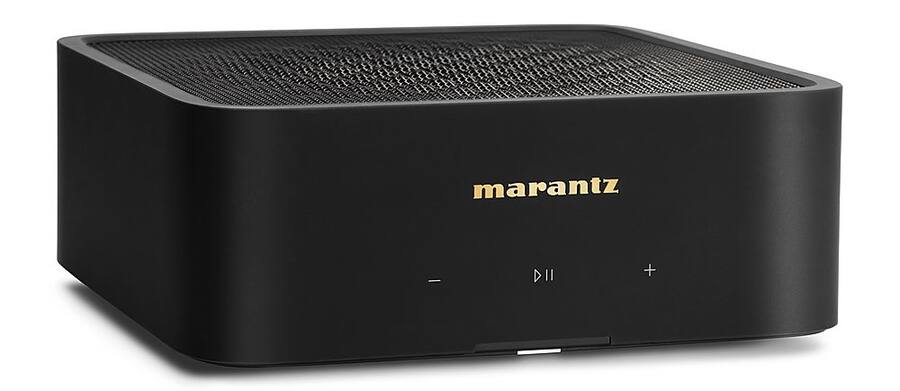

Marantz Model M1 Features and Connectivity: Fewer Ports, More Purpose
The Marantz Model M1 is designed as a compact, all-in-one streaming amplifier that simplifies system building without stripping away capability. Rated at 100 watts per channel into 8 ohms with very low distortion, it has enough power to drive a wide range of bookshelf and smaller floorstanding speakers—within reason, of course.
The inclusion of a dedicated subwoofer output with adjustable crossover and ±15dB level trim adds real flexibility for 2.1 setups, allowing for proper integration rather than guesswork.
Unlike traditional integrated amplifiers that juggle analog and digital signal paths, the M1 operates as a digital-first platform. It supports high resolution PCM up to 24-bit/192 kHz and DSD playback, handling content from streaming services, network storage, or direct USB input with consistency. This approach keeps the signal path clean and controlled, which aligns with Marantz’s goal of delivering a more refined and stable sonic presentation rather than chasing raw specification extremes.


Connectivity is focused but practical. Wireless options include Bluetooth, AirPlay 2, Qobuz Connect, TIDAL Connect, Spotify Connect, while HEOS provides the backbone for multi-room audio with support for up to 32 zones. HEOS also enables integration with home control systems such as Control4, URC, and Crestron, making the M1 viable in both simple and more complex installations.
It also works as a Roon player, although that requires an active Roon subscription and a Roon Core running on your network. The Core acts as the media server and can be hosted on a computer, NAS drive, or other compatible hardware.
For TV integration, HDMI eARC allows the M1 to function as a legitimate soundbar alternative with proper stereo imaging and significantly better amplification. Volume and power control can be handled directly through the TV remote, and the unit can be tucked out of sight without losing usability thanks to full app control and IR learning capability for third-party remotes.
One limitation worth noting is the lack of a built-in phono stage. Vinyl playback requires either a turntable with a built-in preamp or an external phono stage connected to the analog input. It’s a deliberate omission that reinforces the M1’s digital-first identity, but one that analog-focused users will need to plan around.
Onboard Dolby Digital+ decoding supports the audio codecs commonly used by broadcast and streaming TV services, making the Model M1 a viable upgrade over a typical soundbar. Additional options include Dialogue Enhancer for clearer vocals and a Virtual mode that uses Dolby processing to create a more immersive sound field from stereo content.
The Model M1 can also be paired with additional units for multi-room or expanded system setups, and its compact chassis allows two units to fit side-by-side in a standard 19-inch equipment rack if needed.
Cooling is handled through passive thermal management, so there are no fans to introduce noise or potential failure points. Combined with threaded mounting points on the bottom panel, this allows the amplifier to be installed cleanly on a wall bracket or inside cabinetry without concerns about heat buildup.
The Model M1 measures 8-9/16 inches wide, 3-3/8 inches high, and 9-15/16 inches deep, weighs 4.84 pounds, and includes a 5-year warranty.


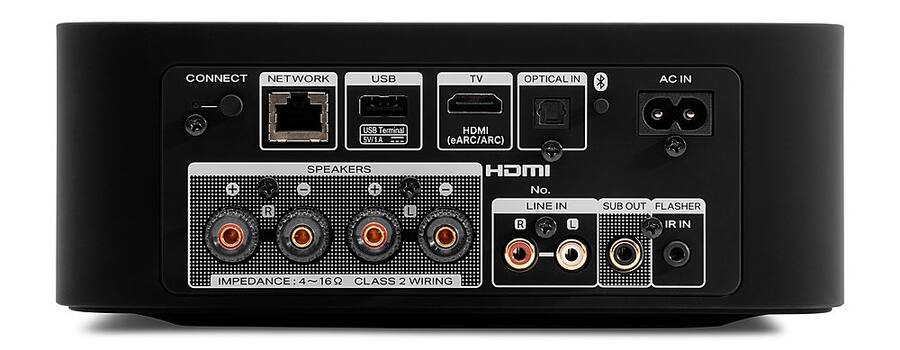
Building a System Around the Marantz Model M1
This is where things get practical. The goal here isn’t to be cheap, it’s to be smart. There’s a difference. Chasing the lowest price usually ends with compromises you can hear five minutes into your first album. The better play is finding speakers that won’t wreck your bank account, because let’s be honest, gas and electric bills are already doing a fine job of that, but still deliver real synergy with the M1 without forcing you into endless EQ tweaks.
That matters more than ever with a product like this. The Model M1 has the control and resolution to expose mismatches, but it’s also forgiving enough to reward a well-balanced pairing. You may not even need a subwoofer depending on your room size and speaker choice, which simplifies things even further. And now that Dirac Live room correction is part of the equation, you’ve got a tool that can actually address room issues that used to derail setups like this. Not a miracle cure, but a serious advantage if you use it properly.
I rotated through the DALI Kupid, Q Acoustics 3020c, Acoustic Energy AE100 MK2, and stepped up to the Wharfedale Diamond 12.3 and Q Acoustics 5040 floorstanders to see how far the M1 could stretch without things getting stupid.
The goal wasn’t to build some aspirational system that lives on a dealer floor. I kept the ceiling under $3,000 for a straightforward two-channel setup, and around $5,000 if you add a turntable or a compact subwoofer. Real-world money. Real-world rooms. The kind of systems people actually use in a den, living room, or bedroom without needing a second mortgage or a dedicated listening shrine.
For some people, the first question is obvious: can this small box actually drive medium to higher-sensitivity floorstanding speakers, or is that pushing it? The answer is yes—with some limits. It comes down to how loud you listen and how much space you’re trying to fill.
In my setup, both the Wharfedale Diamond 12.3 and Q Acoustics 5040 proved to be very workable pairings, but placement matters. These aren’t speakers you shove against a wall and forget about. They need roughly 2 to 3 feet of space behind them and at least 2 feet from the side walls to open up properly.
Give them that breathing room and they reward you with excellent imaging and a presentation that pulls away from the cabinets. The soundstage stretches wide, with a convincing sense of height, and both models do a very good job of disappearing when everything is dialed in correctly.
Darkness on the Edge of Town?
From a tonal perspective, the M1 leans slightly to the dark side of the Force, but not at the expense of clarity, speed, or overall presence. It’s not veiled or slow—it just carries more weight and density through the midrange and bass. Compared to something like the WiiM Ultra, the difference is obvious. The M1 delivers more texture and physicality, while the WiiM chases a bit more sparkle and top-end detail. The Marantz never comes across as thin or clinical.
If you’re familiar with Audiolab’s integrated and streaming amps, this goes in the opposite direction. Audiolab tends to run cool, clean, and very controlled, sometimes to the point of feeling a little detached. The M1 adds body, more impact down low, and a sense of drive that makes music feel less polite. You do give up some resolution and edge definition in the bass compared to Audiolab, but the trade-off is a more engaging and substantial presentation.
That character really shows itself with electronic music. Deadmau5, Boards of Canada, Aphex Twin, Kraftwerk, Tangerine Dream; the M1 hits harder and fills in the space between notes in a way that feels more physical. It’s less about precision and more about momentum. Think thick Crayola markers versus ultra-fine ink pens. The Audiolab and WiiM draw cleaner lines, but the Marantz isn’t afraid to color outside them, and for this kind of music, that’s exactly the right move.
Switching over to vocals, the M1 keeps that same tonal balance intact. Male vocals come through with solid texture and weight, sitting slightly forward without sounding pushed. There’s a fullness here that works well with most recordings, but the speaker pairing makes a noticeable difference. I preferred vocals through the Q Acoustics 5040 over the Wharfedale Diamond 12.3; the 5040 offers better resolution and cleaner lower midrange detail, which gives voices more definition without thinning them out.
Sam Cooke, Elvis, Nick Cave, Jason Isbell, and John Prine all came across smooth and grounded. For some listeners, that might tip a bit too far into “safe,” depending on the speaker. Nick Cave in particular benefited from the added weight, but I missed a bit of the edge and growl that defines his delivery. The M1 doesn’t strip away character, but it does round things off slightly.
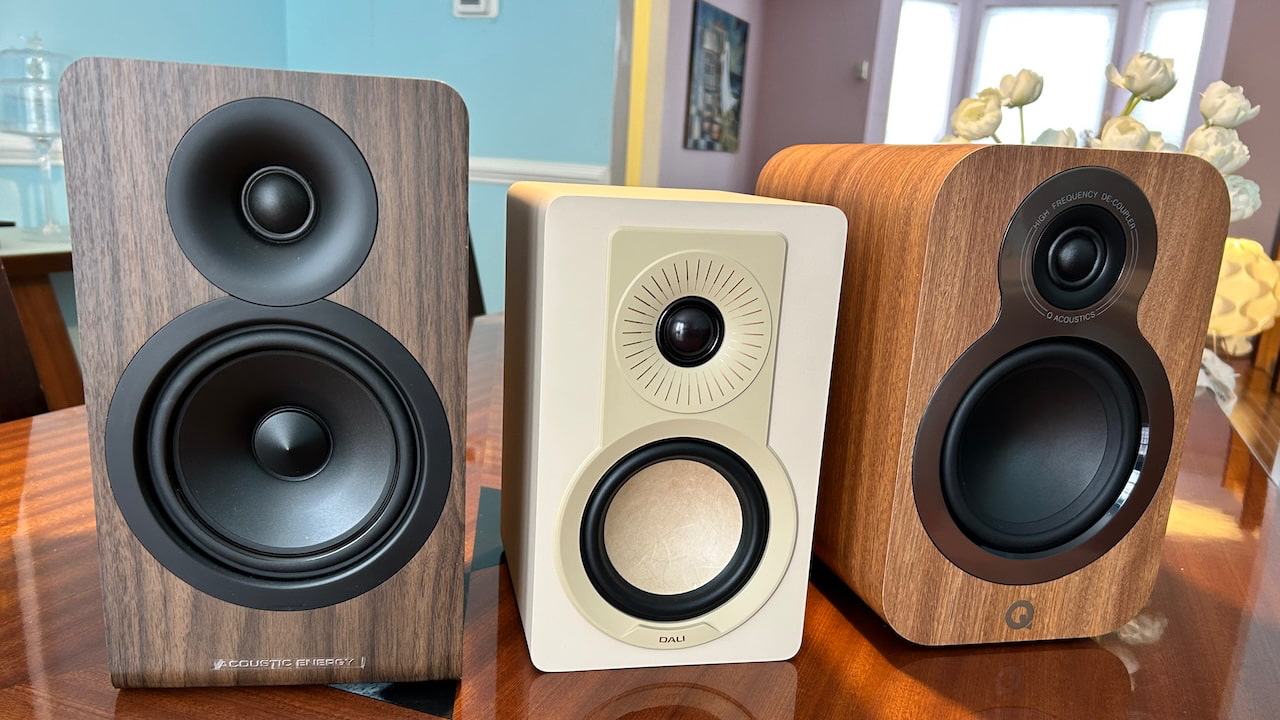

Bookshelf Speakers and the Marantz M1: Where Synergy Wins
The bookshelf choices here weren’t random. The DALI Kupid, Q Acoustics 3020c, and Acoustic Energy AE100 MK2 were picked with a specific goal in mind; maximize performance without turning the room into an equipment shrine. These are the kinds of speakers that can live on proper stands or sit cleanly on a credenza under a TV and still deliver a convincing, full-range experience.
To make that work, they had to check a few non-negotiable boxes: real presence, enough impact to carry both music and movie soundtracks, strong imaging, and a soundstage that doesn’t collapse the second you move off-axis. This isn’t about chasing perfection which isn’t realistic at this price point. it’s about building a system that actually works in a real room, with real constraints, and still sounds like you didn’t cut corners.
For a deeper look at all three, you can check out my shoot-out results, but the short version is that each brings something worthwhile to the table with the M1. The Q Acoustics 3020c is the most complete of the group, offering more output, a wider soundstage, and better overall resolution. The Acoustic Energy AE100 MK2 trades some of that refinement for greater low-end presence and a punchier upper bass and lower midrange, which gives it more weight with rock and electronic tracks.
The DALI Kupid is the most lively of the three, with a more energetic top end that adds air and sparkle without tipping into harshness. That’s not an accident; DALI has a long track record of getting tweeter design right, and it shows here. It’s open and engaging, but never brittle. That said, its U.S. pricing feels a bit ambitious given its size and low-end extension, especially when compared to how it’s positioned in other markets.
So what would I actually buy? Having lived with both pairs of floorstanders, along with the Q Acoustics 3020c and Acoustic Energy AE100 MK2, it’s a lot easier to sort through what works and what doesn’t. On the floorstanding side, I’d lean toward the Q Acoustics 5040—but with a clear condition. Keep them in a reasonably sized room. My den in New Jersey (16 x 13 x 9), the home office I’m converting (21 x 13 x 9), and my Florida setup (15 x 12 x 9) are all good examples of spaces where speakers like the 5040 or Wharfedale Diamond 12.3 make sense. They fill the room without overloading it with bass or turning placement into a constant battle.
On the bookshelf side, I tend to favor the DALI and Q Acoustics pairings for their balance of clarity, imaging, and overall ease of placement. They’re the safer choices if you want something that just works across music, TV, and movies. But if you’re after more low-end weight and a stronger push through the upper bass and lower mids, the Acoustic Energy AE100 MK2 is the sleeper here. It doesn’t get talked about enough. The pacing is excellent, it has real punch for its size, and it looks far more expensive than it has any right to.
But what about HEOS control? That’s going to matter more than anything for a lot of people. In my case, it’s pretty straightforward. I use TIDAL and Qobuz almost exclusively, so having access to TIDAL Connect and Qobuz integration is what I actually care about. Roon isn’t part of the equation anymore. I sold my Nucleus and haven’t looked back. With a 2TB drive on the network holding more than 1,900 CDs ripped to FLAC, I already have everything I need locally without adding another layer of software into the chain.
Before wrapping things up, I also tested the M1 with HDMI eARC across all three of my TVs in New Jersey using a QED cable. No drama. It locked in immediately with no handshake issues, and control worked exactly as expected. Movies and TV were an immediate upgrade. “Landman,” “The Madison” on Paramount+, and even NHL games all benefited from the added scale, clarity, and tonal weight. It’s not even a fair fight compared to internal TV speakers or most of the soundbars I’ve used. I’ll take a proper stereo soundstage and believable dynamics over fake surround tricks every time.
The Bottom Line
The Marantz Model M1 doesn’t try to outgun the competition on features—and that’s the point. It delivers a cohesive, full-bodied sound with real texture, strong midrange presence, and enough power to drive the kinds of speakers people actually use in real rooms. HEOS keeps everything connected, HDMI eARC works without the usual nonsense, and Dirac Live gives you a legitimate tool to deal with room issues instead of pretending they don’t exist.
What you don’t get is just as important. No phono stage, limited analog inputs, and it’s not chasing razor-sharp treble detail or lab-grade precision. This isn’t for someone building a shrine to separates. It’s for someone who wants a clean, compact system that sounds right and doesn’t require a manual and a weekend to figure out. At $1,000, it earns its keep—and then some.
Editors’ Choice in the Network Amplifier category for those who can swing the price and have similar speaker options.
Pros:
- Full-bodied, engaging sound with strong midrange and bass weight
- Works well with both bookshelf and smaller floorstanding speakers
- HEOS integration with built-in TIDAL Connect, Qobuz, and Roon support
- HDMI eARC performs reliably in real-world use
- Dirac Live adds meaningful room correction capability
- Compact design with flexible placement options
- Excellent system-building platform for 2.0 or 2.1 setups
Cons:
- No built-in phono stage
- Limited analog connectivity
- Slightly rounded treble may not appeal to detail-focused listeners
- App-dependent control with no included remote
You must be logged in to post a comment Login