Tech
MartinLogan Motion Discrete Cinema Series Targets Big-Screen Home Theaters With Premium LCR Speakers and Passive Soundbars

Televisions have become substantially larger over the past decade, but the audio systems sitting beneath them have not always kept pace.
Mount an 85-inch television on the wall and place a compact soundbar underneath it and the mismatch can be rather obvious. There are certainly active soundbars capable of producing impressive output, but buyers who want a genuine left, center and right front soundstage usually have to choose between three conventional loudspeakers, architectural speakers hidden in the wall, or a premium passive soundbar.
MartinLogan thinks there is another way.
The new Motion Discrete Cinema Series consists of six passive loudspeakers designed specifically around 65, 75 and 85-inch class televisions. Three are individual LCR speakers that can be installed vertically or horizontally, while three combine discrete left, center and right channels inside a single enclosure.
More interestingly, MartinLogan has not simply made the cabinets longer as the screen size increases. The company increases the number of drivers as well, with the goal of increasing output capability and acoustic scale along with the size of the display.
That makes this considerably more interesting than another skinny speaker designed primarily to disappear beneath a television.
Related Reviews:
Two Ways to Build the Front Soundstage
The Motion Discrete Cinema lineup is divided into LCR5, LCR7 and LCR9 loudspeakers, plus Soundbar 65, Soundbar 75 and Soundbar 85 three-channel passive soundbars.
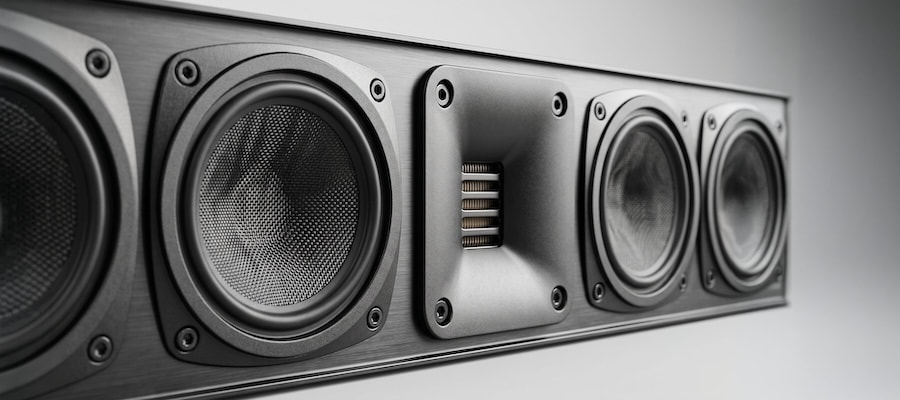
All six models use MartinLogan’s Gen2 Folded Motion Tweeter with Folded Motion Waveguide, woven fiberglass woofers and extruded aluminum enclosures.

The LCR5 is designed as a height match for 65-inch class displays and uses a five-driver array consisting of the Gen2 Folded Motion Tweeter and four 4.5-inch woven fiberglass woofers.
The LCR7, intended for 75-inch displays, adds two additional woofers for greater output, higher power handling and improved room control in larger spaces. The flagship LCR9 moves to a nine-driver configuration designed to provide greater output and scale alongside an 85-inch display.
All three can function as left, center or right speakers, which means an installer could place three vertically around a display, rotate one horizontally beneath the television for center-channel duty, or use them as high-output surrounds where their shallow profile makes sense.
The Soundbar models take a different approach.
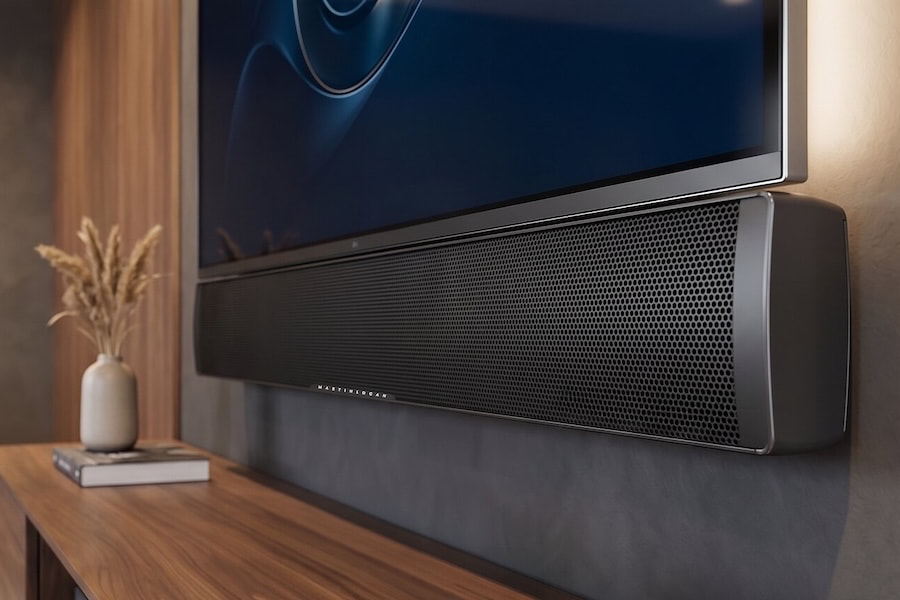
These are not powered soundbars competing directly with products like the Sonos Arc Ultra. There is no built-in AVR replacement here. The Soundbar 65, 75 and 85 contain discrete left, center and right loudspeaker channels and require external amplification.
That means an AV receiver or separates still handle decoding, amplification, bass management and the rest of the home theater system. The advantage is that buyers get three physical front channels inside one enclosure without surrounding a large television with three conventional speaker cabinets.
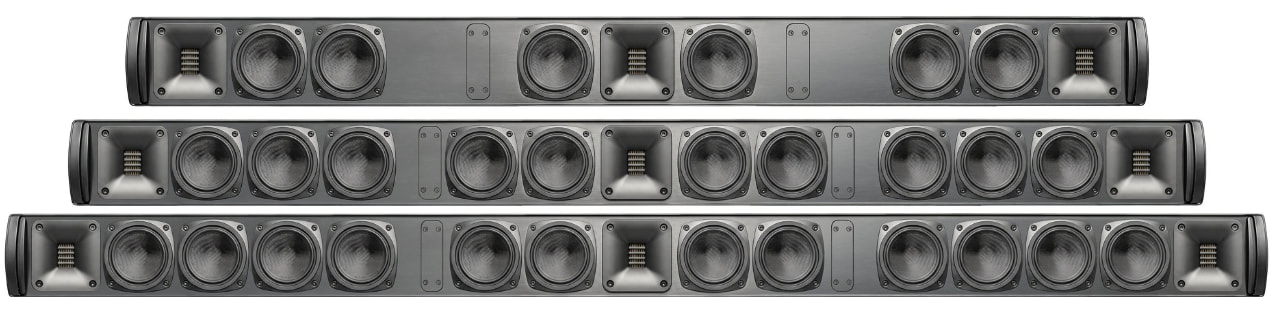
The Soundbar 65 is designed for 65-inch class displays and uses a Gen2 Folded Motion Tweeter and two woofers per channel. The Soundbar 75 increases the driver count, including twice as many woofers in the center channel and additional drivers for the left and right channels.
At the top of the range, the Soundbar 85 uses a 15-driver array across its three discrete channels.

What Makes Motion Discrete Cinema Different?
Screen matching is the clever part.
Plenty of manufacturers produce passive soundbars and slim on-wall loudspeakers. MartinLogan’s approach is to create three progressively larger configurations and increase their acoustic capability rather than offer essentially the same speaker in different cabinet lengths.
That becomes especially relevant with today’s 75 and 85-inch televisions, where a small center channel or narrow soundbar can look disproportionately small and may struggle to create the sense of scale expected from a large image.
There is also some real loudspeaker technology inside these enclosures.
MartinLogan has managed to incorporate its full-size Gen2 Folded Motion Tweeter and an application-optimized Folded Motion Waveguide rather than developing a miniature tweeter specifically to squeeze into the cabinet. The woofer system was intentionally optimized around midrange and upper-bass performance, with MartinLogan assuming that a serious home theater installation will include at least one powered subwoofer.
That last point is worth remembering. These are not being positioned as full-range loudspeakers that somehow violate several inconvenient laws of physics simply because they are expensive and made from aluminum.
Use a subwoofer.
Preferably a good one made by MartinLogan.
Where Do They Fit in the MartinLogan Lineup?
The Motion Discrete Cinema Series fills a fairly obvious hole between MartinLogan’s existing Motion SLM products and its larger conventional Motion and Motion XT loudspeakers.
The Motion SLM family already gives MartinLogan customers thin on-wall speakers designed to complement flat-panel televisions, including individual SLM models and the three-channel Motion SLM X3.
Motion Discrete Cinema is a considerably more ambitious interpretation of the same basic installation problem.
It incorporates MartinLogan’s newer Gen2 Folded Motion technology, offers substantially larger driver arrays and gives installers dedicated versions intended to complement 65, 75 and 85-inch displays.
The new series also overlaps the price territory of MartinLogan’s conventional Motion center-channel speakers, but that does not necessarily make Motion Discrete Cinema a higher-performance tier than Motion XT.
They are built for different jobs.
Motion XT remains MartinLogan’s premium conventional Motion range, including larger cabinets and the company’s Gen2 Folded Motion XT tweeter. Motion Discrete Cinema instead gives custom installers a premium shallow-depth alternative when conventional loudspeaker cabinets would interfere with the room design or television installation.
In other words, you’re paying partly for acoustics and partly for solving a very specific installation problem without reducing the front stage to a typical powered soundbar.
Designed for Custom Installation
The CI focus becomes even clearer when looking at the mounting hardware.
Every Motion Discrete Cinema model includes a universal wall bracket offering leveling and small positional adjustments, useful when wall studs refuse to cooperate with the architect’s carefully centered television.
An optional television bracket can attach to a display frame or VESA mounting pattern, allowing the loudspeaker to move with an articulating television.
MartinLogan has also integrated recessed cable channels into the aluminum chassis to conceal wiring, while removable Phoenix-style connectors with tool-free tension levers allow installers to terminate the speaker cable before the loudspeaker itself is mounted.
None of that will make anyone abandon dinner to stare at the specifications page, but installers will notice immediately. The difference between a clever mounting system and three hours of profanity behind an 85-inch television is not insignificant.

What Are the Closest Competitors?
The closest competition depends on which Motion Discrete Cinema configuration you are considering.
For the individual LCR speakers, the Focal On Wall 302 is arguably the most direct rival. At roughly the same price as the LCR9, it is another premium low-profile loudspeaker intended for home theater installations where conventional speaker cabinets are undesirable. It can also be mounted vertically or horizontally and uses four Flax midbass drivers surrounding Focal’s inverted-dome tweeter.
That makes it a credible alternative for someone building a premium low-profile LCR system around a large television.
For the three-channel models, the GoldenEar SuperCinema 3D Array XL is one of the most obvious competitors. It occupies similar pricing territory to the Soundbar 65 and also combines three passive front channels within a slim enclosure.
GoldenEar takes a somewhat different technical approach, using multiple midbass drivers, its High-Velocity Folded Ribbon tweeters and proprietary technology intended to create a soundstage wider than the enclosure itself.
MartinLogan’s advantage is the breadth of the new lineup.
Instead of offering one primary passive soundbar configuration, Motion Discrete Cinema provides dedicated 65, 75 and 85-inch models along with corresponding individual LCR speakers.
That gives integrators substantially more freedom to maintain a consistent visual and acoustic design across different rooms and screen sizes.
Pricing & Availability
MartinLogan expects the Motion Discrete Cinema Series to reach authorized dealers and custom integrators worldwide by the end of September 2026.
Motion Discrete Cinema LCR Speakers
- LCR5: $1,249.99 each
- LCR7: $1,499.99 each
- LCR9: $1,749.99 each
Motion Discrete Cinema Passive Soundbars
- Soundbar 65: $1,999.99
- Soundbar 75: $2,499.99
- Soundbar 85: $2,999.99
The Bottom Line
MartinLogan is not trying to reinvent the powered soundbar. Motion Discrete Cinema is aimed at customers who want the cleaner appearance of one without surrendering a properly amplified, discrete home theater system.
The ability to choose between separate LCR speakers and three-channel passive soundbars is useful, but the more unusual idea is scaling the driver array with the television itself. An 85-inch display gets a substantially different loudspeaker than a 65-inch model rather than the same acoustic platform wearing a longer grille.
That should make the series especially relevant to custom installers trying to reconcile increasingly enormous televisions with homeowners who have absolutely no interest in seeing enormous loudspeakers sitting beside them.
Physics still gets a vote, however, which is why MartinLogan wisely expects owners to add a subwoofer.
Some things even a very expensive piece of aluminum can’t negotiate.
You must be logged in to post a comment Login