Tech
Massive 41-inch Blades Deliver Clear Efficiency Wins on This Custom-Built Quadcopter Drone
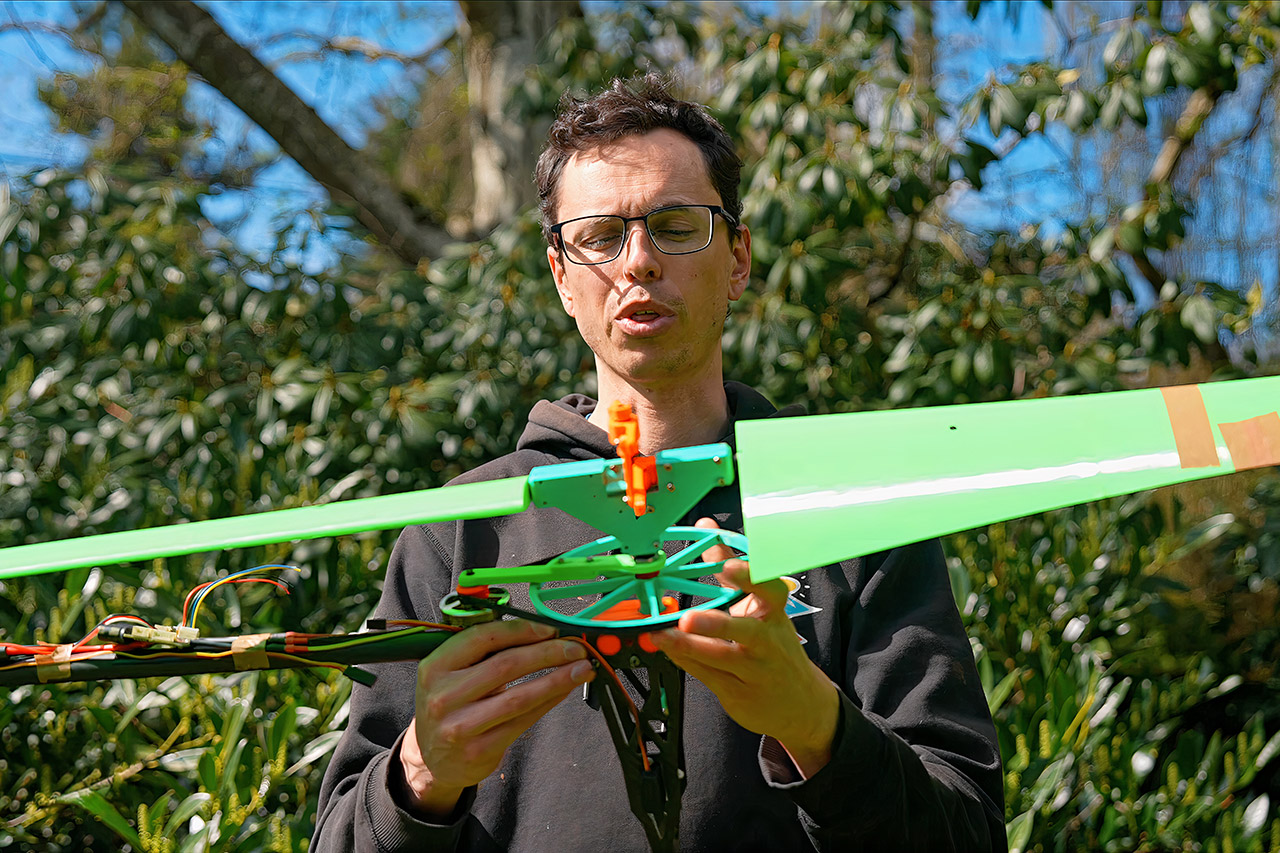
Daniel Riley set out to tackle an issue that had been plaguing him: what if you built a drone with propeller blades a mile longer than regular models? His design features 41-inch blades that reach from tip to tip and spin at a steady 350 to 500 revolutions per minute, a far cry from the tiny, high-speed propellers seen on nearly every commercial drone on the market.


His quadcopter stands out from the crowd due to its gigantic 41-inch blades, and not only because of their size. They also spin at a nice, calm speed of 350 to 500 rpm, as opposed to the thousands of rpm seen on standard models. Riley paired these blades with a sophisticated variable pitch mechanism that allows each rotor to change the angle at which it bites into the air while keeping the motor speed constant. This combination enables the drone to generate lift and remain airborne with significantly less energy than you might expect, especially considering the blades’ high inertia.


Bambu Lab A1 3D Printer, Support Multi-Color 3D Printing, High Speed & Precision, Full-Auto Calibration…
- High-Speed Precision: Experience unparalleled speed and precision with the Bambu Lab A1 3D Printer. With an impressive acceleration of 10,000 mm/s…
- Multi-Color Printing with AMS lite: Unlock your creativity with vibrant and multi-colored 3D prints. The Bambu Lab A1 3D printers make multi-color…
- Full-Auto Calibration: Say goodbye to manual calibration hassles. The A1 3D printer takes care of all the calibration processes automatically…
Riley designed a variable pitch system that allows the servos to change the angle of each blade while the motors continue to run at a consistent speed. This is a creative solution to the problem of high rotational inertia, which would normally make it difficult to swiftly increase and decrease motor speed in order to operate the drone successfully. He mounted high-torque servos at the base of each arm and ran a pushrod through them to the blade roots. As a result, the drone gains precise control over lift and attitude without constantly adjusting the engine speed.
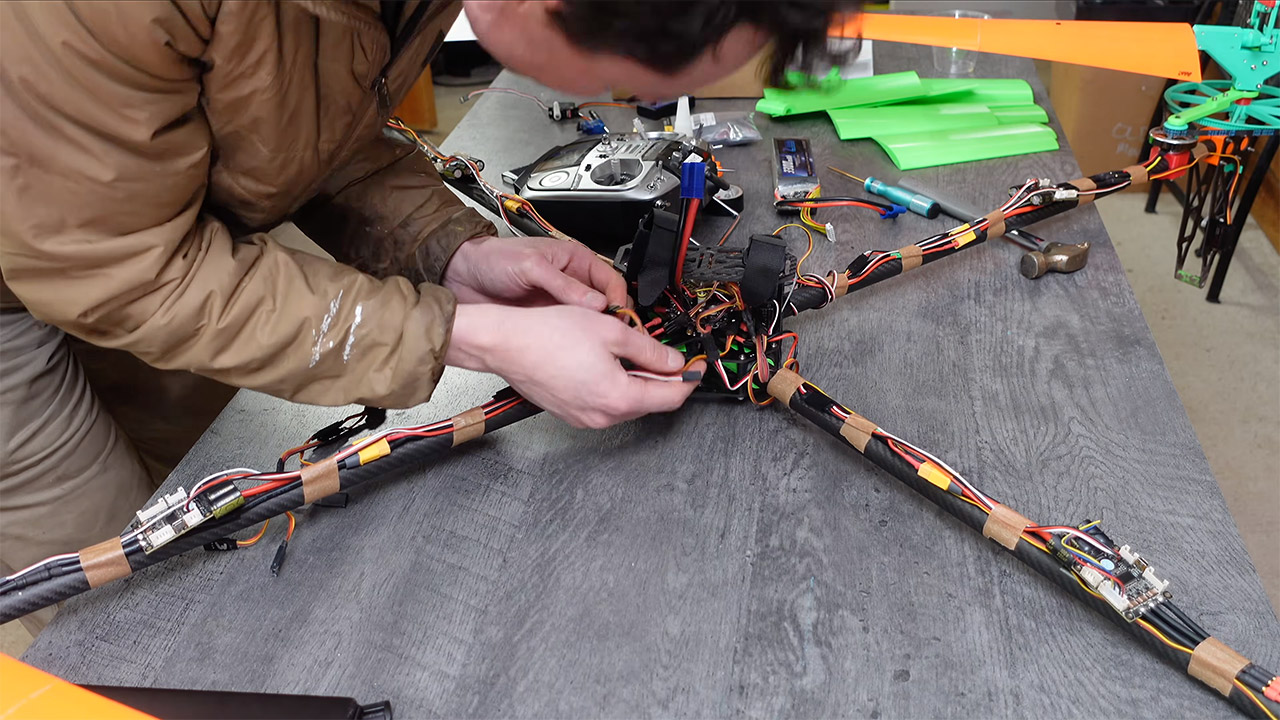
The drone’s chassis was built of carbon fiber tubes attached to 3D printed polycarbonate parts, which gave just enough strength to keep things from breaking without adding too much weight. The propellers were made from PETG plastic reinforced with carbon fiber rods. Four pancake-style 5010 360KV motors power the blades via a belt reduction system, which reduces the speed and increases torque. Riley even removed the motor controllers’ heat sinks and sealed them in epoxy to save a few grams of weight. Every little piece added up to keep the overall power consumption low, allowing the huge rotors to support the airframe with minimal effort.

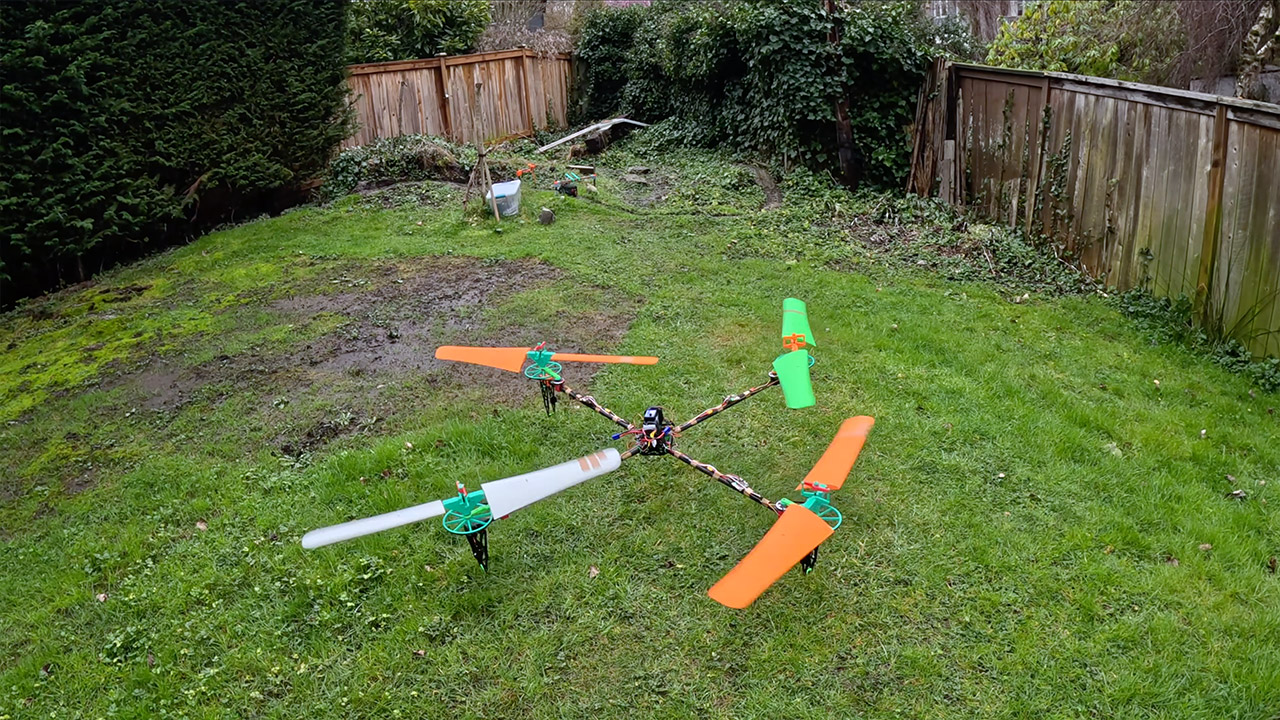
Ground tests produced some really impressive results. When the drone was hovering in situ, it produced a remarkable 18.1 grams of torque for every watt of electricity used, which is roughly half as much as a well-optimized conventional quadcopter. When the power was turned off, the drone was able to slowly circle its way to the ground. The only reason it didn’t come out of it without losing its balance was that it lacked a stabilisation system and crashed.
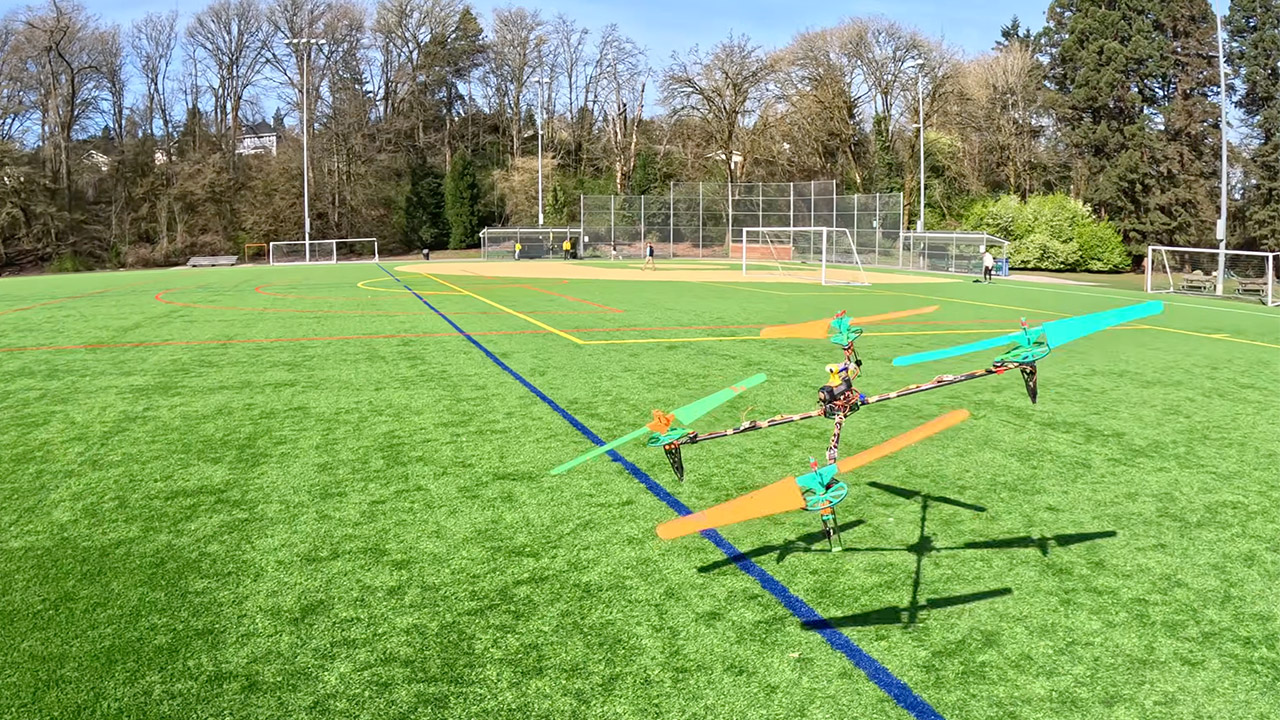
Engineers have long recognized that the key to making rotorcraft fly is getting the power loading just right. Spreading the weight over a larger rotor surface allows you to stay aloft with less energy, like Riley did here. He applied a principle that most commercial drone manufacturers are afraid to explore since it is more sophisticated, and it paid off handsomely. His approach demonstrates that scaling up to larger blades and adding some sophisticated pitch control can result in significant increases in flight time without simply throwing some heavier batteries on it.
[Source]
You must be logged in to post a comment Login