Simes presides over Computer Pals, a volunteer-run group devoted to helping older adults develop digital literacy. Under his guidance, the club’s lessons range from navigating Windows 11 to distinguishing between legitimate and malicious links online. His authority doesn’t stem from age or nostalgia but from curiosity – an instinct that led… Read Entire Article Source link
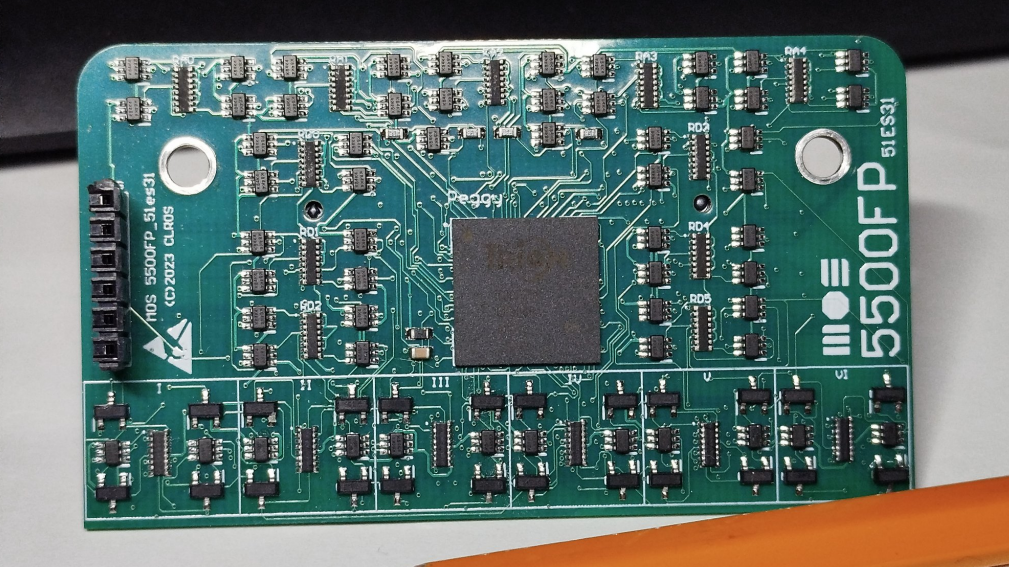
You would be very hard pressed to find any sort of CPU or microcontroller in a commercial product that uses anything but binary to do its work. And yet, other options exist! Ternary computing involves using trits with three states instead of bits with two. It’s not popular, but there is now a design available for a ternary processor that you could potentially get your hands on.
The device in question is called the 5500FP, as outlined in a research paper from [Claudio Lorenzo La Rosa.] Very few ternary processors exist, and little effort has ever been made to fabricate such a device in real silicon. However, [Claudio] explains that it’s entirely possible to implement a ternary logic processor based on RISC principles by using modern FPGA hardware. The impetus to do so is because of the perceived benefits of ternary computing—notably, that with three states, each “trit” can store more information than regular old binary “bits.” Beyond that, the use of a “balanced ternary” system, based on logical values of -1, 0 , and 1, allows storing both negative and positive numbers without a wasted sign bit, and allows numbers to be negated trivially simply by inverting all trits together.
The research paper does a good job of outlining the basis of this method of computing, as well as the mode of operation of the 5500FP processor. For now, it’s a 24-trit device operating at a frequency of 20MHz, but the hope is that in future it would be possible to move to custom silicon to improve performance and capability. The hope is that further development of ternary computing hardware could lead to parts capable of higher information density and lower power consumption, both highly useful in this day and age where improvements to conventional processor designs are ever hard to find.
Advertisement
Head over to the Ternary Computing website if you’re intrigued by the Ways of Three and want to learn more. We perhaps don’t expect ternary computing to take over any time soon, given the Soviets didn’t get far with it in the 1950s. Still, the concept exists and is fun to contemplate if you like the mental challenge. Maybe you can even start a rumor that the next iPhone is using an all-ternary processor and spread it across a few tech blogs before the week is out. Let us know how you get on.
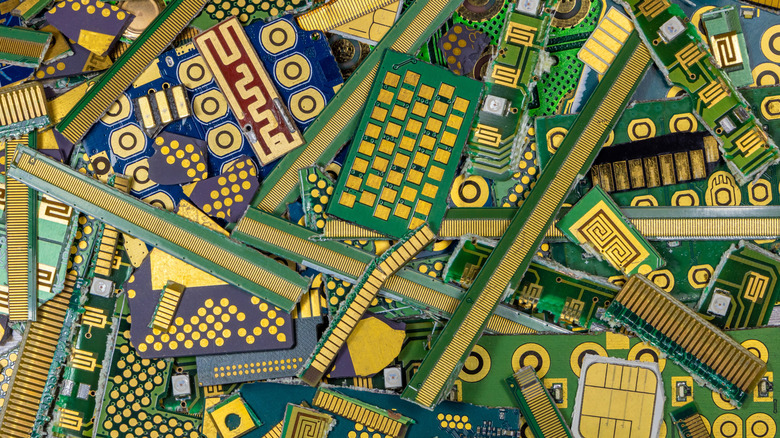
For many people, gold mining conjures images of an old prospector sifting sandy water through a metal pan in the blazing sun. But these days, the process is far more advanced than the 1800s gold rush era of the western United States. In fact, researchers have actually developed a method to recover gold from electronic waste. This means that yes, there’s gold inside your household electronics. So your drawer of outdated devices may be a goldmine—at least in theory.
A study published in Advanced Materials describes how this was achieved with a process using protein amyloid nanofibrils. Extracted from whey, these materials are tiny, thin protein fibers with a huge surface area. This allows them to precisely remove gold from dissolved electronic components like computer motherboards. The process then converts gold ions into single particles, resulting in high-purity gold nuggets.
The study shows that this method of gold recovery costs around $1.10 per gram, a far cry from the market value of about $50 per gram for 22-carat gold. The process is also more eco-friendly than traditional mining methods, as it uses fewer organic materials and produces less waste overall. Additionally, the protein gels used to extract the gold are reusable, and represent a circular approach. The end result is that electronic waste, as well as food waste, is recycled and repurposed into a different substance.
Advertisement
The value and history of gold in electronic devices
Sebastian_Photography/Shutterstock
A typical smartphone has anywhere from 7 to 34 milligrams of gold in its circuit boards and connectors. This equals around $1.16 to $5.81 total value as of this writing. Of course, larger devices like desktop computers can have more gold, though it’s still not an impressive amount. While it’s illegal to throw away electronics in many states, millions of devices are tossed every year, which means the value of the gold inside can add up very quickly.
The reason gold is often used in electronic devices is because of its physical and chemical properties. First, gold conducts electricity very well. It’s also durable and doesn’t corrode over time as other metals can. Plus, it can easily be shaped into thin wires without breaking. All of these features combined better ensure reliable signal transmission, and smooth, extended performance. That’s why gold is the ideal substance for circuit boards, connectors, and other components, inside smartphones, computers, and more.
Advertisement
The use of gold in electronic devices dates back to the mid-20th century. Both computers and military communications equipment required more reliable and longer-lasting connections than what were available at the time. So gold was eventually integrated, becoming an important addition to these devices. As time went on, the military defense sector of the US utilized the precious metal extensively. This led to widespread adoption by NASA, who used the metal in golden records on the Voyager missions, and in various equipment as well.
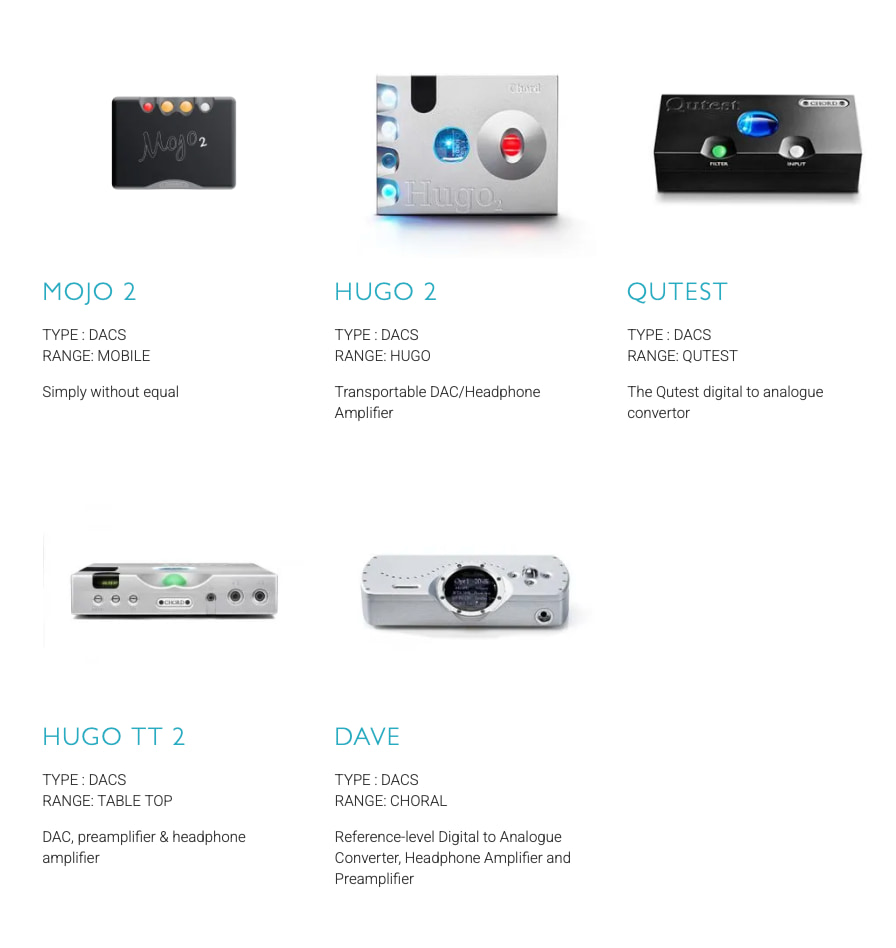
Chord Electronics’ digital audio consultant Rob Watts takes us on a deep dive into the challenges of reproducing lifelike sound from 16-bit/44.1kHz PCM digital audio (CD quality music from compact discs or streaming). From his groundbreaking DAC designs priced from $650 to $20,000, to why off-the-shelf chips can’t compete, Rob explains how his unique approach to D/A (digital to analog) conversion goes beyond conventional measurement-based audio engineering. He also previews Chord’s next flagship product, the Quartet M Scaler, which will build on the Hugo M Scaler, and shares his thoughts on DSD, the importance of cables, and hidden sonic factors like RF and power supply issues. Even 45 years after the CD’s debut, there’s still high-resolution audio left to uncover.
Sponsor: Thank you to our sponsor SVS for your support.
Last week’s cyberattack on medical technology giant Stryker was limited to its internal Microsoft environment and remotely wiped tens of thousands of employee devices.
The organization says in an update on Sunday that all its medical devices are safe to use but electronic ordering systems remain offline, and customers must place orders manually through sales representatives.
Stryker emphasizes that the incident was not a ransomware attack and that the threat actor did not deploy any malware on its systems.
The attacker alleged that they wiped “over 200,000 systems, servers, and mobile devices” and stole 50 terabytes of data. However, investigators did not find any indication that data was exfiltrated.
Following the disruption, Stryker employees in multiple countries started to complain that their managed devices had been remotely wiped overnight.
Some employees had their personal devices enrolled in the company network and lost personal data during the wiping process.
Hackers had Global Admin privileges
A source familiar with the attack told BleepingComputer that the threat actor used the wipe command in Intune, Microsoft’s cloud-based endpoint management service, to erase data from nearly 80,000 devices between 5:00 and 8:00 a.m. UTC on March 11.
Advertisement
The attacker carried out the action after compromising an administrator account and creating a new Global Administrator account.
The investigation is being conducted by the Microsoft Detection and Response Team (DART) in collaboration with cybersecurity experts from Palo Alto Unit 42.
Stryker’s update highlights that the attack did not impact any of its products, connected or otherwise, and was limited exclusively to the internal Microsoft corporate environment.
“All Stryker products across our global portfolio, including connected, digital, and life-saving technologies, remain safe to use,” the company says.
Advertisement
Restoration efforts are currently underway, the main focus being on resuming shipping and transactional services. Customers are encouraged to maintain normal communication with company personnel while the infrastructure is steadily recovered.
Any order placed before the cyberattack will be honored as systems are restored, while those placed during the disruption will be processed when systems are back online, and the supply flow resumes to normal.
The company is working with its global manufacturing sites to deal with potential operational impact.
Stryker’s current priority is to restore the supply-chain system and resume customer orders and shipping. “Our core transactional systems are already on a clear path to full recovery,” the company says.
Advertisement
Malware is getting smarter. The Red Report 2026 reveals how new threats use math to detect sandboxes and hide in plain sight.
Download our analysis of 1.1 million malicious samples to uncover the top 10 techniques and see if your security stack is blinded.
Fujifilm has just introduced the Instax Mini 13, the latest addition to one of the best selling instant camera lines in the world. It sits comfortably in the palm of your hand from the moment you pick it up, and a metallic silver logo on the front adds a subtle touch of shine without making the whole thing feel fussy or overcomplicated.
Simply twist the lens ring and you’re good to go in one fluid action. Twist it again, and the close-up mode appears, allowing you to take close-up photographs of whatever is directly in front of you. Because of built-in parallax correction, the viewfinder lines up perfectly with the lens, ensuring that everything is centered.
Compact and cute design. Easily twist the lens to turn on and off
Built-in selfie mirror for easy selfies Close-up mode with parallax correction
Features automatic exposure and flash control for bright photos that are not “washed-out”
There’s a tiny mirror on the front to help you line up your own pictures perfectly. You have dual timers built in that clock down from two to ten seconds depending on whether you’re taking a group shot or flying solo. Fujifilm also includes a small wedge piece that snaps into the strap and then be used to raise the camera up on a level surface. The countdown will run automatically while you get everything in place. The exposure settings are also automatically adjusted, regardless of the lighting conditions. The flash has its own small control mechanism that performs an excellent job of balancing the results whether you’re in full light or just in the shade.
Advertisement
If you put two regular AA batteries in the bottom, it will print about a hundred times before needing to be replaced. The camera also includes a feature that allows it to turn off after five minutes of inactivity, which helps to extend the battery life. The film loads at the back, just like any other Instax Mini. Each finished print measures approximately 3.5 x 2 inches overall, with a photo area of 2.5 x 1.75 inches. You’ll have to wait around 90 seconds for the colors to appear properly, however if you’re in cool air, it may take a little longer.
There are five colors, including Dreamy Purple, Frost Blue, Candy Pink, Lagoon Green, and Clay White. The camera alone costs $94 MSRP, and Fujifilm is also releasing a new film pack called Pastel Galaxy, which includes sparkling cosmic motifs in ultra delicate pastel tones along the edges. That gives a fun touch to each print. If you scan prints into your phone, you will find that the companion app now does a better job of isolating the image from the background, resulting in cleaner-looking digital copies. Availability begins in late June. [Source]
Affinity’s latest update to introduces Light UI for a brighter and cleaner workplace, Convert to Curves to eliminate manual tracing by transforming objects into a fully editable vector curves, and Live Tone Blend Groups which blends layers dynamically and non-destructively.
Did you ever wonder how the mechanical voltage regulator — that big black box wired up to the generator on a car from the ’60s or before — worked? [Jonelsonster] has some answers.
For most people in 2026 an old car perhaps means one from the 20th century, now that vehicles from the 1990s and 2000s have become the beloved jalopies of sallow youths with a liking for older cars and a low budget. But even a 1990s vehicle is modern in terms of its technology, because a computer controls the show. It has electronic fuel injection (EFI), anti-lock braking system (ABS), closed loop emissions control, and the like.
Go back in time to the 1970s, and you’ll find minimal electronics in the average car. The ABS is gone, and the closest thing you might find to EFI is an electronic ignition where the points in the distributor have been replaced with a simple transistor. Perhaps an electronic voltage regulator on the alternator. Much earlier than that and everything was mechanical, be that the ignition, or that regulator.
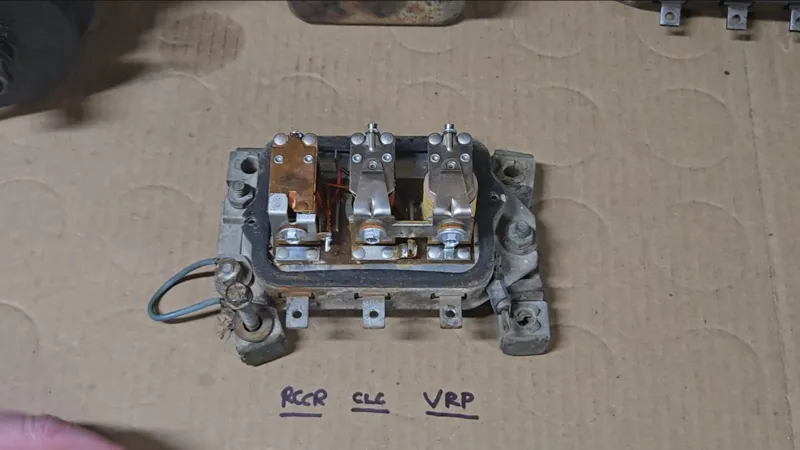
The video below the break has a pair of units, it seems from 1940s tractors. They would have had a DC generator, a spinning coil with a commutator and brushes, in a magnetic field provided by another coil. These things weren’t particularly powerful by today’s standards and sometimes their charging could be a little lackluster, but they did work. We get to see how, as he lifts the lid off to reveal what look like a set of relays.
Advertisement
We’re shown the functions of each of the three coils with the aid of a lab power supply; we have a reverse current relay that disconnects the generator if the battery tries to power it, an over-current relay that disconnects the field coil if the current is too high, and an over-voltage relay that does the same for voltage. The regulating comes down to the magnetic characteristics, and while it’s crude, it does the job.
We remember European devices with two coils and no field terminal, but the principle is the same. There is never a dull moment when you own an all mechanical car.
Nvidia CEO Jensen Huang thinks every company should have an OpenClaw strategy. And Nvidia is here to provide it.
Nvidia has developed NemoClaw, an enterprise-grade AI agent platform, Huang announced during his GTC keynote on Monday. The platform is built on top of OpenClaw, the popular open-source framework for building and running AI agents locally on a company’s own hardware.
The new open source platform is essentially OpenClaw with enterprise-grade security and privacy features baked in. The idea is to turn OpenClaw into a secure platform that enterprises can tap into with one command, giving them control over how agents behave and handle data, according to Nvidia.
“For the CEOs, the question is, what’s your OpenClaw strategy?” Huang said onstage. “We need it. We all have a Linux strategy. We all needed to have an HTTP HTML strategy, which started the internet. We all needed to have a Kubernetes strategy, which made it possible for mobile cloud to happen. Every company in the world today needs to have an OpenClaw strategy, an agentic systems strategy.”
Advertisement
Nvidia worked with OpenClaw’s creator Peter Steinberger to develop NemoClaw, Huang said.
Once released, NemoClaw users will be able to tap any coding agent or open-source AI model, including Nvidia’s NemoTron open models to build and deploy AI agents. The platform allows users to access cloud-based models on their local devices. The platform is hardware agnostic — it doesn’t need to run on Nvidia’s own GPUs — and integrates with NeMo, Nvidia’s AI agent software suite.
For now, Nvidia is describing NemoClaw as an early-stage alpha release. “Expect rough edges. We are building toward production-ready sandbox orchestration, but the starting point is getting your own environment up and running,” the company stated on its website in a note directed toward developers.
Techcrunch event
Advertisement
San Francisco, CA | October 13-15, 2026
Building enterprise AI agent platforms has become the du jour obsession of the AI space in recent months.
Advertisement
OpenAI launched Frontier, its open platform for enterprises to build and manage AI agents, in February. In December, global research firm Gartner released a report about how governance platforms for AI agents would be the crucial infrastructure needed for enterprises to adopt the AI tech. Nvidia clearly got the message.
“OpenClaw gave us, gave the industry exactly what it needed at exactly the time,” Huang said. “Just as Linux gave the industry exactly what it needed at exactly the time, just as Kubernetes showed up at exactly the right time, just as HTML showed up. It made it possible for the entire industry to grab on to this open source stack and go do something with it.”
There are , but most of them are basically digital notebooks. They are great for reading and handwriting notes, but not so great for doing all of that regular tablet stuff like checking emails and doomscrolling. Boox, however, has released a number of E Ink tablets that can , opening up users to the wide world of traditional smartphone apps.
The company’s latest product is a refresh of the Go 10.3 tablet, called the Go 10.3 Lumi. This introduces plenty of new features and, as the name suggests, one is a front light. The tablet has been designed for both natural sunlight and low-light environments. The previous model was great, but it turns into a useless paperweight without access to ambient light.
Boox
Despite the front-facing light, the Go 10.3 Lumi is still lighter than its predecessor, at 12.8 ounces. It’s also on the thinner side, with a 4.8mm profile.
The basic specs are similar to the Go tablet, with an octa-core processor, 4GB of RAM and 64GB of internal storage. It runs on , which is a massive improvement for both security and access to apps. The previous iteration ran on Android 12, and Google . That means no more critical security updates.
Advertisement
In addition to beefed up security, Boox promises the upgrade to Android 15 offers users improved memory management, better multitasking and smoother UI interactions. E Ink devices can be sluggish so I’m all for anything that speeds things up.
It integrates with external keyboards and boasts integrated speakers, which will certainly come in handy when navigating apps downloaded from the Play Store. Despite the screen technology, this is an Android tablet. It should be able to run just about any app available.
However, the E Ink technology will likely run into hiccups with video-based apps and games. It’s just not made for that. This could be a great little gadget for emails and text-based social media, but not for something like TikTok. It should be able to handle non-animated games just fine, like crossword puzzles and stuff like that.
Boox says the tablet gets “substantial battery life” and has been “optimized for extended usage cycles.” The company hasn’t announced detailed battery specs, but did say people “can work all day without looming battery anxiety.” E Ink devices tend to last a good while, so I’m not worried about that.
Advertisement
The Boox Go 10.3 Lumi is available to order right now and costs $450. If you want to save a few bucks and have no interest in a front light, there’s a stripped down version that also runs Android 15 but costs $420.
Artificial intelligence has become a central topic in business strategy discussions, yet many organizations continue to struggle with how to integrate it into everyday operations. Gateway Global AI, a technology company developing voice-first infrastructure, is approaching that challenge from a different angle. According to CTO Jason Trindade, the company focuses on simplifying how businesses deploy AI systems by consolidating multiple functions into a single operational framework.
Gateway Global AI has developed a platform that integrates AI voice systems with business infrastructure. Rather than treating artificial intelligence as a standalone feature, the company’s architecture positions AI as a central operational layer. In practice, that means customer interactions, voice interfaces, and system routing can operate through one coordinated structure rather than a collection of disconnected tools.
Trindade explains that his interest in this area developed while building websites and experimenting with different digital systems over several years. During that process, he began exploring how artificial intelligence interacts with human behavior. He studied behavioral frameworks such as DISC (Dominance, Influence, Steadiness, and Conscientiousness) personality profiles and explored how those concepts might influence AI communication design. According to him, those ideas eventually shaped how Gateway Global AI approaches voice-driven interaction.
“I spent a long time studying how people communicate and how behavior works,” Trindade says. “When we started applying those ideas to AI systems, it became clear that giving AI a behavioral framework can be more effective than simply giving it rules.”
Advertisement
The result is a voice-first platform designed to allow businesses to integrate AI agents into communication channels such as customer calls, service requests, and internal workflows. Instead of functioning as a simple chatbot or voice assistant, the system is designed to operate as a routing layer for AI interactions.
According to Trindade, the router acts as a central entry point for AI interactions across a business. Traditional organizations often have a single point of entry for communication, such as a main phone line or contact system. In a similar way, Gateway Global AI’s platform is designed to allow companies to manage incoming AI-driven interactions through one infrastructure layer. According to Trindade, swapping the phone numbers for QR codes puts voice AI on the IP network, which eliminates bottlenecks and latency.
“What businesses will eventually need is a single point of entry for AI,” he explains. “If artificial intelligence is handling communication and processes, organizations will want one system that manages those interactions in a controlled way.”
A key part of the platform is its portability. The system is designed to run on a single server architecture that can be installed onto existing infrastructure. Trindade notes that this approach grew out of his own development process, during which he spent months reviewing documentation, testing systems, and refining the platform’s structure.
Advertisement
“I built the platform so it can be packaged and deployed like an operating system,” he says. “You can place it onto a server and have the same architecture running almost immediately.”
Gateway Global AI also places a strong emphasis on voice interaction. “Voice AI allows businesses to have natural conversations with customers while still connecting those interactions to the company’s existing digital services,” Trindade says. “In many situations, it can guide people to information that already exists within the company’s ecosystem, whether that’s a website, catalog, or other resources.”
Trindade notes that the broader goal is to make AI systems easier to deploy and manage. In his view, many organizations approach AI projects by focusing first on user interfaces and external features rather than infrastructure. That sequence, he suggests, can make implementation more complicated over time.
From Trindade’s perspective, the company’s platform is designed with scalability in mind, particularly for organizations that operate across multiple locations or serve large customer bases. The architecture supports multi-tenant deployment, he notes, which means a single platform can manage operations across many branches or business units.
Advertisement
Gateway Global AI also plans to expand its ecosystem through developer collaboration. Trindade says the company intends to support software developers who want to build applications on top of the platform’s core infrastructure. The aim is to create a foundation that other developers can extend through APIs and development tools.
Looking ahead, Trindade believes voice-driven interaction will continue to play a growing role in how businesses communicate with customers and manage operations. From his perspective, the next phase of AI adoption will depend not only on new algorithms but also on systems that simplify how organizations implement the technology.
Through Gateway Global AI, Trindade is exploring how infrastructure design, behavioral insights, and voice-based technology might converge to shape that next phase of business AI integration. “Artificial intelligence is evolving quickly,” he says. “The opportunity now is to build infrastructure that allows companies to actually use it in a practical way.”
























































You must be logged in to post a comment Login