Meta will begin cutting 8,000 jobs on 20 May while reporting record quarterly revenue of $56.31 billion, as the company raises AI infrastructure spending to as much as $145 billion in 2026. Employee morale has cratered, with internal protests over surveillance software, declining compensation, and the expectation of further layoffs through the autumn.
Meta will begin cutting approximately 8,000 jobs on 20 May, the largest single round of layoffs the company has undertaken since its 2023 restructuring, in a move that lays bare the scale of Mark Zuckerberg’s bet that artificial intelligence infrastructure is worth more than the people it replaces. The company is also cancelling 6,000 open requisitions, bringing the effective headcount reduction to 14,000 positions.
Advertisement
The cuts arrive not during a downturn but during a period of record financial performance. Meta reported first-quarter 2026 revenue of $56.31 billion and net income of $26.8 billion. Full-year 2025 revenue was $201 billion, up 22 per cent year over year, with free cash flow of $43.6 billion. The company is not shrinking because it is struggling. It is shrinking because it has decided that the return on AI infrastructure exceeds the return on human labour, and it is converting one into the other on a scale that no technology company has attempted before.
The financial arithmetic
Meta has raised its 2026 capital expenditure guidance to between $125 billion and $145 billion, up from $72.2 billion in 2025 and $39.2 billion in 2024. Nearly all of the increase is directed at data centres, Nvidia GPUs, custom silicon, and infrastructure to support the company’s Llama model ecosystem and recommendation systems. In the first quarter alone, Meta added $107 billion in new contractual commitments for cloud and infrastructure deals, and it has committed $27 billion to a joint venture with Nebius for a gigawatt-scale AI data centre campus in Louisiana.
Bank of America has estimated that the layoffs could generate $7 billion to $8 billion in annualised savings, a fraction of the capital expenditure plan but a meaningful contribution to the operating margin that CFO Susan Li has pledged to protect. Li told investors during the Q1 earnings call that the company believed a leaner operating model would allow it to move more quickly while helping to offset its infrastructure investments. She also acknowledged that executives “don’t really know what the optimal size of the company will be in the future,” a remarkable admission from a CFO whose company is simultaneously reporting record profits.
The 💜 of EU tech
Advertisement
The latest rumblings from the EU tech scene, a story from our wise ol’ founder Boris, and some questionable AI art. It’s free, every week, in your inbox. Sign up now!
The arithmetic is blunt: Meta is spending more on AI infrastructure in a single year than the combined annual revenue of most Fortune 500 companies, and it is funding part of that spending by eliminating the jobs of people who helped build the business that generates the revenue in the first place.
What is happening inside the company
The financial case for the restructuring is coherent. The human experience of it is considerably less so. Meta’s record quarterly results were reported three weeks before the layoff notifications are scheduled to go out, a sequence that has produced what employees and industry observers have described as a particularly corrosive form of corporate dissonance.
Zuckerberg held a company-wide town hall on 30 April to address the cuts directly. He was explicit about one thing: AI tools were not driving the job losses. “Getting everyone internally to use AI tools and getting to do the work more efficiently is not the thing that’s driving layoffs,” he said. He did not, however, identify what was driving them, and the silence has fuelled anxiety across the company.
Advertisement
Meanwhile, Meta has been cutting compensation for the broader workforce while dramatically increasing it for AI researchers. Median total compensation at Meta fell from $417,400 in 2024 to $388,200 in 2025. The stock portion of annual raises was cut by 5 per cent in February 2026, on top of a 10 per cent reduction the previous year. At the same time, Zuckerberg has been personally recruiting AI researchers with compensation packages reportedly reaching $100 million to staff Meta Superintelligence Labs, the division he launched last year under former Scale AI chief executive Alexandr Wang.
The gap between those two realities, shrinking pay for most employees and nine-figure packages for a select few, has produced what multiple reports describe as an atmosphere of resignation. Employees have built at least three countdown websites tracking the days until 20 May, one of which carries the header “Big Beautiful Layoff.” Data from Blind, an anonymous professional network that requires work email verification, shows Meta’s overall employee rating has declined 25 per cent from its peak in the second quarter of 2024, with a 39 per cent drop in its culture rating. In every category other than compensation, Meta now underperforms Amazon, Google, and Netflix.
The surveillance question
Compounding the mood is a programme called the Model Capability Initiative, which Meta deployed on US employees’ work laptops in April. The software captures mouse movements, clicks, keystrokes, and screenshots across a designated set of work applications. Meta has said the data is used to teach AI agents how humans navigate software, not as a general surveillance tool. Employees at several US offices have responded with visible protest, distributing flyers that described the programme as an “Employee Data Extraction Factory” and citing the National Labour Relations Act. Workers have characterised the tool as “dystopian” and created an online petition urging Zuckerberg to shut it down, with some reporting that their work computers have slowed noticeably since the programme was installed.
The objection is not merely about privacy. It is about the implication: Meta is asking its remaining employees to generate the training data that will teach AI systems to replicate the computer-use patterns of the very roles being eliminated. The programme may well be a legitimate research initiative, but its timing, weeks before mass layoffs, has made it impossible for employees to read it as anything other than a preview of their own obsolescence.
Advertisement
The restructuring pattern
Including the May round, Zuckerberg has now overseen the elimination of roughly 33,000 positions since 2022. The 2022 cuts corrected pandemic-era over-hiring. The 2023 round was framed as a “year of efficiency.” Early 2025 cuts were presented as performance management. The January and March 2026 reductions, which removed approximately 1,700 employees from Reality Labs, recruiting, and other divisions, were targeted. The May round is different: it is a company-wide structural reorganisation that touches every major business unit, with teams being reconstituted into AI-focused “pods” under Wang’s Superintelligence Labs division.
More layoffs are expected this year, including a potential round in August and another in the autumn, according to people with knowledge of the plans. Earlier reporting suggested the total reduction could eventually reach 20 per cent of the workforce.
Meta is not alone in converting payroll into AI capital expenditure. Microsoft announced its first-ever voluntary retirement programme the same week, offering buyouts to roughly 7 per cent of its US workforce. Oracle cut an estimated 30,000 employees in March. Amazon eliminated 16,000 corporate roles in the first quarter. Across the technology sector, almost 110,000 jobs have been lost at 137 companies so far in 2026, according to Layoffs.fyi, after roughly 125,000 cuts in all of 2025.
The bet
The theory behind Meta’s restructuring is that a smaller number of highly talented people working alongside powerful AI systems can accomplish what previously required entire departments. Zuckerberg has described the vision as developing AI-powered products that amount to a kind of “personal superintelligence” for billions of users. The Superintelligence Labs division, the AI-focused pods, and the massive infrastructure spending are all oriented toward that goal.
Advertisement
Whether the bet pays off depends on whether the AI systems that Meta is building at a cost of more than $100 billion a year can generate enough incremental revenue, through improved advertising targeting, content recommendations, and new AI-powered products, to justify both the infrastructure spending and the loss of institutional knowledge that comes with eliminating 10 per cent of the workforce in a single month.
The human cost of the technology industry’s AI pivot is not evenly distributed. The roles being eliminated at Meta are concentrated in recruiting, sales, middle management, and non-AI-adjacent product work, areas where the skills gap between what employees currently do and what the company now needs is too wide for incremental retraining to bridge. The roles the company is actively hiring for, at salaries between $62,000 for entry-level positions and $240,000 or more for senior AI research scientists, are almost entirely in machine learning, infrastructure engineering, computer vision, and natural language processing.
Zuckerberg has been through this before. The 2023 efficiency programme, which produced 21,000 job cuts across two waves, was followed by a period of exceptional financial performance that silenced critics and sent the stock to record highs. This time, the market has been less forgiving: Meta’s stock is down roughly 7 per cent year to date, underperforming every megacap peer except Microsoft. The broader pattern across Big Tech in 2026 suggests that investors are rewarding the same playbook at every company that adopts it: cut headcount, redirect the savings to AI infrastructure, and let the stock price validate the decision.
For the 8,000 people receiving notifications this week, the validation will be someone else’s. For Zuckerberg, the question is whether personal superintelligence, a product that does not yet exist, can justify a restructuring whose costs are immediate, measurable, and borne by people who did nothing wrong except work in roles that an algorithm has not yet learned to perform.
Bezos is reportedly set to invest $2bn into the company himself.
Jeff Bezos’s Blue Origin is reportedly nearing closing a $10bn funding round that would value the space company at around $130bn. This would be the first time Blue Origin is opening itself up to outside investors since being found in 2000.
Bezos is set to invest $2bn into the company himself, while Coatue Management – which has close ties to Bezos Expeditions – is committing $4bn, reports suggest.
The remaining $4bn has seen significant demand, sources told news publications, mirroring recent investor appetite around major tech IPO listings.
Advertisement
“We finally have enough visibility into our future and our financial success,” Bezos told CNBC in May. “It’s a good time actually to start thinking about the future and bring on some other outside investors.”
The reported funding into Blue Origin comes weeks after its biggest rival, SpaceX, raised a record-breaking $85.7bn in its IPO listing (including the underwriters’ option).
The Elon Musk-owned company has filed for a satellite constellation of up to 1m with major plans for orbital AI data centres. The company currently has more than 10,000 active satellites in orbit.
Earlier this year Blue Origin launched ‘TeraWave’, a new communication network with a planned constellation of nearly 5,500 satellites. The constellation is set to be deployed from Q4 2027, the company said in January. Blue Origin claims that TeraWave will deliver connection speeds of up to 6Tbps anywhere on Earth.
Advertisement
Plans, however, suffered a setback this May after one of Blue Origins’ New Glenn rockets exploded on the launchpad during a hot-fire test. The US Federal Aviation Administration ordered the company to investigate a previous malfunction during a failed launch test in April.
The $11.6bn deal, announced this April, sees Amazon acquire Globalstar’s existing satellite operations, infrastructure and licences. According to Reuters, Globalstar has 32 planned active low-Earth orbit satellites.
The e-commerce giant plans to integrate Globalstar’s assets into its own space internet service Leo, which aims to have more than 3,200 satellites in space. Currently, the company has more than 375 satellites in space already, and is planning several launches over the course of the year.
Advertisement
Don’t miss out on the knowledge you need to succeed. Sign up for the Daily Brief, Silicon Republic’s digest of need-to-know sci-tech news.
OpenAI unveiled its newest family of models on Thursday, introducing a new set of heavyweight programs into an increasingly crowded field of AI offerings.
GPT-5.6 comes in three variants: Sol (considered its workhorse), Terra (a more intermediate option), and Luna (its budget friendly option). These models expand what users can do across a variety of fields — with the company promising powerful capabilities in enterprise work, coding, and even scientific research.
CEO Sam Altman has promised that his company’s newest models are orders of magnitude more efficient and cost-effective than previous versions, recently telling CNBC that Sol is 54% more token efficient when it comes to AI coding tasks.
Most notably, the company calls 5.6 its “strongest cybersecurity model yet, achieving frontier performance with significantly fewer tokens.”
Advertisement
Indeed, much hubbub has been made about the model’s cyber capabilities, as the Trump administration previously sought to restrict its rollout, ostensibly due to fears of how the model could be misused. GPT-5.6 supports defensive activities, including threat modeling, code review and patching, and blue teaming (simulating an attack on your own systems to find weaknesses before real hackers do).
OpenAI also released a new tool called ChatGPT Work, which — just as it sounds — is designed as a workplace companion for enterprise teams, running on desktop, web, and mobile, that can help with daily clerical tasks, like drafting documents, spreadsheets, and presentations.
OpenAI’s newly announced family of models follows on the heels of similar releases this week from competitors SpaceXAI and Meta.
However, GPT-5.6 and its attendant marketing seems most designed to take aim at OpenAI’s primary opponent, Anthropic. Anthropic has managed to make itself the likable underdog of the AI race, focusing fixedly on enterprise customers and winning a growing share of support as a result.
Advertisement
Not to be outdone, OpenAI cites the Artificial Analysis Coding Agent Index, a notable benchmarking metric, to claim that its latest family of models outshines Anthropic’s models at every turn.
OpenAI calls Sol its “best coding model yet,” and has explicitly compared it to Anthropic’s recently released (and much hyped) Fable. Using the Coding Agent Index, OpenAI claims that Sol “sets a new state of the art at 80, 2.8 points above Fable 5, while using less than half the output tokens, taking less than half the time, and costing about one-third less.”
It adds: “That advantage extends across the family: Terra performs just above Fable 5, while Luna outperforms Opus 4.8.”
The company says that 5.6 is now available across ChatGPT, Codex, and the OpenAI API. Availability per million tokens is priced as follows: Sol is $5 input / $30 output, Terra is $2.50 input / $15 output, and Luna is $1 input / $6 output.
Advertisement
When you purchase through links in our articles, we may earn a small commission. This doesn’t affect our editorial independence.
Searching for work sucks; AI combs the internet and sucks it all up. Combine the two and let ‘er rip with this Python project
Combing through job postings and company help wanted pages for a position that matches your resume is the very definition of drudge work. Now, there’s an AI designed to suck up information from the web, do the search for you, and even help you apply.
Software developer Tarun Gupta created just such a tool in the form of Autopilot-Jobhunt. When configured with a profile of the user and their desired jobs (and what they absolutely won’t accept in an opening), A-J will scan the web while users sleep, take stock of the positions that are a good match, and then send a Telegram message to its user.
Advertisement
That message includes all matching openings, scored against the user’s resume and ranked according to the AI’s assessment. Users can ask A-J to format a resume and cover letter tailored to the position, which it’s up to the user to review and send – the bot won’t do so automatically.
You might be thinking that an AI-crafted resume and cover letter would be a bad strategy for getting your foot in the door at a company you’re keen to work for, but that might not be the case, actually. As we reported last year, researchers found that some AI hiring bots, often the first line a company uses to separate the wheat from the chaff, favored applications generated by the same AI model they used for screening – suggesting the human touch may be worth less than you think in the modern job market.
A-J is designed to be free to use (what hard-up developer can afford to do hundreds of AI API calls a night, after all?), and relies on free models to comb the web for jobs. TinyFish’s AI web agent is used to crawl for jobs, while OpenRouter provides the API for one of several default free AI models that A-J will run through, starting with Llama and falling back to free versions of Nvidia’s Nemotron, Google’s Gemma 4, and Alibaba’s Qwen3 when all else fails, or quotas run out.
Claude Code and the Anthropic API can be used in place of OpenRouter if you’ve got tokens to spare.
Advertisement
For those concerned about A-J broadcasting personal details to the web, Gupta writes that it’s designed to be private, providing an entire privacy readme as part of the project’s GitHub documentation.
As mentioned above, A-J never applies for a job on a user’s behalf, and the config file where users link to their locally stored Markdown-formatted resume and set other options is gitignored so it won’t ever be committed by accident.
That said, resumes do get routed to the LLMs OpenRouter is configured to use. Gupta said those who want to avoid sending that data through OpenRouter can use Claude Code instead, provided they have an Anthropic subscription that supports it.
As for who could make use of the tool, it’s configured by default for software developers, and for good reason: According to Hiring Lab data published on Wednesday, the number of job openings for software developers has risen by 15 percent since Anthropic released Claude Code in February 2025, while openings for all other jobs have fallen by seven percent over the same timeframe.
Advertisement
Still, young college graduates in a variety of career fields report not being able to find a job, so the tool could be of use to anyone with the willingness to reconfigure it for a different career field. AI companies, fintechs, and Silicon Valley heavyweights might be programmed into A-J by default, but they can be freely added, removed, and reconfigured as desired.
It’ll probably take some work to get Autopilot-Jobhunt configured for your particular needs, but if you’re having trouble landing a role, giving it a shot can’t hurt. ®
Nuclear chain reactions are contained inside of nuclear reactors within nuclear power plants, allowing fission to create an incredible amount of heat in a safe and controlled environment. However, nuclear reactors come with some rare but big risks — accidents could harm humans with radiation and contaminate the environment. That’s why the Department of Energy had strict safety, environmental protection, and security regulations — until recently.
In January 2026, NPR revealed that the Department of Energy under the Trump Administration had secretly cut around 750 pages of safety and security regulations in an attempt to increase innovation and speed up development. A month later, the Federal Register confirmed that new advanced modular reactors are being excluded from an environmental law requiring more disclosure on environmental protection and consequences of an accident. This coincides with President Donald Trump’s executive order stating that 10 large reactors should be under construction by 2030 — possibly to power the country’s data centers, with companies like Amazon, Google, and Meta backing these new plants.
Advertisement
Is it potentially dangerous to slash security measures for nuclear reactors?
Gsheldon/Getty Images
While the U.S. Department of Energy’s changes could increase how many nuclear reactors there are in the country, a lot of experts are worried about the changes to safety rules. This includes Edwin Lyman, the Director of Nuclear Power Safety at the Union of Concerned Scientists. He accused the new rules of “cutting corners” on public health and environmental protections. He told NPR, “The fact is that any nuclear reactor, no matter how small, no matter how safe it looks on paper, is potentially subject to severe accidents”.
You’ve likely heard of nuclear reactor accidents at Chernobyl and Fukushima, but the United States also had an extremely notorious incident in 1979, referred to as Three Mile Island. The reactor partially melted down near Middletown, Pennsylvania, but radiation was contained, and there was no effect on the environment or people in the area, thanks to the safety measures it had in place. Critics like Lyman say that removing the need for new nuclear reactors to provide the same safety and security precautions as part of their operations could be a huge risk.
The OpenMandriva Linux project announced that it was the target of an attempted act of internal sabotage after a dispute among contributors.
The attempted destructive action extended from wiping GitHub repositories to pushing an empty package that could have damaged users’ systems.
OpenMandriva is an independent, community-run Linux distribution, forked from Mandriva Linux in 2012 and maintained by the OpenMandriva Association.
The distro stands out for building most of its components with the LLVM/Clang toolchain instead of GCC, which is commonly used by most Linux distributions.
According to a post on the project’s forum from long-time OpenMandriva developer and maintainer AngryPenguin, the sabotage attempt occurred after a contributor’s abusive behavior “towards certain users and members of the distribution,” which caused some of them to leave the project.
Advertisement
Following these events, Davide Beatrici, the leading developer of the instant messaging app Mumble and a friend of the attacker, decided to delete part of a repository the OpenMandriva team had been working on for almost a decade.
AngryPenguin stated that Beatrici had administrative privileges because he previously helped migrate and mirror project repositories to his private OneDev instance.
Apart from the data wipe, Beatrici also published an empty package in the Cooker repository that obsoleted the packages for the Gnome and Cosmic desktop environments.
The OpenMandriva team says it is currently restoring the deleted repositories and packages and is conducting a full system audit to determine any other unauthorized changes.
Advertisement
BleepingComputer has contacted Beatrici directly, as well as through the Mumble team, requesting his side of the story, but we have not heard back as of publishing.
However, Beatrici rejected the sabotage claims in a statement for The Lunduke Journal, saying that his goal was never to harm the OpenMandriva community or the distribution’s users.
“Let me state right away that this was by no means a ‘sabotage.’ I’m not the kind of person to do something like that,” Beatrici stated.
“The objective was not to harm the distribution I cared for and contributed to for the past 3 years. I carefully deleted all Cosmic and GNOME repositories from GitHub, the corresponding packages on Cooker (development branch) and pushed a package obsoleting them.”
Advertisement
As Beatrici says, this action was triggered by a few members of the project who did not agree with OpenMandriva’s focus on KDE and LXQt.
“The same members, who notably don’t care about security nor a clean Git commit history, decided to delete the “.onedev-buildspec.yml” file from several repositories without asking/informing me or anyone else first,” the developer said.
AngryPenguin stated on behalf of the OpenMandriva team that although Beatrici’s actions constitute a criminal offense, they have decided not to pursue legal action against the former contributor.
Security teams log 54% of successful attacks and alert on just 14%. The rest move through your environment unseen.
The Picus whitepaper shows how breach and attack simulation tests your SIEM and EDR rules so threats stop slipping by detection.
On September 12, 2025, Allstate informed VMware’s consultant that it had “removed VMware from all devices,” and therefore Allstate was no longer able to “execute the Scripts provided by Broadcom as the scripts are dependent on having VMWare components running in the environment.”
Allstate reportedly followed up in October to tell VMware that “all VMware instances have been terminated and removed from Allstate’s VMware ELA environment” and that its audit obligations were fulfilled, per VMware’s complaint.
Allstate’s story differs. In the June filing, Allstate claimed that after it decided not to renew its VMware and CA contracts, Broadcom “simultaneously and unreasonably initiated four separate audits of Allstate’s use of its licensed CA and VMware software.”
“With respect to VMware, Allstate substantially and in good faith complied with the audit and reporting requirements set forth in its contracts with VMware, and Plaintiff’s claims to the contrary are unfounded,” the statement reads.
Advertisement
Broadcom has a separate case against Allstate under CA Technologies (PDF). In the lawsuit filed in May 2025, CA accuses Allstate of copyright infringement and breach of contract by selling Allstate’s Employer Voluntary Benefits business and the Symantec products that the business used to Oregon-based insurance company StanCorp Financial Group. CA alleges that Allstate initially “sent a letter to Symantec (a company no longer in existence)” about the decision, but “did not send a similar notice letter addressed to CA.”
In both cases, the parties have until May 17, 2027, to file dispositive motions seeking to resolve each case without a trial.
The cases demonstrate Broadcom’s litigious side and a willingness to battle disgruntled VMware customers. Allstate hasn’t said how reliant it was on VMware or what virtualization tech it uses now. But it’s notable that the insurance firm has joined a growing list of known, enterprise-size firms that have decided to move away from VMware and dispute its owner’s business practices in court.
One in four long-form social media posts appear entirely AI-generated, with nearly half of those on Microsoft’s and Elon’s platforms involving AI in some form
No surprise here. A study from AI detection platform Pangram suggests that social media posts are teeming with AI-generated slop, particularly if the posts are long and especially if they live on LinkedIn or X. If you’re sick of reading non-human prose, we’d recommend getting off the platforms altogether.
Along with offering your typical AI-content detection services, Pangram released a Chrome extension at the end of April that, with a $20/month subscription, will automatically scan a user’s LinkedIn, Medium, Substack, X, and Reddit feeds to check for AI-generated or assisted content. With more than one million posts analyzed from users who opted in to share data through the extension since its launch, Pangram has concluded that, while AI slop is flooding social media, it’s hitting longform content particularly hard.
Advertisement
With longform content defined in its study as any post over 250 words, Pangram found that a full 25 percent of such posts across all the platforms it studies were fully AI-generated. Fully, mind you, meaning that doesn’t include posts in which users got the assistance of an LLM to gussy up their bland prose. That average across platforms was hardly evenly distributed, though.
Leading the way was LinkedIn, where 41 percent of longform content was fingered by Pangram as being AI-generated. That’s likely unsurprising to anyone who’s ever bothered to read a lengthy professional diatribe from the Microsoft-owned slop shop, or for El Reg readers – a prior story we reported on in late 2024 from AI detection outfit Originality.ai found that 54 percent of LinkedIn longforms were AI-generated. Originality’s definition of Longform was a bit looser, however, with anything over 100 words counting in its analysis.
Per Pangram, shortform content on LinkedIn isn’t much more likely to be human authored – they found 30 percent of posts between 50 and 250 words were fully written by AI.
For LinkedIn thought slop leaders, it’s generally all or nothing when it comes to using AI to write posts, with a mere 4.3 percent of longform content written with AI assistance. On the other hand, only 55.2 percent of longform posts on the platform, Pangram concluded, are actually written by humans.
Advertisement
While LinkedIn may take the cake in terms of the volume of full-slop longform posts, Elon’s X has it beat when adding partially-written AI garbage into the mix, but not by much, honestly. A quarter of posts on X are fully AI authored, and an additional 23.2 percent are believed to be written with AI help. That leaves 52.7 percent of Twitter posts attributed to humans. In effect, you’re roughly batting .500 on either site.
Pangram found that Medium isn’t that much better, with roughly one in three posts likely to have been written by, or with the aid of, an AI. Substack was far and away the least likely place to find AI slop in disguise, but even then, nearly a quarter (21.9 percent) of posts analyzed by the Chrome extension were written by or with AI.
Reddit is a slightly more complicated situation, with comments on posts making up a large portion of Reddit content. According to Pangram, 11.6 percent of Reddit posts are AI authored or assisted; 98.1 percent of comments were found to be human authored, and the sheer quantity of comments vs. top-level posts meant that Reddit appears to be the place to go if you want to avoid an intrusion of AI thinking.
All said, Pangram concluded from its data that AI writing is flooding social media, just like it’s flooding websites and basically everywhere else online.
Advertisement
“An internet that is completely flooded with undisclosed AI content is bleak, but we don’t believe it’s inevitable,” Pangram CEO Max Spero said of his company’s findings in the report. Pangram believes letting internet users know what’s been AI-generated so they can ignore it is a solution to the problem, but you’ll have to pay $20/month if you want the Chrome extension to provide that service. It’s still usable without paying, but content has to be manually input, and the daily limit is just 4,000 words.
In other words, unless you want to pony up and see who’s bullshitting you on social media, you’ll have to just assume everyone is. Like we suggested up top, maybe it’s time to disconnect from those feeds entirely. ®
Vinyl collecting has entered the spreadsheet era, which sounds terrible until you realize how much money some of us have sitting in crates, shelves, jackets, inner sleeves, outer sleeves, and the occasional box set that required a small act of financial self-deception.
Secret Chord Analogue’s new Vinyl Record Tracker, or VRT, is not another record cataloging tool trying to out-Discogs Discogs. The company is pitching it differently: cataloging tools tell you what you own, but VRT tells you what is happening to your collection. That distinction matters. VRT tracks plays, cartridge hours, stylus wear, record cleaning, Record Restore treatments, playback history, and maintenance reminders from a phone, tablet, or desktop.
For collectors who already obsess over pressing plants, deadwax, mastering engineers, and whether a record was cut from the original analog tapes, the next logical step might be knowing whether your stylus is quietly turning your favorite Blue Note into floor polish.
Related Reviews:
Advertisement
Vinyl Is Bigger, More Expensive, and More Worth Protecting
This product lands at the right moment because vinyl is no longer a niche physical format reserved for audiophiles arguing with strangers in Facebook groups and Reddit threads about deadwax, pressing plants, and whether their copy of Aja was handled by the correct mastering engineer.
According to the RIAA, U.S. vinyl revenue surpassed $1 billion in 2025, marking the format’s 19th consecutive year of growth. Vinyl also remained the dominant physical format, selling 46.8 million units compared to 29.5 million CDs.
That is not nostalgia anymore. That is a growing, financially viable segment, and the music labels are not about to toss vinyl back into the dumpster bin of history now that people are willingly paying $35 to $150 for records they already bought three formats ago.
Luminate’s 2025 Record Store Day data also shows how deep this has become. During the week of Record Store Day 2025, U.S. independent record stores sold 1.2 million albums, just over 1 million of them on vinyl. It was the fifth consecutive year that Record Store Day week exceeded 1 million album sales.
Record Store Day 2026 kept the machine moving with more than 365 exclusive or limited-edition releases and participation from thousands of stores around the world. The first official Record Store Day took place in 2008, but in 2026 it is no longer a niche holiday for crate diggers with elbow pads and coffee. It is a global retail event with real economic weight.
Advertisement
We know how strong Record Store Day has become because we have spent years standing outside in the rain before sunrise next to collectors clutching wantlists, coffee, and the faint aroma of poor life choices.
The problem is that the more vinyl grows, the more casual some of the ownership becomes. People will spend $40, $50, $75, or more on a new pressing, slide it into a cheap paper sleeve, play it with a dirty stylus, forget when it was last cleaned, and then act shocked when surface noise arrives like a letter from your ex reminding you that Langdon’s lacrosse camp payments are due.
Advertisement. Scroll to continue reading.
What Secret Chord Analogue VRT Actually Does
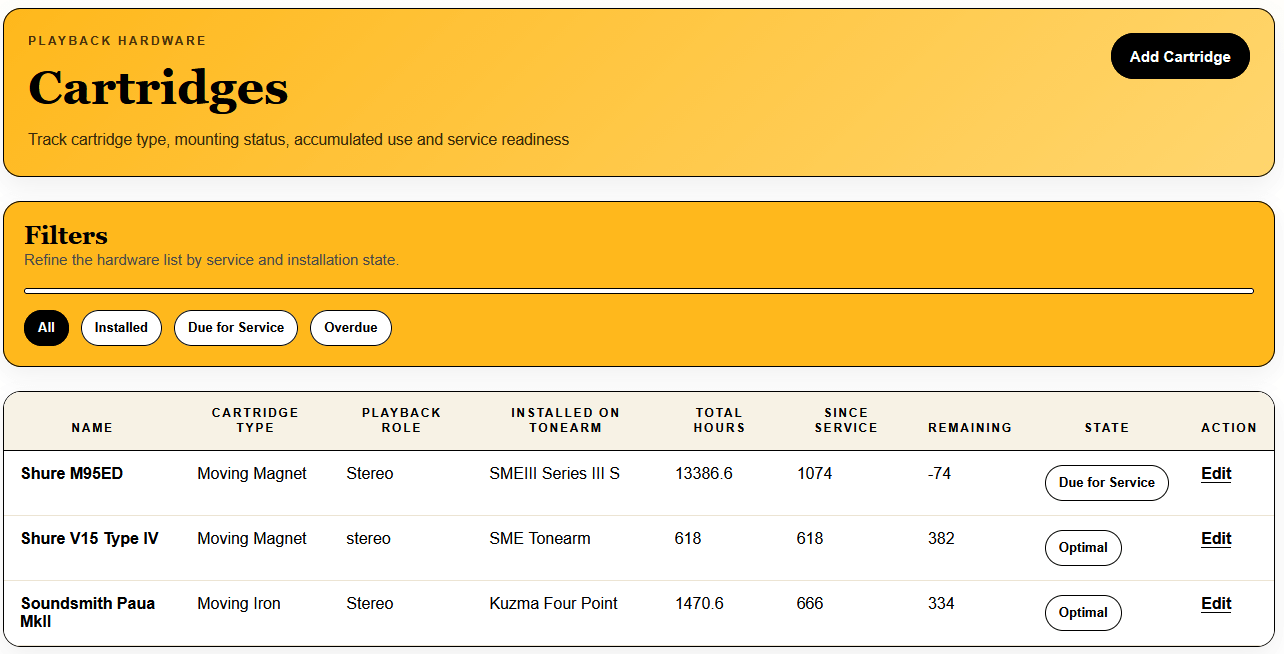
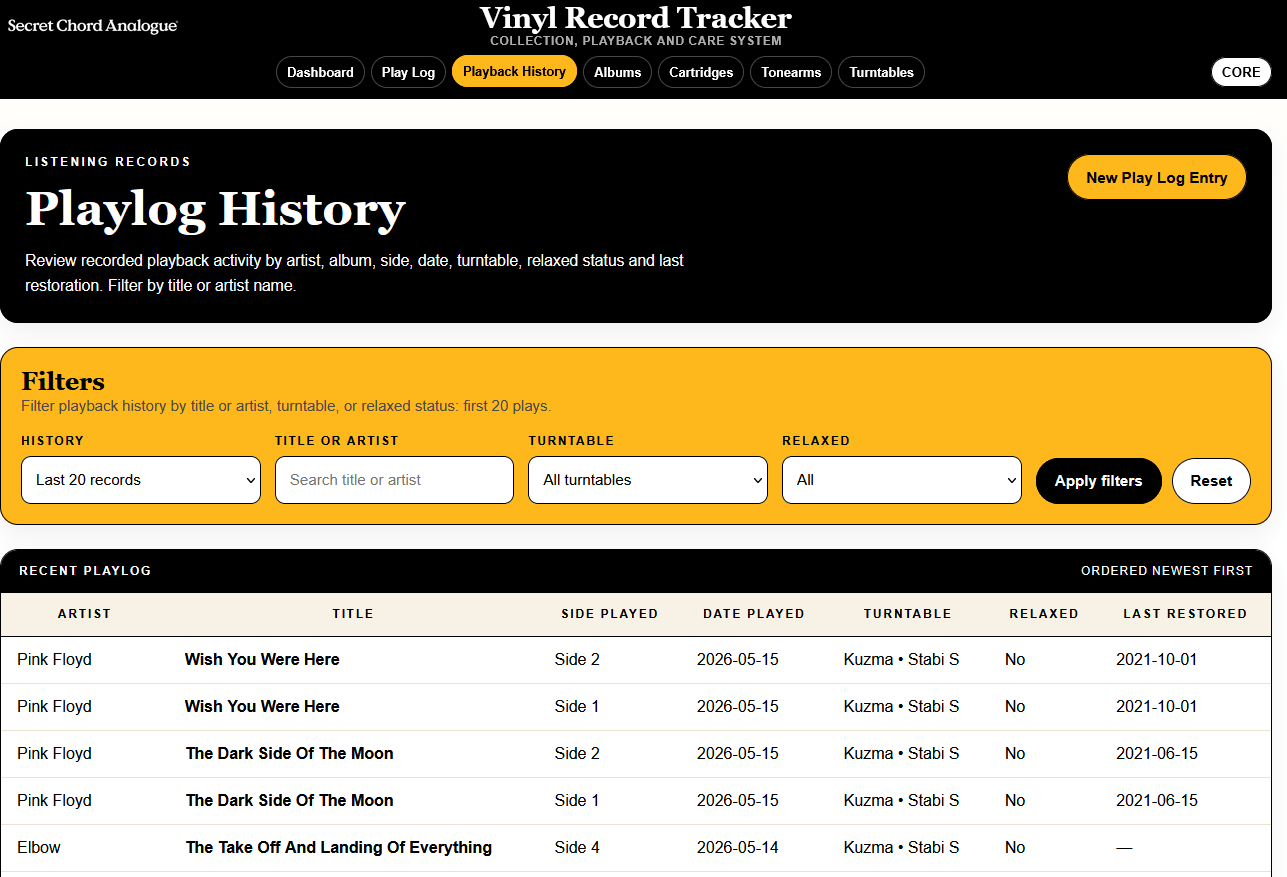
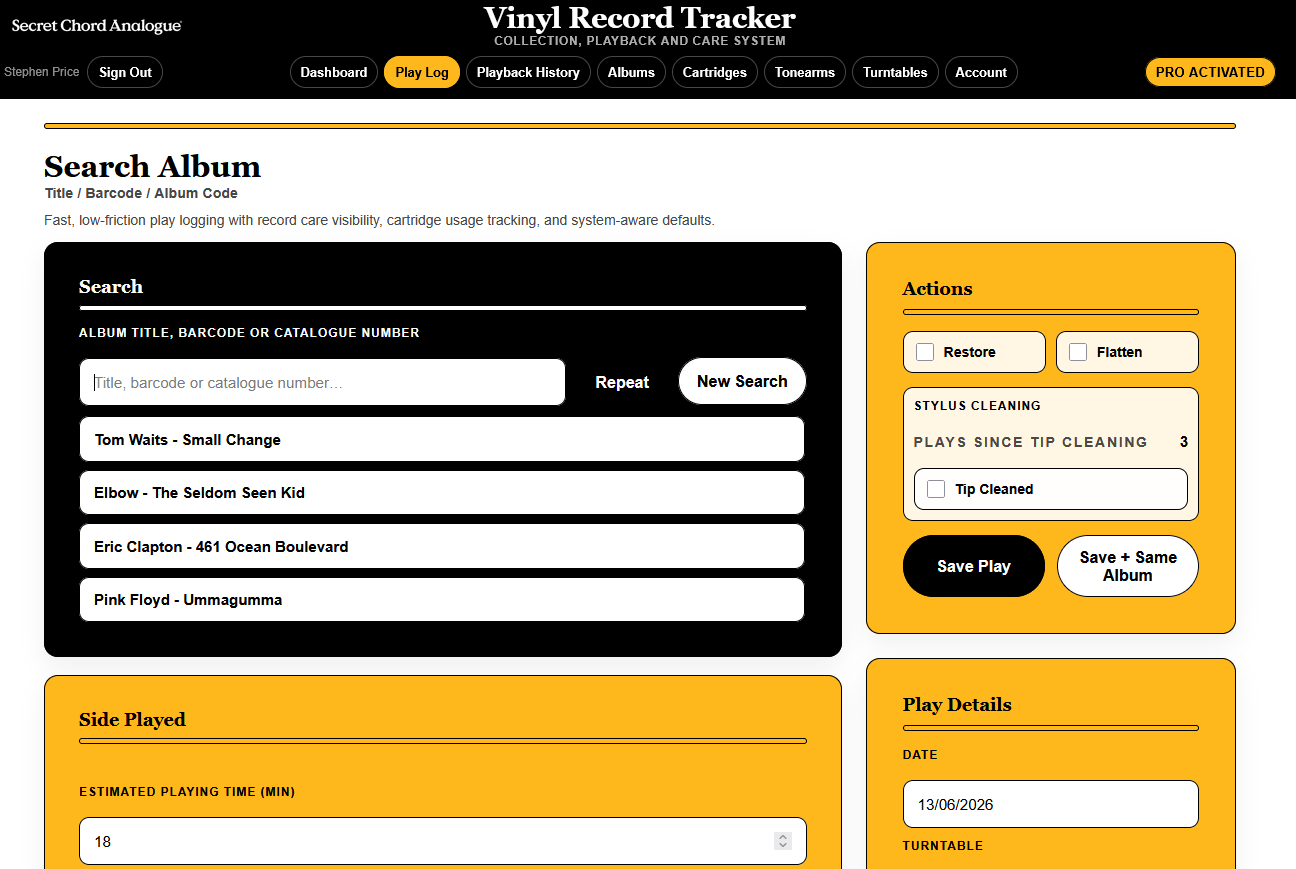
Secret Chord Analogue VRT is a web-based vinyl tracking and care system built around the Play Log. Each listening session can be recorded with the album played, cartridge used, turntable and tonearm configuration, and play duration. From there, VRT tracks cumulative cartridge hours, stylus wear, cleaning status, record treatment history, and playback activity.
Advertisement
The system also supports barcode scanning, Discogs lookup, album management, play-count history, storage tracking, and QR-code location tools for collectors who need to remember whether a record lives in the main listening room, the office, the overflow shelf, or that pile they keep pretending is temporary.
Secret Chord Analogue says VRT can track Record Restore treatments, fluid levels, stylus tip cleaning reminders, cartridge service thresholds, and recent playback history. The dashboard shows cartridge health, Record Restore readiness, recent plays, and system configuration.
That makes VRT less of a “collection database” and more of an analog maintenance dashboard.
Core vs. Pro
VRT is available in Core and Pro versions. According to Secret Chord Analogue’s official product page, current pricing is:
VRT Core Annual Licence: AU$39
VRT Core Lifetime Licence: AU$99
VRT Pro Annual Licence: AU$65
VRT Pro Lifetime Licence: AU$179
Core includes play logging, dashboard, album management, equipment setup, Record Restore tracking, playback history, and backup. Pro adds analytics, data exports, and advanced playback-history tools.
One note: some early reporting lists slightly different Pro annual pricing, so regional pricing should be checked before ordering. The official Secret Chord Analogue product page currently lists Pro Annual at AU$65, while SoundStage Australia lists AU$99.
Advertisement
Why This Is More Interesting Than Another Vinyl App
There are already ways to catalog a record collection. Discogs remains the default for many collectors because it handles pressing information, marketplace value, wantlists, variants, and buying/selling behavior. That is not what makes VRT interesting.
VRT is aimed at the part of vinyl ownership that usually lives in someone’s head, on a Post-it note, or nowhere at all.
When was this record last cleaned? How many times has this cartridge been used? How many hours are on this stylus? Did I already treat that used copy of Kind of Blue, or did I just think about doing it while holding a drink? Which records get played constantly and which ones are basically expensive wall insulation?
That is the gap Secret Chord Analogue is trying to fill.
The company also frames VRT as part of a broader vinyl-care ecosystem that includes its Record Restore treatment system and VSS sleeves. HiFi Pig also reports that VRT is designed to work alongside compatible hardware, including the AFI FLAT.DUO, and can support dealers or resellers using Record Restore as an ongoing monitoring service.
Advertisement
Advertisement. Scroll to continue reading.
Who Should Consider It?
VRT is not for someone with 24 records, a suitcase player, and a copy of Rumours purchased because TikTok had a moment. That listener has bigger problems, some of them structural.
This is for collectors with serious money invested in records, cartridges, and cleaning gear. If you own hundreds or thousands of records, rotate multiple cartridges, buy used vinyl regularly, run a record-cleaning routine, or care about stylus hours, VRT starts to make sense.
Secret Chord Analogue is positioning VRT as more than a collection database. It is part of the company’s broader vinyl-care ecosystem, including Record Restore, VSS sleeves, and compatible hardware such as the AFI FLAT.DUO, with potential use for collectors, dealers, and resellers who want to track cleaning history, cartridge use, and record-care status over time.
The Bottom Line
Secret Chord Analogue VRT is niche, but it is the right kind of niche. It does not promise to make your records sound better by magic, and it does not physically measure groove wear with sensors. Based on the available information, it tracks usage, maintenance, cartridge hours, stylus wear estimates, Record Restore treatments, and playback history from the data users log into the system.
Advertisement
That distinction matters.
VRT is not replacing good record cleaning, cartridge alignment, stylus inspection, or common sense. It is trying to make all of that easier to remember and harder to ignore.
For casual listeners, this might feel like turning vinyl into homework. For serious collectors, it might be the missing maintenance layer between buying records and actually protecting them.
Secret Chord Analogue lists VRT through its official Australian site, with North American shoppers directed to the company’s Record Restore store for local pricing and shipping.
Advertisement
Because at this point, vinyl is not cheap, cartridges are not disposable, and nobody needs to discover that their stylus crossed the danger line three months ago while playing a $125 reissue with the confidence of a man backing into a swimming pool.
As I am typing this, a device rests on my wrist that purports to unlock a trove of real-time information about my body’s performance. I can click a button and check my heart rate and review how much it’s varied over the course of the day. It can tell me how many steps I’ve taken, how many minutes I’ve been “active” throughout the day, and — if I wore it while I slept — just how well I rested, according to the data its sensors can pick up from my arm.
The Apple Watch is a remarkable piece of technology, when you stop and really think about what it does. It’s no surprise, perhaps, then, that we have collectively become obsessed with these things. One 2023 government survey found that one in three Americans wear a smartwatch or wristband to track their health and fitness. More recent industry surveys put that figure even higher: More than half of the US population owns a wearable or connected device and tracks at least one health metric with it.
That’s a lot of people who are swimming in the ocean of information that our Apple Watches, and FitBits, and Oura Rings, and Whoops report back to us. Dr. Michael Joyner, who studies the physiology of exercise at the Mayo Clinic, said he has a three-pronged criteria for thinking about the usefulness of these metrics: Is it measurable? Is what you’re measuring actually meaningful? And is the information that you’re receiving actually actionable?
“If one or two are missing, the thing may be the most interesting thing in the world. It may be cool,” he said. “But it’s not going to make a difference in long-term outcomes.”
Advertisement
Across medicine, we are developing remarkable tools for detecting things in the human body, outpacing our ability to interpret what we are finding. We are getting closer to a future where these devices could offer invaluable insights into how our body is performing outside of the doctor’s office or hospital, but here in the present, we should keep our expectations in check.
Here’s what you should know about some of the most common metrics that wearables track.
Do we really understand what our wearables are telling us?
These devices claim to track both old-fashioned and new-fangled measures of your body’s performance. You’ve got your heart rate — something humans have been able to pick up from the wrist before anybody had dreamed of smart devices — and your step count. My Apple Watch estimates how many calories I have burned throughout the day. The Oura Ring takes your temperature, which can help predict ovulation or offer an early sign that you’re coming down with something.
Advertisement
Sign up for the Good Medicine newsletter
Our political wellness landscape has shifted: new leaders, shady science, contradictory advice, broken trust, and overwhelming systems. How is anyone supposed to make sense of it all? Vox’s senior correspondent Dylan Scott has been on the health beat for a long time, and every week, he’ll wade into sticky debates, answer fair questions, and contextualize what’s happening in American healthcare policy. Sign up here.
But as the technology has gotten better, new measures for things many of us have never heard of have emerged. Heart rate variability, or HRV, has gained a lot of recent interest. It assesses the tiny variations, measured in milliseconds, in the rhythm of your heartbeat; the Economist dubbed it “the most useful indicator” of your overall health. Some devices then use HRV to deliver “recovery” scores that judge how well your body bounces back from your workout or “stress” scores that attempt to quantify how much strain you are under.
HRV demonstrates the conundrum that wearables can present to us, Joyner said. The metric itself has a scientific basis: Researchers have, in fact, found that the amount your heart rate varies over time is associated with your overall health. In general, a higher HRV is better than low, because it suggests your body is more adaptable and better regulated.
Advertisement
But that doesn’t necessarily mean that tracking your HRV from minute to minute with a smartwatch will translate to better health. For starters, we don’t have specific interventions for improving HRV, Joyner said. We don’t even have universally accepted definitions of what high or low HRV is.
In any case, the best strategies are the same heart health guidelines we’ve known about for decades: don’t smoke, don’t drink to excess, eat a healthy diet, exercise. You didn’t need a smartwatch to tell you that’s the best way to take care of your heart, Joyner pointed out. So what good was really derived from closely monitoring your HRV?
“As an individual metric that you can track and do something about, it’s interesting, but there’s no definitive data that you’re going to get better,” Joyner, who was speaking for himself and not the Mayo Clinic, said. “Follow the guidelines. People who follow the guidelines are going to do better on these metrics. But whether you can intervene specifically to make the metrics better or should pay much attention to them, who knows?”
Dr. Ami Bhatt, chief innovation officer at the American College of Cardiology, told me that the bedrocks of evaluating your heart health are still the old mainstays like your blood pressure and your cholesterol, along with newer metrics checked via blood test such as ApoB and lipoprotein. Are you a smoker? What’s your family history?
Advertisement
The value from wearables is less about the specific numbers they are reporting — especially with something like HRV, for which there are not universal guidelines — and more about the long-term trends they can track. By collecting your personal data over time, they can help you figure out what’s normal for you and help you notice if something changes. So don’t freak out if your HRV is different from somebody else’s, or you see one abhorrent reading in your daily report. But if you notice a change in your resting heart rate or HRV that persists over time, then it might be worth going to see a doctor about it.
“We don’t want to overreact to just one abnormal reading,” Bhatt said. “If you just know your baseline when you’re relatively healthy, you can catch the trends.”
It’s all about having realistic expectations about what your wearable can deliver — and recognizing that, for some things, the old ways are still better. When it comes to those metrics that incorporate HRV to determine your stress and “recovery,” Joyner said that self-reported data (literally, how do you feel?) remains the more accurate way to evaluate a person.
And at a certain point, your wearable can straight-up make your health worse. Fixating too much on your sleep problems, for example, can paradoxically cause more sleep problem. An American Society of Sleep Medicine survey this year found that 76 percent of US reported losing sleep because they were worrying about their sleep. It’s a problem — dubbed “orthosominia” — that scientists have been warning about for nearly a decade: the possibility that our obsession with better sleep, and doing things like wearing a device to track our sleep, could actually give us insomnia.
Advertisement
Bhatt said she’d like to see these devices develop the capability to detect when a user may be checking their data a little too compulsively. Joyner, for his part, said he worried that the culture around health and wellness could, ironically, create a lot of stress for the people who get deeply invested in tracking their activity.
“I actually worry we’re entering a too-much-information world,” he said. “It’s going to be anxiety-provoking.”
How to have a healthier relationship with your wearables
Even as we recognize the limitations of wearables, that doesn’t mean they can’t be useful — and they’re going to keep getting better.
Advertisement
Right now, there are obvious situations where a wearable can be helpful. As Bhatt suggested, they can help you understand your personal baseline and notice any changes. Certain patients, such as those with congenital heart failure, can clearly benefit from ongoing monitoring of their heart’s performance, per the American Heart Association. Anybody can use a wearable to make sure their heart rate doesn’t reach dangerous levels during a workout. And these devices could ultimately prove effective in catching underlying heart problems — but there is still work to do. A 2019 study on wearables and atrial fibrillation is telling: At the time, only a tiny percentage of wearers received a notification of an irregular heartbeat, suggesting that there were others that the devices were missing. But, for those who did get an alert, the majority of them did in fact have A-fib. (The FDA has since said that several smartwatches are capable of A-fib detection.) Some patients who have had a serious cardiac event are being asked to put on a wearable, so their doctors can remotely monitor their heart, utilizing an AI assistant that checks the incoming data for any signs of a pending emergency.
And these are the worst wearables we’ll ever have. The future iterations of these devices are going to become more precise and more integrated with AI, which could allow them to ultimately provide more value to the people wearing them. The hypothetical potential for integrating wearables with health care delivery more broadly is immense.
“None of these things will exist in a silo,” Bhatt said. “Your health records, how you’re doing, your wearables, your lab data, people are going to be pulling those together…and trying to give you insights.”
But for now, for the average person, it’s more of a personal choice. Joyner, whose work is all about maximizing human performance, does not wear a smartwatch. Bhatt likes to experiment with different devices with a certain goal in mind, like trying to improve her sleep over the course of a few months.
Advertisement
As Bhatt put it to me, if a wearable motivates you to take your health more seriously, then it’s already doing your body some good. “The best health metric is the one that changes what you do in a way that improves your health,” she said. “For you and I, that may be different things. For your grandmother, it’s something else. For the woman down the road, it’s something else.”
At the most fundamental level, people who use wearables tend to move more when they do — up to 40 more minutes of walking per day, according to a 2022 Lancet study. That is a gain for their health; recent research has shown that even a little bit of movement can have life-saving benefits. The more wearables encourage people to move, the more they can deliver real health benefits.
So if you like wearing one, that’s fine. I’m not dropping my Apple Watch’s step tracker any time soon, because it pushes me to get moving. But be mindful of how your use affects you and how preoccupied you are with certain metrics. Stress is one of the worst things for your health. So is a lack of sleep. If you find your sleep metrics are keeping you up at night, or that your sleep seems to have gotten worse since you started using it, it’s okay to take it off.
Modern cinema relies very heavily on quadrotor drones, because they make for very smooth, very easy to position platforms. From slow pans to chase shots, drones are great– if your shots can be taken at a high enough altitude. Close to the ground, things get a bit dodgier. That’s where [Transistor Man]’s camera chase vehicle comes in— it’s a rover, so it excels close to the ground. In fact, it can’t go anywhere else, except perhaps if provided with a jump. It’s got a hefty gimbal to hold the camera steady on any terrain, a decade-old surplus radio to provide full HD FPV to the remote driver, and a powerful 1/5th scale radio control rally chassis to make it all go. Plus googly eyes, because everything is better with googly eyes.
It looks like an enormous amount of fun to drive, but more importantly it provides smooth, cinematic shots from the professional Sony camera held in the gimbal. One big takeaway is that when 3D printing something that will bounce around this much, you can’t rely on pure strength– flexible filaments are your friend. Just about everything printed ended up remade in TPU if it didn’t start that way. The other takeaway is that we’ve reached enough of a technological plateau that if you scrounge around, you can build something to take a top-of-the-line footage with decade-old castoffs, like the gimbal and radio used in this project, which is a great thing for hobbyists and small studios.
If you can’t find surplus, you could always DIY a gimbal. We’re not filmmakers, but we find ourselves wondering how shots made with this rover would compare to a camera slider.
























































You must be logged in to post a comment Login