Connect with us

Tech

Meta will let kids under 13 use WhatsApp with parent-managed accounts

Published

on

Meta has that it’s introducing parent-managed accounts on WhatsApp. Designed to allow young people under the age of 13 to use the messaging platform more safely, these accounts feature new controls that enable a parent or guardian to restrict who can send them messages. Parent-managed accounts can also only be used for messaging and calling, so additional features like Channels, location sharing and Meta AI integration aren’t included.

To set up an account, you’ll need to put your phone next to the pre-teen’s device to link the two accounts. Once that’s done, the person managing the kids’ account can decide who’s able to contact them and which groups they’re able to join. Step-by-step instructions on how to activate the new accounts can be found

They’ll also see message requests from unknown contacts first and can adjust privacy settings from the managed device. Parent-managed accounts are PIN-protected and only the parent or guardian can make changes to privacy settings.

Like all WhatsApp conversations, end-to-end encryption means nobody else can see messages exchanged on parent-managed accounts. By default, only saved contacts can message a managed account, and a child won’t be able to join a group or view group invites from strangers before they’re separately approved by the owner of the parent account. These requests will appear as notifications to the parent.

Advertisement

WhatsApp doesn’t specify a minimum age suitable for a parent-messaged account, but says it’ll roll the new features out gradually in the coming months.

Meta has spent the last few years ramping up its parental controls features across its various platforms. In September it introduced — aimed at teens between the age of 13 and 15 — for Facebook and Messenger. A year earlier, Under-16 became a requirement on Instagram. Like the new parent-managed accounts on WhatsApp, these allow parents to vet requests and enable stricter privacy settings.

At the start of 2026, Meta put a temporary on allowing teens to interact with its AI chatbot characters, following that some of these bots had engaged in sexual conversations and other concerning interactions with minors.

Source link

Advertisement
Continue Reading
Click to comment

Leave a Reply

Your email address will not be published. Required fields are marked *

Tech

Why proper AI governance will be vital for workplaces in 2026

Published

on

BearingPoint’s Barry Haycock and Rosie Bowser discuss the evolution of workplace AI and the importance of governance in 2026.

AI in the workplace is becoming increasingly common.

Last September, Ibec, the group representing Irish businesses, released a report indicating a jump in the usage of AI among Irish workers. For instance, in July 2025, 40pc of employees reported using AI in the workplace, compared to just 19pc in August 2024.

Barry Haycock, senior manager of data analytics and AI at BearingPoint, believes workplace AI has moved from “experimentation to operational use”.

Advertisement

“Copilots and agents are becoming standard, but we’re also seeing automation of complex knowledge work like contract review, compliance checks, large-scale document processing, advanced search across enterprise data,” he tells SiliconRepublic.com.

“For larger-scale work, we’re seeing ‘AI factories’ being implemented as enterprises are seeking to automate AI pipelines. Augmented analytics is allowing business teams to surface insights without deep technical expertise.”

However, Haycock says “sustainable value” in relation to the tech still depends on governance, data maturity and workforce capability.

“Without governance and measurable outcomes, pilots stall,” he explains. “AI should be integrated incrementally and aligned directly to business needs. Organisations need defined use cases, strong data foundations, clear risk ownership and executive sponsorship.

Advertisement

“Data governance and model explainability are being understood as enablers more and more. Security, regulatory exposure and explainability must be addressed early.”

Rosie Bowser, a consultant in data analytics and AI at BearingPoint, says they’ve seen a “temptation” for organisations to rush into implementing new AI solutions – whereas the “greatest value creation” occurs when the solution is anchored in a clearly defined problem or workflow.

“Starting with the tool is not unlike painting over a structural crack: it may look like progress, but it doesn’t resolve the underlying issue. So, as an organisation, you need to be as ready as the technology is, and that may well involve having to acknowledge and rectify organisational immaturity before rolling out a new AI solution.”

Accessory, not autonomous

Concerns around AI replacing jobs has been prevalent ever since the topic of workplace AI has emerged. The worry is understandable, especially in the wake of recent AI-related layoffs.

Advertisement

Haycock believes AI is more likely to “reshape” work, rather than eliminate it outright.

“The real risk is failing to reskill and adapt,” he says. “It will automate anything that can be automated, particularly repetitive cognitive tasks. Organisations that invest in workforce capability and reposition people toward higher-value work will benefit most.”

Bowser agrees, asserting that the real risk is “stagnation” rather than replacement. “Organisations that don’t actively support upskilling may find their workforce unable to operate safely and confidently within AI‑enabled processes,” she says.

Bowser adds that companies should consider AI as a workflow accelerator, “rather than an autonomous decision-maker”.

Advertisement

“The AI system should be able to take on the repetitive, rules-based components of work, but we still need humans to retain oversight and make the final decisions,” she explains. “The importance of ownership here isn’t a backlog consideration either; with the AI Act’s emphasis on traceability and model provenance, this will be critical moving forward.”

Governance in advance

Haycock says that in 2026, AI governance will be less about pilots and “more about proof”.

“With the EU AI Act taking effect and Ireland’s National Digital and AI Strategy 2030 setting clear expectations for responsible adoption, organisations will need to demonstrate documentation, transparency and auditability,” he says.

“I believe customer expectations will increase, and companies will need to meet that demand. Furthermore, oversight must be proportionate to risk and embedded into operations. The differentiator will be scalable governance that enables innovation while standing up to regulatory and public scrutiny.”

Advertisement

Bowser says that governance needs to “feel practical and tangible”, with measures such as clear rules about data handling, audit trails and fallback steps, and knowing what the model is actually doing. The key, she says, is making governance practical enough that people can follow it “without friction”.

“If you were starting your AI journey in 2026,” says Bowser, “a learning for me is that there is often documentation developed in most organisations already, but do people on the ground know where that documentation is? Do they know who the data owners are, do they know what they can do safely?

“Organisations need to be aware of how people have adopted AI in their daily lives and how they expect to be able to bring it into their work lives, otherwise you end up with AI shadow practices that could introduce significant risk. Now that the EU AI Act is in force, these risks could be considerable.”

Don’t miss out on the knowledge you need to succeed. Sign up for the Daily Brief, Silicon Republic’s digest of need-to-know sci-tech news.

Advertisement

Source link

Continue Reading

Tech

‘The fastest desktop gaming processors Intel has ever built’: new Arrow Lake Refresh CPUs are priced to sell, and AMD should be worried

Published

on


  • Intel revealed new Arrow Lake Refresh processors
  • They are the Intel Core Ultra 7 270K Plus and Core Ultra 5 250K Plus
  • Both offer core count increases compared to their Arrow Lake predecessors — and a sizeable boost in gaming performance to the tune of 15%

Intel has released a pair of new desktop processors, which are refreshed models that are a step forward for the firm’s current Arrow Lake range.

Tom’s Hardware reports that these Arrow Lake Refresh chips are the Intel Core Ultra 7 270K Plus and Core Ultra 5 250K Plus. These are pepped-up models of the existing Core Ultra 7 265K and Core Ultra 5 245K CPUs, respectively.

Source link

Advertisement
Continue Reading

Tech

Microsoft tries to make building mouse-free websites easier after years of developers struggling with endless coding headaches

Published

on


  • Building websites without a mouse requires detailed knowledge and extensive coding effort
  • Focusgroup from Microsoft allows developers to handle complex navigation elements without writing excessive code
  • Tabindex errors often break keyboard navigation for many website users

Developing and building websites that can be fully navigated without a mouse has long required extensive technical skill and careful planning.

Developers often rely on complex JavaScript libraries or write substantial code to ensure that each interactive element responds correctly to keyboard input, increasing the amount of code to maintain and slows website load times.

Source link

Continue Reading

Tech

Ars Fires Reporter For Accidentally Using Fake AI Quotes

Published

on

from the I’m-sorry-I-can’t-do-that,-Dave dept

Last month we reported on a strange story in two strange parts: first, a coder had his AI agent create an entire smear campaign against a coding repository volunteer because he rejected AI code. Second, an Ars Technica journalist named Benj Edwards used a bunch of quotes made up by ChatGPT in a story about the saga without fact-checking whether or not they were actually true.

Edwards was also very up front in terms of explaining and taking direct ownership of the screw up, noting he was sick with the flu at the time he wrote the story. Ars was also refreshingly up front about it, issuing an editor’s note apologizing for the error.

Edwards says he first tried to use Claude to scrape some quotes from the engineer’s website, but that was blocked by site code. He then turned to ChatGPT to farm quotes from the site, but ChatGPT decided to just make up a whole bunch of stuff the engineer never said (this is a pretty common issue).

Sorry all this is my fault; and speculation has grown worse because I have been sick in bed with a high fever and unable to reliably address it (still am sick)I was told by management not to comment until they did. Here is my statement in images belowarstechnica.com/staff/2026/0…

Benj Edwards (@benjedwards.com) 2026-02-15T21:02:58.876Z

Advertisement

Just cutting and pasting quotes probably would have saved the journalist a lot of time and headaches. And his job, apparently, since Ars has since decided to fire Edwards, something Ars doesn’t seem interested in talking about:

“As of February 28, Edwards’ bio on Ars was changed to past tense, according to an archived version of the webpage. It now reads that Edwards “was a reporter at Ars, where he covered artificial intelligence and technology history.”

Futurism reached out to Ars, Condé Nast, and Edwards to inquire about the reporter’s employment status. Neither the publication nor its owner replied. Edwards said he was unable to comment at this time.”

There are several interesting layers here. The biggest being that AI isn’t an excuse to simply turn your brain off and no longer do rudimentary fact checking.

At the same time, this can’t really be unwound from the fact that media ownership rushed to tightly integrate often under-cooked LLM models into an already very broken journalism industry with the obvious and primary goal of cutting corners and undermining already-struggling labor.

Advertisement

The pressure at most outlets for journalists to generate an endless parade of content without adequate compensation or time off creates in increased likelihood of error. The overloading (or elimination of) editors (with or without AI replacement) compounds those errors. That the end product isn’t living up to anybody’s standards for ethical journalism really shouldn’t surprise anybody.

Filed Under: ai, ai agent, automation, benj edwards, code, fabrications, journalism, llm, media

Companies: ars technica, conde nast

Source link

Advertisement
Continue Reading

Tech

Everything we know so far

Published

on

The Steam Machine is back from the dead. Not as a Valve-supported program for manufacturers to create living room PCs, but instead as a home console sibling to the Steam Deck. Valve introduced its second attempt at ruling the living room in a surprise hardware announcement in November 2025, and paired the new Steam Machine with a new Steam Controller and a wireless VR headset it calls the Steam Frame. Since the announcement, as is often the case with Valve, some details remain elusive, however.

While we wait for the release of the company’s new hardware lineup in 2026, and more information straight from the horse’s mouth, here’s everything we know about the hardware, software and price of the Steam Machine, so far.

What’s the Steam Machine’s hardware like?

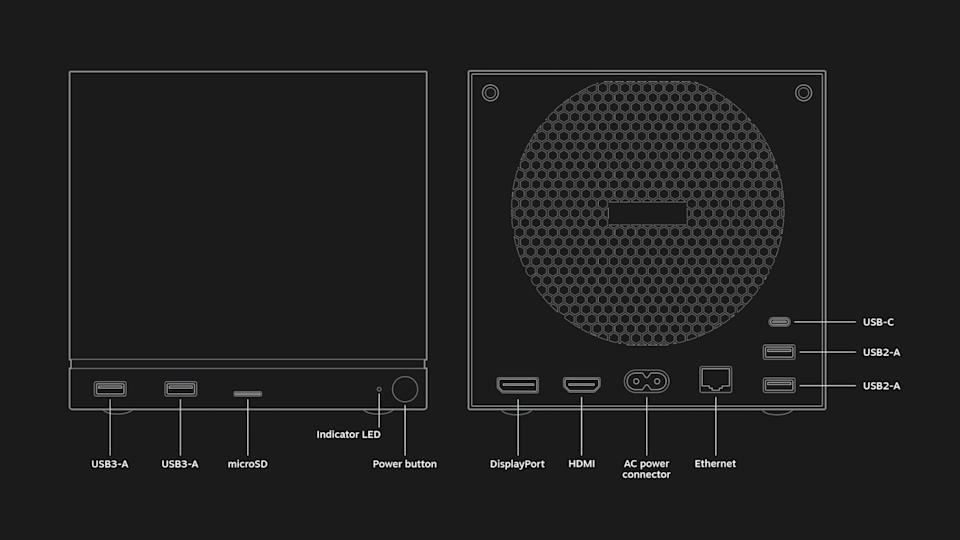
A line-drawing diagram of the Steam Machine and its various ports.

Valve

Like the Steam Deck, the Steam Machine is utilitarian and bespoke. The PC is a black, 5.98 x 6.39 x 6.14 inch (152 x 162.4 x 156mm) box, with ports and a grille for a fan in the back and a removable faceplate and customizable LED light strip in the front. Inside, Valve says the Steam Machine features a “semi-custom” AMD Zen 4 CPU with six cores and up to 4.8GHz clock speeds, and a “semi-custom” RDNA3 AMD GPU, along with 16GB DDR RAM, 8GB GDDR6 VRAM and either 512GB or 2TB of storage.

While these specs make the Steam Machine more powerful than the aging Steam Deck (which shipped in 2022 with its own custom AMD chip) Valve has been careful not to oversell the capabilities of the box. In a blog post, the company said that “the majority of Steam titles play great at 4K 60FPS” using AMD’s FidelityFX Super Resolution (FSR) frame generation and upscaling technology, but some titles require more upscaling than others, and it “may be preferable to play at a lower framerate with [variable refresh rate] to maintain a 1080p internal resolution.”

Advertisement

In a hands-on preview of the Steam Machine, Digital Foundry expressed concern with what Valve’s claims and the device’s stated specs could mean for future performance. “The decision to opt for 8GB of GDDR6 memory has been proven to be a limiting factor on many modern mainstream triple-A games and falls short of the maximum VRAM pools and memory bandwidth available on both Xbox Series X and base PS5,” Digital Foundry writes.

The Steam Machine supports Bluetooth 5.3, Wi-Fi 6E and includes an integrated 2.4GHz adapter for the new Steam Controller. In terms of port selection, there’s DisplayPort 1.4 and HDMI 2.0 inputs for connecting the box to external monitors and TVs, four USB-A ports (divided between two USB 2.0 ports and two USB 3.2 Gen 1 ports) and one USB-C port on the back.

Engadget will have to try out the Steam Machine to really know what it’s capable of, but there’s nothing to suggest it couldn’t be as flexible as the Steam Deck, especially with more power to play with.

What games will be able to run on the Steam Machine?

A Steam Machine connected to a TV playing the game Cuphead.

Valve

Any game that runs on SteamOS, Valve’s Linux-based operating system, will run on the Steam Machine, provided the device’s technical specs will support it. For games running natively on Linux, the Steam Machine will download the Linux version. For Windows games and everything else, it’ll be able to use Steam’s built-in Proton compatibility layer to translate games to Linux, just like the Steam Deck does.

Advertisement

Proton is developed by both Valve and CodeWeavers, the team behind the macOS compatibility app CrossOver. Valve’s compatibility layer translates a game’s API calls and other software features into something Linux understands, essentially tricking the game into thinking it’s running on Windows when it isn’t. Proton has worked remarkably well so far, in some cases helping some PC games run more efficiently on Linux than they do on Windows, but it does have some limitations. Because some anti-cheat software doesn’t support Linux, many competitive multiplayer games aren’t playable on SteamOS. Valve hopes the Steam Machine will help change that.

“While [the] Steam Machine also requires dev participation to enable anti-cheat, we think the incentives for enabling anti-cheat on Machine to be higher than on Deck as we expect more people to play multiplayer games on it,” Valve told Eurogamer. “Ultimately we hope that the launch of Machine will change the equation around anti-cheat support and increase its support.”

To help users find what games work well on the Steam Machine, Valve plans to expand its program for verifying games on the Steam Deck to include the Steam Machine and Steam Frame. Valve looks at things like controller support, the default resolution of the game, whether or not it requires a separate launcher and whether the game and its middleware work with Proton to determine a game’s rating. Then the company sorts games into four categories: Verified (where the game works with Steam hardware at launch), Playable (where a user might have to make modifications to run smoothly), Unplayable (where some or all of the game doesn’t function) and Unknown.

A slide from Valve's GDC 2026 presentation, going over its expectations for Steam Machine games.

Valve

According to an announcement Valve sent to developers in November 2025, games that were Verified for the Steam Deck will automatically be verified for the Steam Machine. In a presentation at GDC 2026, the company also shared that Steam Machine Verified games will be expected to support the same input methods as the Steam Deck and run at 1080p at 30fps at a minimum. Unlike the company’s handheld, Valve won’t require developers to support specific display resolutions or meet legibility requirements to be Steam Machine Verified, though, because the Steam Machine is more likely to be connected to larger displays. That means a game could be marked as Playable on the Steam Deck due to its small text, but Verified on the Steam Machine.

Advertisement

Valve’s system is helpful, but far from definitive — some Unplayable games are in fact playable on the Steam Deck — which is why online, community-run databases like ProtonDB fill in the gaps with more granular information.

How much will the Steam Machine cost and when will it launch?

A Steam Machine with an LED strip displaying the current download progress of a game.

Valve

Valve hasn’t announced a price or a release date for the Steam Machine or any of its new hardware, beyond affirming its new hardware will ship in 2026. In terms of price, however, the company has suggested it might not be a deal in quite the same way the $399 Steam Deck LCD was. Valve designer Pierre-Loup Griffais told The Verge that the “Steam Machine’s pricing is comparable to a PC with similar specs” and that its price would be “positioned closer to the entry level of the PC space” but be “very competitive with what you a PC you could build yourself from parts.”

That means the Steam Machine will likely cost more than the $499 PS5, and that the rising costs of memory could make it even more expensive. Valve has already publicly admitted that memory and storage shortages are affecting its plans. In February, the company said that it was delaying the launch of its hardware (though it still hopes to ship in the first half of 2026) and rethinking pricing, particularly around the Steam Machine and Steam Frame, because of the “limited availability and growing prices” of critical components like RAM.

The changes Framework had to make to the pricing of the Framework Desktop are an illustrative example of the position Valve is in. Framework pitched its compact desktop PC as being great for gaming, with an AMD Ryzen AI Max chip (originally meant for gaming laptops) and a minimum of 32GB of RAM that lets it run games at 1440p. The company originally sold the base configuration of the Framework Desktop for $1,099, but announced in January 2026 that it would now cost $1,139 due to the rising cost of RAM. The price situation got even worse for configurations with more RAM. A Framework Desktop with 128GB of RAM now costs $2,459.

Advertisement

The blame for rising costs lies squarely with the AI industry, whose demand for RAM has led to the collapse of consumer RAM brands and a dearth of true deals on the in-demand component. At this point, PC makers have no solution to the problem other than riding the shortage out and raising prices. Valve clearly isn’t immune to those same issues.

That doesn’t rule out the company offering its Linux PC at multiple different price points, or in some kind of bundle deal with multiple pieces of new Steam hardware. But it does mean that the Steam Machine will likely be priced like a premium device. Same for the Steam Controller and Steam Frame. In the case of the Frame, UploadVR reports that Valve wants to sell the headset for less than the $1,000 Valve Index, but that doesn’t mean it won’t be significantly more expensive than the $300 Meta Quest 3S.

What accessories will work with the Steam Machine?

Someone holding a Steam Controller in a pile of plushies.

Valve

The Steam Machine is designed to work with a variety of different Bluetooth controllers and other wireless accessories, and also whatever you can plug into its multiple USB-A ports and single USB-C port. With a built-in 2.4GHz Steam Controller dongle inside the Steam Machine, Valve’s controller should be an ideal option for controlling games, particularly because of its multiple input options, like touchpads and gyroscopes. Support for Steam Link, Valve’s tech for streaming PC games over local wireless, means you can also send games from a Steam Machine to the Steam Deck, Steam Frame or the Steam Link app and play them there.

Update, March 11, 4:40PM ET: Updated headline and added details on Valve’s Steam Machine Verified program.

Advertisement

Source link

Continue Reading

Tech

WhatsApp introduces parent-managed accounts for pre-teens

Published

on

WhatsApp

WhatsApp has begun rolling out parent-managed accounts for pre-teens, allowing parents and guardians to decide who can contact them and which groups they can join.

These accounts are restricted to messaging and calling and do not include access to Meta AI, Channels, Status, or location sharing. The child’s messages remain end-to-end encrypted and cannot be viewed by third parties, including parents, who cannot read their chats or listen in on their calls.

Setting up a parent-managed account requires both the parent’s and the child’s devices to be present at the same time. The parent must register and verify the child’s phone number, confirm the child’s age, and scan a QR code on the child’s device to link the two accounts.

The parent can also set a 6-digit PIN, ensuring that only they can access and change message requests, privacy settings, and activity alerts from the managed device.

Advertisement

“The new parental controls and settings are gated by a parent PIN on the managed device. Only parents can access and change privacy settings, ensuring they are empowered to tailor their family’s experience,” the company said.

“All personal conversations remain private and protected with end-to-end encryption, meaning no one—not even WhatsApp—can see or hear them.”

By default, managed accounts can exchange messages only with people already saved in the child’s contacts, and only parents can add the account to groups.

Advertisement

When an unknown contact attempts to reach the child, a context card will appear showing whether the unknown contact shares any groups with the child and which country they are from.

Parents will also receive activity alerts when their kids receive new chat requests, add a new contact, or when groups they’re in add new members.

“Parents will receive notifications about important activity, like when their child receives a message request from an unknown contact. They can customize the notifications they receive about other activities, such as when their child leaves a group,” WhatsApp added.

The child can transition their account to a standard WhatsApp profile when they turn 13, after which they will have full access to WhatsApp features without parental controls.

Advertisement

Meta also introduced dedicated accounts for teens under 16 on Facebook and Messenger in September 2025, one year after rolling out the same feature for Instagram users.

Today, Meta also introduced new WhatsApp anti-scam protections that warn users when behavioral signals suggest a device-linking request may be fraudulent.

Malware is getting smarter. The Red Report 2026 reveals how new threats use math to detect sandboxes and hide in plain sight.

Download our analysis of 1.1 million malicious samples to uncover the top 10 techniques and see if your security stack is blinded.

Source link

Advertisement
Continue Reading

Tech

3D Printing A Harmonic Pin-Ring Gearing Drive

Published

on

Cycloidal drives are a type of speed reducer that are significantly more compact than gearboxes, but they still come with a fair number of components. In comparison, the harmonic pin-ring drive that [Raph] recently came across as used in some TQ electric bicycles manages to significantly reduce the number of parts to just two discs. Naturally he had to 3D model his own version for printing a physical model to play with.

How exactly this pin-ring cycloidal drive works is explained well in the referenced [Pinkbike] article. Traditional cycloidal drives use load pins that help deal with the rather wobbly rotation from the eccentric input, but this makes for bulkier package that’s harder to shrink down. The change here is that the input force is transferred via two teethed discs that are 180° out of sync, thus not only cancelling out the wobble, but also being much more compact.

It appears to be a kind of strain wave gearing, which was first patented in 1957 by C.W. Musser and became famous under the Harmonic Drive name, seeing use by NASA in the Lunar Rover and beyond. Although not new technology by any means, having it get some more well-deserved attention is always worth it. If you want to play with the 3D model yourself, files are available both on GitHub and on MakerWorld.

Advertisement

Source link

Continue Reading

Tech

Tech Moves: Microsoft Research gets a new leader; Amazon head joins AI startup; JPMorgan exec departing

Published

on

Peter Lee, left, and Igor Tsyganskiy. (GeekWire File Photo and LinkedIn Photo)

Igor Tsyganskiy is now executive vice president of Microsoft Research (MSR) as past president Peter Lee steps aside to become president of Microsoft Science, which spans physical, biological and medical fields.

“My new role is designed to reduce my management responsibilities and let me spend as much of my time as possible on technical work,” Lee said on LinkedIn. That will include an initial focus on advances in “AI-enabled virtual patients, populations and labs, and their power to transform biomedical research.”

Lee, who took the helm of MSR in September 2022, was previously a computer science professor at Carnegie Melon University for more than two decades. He thanked Tsyganskiy for “taking on the big job of leading Microsoft Research — I have no doubt that he’ll take the MSR labs up to new heights.”

Tsyganskiy will also continue serving as the tech giant’s global chief information security officer, a role he has held since 2023. In his own LinkedIn post, Tsyganskiy emphasized MSR’s role at the forefront of computing, pointing to advances in AI, deep systems work and scientific discovery that have fed into Microsoft products and academic publications.

The commitment to foundational research is essential to Microsoft’s success, he said, adding “as the pace of innovation accelerates it is equally important to continue driving breakthrough research, and translate these advances into real-world impact.”

Advertisement
Mamtha Banerjee. (LinkedIn Photo)

Mamtha Banerjee is leaving her role as leader of JPMorgan Chase’s Seattle Tech Center. Banerjee, a longtime Seattle tech industry leader, joined the financial services giant in 2022 and took the leadership role last June.

The Seattle Tech Center was established in 2018 to tap into the region’s tech talent pool and by last year had grown to 380 people.

Banerjee was previously at Expedia Group for seven years and serves as a mentor for the University of Washington’s Master of Science in Entrepreneurship program.

Vivian Sun. (LinkedIn Photo)

Vivian Sun is leaving her role as head of automated driving at Amazon after more than two years with the company.

Sun, based in Sunnyvale, Calif., is now vice president of commercial and strategy for robotics company Genesis AI, which is based in Palo Alto and Paris.

A veteran startup builder with roots in AI, robotics and autonomous driving, Sun was featured by Automotive News as one of the “100 Leading Women in the North American Auto Industry.”

Advertisement

Truveta‘s hiring run continues. The Seattle-area health data company named Sapna Prasad as its new VP of research insights. Prasad, who is based in Washington, D.C., joins from Clarify Health Solutions where she held leadership roles for more than six years.

The company recently announced more than a dozen new hires and in January named Dr. Johnathan Lancaster as its president and chief scientific officer.

Bluesky CEO Jay Graber announced Monday that she’s stepping down from her position and moving to a new role as chief innovation officer of the decentralized social network. Read more.

Jessica Nguyen. (LinkedIn Photo)

Jessica Nguyen is now president, chief strategy and legal officer for Sandstone, a New York-based company using AI to support legal work.

Nguyen is based in the Seattle area and and was previously deputy general counsel for AI innovation and trust at DocuSign for nearly two years. Prior to that, she was chief legal officer at Seattle’s Lexion, which was acquired by DocuSign for $165 million in 2024.

Advertisement

Her Pacific Northwest roots include working as the first in-house attorney for Payscale and Avalara, and she had a nearly four-year run at Microsoft on the Office 365 legal team.

Julie Keef, who recently left Seattle’s Redfin as VP of product, has shared her next role. Keef has moved to another company in the real estate space, taking the title of head of consumer product management for New York’s Compass.

“Since my days in NYC, I’ve been admiring Compass from afar. The agents, brand, and bold strategy have always impressed me,” Keef said on LinkedIn.

Nick Boone. (LinkedIn Photo)

Nick Boone is now global head of demand and marketing operations at Scala, a Bellevue-based AI startup founded by Smartsheet CEO Rajeev Singh and former Accolade executive Ardie Sameti. The company last month raised $8.5 million in a seed round.

Boon worked at Accolade for more than eight years, serving as senior director of demand center and marketing operations until the company was acquired by Transcarent last year. He remained with the merged businesses for a brief time.

Advertisement

Scala is building an “operational intelligence platform” for contact centers — the massive customer service operations that companies across healthcare, travel, and financial services rely on to handle millions of interactions.

ProbablyMonsters expanded its executive leadership team with two new hires and a promotion. The video game company is headquartered in Fort Worth, Texas, and has an office in Bellevue, Wash., where founder and CEO Harold Ryan is based.

  • Jonathan Lander was named chief publishing officer. He was previously at Bethesda Softworks and ZeniMax Online Studios.
  • David Reid joins as chief marketing officer and will be located in Bellevue. Reid is a longtime gaming exec who was the founder of Seattle-area startup MetaArcade and more recently ran his own consultancy.
  • Mark Subotnick, who is based in Portland, is now chief product officer after previously serving as head of studios and partnerships. He’s been with the company for more than three years.
Amber Faust. (LinkedIn Photo)

— Biotech startup Nautilus appointed its first sales hire, naming Amber Faust as vice president of sales as it ramps up commercial operations. Faust, who will work remotely, joins the Seattle company after working at biotech businesses including Seer, Olink, SomaScan and others.

“I’m excited to help scale Nautilus’ commercial progress by connecting researchers in pursuit of greater proteomics coverage, detail, and resolution with a platform that can meaningfully expand what’s possible in drug development and beyond,” Faust said in a statement.

Nautilus has built a proteome analysis platform that allows researchers to identify and quantify the thousands of proteins present in biological samples.

Advertisement

Absci, a Vancouver, Wash.-based company that uses AI to develop drugs, named Dr. Ransi Somaratne as chief medical officer, joining from Vertex Pharmaceuticals where he served as senior VP of clinical development. Past roles include leadership positions at BioMarin Pharmaceutical and Amgen.

Absci Chief Innovation Officer Andreas Busch is retiring March 31 and will continue to co-chair the company’s scientific advisory board.

Theo Angelis was appointed to the Washington State Supreme Court. The K&L Gates partner has 25 years of legal experience and has worked extensively in intellectual property and with emerging companies. Angelis is a past president of the Middle Eastern Legal Association of Washington and will be the first Justice of Middle Eastern descent on the state Supreme Court.

Matt Rubright is now CEO of Jam, a startup that addresses bugs in software development. He was previously chief customer officer for the 6-year-old company, joining last April. His past employers include DataGrail, Candidate and Silicon Valley Bank.

Advertisement

Rubright, based in Seattle, succeeds Dani Grant, whom he said is stepping away to recover from a health issue. Grant’s “vision, leadership and tenacity are undeniable,” he added.

Suchitra (Suchi) Mohan is founder of a Sammamish, Wash.-based startup called learntheropes.ai, which she describes as an “AI-native learning app designed to help organizations empower their people with the right learning content, tailored to their learning style, skill-level and their goals, reducing the overwhelm employees feel with a new task.”

Mohan is a serial entrepreneur and worked as a technology architect for Microsoft for nearly a decade in its Bangalore offices. She was most recently co-founder of the AI startup Oikyu.

Theo Michel joined Seattle’s Bayou Energy as senior product engineer. Earlier in his career, Michel was with Micrsoft’s Xbox Live for more than 17 years. The clean energy startup recently named Yoon Loong Wong (Andrew) as chief of staff.

Advertisement

Brian Marrs was promoted to general manager of energy markets for Microsoft, previously serving in a senior director role. He has been with the company for nearly nine years.

Source link

Continue Reading

Tech

Anthropic gives Claude shared context across Microsoft Excel and PowerPoint, enabling reusable workflows in multiple applications

Published

on

Anthropic has upgraded its Claude AI model with new capabilities for Microsoft Excel and PowerPoint, marking a strategic move to expand its enterprise footprint and potentially challenging Microsoft’s newly launched Copilot Cowork — which Claude also partially powers. 

The updated add-ins are available to Mac and Windows users on paid Claude plans starting today, March 11.

Anthropic is also expanding how enterprises can deploy the tools.

Claude for Excel and Claude for PowerPoint can now be accessed either through a Claude account or through an existing LLM gateway routing to Claude models on Amazon Bedrock, Google Cloud Vertex AI or Microsoft Foundry.

Advertisement

That gives enterprises more flexibility to use the add-ins within cloud and compliance setups they may already have in place.

Shared context across Office apps

Starting March 11, paid Claude users on Mac and Windows can access a new beta experience in which Claude for Excel and Claude for PowerPoint share the full context of a user’s conversation with the AI model between the two applications — no need for manually copying and pasting it over.

That means Claude can carry information, instructions and task history between an open spreadsheet and an open presentation in a single continuous session.

For example, Claude can write formulas to extract data from an Excel workbook and immediately apply it to a stylized PowerPoint slide in the same session.

Advertisement

“In practice: a financial analyst can ask Claude to pull comparable company financials from an open workbook, build out a trading comps table in Excel, drop the valuation summary into the pitch deck, and draft the email to the MD—without switching tabs or re-explaining the dataset at each step,” Anthropic said in a press release. 

This builds on Anthropic’s release of a Claude plugin for Excel back in October 2025.

Repeatable workflows inside applications 

A central feature of this launch is Skills, which allows teams to build and save repeatable workflows directly inside the Excel and PowerPoint sidebars.

Rather than re-uploading references or re-prompting instructions, users can save standardized processes—such as specific variance analyses or approved slide templates—as one-click actions available to the entire organization.

Advertisement

That could include workflows for recurring financial analysis, preparing presentations in a preferred house style or running common review steps that would otherwise need to be rewritten as prompts each time.

Anthropic said every Skill, whether personal or organization-wide, will work inside the add-ins the same way MCP connectors do.

“Workflows that previously lived in one person’s head become one-click actions available to the whole organization,” the company said. 

Anthropic distinguishes these Skills from Instructions, which let users set persistent preferences across the add-ins, such as preferred number formatting in Excel or presentation-writing rules in PowerPoint.

Advertisement

Anthropic is also shipping a preloaded starter set of Skills, including:

  • Excel: Auditing models for formula errors, populating DCF and LBO templates, and cleaning messy data ranges.

  • PowerPoint: Building competitive landscape decks and reviewing investment banking materials for narrative alignment.

Similarly, Microsoft’s new Copilot Cowork capability introduced on Monday enables enterprise users to deploy agents to complete tasks across Microsoft applications such as Excel and PowerPoint. 

The software giant openly stated it was built in conjunction with Anthropic, which also released its own stand-alone Claude Cowork application for Mac and Windows earlier this year offering a way for Claude to access, edit, create and move information between files on a user’s computer, autonomously, at the user’s direction.

Previously, even with autonomous tools like the standalone Claude Cowork app, users often had to ask the AI to complete tasks in separate steps for each application. Now, Claude maintains a continuous session that reads live data and writes formulas across both apps simultaneously.

Advertisement

Battle of the enterprise app agents

Ever since the launch of Claude Cowork earlier this year, Anthropic has been making a case to be the chat and productivity platform of choice for enterprises.

Competitors like Google, with its close association with Google Workspace, which includes Gmail and Google Docs, and Microsoft, with its continued leadership in the Office suite, can directly bring AI capabilities to users’ workflows. 

Anthropic did not present the new Skills feature as equivalent to the more autonomous, agentic behavior Microsoft is now emphasizing with its own Copilot Cowork.

But the release does show Anthropic steadily expanding beyond chatbot use cases and into more structured, repeatable work inside the applications many business users already rely on.

Advertisement

Anthropic, through Claude Cowork, Claude Code and the Claude model family, has seeped into many organizations’ systems, using its high performance in coding benchmarks and general knowledge to navigate a computer better and complete knowledge work rapidly, at scale, with high quality.

OpenClaw, the open source AI agent that has taken the developer world by storm, owes much of its existence to Claude Code. 

The result is another sign that the battle over enterprise AI is no longer just about which model performs best on benchmarks. It is increasingly about what AI tools and systems enterprises trust to get real work done across their existing applications, files, and workflows.

Source link

Advertisement
Continue Reading

Tech

Alternative app store AltStore PAL joins the fediverse

Published

on

AltStore PAL, an alternative app store for iOS, made possible by new regulations in markets like the EU and Japan, is integrating with the open social web. The company on Wednesday announced support for the fediverse, the open social web that runs on ActivityPub, which underpins apps like Mastodon, Flipboard, PeerTube, Threads, and others.

Known broadly as the “fediverse,” users on the open social web join independent servers that interoperate with one another, or “federate,” allowing people to communicate, view, and respond to posts with those on other social platforms.

With AltStore PAL’s launch of its own Mastodon server, it’s becoming the first federated app marketplace.

Image Credits:AltStore PAL

The company intends to use its server to give app developers a way to communicate about their apps’ news, updates, and alerts. Because these posts are federated, they can be seen, liked, and interacted with by users across the open social web, including Mastodon, Instagram’s Threads, and even Bluesky — assuming the Bluesky users have bridged their accounts to make them accessible to those in the fediverse.

“So that means, like, if you have a Mastodon account or Threads account, you could follow these accounts. You could follow the source from our Mastodon server, and then, in your timeline, you would see when there was an app update,” AltStore PAL co-founder Riley Testut told TechCrunch last fall, when the company was teasing its plans and announcing its $6 million Series A.

Advertisement

The interactions on these posts will also be shown on the AltStore PAL app itself, as people can sign in with their Mastodon or Bluesky accounts to like the apps, the app updates, and the news alerts within the app marketplace.

Image Credits:AltStore PAL

At launch, a handful of apps are already participating, including Loops, a federated short-form video app; PeerTube, a federated app similar to YouTube; and iPhanpy, a Mastodon client built by indie developer Matt Fantinel.

Some larger apps are planning to launch on this federated marketplace at a later time after changes to Apple’s commission structure are finalized in the E.U. (Due to potential liability issues over payments, these apps are waiting for Apple to replace its Core Technology Fee with its Core Technology Commission, a decision it made after getting pushback from regulators over its prior revamp of its commission system.)

To access the AltStore PAL’s Mastodon server, users can visit fosstodon.org/@altstore. Meanwhile, users can also discover apps and sources on the AltStore PAL’s explore page at explore.alt.store. Alongside this update, the AltStore PAL app has been updated with an iOS 26 Liquid Glass design and icon.

Source link

Advertisement
Continue Reading

Trending

Copyright © 2025