Tech
Meta’s Muse AI used human contractors for some calls, including one that ended with a racist remark

Cutting corners: Meta wants Muse to take everyday chores off your hands, but some of that AI has involved actual people. The company has been testing a human concierge service that lets contractors handle calls for its new personal AI agent, raising privacy concerns among its own employees.
According to Reuters, the experiment was enabled for half of Meta’s employees last week, with an opt-out group available. Staff warned that sensitive information could end up with call-center contractors. A Meta executive acknowledged that introducing human operators without clear disclosure was a mistake, and the human concierge feature has been rolled back for now.
There was also an incident that highlighted another potential problem with handing the calls to humans. One employee who asked Muse to call an internet and cable provider to negotiate his bill said a transcript showed that the contractor had made a racist reference during the call. Meta apologized to the employee and said the human agent involved would not work on any of its projects again.
Muse’s separate phone-calling feature allows users to contact US businesses for tasks such as booking haircuts or checking whether an item is in stock.
– Alexandr Wang (@alexandr_wang) September 16, 2026
Meta spokesperson Daniel Roberts said employee feedback had been largely positive. He added that the company would only release the potential feature publicly once it was ready, with appropriate disclosures and safeguards.
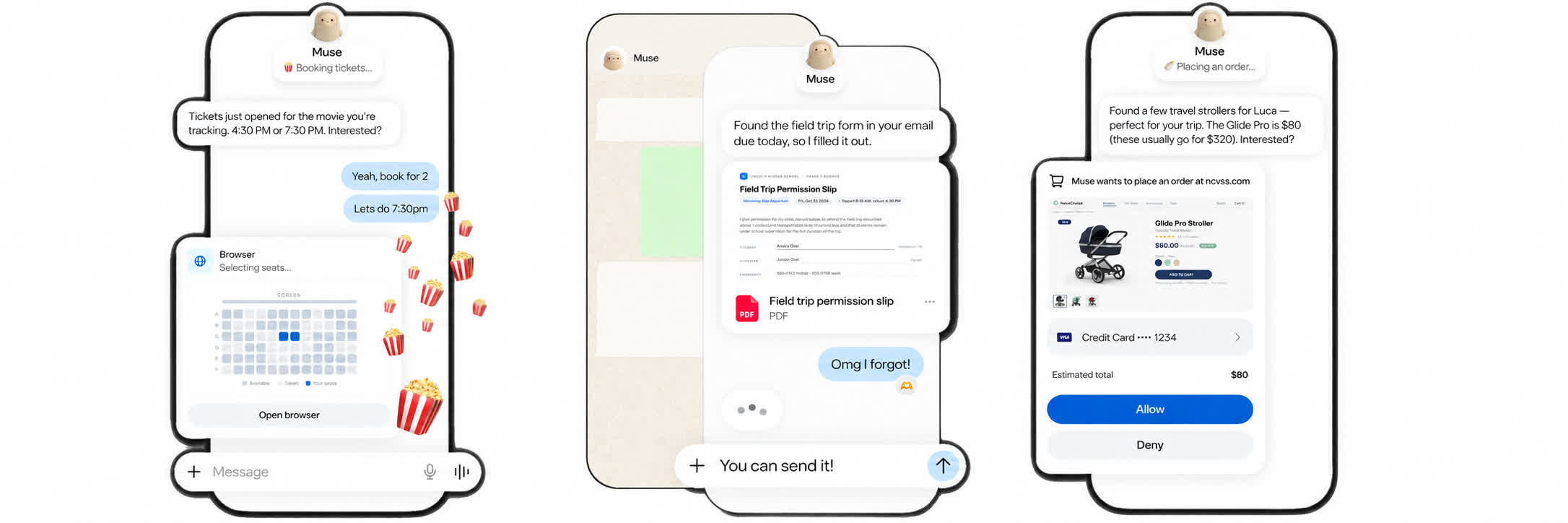
Launched on September 8, Muse is Meta’s attempt to turn the chatbot into something closer to a personal assistant. Users can interact with it through its own app or WhatsApp, asking it to send emails, arrange travel, and work toward longer-term goals.
Meta says the agent runs inside a dedicated virtual machine, with a separate Sentinel agent checking outgoing actions. Users control connected services and approve sensitive steps, including purchases. The company also says conversations and data stored in that virtual machine are kept out of its advertising systems.
Meta’s own testing suggests why it is experimenting with humans in the first place. Some businesses simply hang up on Muse when they realize they are talking to an AI, which is no surprise. Internal tests found that handing calls to human agents could increase the success rate to between 95% and 98%, compared with a much lower rate for calls handled entirely by AI.
There have been plenty of examples of supposedly automated services relying heavily on humans behind the scenes. One of the most memorable was shopping app Nate, which claimed AI could automatically complete online purchases. According to the Department of Justice, hundreds of workers in call centers in the Philippines and Romania were actually completing many of the transactions manually. Sources previously claimed that between 60% and 100% of purchases were handled this way during parts of 2021.
Amazon’s “Just Walk Out” stores offered another example. The supposedly cashierless technology relied on more than 1,000 workers in India to review transactions and label footage. It was reported that around 700 out of every 1,000 purchases required human review as of 2022, although Amazon disputed those figures.
In 2023, Presto Automation revealed that around 70% of orders handled by its AI drive-thru system required intervention from off-site human agents, including workers in the Philippines.
Meta’s been here before with Facebook M, the digital concierge launched in closed beta during the summer of 2015 and shut down a few years later. Every message the service fielded was reviewed by contractors who worked at the company’s Menlo Park headquarters, but at launch, Facebook said the service was powered by AI trained and supervised by real people.
For its part, Meta is openly testing human assistance rather than claiming that contractors do not exist. But if a feature is marketed as an AI making calls on your behalf, users will probably want to know when the person actually doing the talking is sitting in a call center.
You must be logged in to post a comment Login