Tech
Microsoft and Qualcomm think the future lies is in AI wearables

Qualcomm and Microsoft believe cloud-based AI wearables are the future, rather than entirely optional and secure on-device features like Apple Intelligence.
Big tech has all but embraced the proliferation of AI. Microsoft and Qualcomm are the latest to suggest the future of hardware and software development lies in AI-first devices.
On June 2, Microsoft CEO Satya Nadella and Qualcomm CEO Cristiano Amon discussed a new wearable device dubbed Project Solara, a joint venture of the two companies.
“We’re moving from building operating systems, devices for apps, to agents,” said Nadella.
Qualcomm’s CEO describes Project Solara as “a much more personalized and bespoke experience than an app in itself,” and as a product “that’s changing the nature of devices.”
In essence, the two companies are working on a device that does tasks for you through AI agents, rather than a product with an established operating system and apps that let you do things on your own. Additionally, the “whole silicon is designed for you to have a cloud-native experience,” according to Amon.
Design-wise, Project Solara resembles a smartphone attached to a lanyard. Commenting on the product’s design, Amon said that we’ve started to see “incredible new form factors” like Project Solara.
Realistically, though, it’s not a far cry from the ill-fated Rabbit R1 or the Humane AI Pin.
Inside, Microsoft and Qualcomm’s new device will house a power-efficient CPU, along with a variety of sensors to help it understand the world around its wearer. In that respect, the device sounds like most AI wearables on the market, though less convenient than something like Google’s smart glasses.
Microsoft’s AI approach vs. Apple’s ideas
Project Solara stands at odds with Apple’s privacy-first AI philosophy, where on-device models are prioritized over cloud-based processing. The product has an inherent security risk, relative to an iPhone, as information is constantly shared over the internet.
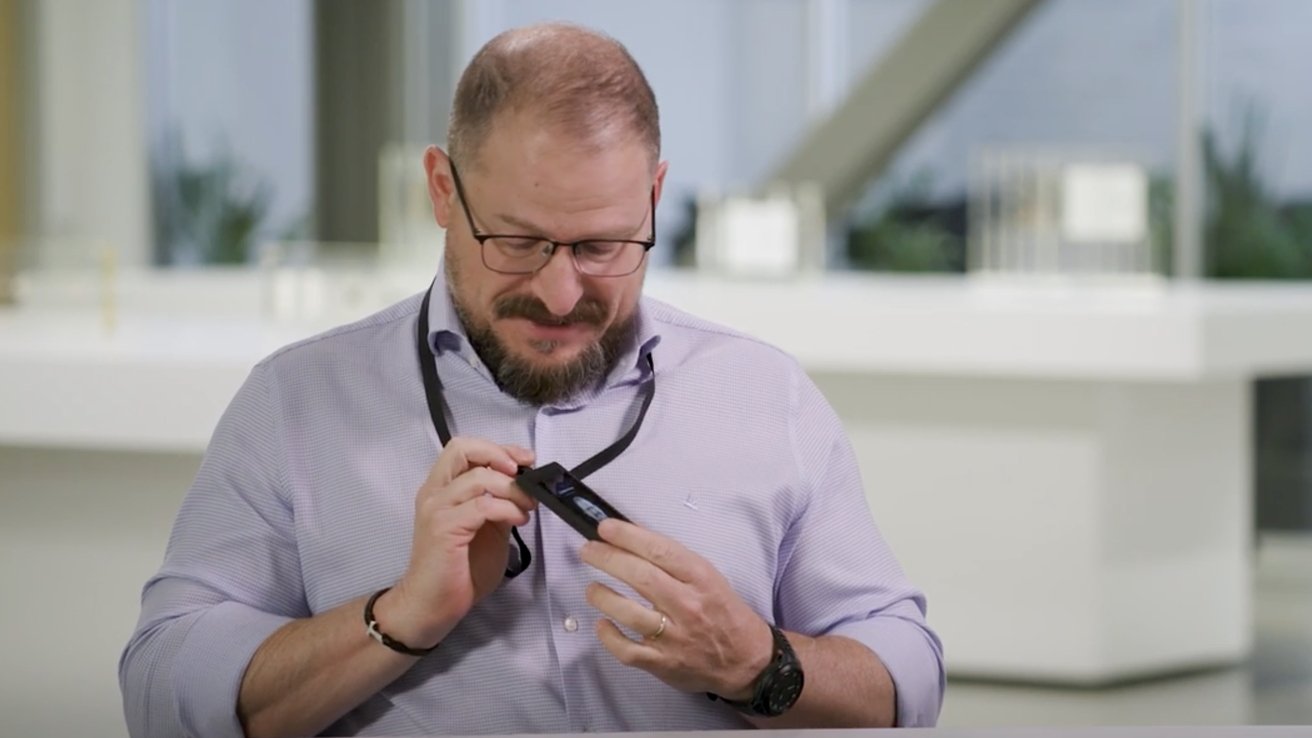
Qualcomm CEO Cristiano Amon spoke about “incredible new form factors,” but the device looks like a smartphone on a lanyard. Image Credit: Qualcomm.
However, there is a small commonality between the AI ideas of Microsoft and Apple. Project Solara will feature an open ecosystem where wearers can choose the AI agents they want to use.
Apple, meanwhile, is said to be working on improved third-party AI support for iOS 27, though its own on-device AI will continue to be the backbone of Apple Intelligence.
In essence, Microsoft will prioritize convenience over privacy, security, and long-term usability. Both Apple and Microsoft will give users freedom of choice when it comes to AI models, though.
When viewed through the context of failures like the Humane AI Pin and Rabbit R1, though, Apple’s idea of offering AI with existing products makes more sense. Google Gemini is similarly available across Android devices, as Apple Intelligence is on iOS.
More importantly, Apple Intelligence is an entirely optional set of features, an auxiliary set of tools. AI is not the cornerstone of the iPhone, and Apple understands that users want the freedom to do things without LLMs. Microsoft’s AI approach is arguably the exact opposite.
However, rumors of an Apple-branded AI pin continue to circulate, and OpenAI is working on an AI-themed device with former Apple designer Jony Ive. Even with the nonexistent success of AI companion devices, tech companies seem to believe there’s still hope for this sort of platform.
Whether any AI-themed device, be it from Apple or Microsoft, will achieve mainstream success remains to be seen.
You must be logged in to post a comment Login