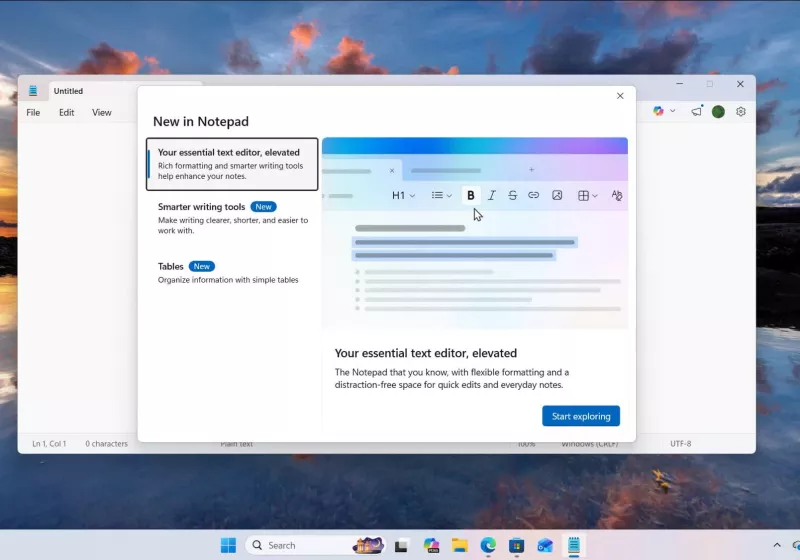
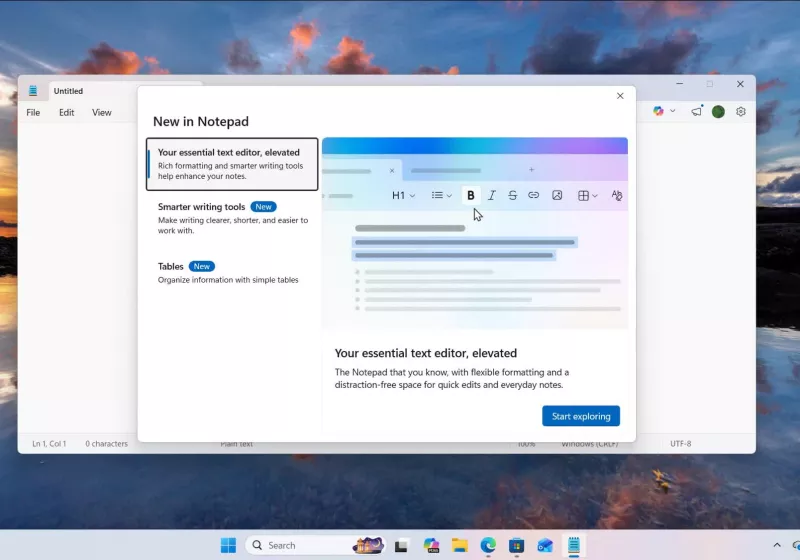
Microsoft is reportedly working on yet another “advanced” Notepad feature that has little to do with basic text editing. According to unnamed sources cited by Windows Latest, the application will soon support inserting images into text-based documents. Read Entire Article Source link
According to The Wall Street Journal, Nvidia is collaborating with MediaTek to develop its N1 and N1X PC SoCs, which integrate CPU, GPU, and NPU components into a single chip. Major PC manufacturers such as Dell and Lenovo are reportedly working on several laptops powered by the new processors, with… Read Entire Article Source link
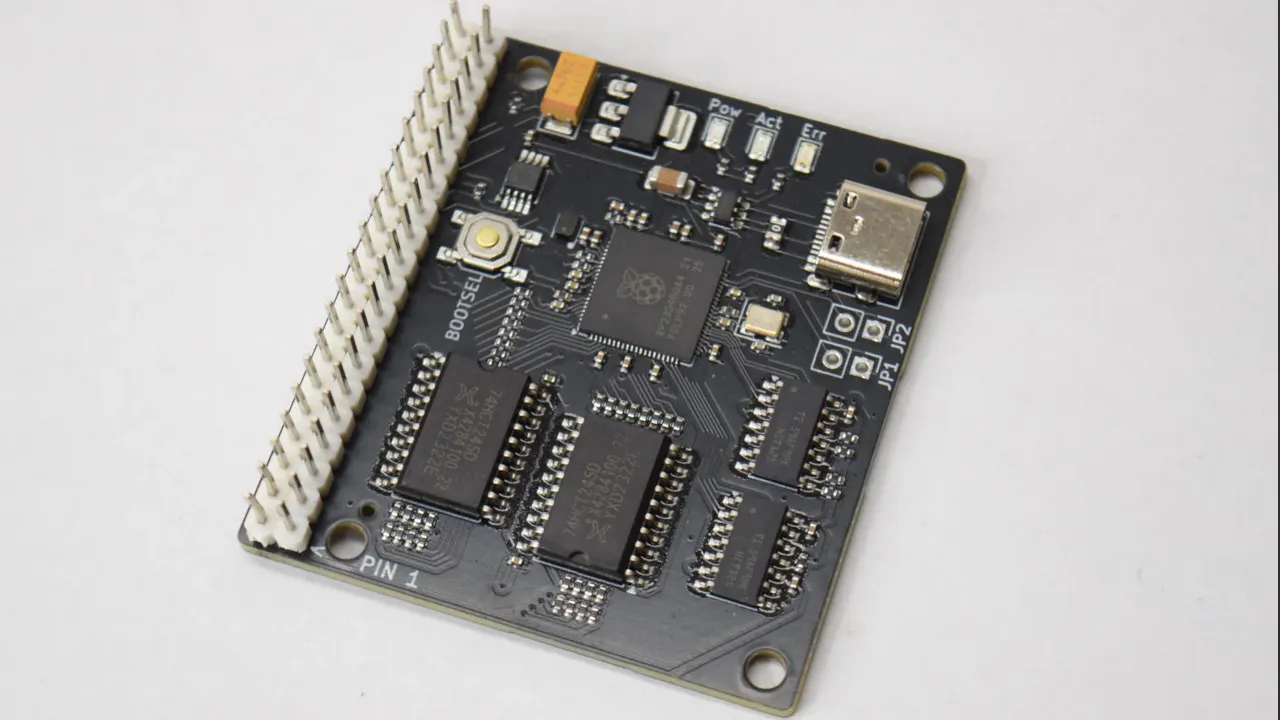
You can get an IDE to USB bridge from all the usual sources, but you may find those fail on the older drives in your collection– apparently they require drives using logical block addressing, which did not become standard until the mid-1990s. Some while some older drives got in on the LBA game early, you were more likely to see Cylinder-Head-Sector (CHS) addressing. That’s why [JJ Dasher], a.k.a [redruM0381] created ATABoy, an open-source IDE bridge that can handle the oldest drives that fit on the bus.
The heart of the build is an RP2350, which serves as both IDE and USB host controller. To computer, after a little bit of setup, the drive attached to ATABoy shows up as a regular USB mass storage device. A little bit of setup is to be expected with drives of this vintage, you may remember. Luckily [JJ] included a handy BIOS-themed configuration utility that can be accessed through any serial console. He says you’ll usually be able to get away with “Auto Detect & Set Geometry,” but if you need to plug in the CHS values yourself, well, it’ll feel just like old times. Seeing is believing, so check it out in the demo video embedded below.
Though the custom PCB has a USB-C connector, and the USB-C standard could provide enough power for ye olde spinning rust drives, [JJ] didn’t include any power delivery with ATABoy. If you’re using it with a desktop, you can use the PSU in the box; MOLEX hasn’t changed. If you’re on a laptop, you’ll need another power supply– perhaps this USB-C powered benchtop unit.
Advertisement
If you’re using a Raspberry Pi or similar SBC, go ahead and skip USB entirely–the GIPO can do PATA IDE.
Several mental health mobile apps with millions of downloads on Google Play contain security vulnerabilities that could expose users’ sensitive medical information.
In one of the apps, security researchers discovered more than 85 medium- and high-severity vulnerabilities that could be exploited to compromise users’ therapy data and privacy.
Some of the products are AI companions designed to help people suffering from clinical depression, multiple forms of anxiety, panic attacks, stress, and bipolar disorder.
At least six of the ten analyzed apps state that user conversations or chats remain private, or are encrypted securely on the vendor’s servers.
“Mental health data carries unique risks. On the dark web, therapy records sell for $1,000 or more per record, far more than credit card numbers,” says Sergey Toshin, founder of mobile security company Oversecured.
Advertisement
Over 1,500 security issues found
Oversecured scanned ten mobile apps advertised as tools that can help with various mental health problems, and uncovered a total of 1,575 security vulnerabilities (54 rated high-severity, 538 medium-severity, and 983 low-severity).
App Type
Installs
Advertisement
High
Medium
Low
Total
Advertisement
Scan date
01
Mood & habit tracker
10M+
1
Advertisement
147
189
337
01/23/2026
02
Advertisement
AI therapy chatbot
1M+
23
63
Advertisement
169
255
01/22/2026
03
AI emotional health platform
Advertisement
1M+
13
124
78
Advertisement
215
01/23/2026
04
Health & symptom tracker
500k+
Advertisement
7
31
173
211
Advertisement
01/22/2026
05
Depression management tool
100k+
–
Advertisement
66
91
157
01/23/2026
06
Advertisement
CBT-based anxiety app
500k+
3
45
Advertisement
62
110
01/22/2026
07
Online therapy & support community
Advertisement
1M+
7
20
71
Advertisement
98
01/23/2026
08
Anxiety & phobia self-help
50k+
Advertisement
–
15
54
69
Advertisement
01/22/2026
09
Military stress management
50k+
–
Advertisement
12
50
62
01/22/2026
10
Advertisement
AI CBT chatbot
500k+
–
15
Advertisement
46
61
01/23/2026
Although none of the discovered issues are critical, many can be leveraged to intercept login credentials, spoof notifications, HTML injection, or to locate the user.
The researchers used the Oversecured scanner to check the APK files of the ten mental health applications for known vulnerability patterns in dozens of categories.
Advertisement
In a report shared with BleepingComputer, the researchers say that some of the verified apps “parse user-supplied URIs without adequate validation.”
One therapy app with more than one million downloads uses Intent.parseUri() on an externally controlled string and launches the resulting messaging object (intent) without validating the target component.
This allows an attacker to force the app to open any internal activity, even if it is not intended for external access.
“Since these internal activities often handle authentication tokens and session data, exploitation could give an attacker access to a user’s therapy records,” Oversecured explains.
Advertisement
Another issue is storing data locally in a way that gives read access to any app on the device. Depending on the saved information, this could expose therapy details, such as therapy entries, Cognitive Behavioral Therapy (CBT) session notes, and various scores.
Oversecured states that they also discovered plaintext configuration data, including backend API endpoints and a hardcoded Firebase database URL, within the APK resources.
Furthermore, some of the vulnerable apps use the cryptographically insecure java.util.Random class for generating session tokens or encryption keys.
According to the researchers, “most of the 10 apps lack any form of root detection.” On a rooted (jailbroken) device, any app with root privileges has access to all health data stored locally.
Advertisement
Oversecured says that six of the ten analyzed apps “had zero high-severity findings, but still carried medium-severity issues that weaken their overall security posture.”
“These apps collect and store some of the most sensitive personal data in mobile: therapy session transcripts, mood logs, medication schedules, self-harm indicators, and in some cases, information protected under HIPAA,” the researchers note.
From BleepingComputer’s observations the collective download count for the apps scanned by Oversecured is more than 14.7 million, and only four received an update as recently as this month. For the rest, the date of the latest update was as recent as November 2025 or even September 2024.
Oversecured’s scans occurred between January 22 and 23 and targeted the latest app versions available at the time. The researchers cannot confirm if any of the uncovered vulnerabilities have been addressed.
Advertisement
BleepingComputer has refrained from the sharing the names of the impacted apps as the vulnerabilities are still being disclosed by Oversecured.
Modern IT infrastructure moves faster than manual workflows can handle.
In this new Tines guide, learn how your team can reduce hidden manual delays, improve reliability through automated response, and build and scale intelligent workflows on top of tools you already use.
Panasonic is handing over the manufacturing, marketing, and sales of its TVs to Shenzhen-based Skyworth, effectively exiting in-house TV production. Ars Technica reports: Skyworth is a Shenzhen-headquartered TV brand. The company claims to be “a top three global provider of the Android TV platform.” In July, research firm Omdia reported that Skyworth was one of the top-five TV brands by sales revenue in Q1 2025; however, Skyworth hasn’t been able to maintain that position regularly. Panasonic made its announcement at a “launch event,” FlatpanelsHD reported today. During the event, a Panasonic representative reportedly said: “Under the agreement the new partner will lead sales, marketing, and logistics across the region, while Panasonic provide expertise and quality assurance to uphold its renowned audiovisual standards with full joint development on top-end OLED models.”
Panasonic also said that it will provide support “for all Panasonic TVs sold up to March 2026 and all those available from April.” Skyworth-made Panasonic TVs will be sold in the US and Europe. In the latter geography, the companies are aiming for double-digit market share. […] The news means there’s virtually no TV production happening in Japan anymore, as other Japanese companies, like Sharp, Toshiba, Hitachi, and Pioneer, have already exited TV production. Earlier this year, Sony announced that it was ceding control of its TV hardware business to TCL.
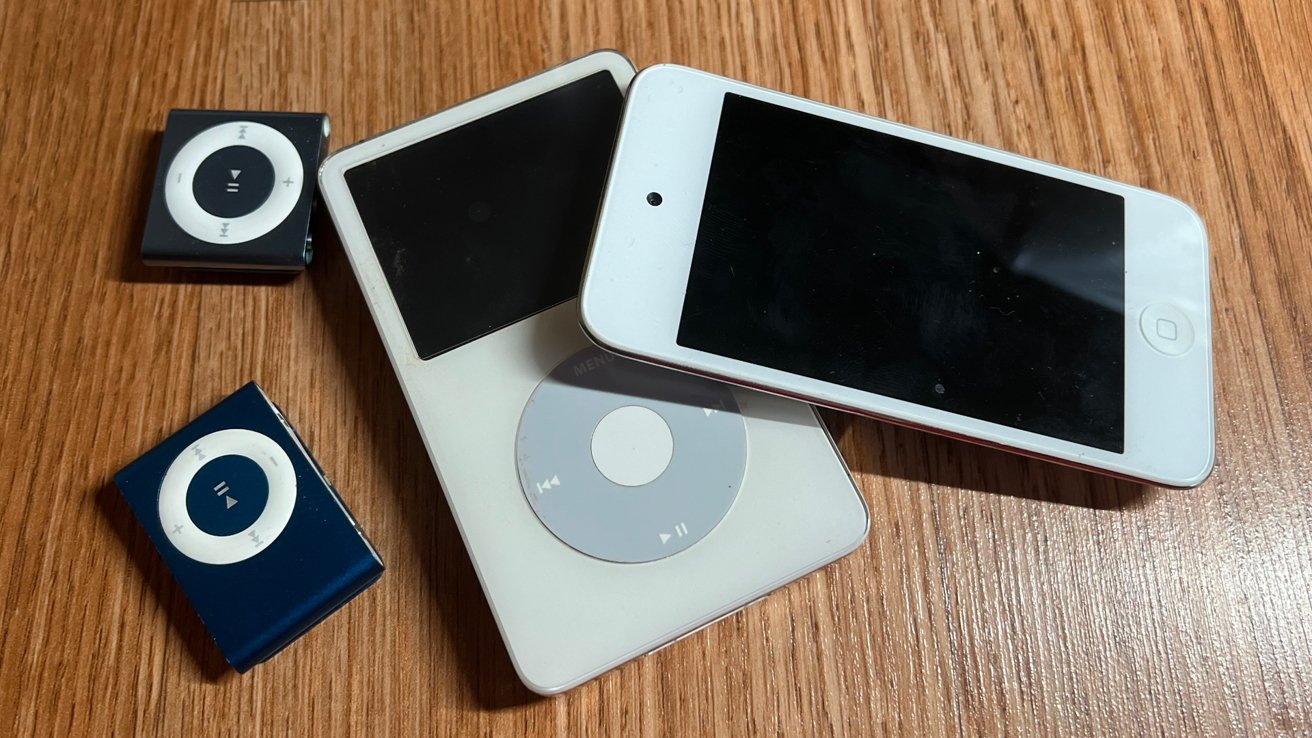
Young adults are eschewing all-in-one devices like the iPhone and moving more towards purpose-built technology, renewing interest in “vintage tech” like the classic iPod. Here’s why.
A veritable pile of ‘Pods
At one point, I think everyone collectively thought that smartphones were pretty great. However, in the last few years, younger generations have started to reject their glowing pocket rectangles in favor of older tech. This isn’t anything new. I know that when I was in my mid-20s, I felt a weird, inexorable urge to start collecting vinyl, despite not having anything to play them on. Continue Reading on AppleInsider | Discuss on our Forums
Microsoft is investigating a known issue that causes the mouse pointer to disappear in the classic Outlook desktop email client for some users.
This bug has been acknowledged almost two months after the first reports started surfacing online, with users saying that Outlook became unusable after the mouse pointer vanished while using the app.
“My mouse just stopped being visible while I am using Outlook, and this is very, very, frustrating because my permission wasn’t given to make these changes, and now I can’t find anything, can’t open emails, can’t copy and paste, and the list goes on and on,” one customer noted.
Microsoft explained in a recent support document that the mouse pointer (and in some cases the cursor) will suddenly vanish as users move it across Outlook’s interface, and noted that this bug also affects some users of other Microsoft 365 apps.
“When using classic Outlook, you may find that the mouse pointer or mouse cursor disappears as you move the pointer over the Outlook interface,” it said. “Although the mouse pointer is not there, the email in the message list will change color as you hover over it. This issue has also been reported with OneNote and other Microsoft 365 apps to a lesser degree.”
Advertisement
Microsoft added that the Outlook team is investigating the issues and will provide updates as more information becomes available. In the meantime, Microsoft is asking affected users to have their Microsoft 365 administrator open a support case with the Outlook Support Team and submit diagnostic log files to assist with analysis.
While a timeline for a permanent fix is not yet available, Microsoft has offered three temporary workarounds that require affected users to click an email in the message list when the cursor disappears, which may cause it to reappear.
Alternatively, switching to PowerPoint, clicking into an editable area, and then returning to Outlook may also restore the mouse pointer. If neither of them works, Microsoft said that restarting the computer should resolve the issue temporarily.
Modern IT infrastructure moves faster than manual workflows can handle.
In this new Tines guide, learn how your team can reduce hidden manual delays, improve reliability through automated response, and build and scale intelligent workflows on top of tools you already use.
This episode of Uncanny Valley covers the people resigning from AI companies and the humans getting hired by AI agents. Plus, we attend a soiree thrown by a conservative women’s magazine.
IBM shares plunged nearly 13% on Monday after Anthropic published a blog post arguing that its Claude Code tool could automate much of the complex analysis work involved in modernizing COBOL, the decades-old programming language that still underpins an estimated 95% of ATM transactions in the United States and runs on the kind of mainframe systems IBM has sold for generations.
Anthropic said the shrinking pool of developers who understand COBOL had long made modernization cost-prohibitive, and that AI could now flip that equation by mapping dependencies and documenting workflows across thousands of lines of legacy code. The sell-off deepened a rough 2026 for IBM, whose shares are now down more than 22% year to date.
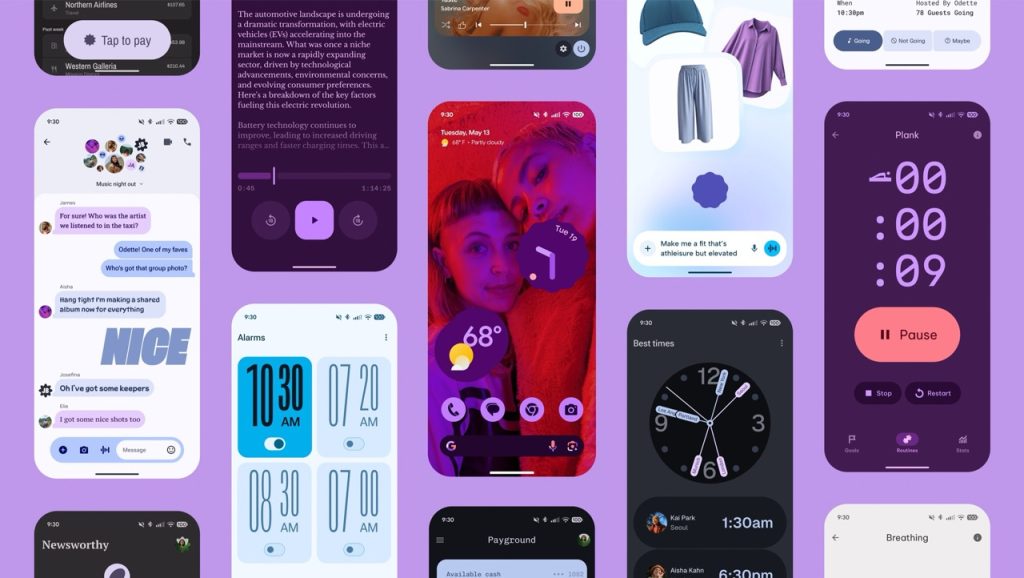
Google has finally released Android 17 Beta 1 after wrapping up its previous testing phase. The release is live as of February 13, 2026. There are several performance improvements, along with updates to foldables and tablets. Additionally, there are a number of visual changes to the Pixel Launcher user interface. With this release, Google is emphasizing long-term development to pave the way for the next Android release.
One of the biggest highlights of Android 17 is Google’s stronger push toward large-screen optimization. Developers are now required to properly adapt their apps for foldables, tablets, and desktop-style modes. Orientation changes and resizable window support are no longer optional. This should lead to a smoother, more consistent experience on larger devices without layout issues.
Furthermore, Android 17 Beta 1 brings a slimmer home screen search bar with a cleaner look. The shortcut now sits inside the bar and can be customized with options like Gemini Live, Translate, or Song Search. Users can also remove the At a Glance widget. Minor tweaks include a refreshed brightness icon and clearer access to the volume panel.
Performance Improvements in Android 17
Google has rolled out various enhancements to the system to make the devices more efficient. The most exciting change includes the introduction of the generational garbage collection system. The update reduces CPU load by optimizing memory cleanup across various stages. This minimizes CPU load.
Moreover, Android 17 improves app memory management to ensure better utilization of system resources. The update also includes notification-related optimizations that lower memory consumption. Although these upgrades run quietly in the background, they improve speed, stability, and overall device performance.
Advertisement
Media and Camera Enhancements
The update introduces advanced tools for media and camera apps. Users will notice smoother transitions between camera modes and generally more solid performance. Google is also working on providing users with a more unified listening experience across different applications and devices.
How to install Android 17 beta 1 on your Google Pixel?
On your phone, go to Settings > System > Software updates.
Check for updates and install Android 17 Beta 1.
As with any beta software, users should expect occasional bugs and instability. It’s best suited for developers or enthusiasts comfortable with early builds rather than primary daily drivers.
Walk into any school and you will find teachers using classroom technology in very different ways. One teacher builds interactive lessons with embedded videos and real-time polls. Down the hall, another uses technology more selectively, focusing on core features that support daily instruction. Both are effective educators. Both deserve classroom technology that works for them — and their students.
The challenge isn’t that teachers need to change how they work; it’s that most classroom technology is designed with only one pathway in mind. When tools offer multiple entry points instead, they can meet teachers where they are while supporting a wide range of student needs.
Recently, EdSurge spoke with three educators who use ViewSonic’s interactive display technology in distinctly different ways: Rebecca Ganger, technology coach and Chromebook coordinator, who also teaches high school students to repair devices and sponsors her district’s middle school Technology Club; Elena Clemente, technology trainer with 29 years of teaching experience in early elementary grades; and Brendan Powell, elementary STEM teacher. Their experiences illustrate what becomes possible when technology adapts to people rather than demanding that people adapt to it.
EdSurge: Why is it important that classroom technology offers multiple ways to engage?
Powell: Students need an engaging system to help them improve their understanding, and it makes learning more fun. Interactive technology helps a lot with coding, so my students can work through problems with me and are more engaged when they actually get to do the examples. Giving students choices helps them understand different concepts and piques their interest.
Advertisement
Clemente: Students learn in different ways, and teachers bring different approaches to their classrooms. While some students may prefer the interactive tools already displayed, others might prefer to choose which tool to use to demonstrate how to solve a math problem. The same goes for teachers. Some may prefer to use ready-made slides, while others prefer to create on the canvas. By offering choices, we allow both students and teachers to use technology in ways that make learning engaging.
Image Credit: ViewSonic
What makes technology feel approachable rather than intimidating for teachers at different comfort levels?
Clemente: As I have led several professional development sessions for teachers, I know that some want only the basics, such as writing on the canvas or projecting slides. Others have created engaging lessons that bring learning to life. All teachers are able to learn more.
I have found that it is best to demonstrate how to use a tool on the interactive panel, have teachers practice and then discuss how they can use it in their lessons. When teachers take that learning back to their classrooms and apply it in a lesson, the tool feels more approachable.
Ganger: Often, new technology requires you to learn so many things just to be able to use the basics and get started. Being able to use parts of the software and then incorporate more as you become familiar and comfortable is a huge plus. You can start with just a little bit of instruction and then learn more to incorporate additional tools into your lessons as you’re ready. You can use it at your comfort level, and it is also very user-friendly for student participation at the board.
What changes occur when students interact directly with classroom displays?
Advertisement
Powell: When students use the display in my classroom, they are more willing to talk to each other about the process and explain their ideas more clearly.
Ganger: They become more focused on the activity and are excited to participate. Students are so accustomed to auditory and visual sources being their primary ways of obtaining information. Having the opportunity to interact with technology fits into their natural way of learning.
Clemente: One of the big changes I have seen, or rather heard, is the amount of conversation that takes place. Students are able to express their thinking out loud while building speaking and listening skills. Students take pride in being able to share and navigate the interactive panel.
How do you keep students actively involved during interactive lessons?
Ganger: I personally enjoy adding a variety of interactive tools. I incorporate sounds, videos and links to other sites all within my presentation. I also enjoy using game boards with subject-specific questions as review activities. Varying the activities keeps things fresh and interesting for students.
Advertisement
Clemente: One way I keep students actively involved is by having them use their [individual] whiteboards to participate while I am projecting. Students know that they are accountable and that I am looking to call on them to share good examples and demonstrate their learning. I also use partner talks so that students can share what they are learning and gain different perspectives. Students love being called up to engage with the interactive panel, so I call them up in groups. They line up and take turns, or sometimes they work as a team and collaboratively solve the problem.
When it works well, how does technology change your teaching?
Clemente: When technology works well, it makes my job as a classroom teacher easier. I am able to easily share material, provide visually appealing interactive slides and engage with my students using hands-on learning activities that build their technical skills. As a technology trainer, I use technology to demonstrate how teaching can come to life, creating engaging lessons that have a positive impact on student learning.
Ganger: It frees up time typically spent lecturing in front of the room, allowing more one-on-one interaction with students. It provides immediate feedback and allows for easy differentiation of material. Being able to reach all types of learning styles with interactive boards and software is a game-changer.
Advertisement
Powell: The technology that works well in my room has changed how my students access information and made learning more flexible for all of them. One thing I like to say in my room is that technology can help us learn new skills and ways of thinking that will benefit us in the long run. Technology is always evolving, so it helps to have my students involved with me as I’m learning as well.