In building LLM applications, enterprises often have to create very long system prompts to adjust the model’s behavior for their applications. These prompts contain company knowledge, preferences, and application-specific instructions. At enterprise scale, these contexts can push inference latency past acceptable thresholds and drive per-query costs up significantly.
On-Policy Context Distillation (OPCD), a new training framework proposed by researchers at Microsoft, helps bake the knowledge and preferences of applications directly into a model. OPCD uses the model’s own responses during training, which avoids some of the pitfalls of other training techniques. This improves the abilities of models for bespoke applications while preserving their general capabilities.
Why long system prompts become a liability
In-context learning allows developers to update a model’s behavior at inference time without modifying its underlying parameters. Updating parameters is typically a slow and expensive process. However, in-context knowledge is transient. This knowledge does not carry across different conversations with the model, meaning you have to feed the model the exact same massive set of instructions or documents every time. For an enterprise application, this might mean repeatedly pasting company policies, customer tickets, or dense technical manuals into the prompt. This eventually slows down the model, drives up costs, and can confuse the system.
“Enterprises often use long system prompts to enforce safety constraints (e.g., hate speech detection) or to provide domain-specific expertise (e.g., medical knowledge),” said Tianzhu Ye, co-author of the paper and researcher at Microsoft Research Asia, in comments provided to VentureBeat. “However, lengthy prompts significantly increase computational overhead and latency at inference time.”
Advertisement
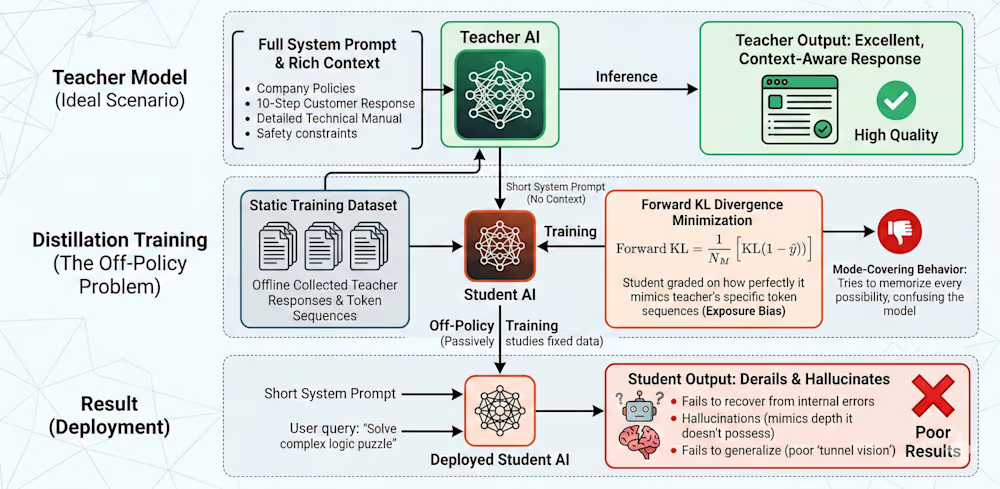
The main idea behind context distillation is to train a model to internalize the information that you repeatedly insert into the context. Like other distillation techniques, it follows a teacher-student paradigm. The teacher is an AI model that receives the massive, detailed prompt. Because it has all the instructions and reference documents, it generates highly tailored responses. The student is a model being trained that only sees the main question and doesn’t have access to the full context. Its goal is simply to observe the teacher’s responses and learn to mimic its behavior.
Through this training process, the student model effectively compresses the complex instructions from the teacher’s prompt directly into its parameters. For an enterprise, the primary value happens at inference time. Because the student model has internalized the context, you can deploy it in your application without needing to paste in the lengthy instructions again. This makes the model significantly faster and with far less computational overhead.
However, classic context distillation relies on a flawed training method called “off-policy training,” where the model is trained on fixed datasets that were collected before the training process. This is problematic in several ways. During training, the student is only exposed to ground-truth data and teacher-generated answers, creating what Ye calls “exposure bias.” In production, the model must come up with its own token sequences to reach those answers. Because it never practiced making its own decisions or recovering from its own mistakes during training, it can easily derail when operating independently. It’s like showing a student videos of a professional driver and expecting them to learn driving without trial and error.
Another problem is the “forward Kullback-Leibler (KL) divergence” minimization measure used to train the model. Under this method, the model is graded on how similar its answers are to the teacher, which encourages “mode-covering” behavior, Ye says. The student model is often smaller or lacks the rich context the teacher had, meaning it simply lacks the capacity to perfectly replicate the teacher’s complex reasoning. Because the student is forced to try and cover all those possibilities anyway, its underlying guesses become overly broad and unfocused.
In real-world applications, this can result in hallucinations, where the AI gets confused and confidently makes things up because it is trying to mimic a depth of knowledge it does not actually possess. It also means that the model cannot generalize well to new tasks.
Advertisement
How OPCD fixes the teacher-student problem
To fix the critical issues with the old teacher-student dynamic, the Microsoft researchers introduced On-Policy Context Distillation (OPCD). The most important shift in OPCD is that the student model learns from its own generation trajectories as opposed to a static dataset (which is why it is called “on-policy”). Instead of passively studying a dataset of the teacher’s perfect outputs, the student is given a task without seeing the massive instruction prompt and has to generate an answer entirely on its own.
As the student generates its answer, the teacher acts as a live instructor. The teacher has access to the full, customized prompt and evaluates the student’s output. At every step along the student’s generation, the system compares the student’s token distribution against what the context-aware teacher would do.
On-policy context distillation
OPCD uses “reverse KL divergence” to grade the student. “By minimizing reverse KL divergence, it promotes ‘mode-seeking’ behavior. It focuses on high-probability regions of the student’s distribution,” Ye said. “It suppresses tokens that the student considers unlikely, even if the teacher’s belief assigned them high probability. This alignment helps the student correct its own mistakes and avoid the broad, hallucinatory distributions of standard distillation.”
Advertisement
Because the student model actively practices making its own decisions and learns to correct its own mistakes during training, it behaves more reliably when deployed in a live application. It successfully bakes complex business rules, safety constraints, or specialized knowledge directly into its permanent memory.
What OPCD delivers: The benchmark results
The researchers tested OPCD in two key areas: experiential knowledge distillation and system prompt distillation. For experiential knowledge distillation, the researchers wanted to see if an LLM could learn from its own past successes and permanently adopt those lessons. They tested this on models of various sizes, using mathematical reasoning problems.
First, the model solved problems and was asked to write down general rules it learned from its successes. Then, using OPCD, they baked those written lessons directly into the model’s parameters. The results showed that the models improved dramatically without needing the learned experience pasted into their prompts anymore. On complex math problems, an 8-billion-parameter model improved from a 75.0% baseline to 80.9%. For example, on the Frozen Lake navigation game, a small 1.7-billion parameter model initially had a success rate of 6.3%. After OPCD baked in the learned experience, its accuracy jumped to 38.3%.
The second set of experiments were on long system prompts. Enterprises often use massive system prompts to enforce strict behavioral guidelines, like maintaining a professional tone, ensuring medical accuracy, or filtering out toxic language. The researchers tested whether OPCD could permanently bake these dense behavioral rules into the models so they would not have to be sent with every single user query. Their experiments show that OPCD successfully internalized these complex rules and massively boosted performance. When testing a 3-billion parameter Llama model on safety and toxicity classification, the base model scored 30.7%. After using OPCD to internalize the safety prompt, its accuracy spiked to 83.1%. On medical question answering, the same model improved from 59.4% to 76.3%.
Advertisement
One of the key challenges of fine-tuning models is catastrophic forgetting, where the model becomes too focused on the fine-tune task and worse at general tasks. The researchers tracked out-of-distribution performance to test for this tunnel vision. When they distilled strict safety rules into a model, they immediately tested its ability to answer unrelated medical questions. OPCD successfully maintained the model’s general medical knowledge, outperforming the old off-policy methods by approximately 4 percentage points. It specialized without losing its broader intelligence.
Where OPCD fits — and where it doesn’t
While OPCD is a powerful tool for internalizing static knowledge and complex rules, it does not replace all external context methods. “RAG is better when the required information is highly dynamic or involves a massive, frequently updated external database that cannot be compressed into model weights,” Ye said.
For enterprise teams evaluating their pipelines, adopting OPCD does not require overhauling existing systems or investing in specialized hardware. “OPCD can be integrated into existing workflows with very little friction,” Ye said. “Any team already running standard RLVR [Reinforcement Learning from Verifiable Rewards] pipelines can adopt OPCD without major architectural changes.”
In practice, the student model acts as the policy model performing rollouts, while the frozen teacher model serves as a reference providing logits. The hardware requirements are highly accessible. According to Ye, enterprise teams can reproduce the researchers’ experiments using about eight A100 GPUs.
Advertisement
The data requirements are similarly lightweight. For experiential knowledge distillation, developers only need around 30 seed examples to generate solution traces. Because the technique is applied to previously unoptimized environments, even a small amount of data yields the majority of the performance improvement. For system prompt distillation, existing optimized prompts and standard task datasets are sufficient.
The researchers built their own implementation on verl, an open-source RLVR codebase, proving that the technique fits cleanly within conventional reinforcement learning frameworks. They plan to release their implementation as open source following internal reviews.
The self-improving model: What comes next
Looking ahead, OPCD paves the way for genuinely self-improving models that continuously adapt to bespoke enterprise environments. Once deployed, a model can extract lessons from real-world interactions and use OPCD to progressively internalize those characteristics without requiring manual supervision or data annotation from model trainers.
“This represents a fundamental paradigm shift in model improvement: the core improvements to the model would move from training time to test time,” Ye said. “Using the model—and allowing it to gather experience—would become the primary driver of its advancement.”
Buyers of cheap travel deals often face canceled bookings and lost money
Fraudulent travel reservations can appear legitimate until banks freeze accounts unexpectedly
Cardholders discover unauthorized charges after multiple bookings have already been completed
Holiday discounts can look tempting, especially when flights and hotels feel overpriced during peak seasons – but experts have warned some of the cheapest deals circulating online are tied to criminal networks operating so-called buy-for-you schemes.
These operations rely on stolen credit card data to secure real bookings, which are later resold at steep discounts to unsuspecting buyers.
Investigations by security firms, including Saily and NordVPN, examined underground forums and private messaging channels where these services are promoted.
How the buy for you travel scam actually works
The findings describe a structured marketplace where sellers advertise flights, hotel stays, and car rentals at prices often 40% to 60% below retail rates.
Transactions frequently move from public social media posts to encrypted chat groups, where payments are requested through crypto or cash transfer apps.
For buyers, the risks are immediate and practical. A booking made with stolen card details can be canceled without warning once the fraud is detected.
Advertisement
Airlines or hotels may flag the reservation, freeze the account, or demand identity verification, and in some cases, buyers report losing both the trip and the money paid to the intermediary.
Sign up to the TechRadar Pro newsletter to get all the top news, opinion, features and guidance your business needs to succeed!
Escrow services are sometimes offered to create a sense of security, yet researchers note that some sellers bypass these safeguards and disappear after collecting funds.
Cardholders whose data is stolen face a different set of problems. Fraud often begins with small test purchases before escalating to expensive travel reservations.
Advertisement
“If your credit card details have been included in a data leak, they could be used to buy someone else a vacation,” says Vykintas Maknickas, CEO of Saily.
Because high-value travel transactions can resemble normal spending, fraudulent charges may not trigger immediate alerts.
Unfortunately, many users only notice the fraud when unusual charges appear on their bank statements, and by that time, multiple bookings may already be complete.
Advertisement
Banks then freeze accounts during investigations, which can disrupt routine payments and create financial stress.
Security specialists advise monitoring bank statements regularly and enabling real-time transaction alerts.
Strong passwords and two-factor authentication add another layer of defense, while limiting where payment details are stored reduces exposure in the event of a data breach.
Broader use of AI tools by financial institutions may help detect suspicious patterns earlier, although detection is not guaranteed.
The appeal of steep discounts continues to draw interest, particularly when offers are framed as insider deals with limited-time availability.
However, any arrangement requiring payment outside established booking platforms should raise concern, especially when communication shifts to private messaging apps.
The promise of a cheap holiday can quickly backfire, leaving both travelers and cardholders facing consequences that far outweigh the initial savings.
Block opened a new strategic European hub in Dublin late last month.
Block is cutting 4,000 jobs – or around 40pc of its global workforce – as company co-founder, head and chair Jack Dorsey said that AI tools and flatter teams are proving more productive.
In a lengthy post on X, Dorsey stated that he made the decision to cut jobs after realising how small teams and intelligence tools have enabled a “new way of working” that “fundamentally changes” the company’s future landscape.
He maintained that the job cuts were not a cost saving measure. “Our business is strong. Gross profit continues to grow … and profitability is improving,” he said.
Advertisement
He also doubled down on his decision in a letter to Block’s shareholders, stating that a “majority of companies” will reach similar conclusions around smaller teams and make similar structural changes “within the next year”.
As pointed out by major publications, Block has conducted several rounds of layoffs in recent years, but it has never cited AI as a reason for redundancies before.
The company previously laid off Irish employees in 2024 as part of its then plans to cut around 1,000 jobs globally.
The new layoffs come after the global fintech giant opened a new Dublin office late last month where it plans to situate 300 of its workers. SiliconRepublic.com has asked Block what impact the layoffs would have on its Irish employees.
Advertisement
Block shares rose by more than 24pc following the announcement, which came alongside a Q4 report boasting 24pc year-over-year growth in gross profit, marked by 51pc growth in its financial solutions and 10pc growth in its bitcoin ecosystem divisions.
As of the end of 2025, Block had 10,205 full-time employees globally, with 2,472 of them working from outside the US. According to Block’s US government filings, the layoffs will be mostly complete by the end of Q2 of the 2026 financial year and will cost the company anywhere between $450m and $500m.
Block, formerly known as Square until 2021, is the operator behind popular fintech services including the consumer-focused Cash App and seller-focused Square.
The company employs more than 6,000 across various sites in Dublin, Cork and Drogheda. RTÉ reported that around 300 Ireland-based jobs would be at risk.
Don’t miss out on the knowledge you need to succeed. Sign up for the Daily Brief, Silicon Republic’s digest of need-to-know sci-tech news.
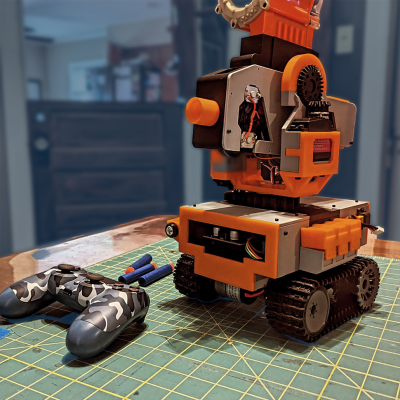
[Joshua Clay] recently unveiled his newest RC Nerf Dart Robot and talks through his design choices, pointing out that in his aim to have it launch darts fast and hard he may have somewhat overshot the mark. He found out first hand during testing that it shoots hard enough to leave welts through a sweatshirt and probably should be downgraded a bit. Thankfully, one of the features of his new unit is a highly modular design that makes iterating easier than ever.
A modular, glue-free assembly that leaves wiring accessible helps make design iterations faster and easier.
This model is an evolution of his first Nerfbot, and the new one is a smaller, tighter design that trades a wheeled base for a tracked one, among other changes.
The tank platform is one example of [Joshua] using affordable, off-the-shelf solutions where it makes sense to do so. For example, the inexpensive tank-track platform means he can focus on the rest of the bot without having to design or make his own tank treads. Similarly, to control the bot he opts for a PlayStation 4 controller, paired to the bot over Bluetooth. It’s high quality, inexpensive, commonly available, and easily interfaced with the RP2040 that runs the show.
[Joshua] aims for a modular, LEGO-inspired mechanical assembly that makes maintenance, wiring, and iteration as easy as possible. We especially like how the battery, wiring, and things like gears for the pan-and-tilt mechanism of the Nerf launcher are easily accessible.
The dart launcher uses two flywheels to grip and propel each dart fed from a high-capacity magazine, and you can watch it move and shoot around the 9:44 mark in the video, embedded below. It’s plenty loud, but the camera is barely able to register darts leaving the barrel.
Advertisement
If you like the looks of [Joshua]’s newest Nerfbot, keep an eye out because he’s got more to share about it and is considering other features like a camera. In the meantime, there are a few more photos on his website.
Representatives for the organisation stated that recent investments are driving the expansion of the Dublin-based European headquarters and the creation of new jobs.
UK neobank Monzo has announced plans to grow its Ireland-based team to 70 employees by mid-2027, nearly doubling its current headcount. Over the last two years, Monzo has invested €83.5m into its Irish operations, expanding the Dublin premises – which is also the European headquarters.
The new roles will span a range of areas including operations, risk and compliance, technology and engineering, financial crime prevention, and product development.
The European expansion, which is supported by the Irish Government through IDA Ireland, is being led by Michael Carney, Monzo’s EU CEO. He is supported by a leadership team that includes EU chief financial officer Nicola O’Brien, EU chief operating officer Sonia Flynn, and Elaine Deehan, the country manager for Ireland.
Advertisement
Commenting on the expansion news, the Tánaiste and Minister for Finance Simon Harris, TD said: “Monzo’s decision to expand its team and establish its European headquarters in Dublin is testament to the country’s reputation as a hub for innovation and financial services.
“This significant investment not only brings new jobs and opportunities but also strengthens Ireland’s position within the European banking sector. I look forward to seeing Monzo contribute to our vibrant economy and deliver innovative banking solutions.”
Carney added: “We’re excited to see our founding Dublin team grow, welcoming experts who bring together the best of banking and technology. Ireland’s deep and expanding talent pool offers the world-class expertise needed to support Monzo’s expansion ambitions across Europe.
“As we take our mission to make money work for everyone in Europe, we’re proud to kick-start that journey in Ireland, with individuals and small businesses now able to join the waitlist.”
Advertisement
In December, Monzo became the first digital bank to secure a full European banking licence through the Central Bank of Ireland. This enables the company to bring its fully regulated personal and business banking products to customers across the EU, starting in Ireland.
Don’t miss out on the knowledge you need to succeed. Sign up for the Daily Brief, Silicon Republic’s digest of need-to-know sci-tech news.
OpenAI has reached an agreement with the Defense Department to deploy its models in the agency’s network, company chief Sam Altman has revealed on X. In his post, he said two of OpenAI’s most important safety principles are “prohibitions on domestic mass surveillance and human responsibility for the use of force, including for autonomous weapon systems.” Altman claimed the company put those principles in its agreement with the agency, which he called by the government’s preferred name of Department of War (DoW), and that it had agreed to honor them.
The agency has closed the deal with OpenAI, shortly after President Donald Trump ordered all government agencies to stop using Claude and any other Anthropic services. If you’ll recall, US Defense Secretary Pete Hegseth previously threatened to label Anthropic “supply chain risk” if it continues refusing to remove the guardrails on its AI, which are preventing the technology to be used for mass surveillance against Americans and in fully autonomous weapons.
It’s unclear why the government agreed to team up with OpenAI if its models also have the same guardrails, but Altman said it’s asking the government to offer the same terms to all the AI companies it works with. Jeremy Lewin, the Senior Official Under Secretary for Foreign Assistance, Humanitarian Affairs, and Religious Freedom, said on X that DoW “references certain existing legal authorities and includes certain mutually agreed upon safety mechanisms” in its contracts. Both OpenAI and xAI, which had also previously signed a deal to deploy Grok in the DoW’s classified systems, agreed to those terms. He said it was the same “compromise that Anthropic was offered, and rejected.”
Anthropic, which started working with the US government in 2024, refused to bow down to Hegseth. In its latest statement, published just hours before Altman announced OpenAI’s agreement, it repeated its stance. “No amount of intimidation or punishment from the Department of War will change our position on mass domestic surveillance or fully autonomous weapons,” Anthropic wrote. “We will challenge any supply chain risk designation in court.”
Advertisement
Altman added in his post on X that OpenAI will build technical safeguards to ensure the company’s models behave as they should, claiming that’s also what the DoW wanted. It’s sending engineers to work with the agency to “ensure [its models’] safety,” and it will only deploy on cloud networks. As The New York Times notes, OpenAI is not yet on Amazon cloud, which the government uses. But that could change soon, as company has also just announced forming a partnership with Amazon to run its models on Amazon Web Services (AWS) for enterprise customers.
The NASDAQ-listed company can access discretionary funds through a 36-month agreement with New Jersey’s Yorkville Advisors.
Irish health diagnostic solutions company Trinity Biotech has secured new funding of up to $25m through a standby equity purchase agreement (SEPA), with proceeds going towards R&D programmes and commercialisation initiatives.
The SEPA deal in conjunction with Yorkville Advisors – based in New Jersey, US – gives Trinity Biotech the option, but with no obligation, to sell up to $25m of newly issued American depositary shares to Yorkville at its discretion over a period of up to 36 months.
John Gillard, Trinity Biotech president and CEO, said: “Our key strategic objectives at Trinity Biotech are to grow our existing business profitably and to advance our exciting innovation agenda, including our flagship development CGM+.”
Advertisement
CGM+ is the company’s new continuous glucose monitoring platform, currently in the later stages of device development, which uses a “proprietary needle-free glucose sensor” that eliminates the need for “finger-stick calibration” by users, the company said.
“This financing agreement provides us with significant additional capability to progress these objectives,” Gillard added.
NASDAQ-listed Trinity Biotech, based in Bray, Co Wicklow, is a commercial stage biotech company focused on diabetes management solutions and human diagnostics, including wearable biosensors. It sells direct in the US and through a network of distributors and partners in more than 75 countries.
The company reported revenues of $48.6m over a trailing 12-month period ended September 30 2025, and said it expects continued operational and financial progress into 2026, based in significant part on it catering to continued global demand for HIV testing provisions.
Advertisement
Innovations currently in development at Trinity Biotech include a cancer monitoring technology and a biomarker-based bioinformatics diagnostic platform.
Microsoft is rolling out new Windows 11 Insider Preview builds that improve security and performance during batch file or CMD script execution.
As Microsoft explained today, IT administrators can now enable a more secure processing mode that prevents batch files from being modified while they run by adding the LockBatchFilesInUse registry value under HKEY_LOCAL_MACHINE\Software\Microsoft\Command Processor.
Policy authors can also enable this mode using the LockBatchFilesWhenInUse application manifest control.
This change is designed to boost performance and security in enterprise environments where admins rely heavily on scripted workflows.
“We are giving administrators and Application Control for Business policy authors additional controls over the processing of batch files and CMD scripts. Starting with this release, administrators may enable a more secure mode for processing batch files that ensures they do not change during execution,” the Windows Insider team said.
Advertisement
“This enhances the performance and security of batch file processing when code integrity is enabled, as signature validation will only be required to be performed a single time, instead of per statement executed in the batch file.”
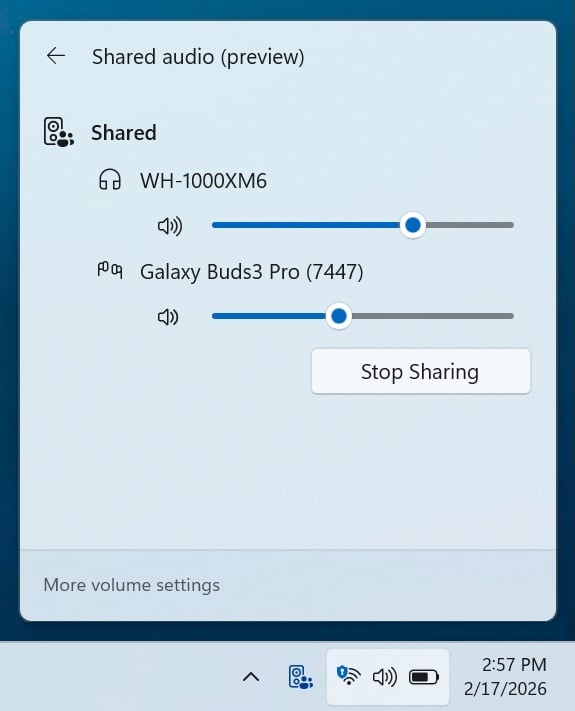
With today’s Windows Insider builds, Microsoft has also improved the Shared audio feature, introduced in October, which allows sharing audio between two headphones, speakers, earbuds, or hearing aids.
Shared Audio volume sliders (Microsoft)
Previously, volume adjustments affected both users equally, but the new update adds individual volume sliders for each listener and device. A new taskbar indicator also appears during active sharing sessions to provide a visual reminder and a one-click shortcut to sharing settings.
The compatible device lineup has also expanded to include more Bluetooth LE Audio accessories, with the Samsung Galaxy Buds 4 and Buds 4 Pro, Sony WF-1000XM6, and Xbox Wireless Headset now also supporting the feature.
These new capabilities are rolling out to Windows Insiders in the Beta and Dev channels who have installed Windows 11 Preview Build 26220.7934 (KB5077242) and Windows 11 Preview Build 26300.7939 (KB5077243), respectively.
Advertisement
Modern IT infrastructure moves faster than manual workflows can handle.
In this new Tines guide, learn how your team can reduce hidden manual delays, improve reliability through automated response, and build and scale intelligent workflows on top of tools you already use.
Sodium Chloride has a melting point of 801 C (1,474 F), putting it comfortably between commonly-cast materials like aluminum and bronze. Which led to [Robinson Foundry] asking the question: can you cast salt like a metal? The answer, surprisingly, was yes!
[Robinson] tries casting the salt with two different methods: like it was glass, and like it was metal. In the glass-like casting, he packs a ceramic mold with salt and tosses it into an electric kiln, there to melt and very slowly cool. In metal-like casting, he just tosses salt into a crucible and melts it in the same beer-can kiln we saw when we featured his lost-pla casting a while back. The molten salt is poured very carefully into sand casting molds. If you’re familiar with the technique, you can skip to about 5:20 when he does the reveal.
As it turns out, the sand casting works out much better. While the glass-style casting in the electric kiln grew much larger crystals and so is more translucent, it’s also stuck completely inside the porous ceramic. Perhaps the ceramic would need glazed to pull off that technique?
On the other hand, the sand reacts with the salt in some way– molten salt isn’t exactly a noble gas, after all–to create a lovely gunmetal finish to the parts. They almost look like metal, though the brittleness gives away the game when he opens the mold to show a dagger in several pieces. For the decorative busts and megalodon teeth in the test, though, it is a great success.
Advertisement
Now, we’re not going to say this video came about because of high metal prices, or comment on what sort of trade policies might be driving up the price of metals like aluminum in the USA, but we do think this a great hack. While salt-based castings are obviously going to have very different physical properties than metal, for decorative work, it creates a lovely finish out of a material that’s cheap as dirt. Hopefully he comes back to the glass-style casting; we would not want to trust that black coating around food, and a salt crystal salt shaker sounds too good to pass up.
The only times we’ve seen molten salt around here is in nuclear reactors, and in homemade batteries, though that first one obviously wasn’t table salt.
There have been skirmishes in the desert nations and a plethora of small stage races on the Iberian Peninsula but this is where the warm-up ends and proper racing begins. This is Belgium, and this is the opening weekend.
Read on and we’ll show you how to watch a 2026 Omloop Nieuwsblad live stream from anywhere with a VPN, and potentially for FREE.
2026 Omloop Nieuwsblad event preview
Advertisement
The 81st Omloop Nieuwsblad starts, as always, in the city of Ghent and finishes 208 kilometers later in Ninove. Along the way it sees the World Tour teams tackle eight bone-shaking cobbled sectors and 12 punishing climbs including the Eikenberg, the Bosberg and the dreaded Muur-Kapelmuur combo.
With no Mads Pedersen who is out injured or Wout van Aert who has pulled out sick, the favorite tag will be pinned on the shoulders of non other than Mathieu van der Poel. After taking a short break following his triumphant cross season he says he is rested and ready to go which is really bad news for every other rider in the peloton.
With last year coming down to a bunch sprint it’s no surprise that this year’s field is stacked with sprint talent. The likes of Biniam Girmay, Arnaud De Lie, Jasper Philipsen, and Paul Magnier will all be hoping they can navigate the perils of the cobbles and arrive in Ninove with a chance to flex their legs.
With so many big name sprinters there will be plenty of teams working hard to ensure the race does indeed finish in a bunch kick, so any riders without a powerful sprint such as Tom Pidcock will have to fight tooth and nail if they are to get away.
Advertisement
Coverage starts at 12:00pm GMT / 7:00am ET / 4:00am PT
Read on for everything you need to know to use a VPN to watch a 2026 Omloop Nieuwsblad live stream from anywhere.
How to watch the 2026 Omloop Nieuwsblad for FREE
You can watch the whole of the 2026 Omloop Nieuwsblad for FREE on both VRT Max andSporza in Belgium andNOS in the Netherlands.
Advertisement
Traveling overseas this weekend? Don’t forget you can use a VPN to watch your usual free service as if you were back home.
Use a VPN to watch a 2026 Omloop Nieuwsblad live stream
How to watch a 2026 Omloop Nieuwsblad live stream in the US
(Image credit: Other)
Cycling fans in the US can watch the 2026 Omloop Nieuwsblad on FloBikes.
Advertisement
A subscription to FloBikes will set you back US$155.88 for the year or US$39.99 on a monthly basis.
If you’re out of the US but still want to watch the 2026 Omloop Nieuwsblad then don’t forget to explore the VPN route set out above, which will help you access your subscriptions from anywhere.
How to watch a 2026 Omloop Nieuwsblad live stream in the UK
Cycling fans in the UK can watch the 2026 Omloop Nieuwsblad on TNT Sports. To access this you’ll either need to add it to your TV package, or you can take out a standalone subscription via Discovery+ which will set you back £30.99 per month, though BT Broadband customers can get a discounted rate.
Advertisement
You will also have access to the Premier League, Champions League and Europa League football plus Tour de France cycling, rugby, wrestling, UFC, and MotoGP.
If you’re traveling abroad, don’t worry, as you can use NordVPN to watch your usual service from overseas.
How to watch a 2026 Omloop Nieuwsblad live stream in Canada
(Image credit: Other)
Cycling fans in Canada can watch the 2026 Omloop Nieuwsblad on FloBikes. A subscription will set you back CAN$203.88 for the year or CAN$39.99 on a monthly basis.
Advertisement
Not at home? Use NordVPN or another VPN service to make your device think you’re still in Canada.
We test and review VPN services in the context of legal recreational uses. For example: 1. Accessing a service from another country (subject to the terms and conditions of that service). 2. Protecting your online security and strengthening your online privacy when abroad. We do not support or condone the illegal or malicious use of VPN services. Consuming pirated content that is paid-for is neither endorsed nor approved by Future Publishing.
Nobody likes a delayed flight; it’s inconvenient, throws plans into disarray, and puts additional costs on both passengers and the airline. There could be several reasons for such events — from technical issues and weather changes to personnel strikes and busy airspaces — and in many cases, the airline has no direct control over them. Nevertheless, some airlines have a better grip on their operations than their competitors, allowing them to keep delays at a minimum.
So, if you’re booking a flight and want to reduce your chances of getting hit with a late departure (or even a canceled flight), we’re looking at five American carriers that had the greatest number of delays by percentage. We based our numbers on the U.S. DOT’s Bureau of Transportation Statistics reports on arrival performance by marketing carrier, with data from March to October 2025. Unfortunately, we’re unsure if we’ll get more recent data, as the biggest U.S. airlines have asked the DOT to stop publishing performance statistics and are lobbying to make flying much worse for everyone.
Furthermore, we looked at the ratio of delayed flights versus the total number of flights. After all, it would be unfair to compare Delta, which had 207,770 delays out of more than 1.1 million flights and one of the best on-time performance rates in the United States, with Frontier, which operated fewer than 134,000 flights, of which more than 37,000 arrived late.
Advertisement
Frontier Airlines
Don Mammoser/Shutterstock
The worst performer by far is Frontier Airlines, with 37,329 delays out of a total of 133,328 flights in the counted period. This meant that 28%, or more than one in four flights, were delayed. It also had the second-highest number of cancellations, with 2,111 flights, or 1.58% of its schedule, getting called off. This is probably one of the reasons why this airline is at the bottom of reliability and customer satisfaction rankings, with its cheap fares being the only thing going right for its passengers.
While airlines cannot do anything about airport traffic congestion and weather-based delays and cancellations, other issues, like crew scheduling limitations, can often be mitigated through advanced crew scheduling systems. Even delays caused by unforeseen technical problems at hub airports can be fixed with the ready availability of backup aircraft or by reducing the number of flights each airframe is assigned per day. However, these measures can be costly for airlines, especially for low-cost carriers that rely on razor-thin margins.
Advertisement
What’s worse is that Frontier says that it does not offer reimbursements, hotel accommodations, or monetary compensation to passengers who are impacted by flight delays or cancellations. The best that you can get is a seat on the next available Frontier flight and meal vouchers if your delay or rebooking is more than three hours and is considered a “controllable situation” like delayed baggage, aircraft damage, or a mechanical issue. If the delay is defined as an “uncontrollable situation,” like those caused by weather, Air Traffic Control, or an incident like a bird strike, then all you can get is a flight rebooking. Alternatively, you can seek a full refund under 14 CFR Part 260 if the delay is over three hours for domestic flights and six hours for international flights.
Advertisement
JetBlue
Markus Mainka/Shutterstock
JetBlue is the second-worst airline when it comes to delays, with 38,117, or 24.52% of flights, arriving 15 minutes late (or longer) out of a total of 155,432 scheduled flights. While this isn’t as bad as Frontier, it is still close to one in four flights getting delayed. It also ranked third when it comes to cancellations, with 1,885, or 1.21% of flights, affected. This number is likely influenced by the emergency software update on Airbus A320 family aircraft in late 2025 that resulted in numerous cancellations and delays. The update was prompted after a JetBlue A320 made an uncommanded rapid descent in flight due to solar radiation. This is especially notable given that JetBlue’s fleet is composed entirely of Airbus aircraft.
JetBlue outlines its policy regarding reimbursements and options in case of delays or cancellations. According to the airline’s website, flights affected by weather disruptions, domestic delays of more than three hours, international delays of more than six hours, or a change from nonstop to a connecting or stopover flight are eligible for a fee waiver. This allows you to change your flight at no extra cost or receive a full refund to the original form of payment.
Advertisement
American Airlines
Markus Mainka/Shutterstock
This is the first and only mainline carrier that lands on our list of airlines with the worst on-time performance. According to the U.S. DOT, out of American’s 1,363,530 flights (which, incidentally, is the highest number of scheduled flights within our time frame), 333,396 flights, or 24.45%, were delayed. That number is so high that it’s greater than the total number of flights operated by Frontier and JetBlue combined. American Airlines is also the worst airline when it comes to cancellations, with the carrier scrapping 28,204, or 2.07%, of its schedules.
Nevertheless, it seems that American is trying to do something about this, at least for affected passengers. The airline is said to be testing an AI tool that keeps track of passengers who could potentially miss their connecting flights because of a delay on a prior flight. It will then adjust the connecting flight without affecting the rest of the day’s schedule, ensuring that passengers can still reach their destination on time. This system will also benefit the airline, as it wouldn’t have to deal with rebooking the affected passengers (although it could likely infuriate other customers who might have to wait up to an hour for the incoming flight).
If you’re flying with American and you experience a significant delay or cancellation caused by the airline, it says that it will give you a voucher for an approved hotel plus round-trip transportation to the airport if the delay is overnight. Furthermore, it will provide meal vouchers for delays that are three or more hours after the scheduled departure. Unfortunately, if you’re affected by unforeseen delays and cancellations caused by weather, you’re not entitled to anything except a rebooking on the next flight with available seats at no extra charge.
Advertisement
Allegiant
Angel DiBilio/Shutterstock
Despite having one of the fewest numbers of flights (second only to Hawaiian before it merged with Alaska Airlines), Allegiant still managed to have one of the worst on-time performances. This airline had 22,210 delays, which is 24.40% of its total of 91,015 flights. But despite offering some of the cheapest airfares available, it still manages to have the best cancellation record in our time frame, reporting only 238 canceled flights, or just 0.26% of its entire schedule.
Just like Frontier, which is also a low-cost carrier, Allegiant says it does not offer delayed passengers any meals, alternate transportation, or reimbursement for incurred overnight expenses. If your flight is rescheduled due to a delay or cancellation and you choose not to take it, your only available options are to either change to a different flight on the same route or cancel the remaining flights and receive a refund for the unused portions of your ticket.
This might be a deal breaker for some people, but those who are looking for the best possible deals on airfare might be willing to take the risk. The airline mentions on its page the possibility of getting reimbursed by Allianz Travel Insurance for cancellations. So, it might be a worthwhile investment to spend a little extra on this type of insurance, which is one of the services that AAA offers and is likely far more affordable than a ticket on a legacy airline.
Advertisement
Southwest Airlines
Just dance/Shutterstock
After the big three (American, Delta, and United), Southwest Airlines has the greatest number of flights, at 954,366 scheduled flights. However, it also has a significant number of delays, at 211,262 flights, or 22.14% of its schedule. Nevertheless, it does have a good track record when it comes to cancellations, with only 5,602 canceled flights, or just 0.59% of its total number of flights.
Southwest Airlines pioneered the low-cost carrier (LCC) model, so just like the other LCCs listed above, don’t expect to get any benefits from it in case of a delay, except the bare minimum required by law. Nevertheless, it is one of the U.S. airlines that offers onboard Wi-Fi, costing just $8 per device throughout the entire flight. While you may not appreciate this service for short hops around the country, you might find it an indispensable yet affordable offering on the airline’s longest routes, like the more than seven-hour flight from Phoenix to Honolulu.