Building a battery pack from 18650 cells traditionally requires patience, a spot welder, and a supply of nickel strip. But what if there was another way? [Ben] is here with Cell-Lock, a modular battery assembly system.
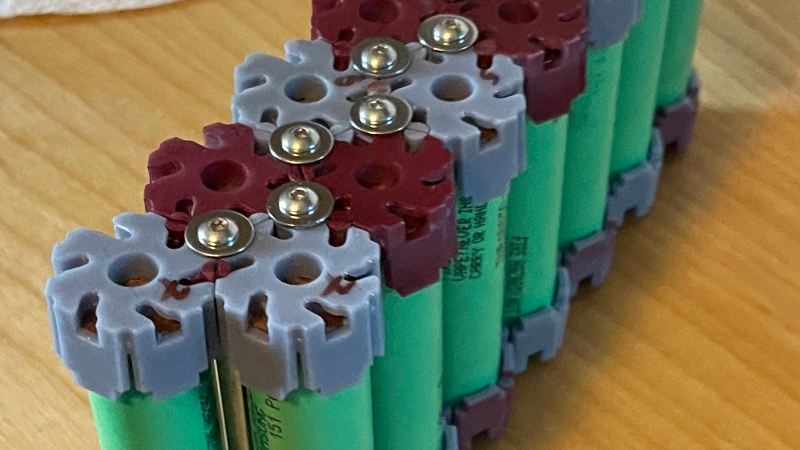
At the system’s heart are a set of interlocking end caps and connection pieces that function as locking cams as well as the electrical connections where needed. They were inspired by the cam systems used for furniture assembly, and are activated by rotation with a screwdriver. The result is a mechanically stable battery system in which different configurations can easily be assembled.
We like that it doesn’t involve any heat near those cells; in part because we’ve seen our share of dodgy connections overheating. But we do have a few concerns. These include how reliable a connection those cams would make, as well as how much current they could safely take without overheating. If both of those could be addressed, we can see that this is an idea with a future.
More than half of the nine developers who worked on the game have either obtained a US visa or tried and failed to do so. Most of them are from China, but the team also intentionally recruited talent from other countries in the hopes of incorporating more diverse immigrant perspectives.
“Everybody knows somebody that’s on a visa, but not all of them are vocal about that part of their identity,” says Andrea Saravia Pérez, an immigrant from Colombia who joined the team in February as a narrative designer. “How can we develop a project that’s interactive and shows people this immigration system that a lot of Americans are not familiar with?”
There’s growing interest across the gaming industry in making political games, says Yang. When her team brought H1B.Life to the annual Game Developers Conference in San Francisco last week, she says they received a tremendous amount of interest and support because they are tackling an important societal issue without expecting to make much profit. (The game was supported by a philanthropic organization and the developers also plan to raise additional funding from a future Kickstarter campaign.)
Yang says she has also heard from people in Germany and Australia interested in licensing or adapting the game for different countries. “The whole world is turning right, and life is getting more difficult for all immigrants,” she says.
Advertisement
“If we can just put people in our shoes, I think it can create a very positive impact,” says Saravia Pérez. “As long as players come to have fun and are able to sympathize and understand it a little bit more, I think that we’ve done our job as a team.”
Courtesy of Reality Reload
Technicalities Versus Emotions
The H-1B visa program, created in 1990, is one of the most reliable US immigration pathways for white collar workers with college degrees. In recent years, the program issued about 85,000 visas annually, but since there are often more applicants than slots, a lottery system determines who ultimately is chosen. And if you don’t get it, you have to wait an entire year before you try again. Every person who has gone through the process has their own success or failure story to tell, me included.
The team behind H1B.Life started developing the game by interviewing immigrants. So far, Yang says they have talked to over two dozen people about their H-1B journeys and used those interviews to make the game more realistic and accurate. The biggest challenge now is to figure out how to balance explaining complicated immigration rules accurately and ensuring the game is still entertaining.
The Switch 2 ports keep on coming. This time it’s Kena: Bridge of Spirits, the award-winning 2021 title from Ember Lab. Previously announced for spring 2026, the visually striking title now has an official release date of March 26.
Kena: Bridge of Spirits won Best Independent Game and Best Debut Indie Game at The Game Awards 2021. It’s already available for PS5 / PS4, PC (Steam and Epic) and Xbox Series X/S and One.
You play as Kena, a young spirit guide on a quest to a sacred mountain shrine. Gameplay has a Zelda-like flair. (That could make it a solid next play after Breath of the Wild and Tears of the Kingdom.) Like in Link’s adventures, you’ll find plenty of exploration, puzzles and fast-paced combat. That encompasses whacking bad guys with Kena’s staff, firing arrows and flinging bombs.
Kena: Bridge of Spirits launches for Switch 2 on March 26 in North America, Europe and Asia. Meanwhile, folks in Thailand can get it a day earlier, on March 25. Details about Taiwan will be announced “soon.” You can preorder the game today in North America and Europe and get a taste of its Pixar-esque art style in the trailer below.
Luxury accessory maker Hermes has announced a new iPhone and Apple Watch charger with its own case for an eye-watering price of $5,150.
Hermes’ new charging station can wirelessly power two things at once
If that figure sounds like a lot to pay for a charger, consider this. You could buy eight $599 MacBook Neo laptops and still have money left over for a new Apple Watch instead. Alternatively, the iPhone 17 Pro Max is the most costly thing you’ll charge with this thing. You could buy four $1,199 256GB iPhone 17 Pro Maxes and still have money left over for a new case. And AppleCare+. Continue Reading on AppleInsider | Discuss on our Forums
Spotify has quietly added a feature that many desktop listeners have been requesting for years. The company’s new Exclusive Mode allows Spotify Premium subscribers using the Windows desktop app to bypass the computer’s normal audio processing and deliver bit perfect playback directly to an external DAC or audio device.
The idea is straightforward. Modern operating systems often resample audio, mix system alerts with music, or apply their own volume processing before the signal ever reaches your DAC. Spotify’s Exclusive Mode takes control of that pipeline and locks the desktop app directly to the output device so the audio stream is passed through without alteration. In practical terms, that means the data sent to your DAC should match the original digital file that Spotify is delivering.
The timing is notable. After years of teasing higher fidelity streaming tiers, Spotify finally launched its long promised Lossless audio option in 2025, putting the service closer to competitors like Apple Music, Amazon Music, and TIDAL that already offer CD quality streaming. Exclusive Mode does not increase the bitrate of Spotify’s stream, but it removes one more layer of processing that could potentially alter the signal on the way out of your computer.
For listeners using a desktop setup with an external DAC, powered speakers, or a headphone amplifier, the feature gives Spotify something it has historically lacked compared with more audiophile focused platforms: a way to deliver the stream without the operating system getting in the middle of it.
Advertisement
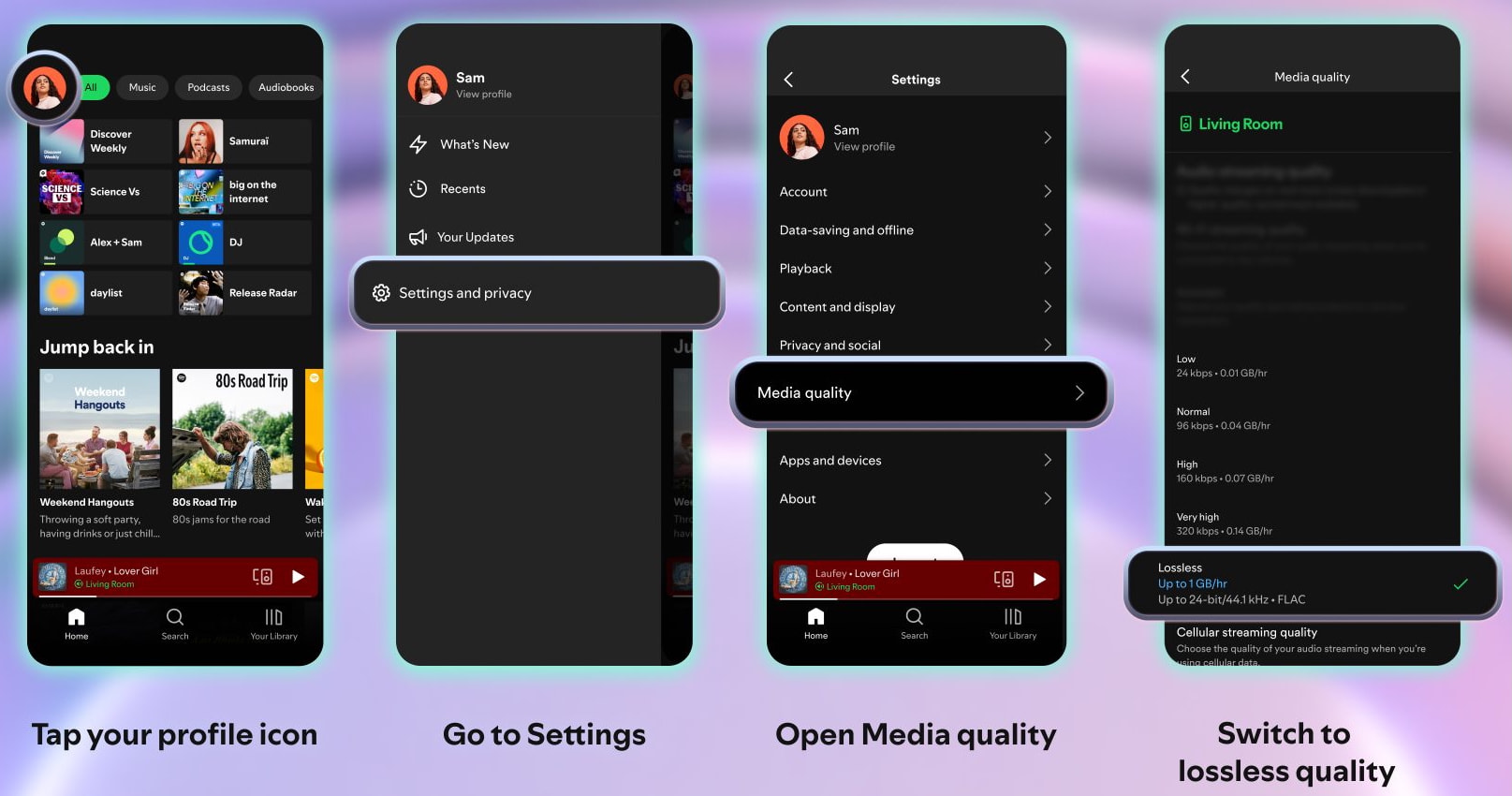
How to Enable Spotify Lossless
What is Bit Perfect Audio?
Bit perfect audio refers to digital playback where the data leaving a music player is identical to the original digital file, with no changes introduced by the operating system, software mixer, or audio driver.
When music is played on a typical computer, the audio often passes through a system level mixer before reaching the output device. During that process the operating system may:
Resample the audio to match the system’s selected sample rate
Mix in other system sounds like notifications or alerts
Apply volume scaling or DSP processing
Each of those steps technically alters the original digital data stream. Bit perfect playback avoids that entirely.
In an exclusive playback mode, the music application takes direct control of the audio output device. The operating system mixer is bypassed, system sounds are blocked, and the audio stream is sent to the DAC at its native sample rate and bit depth.
For audiophiles using external DACs and dedicated headphone or speaker systems, this ensures the converter receives exactly the same digital information contained in the music file or stream. The DAC then performs the only conversion that matters: turning that digital signal into analog sound.
Advertisement
In short, bit perfect playback does not magically improve a recording. What it does is ensure that nothing in the computer changes the signal before it reaches your DAC.
How to Enable Spotify Exclusive Mode
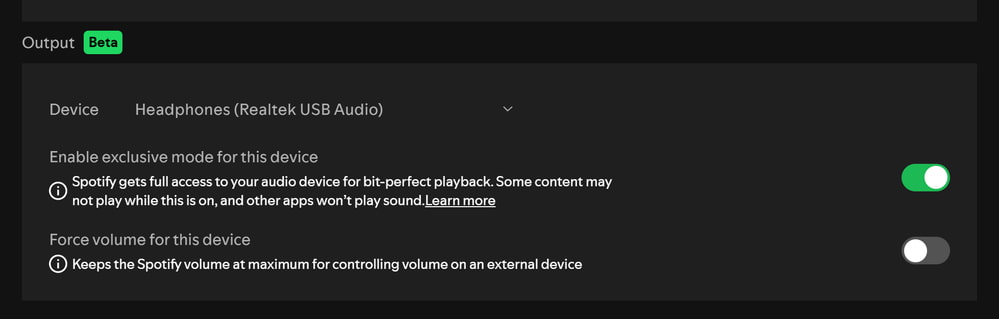
Getting started with Spotify’s Exclusive Mode takes only a few seconds inside the desktop app. Open Spotify, go to Settings, and scroll down to the Playback section. Under Audio Output, select your preferred device from the dropdown menu. Once your DAC, interface, or audio device is selected, toggle Exclusive Mode to On.
Advertisement. Scroll to continue reading.
When enabled, Spotify takes direct control of that audio device and bypasses the operating system’s standard audio mixer. The result is a direct signal path from the Spotify desktop app to your DAC, avoiding the resampling, mixing, and volume adjustments that can occur when the operating system manages audio output.
There is one important trade off. With Exclusive Mode active, Spotify has sole control of the selected output device. System alerts, browser audio, video calls, and other applications will not be heard through that device while music is playing. If you need to hear other audio sources, those applications will have to use a different output device.
Advertisement
At launch, Exclusive Mode is available only on the Spotify desktop app for Windows. The feature does not currently apply to mobile playback, and Spotify has indicated that macOS support is expected in a future update.
The Bottom Line
Spotify’s Exclusive Mode is a useful technical upgrade for desktop listeners, but it doesn’t change the limits of Spotify’s audio quality.
The feature simply bypasses the computer’s audio mixer so the Spotify desktop app can send the stream directly to your DAC without resampling or system sounds interfering. That’s good news for listeners using external DACs, headphone amps, or powered speakers on a computer.
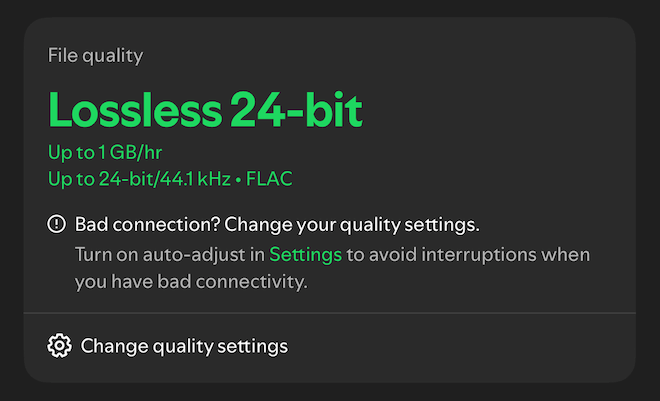
What it does not do is increase resolution. Spotify Lossless remains CD quality at 16 bit 44.1 kHz, and the service still does not offer 24-bit/96 kHz or 24-bit/192 kHz streams like Apple Music, TIDAL, or Qobuz.
So while Exclusive Mode ensures the signal leaving Spotify is cleaner, it does not suddenly make Spotify higher resolution than competing services. It simply ensures you hear the stream exactly as Spotify delivers it.
Poopee’s indoor grass patches are even drawing franchise enquiries from across Southeast Asia
What do you do when your dog refuses to use a pee pad, your schedule won’t allow constant trips downstairs, and your carpet is slowly turning into a wreck day after day?
For 32-year-old Royce Tan, the answer was simple: start a company called Poopee—and bring a patch of real grass straight into the living room as an indoor potty solution.
It all started with his own struggles at home.
Royce’s dogs were grass-trained, but as they aged, daily trips downstairs became increasingly difficult. Plastic pee pads simply didn’t make sense to them, leaving Royce with the familiar frustration of accidents on the carpet.
Advertisement
That’s when the idea clicked: if dogs instinctively understand grass, why not bring it indoors? “The behaviour problem would solve itself naturally,” he said.
After researching existing options, Royce realised there wasn’t a well-designed real grass solution available locally. And that gap in the market became the starting point for the Eco-Turf, Poopee’s signature product.
Entrepreneurship isn’t new to him
Image Credit: @supersalami_ via Instagram/ Sonia Yeo
Royce is no stranger to entrepreneurship.
Before Poopee, he founded The Fragment Room in 2017, Singapore’s first rage room, where people could smash objects to relieve stress. “It was exciting, chaotic, and honestly a lot of fun,” he recalled.
Yet after a few years, the novelty began to fade, and Royce realised he wasn’t “waking up excited” about the business anymore. It no longer felt like something that “reflected who he was or what he wanted to build.”
Advertisement
Eventually, Royce exited the venture sometime in 2019 and took on a full-time job, which he stayed in for about three years.
While it provided financial stability and a fresh perspective on work, he quickly realised that simply clocking in and out every day wasn’t the life he wanted. He needed to build something again—and that drive ultimately led to Poopee.
Image Credit: @poopee, @bossdedoberman via Instagram
In 2023, Royce self-funded the launch of Poopee, bringing his indoor grass solution to the market.
He did not disclose the exact investment; however, he described it as modest, adding that it required “careful spending and a lot of experimentation.”
Keeping the grass alive
According to Royce, most of the initial capital went into “sourcing grass, developing packaging, logistics testing, and building the website.”
Advertisement
The early stages also involved a lot of trial and error.
Working with real grass meant dealing with a living product. He had to consider drainage, airflow, and how to keep it alive and healthy throughout packaging, transport, and delivery.
Image Credit: @poopee via Instagram
Unlike most products, grass cannot sit in a warehouse for long periods. “It has to be inspected, packed, and delivered within a short timeframe,” said Royce, adding that it took considerable effort to balance freshness, reliability, and cost.
Even after delivery, external factors in customers’ homes—such as sunlight and airflow—can affect the grass. To address this, Royce stays in close contact with customers via WhatsApp, troubleshooting issues and finding solutions directly with them.
“With product businesses, the real learning only begins once customers start using the product,” he said. It’s a very hands-on process, and even today, the team is still refining the product.
Advertisement
Poopee’s Eco-Turf has become a necessity for several dog owners
Poopee’s pop-ups at Singapore Dog Festival (left) and Crane (right)./ Image Credit: @sgdogfest, @poopee via Instagram
It seems Poopee’s Eco-Turf has been well-received by dog owners, Royce shared, although he didn’t disclose exact take-up rates.
While most sales happen online, Poopee also hosts pop-ups at fairs and events to reach new customers and give people a chance to experience the product in person.
Some owners have even told him, “You can’t ever close down because we would be lost without you,” highlighting just how much Eco-Turf has become a part of their daily routine.
Image Credit: @poopee via Instagram
Part of the product’s appeal is how simple it is to use: the grass naturally absorbs urine, so customers don’t have to worry about accidents. Solid waste still needs to be cleaned up, though, and watering the turf every one to two days keeps it healthy.
Owners will know it’s time to replace the patch when dogs start peeing at the edges—a sign it’s saturated with their scent, and they’re looking for a fresh spot.
Typically, each patch lasts between one and four weeks, depending on how frequently it’s used.
Advertisement
That’s why Poopee offers a subscription model, with deliveries weekly, bi-weekly, or monthly. Subscriptions make it easier for owners to maintain a fresh patch and allow Royce to plan production.
Because grass cannot be grown instantly, our nursery needs advance notice of how much to grow. Subscription demand helps us forecast how much grass will be needed ahead of time.
Royce Tan, founder of Poopee
Image Credit: @poopee, @maxfromsingapore via Instagram
Beyond positive reviews from customers, what has surprised Royce even more is that Poopee’s Eco-Turf has been recommended by several veterinarians—particularly for older dogs or pets recovering from surgery who struggle with mobility. They can benefit greatly from the Eco-Turf’s easy-to-access, indoor setup.
That said, Royce occasionally meets owners who say their dogs “hate grass.” In many cases, it simply means the dog was never exposed to it early on. “Dogs adapt to the environments we create for them, so part of what we do is gently reintroduce that natural behaviour,” he explained.
He recommends a few simple strategies for these cases: place the Eco-Turf in the spot where the dog usually relieves itself and gradually move it to the desired location, or use a small amount of pee residue under the turf to attract them with a familiar scent. Positive reinforcement—treats or praise when the dog uses the Eco-Turf—also helps encourage the behaviour.
Advertisement
Beyond just grass patches
Royce Tan setting up Poopee’s pop-up booth at Good Pet Fair 2024./ Image Credit: @poopee via Instagram
Running The Fragment Room taught Royce the value of building a brand people actually connect with.
Even though Poopee solves a functional problem, I never wanted it to feel like a boring utility product. I wanted it to feel like a lifestyle brand for dog owners.
Royce Tan, founder of Poopee
That’s why the team puts thought into shaping Poopee’s brand personality, and expanding into merchandise is part of that.
Image Credit: @supersalami_, @poopee via Instagram
Beyond Eco-Turf and its complementary products—such as deodorising sprays—Poopee now offers items like dog carriers, graphic tees, stickers, and even cooling neck wraps for dogs.
All of the merchandise is designed in-house, with some pieces developed through collaborations. For instance, the brand has worked with local streetwear label Koterie on several of its designs.
Making everyday life with dogs more “natural, comfortable & well designed”
Image Credit: @poopee via Instagram
For now, Royce still handles most aspects of the business himself, supported by a small group of part-timers and freelancers who assist with packing, logistics, and marketing when needed.
The team recently moved from a small warehouse setup into a proper office space—a shift that has improved both working conditions and operations, allowing for more organised packing and better quality control.
Advertisement
While operations remain lean, Royce sees clear demand for products like the Eco-Turf.
“Singapore has a large number of high-rise homes, and many pet owners have busy schedules,” he shared. “Solutions that make pet care easier while still respecting a dog’s natural behaviour are becoming increasingly important.”
As the brand grows, Royce plans to expand beyond just the Eco-turf and build a whole ecosystem of products for pet owners. “The idea is to create a cohesive world around the brand for people who love animals.”
Interest in Poopee is also spreading beyond Singapore. According to Royce, the brand has received franchise enquiries from markets like Malaysia, Thailand, and the Philippines, with discussions still ongoing as the team explores potential regional expansion.
Advertisement
Ultimately, Royce hopes to make everyday life with dogs more natural, comfortable, and well-designed.
If Poopee can become something that dog owners trust and rely on, something that genuinely improves the quality of life for both pets and their owners, then we’ve done what we set out to do.
Eclypsium co-founders Yuriy Bulygin, left, and Alex Bazhaniuk. (Eclypsium Photo)
Eclypsium, a Portland-based cybersecurity startup, raised $25 million in new funding to expand its hardware and firmware security platform.
The round was led by PEAK6 Strategic Capital, with participation from Ten Eleven Ventures and an undisclosed bank. Existing investors Andreessen Horowitz, Madrona, Qualcomm Ventures, and others also participated.
Founded in 2017 by former security engineers at Intel, Eclypsium serves private and public sector customers. It scans the hardware and firmware of laptops, servers, network devices, and AI infrastructure for vulnerabilities that sit below the operating system.
The company plans to use the funds to expand further into AI infrastructure and a growing array of edge devices — including GPU servers, NVIDIA BlueField-based appliances, SASE and SD-WAN edge devices, 5G equipment, and CCTV cameras.
The company is led by CEO Yuriy Bulygin and CTO Alex Bazhaniuk and is ranked No. 115 on the GeekWire 200, our list of top tech startups in the Pacific Northwest.
Advertisement
Eclypsium raised $45 million in equity and debt as part of a Series C round last January. Total funding to date is $110 million.
Despite heavy investment in AI tools, many organizations are struggling to realize its promised productivity gains. The issue is not the technology itself, but a widening gap between leadership ambition and employee capability. This gap
Ciara Harrington
Chief People Officer at Skillsoft.
Advertisement
Recent research from Workday reveals a clear disconnect. While 66% of leaders say AI skills development is a top priority, only 33% of employees report having received any AI-related training. This gap is reflected at the executive level as well, with 74% of CEOs citing a lack of AI skills as a key barrier to capturing value from AI investments.
When skills visibility is limited, organizations cannot reliably connect strategy to execution or build the capabilities required for effective human and AI collaboration. The result is predictable: productivity gains are eroded by rework, error correction, and low confidence in using AI tools.
Article continues below
Advertisement
In short, organizations are buying the future faster than they are building the skills needed to run it.
Closing this AI learning gap must become a leadership imperative, not solely a learning and development challenge. And in an increasingly skill-based economy, skills, not job titles, are the new currency of growth and performance.
The question, then, is how leaders can bridge this divide and ensure AI learning is embedded across their organizations.
Advertisement
Aligning leadership goals with employee skills
The persistence of the AI learning gap is often misunderstood. It’s rarely caused by a lack of employee willingness to learn, but rather by organizational misalignment. This isn’t a surprise when there is a lack of clarity around which skills exist today, which are needed next, and how quickly gaps can be closed.
Sign up to the TechRadar Pro newsletter to get all the top news, opinion, features and guidance your business needs to succeed!
At the leadership level, AI is framed in terms of strategy, transformation and competitive advantage. On the frontline, however, employees experience AI as a set of tools that affect daily workflows, including drafting content, analyzing data, supporting decisions or automating tasks.
Advertisement
Without a clear skills framework connecting these perspectives, learning efforts become fragmented and difficult to scale. When learning initiatives fail to bridge these two perspectives, employees struggle to see relevance, and leaders struggle to see returns.
Prioritization is another challenge. In many organizations, AI skills development competes with immediate operational pressures. Training is delayed, treated as optional, or delivered too generically to be useful.
Employees are left to ‘learn by doing’ without clear guidance or guardrails, leading to inconsistent adoption and increased rework. Leaders may see this as resistance, when in reality it reflects a lack of structured support.
Advertisement
To close the gap, leaders must move beyond aspirational statements about AI and embed skills development directly into the flow of work.
That means managing skills deliberately – identifying the capabilities that matter most, addressing gaps that limit execution, and ensuring learning is timely, practical and clearly connected to organizational goals. When employees see how AI supports their work and receive relevant support, confidence and competence grow together.
Which skills matter most now
To ensure effective human and AI collaboration, both leaders and employees must develop digital fluency. This includes understanding how AI systems work, critically interpreting their outputs and applying insights with emotional intelligence.
Advertisement
At the same time, they must continue to strengthen the irreplaceable qualities of humans to create a more resilient, responsive and people-focused organization.
Critical thinking and validation skills are equally essential. Workday’s research shows that anticipated productivity gains are often lost to rework, including correcting errors, rewriting content or double-checking outputs. Training employees to prompt effectively and review carefully can dramatically reduce this friction.
Power skills also matter more than ever. As AI takes on routine tasks, skills such as communication, collaboration, ethical judgement and emotional intelligence become increasingly valuable. These skills enable employees to apply AI outputs responsibly and creatively in real-world contexts.
For managers, an additional layer of capability is required. Leaders must be able to coach teams through AI adoption, set clear expectations and model responsible use. When managers lack visibility into their teams’ skills, the learning gap widens rapidly beneath them.
Advertisement
AI as a catalyst for leadership development
AI itself can play an important role in closing the learning gap, particularly when developing leaders at scale. When applied effectively, it transforms learning from a one-time event into a continuous, personalized journey that evolves alongside both the individual and the organization.
AI-powered learning can analyze skills data, identify gaps in real time, and recommend targeted development aligned to role, experience and business priorities. This creates a continuous skills supply chain — one that connects insight, development and execution as business needs change.
For leaders, this means faster access to the learning that matters most, whether that involves responsible AI use, data-informed decision-making, or strengthening people leadership skills.
Advertisement
AI can also create continuous feedback loops that traditional learning models struggle to deliver. Leaders gain greater insight into how learning translates into behavior change, team performance and organizational impact, shifting development from activity-based to outcome-driven.
Ultimately, organizations that succeed will treat AI as a partner to human leadership, not a substitute for it.
From ambition to execution
Closing the AI learning gap requires intentional action. Leaders must align vision with capability, strategy with skills and technology investment with human development. That means treating skills as a strategic asset and one managed with the same rigor as capital or operations.
Advertisement
When employees understand how AI supports their work and have the skills to use it effectively, productivity gains become real, sustainable and scalable. More importantly, organizations build a workforce that is not just AI-enabled, but AI-ready.
Ultimately, whether organizations capture AI’s full value depends on how effectively leaders bring their employees along on the journey.
This article was produced as part of TechRadarPro’s Expert Insights channel where we feature the best and brightest minds in the technology industry today. The views expressed here are those of the author and are not necessarily those of TechRadarPro or Future plc. If you are interested in contributing find out more here: https://www.techradar.com/news/submit-your-story-to-techradar-pro
After watching the James Bond film GoldenEye, Gavin Free of The Slow Mo Guys couldn’t shake a childhood memory. The explosions on screen were something else to say the least, but what really caught his eye was a tiny detail in the corner of the frame. He then discovered that the crew utilized a method in which they recorded real flames from underneath to achieve that effect.
Gavin and his partner Dan Gruchy decided to try it for themselves, with a simple but compelling goal in mind: film fire from directly underneath in super slow motion. A conventional fire pit was flipped upside down and then a large ring burner loaded with propane was suspended above it, while a sturdy framework of curtain poles, tin sheets, as well as metal fittings was rigged up to keep everything stable.
Sharper Action, Brighter Details – Osmo Nano’s 1/1.3″ sensor captures more light for crisp, vivid shots. Ideal as a 4K POV camera or vlogging…
Ultra-Wide 4K Clarity – Record every moment in 4K/60fps with a 143° ultra-wide view. Ideal as a small action camera or for immersive Pet POV…
Effortless Portability & Versatility – The lightweight, magnetic Osmo Nano is the ideal pocket camera for easy carrying. Use it as a portable camera…
Down on the floor, their camera, the Ember 2.5k, was sitting well, calibrated to shoot between 300 and 1,000 frames per second at a shutter speed that kept everything in sharp focus. That transformed ordinary seconds into minutes of the most intricate movement on film, but even with simple gas flames, the pictures lacked drama and force, so Gavin began sprinkling in cinnamon as a fine burning powder. The cinnamon took fire well, sending sparks flying everywhere, creating the clear sources of light and interest that they were looking for.
When the slowed down footage played back, it was unlike anything they had seen before. The flames moved in ways that felt almost biological, stretching lazily outward in every direction as they searched for oxygen, their edges folding and rolling over in smooth, unhurried waves that looked more like silk than fire. Swirling patterns rippled across the edges as the gas dropped lower, and the colors shifted from teal into deep blues, forming small delicate structures that resembled inverted clouds drifting down toward the camera.
Adding cinnamon brought the whole thing to life, with particles sparkling and scattering through the gas cloud like a shower of tiny stars. The extra material pushed the temperature up and the flames grew brighter and more frantic in response. Without oxygen near the bottom the fire had been dim and almost eerily calm, but the moment it found air higher up it took off in an instant. Cutting the gas supply brought everything to a controlled stop quickly and safely. [Source]
According to cybersecurity firms Flare Research and IBM X-Force, North Korea is using a network of more than 100,000 hackers, developers, and IT operatives to infiltrate global companies, steal people’s private data, and funnel hundreds of millions of dollars to the Kim Jong-Un regime. Read Entire Article Source link
Moxie Marlinspike, the privacy advocate who created the secure communication app Signal and its widely used open source encryption protocol, said this week that his privacy-focused AI platform, Confer, will start incorporating its technology into Meta’s AI systems.
Every day, billions of chat messages sent through Signal, Meta’s WhatsApp, and Apple’s Messages are protected by end-to-end encryption. The feature, which makes it impossible for tech companies and anyone other than the sender and recipient to snoop on your messages, has become mainstream over the past decade. As generative AI platforms explode in popularity, though, people are now also exchanging billions of messages a day with AI chatbots that don’t offer the protection of end-to-end encryption—making it easy for AI firms to access what you talk about.
This is by design, given that platforms often want to train their AI models on as much user data as possible and have made it hard to opt out of having your information used as training data. But as chatbots and AI agents have become more capable, some technologists and companies are pushing to create more constrained and privacy-focused systems.
“As LLMs continue to be able to do more, we should expect even more data to flow into them,” Marlinspike wrote in a short blog post about his collaboration with Meta published on Tuesday. “Right now, none of that data is private. It is shared with AI companies, their employees, hackers, subpoenas, and governments. As is always the case with unencrypted data, it will inevitably end up in the wrong hands.”
Advertisement
Marlinspike wrote that he will “work to integrate Confer’s privacy technology so that it underpins Meta AI.” He also emphasized that Confer, which debuted at the beginning of this year, will continue to operate independent of Meta. The project’s goal, Marlinspike added, is to offer a technology that “allows everyone to get the full power of AI along with the full privacy of an encrypted conversation.”
In 2016, Marlinspike worked with WhatsApp, which is owned by Meta, to roll out end-to-end encryption to more than a billion accounts simultaneously. Over the last year, WhatsApp has introduced a Meta AI chatbot into its app, which isn’t shielded from the company in the same way individual chats are.
“People use AI in ways that are deeply personal and require access to confidential information,” WhatsApp head Will Cathcart wrote on Wednesday on the social media platform X about the collaboration with Confer. “It’s important that we build that technology in a way that gives people the power to do that privately.”
The adoption of encrypted AI is still emerging. The cryptographic schemes used in end-to-end encryption for traditional digital communication aren’t easily or directly translatable into data protections for generative AI. For its part, Confer is still a new project, and Marlinspike’s blog post did not provide specific details about how exactly the collaboration with Meta will work or what the specific goals are for integration.
Advertisement
Neither Marlinspike nor Meta provided WIRED with additional comment ahead of publication.
Mallory Knodel, a cryptography researcher at New York University, says it would be “great for people using chatbots that use Meta AI to have confidentiality and privacy within that exchange.” Crucially, that means Meta would not be able to access AI chat data for training, says Knodel, who along with colleagues recently published a study on end-to-end encryption and AI. “I really hope more AI chatbots adopt this approach.”
Knodel’s preliminary, initial assessments of Confer indicate that the platform isn’t perfect, but is an important example of how to build a private AI chatbot.



 We like that it doesn’t involve any heat near those cells; in part because we’ve seen our share of dodgy connections overheating. But we do have a few concerns. These include how reliable a connection those cams would make, as well as how much current they could safely take without overheating. If both of those could be addressed, we can see that this is an idea with a future.


-Business.png)

























































You must be logged in to post a comment Login