Tech
Mortal Kombat II Review: More Than Just Camp

The creative minds behind Mortal Kombat II know precisely how to make an awful ’90s-style action movie. We get a glimpse of that with footage from “Uncaged Fury,” an in-film demonstration of Hollywood playboy Johnny Cage’s replete with one-liners, glacially slow choreography and ridiculous stunts, all of which would have felt right at home in a forgettable Van Damme flick. By nodding to schlocky action cinema — which definitely includes Mortal Kombat (1995)— director Simon McQuoid and screenwriter Jeremy Slater are also making a statement: They know what not to do. That self-awareness ultimately makes it the best Mortal Kombat film yet.

This sequel is practically a point-by-point refutation of everything in “Uncaged Fury.” McQuoid, Slater and crew made the action far more complex than what we’ve seen before in the franchise. Moves hit harder, characters make more inventive use of their surroundings and everything is shot to emphasize the profound level of skill involved in constructing a modern fight scene. There are quips, to be sure (including a nod to Big Trouble in Little China, which directly influenced the Mortal Kombat games), but they’re more than just throw-away lines.
Perhaps most importantly, it balances those (slightly) loftier cinematic aspirations against the campier aspects of Mortal Kombat. It’s still about a tournament that determines the fate of the world. People have superpowers. There’s a necromancer. But there’s still room to find the humanity in these ridiculous characters.

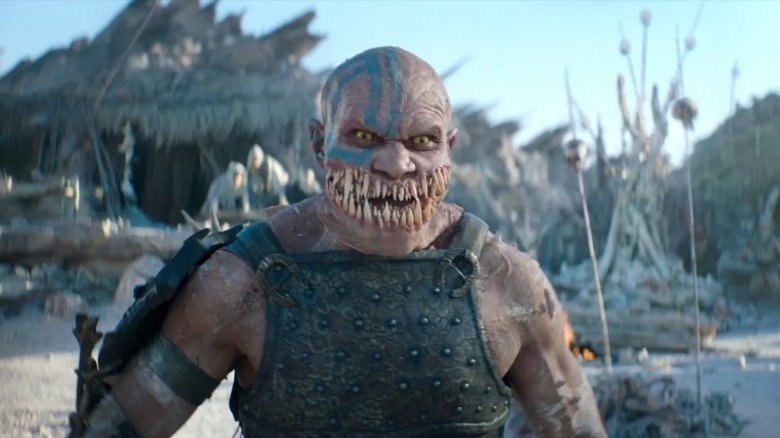
The best example of this is Johnny Cage himself, who is typically just presented as an annoying movie star in the games. In this film, he’s a washed up action star attending a geek convention where nobody recognizes him. As played by Karl Urban — a genre actor who’s appeared in Xena: The Warrior Princess, Lord of the Rings and currently stars in The Boys — Cage is the quintessential sad sack. He hates himself so much, he can’t even accept a modicum of praise from a former fan. Urban captures a man who is both past his prime, and whose prime was giving up a legitimate martial arts career to make schlock movies.
When he’s chosen to fight in Mortal Kombat, it’s impossible for Cage to see himself as an actual hero — after all, he’s only ever pretended to be one. Urban gets to show off his physical comedy chops as he’s thrown about in his first fight, showing us the campy side of the character. But he’s compelling enough as an actor to make us believe in Cage’s gradual heroic transformation.

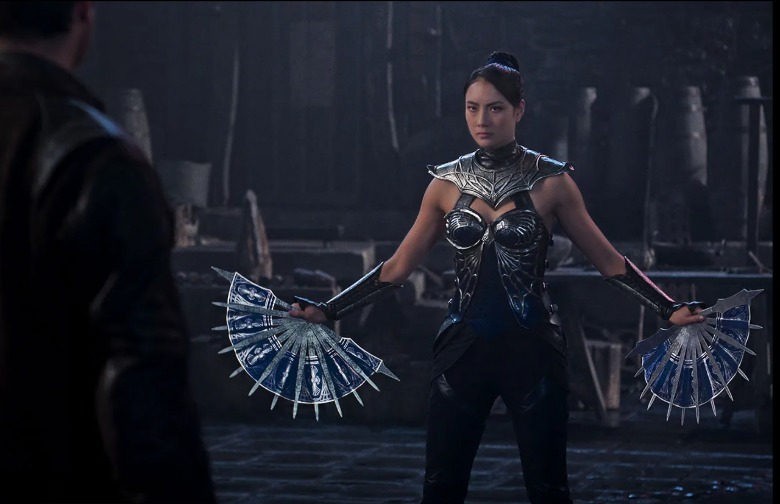
While Johnny Cage steals the show, Mortal Kombat II starts off by introducing us to Kitana as a child princess who is forced to watch her father be brutally murdered by the tyrant Shao Kahn. That loss puts her realm, and all of its people, under Kahn’s rule. Inexplicably, he chooses to adopt her and take her mother on as a consort. Kitana’s focus becomes revenge, all the while putting on the face of a loyal warrior for Kahn. Given the weight of her storyline, there’s less room for Kitana to lean into camp like Johnny Cage, but at least she gets a sick combat fan made of knives.
Everyone else from the Mortal Kombat reboot returns, including Jessica McNamee as Sonya Blade, Ludi Lin as Liu Kang and Lewis Tan’s Cole Young, a new character invented for that film. They all get their time to shine with more elaborate fight scenes, which also appear more frequently, since the tournament serves as the spine of the film. In an interview for my film podcast, The Filmcast, McQuoid mentioned that his stunt team spent more time visualizing choreography and set pieces, which led to far more dynamic action sequences than the first film. It’s something I think even general audiences, who aren’t as particular about fight choreography, will notice.
Now I’m not going to pretend that Mortal Kombat II is a perfect film. It leans so much on the previous entry that it’ll be completely nonsensical to anyone jumping straight in. And people who are less enamored with the world of martial arts films may not appreciate that the characters spend more time punching and kicking than talking. But if you can appreciate the wordless ballet of a well-choreographed fight scene, where character depth is revealed through action itself, you’ll likely have a great time with Mortal Kombat II.
You must be logged in to post a comment Login