The San Francisco startup emerges from stealth with Mayfield backing and a pitch that treats ad creative as a continuous learning loop, not a quarterly deliverable.
Every B2B marketing team knows the problem. A campaign launches, the creative is fresh, the targeting feels right, and then, slowly, it starts dying. Audiences tune out. Click rates fall.
The agency comes back for a creative refresh and the cycle begins again. Matt Jayson calls this “decaying ads,” and it is, by his account, a structural failure of how digital advertising is built: campaigns that start losing effectiveness the moment they go live, because the feedback loop between what customers actually say and what the ads actually say is too slow.
On Wednesday, the startup Multiply emerged from stealth with $9.5 million in funding to tackle that problem. The round was led by Mayfield, with participation from Sorenson Capital, Instacart co-founder Max Mullen, and Josh Woodward, Google’s VP of Labs and Gemini, the executive credited with building NotebookLM and overseeing Google’s flagship AI app.
Advertisement
The 💜 of EU tech
The latest rumblings from the EU tech scene, a story from our wise ol’ founder Boris, and some questionable AI art. It’s free, every week, in your inbox. Sign up now!
Executives from HubSpot, Braze, Brex, Sierra, and Common Room also joined the round.
Multiply’s pitch is that modern B2B companies are already sitting on the data they need to run far better advertising, they just aren’t using it. Sales call recordings, CRM pipelines, and closed-won deal data contain precise information about why customers actually buy.
Advertisement
Multiply’s system plugs directly into those sources and uses a suite of AI agents to translate them into continuously improving ad campaigns on Google Search and LinkedIn.
Hundreds of structured experiments run in parallel each week, testing messaging, audiences, and creative, with winners scaled and losers cut automatically.
The agent architecture breaks down into five components. A Customer Insights Agent extracts language from sales calls to personalise ad copy. An ICP Agent analyses closed-won deals to tighten audience targeting.
A Quality Score Agent tunes keyword alignment and copy for Google’s ranking signals. A Creative Design Agent refreshes imagery on a weekly cycle. An A/B Testing Agent runs the experiments and identifies what’s working.
Advertisement
Human media buyers sit above all of it, providing brand oversight and compliance review, the “hybrid” in what Multiply describes as a hybrid AI-plus-human agency model.
Jayson, who previously worked at Google in user acquisition and then at Brex as Head of Product for core experiences, describes the gap the company is trying to close: the insights that land deals, the specific objections, the competitor comparisons, the language that actually resonates, rarely make their way back into ad campaigns quickly enough.
His co-founder and CTO, Ashish Warty, spent five years as SVP of Product and Engineering at HackerOne and held senior engineering roles at Airship and Dropbox.
“Modern companies already have all the data needed to create radically better ads,” Jayson said in a statement. “Sales conversations, CRM systems, and pipeline outcomes reveal exactly why customers buy, yet those insights rarely make their way into ad campaigns fast enough.”
Advertisement
The timing is deliberate in another sense. Multiply’s infrastructure is, the company says, already being positioned for ChatGPT advertising, a format that OpenAI has signalled it intends to launch but has not yet released at scale.
The argument is that the same campaign learning systems built for search and social can extend into conversational and AI-driven ad formats as they emerge. That is a forward-looking claim that will depend entirely on how those platforms eventually structure their ad products.
“There is a major shift happening in the $50 billion B2B advertising market,” said Patrick Salyer, Partner at Mayfield and a Multiply board member, in a statement. “Service-as-Software is redefining how companies grow, and Multiply has built the first AI model for B2B advertising.”
The $50 billion market figure comes from Mayfield’s own framing and has not been cross-referenced against independent market data.
Advertisement
Multiply is, in essence, making a structural argument about where the ad agency model breaks down: not in creative execution, but in the speed of the feedback loop.
Whether a $9.5 million AI stack can fix that faster than incumbents adapt is the question its pipeline metrics are presumably meant to answer.
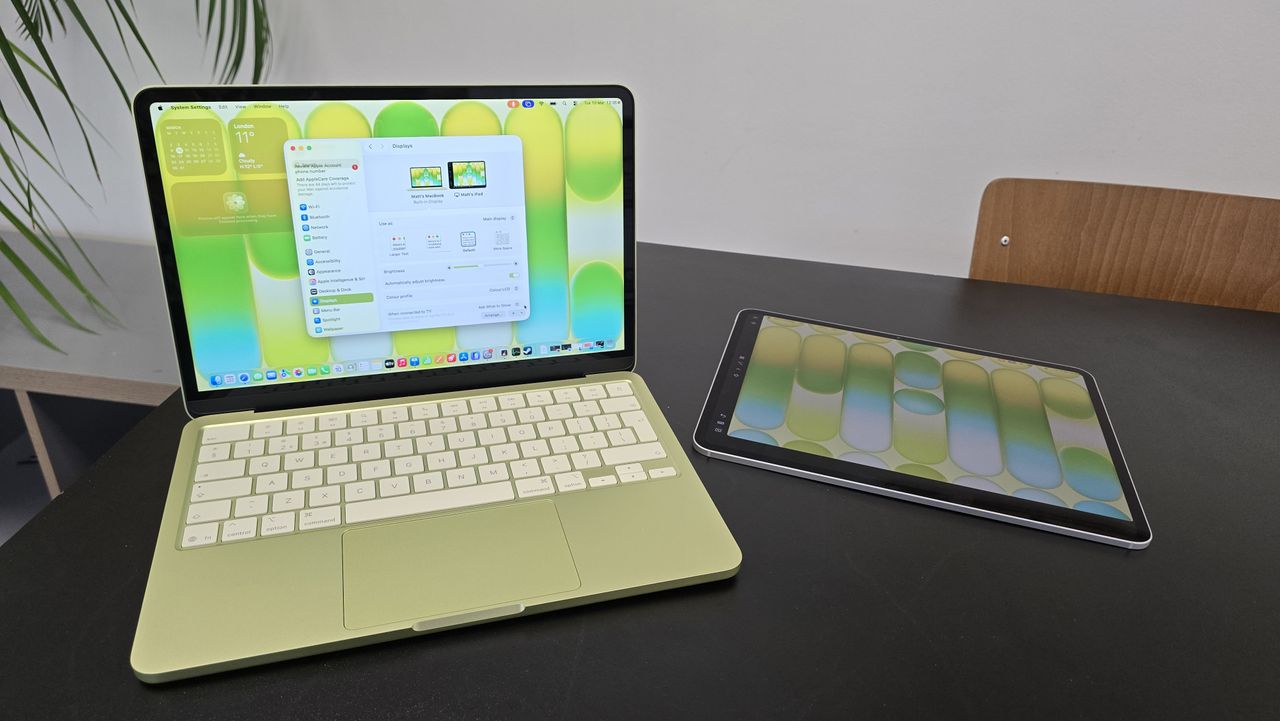
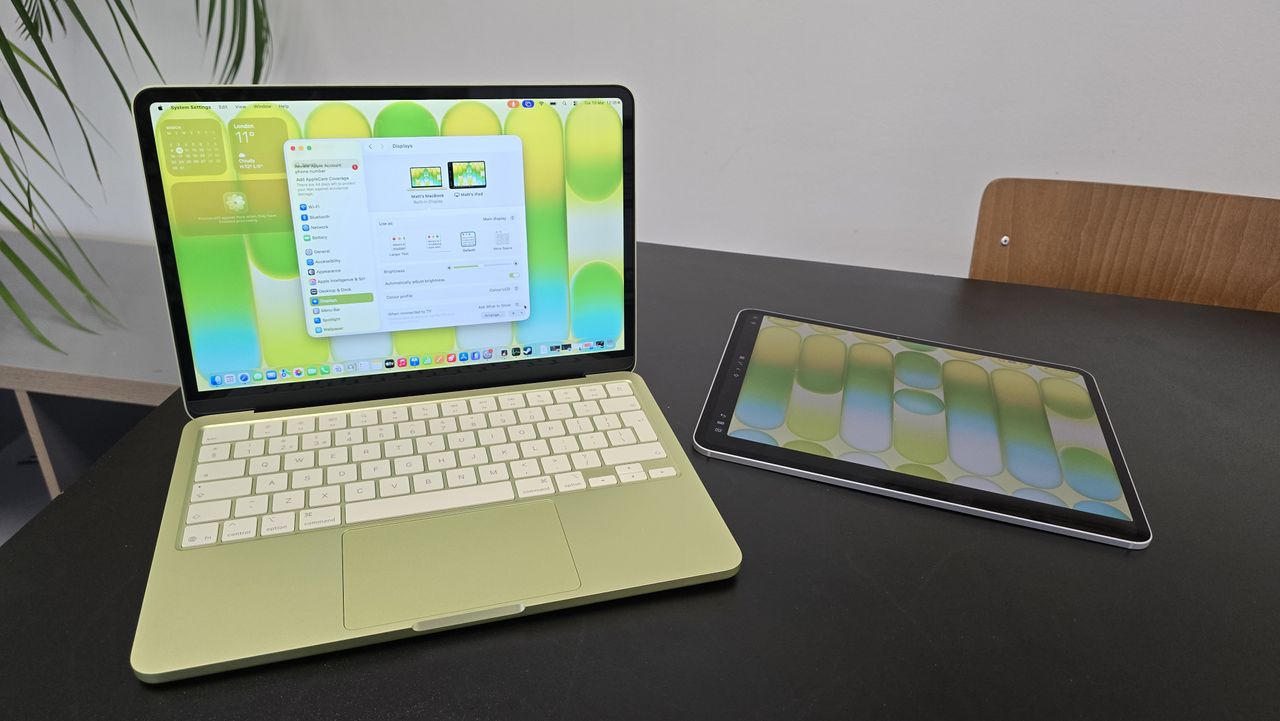
The MacBook Neo, along with the Mac mini, is Apple‘s most affordable computing option at just $599. And yet it is a formidably capable device, possibly, a once-in-a-generation product. Why? One unknown I wanted to clear up was how well it ran Windows 11 in a virtual machine.
So I asked the team at Parallels to benchmark a Windows-equipped Neo, and what they delivered shocked me.
I didn’t have high expectations given the Mac Neo’s limited specifications. It uses similar hardware to the iPhone 16 Pro Max: an Apple A18 Pro with six cores, 256GB storage and 8GB of unified memory.
Advertisement
Article continues below
Against a $1,119 Dell Pro 14 laptop (Intel Core Ultra 5 235U @ 2.00 GHz, 10-core, 16GB RAM, running Windows 11 build 26200 natively), a MacBook Neo with a virtualised Windows 11 (build 26200) with six vCPU and 6GB vRAM (via Parallels Desktop 26) delivered approximately 20% higher single-core CPU performance than natively on the Dell computer.
That’s across five industry-leading benchmark packages: Geekbench, PassMark, 3DMark, PCMark, Blender, and Unigine. I reached out to Parallels to obtain the raw data from these tests and will update the article once it is received.
Advertisement
For typical office productivity workloads, overall performance is approximately 20% slower than native Windows 11 on the Dell laptop.
Parallels said this “remains responsive and practical,” meaning it should be fast enough for everyday use. They also added that “this setup works well for standard office productivity (Microsoft Office, email, calendar), web applications and browser-based tools, business productivity software, and light development and testing”.
Sign up to the TechRadar Pro newsletter to get all the top news, opinion, features and guidance your business needs to succeed!
There are obvious caveats – you still need to buy a copy of Parallels and a Windows 11 license – and this certainly warrants more extensive tests, something that I hope my peers will carry out.
Advertisement
Apple is only warming up
I cannot stress enough how important this finding is.
Here we have an Apple laptop that was never destined to run Windows 11, capable of running Microsoft’s flagship OS in a virtual machine, better than a Dell laptop designed to run Windows 11 natively.
Not only is the Dell laptop far more expensive, but its CPU is also expected to be more powerful. What we have seen is the fruit of vertically integrated platform, something that Apple mastered by kicking out Intel and Samsung from its Mac and iPhone range.
Own the hardware and the software and you can perform miracles.
This is mind-blowing and both Apple and Parallels deserve a big pat on the back for achieving this. It’s too early to say the writing is on the wall for Windows laptops, but expect Apple to sell millions of these in the current financial year. Could it become Apple’s best-selling computer ever? I wouldn’t bet against this.
Matt Hanson, who reviewed the MacBook Neo for TechRadar, quipped that “While I wouldn’t recommend using Windows 11 on the MacBook Neo full-time, as native macOS performance is always going to be better, Apple’s affordable laptop has put budget laptop and Chromebook makers on notice. It’s not perfect, but the performance, build quality and design mean there’s really no choice if you’re looking for a laptop under $600: buy the MacBook Neo”.
Advertisement
Matt gave it a 4.5 out of 5, noting the presence of USB 2.0 ports, the lack of a keyboard backlight, and limited RAM as the only significant drawbacks of an otherwise stellar laptop.
I will not buy Apple’s cheapest laptop just yet but I – and I am sure millions of others – would find it hard to resist a $99.99 refurbished MacBook Neo in a few years.
Yesterday’s discount on the Sonos Ace over-ear headphones wasn’t the only sale you can find on new additions to your Sonos setup. You can also nab the Sonos Roam 2 for just $139 as part of the Amazon Spring Sale. This Bluetooth speaker has excellent sound despite its relatively compact size, and of course it plays nicely with your other Sonos speakers.
Unlike older Sonos products, the Roam 2 now has Bluetooth in addition to Wi-Fi. When you’re home, the speaker joins your network and acts just like any other Sonos speaker in your setup. Take it on the go, and you can easily connect your phone and keep the tunes rolling. The Sonos app isn’t always the best at finding new speakers, but in this case it fired right up and connected to the Roam 2, good news for the easily frustrated. It has a fun sound profile that’s great for picnics or backyard hangs, with solid bass and balanced mid and upper ranges. Some other Bluetooth speakers might get louder, but the Roam 2 makes up for it by joining a chorus of other speakers around your home.
While the first-generation Roam suffered from some long-term battery health issues, Sonos has assured us that the Roam 2 more than fixes the problem, and at least in the short time our reviewer Parker Hall spent with it, it wasn’t an issue anymore. The outside is also slightly prone to smudges and scuffs, something to keep in mind if you prefer your equipment looking pristine. It’s waterproof, though, and quite sturdy, so just know that any marks you see on the housing are just surface level.
Fusion power company Helion Energy has taken the top spot in the latest update of the GeekWire 200, our quarterly ranking of the top privately held technology startups in the Pacific Northwest.
Helion replaced Highspot, which announced a merger with Seismic in a significant sales software deal last month (exited companies graduate from the list). Backed by the likes of SoftBank and Sam Altman, Helion announced two key milestones in February on its mission to generate usable energy from fusion reactions.
The company’s ascent atop the GeekWire 200 reflects a broader trend on the rankings, as startups building complex hardware across sectors like space, energy, robotics, and agriculture make up a sizable chunk of the list. It’s a notable change for a region traditionally dominated by enterprise software.
The top 10 includes companies such as Agility Robotics, which is building humanoid robots; Brinc, a drone maker serving public safety customers; Stoke Space, a space manufacturing company; and Carbon Robotics, which sells weed-zapping machines to farmers. Seattle VC firm Ascend has coined this crop of companies as “Cascadian Dynamism.”
Advertisement
The GeekWire 200 is a great resource to help keep track of the region’s up-and-coming companies, along with established leaders.
The list, which dates to 2013, combines objective data and editorial insight to provide a broad view of the region’s startup landscape. The GeekWire 200 has long served as a resource for investors, job seekers, service providers, and others tracking the Pacific Northwest tech scene.
The top 10 includes one new member: infrastructure startup Temporal, now valued at $5 billion after raising a $300 million Series D round last month. Temporal’s revenue grew more than 380% year-over-year as it helps companies move their AI agents into real-world production.
Several other startups rose up the list this quarter:
Auger, the supply chain software startup that raised a $100 million seed round in 2024, continues to hire rapidly — headcount is up more than 200% year-over-year — and is now ranked No. 41. Auger also announced a partnership with Microsoft on Wednesday.
Echodyne, the Seattle-area radar platform company, announced plans to build a new manufacturing facility in Washington state and moved up to No. 54.
Starfish Space is now No. 64 after landing a $54.5 million Space Force contract for its satellite servicing spacecraft.
AIM Intelligent Machines, the autonomous construction startup that recently inked its own government contract, moved up to No. 122.
Avalanche Energy, which announced a $29 million round last month to fuel its fusion technology, moved up to No. 156.
Tin Can, the hot Seattle startup behind a landline-style telephone for kids, sprang to No. 167 after raising $12 million in December.
There are also a batch of newcomers making their debut on the list, including:
Tune Therapeutics (No. 140), a biotech company co-headquartered in Seattle that’s developing epigenome editing programs.
Gradial (No. 151), a Seattle-based startup developing agentic marketing tools that raised $35 million in December and recently launched a new tool for GEO, or Generative Engine Optimization.
Starcloud (No. 171), the Redmond, Wash.-based company working on space-based data centers that was featured during Jensen Huang’s keynote at NVIDIA GTC this week.
Others new entrants include Union.ai; Integrate; Clearly AI; mpathic; AheadComputing; Casium; RentSpree; Inflection.io; Dopl Technologies; Loopr; Scala; Elevāt; Certivo; AZX; and MontyCloud.
Notes on the GeekWire 200
Our list is not scientific, by any means, and the specific rankings should be taken with a grain of salt. But it has proven to be a highly useful tool. We hear regularly from readers who use the GeekWire 200 to look for jobs, prospect for customers, mine for potential investments, and get a high-level view of the tech community.
We also use the list as a valuable insights tool, gathering survey data to highlight trends among fast-growing startups.
We’re looking at each company’s employee growth over the past 12 months, factoring in both the percentage increase and the number of jobs added.
Larger companies still earn credit for maintaining scale — a sign of maturity and customer traction. But this is weighted less heavily than growth, to help spotlight emerging players.
We include LinkedIn follower counts as a rough measure of a company’s public traction. To avoid favoring long-established firms, we apply a curve that gives younger companies a fairer shot.
Companies founded 15 years ago or later “graduate” from the GeekWire 200, and are not included. We also remove companies due to mergers, acquisitions and private equity deals in which they sell a majority of their shares.
To make sure your Pacific Northwest technology startup is eligible for the GeekWire 200, first confirm it’s included in the broader GeekWire Startup List. If so, there’s no need to submit it separately. If your startup isn’t among the companies on that larger list, you can submit it for inclusion here, and we’ll crunch the numbers to see if your company makes the next GeekWire 200 update. Email us at tips@geekwire.com with any questions.
The New York digital comics platform is combining its 300,000-title library with INKR’s AI localisation engine, and bringing in new leadership to execute the expansion.
The problem with getting manga into the hands of readers outside Japan is not demand. Manga is the fastest-growing category in American book publishing; global interest has been building for years, accelerated by streaming adaptations of franchises like Demon Slayer, Attack on Titan, and Jujutsu Kaisen.
The problem is infrastructure. Translating, reformatting, and distributing a comics series across languages and screen sizes is still a largely manual process, and the industry’s publishing toolchain has never been built to handle it at speed or at scale.
GlobalComix, the New York-based digital comics platform, is betting it can fix that. On Wednesday the company announced three moves at once: a $13 million funding round, the appointment of Henrik Rydberg as chief executive, and the acquisition of INKR, a Singapore-founded AI localisation platform for comics.
Together, the announcements describe a company that wants to be not just a reading destination but the infrastructure layer beneath the global comics publishing industry.
Advertisement
The $13 million round was co-led by SBI US Gateway Fund, the US arm of SBI, one of Japan’s most active venture capital firms with more than 1,200 portfolio companies, and Point72 Ventures, the venture arm of Steve Cohen’s Point72 Asset Management.
Point72 Ventures previously led GlobalComix’s $6.5 million Series A in July 2023 and returns here as co-lead. Additional participants include Scrum Ventures, Wise Ventures, Wicklow Capital, and Upside VC.
The Japan-US investor pairing is deliberate. SBI’s network spans Japanese media and publishing, the market that produces manga, while Point72 brings continuity and US market perspective.
Shohei Yamada, Managing Partner of SBI US Gateway Fund, described GlobalComix as “building the infrastructure that connects creators, publishers, and readers worldwide,” adding that he believed it had the potential to make manga and comics “accessible to anyone, anywhere.”
Advertisement
Ishan Sinha, now a Partner at Point72 Ventures who led the 2023 Series A, said the addition of INKR’s AI team and localisation technology “meaningfully expands what the platform can support for creators and publishers.”
The INKR acquisition brings the most technically substantive element of the announcement.
INKR was founded in 2019 by Ken Luong, Khoa Nguyen, and Hieu Tran, a team based in Singapore and Ho Chi Minh City, and launched its app in October 2020.
The platform’s core product is an AI localisation engine that automates the most labour-intensive steps in preparing a comic for a new language market: text and object detection, image cleaning, translation, and typesetting.
Advertisement
The company says the technology reduces localisation time from days to hours and has been used to localise more than 15,000 comics, though that figure comes from GlobalComix’s press materials and has not been independently verified.
GlobalComix’s platform currently hosts more than 300,000 titles from publishers including Marvel, DC, Kodansha, Image Comics, and Tokyopop, alongside more than 25,000 independent creators.
The company’s ambition is to combine INKR’s localisation pipeline with its existing distribution and monetisation infrastructure, effectively creating a vertically integrated system: a publisher brings a Japanese title in, the AI engine prepares it for English, French, or Brazilian Portuguese markets, and GlobalComix handles distribution and revenue.
The global manga market is estimated to exceed $20 billion annually, with demand for translated content growing across the West.
Advertisement
Whether GlobalComix can capture meaningful share of that workflow, against established players including Viz Media, Yen Press, and digital platforms like WEBTOON, depends on whether the AI localisation quality is good enough for professional publishing standards and whether publishers will trust a startup with their most valuable IP.
The acquisition of INKR, whose technology is described as already trusted by publishers in Japan and Korea, is the clearest attempt to answer that second question before it is asked.
Flock, valued at roughly $7.5 billion and backed by venture capital giant Andreessen Horowitz, says its systems help police identify vehicles linked to criminal activity by analyzing license plates and other features, such as bumper stickers. But the same capability has alarmed privacy advocates and local governments, particularly after reports that… Read Entire Article Source link
An Employment and Recruitment Federation report suggests that despite Ireland’s positive hiring market, progress is being stalled.
New research published by the Employment and Recruitment Federation and supported by Icon Accounting has highlighted how the skills shortage in Ireland is starting to delay further growth for organisations, despite some positive numbers.
The Irish Labour Monthly Monitor report found that more than half of contributing recruiters reported an increase in permanent vacancies and 43pc said there is higher demand for contract roles. 41pc reported increased temporary vacancies and more than half also said that they expect vacancy levels to rise further over the next three months.
But despite the positive hiring market, the research also indicated that Ireland’s talent pool is not keeping pace. Of those who contributed their information, two thirds of recruiters said that they expect no improvement in the availability of applicants with suitable skills. The report said this points to a widening gap between what employers need and what the market can currently provide.
Advertisement
Commenting on the figures, Siobhán Kinsella, the president of the Employment and Recruitment Federation, noted that this is the real challenge at present: not a lack of jobs, but a shortage of the right skills.
She said: “What this data shows very clearly is that Ireland does not have a jobs problem. It has a skills problem. Employers are still hiring. Recruiters are still filling roles. But finding people with the right experience and qualifications is getting harder, and that is now starting to hold businesses back.
“This is still a strong jobs market, but it is becoming harder and more expensive for employers to hire. Businesses are dealing with higher costs, continued uncertainty and fast-changing requirements at the same time.”
She explained that if Ireland wants to maintain its momentum, there needs to be a serious commitment to training, reskilling and workforce readiness. “We cannot keep talking about strong employment numbers if employers cannot find the people they need to fill the roles that are there,” she said.
Advertisement
Competing needs
The report noted how in February, Ireland’s unemployment rate stood at less than 5pc, resulting in a landscape where many employers find themselves competing for a limited pool of experienced workers, across sectors such as technology, engineering, healthcare, logistics and financial services, among others.
Youth unemployment figures were also shown to be comparitively high, with the latest CSO figures showing a rate of 12.4pc for 15 to 24-year-olds, highlighting the continuing challenge of ensuring that people entering the workforce have the right skills to access available roles.
Kinsella noted that the findings are reflective of a much wider pattern now visible across developed economies, where the issue is no longer job creation, but whether countries have the people and capacity needed to support continued growth.
She said: “What Ireland is facing is part of a much wider shift across advanced economies. We have adapted before as technology changed the way we work, and we will adapt again.
Advertisement
“But this next phase will depend on whether we invest properly in skills, support people to retrain and make it easier for employers to access the talent they need in areas such as AI, machine learning, engineering and healthcare. That is where the real focus now needs to be.”
Earlier this month, WiCyS and FourOne Insights published data that explored how skills-based cyber practices have the potential to positively impact employees and their organisations.
The ‘ROI of Resilience: How Cybersecurity Talent Management Best Practices Improve the Bottom Line’ study suggested that skills-based, talent-friendly practices often generate the highest returns for an organisation and its workforce.
The report said: “High-ROI practices, such as transparent promotion processes, executive sponsorship, access to upskilling and mentorship, and engagement with trusted third-party partners, can consistently reduce hiring friction and support retention. Over time, they open advancement pathways that have historically been narrow, especially for women.”
Advertisement
Don’t miss out on the knowledge you need to succeed. Sign up for the Daily Brief, Silicon Republic’s digest of need-to-know sci-tech news.
Over the years, OPPO’s A series has delivered some great value phones for price-conscious buyers. Keeping that spirit alive, OPPO has launched the OPPO A6s 5G in India. The Chinese smartphone maker says the A6s focuses on battery life, smooth performance, and a camera setup designed for everyday photography. Here’s everything you need to know about it.
Design & Cameras
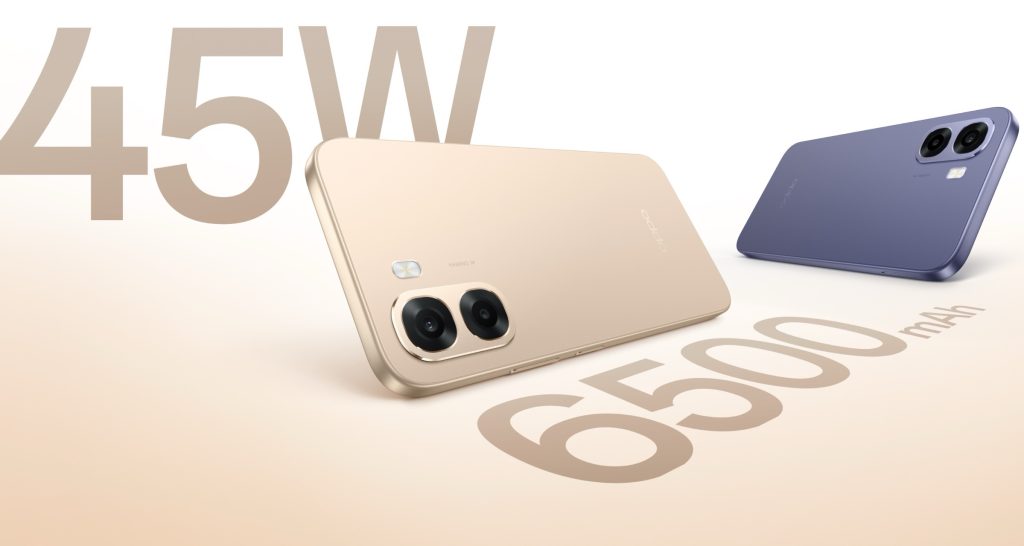
The OPPO A6s 5G features a flagship-inspired design with a slim profile measuring 8.61mm in thickness and weighing around 212 grams. Color options, of which there are two, include Aurora Gold and Plum Purple. The phone features a bright display for outdoor visibility, along with a metallic unibody-style frame that offers both durability and a premium look.
Optics are headed by a 50MP main camera accompanied by a 2MP secondary sensor. According to OPPO, the camera system is designed to capture clear images with natural colours across different lighting conditions. Selfies are handled by a 5MP sensor.
Performance & Battery
Powering the OPPO A6s 5G is the MediaTek Dimensity 6300 chipset. We’ve used several phones with the same processor in the past, and it’s a reliable performer. The smartphone runs ColorOS 15, which introduces system-level optimizations, including the Luminous Rendering Engine and Trinity Engine, to improve animation smoothness and overall performance.
Battery life is one of the main highlights of the OPPO A6s 5G. The phone packs a 6,500mAh battery, which is coupled with 45W SUPERVOOC fast charging, allowing the device to charge from 1% to 41% in about 30 minutes.
Pricing & Availibility
The OPPO A6s 5G starts at ₹18,999 for the 4GB + 128GB variant, while the 6GB + 128GB model is priced at ₹20,999. The smartphone is available starting today through Amazon, Flipkart, the OPPO online store, and offline retail outlets. As part of launch offers, buyers can get ₹1,000 instant cashback on select credit cards and no-cost EMI options for up to three months.
Spotify is rolling out a new Exclusive Mode on desktop for listeners who care about audio quality. This feature gives you more control over how sound is delivered, reducing system interference and allowing bit-perfect playback.
In simple terms, your music can now reach your headphones or speakers without being altered by your computer’s audio system. This update is currently available on the desktop app for Windows, with Mac support coming later.
What is Exclusive Mode in Spotify, and how does it work?
Exclusive Mode is designed for people who use external DACs or high-end audio setups, where even small processing changes can affect sound.
Spotify
Normally, your operating system mixes audio from different apps, which can resample or modify the signal. Exclusive Mode changes that by letting Spotify take full control of the audio output.
When you turn on Exclusive Mode, Spotify bypasses the system mixer. That means your music is sent directly to your audio device without being changed. This is what allows bit-perfect playback, where the audio data remains exactly as intended.
Advertisement
It also reduces interruptions from other apps. Since Spotify controls the output, other system sounds are blocked while you are listening.
How to turn on Exclusive Mode in Spotify?
Spotify
To enable Exclusive Mode, first connect your external audio device, such as a DAC or audio interface, to your computer. If your system already has a headphone or speaker port, it may include a built-in DAC.
Next, open the Spotify desktop app and go to Settings. Scroll down to Playback, then under Output, select your audio device from the dropdown menu. Once that is set, turn on Exclusive Mode.
Spotify also suggests turning off certain features in its settings for the best playback. This includes Automix, Crossfade, Equalizer, and Normalize Volume, all available under Settings > Playback.
If you want to turn it off, go back to Settings and switch off Exclusive Mode. This will return audio control to your system, allowing other apps to play sound alongside Spotify.
Rotel’s luxury Michi brand has expanded its digital lineup with the Michi Prestige Q430 CD Player, a full-function disc player designed for listeners who still take Red Book CD playback seriously. Unlike a transport-only design, the Q430 includes its own internal DAC while also offering a digital output for those who prefer to experiment with an external converter. Rotel already has a long track record in the two-channel component space, and while we’ve covered the brand extensively at eCoustics, the Michi line sits firmly at the company’s high-end tier.
The Prestige Q430 now enters a surprisingly competitive premium CD player category that includes impressive new models from Marantz, Quad, Hegel, TEAC, Shanling, and several other brands determined to prove that the compact disc still has plenty of life left in it.
In recent years, we’ve also covered several other Michi products including the Q5 CD Transport DAC (2024), the Series 2 Amplifiers and Preamplifiers (2023), and our full review of the Michi X3 Integrated Amplifier (2022); all of which reinforced the brand’s focus on premium construction, refined industrial design, and performance aimed squarely at the higher end of the hi-fi market.
Michi Prestige Line Adds the Q430 CD Player
The Michi Prestige line is designed to give listeners a clear entry point into ultra-high-performance components built with the same design discipline, power supply priorities, and craftsmanship expected of reference-level audio.
Advertisement
Drawing on more than 60 years of Rotel amplifier and circuit development, Prestige models aim to deliver effortless dynamics, exceptional clarity, and the kind of long-term reliability that serious two-channel systems demand.
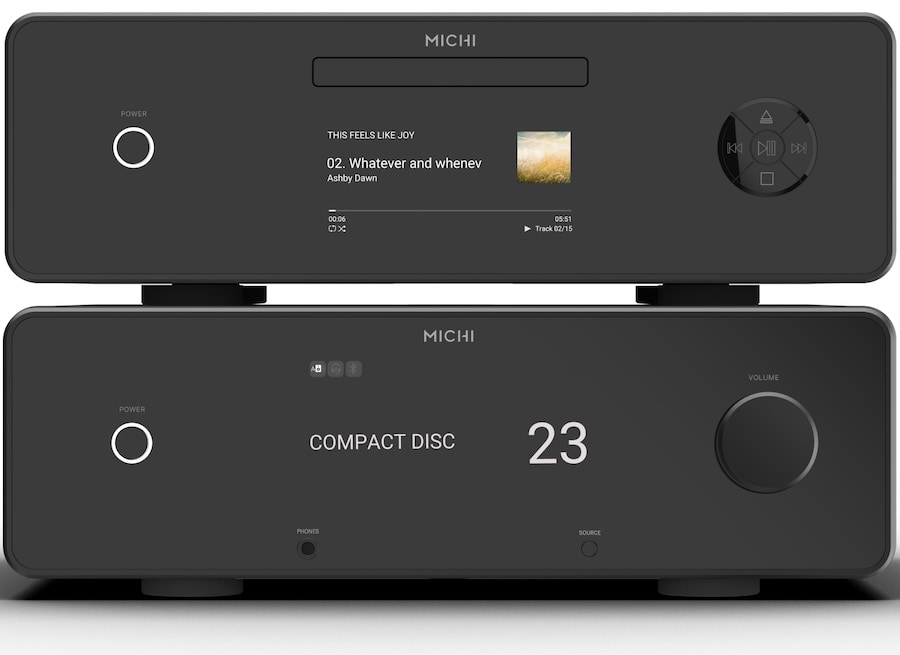
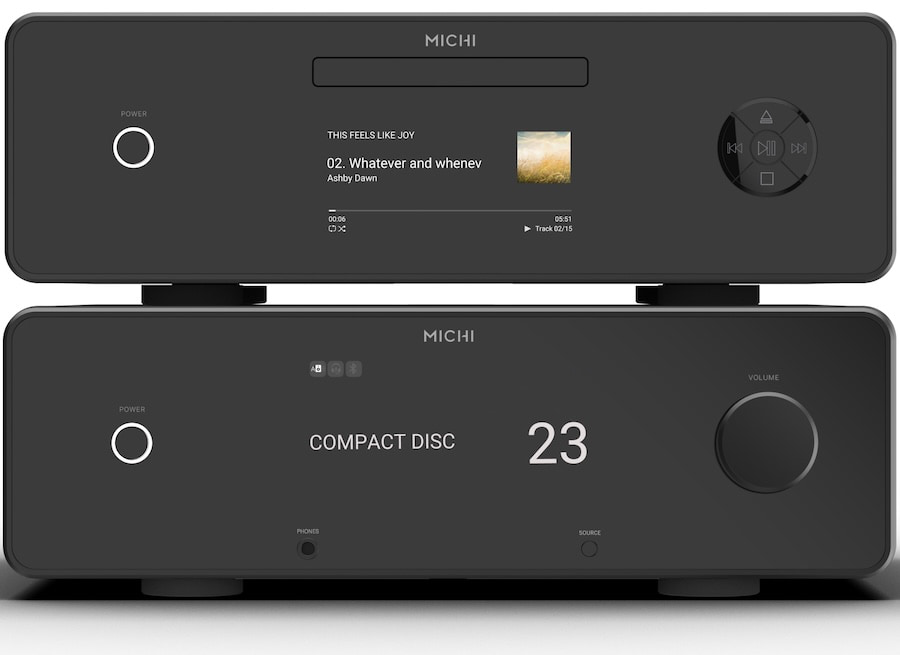
Michi Prestige Q430 CD Player atop Michi X430 Integrated Amplifier
For 2026, Michi has introduced two new additions to the series: the Prestige Q430 CD Player and the X430 Integrated Amplifier. We covered the X430 in a companion article, but here the focus shifts to the Q430 CD Player, a premium disc player designed for listeners who still value dedicated CD playback in a high-end system.
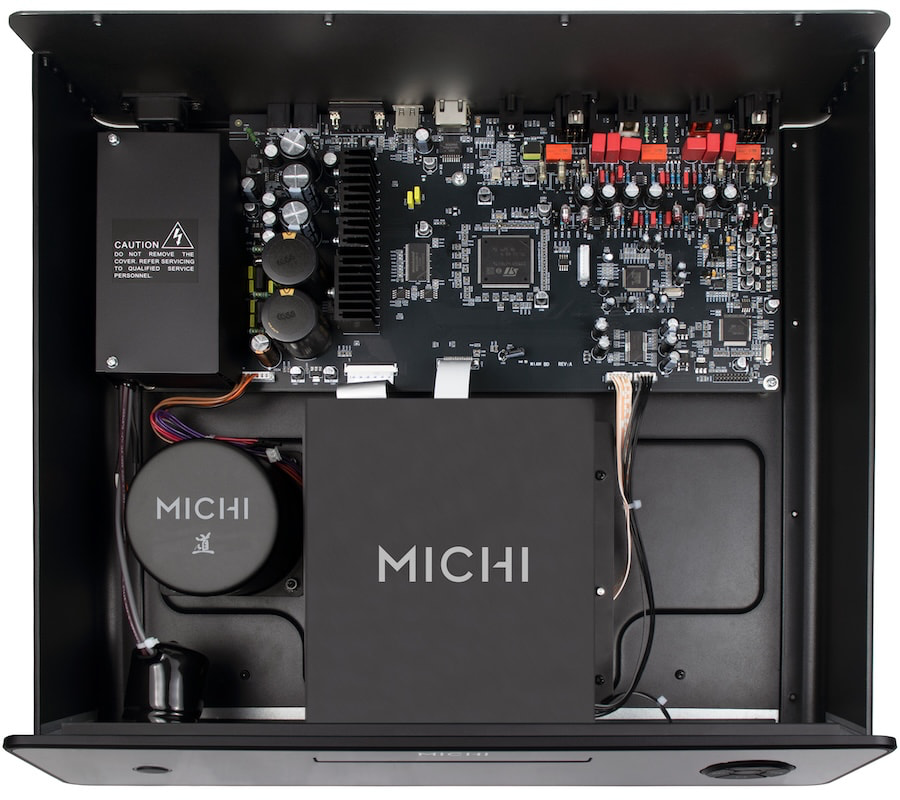
Building on Michi’s heritage of precision engineering and industrial design, the Q430 combines a high-quality floating CD mechanism capable of playing Red Book CD, CD-R, and CD-RW discs with a meticulously designed proprietary power supply built in-house. Multiple stages of isolated voltage regulation reduce noise at the source, helping deliver exceptionally low distortion and a very quiet acoustic background where subtle details and ambient cues can emerge clearly from the mix.
At the heart of the digital stage is an ESS SABRE ES9028PRO 8-channel DAC, configured and optimized for stereo playback. The DAC is intended to deliver precise, neutral sound with wide soundstage presentation and strong resolution through both single-ended RCA and balanced XLR analog outputs, providing flexibility when integrating the player into a wide range of high-end systems.
Advertisement
Measured performance is equally ambitious. The Q430 is rated for ultra-low distortion (THD below 0.0006%) and a signal-to-noise ratio exceeding 120 dB, helping preserve transient impact and low-level detail even in complex musical passages. Channel separation greater than 105 dB at 10 kHz further supports precise stereo imaging and spatial detail, contributing to a convincingly three-dimensional soundstage.
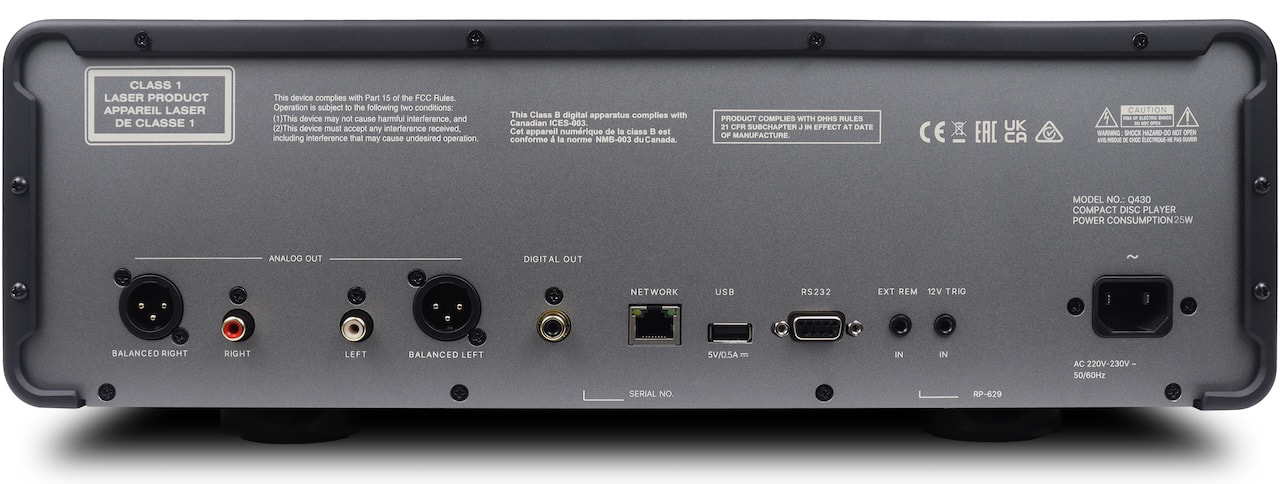
Connectivity is straightforward but purposeful. In addition to its analog outputs, the Q430 includes a coaxial digital output, allowing the player to function as a dedicated CD transport when paired with an external DAC for listeners who prefer to experiment with different digital conversion stages.
However, there are a few notable omissions for a player positioned at this level. The Q430 does not support SACD playback, which some listeners may expect given its price category and the capabilities offered by competing models. In addition, the internal DAC cannot be used with external digital sources or streamers, a feature that has become increasingly common in 2026 as manufacturers try to broaden the utility of standalone disc players within modern streaming-focused systems.
Advertisement. Scroll to continue reading.
Advertisement
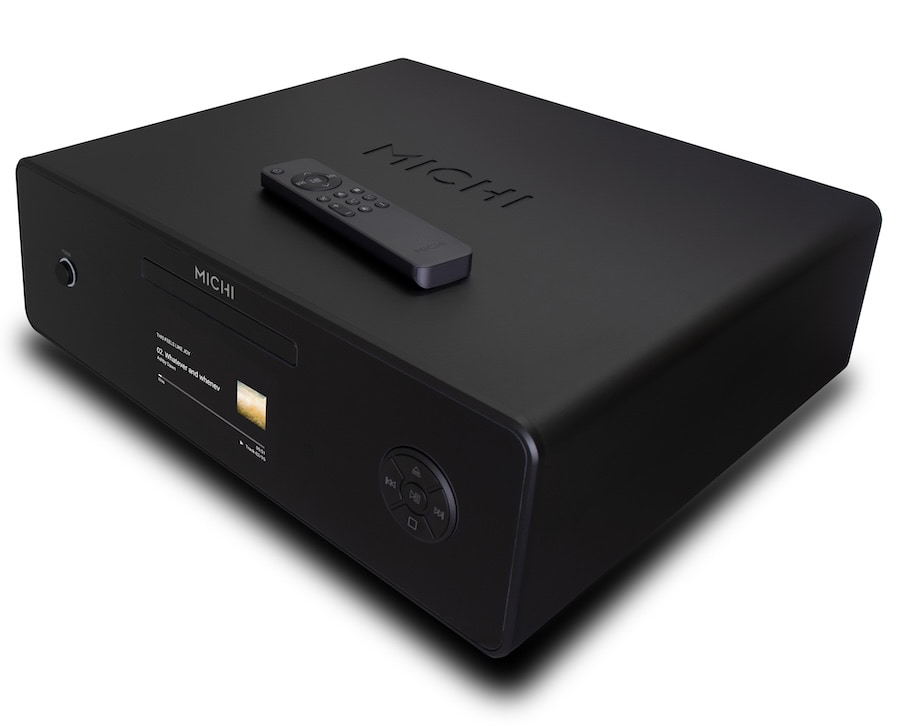
For ease of operation, the Michi Prestige Q430 CD Player includes a wireless remote control that allows listeners to navigate album artwork, settings, and disc information displayed on the front panel’s full-color TFT display. The interface is designed to make browsing and playback straightforward while providing clear visual feedback during use.
All of the internal components are housed inside a precision-milled aluminum chassis that reflects Michi’s design philosophy of durability, performance, and long-term reliability. The solid enclosure also helps minimize vibration and electrical interference, supporting stable disc playback and consistent sonic performance.
The Q430 measures 431 x 148 x 385 mm (17 x 6 x 15-1/4 inches) with a front panel height of 131 mm (approximately 5-1/6 inches). The unit weighs 8.8 kg (19.5 lbs), reflecting the robust chassis construction and internal power supply design typical of Michi components.
Unbalanced (RCA) > 105 dB @ 10 kHz Balanced (XLR) > 110 dB @ 10 kHz
> 104 dB @ 10k Hz
Signal to Noise Ratio (IHF A-Weighted)
Unbalanced (RCA) > 120 dB Balanced (XLR) > 125 dB
> 115 dB
Dynamic Range
> 99 dB
> 99 dB
Input Sensitivity
Not Indicated
0 dBfs / 75 ohms
CD Output
Not Indicated
Digital output (16-Bit / 44.1k Hz, 0 dBFS)
Analog Output Level / Impedance
Unbalanced (RCA) 1.96 V / 100 ohms
Advertisement
Balanced (XLR) 4.2 V / 2 k ohms
Unbalanced (RCA) 2.3 V / 100 ohms
Balanced (XLR) 4.9 V / 4K ohms
Digital to Analog Converter
ESS ES9028PRO DAC
ESS ES9028PRO DAC
Digital Output
Coaxial Out
SPDIF LPCM (up to 24-bit / 192 kHz)
PC-USB
USB provided for power and firmware updates only.
USB Audio Class 2.0 (up to 32-bit / 384k Hz)* *Driver installation required
Advertisement
Support native DSD (up to 4X, 11.2M) and DoP (up to 2X, 5.6M)
Support MQA and MQA Studio (up to 24-bit / 384 kHz)
Power Requirements
Europe 230 V, 50 Hz USA 120 V, 60 Hz
Europe 230 V, 50 Hz USA 120 V, 60 Hz
Power Consumption
25 watts
25 watts
Standby Power Consumption
< 0.5 watts
< 0.5 watts
Full-color TFT Display
Yes
Yes
Control
Wireless Remote, RS232, Ethernet, 12V Trigger
Wireless Remote, RS232, and Ethernet
Dimensions (WxHxD)
431 x 148 x 385 mm (17 x 6 x 15-1/4 inches)
485 x 150 x 452 mm (19 x 6 x 17-3/4 inches)
Front Panel Height
131 mm (5-1/6 inches)
132 mm (5-1/4 inches)
Net Weight
8.8 kg (19.5 lbs)
23.5 kg (51.8 lbs)
Finish
Black
Black
The Bottom Line
The Michi Prestige Q430 CD Player is aimed at listeners who still value dedicated Red Book CD playback and want a component that matches the build quality and aesthetic of a high-end two-channel system. With its floating transport mechanism, ESS SABRE ES9028PRO DAC optimized for stereo use, balanced and single-ended outputs, and robust aluminum chassis, the Q430 is clearly designed to deliver refined CD performance rather than serve as a digital hub for multiple sources.
However, its focus is also its limitation. At $4,000, the Q430 lacks several features that competing players in this price category increasingly offer, including SACD playback and digital inputs that would allow the internal DAC to be used with external streamers or transports. For some buyers, those omissions will be difficult to ignore.
Ultimately, the Q430 is best suited for high-end two-channel listeners who still maintain a substantial CD collection and want a dedicated player that prioritizes build quality and straightforward disc playback rather than broad digital flexibility. For everyone else, especially those looking for SACD support or a more versatile DAC—the competition from brands like Marantz, Esoteric, TEAC, and Shanling may offer a more compelling case.
Advertisement
Price & Availability
Priced at $3,999, the Michi Q430 CD Player will initially be available in North America beginning March 2026, with global availability to follow early in the second quarter of 2026 through Rotel’s Dealer Network at €3,999 or £3,599.
Rumors are swirling that a DJI Pocket 4 is on its way, but don’t let the promise of a shiny new action cam distract you from what’s available right now — the DJI Osmo Pocket 3 is currently cheaper than ever. Although it’s nearly three years old now, the Pocket 3 is still an extremely capable camera. With features like a portrait filming mode and a 2-inch screen that’s ideal for viewing a live camera feed, the Pocket 3 has proven hugely popular with vloggers and content creators in particular.
In our DJI Osmo Pocket 3 review, our tester called it “class-leading”, and highlighted the “amazing video quality and beautiful slow-motion scenes”. It was awarded a near-perfect 4.5 stars. TechRadar’s camera editor Tim Coleman thinks it’s well worth considering, even with the Pocket 4 on the horizon, commenting: “For many solo vloggers it will serve their needs perfectly, and for a much lower price than the latest models.”
Today’s best DJI Osmo action cam deals
Advertisement
More DJI Osmo action cam deals
The Osmo Pocket 3 deals sit amongst a variety of excellent DJI action cam price drops available right now — there are also lowest-ever prices on the likes of the “seriously feature-packed” DJI Osmo Action 5 Pro and “fantastic” Osmo Action 4.
I’ve checked prices across leading retailers, and the best prices right now are at Amazon, but many options are available for only a few cents more at Best Buy. Typically, these cameras are sold in Essential, Standard, or Adventure Combos, with each bundle, respectively, including more accessories.






.png)































































You must be logged in to post a comment Login