Tech
Muse HiFi M3 Ultra Review: A Portable Tube DAC Amp That Makes Digital Audio Sound Less Sterile

If Muse HiFi is not a brand on your radar, you’re not alone. Founded in 2022, the young manufacturer has been building a focused lineup of affordable DACs and headphone amplifiers aimed at listeners who want better sound without emptying their bank accounts. Its R&D and manufacturing-first approach has allowed the company to deliver surprisingly advanced source components at very competitive prices. The $110 M3 Ultra is one of its newest products, and it might be the one that gets more people paying attention.
Related Reviews:
Technology
When it comes to portable DACs and headphone amplifiers, there is no shortage of technical detail to sort through. For the M3 Ultra, these are the key specifications that matter most:
- Outputs: 3.5mm, 4.4mm
- Input: USB-C
- Output Power:
- 460mW @ 32 ohms via 3.5mm
- 480mW @ 32 ohms via 4.4mm
- Output Impedance:
- ~13.5 ohms via 3.5mm
- ~8.6 ohms via 4.4mm
- DAC: ESS ES9028Q2M
- Amplifier Stage: Dual JAN6418 tubes with ES9603Q
- Decoding: PCM up to 32-bit/384kHz, native DSD256


The important part is that the M3 Ultra is not lacking for output power. With a peak rating of 480mW into 32 ohms, it should have enough muscle for most portable headphones and IEMs, though truly demanding full-size headphones will still benefit from something with more drive and current delivery.
Muse HiFi does not publish official output impedance specifications for the M3 Ultra, but this is something that can be tested at home with the load-resistor method. Using that approach, I measured approximately 8.62 ohms from the 4.4mm output and nearly 13.5 ohms from the 3.5mm output.
That matters.
Output impedance this high can alter the way some IEMs and headphones sound, especially models with more complex impedance curves. In some cases, that interaction can add more bass presence, soften the top end, or shift the overall tonal balance in a more relaxed direction. It is not magic tube dust, and it is not always predictable. The final result depends heavily on the earphone or headphone being used.
I could spend a few thousand words unpacking the relationship between source impedance, headphone impedance, and frequency response, but the shorter version is simple: the M3 Ultra is not designed to be a perfectly neutral, invisible source. Its high output impedance is part of its personality, and for listeners who want their portable setup to sound a little fuller, smoother, and less clinical, that may be exactly the point.
Build
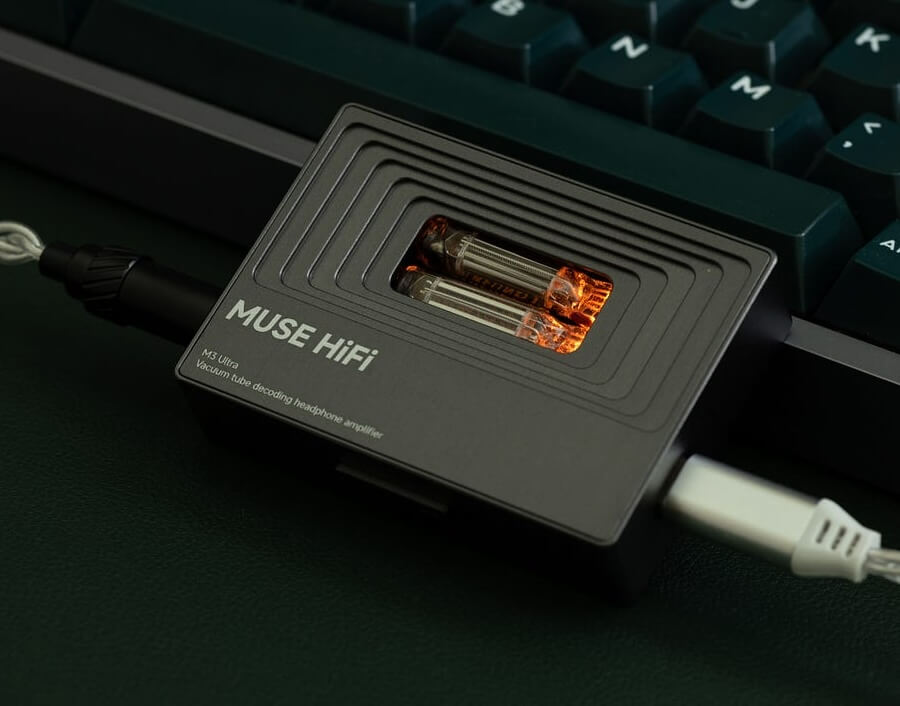
The M3 Ultra uses an aluminum chassis with what Muse HiFi describes as a “floating tube” design. A central cutout in the shell exposes the vacuum tubes, giving the device a distinctive look that immediately separates it from the usual stack of anonymous portable DAC/amps.
It is visually striking, but there is an obvious trade-off. Those tubes are not just there for show, and exposing them also makes the M3 Ultra more vulnerable to impacts, dust, and debris. It looks cool. It also means you probably should not toss it into a bag with keys, coins, and the rest of your daily-carry junk drawer.
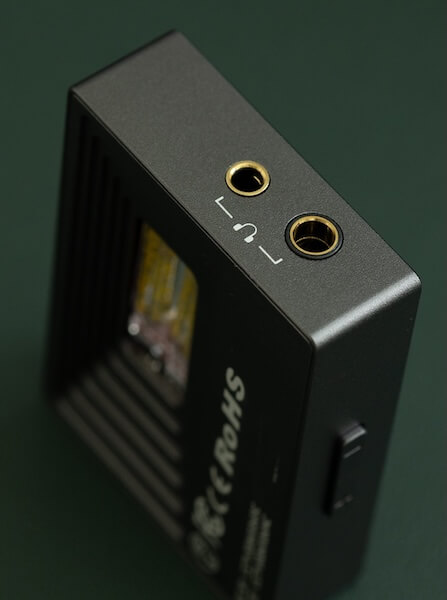
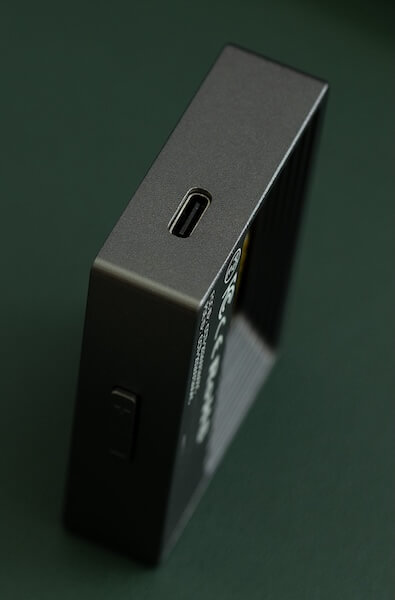
One end of the M3 Ultra’s aluminum chassis houses the USB-C input, while the opposite end features its 3.5mm and 4.4mm headphone outputs. All three connectors feel solid, with a secure fit that does not inspire the usual budget-fi anxiety.
The independent volume buttons are located along the long side of the chassis and are also machined from metal. They feel sturdy in use, although they do rattle slightly if the M3 Ultra is shaken. That is not exactly a deal-breaker, but it is one of those small fit-and-finish reminders that this is still an affordable portable DAC/amp.


The M3 Ultra includes a USB-C-to-USB-C cable, and it is actually rather good. It is not especially long, but the length is appropriate for most portable-audio use cases. I had no issues getting a stable connection with any of my devices, including a Google Pixel 10 Pro, iPad, Dell XPS 15 running Windows 11, and an M3 MacBook Pro.
That broad compatibility is a major plus, although I did notice a meaningful increase in power draw compared to some of my more modest USB-C DACs. Compact options like Apple’s USB-C dongle sip power by comparison, but they also offer far less output. Other higher-end solid-state USB-C DAC/amps, such as the Audioengine HXL, get closer to the M3 Ultra’s output capability while still benefiting from the efficiency advantages of an all-solid-state design.
Listening
The M3 Ultra pairs modern technology with a more retro presentation, delivering a warmer, more tube-like experience without many of the common irritations that come with portable analog amplifiers. Muse HiFi’s use of digital noise-cancellation algorithms and physical vibration damping gives the M3 Ultra an impressively quiet noise floor, even with sensitive IEMs like the Campfire Audio Andromeda 10. Ringing is also a non-issue, even when placing the M3 Ultra down on a table with less care than one probably should.
That combination of old-school flavor and modern execution works rather well, allowing the M3 Ultra to compete directly with contemporary solid-state DAC/amps. The built-in ES9028Q2M is a capable DAC, decoding large uncompressed audio files without any issues. Playback is dynamic and clear, creating a useful technical contrast with the amplifier stage’s fuller and more relaxed tonal balance.
The M3 Ultra preserves strong dynamic range while rendering transients cleanly and clearly. I did not hear any obvious distortion, even at higher listening levels or when driving more demanding headphones.
Pairings
Given the high-impedance nature of the M3 Ultra’s outputs, I’ve tested a few pairings with various hybrid/tribrid IEMs in my collection. The breadth of change from ~8 ohms to ~14 ohms is significant, so take that into account when selecting between the 3.5mm and 4.4mm outputs. As a general rule of thumb, the M3 Ultra’s 3.5mm output should sound warmer/thicker due to its higher impedance rating.
Xenns Mangird Top Pro


The Xenns Mangird Top Pro is a well-regarded 10-driver hybrid IEM. It features two dynamic drivers and eight balanced-armature drivers per side, connected across a four-way crossover. With a 16-ohm impedance rating, the Top Pro is a prime candidate for a tangible shift in tonality when paired with a high-impedance source like the M3 Ultra.
The Top Pro is known for sounding dry and somewhat sterile, with a lower register that is primarily focused on sub-bass. When connected to the M3 Ultra’s 4.4mm output, the Top Pro picks up a bit of weight in the lower mids, evening out its otherwise unemotional vocal presentation. Its mid-bass also fills in slightly, reducing, but not eliminating, its dry bass tonality.
Swapping from the M3 Ultra’s 4.4mm output to its 3.5mm output changes things a bit more. The Top Pro’s mids gain additional body, adding some much-needed harmonic fullness to string instrumentation and lower-pitched vocals. Its bass also fills in further, reducing its substantial mid-bass scoop to something far more manageable. In practice, this gives the Top Pro’s bass more presence and authority when rendering bass guitars and deeper string instrumentation.
While I do appreciate the increase in tonal cohesion, the Top Pro’s bass does feel slower and softer compared to how it performs with more traditional solid-state USB-C DACs.
Melody Wings Neptune


The Neptune is Melody Wings’s newest IEM and current flagship. It features a tribrid driver configuration, packing one dynamic, four balanced-armature, and one bone-conduction driver per side via a 3-way crossover. At 19 ohms, it is rated at a slightly higher impedance than the aforementioned IEMs, but not by much.
When paired with the M3 Ultra, the Neptune picks up some much-needed richness in its lower register. This manifests as a subtle improvement in lower-midrange fullness and mid-bass presence. I found the Neptune to be a bit lacking in organic tonality on transparent sources, but the M3 Ultra’s tube-ish warmth and higher output impedance tipped my scales of preference more in the Neptune’s favor.
The Neptune was never a particularly bright IEM, but the increase in weight the M3 Ultra delivers below the 400Hz mark allows it to play against its treble with greater contrast. Tracks like “Hear You Me” by Jimmy Eat World sound tangibly fuller on the M3 Ultra, giving the gentle strumming of guitar strings much more dynamic space to play in.

The Bottom Line
The Muse HiFi M3 Ultra is not trying to be the most transparent portable DAC/amp in the category, and that is really the point. Its appeal comes from the way it combines a modern USB-C DAC section, generous output power, and a tube-based amplifier stage with unusually high output impedance that can reshape the tonal balance of certain IEMs and headphones.
That will not be ideal for everyone. Listeners who want their source to disappear, or who expect every IEM in their collection to sound exactly as intended, should probably look elsewhere. The M3 Ultra has a personality, and it is not subtle about it.
For the right listener, however, that personality is the draw. The M3 Ultra can give some leaner, drier, or more clinical IEMs a fuller and more forgiving presentation, while still offering enough power for most portable headphones. Its aluminum construction feels reassuring at the price, and the exposed tube design gives it a visual identity that most portable DAC/amps lack.
The trade-offs are real. Battery drain is higher than more efficient solid-state dongles, the exposed tube section makes it less friendly for dusty, wet, or rough environments, and its tonal influence will vary depending on the earphone or headphone being used. But for listeners who want a compact source with character, strong output, and a more relaxed tonal balance, the M3 Ultra is one of the more interesting and accessible portable DAC/amps currently available.
Pros:
- Powerful output for a compact portable DAC/amp
- Distinctive tube-based presentation with a fuller, smoother tonal balance
- High output impedance can improve synergy with some leaner or drier IEMs
- Quiet noise floor, even with sensitive IEMs
- Solid aluminum construction and visually striking exposed tube design
Cons:
- Not ideal for listeners who want a transparent, neutral source
- Tonal changes will vary depending on the IEM or headphone pairing
- Higher battery drain than more efficient solid-state USB-C dongles
- Exposed tube design is more vulnerable to dust, debris, and rough handling
- 3.5mm and 4.4mm outputs sound meaningfully different because of output impedance differences
Our Ratings
★★★★★★★★★★ Sound Quality
★★★★★★★★★★ Build Quality
★★★★★★★★★★ Features
★★★★★★★★★★ Value
You must be logged in to post a comment Login