“This is just not the right pathway forward,” Isaacman said.
A senior NASA official, speaking on background to Ars, noted that the space agency has experienced hydrogen and helium leaks during both the Artemis I and Artemis II prelaunch preparations, and these problems have led to monthslong delays in launch.
“If I recall, the timing between Apollo 7 and 8 was nine weeks,” the official said. “Launching SLS every three and a half years or so is not a recipe for success. Certainly, making each one of them a work of art with some major configuration change is also not helpful in the process, and we’re clearly seeing the results of it, right?”
The goal therefore is to standardize the SLS rocket into a single configuration in order to make the rocket as reliable as possible, and launching as frequently as every 10 months. NASA will fly the SLS vehicle until there are commercial alternatives to launch crews to the moon, perhaps through Artemis V as Congress has mandated, or perhaps even a little longer.
Advertisement
Is Everyone on Board?
The NASA official said all of the agency’s key contractors are on board with the change, and senior leaders in Congress have been briefed on the proposed changes.
The biggest opposition to these proposals would seemingly come from Boeing, which is the prime contractor for the Exploration Upper Stage, a contract worth billions of dollars to develop a more powerful rocket that was due to launch for the first time later this decade. However, in a NASA news release, Boeing appeared to offer at least some support for the revised plans.
“Boeing is a proud partner to the Artemis mission and our team is honored to contribute to NASA’s vision for American space leadership,” said Steve Parker, Boeing Defense, Space & Security president and CEO, in the news release. “The SLS core stage remains the world’s most powerful rocket stage, and the only one that can carry American astronauts directly to the moon and beyond in a single launch. As NASA lays out an accelerated launch schedule, our workforce and supply chain are prepared to meet the increased production needs.”
Solid Reasons for Changing Artemis III
NASA’s new approach to Artemis reflects a return to the philosophy of the Apollo program. During the late 1960s, the space agency flew a series of preparatory crewed missions before the Apollo 11 lunar landing. These included Apollo 7 (a low-Earth-orbit test of the Apollo spacecraft), Apollo 8 (a lunar orbiting mission), Apollo 9 (a low-Earth-orbit rendezvous with the lunar lander), and Apollo 10 (a test of the lunar lander descending to the moon, without touching down).
Advertisement
With its previous Artemis template, NASA skipped the steps taken by Apollo 7, 9, and 10. In the view of many industry officials, this leap from Artemis II—a crewed lunar flyby of the moon testing only the SLS rocket and Orion spacecraft—to Artemis III and a full-on lunar landing was enormous and risky.
The Artemis II crew rehearse a walkout from the Neil A. Armstrong Operations and Checkout Building at NASA’s Kennedy Space Center.Photograph: Joe Raedle/Getty Images
The Xiaomi 17 Ultra is an excellent all-rounder with incredible cameras, speedy performance, an excellent screen and speakers, solid battery life, and speedy charging. There’s something for everyone here, but photographers are sure to love it the most.
Brilliant cameras
Lightning quick
Great display and speakers
Not so good for macro photography
On the pricey side
Squirrel Widget
Key Features
Top-of-the-line cameras
With three 50MP cameras, including a 1-inch main camera and an innovative new spin on the 200MP telephoto, the Xiaomi 17 Ultra’s camera system is second to none.
A real optical zoom
Advertisement
Rather than relying on two separate telephoto cameras, the Xiaomi 17 Ultra sports a real optical zoom that can mechanically shift from 3.2x to 4.3x.
Super speedy
With the latest flagship Qualcomm silicon at its core, the Xiaomi 17 Ultra is one of the fastest phones around. Whether you’re interested in gaming or productivity, this handset has the muscle for it.
Introduction
Xiaomi’s top-of-the-line camera-focused flagship for 2026 has finally arrived. It’s time to get acquainted with Xiaomi 17 Ultra.
Advertisement
To save any confusion, you haven’t missed anything. Xiaomi decided to skip 16 and jump straight to 17 for this series. It seems the brand finally got tired of Apple having the larger model number.
Other than the naming oddity, the Xiaomi 17 Ultra brings with it plenty of goodies. There’s a brand new optical zoom and selfie camera, an improved screen, the latest Snapdragon chip, and a bigger battery.
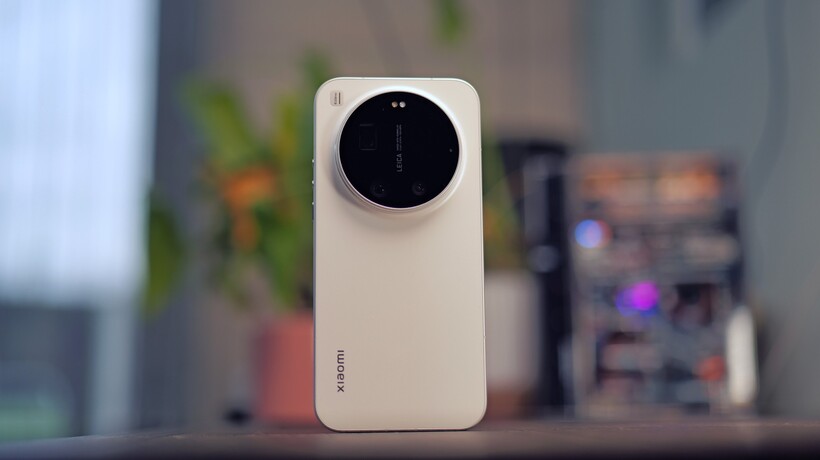
The Xiaomi 17 Ultra doesn’t look too dissimilar to its predecessor. The overall shape is similar, and you still get the same large centrally-placed camera hob on the rear panel.
Image Credit (Trusted Reviews)
What’s changed this time, though, is that it’s much less curvy. The micro curves on the edge of the display and rear panel are both gone, replaced with completely flat panels. This is great when it comes to screen-protector compatibility, and I think I prefer it generally speaking, but some are sure to miss those curves.
Advertisement
It’s a sizable and fairly weighty device, but this is an “Ultra” after all, and that tends to come with the territory. It’s less than 2 grams heavier than its predecessor, and while that was no featherweight, I appreciate that it hasn’t bulked up further.
Image Credit (Trusted Reviews)
This time around, the IP rating has been bumped up to dual IP68/IP69K, rather than just IP68. Supposedly, it can now withstand immersion at up to 6m for 30 mins, rather than just 1.5m. It’s also immune to blasts from jets of hot water, which could prove useful for hot tub-related mishaps.
The Xiaomi 17 Ultra comes with a basic clear case in the box, but it’s not the usual flexible TPU number. This one’s much more rigid and shouldn’t turn yellow quite as readily. I suspect scuffs might be an issue in the long term, though.
Image Credit (Trusted Reviews)
Unlike some rivals, there are no extra buttons on the Xiaomi 17 Ultra, just the usual power button and volume combo. However, that changes if you spring for the Leica LeitzPhone edition, which adds a rotary control around the camera island that can be used to control your zoom.
Advertisement
Advertisement
I have the standard model in for testing, so I can’t speak to how well this control wheel works. In theory, it seems like a great idea, but in practice, I can imagine it being quite easy to knock it accidentally.
The Xiaomi 17 Ultra is available in three colours for the global market: black, white, or green. I have the white model in for testing, and it’s rather understated, with a uniform matt finish on the rear and matt aluminium side rails. The black model takes a similar approach, only with dark colour-matched side rails and a subtle red ring around the camera housing.
Image Credit (Trusted Reviews)
If you want to make a statement, though, you’ll certainly want to check out the green model. It has a flecked finish on the rear panel that makes it stand out from the pack, and matching siderails to finish it off.
If you opt for the Leica edition, you’ll be able to choose between black and white versions, both featuring a vegan leather rear panel, two-tone detailing, and the iconic circular red Leica badge. There’s also an optional photography grip kit, which looks to be quite similar to the previous generation.
Screen
6.9-inch 120Hz 1200×2608 OLED
Flat screen, 2160Hz PWM
3500 nits peak brightness
Advertisement
The Xiaomi 17 Ultra boasts a spacious 6.9-inch OLED display with a 120Hz refresh rate and a peak brightness of 3500nits, up from 3200 on the previous model.
Advertisement
The other big change is that the panel now supports 2160Hz PWM dimming, up from 1920Hz. I’m not someone who is sensitive to flicker, so I can’t say I noticed the difference, but for some, that could be a big deal.
Image Credit (Trusted Reviews)
What made more of an impact, for me, is the change from curved edges to a fully flat display. It seems to be the general trend at the moment, and I think I’m on board. I do like the way gesture controls feel on curved displays, but the durability, lack of glare, and screen protector compatibility might make flat displays the outright winner in my eyes.
Otherwise, the screen is as fantastic as you’d expect with specs like these. The colours are vivid and accurate, it’s plenty bright enough to see outdoors, and HDR content really pops. There are plenty of options if you prefer to tweak the colour balance, too, but I was fine with the default settings.
Image Credit (Trusted Reviews)
Advertisement
Cameras
50MP main camera (1-inch sensor)
50MP ultrawide (1/2.76-inch)
200MP 3.2x – 4.3x telephoto (1/1.4-inch sensor)
50MP selfie camera (AF)
Xiaomi has shaken things up in the camera department. Instead of four separate sensors on the rear, you now get three. Rather than two separate periscope telephotos, you now get a single 200MP unit that can optically zoom between 3.2x and 4.3x.
Image Credit (Trusted Reviews)
We’ve seen similar tech from Sony and its Xperia flagships, but the difference here is with the sensor size and resolution. This zoom camera has a massive 1/1.4-inch sensor and a 200MP resolution, matching the likes of the Vivo X300 Pro and Honor Magic 8 Pro.
It’s super impressive technology, but I was a little disappointed when I realised how small the zoom range is. In full-frame terms, you can zoom from 75mm to 100mm, and honestly, that’s not a dramatic difference in framing.
Advertisement
Advertisement
Beyond that, you’ll be digitally cropping, but a combination of the extremely high-res sensor and very clever image processing means that you get shockingly good results when doing so.
What I found really disappointing, though, were the telemacro capabilities. This optical zoom configuration means that the Xiaomi 17 Ultra telephoto can’t focus as close as the Xiaomi 15 Ultra could – and it lags behind the rivals like the Magic 8 Pro and X300 Pro, too. You can still get decent macro shots, but you’ll need to digitally crop more to achieve the results, whereas with the previous model, you could just get closer.
Aside from the new telephoto setup, the main camera and ultrawide have similar specifications to their predecessors. That’s no bad thing, as they both produce fantastic results. Especially the main camera, which excels in low-light conditions and produces lovely bokeh with its 1-inch type sensor.
Around the front, the selfie camera has been upgraded, too. It’s now 50MP, up from 32MP, and it has a larger sensor, which makes it more usable in dim conditions. Selfies on this phone are sharp, detailed, and have excellent dynamic range.
Advertisement
Advertisement
Overall, I have been really pleased with the images I was able to take with the Xiaomi 17 Ultra. It feels like Xiaomi has refined its image processing with this generation, and I’m no longer seeing the slight overexposure or heavy-handed sharpening that I normally associate with the brand. Images from this phone look wonderfully natural, more like what I would expect from a professional mirrorless camera.
Video performance is also excellent. You can shoot at up to 4K 120fps on both the main and telephoto cameras, while the selfie camera and ultrawide shoot at up to 4K 60fps. There’s a very decent Log profile, and the ability to record in Dolby Vision HDR, too.
I have no doubts that this is one of the best smartphone camera systems on the market right now. Whether it’s portraits, sports, landscapes, or long-range zooms, you name it, the 17 Ultra can hang with the best. It’s really only the lack of telemacro capabilities that holds this phone back – and how much that matters will depend on what you like to shoot.
Advertisement
Accessories
Slimmed-down Photography Kit
Full-featured Photography Kit Pro
Tactile buttons, Wirst Strap, and 67mm filters compatibility
Xiaomi’s Ultra phones have come with optional photography grips for the last few years, so it’s not too surprising that Xiaomi has released anequivalent accessory for the 17 Ultra. What surprised me, though, is that there are now two different kits to choose from.
Advertisement
The design that we’re most familiar with, featuring a removable battery grip and separate phone case is now called the Photography Kit Pro, while the standard Photography Kit is a much slimmer all-in-one package.
Image Credit (Trusted Reviews)
Starting with the new addition, it’s basically a phone case with a sculpted grip towards the base. It has a two-stage shutter button and a video record button, and it connects to the phone via Bluetooth. There’s a built-in battery, but that’s only to power the Bluetooth buttons; it doesn’t charge the phone itself.
The video record button can be programmed to activate almost anything within the camera app, but the shutter button is limited to single photo or burst mode. It’s a two-stage button, though, so you can half-press to focus before taking your shot.
Image Credit (Trusted Reviews)
The styling is similar to the Leica edition phones, with a two-tone textured vegan leather lower and smooth upper. It looks great, in my opinion, but it’s not as functional as the Pro grip. For instance, you can’t attach filters over the lenses, and there’s no way to access the control ring on Leica edition handsets.
Advertisement
Advertisement
Other than some aesthetic tweaks, the Pro grip functions almost identically to the last few generations, incorporating a 2000mAh battery that charges the phone in use, as well as a tactile shutter button, video button, zoom rocker, and control dial.
Image Credit (Trusted Reviews)
What’s new this time, though, is that the case has MagSafe-compatible magnets built in (and it works with Qi chargers). There’s also a clever new 67mm filter mounting ring that rotates, so you can add something like an ND filter or a mist filter, and still be able to use the zoom ring on Leica edition phones.
Image Credit (Trusted Reviews)
The Pro kit is definitely superior in terms of functionality, but if you never use filters, and you want something cheaper and more compact, it’s really nice that Xiaomi is providing an additional option.
Performance
Qualcomm Snapdragon 8 Elite Gen 5
12GB/16GB RAM, 512GB/1TB storage
Dual stereo speakers
Advertisement
The Xiaomi 17 Ultra has Qualcomm’s latest and greatest flagship SoC at its core, the Snapdragon 8 Elite Gen 5, along with either 12GB or 16GB of RAM and 512GB or 1TB of storage. I’m testing the 16GB+512GB version.
As you might expect, with specs like these, the Xiaomi 17 Ultra is a bit of a rocket. Whether you want to edit complex videos, run AI models, or play the most graphically demanding games, this phone will take it in its stride.
Image Credit (Trusted Reviews)
I played a couple of hours of Genshin Impact with the settings maxed out, and of course, the Xiaomi 17 Ultra took it in its stride. After a good 45 minutes of playing, the phone barely heated up, and there wasn’t a frame drop in sight. This phone clearly has a very impressive cooling system on the inside.
There’s a fairly full-featured game overlay built in, too. You can use it to boost performance, block notifications, lock your screen brightness, and even open messaging apps as a floating window.
Advertisement
The speakers on this phone are also very impressive. The bass is much stronger than that of most Android flagships, and it’s more controlled and less boomy than the Honor Magic 8 Pro. There’s plenty of detail and a decent stereo effect, too.
Advertisement
Software & AI
HyperOS 3, based on Android 16
4 OS upgrades, 6 years of security patches
Loads of AI features
The 17 Ultra runs HyperOS 3, Xiaomi’s latest custom software built on top of Android 16. Functionally, it’s very similar to HyperOS 2, but this version comes with some significant aesthetic changes, and the iOS influence is more apparent than ever.
Image Credit (Trusted Reviews)
There are some very iOS-looking lock screen options, including the ability to have a massive clock, depth effects, so that the clock interacts with your wallpaper, and even the ability to animate your wallpaper with generative AI.
Image Credit (Trusted Reviews)
There’s also a fresh new Dynamic Island clone, which Xiaomi calls Hyper Island. It’s nothing particularly creative or new, but it’s super handy. Personally, I love having a way to quickly access the music that’s playing, my timers, or navigation.
Advertisement
Of course, there are plenty of AI features littered throughout the system, including the usual translation tools and writing assistance. One that I found particularly handy is the ability to add AI-generated subtitles to anything you’re watching, regardless of the app it’s playing in.
Advertisement
Image Credit (Trusted Reviews)
There are plenty of AI features for photo editing, too, and they all work quite well. There’s outpainting, which I always find useful, as well as object removal and the ability to add background blur to a photo without having to have shot it in Portrait mode.
Xiaomi is promising 4 major OS upgrades and 6 years of security patches for this model. It fails to match the likes of Google and Samsung, but it’s not a bad commitment.
Battery life
6000mAh battery
90W wired charging
50W wireless charging
The battery situation with the Xiaomi 17 Ultra is a bit of a strange one. The global model gets a 6000mAh cell, which is a healthy increase over last year’s 5410mAh battery, but pales in comparison to the Chinese version of this phone, which gets a 6800mAh battery.
Advertisement
Image Credit (Trusted Reviews)
There’s nothing too strange about that; shipping regulations in Europe often mean the global versions of Chinese phones have their batteries nerfed. What makes this so peculiar, though, is that the global version of the smaller and cheaper Xiaomi 17 sports a larger 6300 mAh battery.
Regardless, for my needs, the battery life of the Xiaomi 17 Ultra has been more than sufficient. It’ll get me through the day with ease. I’ll usually end the day with around 30% or more remaining, but it’s not a two-dayer like the Oppo Find X9 Pro is.
Image Credit (Trusted Reviews)
When it comes to charging, the Xiaomi 17 Ultra is lightning quick. It supports up to 90W speeds with a wire and 50W wirelessly. There’s no charger in the box, though, so you’ll need to budget for an appropriately quick wall adapter.
I found that just 30 minutes on the charger would take me well over 60% charged, while a full charge took just over an hour. I should note, though, that I was using a third-party charger; it may be even quicker using an official Xiaomi adapter.
Advertisement
Advertisement
Squirrel Widget
Should you buy it?
You want one of the best camera phones around
The Xiaomi 17 Ultra is pretty great at everything, but the cameras steal the show. If you’re looking for a device that blurs the lines between smartphone and professional camera, look no further.
Advertisement
You love macro photography
Advertisement
The only letdown with this camera system is that the telephoto isn’t as good for close-up shots. It’s still decent, but the competition fares better in this area.
Final Thoughts
The Xiaomi 17 Ultra is a well-rounded flagship that has something to offer in every area. Whether you’re looking for high-end gaming performance, a superb screen and speakers, solid battery life and speedy charging, or an incredible camera system, the 17 Ultra has you covered.
Advertisement
It’s really those who are into photography and videomaking that will enjoy this phone the most, though. The camera system is truly excellent, and at times, this feels more like a camera than a phone.
Of course, no product is perfect, and there are a few areas where Xiaomi is bested by the competition. For instance, both the Oppo Find X9 Pro and Honor Magic 8 Pro have better battery life (in my experience), and they’re better for macro photography, too.
But does that mean they’re better choices? Not necessarily. Xiaomi’s image processing and filter selection mean I often prefer the shots from the 17 Ultra, and it has plenty to offer elsewhere, too. One thing’s for certain, this is among the best camera phones available right now.
How We Test
We test every mobile phone we review thoroughly. We use industry-standard tests to compare features properly and we use the phone as our main device over the review period. We’ll always tell you what we find and we never, ever, accept money to review a product.
Advertisement
Used as a main phone for over a week
Thorough camera testing in a variety of conditions
Tested and benchmarked using respected industry tests and real-world data
FAQs
Does the Xiaomi 17 Ultra support eSIM?
Yes, the global version of the Xiaomi 17 Ultra has full eSIM support.
Does the global version of the Xiaomi 17 Ultra have a smaller battery?
Yes, the global version has a 6000mAh battery, rather than a 6800mAh battery.
Xiaomi has officially unveiled the Xiaomi Pad 8 Pro, and it’s immediately clear that this is the company’s boldest attempt yet to compete with the iPad Pro. With a design unmistakably inspired by Apple’s premium tablet and a strong focus on keyboard-centric productivity, Xiaomi is signalling that the Android tablet segment is ready to take pro-level computing more seriously.
At the core of the Xiaomi Pad 8 Pro is the Snapdragon 8 Elite platform
A chipset that brings the kind of performance usually reserved for high-end smartphones and some laptops. This makes the tablet capable of handling demanding apps, complex multitasking, heavy design workloads, and high-frame-rate gaming without hesitation. HyperOS provides the accompanying software layer, giving the interface a level of speed and fluidity that matches the hardware’s ambitions.
The display is an immediate standout. The 3.2K resolution combined with a 144Hz refresh rate creates a fluid and visually rich experience that supports everything from entertainment and reading to design work and motion graphics. The screen’s brightness and color accuracy further elevate its appeal for artists, students, and professionals who depend on visual clarity. Powering this is a 9,200mAh battery that provides enough endurance for long working hours, extended travel use, and continuous content consumption without frequent recharging.
A keyboard and stylus that reshape how the tablet is used
What makes the Xiaomi Pad 8 Pro a genuine iPad Pro challenger is not just its hardware but the ecosystem around it. Xiaomi’s new magnetic keyboard case turns the tablet into a laptop-style machine, complete with a comfortable key layout and a responsive touchpad. This accessory transforms the character of the tablet, allowing it to handle more serious tasks such as long writing sessions, office work, productivity apps, and messaging with far greater ease.
Advertisement
Alongside the keyboard is the Xiaomi Focus Pen Pro, which introduces low-latency writing, improved pressure sensitivity, and more natural tilt recognition. Together, these enhancements make the stylus feel accurate and responsive, enabling everything from precise sketching and illustration to handwriting and markup work. This combination of tools positions the Pad 8 Pro as a versatile device that can shift between creative expression and productivity without effort.
A meaningful shift in the premium tablet landscape
The Pad 8 Pro arrives at a time when Android tablets are rapidly evolving. For years, the premium space has been dominated by Apple, but Xiaomi’s approach shows that an Android tablet can offer a polished, pro-grade experience if the company commits to performance, display quality, and accessory support. Users who prefer Android now have an option that does not force compromise and integrates smoothly with their existing ecosystem of phones, wearables, and laptops.
The tablet’s appeal extends further to students, hybrid workers, and creators. Anyone who wants a powerful but portable device will find the Pad 8 Pro compelling because it merges laptop-like typing, stylus precision, fast processing, and an immersive display in one device. It also serves as an option for users who want more openness and flexibility than what Apple’s closed ecosystem offers.
Cross-device integration is the future
Xiaomi’s direction with the Pad 8 Pro suggests a future where its tablets will receive deeper cross-device integration and more productivity-oriented features within HyperOS. As the company continues refining its ecosystem, the Pad 8 Pro stands as one of the clearest signals that Android tablets are entering a new era—one where performance, accessories, and software all work together to create a true alternative to the iPad Pro.
Someone jumped at the opportunity to steal $4.4 million in crypto assets after South Korea’s National Tax Service exposed publicly the mnemonic recovery phrase of a seized cryptocurrency wallet.
The funds were stored in a Ledger cold wallet seized in law enforcement raids at 124 high-value tax evaders that resulted in confiscating digital assets worth 8.1 billion won (currently approximately $5.6 million).
When announcing the success of the operation, the agency released photos of a Ledger device, a popular hardware wallet for crypto storage and management.
However, the images also showed a handwritten note of the wallet recovery phrase, which serves as the master key that allows restoring the assets to another device.
Images released by the South Korean tax authority Source: mk.co.kr
The authorities failed to redact that info, allowing anyone to transfer into their account the assets in the cold wallet.
Reportedly, shortly after the press release was published, 4 million Pre-Retogeum (PRTG) tokens, worth approximately $4.8 million at the time, were transferred out of the confiscated wallet to a new address.
Advertisement
“On-chain data (Etherscan) analysis shows that the attacker first deposited a small amount of Ethereum (ETH) into the wallet to pay transaction fees (gas fees), and then meticulously transferred the 4 million PRTG tokens to their own wallet in three separate transactions,” reports Korean media.
Blockchain data analysis expert Cho Jae-woo, a professor at Hansung University in Seoul who observed the transfer, commented on the authorities’ blunder by comparing it to leaving a wallet open and advertising it to the entire nation for people to take the money.
The professor attributed the mistake to the tax authorities’ “lack of basic understanding of virtual assets,” which effectively cost the national treasury tens of billions of won that had been successfully confiscated.
The press release has now been removed from the NTS website, and it is unclear if authorities started an investigation to determine where the stolen funds ended.
Advertisement
The case is a reminder for hardware wallet owners that their seed phrase gives complete access to their wallet without any additional protections. Anyone who has it can recreate the wallet anywhere without their device, PIN, or permission.
It is recommended to avoid digitizing seed phrases, store them in electronic notes, photos, in email messages, cloud storage, or send them over messaging apps. If a seed is exposed, all funds should be moved to a new wallet as soon as possible.
Modern IT infrastructure moves faster than manual workflows can handle.
In this new Tines guide, learn how your team can reduce hidden manual delays, improve reliability through automated response, and build and scale intelligent workflows on top of tools you already use.
Watch Knights vs Cowboys live streams as the NRL 2026 season kicks off with a Newcastle vs North Queensland banger from Allegiant Stadium in first of the season-opening Rugby League Las Vegas games. Plenty has changed in the off-season, too, with Kiwi star Dylan Brown joining the former, and Tom Chester returning for the latter after a serious knee injury.
After propping up the ladder last year, the Knights also have a new coach for the 2026 campaign, with Justin Holbrook coming in to take change. Talismanic five-eighth Sandon Smith has arrived from the Roosters, with fellow newbie Brown set to form a tantalizing halfback pairing with fit-again Fletcher Sharpe. Star fullback Kalyn Ponga is also raring to go after recovering from a foot injury to feature in what will be his first game since Round 17 last year.
After a disappointing 2025 in which they failed to reach the finals series, the Cowboys will be delighted to welcome back second-rower Heilum Luki for his first NRL game since the 2024 finals following an ACL injury before the start of last term. Luki joins young gun Chester in recovering from the serious knee injury to return to the North Queensland lineup, with the latter replacing the suspended Zac Laybutt in the centers. Hooker Reed Mahoney will make his debut after arriving in the off-season from the Bulldogs.
The Knights haven’t beaten the Cowboys since 2021 – can they bag an early upset? Here’s where to watch Knights vs Cowboys NRL 2026 live streams online from anywhere – including options to watch with 7-day FREE trials!
Advertisement
Can I watch Knights vs Cowboys for free?
Three NRL games are on free-to-air Channel 9 and 9Now in Australia during each week of the regular season, but unfortunately season opener Knights vs Cowboys isn’t one of them.
Use a VPN to watch Knights vs Cowboys from anywhere
This handy piece of software can make your device appear as if it’s back in your home country and let you watch your usual streaming services. The best VPN right now? We recommend NordVPN – it does everything and comes with a 74% discount and a free Amazon Gift Card.
Advertisement
Using a VPN is incredibly simple:
1. Install the VPN of your choice. As we’ve said, NordVPN is our favorite.
2. Choose the location you wish to connect to in the VPN app. For instance, if you’re visiting the US and want to view your usual Australian service, you’d select a server in Australia from the list.
3. Sit back and enjoy the action. Head to your usual local streaming service and watch the footy.
Advertisement
How to watch Knights vs Cowboys live streams in the US
In the US, three NRL games are shown on Fox Sport each week during the regular season, plus the entirety of the State of Origin and Finals Series. Knights vs Cowboys will be on FS2.
Cord cutters will be able to watch on the network’s Fox One streaming platform, which costs from $19.99 a month after a 7-day free trial. Or go for a full OTT cable replacement service such as Sling TV (in selected cities), Fubo, YouTube TV and Hulu + Live TV.
Only bothered about the rugby? You can see every single game on the dedicated Watch NRL streaming platform, from $20 per week.
Advertisement
If you’re traveling outside of the US, you can make use of NordVPN to catch the action on any of the above services.
How to watch Knights vs Cowboys live streams in Canada
NRL 2026 coverage goes out on Sportsnet in Canada, with three matches per week, State of Origin and Finals Series. Knights vs Cowboys is one of them.
That means you can also watch online thanks to its Sportsnet+ streaming service (from $29.99 a month / $249.99 a year). And the Watch NRL platform will show every single fixture.
Advertisement
If you already subscribe to these services but find yourself outside Canada, download a VPN and watch NRL games as if you were back at home.
How to watch Knights vs Cowboys live streams in the UK
NRL 2026 action, including Knights vs Cowboys, is covered bySky Sports in the UK. Its channels will show three games per week, together with all Final Series, State of Origin and Grand Final matches.
Knights vs Cowboys will be shown on Sky Sports Action.
Advertisement
Sky Sports packages start from £22 per month or you can get a more flexible Now Sports membership starting from £14.99 for a day pass.
Alternatively, die-hard fans might want to check out Watch NRL, which costs £16 a week, £39 a month month or £143 for the whole season and will unlock access to every single NRL game of the 2026 season.
Outside the UK? You’ll might need to download a VPN, as detailed above, to watch your usual stream from abroad.
Advertisement
How to watch Knights vs Cowboys live streams in Australia
As mentioned above, Knights vs Cowboys isn’t one of the three NRL games per week are on free-to-air Channel 9 in Australia.
Don’t worry, though, because every single NRL 2026 game will be shown on Fox League via Foxtel. Kayo Sports, meanwhile, is a much more cost-efficient option, with plans starting from $30 a month after you’ve taken advantage of its first month for $1 offer or 7-day free trial.
If you’re currently out of Australia but want to watch Knights vs Cowboys live streams, you’ll need to get yourself a VPN, as per the instructions above.
Advertisement
How to watch Knights vs Cowboys live streams in New Zealand
Sky Sport NZ is the NRL rights holder in New Zealand, with Knights vs Cowboys set to be shown.
You can access Sky Sport through satellite TV or get a live stream with the Sky Sport Now subscription service starting at $29.99 per day or $54.99 per month.
Overseas? NordVPN will give you access to your home streaming service.
Advertisement
How to watch NRL 2026 live streams in Rest of World
Every single match of the 2026 NRL Premiership season, including Knights vs Cowboys, will be shown on the dedicated Watch NRL streaming platform, which is available in all territories except for Australia, New Zealand, the Pacific Islands and other selected sanctioned jurisdictions (e.g. Russia, Belarus, Cuba, Iran, North Korea).
Subscriptions cost $20 per week, $39 per month or $182 for a whole year. Check the website for pricing in your region.
Many countries also show games on TV and online through their domestic broadcasters:
Advertisement
How to watch Knights vs Cowboys – FAQ
What is the date and time of Knights vs Cowboys?
📅 Saturday, February 28
Knights vs Cowboys | 9.15pm ET / 6.15pm PT (local time) / 2.15am GMT (Sunday) / 1:15pm (Sunday) AEDT Allegiant Stadium, Las Vegas, Nevada 📺 7-day FREE trials –Fox One (US) / Fox Sports via Kayo Sports (AUS)
Can I watch Knights vs Cowboys on my mobile?
The vast majority of broadcasters mentioned in this article have streaming services that you can access through mobile apps or via your phone’s browser. For example, Watch NRL, 9Now, Fox One and Sky Go all have mobile apps.
You can also stay up-to-date with the latest NRL news on the official social media channels on X (@NRL), Instagram (nrl), Facebook (NRL) TikTok (@nrl) and YouTube (@NRL).
Advertisement
We test and review VPN services in the context of legal recreational uses. For example: 1. Accessing a service from another country (subject to the terms and conditions of that service). 2. Protecting your online security and strengthening your online privacy when abroad. We do not support or condone the illegal or malicious use of VPN services. Consuming pirated content that is paid-for is neither endorsed nor approved by Future Publishing.
Who would’ve guessed we’d get to play the original Banjo-Kazooie on a handheld with just a D-pad in 2026. HyperMegaTech!’s latest release is a collaboration with Rare Ltd., the legendary game developer known for the Banjo-Kazooie franchise and, more recently, Sea of Thieves, called the Super Pocket Rare Edition.
The vertical handheld features 14 classics from the British developer, including two Battletoads titles, Conker’s Pocket Tales and many more. While most of the games were released on 8- or 16-bit consoles, Banjo-Kazooie will be the headliner since it was originally released on the Nintendo 64. It may sound weird to control Banjo and Kazooie with a D-pad, but HyperMegaTech! assured that the game has been enhanced and optimized specifically for the Super Pocket handheld.
Since HyperMegaTech! and Evercade share Blaze Entertainment as a parent company, that means the Rare Edition handheld will be compatible with Evercade cartridges. Once you’re done with the 14 included games, you can expand your Super Pocket’s library with cartridges that feature collections from Taito, NeoGeo or Atari. HyperMegaTech! said the Rare Edition handheld will be available for $69.99 in June 2026, but has already opened preorders.
The new MotoGP season kicks into gear this weekend, with familiar rivalries set to be renewed and a number of exciting new riders joining the grid.
Advertisement
Spanish star Marc Márquez clinched last season’s Riders’ Championship at the Japanese Grand Prix with five races to spare, but the Ducati star’s recovery from a shoulder injury that ended his season early last term could factor into the new season’s opening races.
The biggest storyline of the new season might be the brotherly rivalry between Márquez and his younger sibling. Álex Márquez will be looking to build on his runner-up showing last term with Gresini Racing, while there are high hopes for Turkish three-time WorldSBK champion Toprak Razgatlıoğlu as he joins Pramac Yamaha alongside Aussie star Jack Miller.
The new season sees some significant changes to the calendar, with Brazil making a long-awaited return to the schedule, replacing Argentina as the second round, while the stop off at Silverstone in the UK has moved from May back to its traditional August slot.
A full list of Grand Prix for the 2026 season can be found at the bottom of this page. Check Fox Sports for race times.
Advertisement
Marc Márquez finished his superb 2025 MotoGP championship-winning season early due to a fractured right collarbone and ligament injury sustained at the Indonesian Grand Prix.
Alessandro Giberti/Anadolu/Getty Images
How to watch the 2026 MotoGP Season online from anywhere using a VPN
If you can’t view the races locally, you may need a different way to watch this match; this is where a VPN can come in handy. A VPN is also the best way to stop your ISP from throttling your speeds on game day by encrypting your traffic. It’s also a great idea if you’re traveling and find yourself connected to a Wi-Fi network and want to add an extra layer of privacy for your devices and logins.
Advertisement
With a VPN, you can virtually change your location on your phone, tablet or laptop to get access to the game. Most VPNs, like our Editors’ Choice, ExpressVPN, make it really easy to do this.
Using a VPN to watch or stream sports is legal in any country where VPNs are legal, including the US, UK and Australia, as long as you have a legitimate subscription to the service you’re streaming. You should be sure your VPN is set up correctly to prevent leaks: Even where VPNs are legal, the streaming service may terminate the account of anyone it deems to be circumventing correctly applied blackout restrictions.
Looking for other options? Be sure to check out some of the other great VPN deals taking place right now.
Price $13 per month, $75 for the first year or $98 total for the first two years (one- and two-year plans renew at $100 per year)Latest Tests No DNS leaks detected, 18% speed loss in 2025 testsJurisdiction British Virgin IslandsNetwork 3,000 plus servers in 105 countries
ExpressVPN is our best VPN pick for people who want a reliable and safe VPN that works on a variety of devices. Prices start at $3.49 a month on a two-year plan for the Basic tier. Note that ExpressVPN offers a 30-day money-back guarantee.
Advertisement
73% off with 2yr plan (+4 free months). Now only $3.49/month
Livestream the 2026 MotoGP season in the US
Fox Sports is set to show every grand prix and every sprint race this season. Coverage will span across Fox Sports 1 and Fox Sports 2, with every race set to be available to watch on the Fox Sports app.
Both channels are available on most of the major live TV streaming services. The least expensive service is Sling TV Blue.
Advertisement
Sling/CNET
Sling TV’s Blue plan includes FS1, while its Sports Extra add-on includes FS2. Enter your address here to see which local channels are available where you live.
The Bue plan currently costs $46 per month, while adding the Sports Extra package is an additional $11 per month.
Advertisement
Numerous other live TV streaming services carry Fox stations as well, namely YouTube TV, Hulu Plus Live TV, and Fubo. They all cost far more than Sling, but they also carry a full complement of live channels. Check out our live TV streaming services guide for details.
Sarah Tew/CNET
For $65 a month, YouTube TV’s Sports Plan gives access to FS1 as well as FS2. Plug in your ZIP code on YouTube TV’s welcome page to see which local networks are available in your area. YouTube TV’s genre plans are slowly rolling out and are not yet available in all areas. If that’s you, it’s $83 monthly for the full service package.
Advertisement
Fubo
Fubo Sports plus News package costs $46 for the first month and $56 thereafter and includes FS1 and FS2. Click here to see which local channels you get in your region with Fubo. Read our Fubo review.
Hulu Plus Live TV includes Carries FS1 and FS2 in most markets. On its live news page, you can enter your ZIP code under the “Can I watch local news in my area?” question at the bottom of the page to see which local channels you get. Read our Hulu with Live TV review.
All the live TV streaming services above offer free trials, allow you to cancel anytime and require a solid internet connection. Looking for more information? Check out our live TV streaming services guide.
Watch the 2026 MotoGP season in the UK
Motorsports fans in the UK can watch the MotoGP season unfold on TNT Sports, which has live broadcasting rights in the UK.
Advertisement
TNT Sports
TNT Sports will be broadcasting every race of the 2026 MotoGP season live. You can access TNT Sports via Sky Q as a TV package, as well as the option of streaming online. It costs £31 either way and comes in a package that includes the Discovery Plus library of documentary content.
Stream MotoGP 2026 races in Australia
MotoGP races can be watched Down Under on Fox Sports via Foxtel. If you’re not a Fox Sports subscriber, your best option is to sign up for the streaming service Kayo Sports.
Advertisement
Kayo Sports
A Kayo Sports subscription starts at AU$30 a month and lets you stream on one screen, while its Premium tier costs AU$46 a month for simultaneous viewing on up to three devices.
The service gives you access to a wide range of sports, including F1, NRL, NFL, NHL and MLB, and there are no lock-in contracts.
Advertisement
Better still, if you’re a new customer, you can take advantage of a one-week Kayo Sports free trial.
Stream the 2026 MotoGP season in Canada
If you want to stream MotoGP live in Canada, you have two options. REV TV will be broadcasting every race live on linear TV and is available via most cable operators. All races will also be broadcast live on Sportsnet.
Sportsnet
Advertisement
Sportsnet’s standalone streaming service Sportsnet Plus will be showing races live online, with a subscription starting at CA$30 for the Standard tier and CA$43 for its Premium offering.
MotoGP 2026: Full race schedule
March 1: Thailand (Chang International Circuit, Buriram)
March 22: Brazil (Autódromo Internacional Ayrton Senna, Goiânia)
March 29: Americas (Circuit of the Americas, Austin)
April 12: Qatar (Lusail International Circuit, Lusail)
April 26: Spain (Circuito de Jerez-Ángel Nieto, Jerez de la Frontera)
May 10: France (Bugatti Circuit, Le Mans)
May 17: Catalonia (Circuit de Barcelona-Catalunya, Montmeló)
May 31: Italy (Autodromo Internazionale del Mugello, Scarperia e San Piero)
June 7: Hungary (Balaton Park Circuit, Balatonfőkajár)
June 21: Czech Republic (Automotodrom Brno, Brno)
June 28: Netherlands (TT Circuit Assen, Assen)
July 12: Germany (Sachsenring, Hohenstein-Ernstthal)
Aug. 9: Great Britain (Silverstone Circuit, Silverstone)
Aug. 30: Aragón (MotorLand Aragón, Alcañiz)
Sept. 13: San Marino (Misano World Circuit Marco Simoncelli, Misano Adriatico)
Sept. 20: Austria (Red Bull Ring, Spielberg)
Oct. 4: Japan (Mobility Resort Motegi, Motegi)
Oct. 11: Indonesia (Pertamina Mandalika International Street Circuit, Mandalika)
Oct. 25: Australia (Phillip Island Grand Prix Circuit, Phillip Island)
Nov. 1: Malaysia (Sepang International Circuit, Sepang)
Nov. 15: Portugal (Autódromo Internacional do Algarve, Portimão)
The clearance puts Apple in an exclusive position – no other consumer smartphone or tablet maker has ever reached the same security threshold under the alliance’s information assurance standards. Read Entire Article Source link
The in-ceiling and in-wall speaker category isn’t some sleepy backwater anymore. Since the pandemic pushed people to rethink their living spaces, custom integration has gone from niche to mainstream and nearly every major loudspeaker brand now wants a piece of your drywall. Focal, Dynaudio, DALI, Monitor Audio, KEF, Bowers & Wilkins, MartinLogan, and Theory Audio Design all field deep architectural lineups aimed at homeowners who want serious sound without surrendering floor space.
Which makes the timing of the Q Acoustics Easyfit In-Ceiling Speaker Series less surprising and more inevitable. Q Acoustics has built its reputation on delivering legitimately good sound at prices that don’t require a second mortgage, so going deeper into custom install was only a matter of time. With Easyfit, the focus is clear: faster installation, cleaner aesthetics, and that familiar Q Acoustics house sound at price points designed to compete aggressively in a category that’s suddenly very crowded.
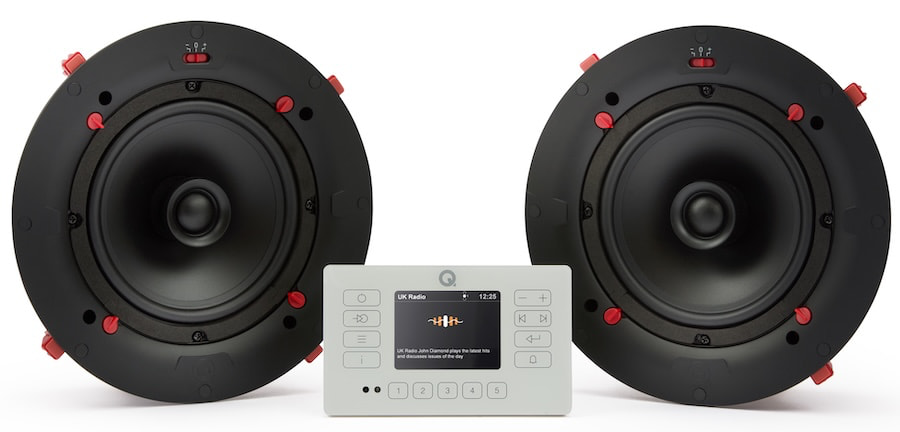
Q Acoustics QI65CE in-ceiling speakers
Easyfit Models
The Easyfit Series launches with three 6.5-inch models: the QI65CE, QI65CWE, and QI65CWE Stereo, with a larger QI80CE 8-inch in ceiling model scheduled to follow later in 2026. All four are designed to deliver wide dispersion and room filling output while remaining visually discreet, disappearing into the ceiling rather than dominating it.
What the Easyfit Ceiling Speakers Share
At the core of the new range is Q Acoustics’ Easyfit mounting system, engineered to streamline installation and eliminate much of the trial-and-error that typically comes with in ceiling speakers. The mechanism is designed to reduce time on the ladder and minimize frustration, whether you’re a professional installer or a confident DIY homeowner.
Advertisement
The Easyfit models are optimally voiced to integrate with Q Acoustics’ E50, E120, and E300A easy install amplifier systems, creating a cohesive ecosystem for distributed audio. At the same time, they remain fully compatible with third party amplification and control platforms, giving installers the flexibility they expect in today’s highly competitive custom integration market.
Q Acoustics QL65CE in-ceiling speakers
With a minimalist design and refined finish, the speakers are designed to integrate into any room in the home – delivering powerful, immersive sound without being visually distracting.
Easyfit Install Features
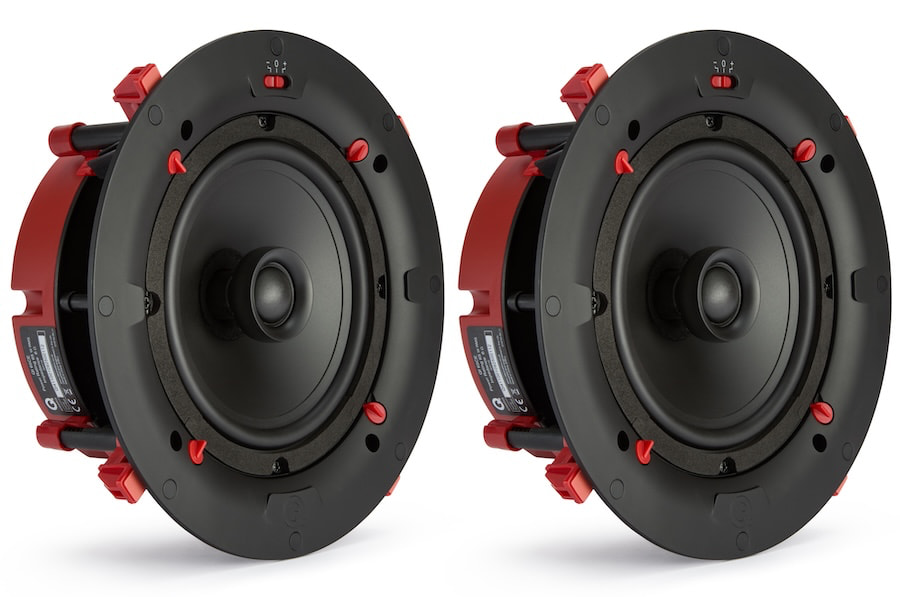
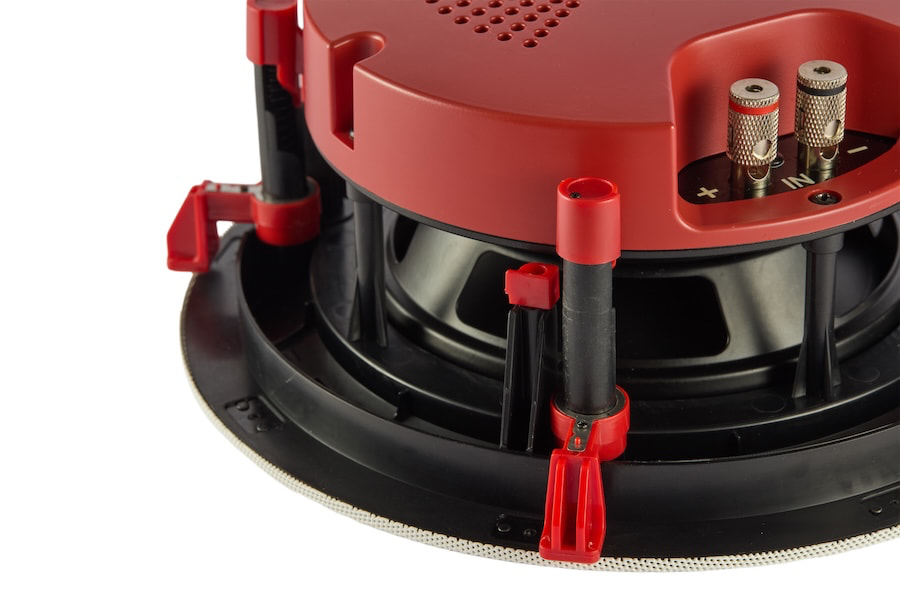
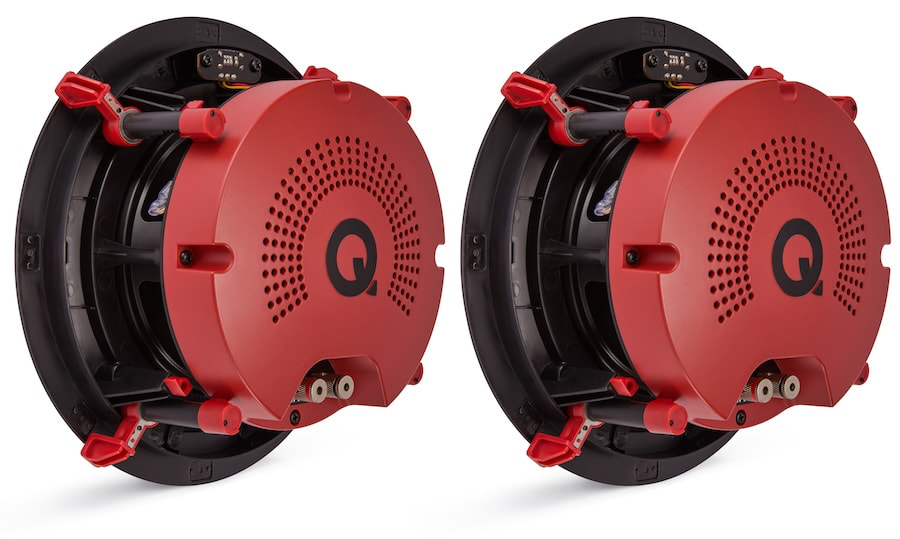
The Easyfit spring mechanism has been engineered to significantly reduce fitting time, while improving long- term reliability. By eliminating the need for power tools and traditional screw-tightened fittings, which can often strip or break over time – Easyfit offers an installer-friendly solution.
Each speaker uses four high-tension spring fixings that apply consistent pressure against plasterboard. The fixings can be primed into a locking position and, once the speaker is wired and placed into the ceiling void, the installer simply releases each catch. The springs then deploy automatically, securing the speaker firmly in place.
A screwdriver is only required for removal, using a simple push, lift, and 90-degree turn to retract the mechanism. It’s quick, reliable, and highly cost-effective.
Advertisement
The Drivers
The speaker drivers feature polypropylene mid/bass woofer cones, chosen for their excellent bass and mid-range performance, as well as their suitability for moisture-resistant applications.
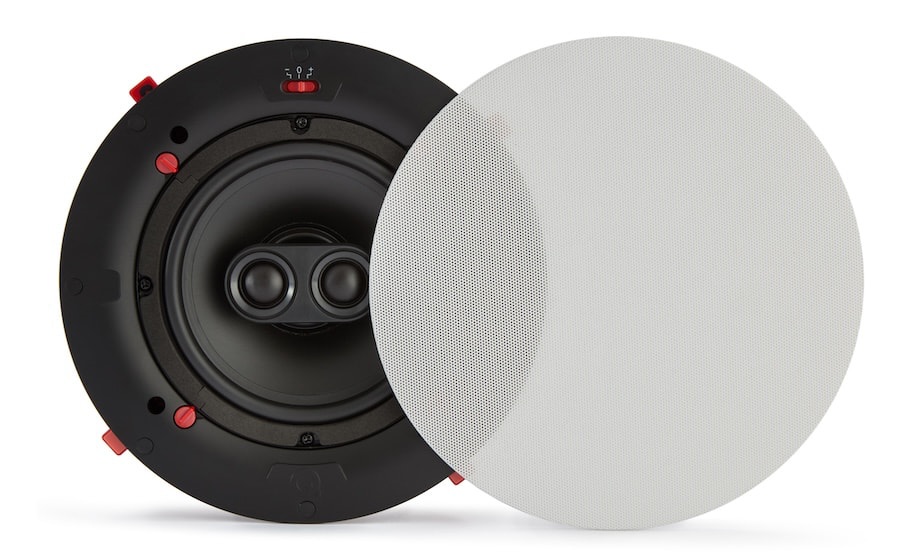
On the QI65CWE, QI80CE, and Stereo QI65CE models, the tweeter can be pivoted up to 22 degrees through 360 degrees, allowing installers to direct high frequencies towards a specific listening position for optimal clarity and detail. A high-frequency EQ switch also allows fine-tuning of the sound by ±1.5 dB to suit different rooms and preferences.
Advertisement. Scroll to continue reading.
Additional Features
For bathrooms and kitchens, the QI65CWE and QI65CWE Stereo models in the Easyfit range are IPX4 certified. This means the speakers are resistant to splashing water from any direction.
Advertisement
To further enhance durability, the grilles are zinc-plated before painting, helping to prevent corrosion in humid environments.
Every model in the Easyfit series benefits from a refined, minimalist aesthetic. The updated white finish delivers a cleaner, brighter look on the ceiling, while the inward-bent metal grille creates a seamless, low-profile appearance. The result is a speaker that virtually disappears into the room.
With the launch of the Easyfit Speaker Series, Q Acoustics continues its tradition of providing outstanding sound and intelligent design, and also combines those elements with effortless installation. Q Acoustics has an excellent reputation for designing class-leading loudspeakers, and that expertise is fully reflected in the Easyfit range.
Q Acoustics QI65CWE in-ceiling speakers
Q Acoustics Easyfit Ceiling Speakers Comparison
QI65CE
QI65CWE
QI65CWE Stereo
QI80CE
Product Type
Ceiling Speaker
Ceiling Speaker
Ceiling Speaker
Ceiling Speaker
Price
£249 / €319 (pair)
£299 / €389 (pair)
£199 / €259 (single)
349 / €449 (pair)
Tweeter
1 x 19 mm (0.75 in)
1 x 19 mm (0.75 in)
2 x 19 mm (0.75 in)
1 x 19 mm (0.75 in)
Mid-Bass
165 mm (6.5 in)
165 mm (6.5 in)
165 mm (6.5 in)
203 mm (8in)
Power Rating
65 W RMS
65 W RMS
65 W RMS
65 W RMS
Frequency response (-6 dB)
50 Hz – 34 kHz
73 Hz – 34 kHz
67 Hz – 40 kHz
N/A
Nominal impedance
8 Ω
8 Ω
8 Ω
8 Ω
Minimum impedance
6.4 Ω
6.3 Ω
6 Ω
N/A
Sensitivity (1m, 2.83 Vrms @ 1 kHz)
88 dB
88 dB
88 dB
88 dB
Crossover frequency
2.9 kHz
2.9 kHz
2.9 kHz
2.9 kHz
IPX Rating
–
IPX4
IPX4
–
Terminal
2 x 4 mm spring-loaded
2 x 4 mm spring-loaded
4 x 4 mm spring-loaded
4 x 4 mm spring-loaded
Dimensions (HWD)
242 x 242 x 106 mm (9.53 x 9.53 x 4.2 inches)
242 x 242 x 106 mm (9.53 x 9.53 x 4.2 inches)
242 x 242 x 106 mm (9.53 x 9.53 x 4.2 inches)
N/A
Cut out size
212 mm (8.35 in)
212 mm (8.35 in)
212 mm (8.35 in)
N/A
Maximum wall thickness
30 mm (1.18 in)
30 mm (1.18 in)
30 mm (1.18 in)
N/A
Weight (per speaker)
1.8 kg
1.85 kg
1.95 kg
N/A
Q Acoustics QI65CWE Stereo in-ceiling speakers
The Bottom Line
Architectural speakers are no longer an afterthought. They are a core part of modern system design, and Q Acoustics clearly understands that. The Easyfit series is built around proven polypropylene driver technology the company has used successfully in its traditional loudspeakers, which means these are not “background music only” ceiling units. Expect the familiar Q Acoustics balance: clean midrange, controlled bass, and a smooth top end that works in real rooms without drama.
The Easyfit mounting system is the practical hook, but the real story is value and performance. If Q Acoustics sticks to its usual pricing strategy, these should land at competitive, attainable price points — especially compared to some of the heavy hitters already entrenched in the category. They also make a lot of sense for home theater. Adding Easyfit models as height channels to a Q Acoustics 3000c or 5000 Series system is a clean, timbre-friendly way to build out a proper Dolby Atmos layout without cluttering the room with additional boxes.
Advertisement
U.S. pricing is still pending, but if these deliver the company’s established house sound with painless installation and sensible pricing, they’re going to be very hard to ignore in a crowded custom install market.
Price & Availability
The Q Acoustics Easyfit Speaker Series will initially be released in Europe at the end of March 2026 at the following prices:
Redditor “bmr99” spotted several Amazon pages for HP laptops advertised as including 1.2TB of storage, but they actually combine 128GB internal SSDs with free one-year OneDrive cloud storage trials. All of the examples also include dangerously low-end specs while attempting to boost interest with steep temporary discounts. Read Entire Article Source link
Charles Proteus Steinmetz was a towering figure in the early decades of electrical engineering, easily the intellectual equal of Thomas Edison and Nikola Tesla—men he considered his friends. One of Steinmetz’s most significant achievements was to quantify and characterize the phenomenon of magnetic hysteresis—the behavior of magnetism in materials—and then devise a simple law that allowed for predictable transformer and motor design. He also established a revolutionary framework for analyzing AC circuits, which is still taught today in power engineering. And from 1893, he served as chief consulting engineer at General Electric at a pivotal moment for the young company and for the U.S. effort to expand its power grid. For these and other accomplishments, he was well known in his time, even if he’s not exactly a household name today.
Steinmetz was also an evangelist for electric vehicles. In March 1920, he typed out his thoughts, comparing the pros and cons of EVs to the gasoline-propelled alternative. Among the advantages: low cost of maintenance, reliability, simplicity of operation, and lower cost of operation. The disadvantages: dependence on charging stations, limited range on a single charge, and lower speeds. More than a century later, his list remains remarkably pertinent.
Steinmetz could often be seen decked out in a suit and top hat, smoking his trademark BlackStone panatela cigar while riding around Schenectady, N.Y., in his 1914 Detroit Electric sedan. According to John Spinelli, emeritus professor of electrical and computer engineering at Union College, in Schenectady, sometimes both Steinmetz and his chauffeur sat in the backseat—you could control the car from both the front and the rear—so that it would appear to be a driverless car. With a top speed of 40 kilometers per hour (25 miles per hour), the car ran on 14 six-volt batteries and could go about 48 km between charges.
Steinmetz’s 1914 Detroit Electric car is now at Union College in Schenectady, N.Y., where Steinmetz had founded, chaired, and taught in the department of electrical engineering.Paul Buckowski/Union College
In 1971, the car was purchased by Union College, where Steinmetz had founded, chaired, and taught in the department of electrical engineering. The car had been discovered rotting in a field, so it needed some work. Over the next decade, faculty and engineering students restored it to its former glory. Still in running condition, it’s now on permanent display at the college.
Advertisement
Steinmetz’s Contributions to Electrical Engineering
Karl August Rudolf Steinmetz was born in 1865 in Breslau, Prussia (now known as Wrocław, Poland). He studied mathematics, physics, and the burgeoning field of electricity at the University of Breslau. He also joined a student socialist club and edited the party newspaper, The People’s Voice. He completed his doctoral studies, but before receiving his degree, Steinmetz fled to Switzerland in 1888, after his socialist writings came under the scrutiny of the Bismarck government.
Steinmetz immigrated to New York the following year, anglicized his first name, dropped his two middle names, and added Proteus, a nickname he had picked up at university (after the shape-shifting sea god of Greek mythology). Eventually, he became a U.S. citizen.
Charles Proteus Steinmetz solved a number of important problems that helped the power grid expand.Bettmann/Getty Images
In January 1892, Steinmetz burst onto the engineering scene when he read his paper “On the Law of Hysteresis” before the American Institute of Electrical Engineers, a forerunner of today’s IEEE. I can’t quite imagine sitting through the delivery of its 62 pages, but those assembled recognized its groundbreaking nature. The ideas Steinmetz outlined allowed engineers to calculate power losses in the magnetic components of electrical machinery during the design phase. Prior to this, the design process for transformers and electric motors was largely trial and error, and power losses could be measured only after the machine was built, which greatly added to the cost.
Steinmetz was not just an equations and theory guy, though. He loved working in the lab and building things. In 1893, General Electric acquired the small manufacturing firm of Eickemeyer & Osterheld, in Yonkers, N.Y., where Steinmetz had worked since shortly after his arrival in the United States. So Steinmetz began his new life as a corporate engineer, an interesting turn for the socialist. During his first few years with GE, he mostly designed generators and transformers. But he also created an informal position for himself as a consultant, giving expert opinions on various problems across divisions. He eventually formalized this role, becoming GE’s chief consulting engineer, and he maintained a relationship with the company for the rest of his life, even after joining the faculty of Union College in 1902.
Advertisement
By the time Steinmetz died in 1923 at the age of 58, he had been granted more than 200 patents and had made major contributions to various subfields in electrical engineering, including phasors and complex numbers (for steady-state AC analysis); electrical transients, switching surges, and surge protection (based on his research on lightning); industrial research (including how to run a corporate lab); and engineering methods (by writing textbooks that standardized practice).
Why Steinmetz Believed in Electric Cars
By 1914, Steinmetz was convinced that the future of transportation was electric. In June, he addressed the National Electric Light Association convention in Philadelphia with a bold prediction: “I have no doubt that in 10 years, more or less—rather less than more—we will see the field of the pleasure and business vehicle covered by such an electric car in large numbers. And I believe I underestimate when I say that 1,000,000 or more will be used.”
As we now know, Steinmetz was overly optimistic. At the time, there were about 1.2 million gasoline-powered cars in use in the United States, and only about 35,000 EVs. It would take until 2018 for the number of EVs (including plug-in hybrids) on U.S. roads to surpass a million. Worldwide, there are now about 60 million electric vehicles in use.
But Steinmetz had his reasons. He firmly believed that electric vehicles would flourish in urban areas, where most rides involved short distances at low speed. He also thought EVs would be a boon for power companies, which were eager to drum up more business, especially at night. With 1 million electric cars being charged about 5 kilowatt-hours on most nights, and at a rate of 5 cents per kilowatt-hour, Steinmetz predicted US $75 million (about $2.5 billion today) of new business for central power stations each year.
Advertisement
In 1971, Union College purchased Steinmetz’s car, which had been found rotting in a field, and faculty and students restored it to working condition.Special Collections & Archives/Schaffer Library/Union College
Steinmetz went to work to improve the electric car. He developed a double-rotor motor that was integrated into the rear axle, which did away with the need for a mechanical differential or drive shaft and drastically reduced the overall weight, which improved the mileage. Dey Electric Corp. incorporated Steinmetz’s design into its electric roadster and priced it under $1,000. Unfortunately, an internal combustion engine Ford Model T cost about half as much, and the Dey roadster flopped, ending production within a year.
Undeterred, Steinmetz formed the Steinmetz Electric Motor Car Corp. in 1920 with the initial goal of bringing to market an electric truck for deliveries and light industrial use. The first truck debuted on a cold February day in 1922 with a publicity stunt of climbing the steep Miller Avenue hill in Brooklyn, N.Y. According to a report in The New York Times, the vehicle went up the 14.5 percent grade between Jamaica Avenue and Highland Boulevard in 51 seconds. During a second climb, it stopped a number of times to show how easily it restarted. The truck had a range of 84 km (52 miles).
The company planned to manufacture 1,000 trucks per year and 300 lightweight delivery cars, plus a five-passenger coupe, but it made a total of only 48 vehicles. After Steinmetz died in 1923, the company soon ceased operation.
Steinmetz wasn’t only bullish on the electric car, but on electricity in general. A New York Times article recorded his belief that by 2023, we would work no more than 4 hours a day, 200 days a year because electricity would have eliminated the drudgery and unpleasantness of labor. He also predicted that electricity would bring about an end to urban pollution: “Every city would be a spotless town.” With an expansion of leisure time, people would be healthier, engaging in gardening (especially growing their own food) and pursuing educational interests to become “much more intelligent and self-expressive creature[s].”
Advertisement
Steinmetz’s Chosen Family
I decided to write about Steinmetz last year, after IEEESpectrum published an essay I wrote about why engineering needs the humanities. The article contains this line: “In 1909, none other than Charles Proteus Steinmetz advocated for including the classics in engineering education.” I had been impressed to learn of Steinmetz’s recognition of the value of a liberal arts education. But my copy editor didn’t know who Steinmetz was or why he merited the qualifier “none other.” More people should know about this remarkable man, I decided. And so I went looking for a museum object associated with him, so I could include him in a Past Forward column.
Steinmetz [left] was easily the intellectual equal of Thomas Edison [right], whom he considered a friend.Corbis/Getty Images
The electric car is only one avenue into Steinmetz’s life. I could instead have looked into Steinmetz solids (the geometric shapes that form when two or three identical cylinders intersect at right angles), Steinmetz curves (the edges of a Steinmetz solid), or the Steinmetz equivalent circuit (a mathematical model that describes a transformer using resistors and inductors). But none of those concepts could be easily captured in a picture-worthy object. His love of his electric car, on the other hand, was a fun and fitting entry point for this most unusual engineer.
I also saw an opportunity to highlight how Steinmetz became a family man. Steinmetz had dwarfism—he stood just 122 centimeters tall—as well as kyphosis, a severe curvature of the spine, as did his father and grandfather. He didn’t wish to pass along those traits, and so he never married or had children of his own. But that didn’t mean he didn’t want a family.
In 1903, Steinmetz’s favorite lab assistant, Joseph LeRoy Hayden, told his boss that he was getting married. Steinmetz invited the couple to dinner, and then invited them to live in his large home. They agreed to this unusual living arrangement, with Corinne Rost Hayden running the household and cooking for her husband and Steinmetz. She forced the men to set aside their work for regular family meals.
Advertisement
Eventually, the Hayden family expanded, welcoming Joe, Midge, and Billy. Steinmetz legally adopted the elder Hayden, thereby gaining three grandchildren as well. Steinmetz, whom TheNew York Times had named a “modern Jove” who “hurls thunderbolts at will” (from a high-voltage lightning generator), delighted at entertaining the grandkids with wondrous tricks of electricity and chemistry.
In writing about the history of electrical engineering, I sometimes fall into the trap of focusing too much on the technology. But it’s just as important to recognize the people behind the technology—their personalities, their frailties, their feelings, their challenges. Steinmetz faced adversity for his political beliefs, for being an immigrant, and for his physical stature, yet none of that ever stopped him. In word and deed, he showed that he had a generous heart as mighty as his intellect.
Part of a continuing series looking at historical artifacts that embrace the boundless potential of technology.
An abridged version of this article appears in the March 2026 print issue as “Charles Proteus Steinmetz Loved His Electric Car.”





























 Steinmetz’s 1914 Detroit Electric car is now at Union College in Schenectady, N.Y., where Steinmetz had founded, chaired, and taught in the department of electrical engineering.Paul Buckowski/Union College
 Charles Proteus Steinmetz solved a number of important problems that helped the power grid expand.Bettmann/Getty Images
 In 1971, Union College purchased Steinmetz’s car, which had been found rotting in a field, and faculty and students restored it to working condition.Special Collections & Archives/Schaffer Library/Union College
 Steinmetz [left] was easily the intellectual equal of Thomas Edison [right], whom he considered a friend.Corbis/Getty Images


































