Tech
NASA’s chief talks up nuclear power during ‘Inspiration Tour’ of Northwest space ventures


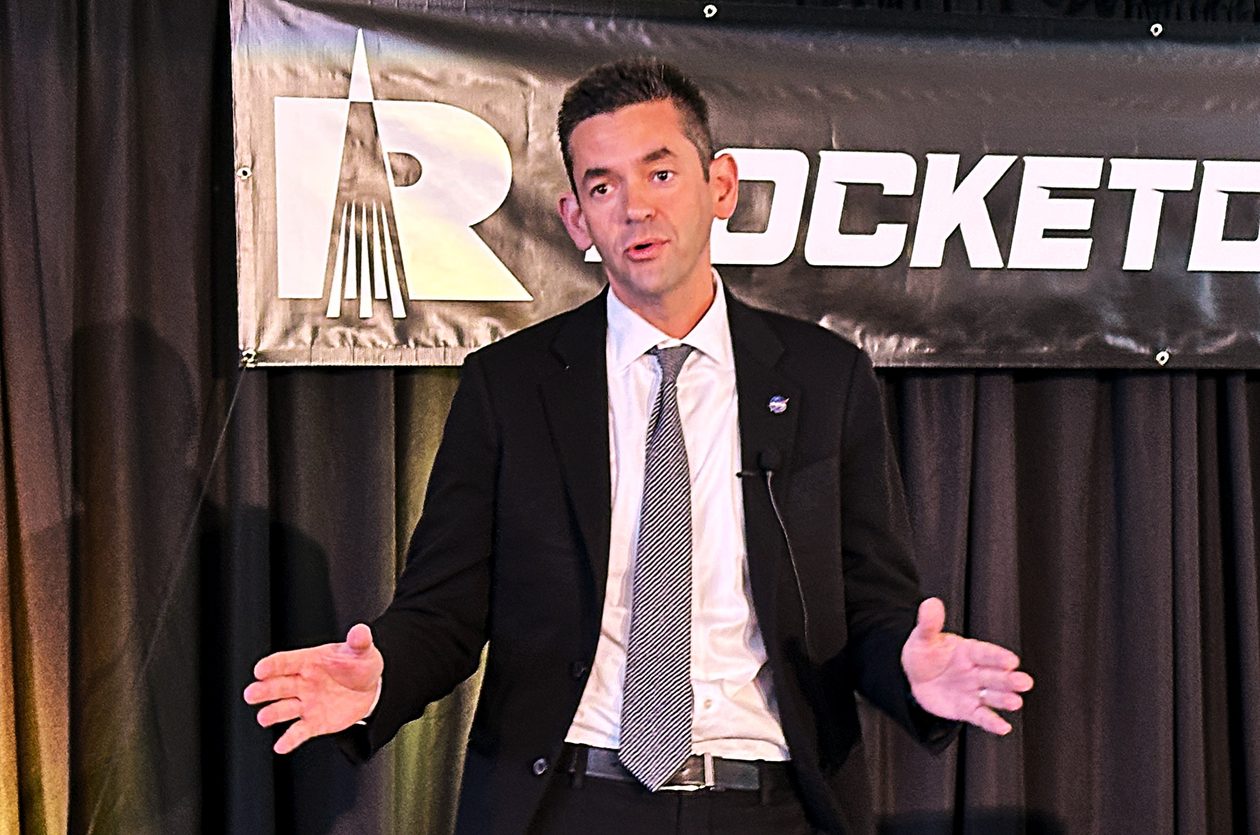
REDMOND, Wash. — NASA Administrator Jared Isaacman came to Rocketdyne’s facility here today to give a pep talk to the space company’s employees — and lay out his vision for the future of America’s space effort.
Isaacman made clear that nuclear power will be a big part of that vision.
“NASA is at our best when we’re doing the near-impossible,” he said. “There is no obvious revenue model or business case for what we’re doing. We’re just out there pursuing the secrets of the universe, and nuclear or fission-powered spacecraft make sense in that it helps us extend our reach farther into the solar system.”
The pathfinder mission for NASA’s nuclear ambitions is likely to be SR-1 Freedom, a Mars probe that’s scheduled for launch in 2028. SR-1 Freedom is designed to carry a fission reactor and nuclear electric propulsion system.
Rocketdyne’s Redmond facility is working on thrusters for the system. “We built here, in Redmond, the Advanced Electric Propulsion System,” Rocketdyne CEO Kristin Houston told GeekWire before Isaacman’s talk. “It’s a 12-kilowatt Hall-thruster system, and that is going to be the propulsion element on the SR-1 Freedom. So, yeah, we’re really proud of that.”
Today’s visit was part of the Pacific Northwest leg of Isaacman’s nationwide “Inspiration Tour,” aimed at strengthening the connections between NASA and its partners. A similar tour in August brought Isaacman to Idaho National Laboratory, which will play a key role in providing the 20-kilowatt reactor for SR-1 Freedom.

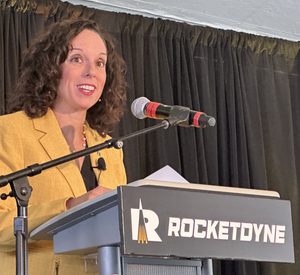
In partnership with the U.S. Department of Energy, NASA is also looking into the prospects for putting a nuclear reactor on the lunar surface by 2030 as part of its Moon Base initiative. Houston said Rocketdyne is interested in playing a part in that program.
“That’s not as much out of the Redmond site, but as Rocketdyne, we’re doing a lot of investment in the power conversion and the power management and distribution design that could be used for that,” she said.
Over the course of nearly 60 years, Rocketdyne’s Redmond site has played a role in nearly every interplanetary NASA mission — and has gone through several ownership changes along the way. The company’s latest transition, including its rebranding as Rocketdyne, became official last month after AE Industrial Partners acquired a majority stake from L3Harris.
Nowadays, Rocketdyne is arguably best-known as one of the commercial partners in NASA’s Artemis moon program. “We have 21 engines on the Orion spacecraft,” Houston said. “That’s between the crew module and the service module … all built in Redmond.”
The Redmond facility oversees the refurbishment of space shuttle engines for upcoming Artemis missions and is redesigning the spacecraft’s Orion Main Engine for missions starting with Artemis 7. “Our in-space propulsion business, really based here, has the lead on the entire OME program,” Houston said. “So we’re already concurrently doing the design and test of the new engine while doing all the refurbishment.”
Isaacman said the Artemis program is one of NASA’s top priorities, in part due to geopolitical competition. The current schedule targets a crewed lunar landing in early 2028, followed by initial work on a permanent base near the moon’s south pole later that year.
“NASA is very hot,” he said. “But NASA is hot right now because we are in a great-power competition. That’s across AI, energy and infrastructure, and everything you can imagine militarily, but certainly in the domain of space. We cannot take our foot off the gas. Really, if we miss our time by a matter of months, there are only so many good parking spots in the south pole of the moon, where we want to build our moon base. Well, the Chinese want to build their moon base there, too.”
NASA is relying on Rocketdyne and other commercial partners to set a fast pace.
“For all the great companies, the partners that are contributing to our near-impossible objectives, now is absolutely the time,” Isaacman said. “Just as so many of you were probably inspired by the space race in the 1960s and what we accomplished — all those books and movies that came from it — you’re now contributing to that.”
One of the VIPs in the audience, Redmond Mayor Angela Birney, said she was energized by Isaacman’s visit. “I am so excited that Rocketdyne is on the forefront of missions in space,” she said. “For me, as a former science teacher and someone who’s so interested in encouraging innovation and development, this just feels like a fantastic day to celebrate all of that.”
Rocketdyne wasn’t Isaacman’s only scheduled stop on this week’s tour. Earlier in the week, the administrator and other federal officials paid a visit to Lawrence Livermore National Laboratory and the Castle Air Museum in California’s Central Valley. Today’s Redmond visit fell between stops at United Precision Corp.’s headquarters in Washougal, Wash., and at Boeing’s Everett facility. Stoke Space is on the agenda for Friday.
After his talk, Isaacman told GeekWire that Washington state is home to a “lot of industry” that’s contributing to America’s space effort.
“It takes contributions from great talent all across the nation to contribute to our world-changing efforts,” he said, “but it just happens to be that a lot of it is here in Washington.”
You must be logged in to post a comment Login